
- Home
- »
- Beauty & Personal Care
- »
-
U.S. Face Creams & Moisturizers Market Size Report, 2033GVR Report cover

U.S. Face Creams & Moisturizers Market (2026 - 2033)
Size, Share & Trends Analysis Report By Product (Face Cream, Facial Moisturizer, Face Gel), Product By Ingredient, Product By End User, Product By Price Tier, By Distribution Channel, And Segment Forecasts
Market Size, 2025
$6.2BMarket Estimate, 2026
$6.5BMarket Forecast, 2033
$9.6BCAGR, 2026–2033
5.6%U.S. Face Creams & Moisturizers Market Summary
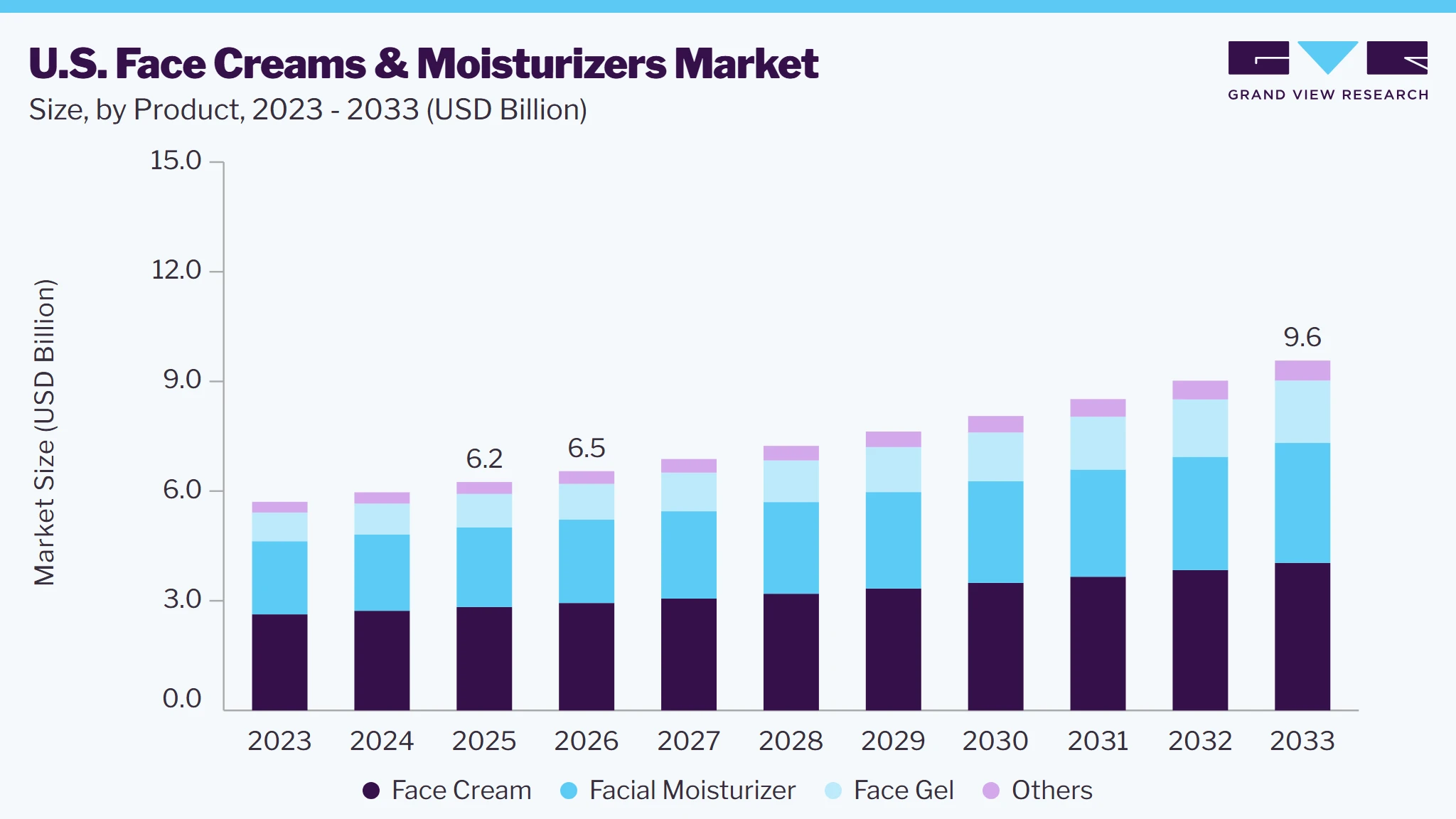
The U.S. face creams & moisturizers market size was valued at USD 6.2 billion in 2025 and is projected to grow from USD 6.5 billion in 2026 to USD 9.6 billion in 2033, at a CAGR of 5.6% from 2026 to 2033. The market is driven by the widespread use of daily facial skincare products, rising consumer focus on hydration and skin barrier care, growing demand for targeted formulations, and continued innovation in dermatologist-backed and ingredient-led products.
Key Market Trends & Insights
- By product: The face cream accounted for the largest revenue share of 45.3% in 2025
- By product by ingredient segment: The synthetic ingredients in face cream accounted for the largest revenue share of 63.2% in 2025.
- By product by end user: The segment, facial moisturizers for women accounted for the largest revenue share of 70.5% in 2025.
- By distribution channel: The offline segment accounted for the largest revenue share of 67.2% in 2025.
Market Size & Forecast
- Market size in 2025: USD 6.2 billion
- Estimated market size in 2026: USD 6.5 Billion
- 2033 Projected Market Size: USD 9.6 billion
- CAGR (2026-2033): 5.6%
Prism AI by Grand View Research Free to tryAsk a question about the U.S. face creams & moisturizers marketTry asking✓Every figure cited from GVR research Prefer the report? Download free sample →The market is further supported by premiumization, expanding e-commerce penetration, and increasing consumer interest in products addressing specific skin concerns such as dryness, sensitivity, aging, and uneven skin tone. Growing consumer engagement with facial skincare is strengthening the demand base for the market, as facial skincare becomes a routine component of daily beauty and personal-care regimens. According to The Benchmarking Company’s 2025 study of U.S. beauty-buying women, 96% reported using facial skincare, with 49% using these products daily and 46% using them multiple times per day. In addition, 45% had purchased daily moisturizers during the preceding six months. The high frequency of facial skincare use and continued purchasing of daily moisturizers indicate sustained consumer reliance on hydration-focused products and reinforce the role of facial moisturizers within everyday skincare routines.
 Source: Grand View Research, IR Documents, Primary Interviews, Paid DatabasesTo learn more about this report,
 Download Free Sample Report
The growing emphasis on convenience and multiple benefits is further expanding opportunities for face creams & moisturizers. The Benchmarking Company found in 2025 that 67% of 3,900 U.S. beauty-buying women regularly purchased beauty products that performed more than one function or addressed multiple concerns. Among multifunctional skincare formats, 89% selected moisturizers, making them the preferred format in the survey. This preference is encouraging brands to position facial moisturizers beyond basic hydration by incorporating additional benefits such as skin-barrier support, anti-aging, brightening, and other targeted skincare functions. The trend favors products that consolidate multiple steps of a skincare routine into a single formulation, increasing the relevance of multifunctional moisturizers in the U.S. market.
The shift toward dermatologist-developed and science-backed skincare is further shaping the market, as consumers increasingly encounter products positioned around clinically supported ingredients and skin-barrier science. CeraVe expanded its portfolio in 2025 with an Intensive Moisturizing Cream alongside other barrier-focused innovations, while continuing to emphasize formulations developed with dermatologists and its three essential ceramides. This positioning reinforces the importance of efficacy, skin compatibility, and barrier support in the purchase of facial moisturizers.
Market Dynamics
Consumers are increasingly seeking moisturizers tailored to individual skin types and concerns, supporting innovation across sensitive, dry, oily, acne-prone, and combination skin segments. The American Academy of Dermatology recommends selecting moisturizers according to skin type and highlights ingredients such as ceramides and hyaluronic acid for hydration and skin-barrier support. It also notes that acne treatments can dry and irritate the skin, creating a need for daily, non-comedogenic moisturizers among acne-prone consumers. These needs are prompting brands to expand targeted face creams & moisturizers with specialized textures, ingredients, and claims.
Higher prices can constrain spending on premium face creams & moisturizers, particularly when consumers have access to a wide range of mass-market alternatives. Tinuiti's 2026 Beauty Marketing Study found that 68% of surveyed U.S. beauty shoppers believed tariffs were raising beauty prices. Its 2025 study also found that 41% of beauty shoppers had shopped around more because of inflation, while 38% had purchased fewer beauty products, and 37% had searched more for promotions and coupon codes. Increased price sensitivity can therefore encourage consumers to trade down, delay purchases, or prioritize promotional offers when purchasing facial skincare.
The increasing availability of digital skin-assessment and recommendation tools provides an opportunity for brands to improve product discovery and match consumers with facial moisturizers based on individual skin concerns. Olay's Skin Advisor, for example, uses technology to recommend personalized skincare routines based on skin goals such as dryness, fine lines and wrinkles, dark spots, uneven tone, and dullness. Such tools can help brands reduce product-selection uncertainty while directing consumers toward more suitable moisturizer formulations.
Analyst Perspective
The market is evolving toward ingredient-led, multifunctional, and skin-health-focused skincare, with consumers increasingly seeking products that provide hydration while addressing concerns such as skin-barrier damage, sensitivity, fine lines, and uneven skin tone. Demand is supported by growing awareness of active ingredients such as ceramides, hyaluronic acid, peptides, and niacinamide, alongside interest in dermatologist-backed formulations. Brands are expanding their face creams & moisturizers portfolios through lightweight textures, targeted anti-aging solutions, barrier-repair formulations, and multifunctional facial moisturizers, while strengthening distribution across e-commerce, specialty beauty retailers, and mass-market channels.
Consumer Insights
 To learn more about this report, Download Free Sample Report
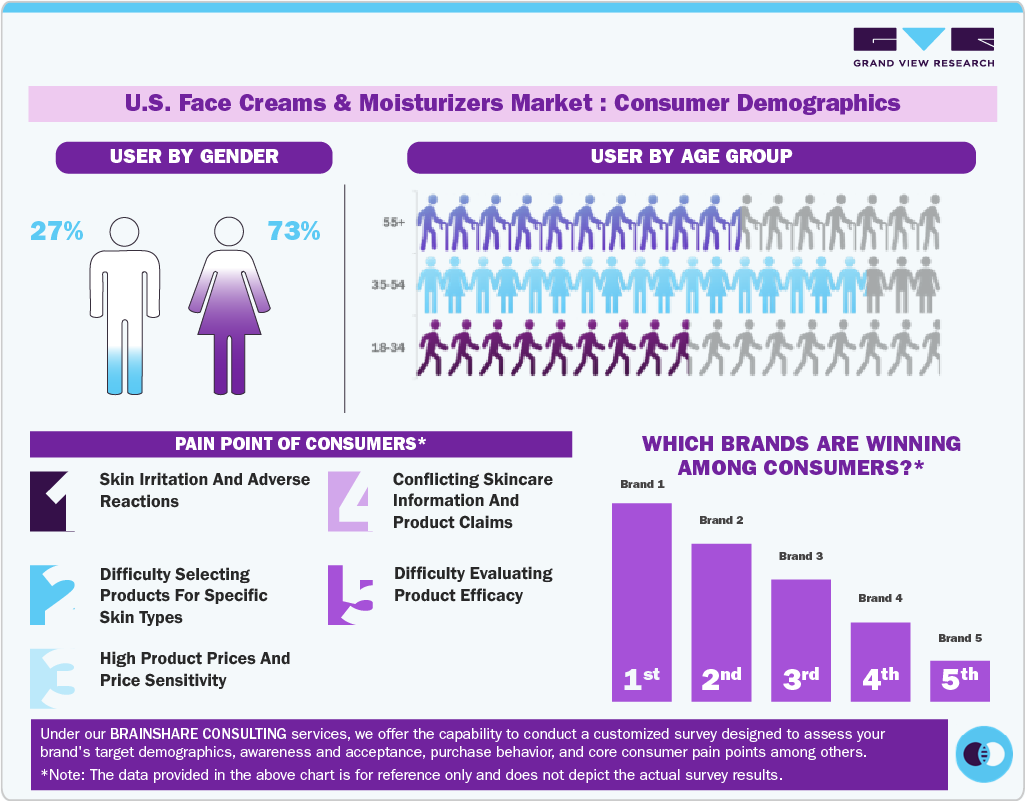
The U.S. market serves consumers across diverse age groups and genders, with demand influenced by skincare routines, skin concerns, product preferences, and the need for hydration, skin-barrier support, and anti-aging benefits.
Users by Gender:
-
Female consumers account for the largest share at 73%, reflecting their higher participation in facial skincare routines and greater usage of facial moisturizers. Women increasingly incorporate moisturizers into daily skincare regimens to address hydration, aging, skin texture, sensitivity, and other specific skin concerns.
-
Male consumers account for an estimated 27%, supported by growing adoption of facial skincare routines among men. Increasing awareness of hydration, skin health, grooming, and preventive skincare is encouraging more male consumers to incorporate face creams & moisturizers into their daily routines.
Users by Age Group:
Consumers aged 35-54 form the largest user group, consisting of consumers who increasingly focus on maintaining skin hydration, addressing visible signs of aging, improving skin texture, and preventing further skin damage. Those aged 55 and above are primarily driven by concerns related to wrinkles, dryness, loss of firmness, and mature-skin hydration, with greater interest in anti-aging, restorative, and intensive moisturizing formulations. Consumers aged 18-34 are primarily younger skincare consumers who are incorporating face creams & moisturizers into regular routines, with greater interest in lightweight textures, multifunctional products, ingredient-focused formulations, and solutions for hydration, sensitivity, acne, and early signs of aging.
Consumers in the market commonly face several product-related challenges that can influence purchase decisions and satisfaction.
-
Skin irritation and adverse reactions remain a major concern, as fragrances, preservatives, retinol, exfoliating acids, and other active ingredients may cause sensitivity or irritation for some consumers.
-
Difficulty selecting products for specific skin types can complicate purchasing decisions, particularly when consumers need to differentiate between formulations designed for dry, oily, combination, sensitive, or acne-prone skin.
-
High product prices and price sensitivity can limit purchases, particularly for premium and dermatologist-positioned Facial Moisturizers. Consumers may compare prices, seek promotions, or reduce the number of products purchased when skincare costs increase.
-
Difficulty evaluating product efficacy remains another challenge because consumers encounter numerous products with different active ingredients, clinical claims, and benefit propositions, making it difficult to determine which formulation will deliver the desired results.
-
Conflicting skincare information and product claims can make product selection more difficult, as consumers encounter recommendations from brands, social media platforms, influencers, and online reviews that may provide differing guidance on suitable ingredients and routines.
Product Insights
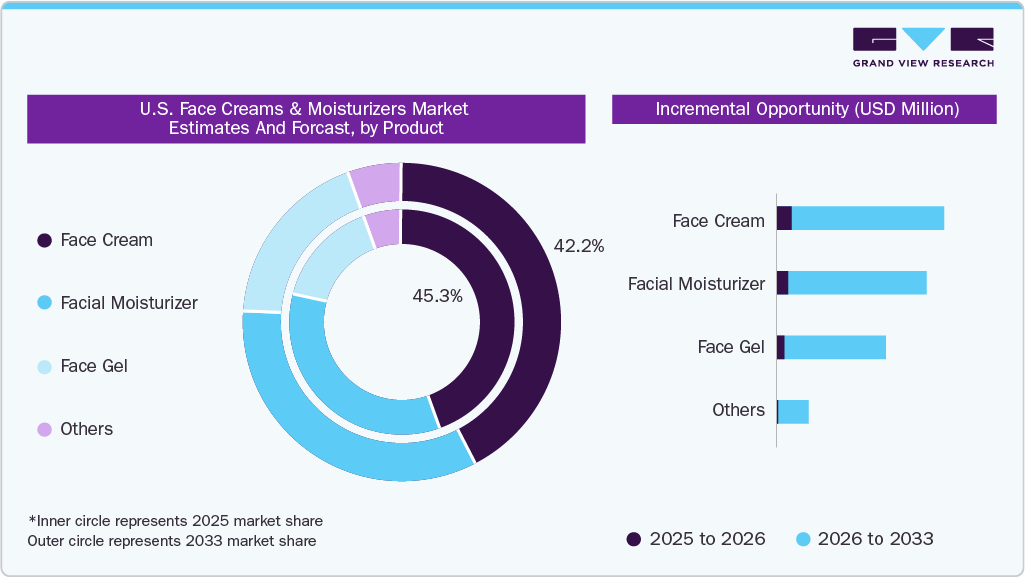
Face cream accounted for the largest revenue share of 45.3% in 2025, driven by demand for targeted hydration, skin-barrier support, and multifunctional anti-aging benefits. Consumers are increasingly seeking formulations that combine moisturization with active skincare ingredients such as ceramides, hyaluronic acid, peptides, and niacinamide. Product innovation is also shifting toward specialized formulations addressing specific skin concerns. For instance, SkinCeuticals launched Advanced RGN-6 in May 2025, a regenerative skincare cream inspired by laser regeneration science and formulated to address six visible signs of aging and skin-tone damage, including redness, discoloration, wrinkles, and loss of firmness. The launches highlight the growing emphasis on ingredient-led, multifunctional, barrier-supporting, and anti-aging face creams, supporting continued product innovation in the market.
 To learn more about this report, Download Free Sample Report
Face gels are expected to grow at a CAGR of 8.3% from 2026 to 2033, driven by increasing consumer preference for lightweight, fast-absorbing, and non-greasy moisturizing formats. Demand is also supported by the growing use of ingredient-focused formulations that combine hydration with skin-barrier support and targeted skincare benefits. For instance, CeraVe launched its Hydrating HA Water Gel Face Moisturizer in June 2026, featuring hyaluronic acid, three essential ceramides, niacinamide, and Ceramide Booster Technology in a lightweight, dry-touch water-gel format. The product provides 72-hour hydration and is designed to strengthen the skin barrier while delivering a non-greasy finish. Similarly, Mad Hippie launched its Brightening Gel Moisturizer in January 2026, expanding its clean skincare portfolio with a gel-based moisturizing format. The trend is shifting toward active-rich, lightweight, multifunctional Face Gels that deliver targeted skincare benefits while maintaining a fast-absorbing texture, supporting continued growth of the segment within the U.S. market.
Product by Ingredient Insights
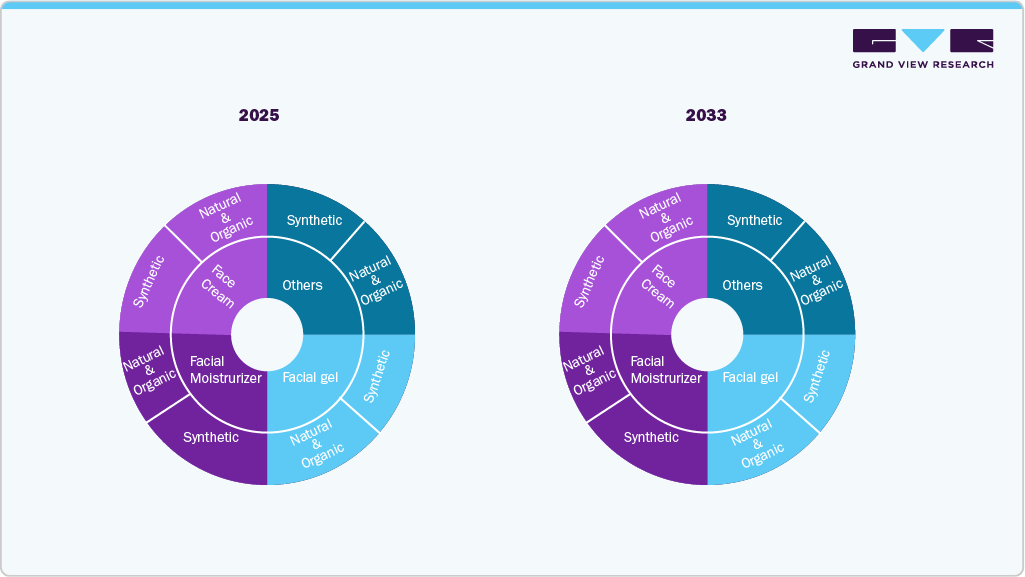
Synthetic ingredients in face cream accounted for the largest revenue share of 63.2% in 2025, driven by their ability to provide consistent formulation performance, product stability, and targeted functional benefits. Synthetic preservatives help maintain product integrity by controlling microbial growth, while other laboratory-produced ingredients can improve texture, consistency, and skin feel. The segment is also supported by demand for formulations designed to address specific concerns such as aging, uneven texture, and barrier support. For instance, OLAY relaunched its Regenerist Micro-Sculpting Cream in January 2026 with Triple Collagen Peptide technology, niacinamide, and Pro-Vitamin B5, targeting firmness, elasticity, hydration, and visible signs of aging.
 To learn more about this report, Download Free Sample Report
The natural & organic ingredients in face gel are expected to grow at a CAGR of 9.9% from 2026 to 2033, driven by the incorporation of botanical ingredients into lightweight, water-based facial formats. In the U.S., Sky Organics launched its USDA Organic facial skincare collection in July 2025, with the Organic Aloe Vera Glow Cleanser featuring aloe vera, lactic acid, and organic white willow bark extract in a foaming gel format. The collection was launched exclusively at Whole Foods Market locations nationwide. The product demonstrates how certified organic botanicals, such as aloe vera and willow bark, are being incorporated into gel-based facial products to provide hydration and soothing-oriented benefits.
Product by End User Insights
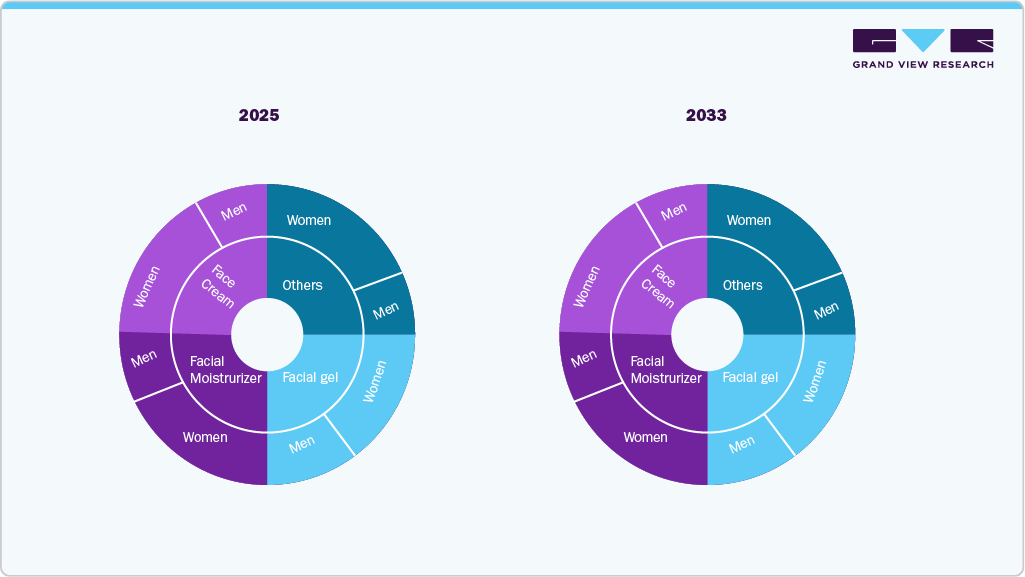
Facial moisturizers for women accounted for the largest revenue share of 70.5% in 2025, gaining traction as women increasingly seek multifunctional skincare products that provide hydration while targeting concerns such as dryness, dullness, uneven skin tone, skin firmness, and barrier health. Women are also showing greater interest in lightweight textures that can be easily incorporated into daily skincare and makeup routines, while targeted formulations allow brands to cater to different skin needs across age groups. For instance, Tatcha launched its Dewy Milk Moisturizer in the U.S. in June 2025 through Sephora, offering a lightweight format designed to provide hydration and a dewy, plumped appearance. The launch featured Olympic gymnast Suni Lee, reinforcing the product's position within women's daily facial skincare routines
 To learn more about this report, Download Free Sample Report
Face gel for men is expected to grow at a CAGR of 9.6% from 2026 to 2033, as male consumers increasingly prefer lightweight, fast-absorbing skincare formats that provide hydration without a heavy or greasy feel. Demand is also supported by interest in products that combine moisturization with benefits such as oil control, skin soothing, and post-shaving care, making gel-based formulations suitable for simple and efficient daily routines. For instance, Clinique launched its for men maximum hydrator activated water-gel concentrate in the U.S., a lightweight water-gel moisturizer formulated to replenish and retain skin moisture. The product is specifically positioned within Clinique’s men’s skincare range, supporting the use of gel formats for male consumers seeking convenient daily hydration.
Product by Price Tier Insights
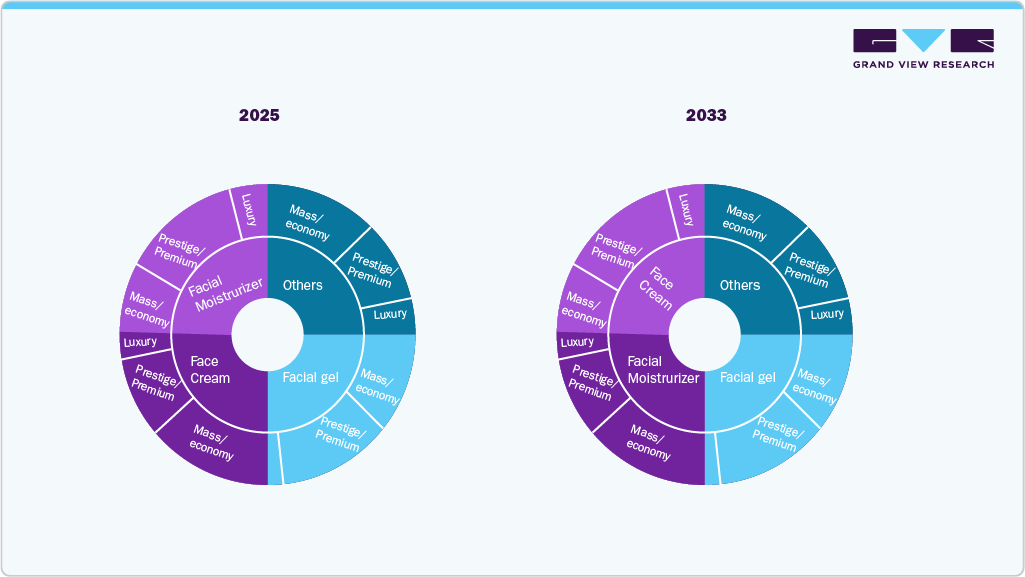
The mass/economy price tier accounted for the largest revenue share of 57.4% in 2025. Supported by the availability of affordable gel-based facial formulations that combine lightweight textures with basic hydration and skin-conditioning benefits. The low-price positioning makes gel formats accessible to consumers seeking a quick-absorbing alternative to heavier facial products. For instance, e.l.f. Cosmetics offers its Holy Hydration! Gel-Yeah Moisturizer at an accessible price point, with a classic gel texture, fast absorption, and a non-greasy finish, while the formulation contains allantoin and prickly pear and is positioned specifically for oily and combination skin. E.l.f. Cosmetics e.l.f. also positions its Hydro-Gel Moisturizer as a lightweight, makeup-friendly gel format at USD 13, reinforcing the availability of affordable gel-based facial market products.
 To learn more about this report, Download Free Sample Report
The luxury price of face gel is expected to grow at a CAGR of 10.8% from 2026 to 2033, supported by demand for premium gel formulations that combine lightweight textures with advanced ingredients and multiple skincare benefits. Luxury and prestige brands are increasingly using sophisticated active complexes and sensorial textures to differentiate gel-based products from conventional facial formulations. For instance, INNBEAUTY Project’s Recharge Gel Cream, priced at USD 48 and available through Sephora U.S., combines peptides, orchid stem cells, ginseng water, and glycerin and is positioned to provide hydration while improving skin smoothness, radiance, and barrier support. The product demonstrates how premium face gels are incorporating high-value ingredients and multifunctional claims to justify higher price positioning.
Distribution Channel Insights
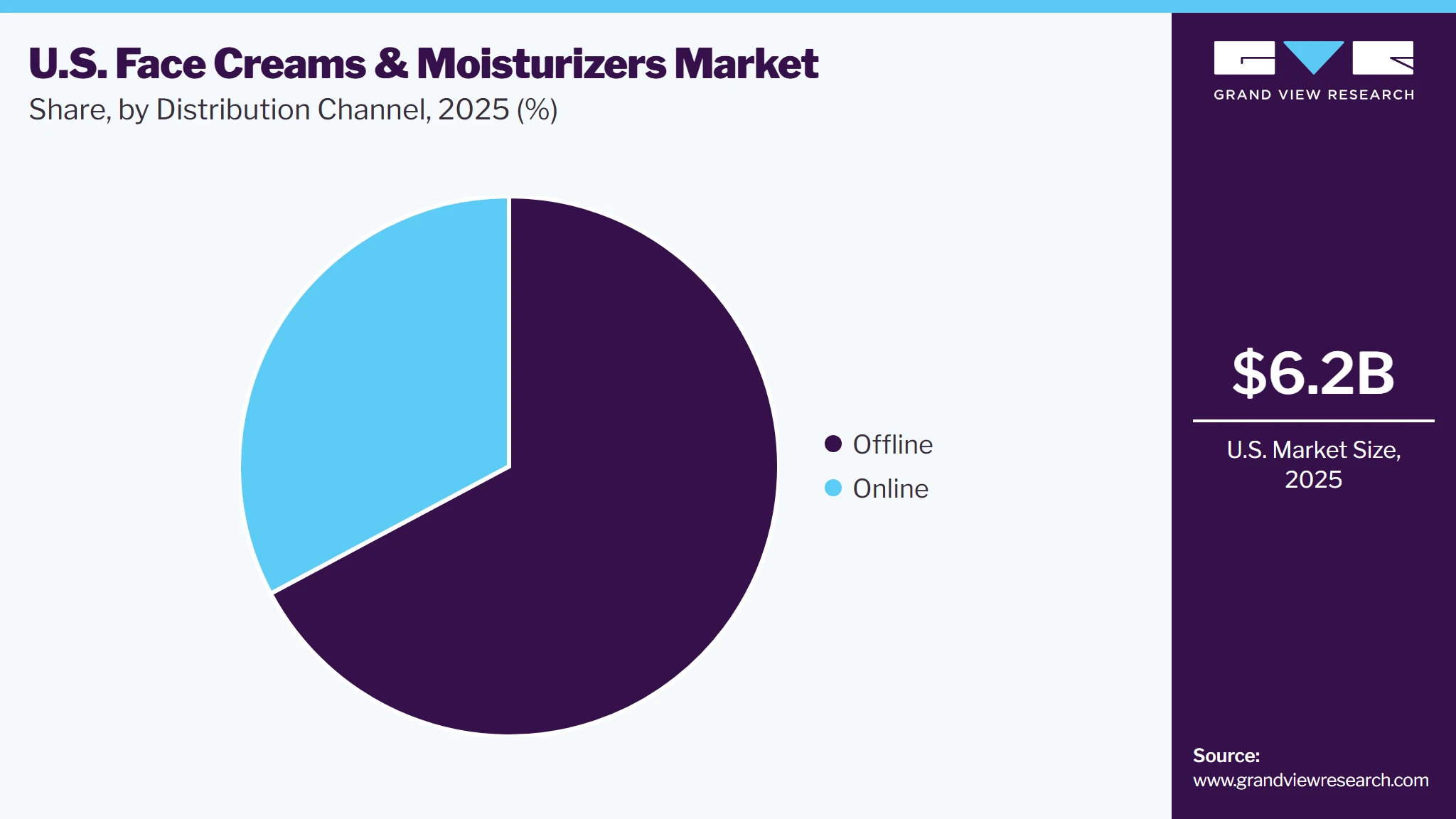
The offline distribution channel accounted for the largest revenue share of 67.2% in 2025, reflecting the continued importance of physical retail outlets for consumers purchasing face creams & moisturizers. The recent retail expansions by skincare brands demonstrate the continued role of physical stores in increasing consumer access to face creams & moisturizers. For instance, La Roche-Posay expanded into 1,460 Walmart stores across the U.S. in April 2026, bringing its skincare portfolio, including the Toleriane Double Repair Moisturizer, to Walmart’s physical retail network. The launch also included specialized training for Walmart pharmacists to provide skincare consultations
 To learn more about this report, Download Free Sample Report
The online distribution channel is expected to grow at a CAGR of 8.7% from 2026 to 2033, supported by the increasing shift toward digital purchasing, wider product availability, and convenient access to face creams & moisturizers through major e-commerce platforms. Online channels also allow consumers to compare formulations, ingredients, reviews, and prices before purchase, while enabling skincare brands to reach a broader U.S. consumer base without relying solely on physical retail networks. For instance, The Ordinary officially launched its U.S. Amazon Premium Beauty storefront in January 2025, giving consumers direct access to its skincare portfolio through Amazon with Prime shipping. Similarly, Origins launched in the U.S. Amazon Premium Beauty store in May 2025, making its skincare products available to Amazon shoppers nationwide. In addition, Dr. G entered the U.S. market exclusively through Amazon in November 2025, offering its dermatologist-developed skincare portfolio, including its Red Blemish Clear Soothing Cream, through an online-only launch strategy.
Key U.S. Face Creams & Moisturizers Company Insights
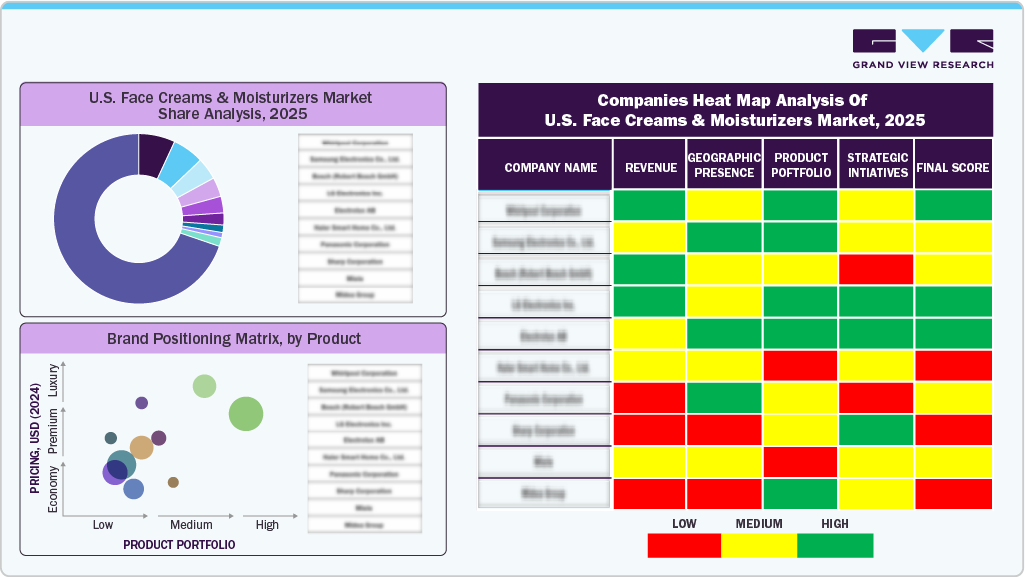
The market is characterized by a competitive structure comprising multinational beauty and personal-care companies, dermatological skincare specialists, prestige beauty groups, and established consumer-health companies. Competition is primarily shaped by brand recognition, formulation efficacy, active ingredients, dermatologist credibility, product innovation, pricing, distribution reach, and the ability to address specific concerns such as hydration, skin-barrier repair, sensitivity, and aging. Major companies operate across multiple price tiers and leverage mass retail, specialty beauty stores, pharmacies, department stores, and e-commerce channels.
-
Mass-Market & Broad-Portfolio Leaders: Companies such as L'Oréal, Procter & Gamble (P&G), Kenvue, and Unilever compete through extensive skincare portfolios, broad retail availability, strong consumer recognition, and continuous product innovation. L'Oréal benefits from brands such as CeraVe, La Roche-Posay, and SkinCeuticals, with CeraVe's U.S. performance supported by skincare innovation and moisturizing products. P&G competes through OLAY within its Beauty and Skin & Personal Care portfolio, while Kenvue leverages Neutrogena and Aveeno with an emphasis on hydration, skin health, and science-backed formulations.
-
Prestige & Premium Skincare Companies: Estée Lauder Companies, Shiseido, and Beiersdorf compete at the premium end of the face creams & moisturizers category through high-value formulations, brand heritage, advanced skincare technologies, and differentiated consumer experiences. Estée Lauder Companies operates a portfolio of more than 20 prestige beauty brands spanning skincare and other categories, including Estée Lauder, Clinique, La Mer, Origins, and Dr.Jart+.
-
Dermatological & Skin-Health Specialists: Galderma, L'Oréal, and Kenvue strengthen competition through dermatologist-oriented products, clinical positioning, and formulations focused on skin health. Galderma's dermatology-focused portfolio provides exposure to professional and consumer skincare, while L'Oréal's Dermatological Beauty division includes CeraVe, La Roche-Posay, and SkinCeuticals. Kenvue similarly emphasizes clinical research around hydration, skin longevity, and sun protection through brands such as Neutrogena and Aveeno.
-
Mass & Value-Oriented Skincare Players: Colgate-Palmolive, Unilever, and P&G compete through accessible pricing, high retail penetration, established personal-care brands, and broad distribution networks. Their ability to introduce new formulations across different price points allows them to address mainstream demand for everyday facial moisturizers, while established retail relationships support availability across mass merchants, drugstores, supermarkets, and online channels.
 To learn more about this report, Download Free Sample Report
Key U.S. Face Creams & Moisturizers Companies
The following key companies have been profiled for this study on the U.S. face creams & moisturizers market.
-
L'Oréal
-
Procter & Gamble (P&G)
-
Kenvue
-
Estée Lauder Companies
-
Unilever
-
Beiersdorf
-
Galderma
-
Colgate-Palmolive
-
Coty
-
Shiseido
Competitive Benchmarking
Category
Operating Strategies
Competitive Edge
Key Challenges
Established Players:
(L'Oréal; Procter & Gamble (P&G); Kenvue; Estée Lauder Companies; Unilever; Beiersdorf; Galderma; Colgate-Palmolive; Coty; Shiseido)Focus on maintaining broad skincare portfolios spanning mass-market, premium, prestige, and dermatological segments. Companies emphasize hydration, anti-aging, skin-barrier support, sensitive-skin care, ingredient-led formulations, and targeted skin concerns while utilizing extensive retail, pharmacy, specialty, and e-commerce networks.
Strong brand equity, established consumer relationships, extensive distribution infrastructure, R&D capabilities, and diversified product portfolios provide broad market access. Their portfolios include well-established skincare brands such as Olay, Neutrogena, Aveeno, CeraVe, Eucerin, Cetaphil, and La Roche-Posay.
Intense competition across mass, masstige, premium, and dermatological skincare requires continuous formulation and product innovation. Companies also face changing ingredient preferences, demand for clinically supported claims, pricing pressure, and competition from digitally native and indie skincare brands.
Emerging Players:
(Bubble Skincare; Dieux; BYOMA; Cocokind)Focus on targeted skin concerns, simplified routines, distinctive active ingredients, clean formulations, barrier care, sensitive-skin solutions, and direct-to-consumer or digitally driven distribution. Emerging brands increasingly use social media, creator marketing, online communities, and specialty beauty retailers to build awareness and reach consumers.
Greater flexibility in product development, focused brand positioning, rapid response to skincare trends, and strong digital engagement can help smaller brands differentiate from multinational portfolios. The U.S. market also provides access to consumers seeking specialized and niche skincare solutions.
Limited scale, lower distribution reach, smaller R&D budgets, and lower brand recognition compared with multinational companies create barriers to expansion. Emerging brands must also compete for digital visibility and shelf space while maintaining product efficacy, regulatory compliance, and consistent supply. Indie beauty competition has continued to expand, with new brands increasingly entering skincare and adjacent beauty categories.
Recent Developments
-
In June 2026, CeraVe launched its Hydrating HA Water Gel Face Moisturizer in the U.S., exclusively through Amazon. The product combines hyaluronic acid, three essential ceramides, and patent-pending Ceramide Booster Technology, strengthening CeraVe’s Face Creams & Moisturizers portfolio with a lightweight, hydration-focused formulation targeting skin-barrier support.
-
In April 2026, L’Oréal reported continued growth in its Dermatological Beauty division in North America, with CeraVe’s performance supported by strong demand for its skincare portfolio, particularly its moisturizing range. The development highlights sustained consumer demand for Face Creams & Moisturizers and reinforces CeraVe’s market presence.
-
In June 2026, OLAY launched its Science Cell Repair collection in the U.S., featuring two moisturizers formulated with peptide technology and positioned to address early signs of aging. The launch expanded OLAY’s face creams & moisturizers portfolio with science-led formulations targeting firmness, fine lines, and other age-related skin concerns.
U.S. Face Creams & Moisturizers Market Report Scope
Report Attribute
Details
Market size in 2025
USD 6.2 billion
Estimated market size in 2026
USD 6.5 billion
2033 Projected Market Size
USD 9.6 billion
Growth rate
CAGR of 5.6% from 2026 to 2033
Actuals
2021 - 2025
Forecast period
2026 - 2033
Quantitative units
Revenue in USD billion and CAGR from 2026 to 2033
Report coverage
Revenue forecast, company ranking, competitive landscape, growth factors, and trends
Segments covered
Product, product by ingredient, product by end user, product by price tier, distribution channel
Key companies profiled
L'Oréal; Procter & Gamble (P&G); Kenvue; Estée Lauder Companies; Unilever; Beiersdorf; Galderma; Colgate-Palmolive; Coty; Shiseido
Customization scope
Free report customization (equivalent up to 8 analysts’ working days) with purchase. Addition or alteration to country, regional & segment scope.
Pricing and purchase options
Avail customized purchase options to meet your exact research needs. Explore purchase options
U.S. Face Creams & Moisturizers Market Report Segmentation
This report forecasts revenue growth at country levels and provides an analysis of the latest trends and opportunities in each of the sub-segments from 2026 to 2033. For this study, Grand View Research has segmented the U.S. face creams & moisturizers market report based on product, product by ingredient, product by end user, product by price tier, and distribution channel:
-
Product Outlook (Revenue, USD Billion, 2021 - 2033)
-
Face Cream
-
Facial Moisturizer
-
Face Gel
-
Others
-
-
Product by Ingredient Outlook (Revenue, USD Billion, 2021 - 2033)
-
Face Cream
-
Natural & Organic
-
Synthetic
-
Facial Moisturizer
-
Natural & Organic
-
Synthetic
-
Face Gel
-
Natural & Organic
-
Synthetic
-
Others
-
Natural & Organic
-
Synthetic
-
-
Product by End User Outlook (Revenue, USD Billion, 2021 - 2033)
-
Face Cream
-
Men
-
Women
-
-
Facial Moisturizer
-
Men
-
Women
-
-
Face Gel
-
Men
-
Women
-
-
Others
-
Men
-
Women
-
-
-
Product by Price Tier Outlook (Revenue, USD Billion, 2021 - 2033)
-
Face Cream
-
Mass/economy
-
Prestige/premium
-
Luxury
-
-
Facial Moisturizer
-
Mass/economy
-
Prestige/premium
-
Luxury
-
-
Face Gel
-
Mass/economy
-
Prestige/premium
-
Luxury
-
-
Others
-
Mass/economy
-
Prestige/premium
-
Luxury
-
-
-
By Distribution Channel Outlook (Revenue, USD Billion, 2021 - 2033)
-
Offline
-
Hypermarkets & Supermarkets
-
Specialty Beauty Stores/Retailers
-
Pharmacies & Drugstores
-
Department Stores
-
Others
-
-
Online
-
Brand-Owned E-Commerce (Online DTC)
-
Online Marketplaces (Amazon, Walmart, etc.)
-
Specialty Beauty Stores/Retailers
-
Others
-
-
Research Methodology
The U.S. face creams & moisturizers market figures in this report are based on a proven research process that combines executive interviews with secondary research from proprietary databases, company filings, and recognized regulatory and institutional sources. Market size is built through value-chain sizing-reconciling supply-side and demand-side estimates-and triangulated with bottom-up and top-down approaches. Every estimate passes multiple levels of expert validation before publication, with each U.S. face creams & moisturizers segment quantified using the revenue-capture definitions in the table below.
Segment Definition
Product
Revenue capture definition
Face Cream
Revenue from facial skincare products formulated as creams to provide hydration, nourishment, skin conditioning, and targeted benefits such as anti-aging, firming, brightening, and barrier support. This includes day creams, night creams, anti-aging creams, and other cream-based facial moisturizers.
Facial Moisturizer
Revenue from facial moisturizing products designed primarily to hydrate and maintain skin moisture levels. This includes lightweight moisturizers, hydrating lotions, daily moisturizers, and other facial hydration products that may target dryness, skin barrier support, or overall skin conditioning.
Face Gel
Revenue from gel-based facial skincare products formulated to provide lightweight hydration and skin conditioning with a fast-absorbing, non-heavy texture. This includes water gels, gel moisturizers, and other leave-on gel-based facial hydration products.
Others
Revenue from other facial moisturizing formats that do not fall under conventional face creams, facial moisturizers, or face gels. This includes moisturizing balms, water creams, sleeping moisturizers, moisturizing sticks, and other specialized facial hydration formats.
Estimation Model
Layer
Guiding Question
Description
Face Care Consumer Base Layer
Who uses face creams & moisturizers?
Identifies the U.S. consumer population using facial skincare products or having moisturizing and face‑care needs. Includes consumers across age groups, skin types, and skincare routines who are potential users of face creams and moisturizers.
Skincare Need & Interest Layer
Who actively considers face creams & moisturizers?
Captures consumers seeking hydration, skin‑barrier support, anti‑aging, sensitive‑skin care, brightening, oil control, and other targeted facial skincare benefits. Focuses on consumers actively considering moisturizers and face creams as part of their skincare routines.
Purchase & Usage Layer
Who purchases face creams & moisturizers?
Segments demand by product type, including face creams, facial moisturizers, day creams, night creams, gel moisturizers, lotions, and targeted formulations. Also considers purchases through mass retailers, pharmacies, specialty beauty stores, department stores, brand websites, and e‑commerce platforms.
Monetization Layer
How much revenue is generated?
Converts consumer purchases of face creams and moisturizers into market revenue. Uses product prices, purchase frequency, pack sizes, premium and mass‑market positioning, and channel‑specific spending to estimate total market value.
Delivered Customizations
This report has been delivered with the following In-depth customizations
Client Request
Customization Delivered
Value Adds
U.S. Face Creams & Moisturizers Market Demand, Consumer Preferences & Buying Behavior Analysis
Conducted a detailed assessment of consumer demand for face creams and moisturizers, including hydration, skin-barrier support, anti-aging, sensitive-skin care, ingredient preferences, and changing skincare routines.
Helps stakeholders identify high-demand product attributes, understand evolving consumer needs, and assess opportunities for targeted formulation and positioning strategies.
U.S. Face Creams & Moisturizers Market Product Innovation, Ingredient Customization & Consumer Trends
Evaluated product innovation across face creams and moisturizers, focusing on ingredient-led formulations, fragrance-free and sensitive-skin products, lightweight textures, barrier-repair solutions, and multifunctional skincare offerings.
Provides insights into evolving formulation preferences and emerging product concepts, supporting innovation pipelines, differentiated product development, and consumer-focused positioning. Recent skincare coverage also highlights continued interest in barrier-supporting ingredients such as ceramides, hyaluronic acid, glycerin, and niacinamide.
U.S. Face Creams & Moisturizers Market Distribution & Market Opportunity Assessment
Assessed growth opportunities across pharmacies and drugstores, mass retailers, specialty beauty stores, department stores, brand websites, online marketplaces, and social-commerce channels, while evaluating accessibility, premium and mass positioning, and evolving shopping behavior.
Supports investment and expansion decisions by identifying high-potential distribution channels, strengthening omnichannel strategies, and assessing opportunities created by the continued shift toward e-commerce and social commerce in U.S. beauty retail.
Frequently Asked Questions About This Report
The U.S. face creams & moisturizers market size was estimated at USD 6.2 billion in 2025 and is expected to reach USD 6.5 billion in 2026.
The U.S. face creams & moisturizers market is expected to grow at a compound annual growth rate of 5.6% from 2026 to 2033 to reach USD 9.6 billion by 2033.
In the product segment, face cream accounted for the largest revenue share of 45.3% in 2025
The offline distribution channel accounted for the largest revenue share of 67.2% in 2025.
Growing consumer focus on skin hydration, barrier repair, and anti-aging benefits is driving demand for U.S. face creams & moisturizers. Rising interest in multifunctional and ingredient-focused products, including formulations with hyaluronic acid, ceramides, niacinamide, and peptides, is further supporting market growth.
Key players in the U.S. face creams & moisturizers Market include L’Oréal, Estée Lauder, Procter & Gamble, Kenvue, Beiersdorf, Unilever, Shiseido, and Kao Corporation.
In the product by ingredient segment, synthetic ingredients in face cream accounted for the largest revenue share of 63.2% in 2025.
In the product by end user, segment, facial moisturizers for women accounted for the largest revenue share of 70.5% in 2025.
In the product by price tier, mass/economy face creams & moisturizers accounted for a revenue share of 57.4% in 2025.
About the Author(s)
Beauty & Personal Care Research Team
Consumer Goods · Beauty & Personal CareThis report was authored by the beauty & personal care research team at Grand View Research - comprising two research analysts, one senior research analyst, and one industry expert - with specialized expertise in the beauty & personal care segment of the consumer goods industry. All findings are based on proprietary consumer goods databases, executive interviews, and regulatory analysis, subject to internal peer review prior to publication.
Last Updated:
Speak to Analyst

Customize this report to your needs - add regions, segments, or data points, with 20% free customization.
Or view our licence options:


ISO 9001:2015 & 27001:2022 Certified
We are GDPR and CCPA compliant! Your transaction & personal information is safe and secure. For more details, please read our privacy policy.


