
- Home
- »
- Homecare & Decor
- »
-
U.S. Homeware Market Size, Share & Trends Report, 2033GVR Report cover

U.S. Homeware Market (2026 - 2033)
Size, Share & Trends Analysis Report By Product (Kitchen & Dining, Storage & Organization, Home Textiles, Home Décor, Bathroom Accessories, Cleaning & Household Utility), By Distribution Channel (Offline, Online), And Segment Forecasts
Market Size, 2025
$48.8BMarket Estimate, 2026
$52.0BMarket Forecast, 2033
$81.3BCAGR, 2026–2033
6.6%U.S. Homeware Market Summary
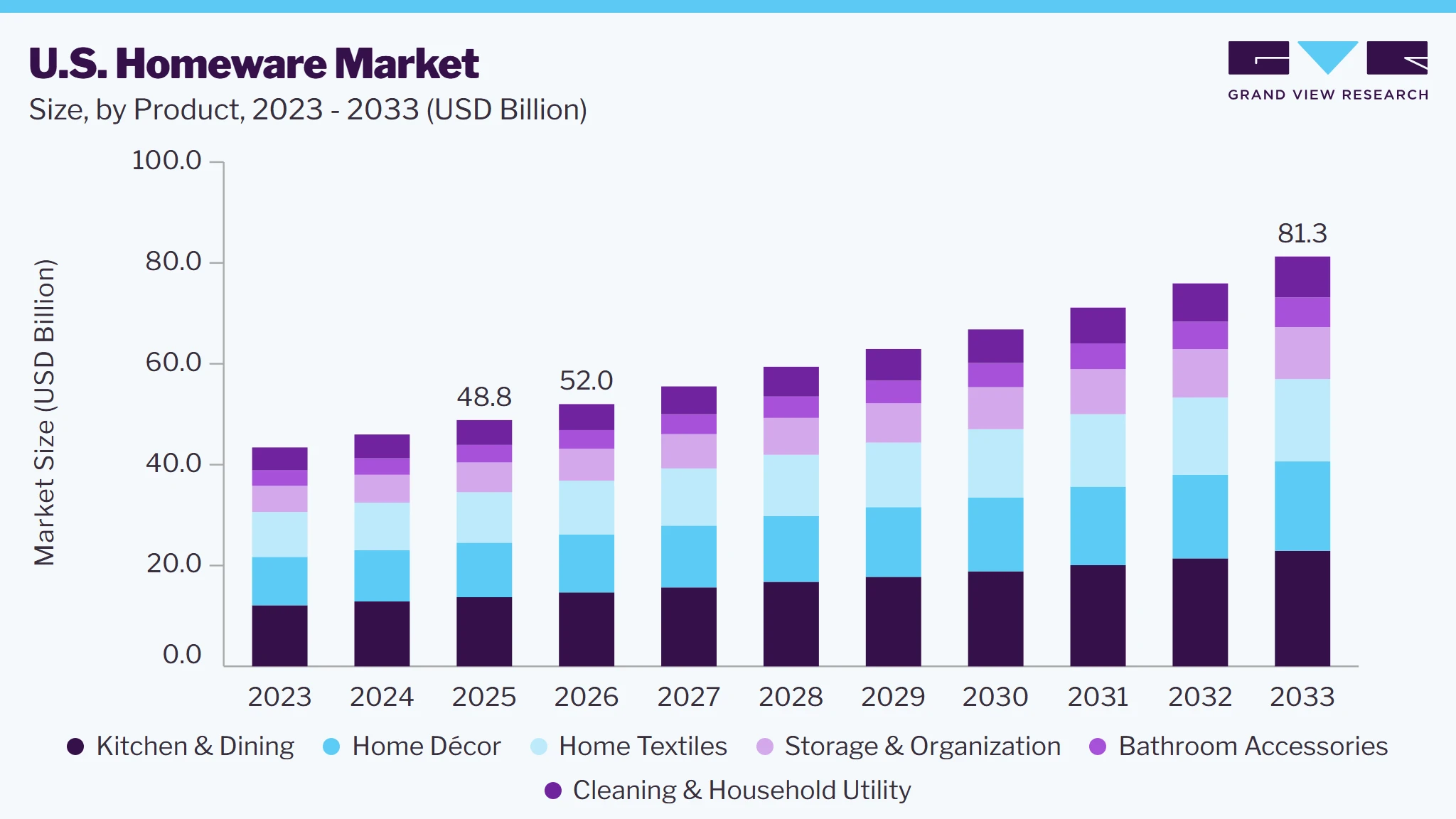
The U.S. homeware market size was valued at USD 48.8 billion in 2025 and is projected to grow from USD 52.0 billion in 2026 to USD 81.3 billion in 2033, at a CAGR of 6.6% from 2026 to 2033. Rising investment in home renovation and personalization is creating a favorable demand environment for the market. In 2024, 54% of U.S. homeowners undertook renovation projects, while another 54% undertook decorating projects, according to Houzz’s 2025 U.S. Houzz & Home Study covering nearly 22,000 respondents.
Key Market Trends & Insights
- By product: Kitchen & dining accounted for a market share of 28.1% in 2025.
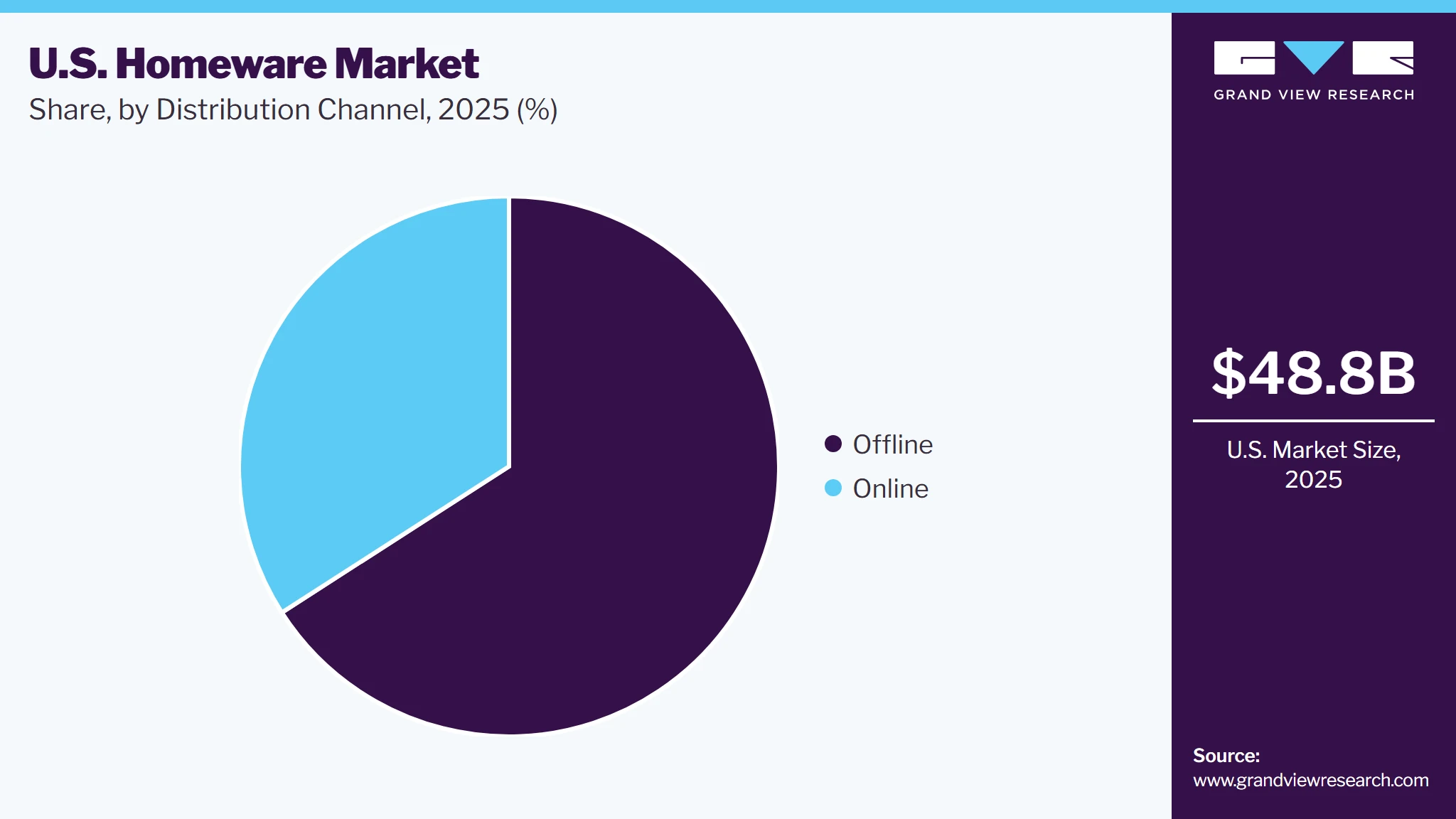
- By distribution channel: Offline channels accounted for a market share of 65.9% in 2025.
Market Size & Forecast
- Market size in 2025: USD 48.8 Billion
- Estimated market size in 2026: USD 52.0 Billion
- Projected market size by 2033: USD 81.3 Billion
- CAGR (2026-2033):6.6%
Prism AI by Grand View Research Free to tryAsk a question about the U.S. homeware marketTry asking✓Every figure cited from GVR research Prefer the report? Download free sample →The high level of renovation and decoration activity is driving demand for homeware products as homeowners seek to upgrade, coordinate, and personalize their living spaces. Renovation projects create requirements for complementary products such as kitchen and dining items, bathroom accessories, storage and organization products, and cleaning and household utility products, while decorating projects stimulate purchases of home décor and home textiles, including curtains, cushions, and other decorative furnishings. As homeowners increasingly invest in improving existing residential spaces rather than only purchasing new homes, renovation and decoration spending creates recurring replacement and discretionary demand for homeware products, thereby supporting market growth. Continued renovation and decoration activity is expected to support recurring and discretionary purchases across key homeware categories, strengthening overall market demand.
Rising investment in home renovation and personalization is also encouraging consumers to explore homeware products across multiple purchasing channels. A November 2024 Home Accents Today report, based on more than 3,000 U.S. consumers, found that 48% preferred purchasing home furnishings in physical stores, while 28% preferred online channels. More than 60% used digital touchpoints, including home décor websites and social media, for inspiration, with 48% identifying social media as a primary source of product discovery. This combination of digital discovery and physical or online purchasing is strengthening omnichannel homeware retail, expanding product accessibility, and encouraging consumers to research, compare, and purchase décor, bedroom products, and other homeware items through multiple channels.
 Source: Grand View Research, IR Documents, Primary Interviews, Paid DatabasesTo learn more about this report,
 Download Free Sample Report
Changing consumer priorities are supporting demand for functional and affordable homeware products in the U.S. In 2025, U.S. consumers reduced spending on large discretionary home purchases such as furniture and mattresses, while spending held up better for décor, kitchen products, repairs, and home maintenance, according to Consumer Edge. The shift was attributed to elevated interest rates, limited housing turnover, and affordability pressures, which encouraged households to postpone major investments while continuing to make smaller, lower-commitment improvements to their homes.
This trend is also reflected in retailer product strategies. In September 2025, IKEA U.S. launched its Year of Cooking & Eating initiative and announced plans to introduce more than 200 new products over the following year, covering dining tables, food-storage solutions, and kitchen products, alongside solutions for storing, organizing, preparing, serving, eating, and cleaning. The shift toward smaller, functional upgrades and expanded kitchen and dining assortments is therefore creating recurring demand across kitchen & dining, storage & organization, and cleaning & household utility categories.
The 2025 spending pattern also points to younger homeowners as an important demand base for home improvement and homeware products. According to Consumer Edge, consumers aged 25-44 increased their share of home improvement spending in 2025, while retailers such as Lowe’s, Home Depot, Ace Hardware, and Sherwin-Williams gained traction through loyalty programs, digital tools, and project-support resources. This shift is supported by retailers’ efforts to simplify homeownership and DIY projects. For example, Lowe’s expanded its MyLowe’s Rewards loyalty ecosystem and introduced MyLowe, an AI-powered virtual advisor providing project guidance and product recommendations, while The Home Depot has developed digital resources and project-management tools for homeowners and DIY customers. As younger homeowners increasingly undertake repairs, décor updates, and DIY projects, their rising participation is expected to support recurring demand for functional, affordable, and easy-to-use homeware products across categories such as home décor, storage and organization, kitchen and dining, bathroom accessories, and cleaning utilities.
Market Dynamics
Growing home improvement and renovation activities are supporting demand for homeware as homeowners increasingly invest in upgrading and modernizing existing residential spaces. This trend is reinforced by the aging U.S. housing stock, with nearly half of homes being 42 years old or older, creating recurring requirements for renovation and replacement. Within renovation activity, kitchens and bathrooms remain important spending areas in 2025. Kitchens accounted for 26% of interior renovation projects, while median spending increased to USD 24,000 for kitchens and USD 15,000 for primary bathrooms. These projects create additional demand for kitchen and dining products, storage solutions, bathroom accessories, home textiles, décor, and cleaning utilities, supporting the broader market. The continued scale of home renovation and remodeling activity is expected to drive recurring demand for homeware products as homeowners replace, upgrade, and add functional and decorative items across kitchens, bathrooms, living spaces, and storage areas.
Rising household costs and persistent price sensitivity are constraining discretionary spending on homeware, particularly for products that are not essential or require frequent upgrades. In the U.S., household furnishings and supplies increased 3.4% year over year in December 2025, while furniture and bedding prices increased 3.6%, according to the U.S. Bureau of Labor Statistics. Within home-related categories, nonelectric cookware and tableware increased 10.4%, while clocks, lamps, and decorator items increased 3.9%, increasing the cost of selected homeware purchases. At the same time, Consumer Edge reported that affordability concerns contributed to weaker home-related discretionary spending in 2025, with spending slowing across income groups and consumers postponing larger home purchases. As consumers become more price-conscious, they may delay replacement of non-essential décor, textiles, tableware, and organizational products or shift toward lower-priced, promotional, and private-label alternatives, limiting value growth across the market.
Increasing urbanization, smaller living spaces, and the need to maximize available space are creating opportunities for multifunctional and space-saving homeware. Consumers are increasingly seeking products that provide multiple functions, flexible configurations, or storage without requiring additional floor space, supporting demand for compact organizers, stackable storage, trolleys, under-bed storage, foldable products, and multipurpose kitchen and bathroom accessories. IKEA highlights that smaller apartments make storage increasingly difficult and promotes solutions that use space above and around existing areas, including under-bed storage, modular systems, trolleys, and flexible storage. The growing need to maximize limited residential space is creating opportunities for manufacturers to develop compact, modular, multifunctional, and easily reconfigurable homeware that combines storage, organization, and everyday utility.
Analyst Perspective
The market is increasingly shaped by changing lifestyles, home improvement, convenience, and personalization. Rising renovation and decorating activity is supporting demand for functional and decorative products across kitchens, bathrooms, living spaces, and storage areas. Consumers are also seeking multifunctional, space-saving, durable, and aesthetically appealing products that improve household organization and usability. E-commerce, DTC platforms, marketplaces, and specialty retailers are expanding product accessibility while enabling greater product comparison and customization. Meanwhile, sustainability is encouraging manufacturers to adopt recycled, renewable, and reusable materials. Continued innovation in compact designs, multifunctional products, sustainable materials, and digitally enabled retail experiences is expected to create further opportunities for homeware manufacturers and retailers.
Brand Market Share Insights
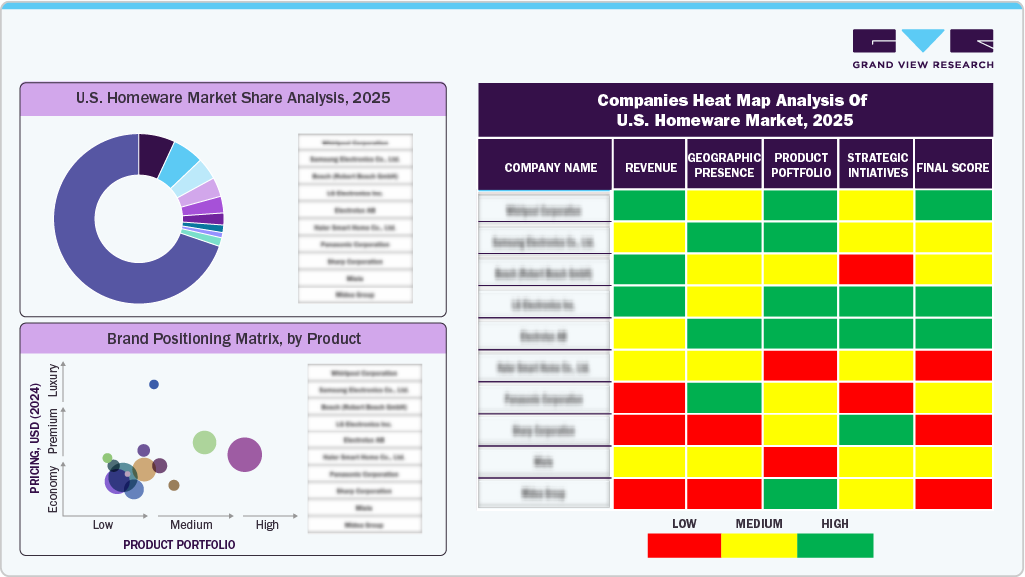
The market is characterized by competition across kitchenware, tableware, drinkware, home décor, and household utility products, with companies increasingly expanding assortments through new designs, categories, and functional products. Lifetime Brands continues to develop kitchenware and home solutions across brands, including Farberware, KitchenAid, Mikasa, and BUILT NY, supported by its innovation programs. Fiskars Group expanded Iittala’s portfolio with the Solare collection, adding tableware, glass art, accessories, and textiles, while Wedgwood introduced giftable Florentine Colors additions, including scented candles.
 To learn more about this report, Download Free Sample Report
Villeroy & Boch added the Lave Vert collection in 2025 with 13 new green tableware items and expanded Manufacture with five new pieces, including versatile bowls. Newell Brands is also strengthening product innovation through its AI-enabled InnoGEN development approach and a new customer experience center showcasing consumer-led products to retail partners. Companies are increasingly differentiating through product design, multifunctionality, material innovation, brand positioning, sustainability, and omnichannel distribution. The breadth of product portfolios is also enabling companies to address multiple homeware categories rather than relying on a single product segment. For example, Fiskars Group reported that its Vita business generated approximately 53% of sales through direct-to-consumer channels and 47% through wholesale channels in 2025, illustrating the increasing importance of combining owned retail and digital channels with wholesale distribution. Product-line expansion, functional innovation, design differentiation, and omnichannel distribution remain important competitive strategies.
Consumer Insights
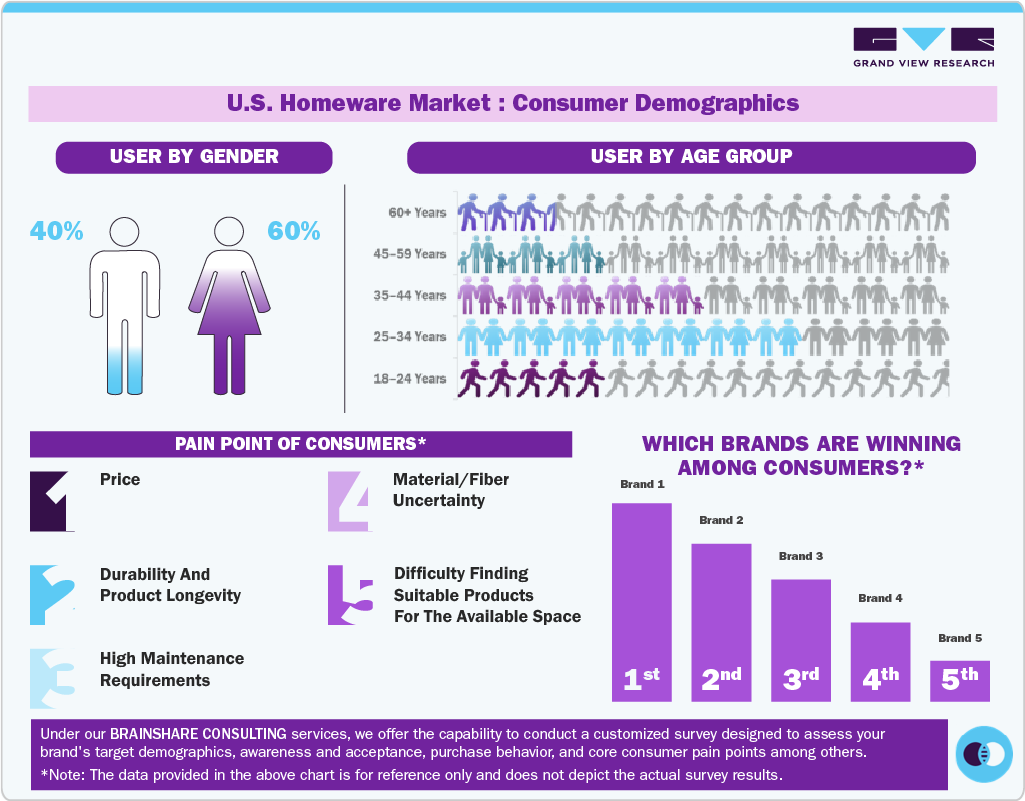
Consumer market preferences are increasingly driven by functionality, convenience, organization, aesthetics, and ease of use. Consumers tend to prefer products that simplify household routines, improve accessibility, and help maintain organized living spaces without requiring significant effort or additional space. According to YouGov, 91% of U.S. adults consider having an organized home at least somewhat important, while 66% organize their homes to find items more easily, and 61% to reduce clutter, highlighting demand for practical organization solutions.
 To learn more about this report, Download Free Sample Report
These preferences are also creating opportunities for homeware products that combine functionality with space optimization and visual appeal. YouGov found that 46% of Americans identify insufficient storage space as a challenge to maintaining an organized home, while 38% organize their homes so they look good for guests. This indicates that consumers increasingly view storage and organization products not only as functional necessities but also as contributors to household comfort and aesthetics. Consequently, manufacturers are emphasizing compact, accessible, multifunctional, and aesthetically appealing homeware products that help consumers maximize available space while improving everyday household organization.
Product Insights
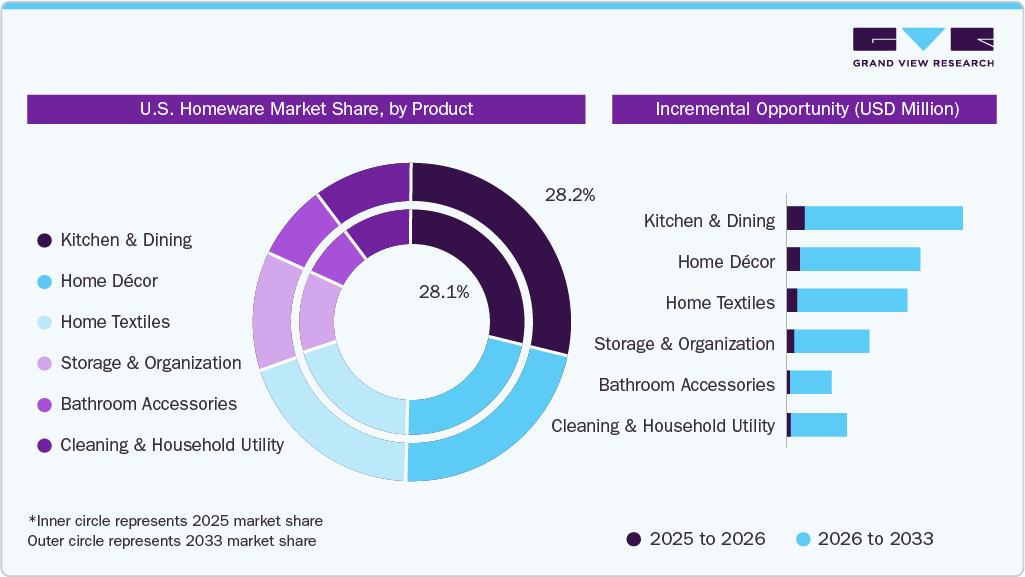
Kitchen & dining products accounted for the largest share of 28.1% in 2025, supported by their broad product coverage across cookware, bakeware, tableware, drinkware, lunch boxes, and serving products, as well as the recurring nature of replacement purchases. Consumer demand is also supported by continued investment in cooking and dining at home. Recent product launches are expanding the range of functional and design-oriented kitchen & dining products available to consumers.
 To learn more about this report, Download Free Sample Report
The storage & organization segment is anticipated to grow at a CAGR of 7.2% from 2026 to 2033, driven by continued consumer demand for practical household organization products and replacement purchases. Recent consumer research also indicates that storage demand extends beyond conventional decluttering. In November 2025, YouGov found that 10% of U.S. adults currently rented a self-storage unit, while another 23% had used one previously. In addition, IKEA’s 2026 Life at Home research highlights increasing consumer interest in customizable and adaptable storage solutions, particularly as households seek to make better use of available space and adjust storage according to changing needs. This trend is particularly relevant for smaller homes and first homes, where flexible and space-efficient solutions can help consumers organize belongings without requiring extensive additional space. Growing demand for flexible, customizable, and space-efficient storage solutions is expected to create opportunities for manufacturers offering modular and adaptable home organization products.
Distribution Channel Insights
The sales of homeware through offline channels accounted for the largest market share of 65.9% in 2025, supported by consumers’ continued preference for physical stores when purchasing homeware products that benefit from direct product inspection, comparison, and tactile evaluation. Recent retail expansion also demonstrates continued investment in physical homeware distribution. In September 2025, REAL SIMPLE launched more than 270 home products exclusively with At Home, with the collection made available across 229 At Home stores nationwide as well as online. In addition, IKEA U.S. operates 51 retail locations, providing consumers with physical access to kitchen, dining, storage, décor, textile, and household utility products. Consequently, the broad store networks of mass merchants, home-specialty retailers, warehouse clubs, and other physical retailers, together with consumers' continued preference for inspecting and purchasing selected homeware products in person, are expected to sustain the offline channel's substantial share of the market.
 To learn more about this report, Download Free Sample Report
The sales of homeware through online channels are anticipated to grow at a CAGR of 7.0% from 2026 to 2033. The growth is mainly due to increasing consumer adoption of e-commerce, broader product availability, convenient home delivery, digital product discovery, and the expansion of omnichannel strategies by homeware retailers. Recent company activity further demonstrates the expansion of online homeware distribution. In FY2025, IKEA U.S. generated USD 1.9 billion in e-commerce sales out of USD 5.3 billion in total sales, highlighting the increasing contribution of digital channels to its U.S. business. IKEA also reported investments in digital capabilities and fulfillment networks to improve omnichannel access. Expanding e-commerce adoption, broader digital assortments, price comparison, promotional offers, convenient delivery, and retailers' investments in omnichannel fulfillment are expected to support the continued growth of the online distribution channel through 2033.
Key U.S. Homeware Companies
-
Lifetime Brands
-
Newell Brands
-
Fiskars Group
-
Villeroy & Boch
-
Portmeirion Group
-
Borosil, Ltd.
-
La Opala RG
-
Cello World
-
Williams-Sonoma
-
Wayfair
-
Zwilling J.A. Henckels
-
Tramontina
-
Le Creuset
-
Duralex
-
Bodum
Competitive Benchmarking
Category
Operating Strategies
Competitive Edge
Weakness
Established Players (Lifetime Brands; Newell Brands; Fiskars Group; Villeroy & Boch; Williams-Sonoma; Wayfair; Cello World)
- Focus on broadening product portfolios across kitchenware, tableware, drinkware, storage, décor, and household utility while strengthening omnichannel distribution. Companies are investing in new product collections, brand extensions, collaborations, digital commerce, and retail partnerships.
- Broad product portfolios enable cross-selling across multiple homeware categories and consumer occasions. Strong brand recognition, established retail relationships, global distribution networks, and omnichannel capabilities provide access to both physical and digital consumers.
- Broad product portfolios increase supply-chain, inventory, manufacturing, and product-development complexity. Premium-oriented companies can face price sensitivity during periods of weaker discretionary spending, while companies dependent on specific categories such as tableware or glassware remain exposed to changes in consumer preferences and raw-material costs. Digital-focused retailers also face fulfillment, logistics, and customer-acquisition costs.
Emerging (Portmeirion Group; Borosil Ltd; La Opala RG)
- Focus on specialized categories such as premium tableware, glassware, home décor, and dining products. Strategies emphasize design differentiation, heritage brands, material expertise, collection expansion, and premium positioning.
- Strong category specialization establishes brand identity, product design expertise, and differentiated materials provide opportunities to build customer loyalty and command premium positioning. Specialized portfolios also allow companies to develop products targeted at specific dining, gifting, hospitality, and household applications.
- Narrower product portfolios can limit cross-category selling opportunities compared with diversified homeware companies. Greater exposure to discretionary purchases, premium pricing, category-specific demand, and fluctuations in glass, ceramic, packaging, and other raw-material costs can affect performance.
Recent Developments
-
In July 2026, Kreate launched the HDX Vista Stack and HDX Defender storage collections with The Home Depot, featuring clear, stackable bins designed to improve visibility, space utilization, and organization. The Vista Stack collection offers multiple sizes for closets, pantries, bedrooms, and laundry areas, while Defender provides durable storage with heavy-duty latches and integrated gaskets for garages, basements, and workshops. The collections were launched through The Home Depot’s U.S. stores and online channels.
-
In March 2026, YouCopia launched new organization products, including MagicTrack rectangle turntables, two-tier turntables with removable bins, and expandable deep-drawer organizers. The products were designed to improve cabinet and drawer space utilization while keeping household items visible and accessible. The launch reflects growing demand for space-efficient, flexible, and easy-to-use storage solutions that help consumers organize kitchens and other areas of the home more effectively.
U.S. Homeware Market Report Scope
Report Attribute
Details
Market size in 2025
USD 48.8 billion
Estimated market size in 2026
USD 52.0 billion
Projected market size by 2033
USD 81.3 billion
Growth rate
CAGR of 6.6% from 2026 to 2033
Historical data
2021 - 2025
Forecast period
2026 - 2033
Quantitative units
Revenue in USD billion and CAGR from 2026 to 2033
Report coverage
Revenue forecast, company ranking, competitive landscape, growth factors, and trends
Segments covered
Product, distribution channel
Key companies profiled
Lifetime Brands; Newell Brands; Fiskars Group; Villeroy & Boch; Portmeirion Group; Borosil, Ltd.; La Opala RG; Cello World; Williams-Sonoma; Wayfair; Zwilling J.A. Henckels; Tramontina; Le Creuset; Duralex; Bodum
Customization scope
Free report customization (equivalent up to 8 analysts working days) with purchase. Addition or alteration to country, & segment scope.
Pricing and purchase options
Avail customized purchase options to meet your exact research needs. Explore purchase options
U.S. Homeware Market Report Segmentation
This report forecasts revenue growth at the country level and provides an analysis of the latest trends and opportunities in each of the sub-segments from 2021 to 2033. For this study, Grand View Research has segmented the U.S. homeware market report based on product and distribution channel:
-
Product Outlook (Revenue, USD Billion, 2021 - 2033)
-
Kitchen & Dining
-
Cookware
-
Bakeware
-
Tableware
-
Drinkware
-
Others (Lunch boxes, serving trays)
-
-
Home Décor
-
Wall décor
-
Vases
-
Decorative mirrors
-
Artificial plants
-
Others (Sculptures, photo frames, decorative clocks)
-
-
Home Textiles
-
Mats
-
Curtains
-
Kitchen & dining linen
-
Bath & hand towels
-
Decorative pillows
-
Others
-
-
Storage & Organization
-
Storage boxes, bins & baskets
-
Drawer & Shoe Organization
-
Racks & Hooks
-
Shelving & wall storage
-
Others
-
-
Bathroom Accessories
-
Bathroom organizers & trays
-
Soap dispensers
-
Holders
-
Others (Towel rack/ring)
-
-
Cleaning & Household Utility
-
Floor cleaning tools
-
Cleaning & utility containers
-
Laundry & drying accessories
-
Ironing accessories
-
Others
-
-
-
Distribution Channel Outlook (Revenue, USD Billion, 2021 - 2033)
-
Offline
-
Online
-
Research Methodology
The U.S. homeware market figures in this report are based on a proven research process that combines executive interviews with secondary research from proprietary databases, company filings, and recognized regulatory and institutional sources. Market size is built through value-chain sizing-reconciling supply-side and demand-side estimates-and triangulated with bottom-up and top-down approaches. Every estimate passes multiple levels of expert validation before publication, with each U.S. homeware segment quantified using the revenue-capture definitions in the table below.
Segment Definition
Segment - Product
Revenue capture definition
Kitchen & Dining
This segment includes homeware products used for food preparation, cooking, baking, serving, dining, and beverage consumption within residential settings. It includes cookware, bakeware, tableware, drinkware, and other products such as lunch boxes and serving trays.
Home Décor
This segment includes decorative homeware products primarily used to enhance the visual appearance, ambiance, and personalization of interior spaces. It includes wall décor, vases, decorative mirrors, artificial plants, sculptures, photo frames, and decorative clocks.
Home Textiles
This segment includes textile-based homeware products used for decoration, comfort, surface covering, and everyday household functions. It includes mats, curtains, kitchen and dining linen, bath and hand towels, decorative pillows, and other household textile products.
Storage & Organization
This segment includes homeware products designed to store, organize, arrange, or optimize household belongings and available space without constituting furniture. It includes storage boxes, bins and baskets, drawer and shoe organizers, racks and hooks, and shelving and wall-storage products.
Bathroom Accessories
This segment includes products used to organize, accessorize, and improve the functionality and convenience of bathroom spaces. It includes bathroom organizers and trays, soap dispensers, holders, towel racks and rings, and other bathroom accessories.
Cleaning & Household Utility
This segment includes household utility products used for cleaning, maintaining, drying, laundering, and performing routine domestic tasks. It includes floor-cleaning tools, cleaning and utility containers, laundry and drying accessories, ironing accessories, and other related household utility products.
Estimation Model
Consumer Need & Target Base Layer
Product Accessibility & Distribution Layer
Active Purchasing & Engagement Layer
Monetization Layer
Who is a potential user of consumer wound healing products?
Who has access to wound care products?
Who actively purchases and uses consumer wound healing products?
How much revenue is generated?
The addressable population includes consumers requiring products for minor wounds, cuts, burns, abrasions, surgical wound aftercare, and scar management. Demographic factors, household composition, age groups, lifestyle activities, and consumer spending on health and personal care products influence the potential consumer base.
Consumer access to wound healing products is supported through retail pharmacies, drugstores, supermarkets, hypermarkets, specialty healthcare retailers, e-commerce platforms, direct-to-consumer channels, and healthcare recommendations. Distribution reach, product availability, and retail penetration influence market accessibility.
Active purchase rates are determined by requirements for wound treatment, first aid preparedness, household healthcare practices, consumer awareness, product efficacy perceptions, frequency of minor injuries, and recurring purchases. Utilization patterns vary across age groups, households, and health-conscious consumers.
Market value is generated through spending on wound healing products, including antiseptics, dressings, scar treatments, wound gels, creams, sprays, and related consumer healthcare products. Revenue is estimated by combining active consumer demand with average annual spending, product pricing, replacement frequency, and category penetration rates.
Customization Table
Client Request
Customization Delivered
Value Adds
U.S. Homeware Market & Product Trend Analysis
Conducted a detailed assessment of the U.S. homeware market across kitchen & dining, home décor, home textiles, storage & organization, bathroom accessories, and cleaning & household utility, evaluating product formats, materials, functionality, price tiers, consumer applications, product launches, and recent category developments.
Helps stakeholders identify high-potential homeware categories, understand shifts toward multifunctional, space-efficient, durable, aesthetically oriented, and value-focused products, and evaluate competitive positioning across essential and discretionary homeware categories.
U.S. Consumer & Distribution Channel Analysis
Evaluated U.S. consumer purchasing behavior across DTC websites, online marketplaces, online retailers, supermarkets & hypermarkets, specialty stores, department stores, home improvement/home furnishing stores, and warehouse clubs, with assessment of purchase intent, replacement demand, price sensitivity, willingness to pay, and online/offline accessibility. Recent consumer research was assessed to understand the importance of quality, durability, convenience, promotions, delivery, and product functionality in homeware purchases.
Provides insights into channel-specific opportunities, consumer price sensitivity, replacement-driven demand, and the role of online and physical retail in expanding homeware purchases. Supports channel strategy, pricing decisions, retail expansion, and consumer-targeting strategies.
Technology, Distribution & Competitive Landscape Assessment
Assessed developments in smart and multifunctional homeware, space-saving storage solutions, innovative materials, easy-clean products, modular designs, sustainable/reusable formats, and digitally enabled retail experiences, alongside key companies, product launches, portfolio expansions, retail strategies, and omnichannel developments. The analysis also evaluated competitive strategies across established homeware manufacturers, specialty tableware companies, and digital-first retailers.
Supports product-development and competitive-positioning strategies by identifying emerging product concepts, functional differentiators, material and design innovations, pricing opportunities, distribution strategies, and consumer-driven innovation areas within the U.S. homeware market.
Frequently Asked Questions About This Report
Cookware accounted for the largest share within the Kitchen & dining segment.
The U.S. homeware market is expected to grow at a compound annual growth rate of 6.6% from 2026 to 2033 to reach USD 81.3 billion by 2033.
Kitchen & dining products accounted for the largest revenue share of 28.1% in 2025.
Offline channels accounted for the largest revenue share of 65.9% in 2025.
Growing home improvement and renovation activities are supporting demand for homeware as homeowners increasingly invest in upgrading and modernizing existing residential spaces.
Key players in the U.S. homeware market Lifetime Brands; Newell Brands; Fiskars Group; Villeroy & Boch; Portmeirion Group; Borosil Ltd; La Opala RG; Cello World; Williams-Sonoma; Wayfair; Zwilling J.A. Henckels; Tramontina; Le Creuset; Duralex; Bodum.
Storage & organization are the fastest-growing in the U.S. homeware market.
Online channels are the fastest-growing in the U.S. homeware market.
The U.S. homeware market size was estimated at USD 48.8 billion in 2025 and is expected to reach USD 52.0 billion in 2026.
About the Author(s)
Homecare & Decor Research Team
Consumer Goods · Homecare & DecorThis report was authored by the homecare & decor research team at Grand View Research - comprising two research analysts, one senior research analyst, and one industry expert - with specialized expertise in the homecare & decor segment of the consumer goods industry. All findings are based on proprietary consumer goods databases, executive interviews, and regulatory analysis, subject to internal peer review prior to publication.
Last Updated:
Speak to Analyst

Customize this report to your needs - add regions, segments, or data points, with 20% free customization.
Or view our licence options:


ISO 9001:2015 & 27001:2022 Certified
We are GDPR and CCPA compliant! Your transaction & personal information is safe and secure. For more details, please read our privacy policy.


