
- Home
- »
- Animal Health
- »
-
U.S. Livestock Monitoring Market Size, Industry Report, 2033GVR Report cover

U.S. Livestock Monitoring Market (2025 - 2033) Size, Share & Trends Analysis Report By Animal (Bovine, Poultry, Swine, Others), By Solution (Hardware, Software), By Application, By Sector, And Segment Forecasts, Key Companies And Competitive Analysis
U.S. Livestock Monitoring Market Summary
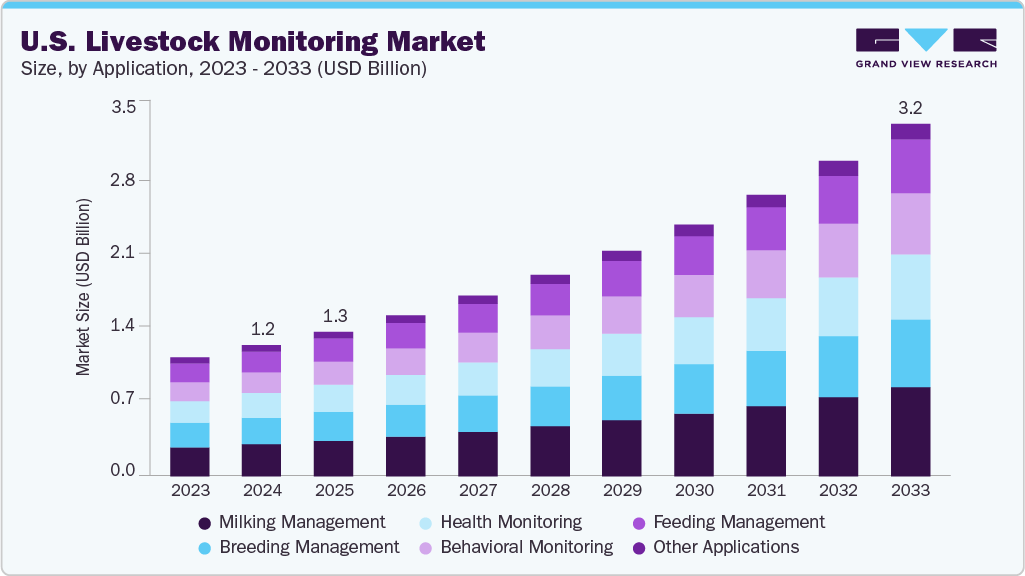
The U.S. livestock monitoring market size was estimated at USD 1.18 billion in 2024 and is projected to reach USD 3.18 billion by 2033, growing at a CAGR of 11.81% from 2025 to 2033. The livestock monitoring market in the U.S is growing significantly, driven by increasing focus on animal health and welfare, technological advancements in health management systems, the emergence of predictive farming practices, a boost to innovative strategies and government initiatives and sustainability goals.
Key Market Trends & Insights
- By animal, the bovine segment held the largest share of over 46.35% of the market in 2024.
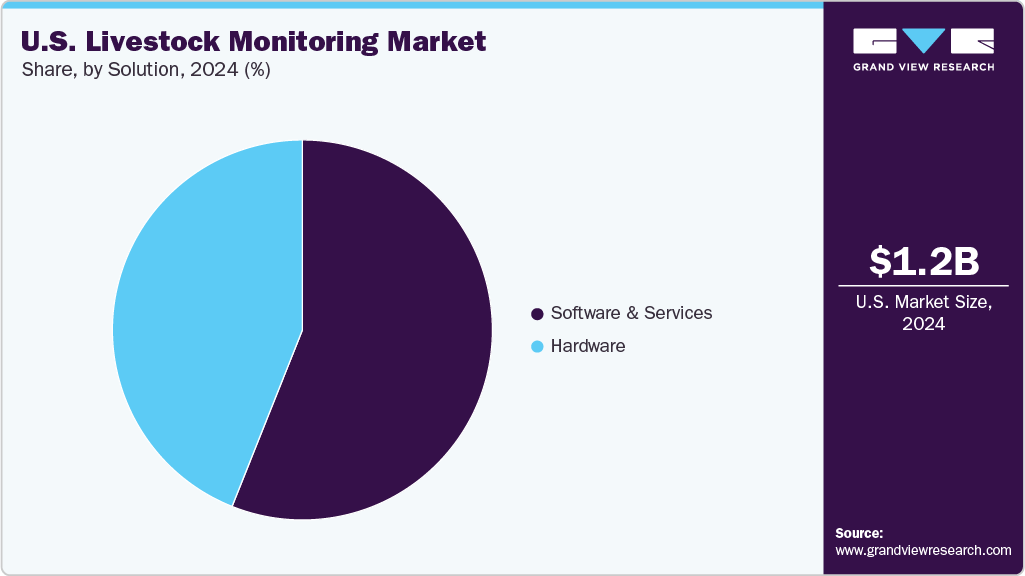
- By solution, software & services segment held the highest market share in 2024.
- Based on application, the milking management segment held the highest market share in 2024.
Market Size & Forecast
- 2024 Market Size: USD 1.18 Billion
- 2033 Projected Market Size: USD 3.18 Billion
- CAGR (2025-2033): 11.81%
Three ways to get this report
Buy it, customize it, or ask a question.Ask an Analyst
Analyst response in 1 business day
- AccessReport author, directly
- Reply timeWithin 1 working day
- No sales callDirect answer only
- FormatEmail reply
- CostFree, no cost
Get the Full Report
What the study covers
- FormatsPDF · Excel · Dashboard
- Timeline2025–2033 annual, 2024 base
- Coverage20+ countries, 5 regions
- Companies10+ key players profiled
Customize the Report
20% free customization
- IncludeCountries, segments, points
- TailorTo your product definition
- ExtendDeeper competitor detail
- OrA fully bespoke study
- Turnaround5–10 working days
In recent years, U.S. livestock producers have been increasingly embracing predictive farming, leveraging sensor technologies, data analytics, and automation to anticipate issues rather than react. Real-time monitoring through environmental sensing and wearable sensors is the foundation of predictive farming. Vital indicators, behavioral changes, feed intake, reproductive cycles, and movement patterns are all monitored via devices. These sensors capture data all the time, which is then used by computers to predict any health problems, make the best use of feed and resources, and plan maintenance or remedies before losses happen. The referenced analysis highlight that such capabilities like predicting illness, optimizing breeding windows, minimizing stress allow farmers to reduce waste, improve animal welfare, and increase yield. One of the drivers in the U.S. is the fall in cost and rise in sensor hardware and connectivity reliability. Advances in IoT platforms now make it feasible to deploy large numbers of sensor devices with manageable maintenance, even across remote or pasture-based operations. Enhanced wireless networks, edge processing, and battery/energy advancements mean monitoring can be both scalable and economically viable.Another factor pushing predictive practices forward is regulatory pressure and market demand. Consumers increasingly expect transparency around animal welfare, traceability, and food safety. Producers who show minimized disease outbreaks, fewer antibiotic interventions, and more precise resource use gain a competitive advantage. Predictive monitoring tools enable reporting and assurance.
 Source: Grand View Research, IR Documents, Primary Interviews, Paid DatabasesTo learn more about this report,
 Download Free Sample Report
 Moreover, predictive farming aligns with sustainability goals. By forecasting feed needs and environmental conditions, farms can reduce overuse of resources like water, feed, energy and lower their carbon footprint. Similarly, early detection of animal health issues reduces mortality and the need for broad treatment, aiding welfare and cost containment.
Challenges such as data integration, interoperability of different sensor systems, ensuring data accuracy, and the need for farmer training are still persistent, but the momentum is evident. Overall, the emergence of predictive farming practices transforms livestock monitoring from a surveillance tool into a proactive decision-support infrastructure. This transformation shapes current market expansion and shaping the future expectations of producers, consumers, and regulators. Such aforementioned factors driving the U.S. livestock monitoring market.
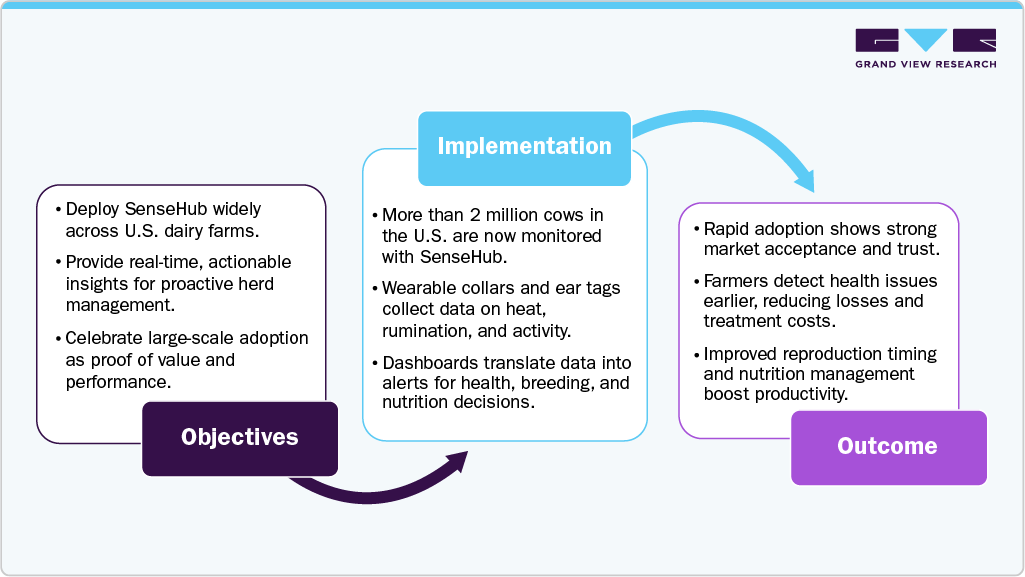
Case Study: Merck Animal Health - Scaling SenseHub to Monitor 2 Million Cows
Background -
The SenseHub cattle monitoring system from Merck Animal Health utilizes data analytics and wearable technology. It assists producers in tracking reproduction, health, nutrition, and behavior. The repetitive and reactive characteristics of traditional monitoring resulted in inefficiencies.
 To learn more about this report, Download Free Sample Report
 Conclusion -
Merck Animal Health, via its SenseHub system, has achieved a significant milestone by monitoring over 2 million dairy cows in the U.S., demonstrating broad adoption of wearable / sensor-based livestock monitoring. The case shows how combining technology (wearables + analytics) with on-farm deployment can produce scalable benefits in health, reproduction, nutrition, and efficiency while also surfacing challenges around infrastructure, cost, and data reliability.
Market Concentration & Characteristics
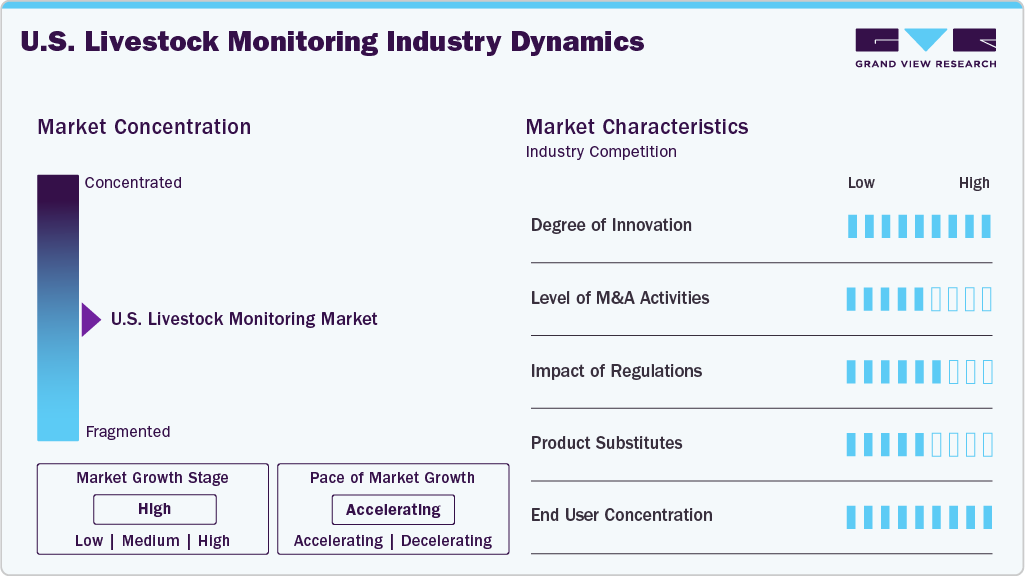
Innovation is accelerating in the country by integrating AI-driven analytics, IoT-enabled wearables, and next-generation implantable and satellite-based tracking systems. These advancements enable precise, continuous health monitoring and predictive insights, helping producers optimize herd management and proactively mitigate disease risks. Even in remote livestock regions, real-time data collecting has become feasible owing to advances in connectivity options, which encourage early intervention and lower losses. The advancement driven by technology places livestock monitoring in the U.S. at the forefront of highly efficient, welfare-focused, and sustainable farming practices.
In the U.S., consolidation in the livestock monitoring market is intensifying. Precision equipment companies are forging strategic partnerships to deliver end-to-end solutions. These deals are focused on integrating hardware, software, and automation capabilities to streamline producers' operations. M&A activity is increasingly aimed at scaling predictive insights, reducing labor dependence, and enhancing biosecurity readiness. This wave of collaboration is creating a more interconnected ecosystem, positioning U.S. farms to adopt fully autonomous and data-driven livestock management systems.
 To learn more about this report, Download Free Sample Report
 The effect of regulations in the country is shaped by federal frameworks such as the Animal Disease Traceability (ADT) rule and its 2024 amendment mandating electronic ID tags for certain cattle and bison. These requirements are pushing producers to adopt digital identification and recordkeeping systems capable of meeting interstate movement and traceability standards. Federal laws related to animal health, welfare, and transportation also promote ongoing observation to ensure compliance and rapid disease intervention. When taken in entirety, these rules are speeding up investment in RFID, sensor networks, and data-sharing platforms that improve accountability, transparency, and biosecurity throughout the cattle value chain.
Advanced livestock monitoring systems are frequently substituted by more conventional methods like visual tagging, manual herd checks, and basic environmental monitoring, especially in smaller or more budget-conscious businesses. While these methods are familiar and inexpensive, they often lack the speed, precision, and scalability required for large-scale, welfare-focused production. Reliance on manual procedures is gradually being challenged by increasing requirements for early disease evaluation, traceability compliance, and labor efficiency; thereby technology-driven monitoring is gaining market dominance.
In the U.S. livestock monitoring Market Estimates and Forecasts, adoption is primarily concentrated among large commercial dairy, beef, and mixed livestock operations, which possess the capital and infrastructure to deploy advanced IoT- and AI-enabled monitoring systems at scale. A large portion of the demand is fulfilled through these vast farms, which have advantages over smaller operations in terms of affordability, regulatory compliance, and predictive insights.
Animal Insights
Bovine segment held the largest revenue share of 46.35% in 2024 and is expected to grow at the fastest rate over the forecast period. This is mainly due to the high economic value and scale of dairy and beef operations. Large herd sizes in commercial farms necessitate continuous health, reproduction, and nutrition monitoring to maintain productivity and profitability. Since bovines are particularly susceptible to metabolic diseases, mastitis, and reproductive problems, early identification of diseases and predictive monitoring are extremely important. Technology adoption in cattle is additionally driven by regulatory compliance, which includes requirements for digital tracking and traceability.
Additionally, the segment benefits from advanced sensor integration, such as wearable devices, rumination trackers, and automated feeding systems, which optimize herd management. The combination of high investment capability among bovine producers, the critical need for precise health and productivity tracking, and regulatory incentives positions this segment as the largest and fastest-growing within livestock monitoring.
Application Insights
Milking management segment held the largest share in terms of market share in 2024. This can be due to the critical role of dairy operations in overall productivity and revenue. Monitoring milk yield, composition, and cow health allows producers to detect early mastitis, metabolic disorders, and reproductive issues. Automated milking systems integrated with sensors optimize milking schedules, improve efficiency, and reduce labor costs. Milking management is among the most widely used applications in the livestock monitoring industry because of its economic importance, legal requirements, and the availability of advanced monitoring technologies.
Behavioral monitoring is the fastest-growing segment over the forecast period. The increasing adoption of AI-powered analytics and predictive monitoring tools mainly drives this. Advanced sensors track movement, feeding, rumination, and social interactions to detect early signs of stress, illness, or estrus. These data streams are evaluated by machine learning algorithms to identify potential health problems and improve herd management. Real-time alerts and actionable insights are made possible by integration with cloud platforms, which improves productivity and animal welfare. This market is expanding quickly owing to a combination of AI, predictive analytics, and ongoing behavioral tracking.
Sector Insights
The dairy segment dominated the livestock monitoring Market Estimates and Forecasts, generating the largest revenue share due to dairy farms' high economic value and operational intensity. Monitoring milk yield, cow health, reproduction, and nutrition is critical for maximizing productivity and maintaining herd welfare. Dairy operations increasingly rely on IoT-enabled sensors, automated milking systems, and predictive analytics to optimize efficiency and reduce losses. Adoption of technology is further impacted by consumer demand for superior dairy products, traceability, and regulatory compliance. All of these aspects combine to make the dairy industry the market leader for livestock monitoring..
The meat segment is emerging as the fastest-growing category in the livestock monitoring market. This is primarily because of the need for efficient herd management and the growing demand for meat products like beef and pork. In order to monitor animal health, growth rates, and feed efficiency, producers are increasingly utilizing wearable devices, IoT-enabled sensors, and predictive analytics. The profitability is directly influenced by real-time insights that assist in preventing disease outbreaks, lower mortality, and improving slaughter preparedness. Further driving the adoption of technology in meat-focused operations are consumer expectations regarding welfare and traceability, as well as regulatory compliance.
Solution Insights
The software and services segment represented the largest revenue share and fastest-growing segment of the livestock monitoring market because it provides the analytical backbone for IoT-enabled devices, wearable sensors, and automated systems. Cloud- and on-premises platforms allow producers to collect, store, and analyse large volumes of real-time animal data, generating actionable insights for health management, nutrition optimization, and reproductive efficiency. Advanced software enables predictive analytics, early disease detection, and integration with farm management systems, reducing labour costs and improving decision-making. Subscription-based services, maintenance, and data analytics support further enhance operational efficiency and scalability. Additionally, regulatory compliance and traceability requirements incentivize the adoption of robust software solutions.
 To learn more about this report, Download Free Sample Report
 Furthermore, the country is witnessing the rapid adoption of cloud-based platforms, driven by the need for scalable, real-time data access across multiple farm locations. Cloud solutions enable seamless integration of IoT devices, advanced analytics, and remote herd management, supporting predictive decision-making and operational efficiency. This trend accelerates the shift from traditional on-premises systems to flexible, subscription-based models that reduce IT overhead and enhance collaboration. Together, these factors make software and services the largest and fastest-growing component, as they convert raw sensor data into measurable economic and welfare benefits for livestock operations.
Key U.S. Livestock Monitoring Company Insights
The U.S. livestock monitoring market is rapidly evolving, driven by AI, IoT-enabled wearables, and advanced tracking systems that enable predictive herd management and real-time health monitoring. Market consolidation and strategic partnerships create integrated, end-to-end solutions for large-scale producers. Though the necessity for efficiency, early identification of diseases, and welfare conformity is reducing the use of traditional techniques, adoption is accelerating due to regulatory requirements for biosecurity and traceability. Large dairy and beef operations continue to dominate, though smaller farms are increasingly adopting portable, cost-effective technologies, fostering a more interconnected, data-driven ecosystem.
Key U.S. Livestock Monitoring Companies:
- DeLaval
- Affimilk Ltd.
- BouMatic
- Merck & Co., Inc. (Allflex)
- Zoetis
- Lely
- Moocall
- GEA Group Aktiengesellschaft
- Fullwood JOZ
- Dairymaster
- Fancom BV
- Nysbys
- PsiBorg Technologies Pvt. Ltd
- Boehringer Ingelheim
- Digitanimal
Recent Developments
-
In June 2025, Unigen and MACSO Technologies partnered to introduce an AI-powered livestock monitoring system that utilizes edge computing for early disease detection and improved animal health management. This collaboration integrates MACSO's sensory AI with Unigen's Poundcake edge AI server, enabling scalable, on-premise solutions for farms, particularly focusing on swine health monitoring.
-
In August 2025, Nexa Labs launched the first implantable cattle monitoring system, offering more advanced tracking and health insights than traditional collars, tags, or boluses. The technology enables continuous, precise monitoring of cattle behavior and physiology to support better herd management.
U.S. Livestock Monitoring Market Report Scope
Report Attribute
Details
Market size value in 2025
USD 1.30 billion
Revenue forecast in 2033
USD 3.18 billion
Growth rate
CAGR of 11.81% from 2025 to 2033
Actual data
2021 - 2023
Forecast period
2025 - 2033
Quantitative units
Revenue in USD million/billion and CAGR from 2025 to 2033
Report coverage
Revenue forecast, company ranking, competitive landscape, growth factors, and trends
Segments covered
Animal, solution, application, and sector
Country scope
U.S.
Key companies profiled
DeLaval; Affimilk Ltd.; BouMatic; Merck & Co., Inc. (Allflex); Zoetis; Lely; Moocall; GEA Group Aktiengesellschaft; Fullwood JOZ; Dairymaster; Fancom BV; Nysbys; PsiBorg Technologies Pvt. Ltd; Boehringer Ingelheim; Digitanimal
Customization scope
Free report customization (equivalent up to 8 analysts working days) with purchase. Addition or alteration to country, regional & segment scope.
Pricing and purchase options
Avail customized purchase options to meet your exact research needs. Explore purchase options
U.S. Livestock Monitoring Market Report Segmentation
This report forecasts revenue growth at country level and provides an analysis of the latest industry trends in each of the sub-segments from 2021 to 2033. For this study, Grand View Research has segmented the U.S. livestock monitoring market report based on animal, solution, application, and sector.
-
Animal Outlook (Revenue, USD Million, 2021 - 2033)
-
Bovine
-
Poultry
-
Swine
-
Other Animals
-
-
Solution Outlook (Revenue, USD Million, 2021 - 2033)
-
Hardware
-
Sensors
-
Collars
-
Limb Wearables
-
-
GPS/RFID
-
Collars
-
Tags
-
-
Other Hardware
-
-
Software & Services
-
On-premise
-
Cloud
-
-
-
Application Outlook (Revenue, USD Million, 2021 - 2033)
-
Milking Management
-
Breeding Management
-
Feeding Management
-
Health Monitoring
-
Behavioral Monitoring
-
Other Applications
-
-
Sector Outlook (Revenue, USD Million, 2021 - 2033)
-
Dairy
-
Meat
-
Other Sectors
-
Frequently Asked Questions About This Report
Key factors that are driving the market growth include increasing focus on animal health and welfare, technological advancements in health management systems, emergence of predictive farming practices, boost to innovative strategies and government initiatives & sustainability goals.
The U.S. livestock monitoring market size was estimated at USD 1.18 billion in 2024 and is expected to reach USD 1.30 billion in 2025.
The U.S. livestock monitoring market is expected to grow at a compound annual growth rate of 11.81% from 2025 to 2033 to reach USD 3.18 billion by 2033.
By animal, bovine segment held the largest revenue share of 46.35% in 2024 and is expected to grow at the fastest rate over the forecast period. This is mainly due to the high economic value and scale of dairy and beef operations. Large herd sizes in commercial farms necessitate continuous health, reproduction, and nutrition monitoring to maintain productivity and profitability.
Some key players operating in the U.S. livestock monitoring market include DeLaval, Affimilk Ltd., BouMatic, Merck & Co., Inc. (Allflex), Zoetis, Lely, Moocall, GEA Group Aktiengesellschaft, Fullwood JOZ, Dairymaster, Fancom BV, Nysbys, PsiBorg Technologies Pvt. Ltd, Boehringer Ingelheim, and Digitanimal
About the Author(s)
Animal Health Research Team
Healthcare · Animal HealthThis report was authored by the animal health research team at Grand View Research - comprising two research analysts, one senior research analyst, and one industry expert - with specialized expertise in the animal health segment of the healthcare industry. All findings are based on proprietary healthcare databases, executive interviews, and regulatory analysis, subject to internal peer review prior to publication.
Last Updated:
Speak to Analyst

Customize this report to your needs - add regions, segments, or data points, with 20% free customization.
Or view our licence options:


ISO 9001:2015 & 27001:2022 Certified
We are GDPR and CCPA compliant! Your transaction & personal information is safe and secure. For more details, please read our privacy policy.


