
- Home
- »
- Consumer F&B
- »
-
U.S. Premium Bottled Water Market Size Report, 2026-2033GVR Report cover

U.S. Premium Bottled Water Market (2026 - 2033)
Size, Share & Trends Analysis Report By Product (Still Water, Sparkling Water), By Price Point (Premium, Super- Premium), By Packaging Type (Glass), By Distribution Channel, By Pack Size, By Pack Type, And Segment Forecasts
Market Size, 2025
$19.3BMarket Estimate, 2026
$23.6BMarket Forecast, 2033
$45.2BCAGR, 2026–2033
9.7%U.S. Premium Bottled Water Market Summary
The U.S. premium bottled water market size was valued at USD 19.3 billion in 2025 and is projected to grow from USD 23.6 billion in 2026 to USD 45.2 billion in 2033, at a CAGR of 9.7% from 2026 to 2033. The U.S. premium bottled water industry is witnessing increasing demand as consumers place greater emphasis on wellness, distinctive water sources, and premium product experiences. Brands are strengthening their market positioning through differentiated mineral profiles, sparkling and functional offerings, sophisticated packaging, and sustainability-focused formats.
Key Market Trends & Insights
- By product: Still water held the largest market share of 39.9% in 2025.
- By price point: Premium-priced bottled water held the largest market share of 60.2% in 2025.
- By packaging type: PET bottles held the largest market share of 57.5% in 2025.
- By distribution channel: Off-premise held the largest market share of 53.3% in 2025.
- By pack size: Up to 500ml segment is expected to grow at the fastest CGAR of 10.2% from 2026 to 2033.
- By pack type: Multi pack premium bottled water is projected to grow at the fastest CAGR of 10.4% from 2026 to 2033.
Key Market Trends & Insights
- Market Size in 2025: USD 19.3 Billion
- Estimated Market Size in 2026: USD 23.6 Billion
- Projected Market Size by 2033: USD 45.2 Billion
- CAGR (2026-2033): 9.7%
Prism AI by Grand View Research Free to tryAsk a question about the U.S. premium bottled water marketTry asking✓Every figure cited from GVR research Prefer the report? Download free sample →
U.S. consumers are increasingly shifting toward premium bottled water as health, wellness, convenience, and product quality become stronger purchasing considerations. Demand is supported by interest in products perceived to offer greater purity, distinctive mineral profiles, natural or protected sources, and added functional benefits compared with conventional bottled water. Functional waters containing electrolytes, minerals, vitamins, and other wellness-oriented ingredients are gaining traction among health- and fitness-conscious consumers seeking more than basic hydration. Portability also keeps bottled water relevant across commuting, travel, exercise, dining, and other on-the-go occasions. For instance, in March 2025, Jovē launched its first 12-ounce recyclable aluminum can in the U.S., expanding its functional-water portfolio into a convenient single-serve format and demonstrating the convergence of wellness, convenience, and sustainable packaging.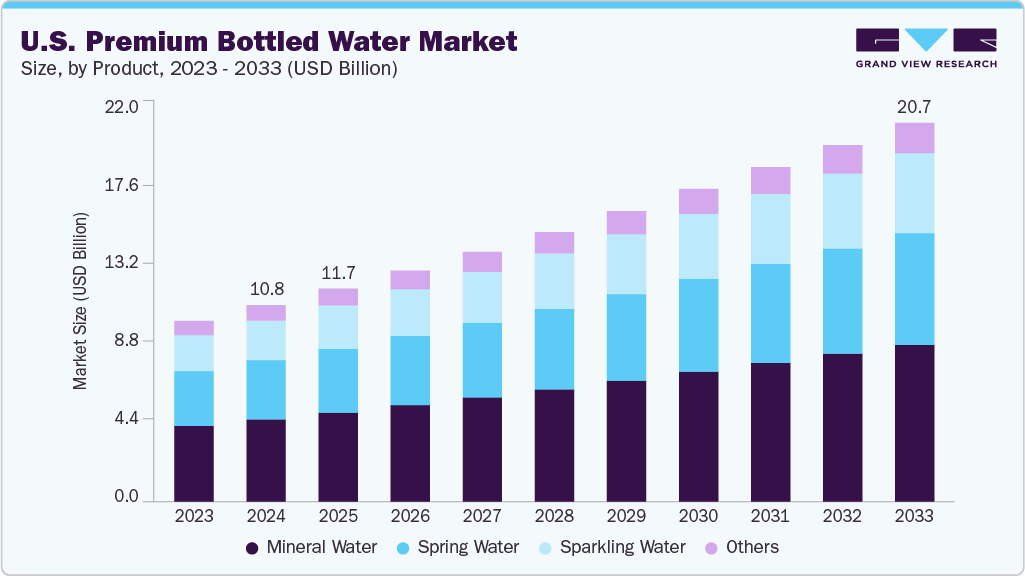 Source: Grand View Research, IR Documents, Primary Interviews, Paid DatabasesTo learn more about this report,
 Download Free Sample Report
The growing emphasis on sustainability and product transparency is also influencing purchasing behavior. Consumers are paying closer attention to packaging materials, recyclability, water sourcing, and environmental credentials, prompting premium brands to explore recycled PET, glass, aluminum, and other alternative materials. Premium water is also becoming increasingly associated with lifestyle and social experiences, particularly across restaurants, hotels, resorts, fitness facilities, and luxury events. However, higher price points remain a key consideration, requiring brands to demonstrate value through source provenance, functional benefits, packaging innovation, quality credentials, and differentiated brand experiences.
U.S. Bottled Water Unit Sales Data, Million
Category
Unit Sales (Million)
% Change vs prior year
Non-flavored convenience/ bottle still water
4,662.4
-1.2%
Flavored seltzer/ sparkling/ mineral water
1,879.9
0.7%
Flavored convenience/ bottle still water
889.7
0.2%
Non-flavored jug/bulk still water
1,320.0
2.6%
Non-flavored seltzer/ sparkling/ mineral water
322.2
6.2%
Category total
9,074.2
0.1%
Source: Circana
 To learn more about this report, Download Free Sample Report
Market Dynamics
The U.S. premium bottled water industry is being propelled by premiumization, rising health consciousness, demand for differentiated water sources, and growing interest in wellness-focused hydration. Consumers are increasingly willing to pay a premium for products offering attributes such as natural mineral content, source provenance, functional benefits, and distinctive packaging. Demand is also expanding across fitness, travel, hospitality, and on-the-go consumption occasions. For instance, in 2025, Swiss premium mineral-water brand Wald entered the U.S. market with naturally alkaline water sourced from Alpine springs and packaged in recyclable glass, targeting health-conscious consumers, luxury hospitality, fine dining, and specialty retail.
The U.S. premium bottled water industry faces constraints from higher price points, environmental concerns, substitute products, regulatory requirements, and rising operating costs. Premium pricing can limit penetration among cost-conscious consumers, particularly during periods of economic pressure. Concerns over single-use plastic waste and packaging-related emissions may further affect consumer preferences. Meanwhile, tap water, home filtration systems, and reusable hydration solutions offer cost-effective alternatives. In addition, higher costs for packaging, transportation, and raw materials, together with evolving regulations on plastics, recycling, labeling, and environmental claims, can increase compliance and operating expenses for market participants.
The U.S. premium bottled water market presents significant opportunities across functional hydration, sustainable packaging, premium hospitality, and product differentiation. Rising consumer willingness to pay for value-added hydration is creating opportunities for products enriched with electrolytes, minerals, vitamins, and other wellness-oriented ingredients. At the same time, aluminum, recycled PET, and reusable packaging formats are gaining relevance as brands seek to combine environmental credentials with premium positioning. Personalized hydration represents another emerging opportunity. In January 2026, Aquablu introduced its BOLD hydration system in the U.S., enabling consumers to customize water temperature, flavors, and functional additions such as electrolytes, protein, and caffeine. This development highlights the potential for premium water brands to leverage technology and personalization to create differentiated hydration experiences beyond conventional bottled-water offerings.
Analyst Perspective
The U.S. premium bottled water market is evolving beyond basic hydration toward wellness, quality, convenience, and lifestyle-oriented consumption. Consumers increasingly look for perceived purity, superior taste, natural mineral content, source authenticity, functional benefits, and attractive packaging when selecting premium water. Sustainability is also becoming a stronger consideration, encouraging demand for recycled, refillable, and reusable packaging formats. At the same time, premium brands face pressure to justify higher prices as consumers compare their value with conventional bottled and filtered water. Market participants are therefore focusing on product differentiation, functional innovation, sustainable packaging, brand storytelling, and premium experiences to strengthen consumer appeal and support market growth.
Consumer Insights
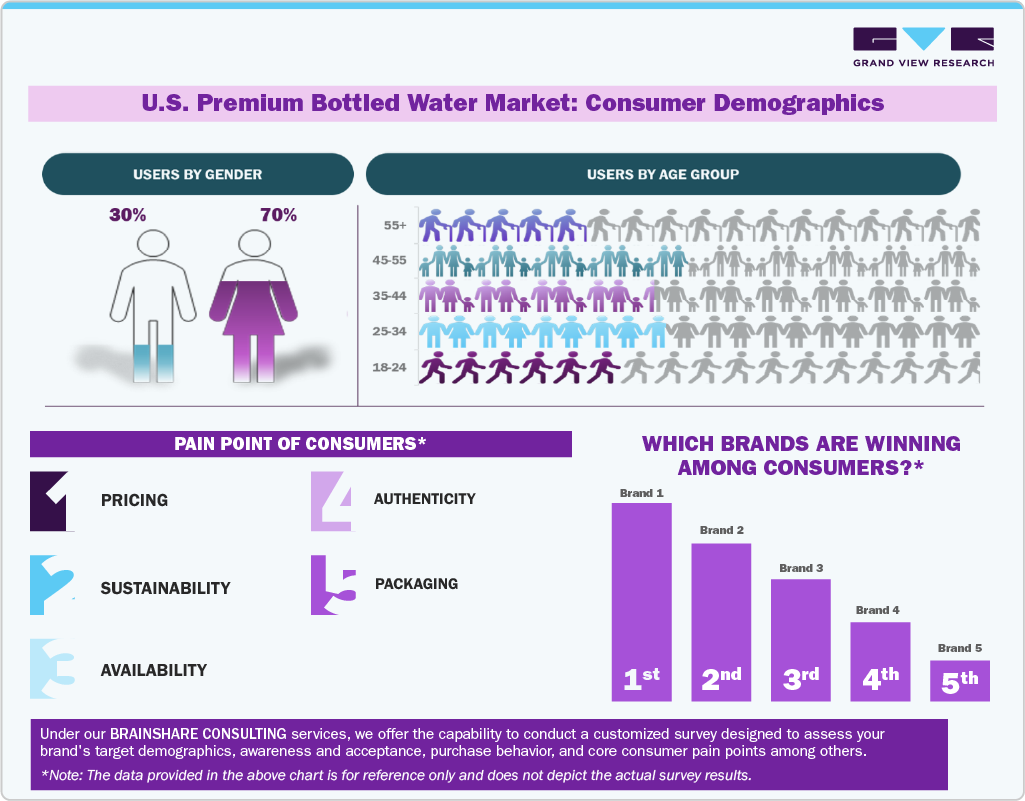
Consumers in the U.S. are increasingly prioritizing health, hydration, convenience, and product quality when purchasing bottled water. Premium buyers place greater value on purity, natural mineral composition, distinctive sourcing, functional attributes, and sustainable packaging, while portability remains important for on-the-go occasions. Rising wellness awareness is also driving interest in products that offer added benefits such as electrolytes, minerals, energy, and recovery support, creating opportunities for brands to differentiate themselves beyond conventional hydration.
 To learn more about this report, Download Free Sample Report
Gen Z and millennials represent important consumer segments, with active lifestyles and health-conscious behaviors supporting demand for packaged water. Younger consumers are also receptive to flavored and functional variations of traditional water products, encouraging innovation around taste, wellness benefits, and convenient formats. However, price sensitivity remains a consideration, making it increasingly important for premium brands to demonstrate clear value through quality, functionality, sustainability, and differentiated product positioning.
Product Insights
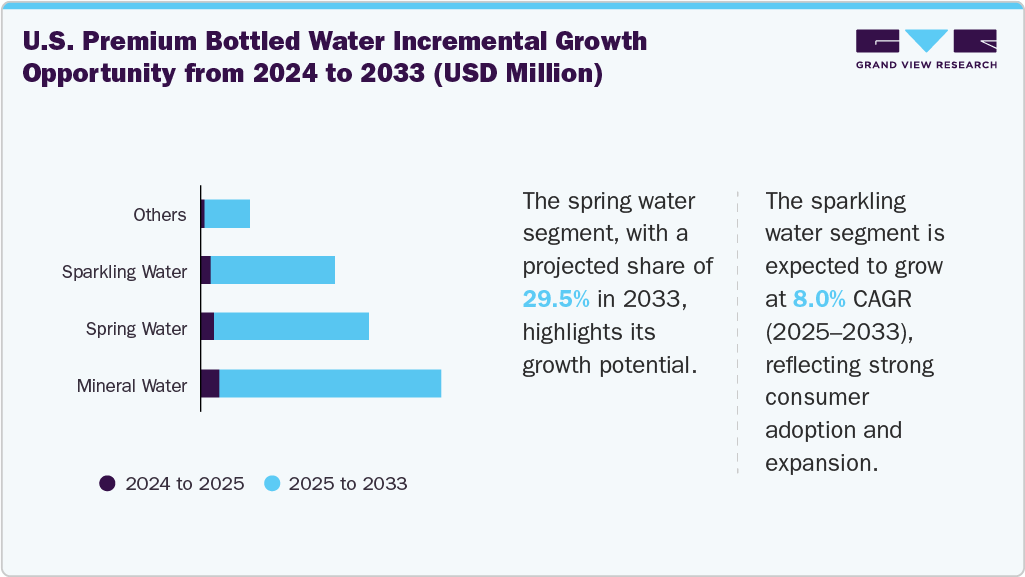
Still water dominated the U.S. premium bottled water industry, accounting for a revenue share of 39.9% in 2025. Its strong position is attributed to the broad consumer acceptance of clean-tasting, non-carbonated hydration and its suitability for everyday consumption. Demand is further supported by growing interest in natural mineral composition, purity, source transparency, and premium provenance. Still water also has broad applicability across households, workplaces, travel, fitness, restaurants, hotels, and wellness settings, giving premium brands multiple consumption occasions. For instance, in 2025, Evian continued strengthening its premium still-water positioning through its presence in upscale dining and hospitality, where its still water is offered in premium glass formats designed for foodservice environments.
 To learn more about this report, Download Free Sample Report
Functional premium bottled water is projected to grow at the fastest CAGR of 14.6% from 2026 to 2033, driven by consumers’ growing preference for hydration products that deliver additional wellness and performance benefits beyond basic hydration. Demand is being supported by rising interest in electrolytes, vitamins, adaptogens, energy, recovery, and other functional ingredients, particularly among fitness-oriented and health-conscious consumers. The segment is also benefiting from the shift toward lower-sugar alternatives to traditional functional beverages. For instance, in September 2025, Wet Hydration launched Focus Water in the U.S., combining electrolytes with functional ingredients such as ashwagandha and L-theanine to target daily performance and wellness needs.
Price Point Insights
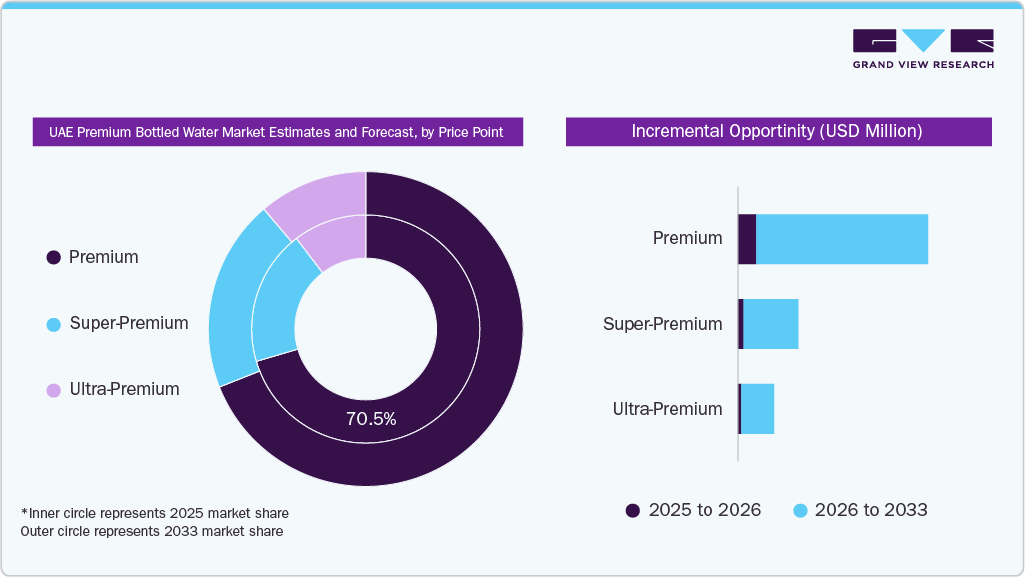
The premium bottled water segment dominated with a revenue share of 60.2% in 2025. The market is driven by the increasing positioning of bottled water as a luxury, wellness, and lifestyle offering rather than a conventional hydration product. Demand is being supported by consumer interest in distinctive water origins, premium packaging, exclusive product editions, functional benefits, and compelling brand narratives, enabling ultra-premium brands to differentiate their offerings and command higher price points.
 To learn more about this report, Download Free Sample Report
The ultra-premium bottled water is projected to grow at the fastest CAGR of 12.7% from 2026 to 2033. The market is driven by consumers’ growing willingness to pay for differentiated hydration, wellness-oriented benefits, exclusivity, and elevated product experiences. Demand is further supported by interest in functional and science-backed water, distinctive sourcing, premium packaging, and products aligned with health-conscious lifestyles. Brands in this category are increasingly pursuing partnerships with wellness experts, celebrities, luxury hospitality operators, and established lifestyle platforms to strengthen credibility and premium positioning. For instance, in January 2026, Dr. Nicholas Perricone announced the launch of an ultra-premium hydrogen-infused wellness water in the U.S., positioned around wellness, recovery, energy, and cellular health.
Packaging Type Insights
PET bottles held the largest share in the U.S. premium bottled water market, accounting for 57.5% of total revenue in 2025. Its leading position is supported by the lightweight, durable, portable, and cost-efficient nature of PET packaging, along with its well-established presence across grocery stores, convenience outlets, foodservice establishments, and other high-volume retail channels. The format is particularly suited to single-serve and on-the-go consumption, reinforcing its widespread adoption among U.S. consumers.
Cans are projected to grow at the fastest CAGR of 12.2% from 2026 to 2033. The segment growth is driven by growing consumer interest in sustainable packaging, durability, and differentiated product presentation. Aluminum cans offer a recyclable alternative to conventional plastic bottles while providing strong shelf visibility and convenience for on-the-go consumption. The format is also gaining traction among premium and wellness-focused brands seeking to combine product quality with packaging innovation. For instance, in May 2026, WaterOuai! launched in the U.S. with artesian water packaged in an aluminum can, positioning the format around material-conscious design and modern wellness preferences.
Distribution Channel Insights
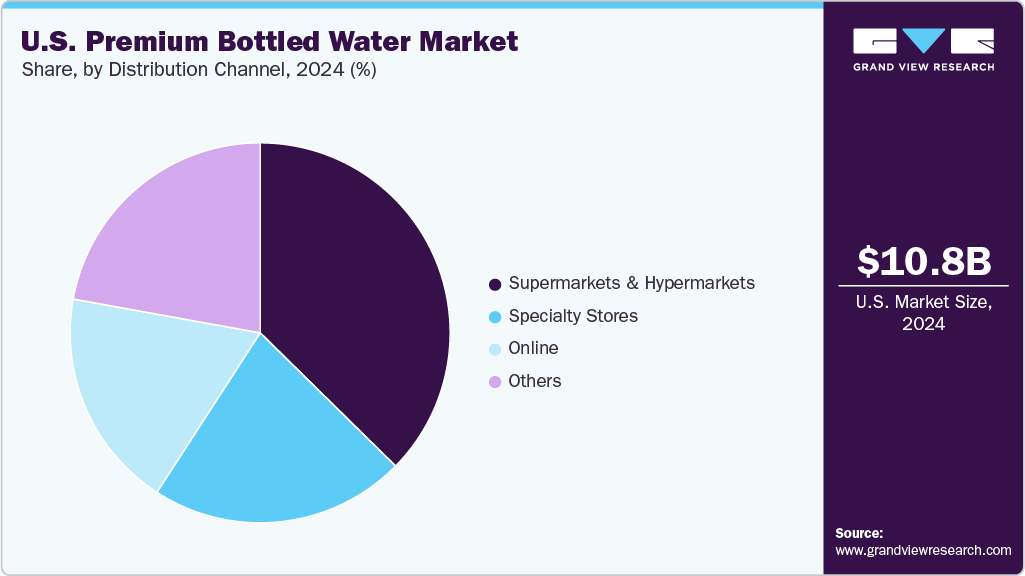
The off-premise channels dominated the U.S. premium bottled water industry, accounting for a revenue share of 53.3% in 2025. The distribution of premium bottled water through off-premise channels in the U.S. is supported by consumer demand for convenient, readily available hydration products for use at home, at work, while traveling, and on other occasions. Supermarkets, grocery stores, mass merchandisers, convenience stores, and specialty retailers provide broad product visibility and enable consumers to compare brands by water source, mineral content, packaging, sustainability, and perceived quality. Retail expansion by premium brands is further strengthening this channel. For instance, in March 2025, Perfect Hydration expanded its grocery distribution across the U.S., securing new placements at Harris Teeter, Basha’s, Winn-Dixie, Harp’s, Lowe’s Foods, and Vallarta, while also expanding its presence at Food Lion and select Sam’s Club stores. The premium alkaline-water brand’s gallon format was also available in more than 25,000 retail locations across the U.S., demonstrating how premium bottled-water brands are strengthening their off-premise presence through supermarkets, grocery stores, convenience retailers, and big-box outlets.
 To learn more about this report, Download Free Sample Report
The on-premise channel is projected to grow at the fastest CAGR of 10.6% from 2026 to 2033. The U.S. on-premise premium bottled water channel is supported by demand from restaurants, hotels, resorts, cafés, and other foodservice establishments, where bottled water contributes to the overall quality and positioning of the consumer experience. Premium brands gain traction through elevated packaging, distinctive water sources, and strong brand equity, which align well with upscale hospitality environments. For instance, in July 2025, Evian established a multi-year partnership with the MICHELIN Guide as the exclusive still and sparkling water provider for MICHELIN award ceremonies, reinforcing its positioning within premium dining and hospitality segments.
Pack Size Insights
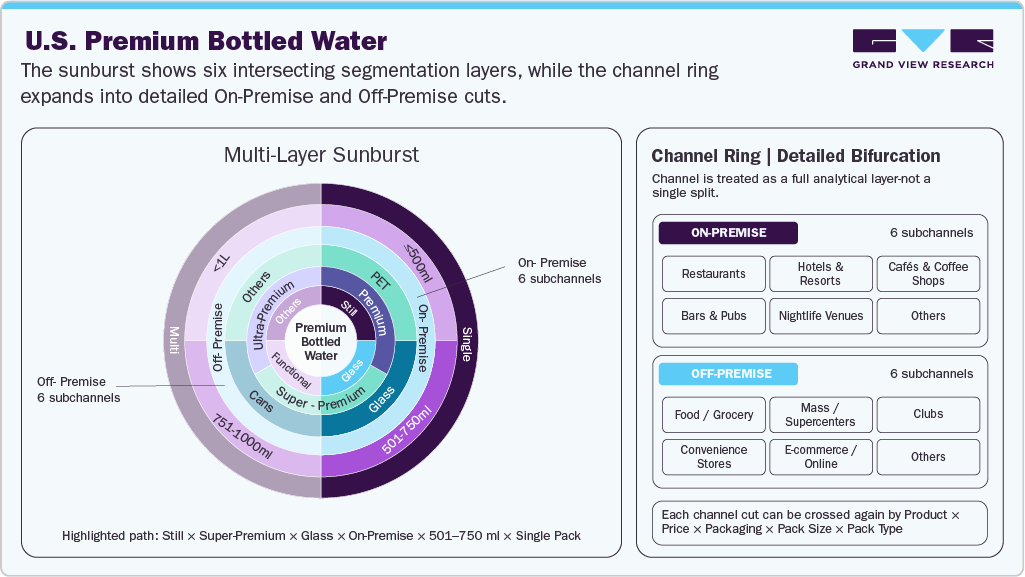
The up to 500 mL of premium bottled water dominated the U.S. premium bottled water industry, accounting for a revenue share of 42.7% in 2025. The growth is driven by strong consumer preference for portable, single-serve formats that suit on-the-go consumption across commuting, travel, fitness, dining, and workplace occasions. Recent product activity further supports this trend. For instance, in August 2025, MTN WTR launched a 500 mL can across its still and sparkling water range in the U.S., targeting grab-and-go coolers and grocery retail outlets. The launch highlights the continued role of smaller pack sizes in expanding access to premium water across high-frequency consumption occasions.
The 501-750 mL of premium bottled water segment is projected to grow at the fastest CAGR of 9.9% from 2026 to 2033. The 501-750 mL pack-size segment benefits from consumer demand for formats that combine portability with greater hydration volume. These bottles offer a practical option for travel, fitness, outdoor activities, and longer-duration consumption while remaining convenient to carry. Premium water brands are increasingly responding to these occasions by offering larger single-serve options. For instance, in July 2025, FIJI Water introduced a 700 mL bottle in the U.S., expanding its portfolio with a portable format designed to provide greater hydration for consumers on the move.
Pack Type Insights
The premium bottled water in multi packs held the largest position in the U.S. premium bottled water market, representing 66.6% of revenue in 2025. The multipack segment benefits from growing demand for convenient bulk purchasing, household replenishment, and perceived value across grocery and e-commerce channels. In July 2025, Liquid Death introduced Cereal Criminal sparkling water in the U.S. in 6-pack and 12-pack configurations of 12-ounce cans. Following its initial availability at select Walmart stores, the product expanded nationwide, illustrating how multipack offerings can support broader retail penetration and strengthen premium water brands’ presence across high-volume consumer channels.
The premium bottled water in single pack is projected to grow at the fastest CAGR of 8.3% from 2026 to 2033. The single-pack segment is being driven by the growing preference for on-the-go hydration, convenience, portability, and immediate consumption. Rising mobility and busy lifestyles are encouraging consumers to purchase individual bottles for commuting, travel, fitness, outdoor activities, and workplace consumption. The segment is also benefiting from impulse purchasing through convenience stores, vending machines, restaurants, and cafés, where consumers typically seek ready-to-drink products rather than bulk quantities. In the premium category, premium packaging, distinctive bottle designs, functional water attributes, and sustainability-focused materials are further supporting demand for individual formats.
Key U.S. Premium Bottled Water Company Insights
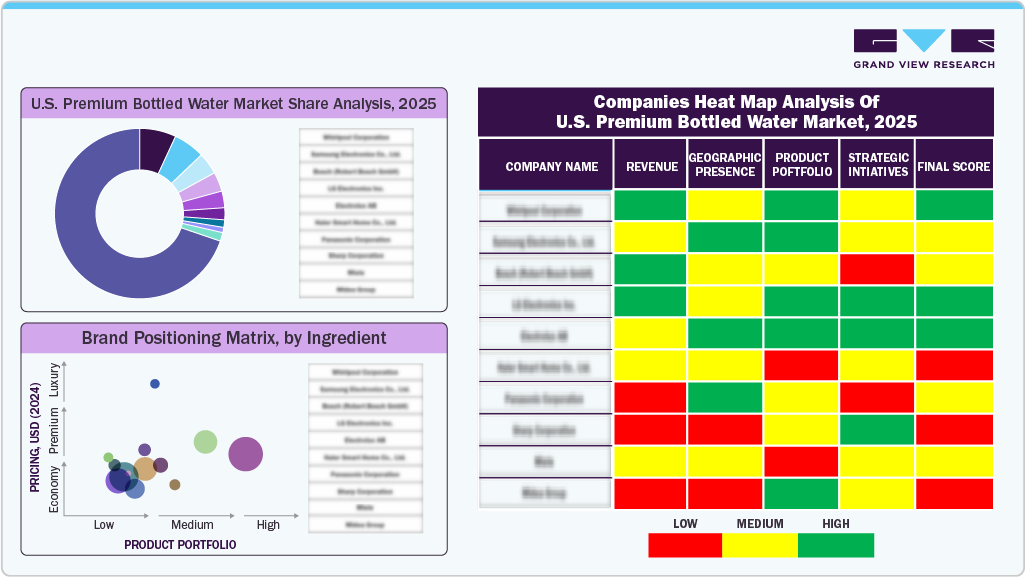
The U.S. premium bottled water market is competitive, with established multinational brands and emerging premium players competing across retail, foodservice, hospitality, and e-commerce channels. Companies are focusing on product innovation, portfolio expansion, sustainable packaging, strategic partnerships, digital marketing, and channel expansion to strengthen market positioning.
 To learn more about this report, Download Free Sample Report
Key U.S. Premium Bottled Water Companies
-
Beverly Hills Drink Company
-
Smartwater
-
FIJI
-
Evian
-
ACQUA PANNA
-
Saratoga Spring Water
-
LIFEWTR
-
VOSS
-
S.Pellegrino
-
Perrier
Competitive Benchmarking
Category
Operating Strategies
Competitive Edge
Weakness
Established Players (Smartwater, FIJI, Evian, ACQUA PANNA, LIFEWTR, VOSS, S.Pellegrino, Perrier)
- Expand premium portfolios through distinctive sources, premium packaging, sustainability initiatives, and broad retail and hospitality distribution.
- Strong brand recognition, established distribution, trusted sources, and premium positioning.
- Higher operating costs, regulatory pressures, and intense competition from private-label and specialist brands.
Emerging Players (Beverly Hills Drink Company, Saratoga Spring Water)
- Target niche opportunities through flexible production, specialist offerings, differentiated sourcing, and selected retail or hospitality channels.
- Greater flexibility, customer-focused solutions, and differentiated product propositions.
- Limited brand awareness, distribution reach, production scale, and marketing resources.
Recent Developments
-
In July 2026, Waiakea launched its Paʻa Premium Glass Collection, featuring still and sparkling water in reusable glass bottles. The launch expanded the brand’s sustainable packaging portfolio beyond recycled PET to include reusable glass and refillable aluminum, supporting its premium positioning while responding to growing demand for environmentally responsible packaging.
-
In July 2025, FIJI Water introduced a new 700 mL bottle of its natural artesian water in the U.S., featuring a slimmer design intended to fit easily into car cupholders and backpacks.
U.S. Premium Bottled Water Market Report Scope
Report Attribute
Details
Market size in 2025
USD 19.3 billion
Estimated market size in 2026
USD 23.6 billion
Projected market size by 2033
USD 45.2 billion
Growth rate
CAGR of 9.7% from 2026 to 2033
Actuals
2021 - 2025
Forecast period
2026 - 2033
Quantitative units
Revenue in USD million/billion, volume in million liters, and CAGR from 2026 to 2033
Report coverage
Revenue forecast, volume forecast, company ranking, competitive landscape, growth factors, and trends
Segments covered
Product, price point, packaging type, distribution channel, pack size, and pack type
Country scope
U.S.
Key companies profiled
Beverly Hills Drink Company; Smartwater; FIJI; Evian; ACQUA PANNA; Saratoga Spring Water; LIFEWTR; VOSS; S.Pellegrino; Perrier
Customization scope
Free report customization (equivalent up to 8 analysts’ working days) with purchase. Addition or alteration to country, regional & segment scope.
Pricing and purchase options
Avail customized purchase options to meet your exact research needs. Explore purchase options
U.S. Premium Bottled Water Market Report Segmentation
This report forecasts revenue & volume growth at the country level and provides an analysis of the latest industry trends and opportunities in each of the sub-segments from 2021 to 2033. For this study, Grand View Research has segmented the U.S. premium bottled water market report based on product, price point, packaging type, distribution channel, pack size, and pack type:
-
Product Outlook (Volume, Million Liters; Revenue, USD Million; 2021 - 2033)
-
Still Water
-
Sparkling Water
-
Functional Water
-
Others
-
-
Price Point Outlook (Volume, Million Liters; Revenue, USD Million; 2021 - 2033)
-
Premium
-
Super-Premium
-
Ultra-Premium
-
-
Packaging Type Outlook (Volume, Million Liters; Revenue, USD Million; 2021 - 2033)
-
PET Bottles
-
Glass
-
Cans
-
Others
-
-
Distribution Channel Outlook (Volume, Million Liters; Revenue, USD Million; 2021 - 2033)
-
On-Premise
-
Restaurants
-
Hotels & Resorts
-
Cafés & Coffee Shops
-
Bars & Pubs
-
Nightlife Venues
-
Others
-
-
Off-Premise
-
Food / Grocery
-
Mass (incl. supercenters)
-
Clubs
-
Convenience Stores
-
E-commerce / Online
-
Other
-
-
-
Pack Size Outlook (Volume, Million Liters; Revenue, USD Million; 2021 - 2033)
-
Up to 500 ml
-
501-750 ml
-
751-1000 ml
-
Above 1 Liter
-
-
Pack Type Outlook (Volume, Million Liters; Revenue, USD Million; 2021 - 2033)
-
Single Pack
-
Multi Pack
-
Research Methodology
The U.S. premium bottled water market figures in this report are based on a proven research process that combines executive interviews with secondary research from proprietary databases, company filings, and recognized regulatory and institutional sources. Market size is built through value-chain sizing-reconciling supply-side and demand-side estimates-and triangulated with bottom-up and top-down approaches. Every estimate passes multiple levels of expert validation before publication, with each U.S. premium bottled water segment quantified using the revenue-capture definitions in the table below.
Segment Definition
Segment - Product
Revenue capture definition
Still Water
This segment includes the sales of premium still water, including natural spring water, mineral water, artesian water, and purified water without carbonation.
Sparkling Water
This segment includes the sales of premium sparkling water, including naturally sparkling and carbonated water products.
Functional Water
This segment includes the sales of premium water enhanced with functional ingredients, such as electrolytes, vitamins, minerals, antioxidants, and other nutrients intended to support hydration and wellness.
Others
This segment includes the sales of other premium bottled water products, including specialty water products differentiated by unique sourcing, processing, or formulation.
Estimation Model
Layer
Stage
Key Question
Description
Consumption Profile Layer
Consumer Demand
Who consumes premium bottled water?
Demand is supported by consumers seeking high-quality hydration, perceived purity, superior taste, natural mineral content, functional benefits, and premium experiences. Wellness awareness, convenience, and interest in sustainable consumption further influence purchasing preferences.
Market Reach Layer
Distribution & Accessibility
Where are they sold?
Products reach consumers through retail, e-commerce, restaurants, hotels, foodservice, and specialty channels, with distribution breadth supporting market penetration.
Innovation & Differentiation Layer
Brand Differentiation
How do brands differentiate?
Brands differentiate through source provenance, mineral composition, functional benefits, sparkling formats, premium bottle designs, and sustainable packaging.
Value Generation Layer
Revenue Generation
How does consumption convert into market value?
Revenue is generated through premium-priced product sales, supported by brand equity, differentiated offerings, packaging value, and consumer willingness to pay.
Delivered Customizations
This report has been delivered with the following In-depth customizations
Client Request
Customization Delivered
Value Adds
Understand premium bottled water consumer preferences and purchasing behavior
Developed a U.S.-specific consumer assessment covering preferences for natural spring water, mineral content, source origin, purity, taste, packaging format, sustainability, and functional benefits. Evaluated purchasing behavior across supermarkets, convenience stores, specialty retailers, foodservice, and e-commerce.
Helps identify high-value consumer segments, key purchase drivers, and attributes that support premium pricing and brand differentiation in the U.S. market.
Benchmark competitive positioning of leading premium bottled water brands
Assessed major U.S. and international brands based on water source, product positioning, packaging, price tier, brand image, sustainability initiatives, distribution footprint, and product portfolio. Evaluated how brands differentiate through provenance, purity, functionality, and premium packaging.
Provides a structured competitive benchmark to identify positioning gaps, whitespace opportunities, and potential strategies for strengthening market presence
Identify emerging product categories and innovation opportunities
Evaluated emerging trends including still water, sparkling water, functional water, and other premium water category. Assessed innovation around ingredients, packaging, sourcing, and consumer experience.
Supports identification of high-potential product opportunities and innovation pathways aligned with evolving U.S. preferences for health, wellness, convenience, sustainability, and premium experiences.
Frequently Asked Questions About This Report
Demand is supported by interest in products perceived to offer greater purity, distinctive mineral profiles, natural or protected sources, and added functional benefits.
PET bottles accounted for the largest revenue share in 2025, while cans are expected to be the fastest-growing segment.
Off-Premise channels accounted for the largest revenue share in 2025, while On-Premise channels are expected to be the fastest-growing segment.
Key players include Beverly Hills Drink Company; Smartwater; FIJI; Evian; ACQUA PANNA; Saratoga Spring Water; LIFEWTR; VOSS; S.Pellegrino; Perrier
The U.S. premium bottled water market size was valued at USD 19.3 billion in 2025 and is estimated to reach USD 23.6 billion in 2026.
The U.S. premium bottled water market is expected to grow at a CAGR of 9.7% from 2026 to 2033, reaching USD 45.2 billion by 2033.
Still water dominated the U.S. premium bottled water market, accounting for a 39.9% revenue share in 2025, while the functional water is expected to register the fastest growth during the forecast period.
Premium priced bottled water accounted for the largest revenue share in 2025, while ultra-premium priced bottled water are expected to be the fastest-growing segment.
Multi pack bottled water accounted for the largest revenue share in 2025 while single pack bottled water are expected to be the fastest-growing segment.
About the Author(s)
Consumer F&B Research Team
Consumer Goods · Consumer F&BThis report was authored by the consumer f&b research team at Grand View Research - comprising two research analysts, one senior research analyst, and one industry expert - with specialized expertise in the consumer f&b segment of the consumer goods industry. All findings are based on proprietary consumer goods databases, executive interviews, and regulatory analysis, subject to internal peer review prior to publication.
Last Updated:
Speak to Analyst

Customize this report to your needs - add regions, segments, or data points, with 20% free customization.
Or view our licence options:


ISO 9001:2015 & 27001:2022 Certified
We are GDPR and CCPA compliant! Your transaction & personal information is safe and secure. For more details, please read our privacy policy.


