
- Home
- »
- Consumer F&B
- »
-
U.S. Sesame Seeds Market Size & Share Report, 2026-2033GVR Report cover

U.S. Sesame Seeds Market (2026 - 2033)
Size, Share & Trends Analysis Report By Product Type (Raw Sesame Seeds, Processed Sesame Seeds), By Form (Natural/Unhulled, Hulled), By Application (Bakery & Confectionery, Nutraceuticals/Health Foods), By Region, And Segment Forecasts
Market Size, 2025
$1.4BMarket Estimate, 2026
$1.5BMarket Forecast, 2033
$2.2BCAGR, 2026–2033
5.0%U.S. Sesame Seeds Market Summary
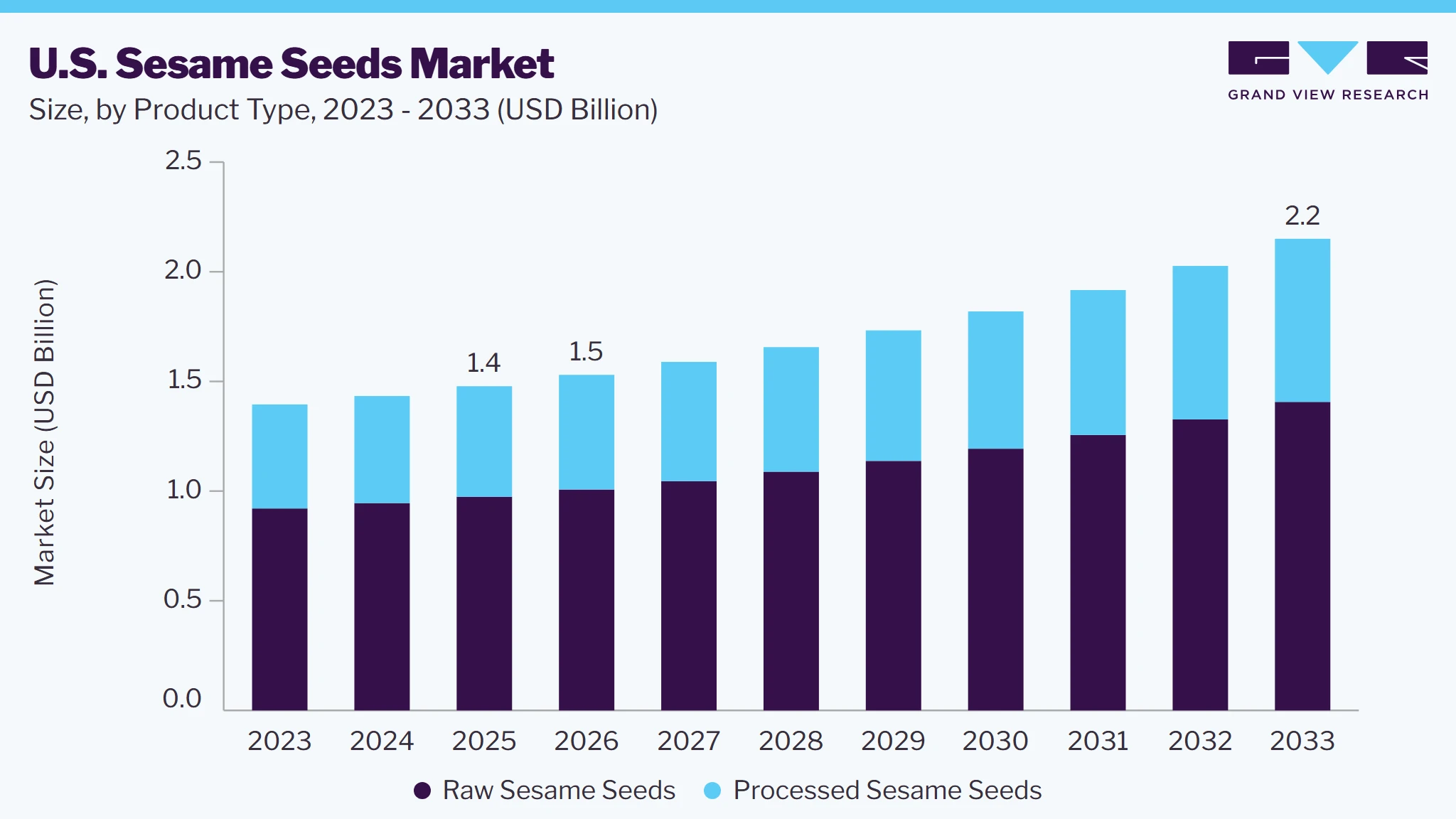
The U.S. sesame seeds market size was valued at USD 1.4 billion in 2025 and is projected to grow from USD 1.5 billion in 2026 to USD 2.2 billion by 2033 at a CAGR of 5.0% from 2026 to 2033. The U.S. sesame seeds market is driven by growing consumer demand for healthy, plant-based, and nutrient-rich foods. Rising consumption of sesame-based products such as tahini, hummus, bakery products, and snacks is further supporting market growth.
Key Market Trends & Insights
- By product type: Raw sesame seeds led the market and accounted for a share of 65.9% in 2025.
- By form: Hulled sesame seeds accounted for the largest share of 40.6% of the revenue in 2025.
- By application: Bakery & confectionery segment led the market and accounted for a share of 45.2% in 2025.
Key Market Trends & Insights
- Market size in 2025: USD 1.4 Billion
- Estimated market size in 2026: USD 1.5 billion
- Projected market size by 2033: USD 2.2 billion
- CAGR (2026-2033): 5.0%
Prism AI by Grand View Research Free to tryAsk a question about the U.S. sesame seeds marketTry asking✓Every figure cited from GVR research Prefer the report? Download free sample →Additionally, increasing awareness of sesame’s protein, fiber, and healthy fat content is encouraging its use across the food industry. Moreover, the U.S. sesame seeds market is benefiting from the growing popularity of international and ethnic cuisines, particularly Middle Eastern and Asian foods. Food manufacturers are also expanding the use of sesame in sauces, dressings, confectionery, and prepared meals, creating new avenues for consumption. According to data published in April 2025, Yelp searches for tahini lattes surged 900%, while searches for tahini coffee surged 678%, signaling growing U.S. consumer interest in sesame-based coffee beverages. The trend points to increasing demand for Middle Eastern-inspired flavors and innovative coffee options in the U.S. market.
 Source: Grand View Research, IR Documents, Primary Interviews, Paid DatabasesTo learn more about this report,
 Download Free Sample Report
In addition, improvements in processing technologies and supply-chain networks are further supporting consistent product availability across the country. Companies such as Sesame King’s U.S.-made tahini is produced using state-of-the-art machinery and a computer-controlled pasteurization process, supporting efficient and consistent production. The company also offers multiple pack sizes, including bulk and food-service formats, with nationwide shipping, supporting product availability across the U.S.
Furthermore, growing retail availability through supermarkets, specialty stores, and online platforms is making sesame products more accessible to consumers. According to the data published in July 2025, Little Sesame expanded its tahini-based hummus from a Washington, D.C., restaurant concept to nearly 2,500 stores nationwide, demonstrating strong U.S. retail growth. In addition, product diversification into roasted, hulled, organic, and value-added sesame varieties is creating opportunities for market expansion.
Market Dynamics
The growing popularity of Middle Eastern and Asian cuisines is supporting demand for sesame seeds across the U.S. food market. Sesame is a traditional ingredient in dishes such as sushi, hummus, tahini-based preparations, and various Asian recipes. As consumers increasingly explore diverse culinary experiences, restaurants and food manufacturers are incorporating sesame into a wider range of offerings. In March 2026, Mazra in San Bruno reopened after a two-year closure following a major remodel, expanding to 177 seats and adding a 70-seat outdoor patio. The revamped restaurant features a custom 20-foot charcoal grill and continues serving Jordanian-inspired dishes, including its popular lemon tahini cauliflower. This trend is broadening the ingredient’s presence beyond conventional applications. Consequently, greater culinary diversity is contributing to sustained sesame seed consumption.
The U.S. sesame seeds market faces supply chain challenges due to its significant reliance on imports to meet domestic demand. This dependence exposes market participants to fluctuations in international shipping costs, trade policies, currency exchange rates, and production conditions in major exporting countries. For instance, in September 2025, Mundus Agri reported that U.S. sesame seed production stood at approximately 10,000 metric tons, while combined imports into the U.S. and Canada ranged between 35,000 and 40,000 metric tons, with India serving as a major supplier. Furthermore, disruptions in international shipping routes, port congestion, and fluctuations in overseas sesame production can affect supply availability, extend delivery timelines, and increase procurement costs. Such uncertainties make it challenging for manufacturers and distributors to maintain consistent inventory levels and stable pricing. Consequently, the market's dependence on imported sesame seeds can increase supply chain vulnerabilities, place pressure on operating margins, and constrain market growth.
The growth of tahini, sesame butter, and other value-added products presents an opportunity for market participants to increase the commercial value of sesame. These products allow manufacturers to target consumers seeking convenient ingredients for cooking, spreads, sauces, and prepared foods. Product innovation can also support premium positioning through different flavors, textures, and formulations. Expanding distribution across retail and foodservice channels can further increase consumer access. In July 2025, Little Sesame raised USD 8.5 million to build a new Maryland facility, quadrupling production capacity and expanding its range of hummus flavors, kids’ products, and healthy snacks. The facility is expected to supply 3,000+ stores nationwide, highlighting opportunities to increase the value of sesame through innovative products and wider retail distribution. This value-added segment provides opportunities to diversify beyond the sales of conventional whole sesame seeds.
Analyst Perspective
The U.S. sesame seeds market is positioned for continued expansion as demand diversifies across packaged foods, foodservice, and specialty ingredient applications. Product innovation, premium formulations, and greater adoption of sesame-based ingredients are creating avenues for suppliers to strengthen their market positioning. The market is also shaped by the U.S. food industry's emphasis on consistent quality, traceability, and dependable sourcing. Import dependency makes procurement strategies and supplier relationships particularly important for maintaining continuity of supply. Going forward, companies that combine reliable sourcing with differentiated product offerings are likely to be better positioned to capture emerging demand.
Product Type Insights
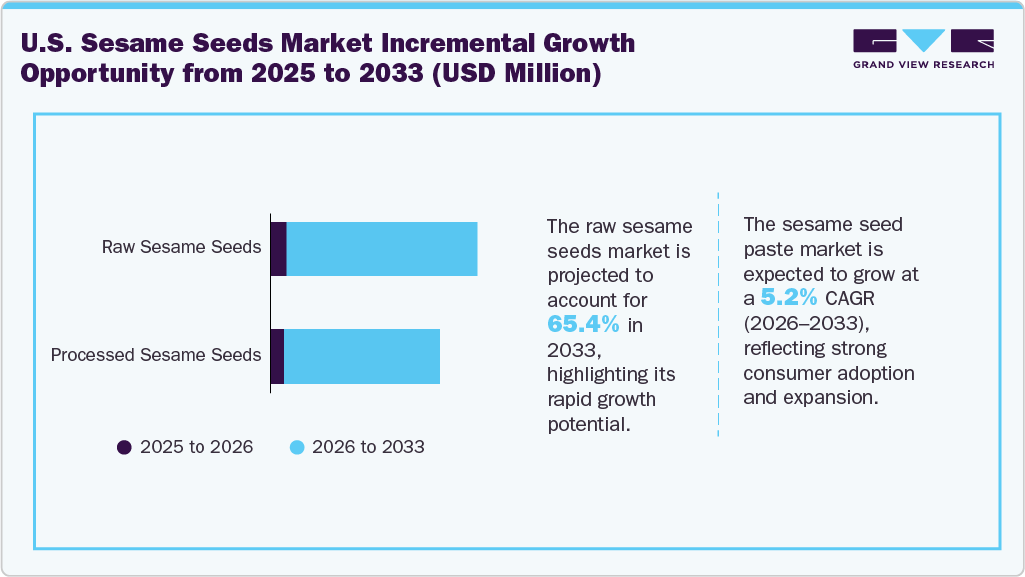
The raw sesame seeds market accounted for the largest share, accounting for around 65.9% of the U.S. sesame seeds market in 2025. Raw sesame seeds are gaining demand from U.S. food manufacturers that prefer flexible ingredients for further processing and formulation. Their unprocessed nature allows businesses to roast, grind, mill, or incorporate the seeds according to specific product requirements. They are widely suitable for manufacturers seeking greater control over flavor, texture, and processing conditions. Demand is also supported by their use as an input for producing sesame-based ingredients and preparations. This versatility makes raw seeds an important component of commercial procurement.
 To learn more about this report, Download Free Sample Report
The processed U.S. sesame seeds industry is projected to grow at the fastest CAGR of 5.2% from 2026 to 2033. Processed sesame seeds are benefiting from manufacturers’ preference for ingredients that require less preparation before incorporation into finished products. Processing can improve consistency, convenience, and suitability for applications requiring specific textures or flavor profiles. Food producers can select processed varieties according to the technical requirements of their recipes and manufacturing processes. Their ready-to-use characteristics can help reduce preparation requirements during large-scale production.
Form Insights
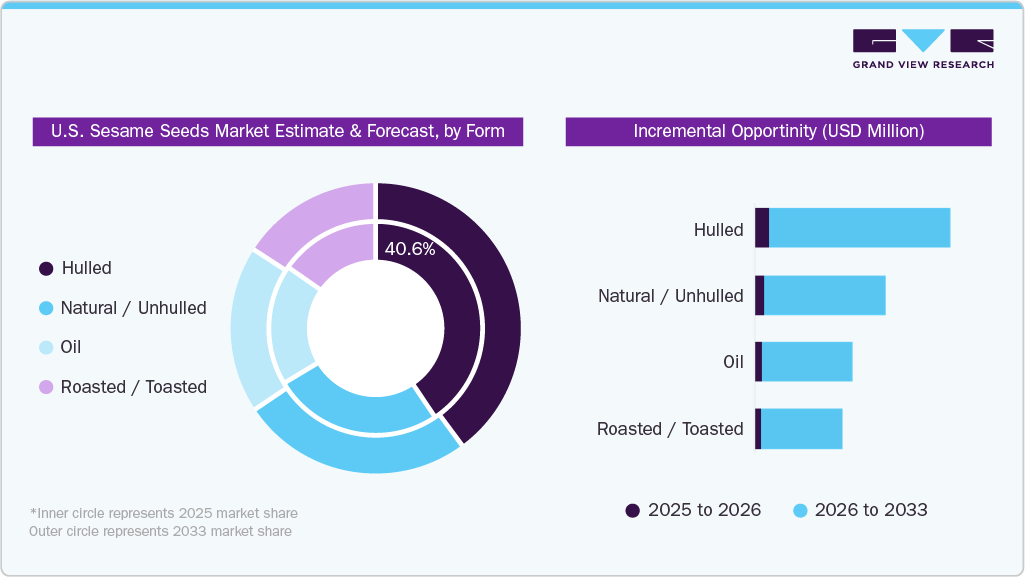
The hulled sesame seeds accounted for the largest share of 40.6% of the revenue in 2025. Hulled sesame seeds are supported by their smoother texture and milder sensory profile, making them suitable for products where the outer seed coating is undesirable. Their appearance can also provide a cleaner visual presentation in breads, crackers, sauces, and other prepared foods. Food manufacturers may favor hulled seeds when product formulations require easier grinding or incorporation. Their use in sesame pastes and ingredient preparations further expands their commercial relevance. These characteristics support demand across both industrial processing and finished-food applications.
 To learn more about this report, Download Free Sample Report
The roasted/toasted sesame seed market is projected to grow at a CAGR of 5.5% from 2026 to 2033. Roasted and toasted sesame seeds benefit from their enhanced aroma, deeper flavor, and appealing texture compared with untreated seeds. These characteristics make them particularly attractive for applications where sesame is intended to provide a noticeable sensory element. They are increasingly incorporated into toppings, seasonings, meal kits, and prepared foods to improve flavor and presentation. Their convenience also allows foodservice operators and manufacturers to add a finished sesame component without additional roasting.
Application Insights
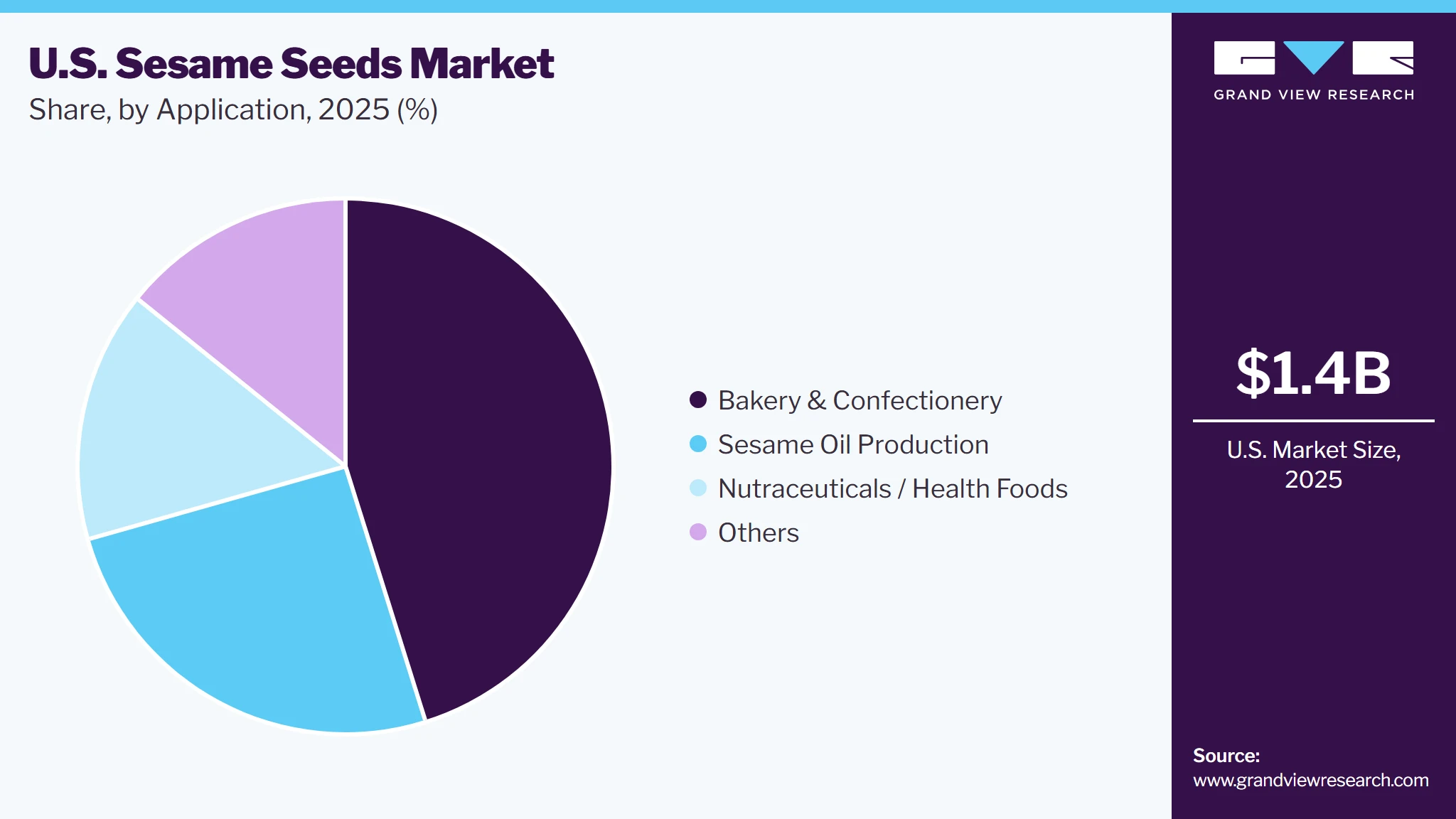
The use of U.S. sesame seeds in bakery & confectionery accounted for the largest share of 45.2% of the revenue in 2025. Bakery and confectionery products represent an important application because sesame can contribute distinctive flavor, texture, and visual appeal to finished products. It is used across items such as breads, buns, crackers, cookies, snack bars, and specialty confectionery. Product developers can use sesame as a topping, inclusion, or flavor component depending on the formulation. Its compatibility with both sweet and savory recipes provides manufacturers with considerable formulation flexibility.
 To learn more about this report, Download Free Sample Report
The use of U.S. sesame seeds in nutraceuticals/health foods is projected to grow at a CAGR of 5.4% from 2026 to 2033. The nutraceuticals and health foods segment is supported by sesame’s naturally occurring protein, minerals, dietary fiber, and unsaturated fats. Manufacturers can incorporate sesame ingredients into products designed around nutrient density and balanced dietary profiles. Its compatibility with formulations such as nutrition bars, seed blends, spreads, and functional foods creates opportunities for product diversification. Growing interest in whole-food ingredients also encourages manufacturers to feature recognizable seed-based components. This provides a foundation for expanding sesame applications within health-oriented food categories.
Key U.S. Sesame Seeds Company Insights
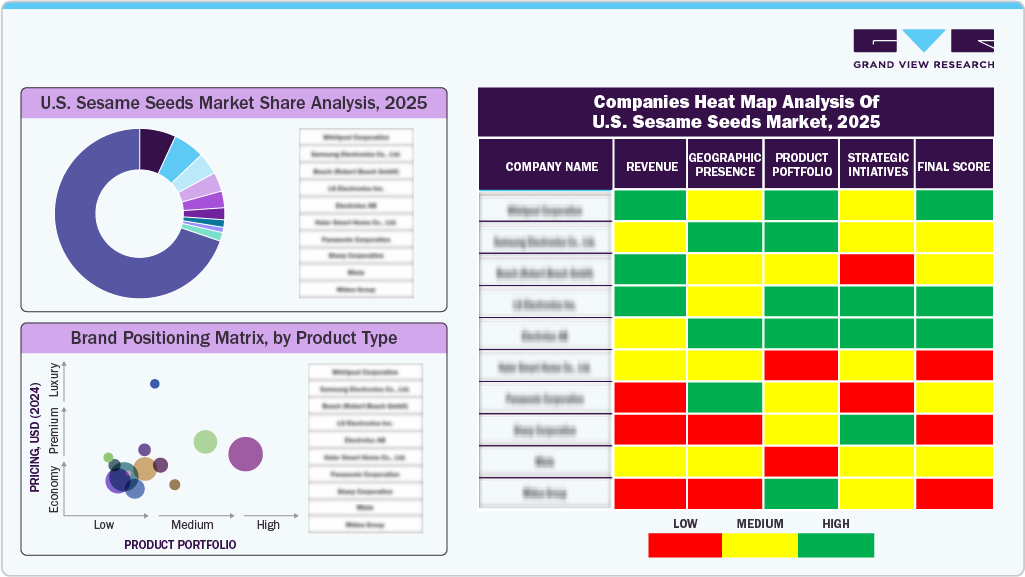
The U.S. sesame seeds industry is characterized by the presence of established importers, processors, distributors, and specialty food companies. Market participants compete through product quality, sourcing capabilities, processing expertise, and distribution reach. Companies are increasingly focusing on expanding their sesame product portfolios to serve food manufacturers, retailers, and foodservice operators. Market share is influenced by supplier relationships, geographic coverage, product availability, and the ability to meet varying customer specifications. Competitive positioning also depends on maintaining a reliable supply while responding to changing demand across end-use applications.
 To learn more about this report, Download Free Sample Report
Key U.S. Sesame Seeds Companies:
-
Olam International Limited
-
Archer Daniels Midland Company (ADM)
-
Cargill, Incorporated.
-
Wilmar International Limited
-
Dipasa USA, Inc.
-
Frontier Co-op Ingredients
-
SunOpta Inc.
-
Shiloh Farms
-
McCormick & Company, Inc.
-
Hudson Trading Group LLC
Competitive Benchmarking
Category
Operating Strategies
Competitive Edge
Weakness
Established Players (Olam International Limited; Archer Daniels Midland Company (ADM))
- Expand value-added processing, strengthen customer partnerships, and diversify sourcing.
- Broad product portfolios, established U.S. customer base, processing expertise, and scale.
- Complex operations, margin pressure, and dependence on imported raw sesame.
Emerging Players (Frontier Co-op, Shiloh Farms)
- Target specialty grades, flexible order volumes, quality differentiation, and niche B2B segments.
- Agility, competitive sourcing, customized specifications, and faster response to niche demand.
- Lower brand recognition in the U.S., limited local infrastructure, and smaller customer networks.
Recent Developments
-
In July 2025, Little Sesame raised USD 8.5 million to build a new Maryland facility, quadrupling production capacity and expanding its range of hummus flavors, kids’ products, and healthy snacks. The facility is expected to supply 3,000+ stores nationwide, highlighting opportunities to increase the value of sesame through innovative products and wider retail distribution.
-
In October 2024, Beeyond Snacks brought the traditional Greek pasteli sesame snack to U.S. snack aisles, introducing two new flavors. The launch expands the availability of sesame-based, value-added snack products in the U.S. market.
U.S. Sesame Seeds Market Report Scope
Report Attribute
Details
Market size in 2025
USD 1.4 billion
Estimated market size in 2026
USD 1.5 billion
Projected market size by 2033
USD 2.2 billion
Growth Rate (Revenue)
CAGR of 5.0% from 2026 to 2033
Actuals
2021 - 2025
Forecast period
2026 - 2033
Quantitative (Revenue) units
Revenue in USD million and CAGR from 2026 to 2033
Report coverage
Revenue forecast, company ranking, competitive landscape, growth factors, and trends
Segments covered
Product type, form, application
Country scope
U.S.
Key companies profiled
Olam International Limited, Archer Daniels Midland Company (ADM), Cargill, Incorporated, Wilmar International Limited, Dipasa USA, Inc., Frontier Co-op, SunOpta Inc., Shiloh Farms, McCormick & Company, Inc., Hudson Trading Group LLC
Customization scope
Free report customization (equivalent up to 8 analysts’ working days) with purchase. Addition or alteration to country, regional & segment scope.
Pricing and purchase options
Avail customized purchase options to meet your exact research needs. Explore purchase options
U.S. Sesame Seeds Market Report Segmentation
This report forecasts revenue growth at the regional and country levels and provides an analysis of the latest industry trends and opportunities in each of the sub-segments from 2021 to 2033. For the purpose of this study, Grand View Research has segmented the U.S. sesame seeds market report on the basis of product type, form, and application:
-
Product Type Outlook (Revenue, USD Million, 2021 - 2033)
-
Raw Sesame Seeds
-
Processed Sesame Seeds
-
-
Form Outlook (Revenue, USD Million, 2021 - 2033)
-
Natural/Unhulled
-
Hulled
-
Roasted/Toasted
-
Oil
-
-
Application Outlook (Revenue, USD Million, 2021 - 2033)
-
Bakery & Confectionery
-
Nutraceuticals/Health Foods
-
Sesame Oil Production
-
Others
-
Research Methodology
The U.S. sesame seeds market figures in this report are based on a proven research process that combines executive interviews with secondary research from proprietary databases, company filings, and recognized regulatory and institutional sources. Market size is built through value-chain sizing-reconciling supply-side and demand-side estimates-and triangulated with bottom-up and top-down approaches. Every estimate passes multiple levels of expert validation before publication, with each U.S. sesame seeds segment quantified using the revenue-capture definitions in the table below.
Segment Definition
Segment - Product Type
Revenue capture definition
Raw sesame seeds
Raw sesame seeds generate revenue through transactions involving untreated seeds sold according to commercial grades and buyer specifications. Pricing is influenced by factors such as contract volumes, market conditions, quality certifications, and procurement requirements. Revenue is captured through spot purchases, long-term procurement arrangements, distributor networks, and institutional sales. Additional value can arise from specialized varieties, certified sourcing, and customized packaging formats.
Processed sesame seeds
Processed sesame seeds capture revenue by converting basic seed material into formats tailored to specific customer requirements and applications. Suppliers can command higher unit values through specialized treatment, quality control, customized specifications, and packaging. Revenue is generated through recurring B2B contracts, private-label supply, food-industry procurement, and specialty distribution. Higher margins may be achieved where processing capabilities provide differentiated functionality, consistency, or convenience.
Estimation Model
Layer
Key Question
Description
Consumption Universe Layer
Who uses sesame seeds across U.S. industries?
Food manufacturers, bakeries, snack producers, restaurants, foodservice operators, and prepared-food companies.
Access & Availability Layer
Who can source sesame seeds?
Importers, distributors, ingredient suppliers, wholesalers, and direct supplier relationships.
Purchase & Usage Layer
Who regularly purchases sesame seeds?
Industrial users buying sesame for bakery toppings, tahini, sauces, snacks, seasoning blends, and prepared foods.
Revenue Conversion Layer
How is revenue generated from sesame seed consumers?
Revenue from bulk sesame seeds, processed sesame ingredients, tahini, sesame oil, and sesame-based formulations.
Delivered Customizations
This report has been delivered with the following In-depth customizations
Client Request
Customization Delivered
Value Adds
U.S. Sesame Seed Consumer & Demand Assessment
Segmented U.S. sesame seed demand across bakery, snacks, prepared foods, foodservice, ethnic cuisines, tahini and other ingredient applications. Assessed purchase drivers including health positioning, convenience, flavor profiles, clean-label preferences, and adoption of sesame-based foods.
Identifies the most attractive US demand pools and consumption occasions, helping prioritize applications, customer segments, product formats, and go-to-market opportunities.
U.S. Sesame Seed Sourcing, Trade & Supply Outlook
Assessed U.S. dependence on imported sesame, major origin markets, supplier concentration, import flows, pricing movements, logistics considerations, and sourcing risks. The analysis also considered implications of changing trade conditions and the need for supply continuity.
Enables more resilient sourcing strategies by identifying origin diversification opportunities, supplier-risk exposure, procurement priorities, and potential levers for managing landed cost and availability.
U.S. Sesame Seed Product & Application Opportunity Assessment
Mapped key sesame seed product forms and downstream applications in the U.S., including hulled and natural seeds, roasted formats, tahini, sesame flour and other value-added ingredients. Assessed application-specific requirements, innovation trends, and areas of emerging demand.
Identifies high-potential product and application spaces, enabling portfolio prioritization, innovation planning, and identification of opportunities to move toward higher-value sesame products.
About the Author(s)
Consumer F&B Research Team
Consumer Goods · Consumer F&BThis report was authored by the consumer f&b research team at Grand View Research - comprising two research analysts, one senior research analyst, and one industry expert - with specialized expertise in the consumer f&b segment of the consumer goods industry. All findings are based on proprietary consumer goods databases, executive interviews, and regulatory analysis, subject to internal peer review prior to publication.
Last Updated:
Speak to Analyst

Customize this report to your needs - add regions, segments, or data points, with 20% free customization.
Or view our licence options:


ISO 9001:2015 & 27001:2022 Certified
We are GDPR and CCPA compliant! Your transaction & personal information is safe and secure. For more details, please read our privacy policy.


