
- Home
- »
- IT Services & Applications
- »
-
UX Services Market Size, Share & Growth Report 2026-2033GVR Report cover

UX Services Market (2026 - 2033)
Size, Share & Trends Analysis Report By Service Type (UX Research, UX Design, UX Audit, UX Training), By Enterprise Size (SMEs, Large Enterprises), By Application (Web Applications, Mobile Applications), By End Use, By Region, And Segment Forecasts
Market Size, 2025
$6.4BMarket Estimate, 2026
$8.3BMarket Forecast, 2033
$58.7BCAGR, 2026–2033
32.2%UX Services Market Summary
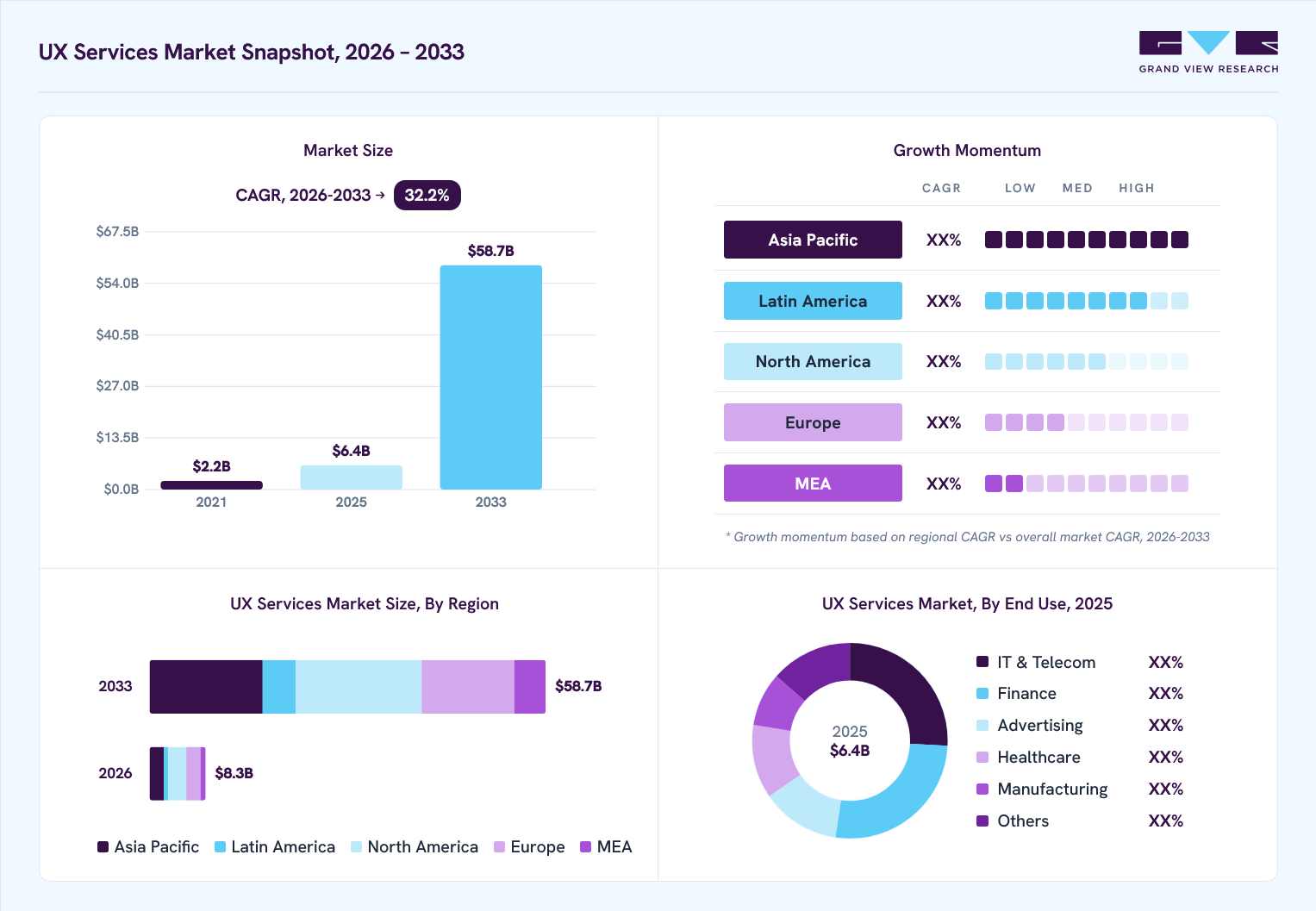
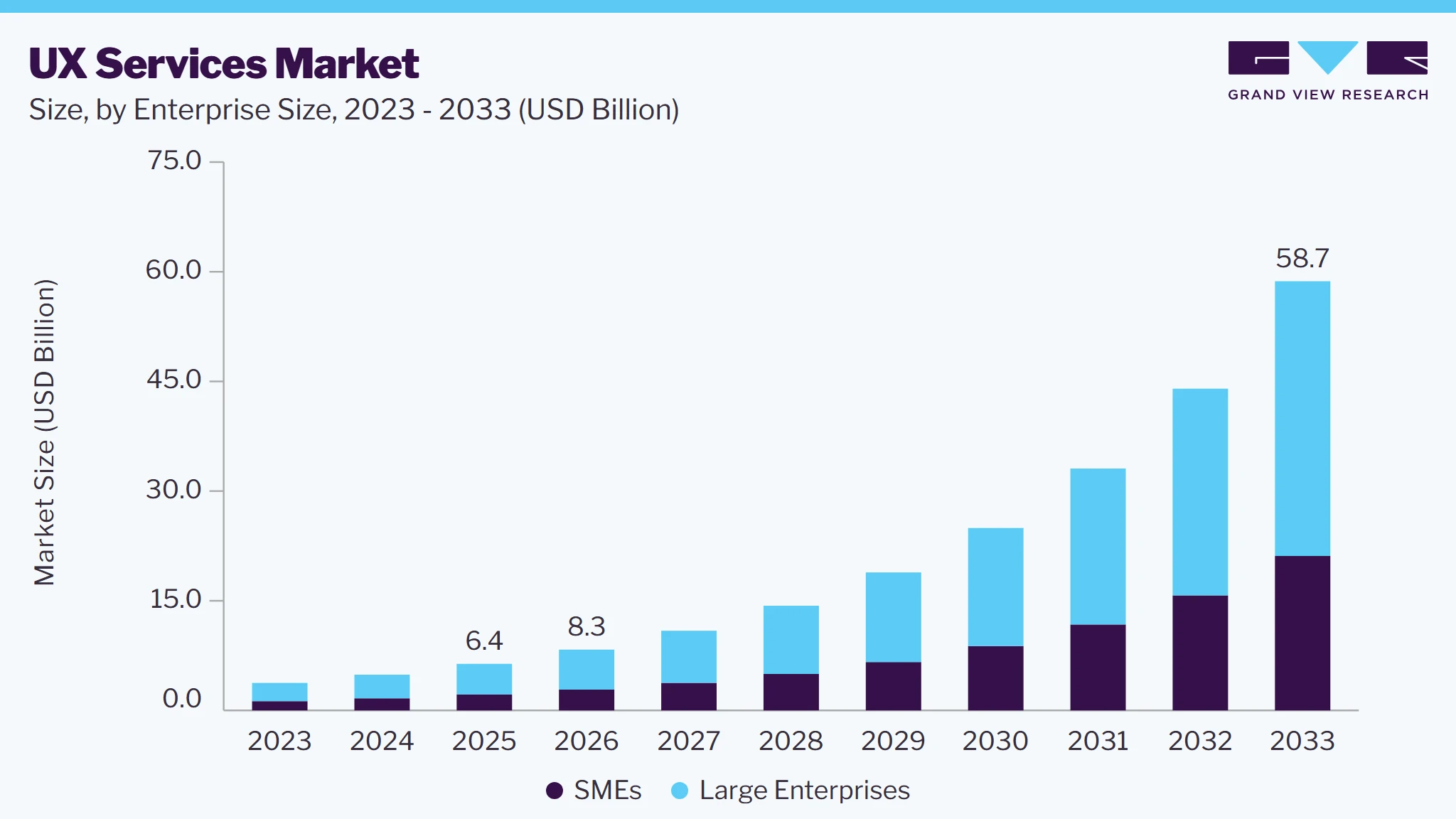
The global UX services market size was valued at USD 6.4 billion in 2025 and is projected to grow from USD 8.3 billion in 2026 to USD 58.7 billion by 2033, at a CAGR of 32.2% from 2026 to 2033. The market in North America dominated with a revenue share of 32.2% in 2025. The market is driven by accelerating digital transformation and modernization of digital products, rising demand for AI-enabled and personalized user experiences, expanding adoption of mobile and digital commerce, increasing emphasis on accessibility and inclusive design, and a growing focus on simplifying customer journeys and improving conversion, engagement, and loyalty.
 Source: Grand View Research, IR Documents, Primary Interviews, Paid DatabasesTo learn more about this report,
 Download Free Sample Report
 Key Market Trends & Insights
- By service type: UX design segment dominated the market, with a revenue share of over 30.0% in 2025.
- By enterprise size: Large enterprises segment dominated the market, with a revenue share of over 65.0% in 2025.
- By application: Web applications segment held the largest revenue share of 30.5% in 2025.
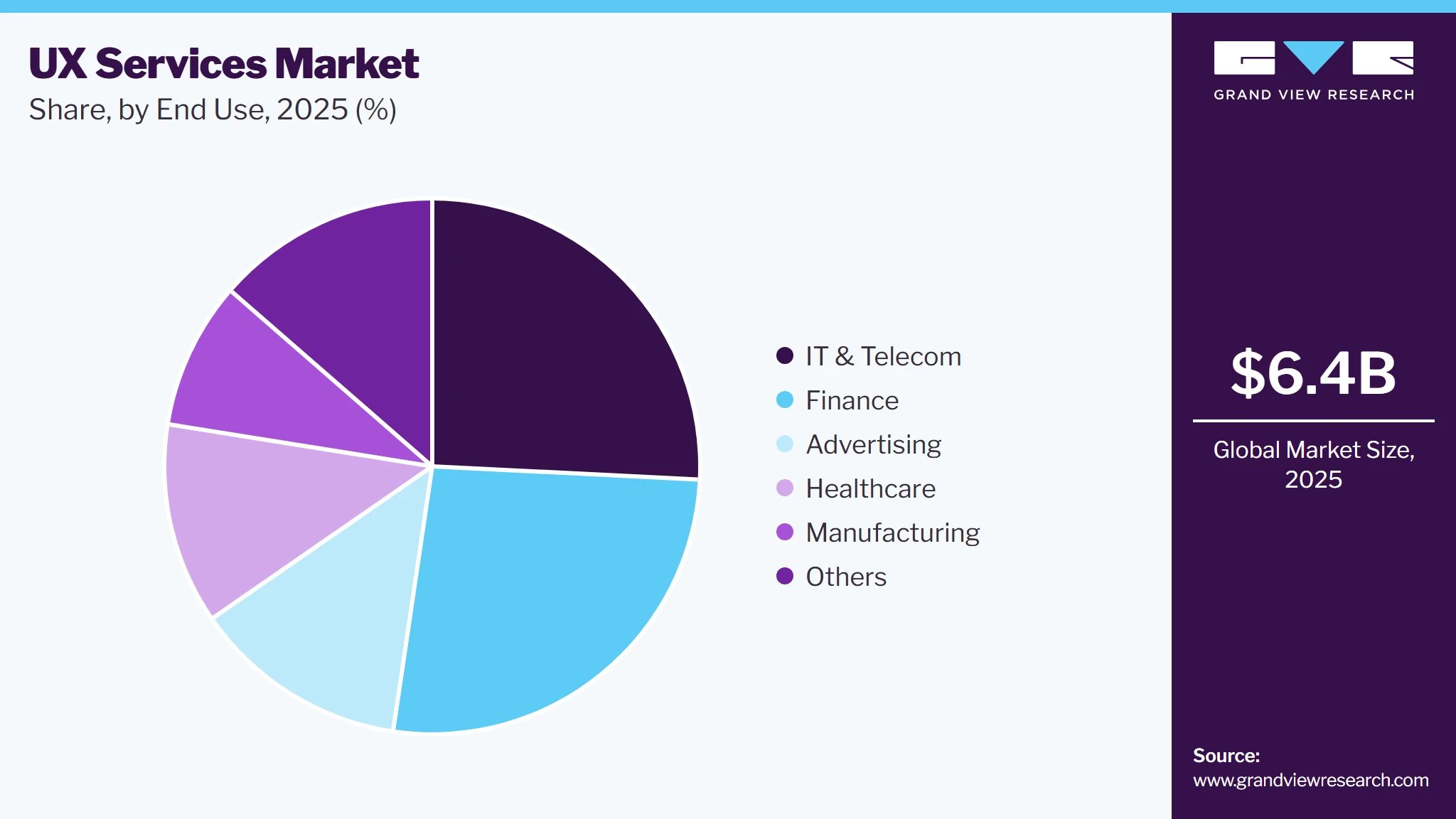
- By end use: Finance sector segment held the largest revenue share of 26.6% in 2025.
Regional Highlights
- Largest regional market: North America (32.2% revenue share, 2025)
- Fastest-growing regional market: Asia Pacific (highest CAGR, 2026-2033)
- By country: The U.S. held the largest market share in 2025
Market Size & Forecast
- Market size in 2025: USD 6.4 Billion
- Estimated market size in 2026: USD 8.3 Billion
- Projected market size by 2033: USD 58.7 Billion
- CAGR (2026-2033): 32.2%
Three ways to get this report
Buy it, customize it, or ask a question.Ask an Analyst
A direct answer, usually in 1 working day
- AccessReport author, directly
- Reply timeWithin 1 working day
- No sales callDirect answer only
- FormatEmail reply
- CostFree, no cost
Get the Full Report
What the study covers
- FormatsPDF · Excel · Dashboard
- Timeline2026–2033 annual, 2025 base
- Coverage20+ countries, 5 regions
- Companies10+ key players profiled
Customize the Report
20% free customization
- IncludeCountries, segments, points
- TailorTo your product definition
- ExtendDeeper competitor detail
- OrA fully bespoke study
- Turnaround5–10 working days
The UX services market is being propelled by the rapid adoption of AI-driven UX research, automated usability analysis, intelligent prototyping, and AI-assisted interface design to accelerate digital product development. Generative AI enables UX service providers to analyze large volumes of user feedback and behavioral data, automate repetitive design activities, and accelerate design iterations across digital products. This is driving demand for AI-powered UX design, UX research, usability testing, and experience optimization across enterprise applications, mobile platforms, software products, and e-commerce platforms. As AI becomes increasingly embedded within UX workflows, service providers are combining automation with human-centered design expertise to address personalization, accessibility, complex user journeys, and evolving digital interaction requirements. The shift toward AI-augmented delivery is therefore accelerating productivity, expanding the scope of user experience (UX) design services, and creating new opportunities for UX consulting and advanced digital experience transformation.
 To learn more about this report, Download Free Sample Report
 The rise of AI agents is accelerating the UX services market toward goal-oriented and autonomous digital experiences, enabling users to define desired outcomes rather than navigate complex workflows manually. This shift is driving demand for agentic UX design, conversational UX, human-AI interaction, AI interface design, UX research, and usability testing across enterprise software, financial applications, customer service platforms, digital commerce, and mobile applications. UX service providers are increasingly designing permissions, approval workflows, escalation mechanisms, transparency features, and error-recovery pathways to maintain user control, trust, and accountability in autonomous interactions. The growing adoption of agentic applications is also strengthening demand for UX strategy and consulting, as organizations require specialized expertise to redesign workflows, user journeys, and digital interfaces around AI-driven decision-making. As autonomous experiences gain traction, they are expanding the scope of UX design services and creating new opportunities for UX research, usability testing, and experience optimization services.
Increasing accessibility requirements and growing demand for inclusive digital experiences are making accessibility a core component of the UX services market. Organizations are increasing investment in accessible UX design, inclusive design, accessibility testing, WCAG-aligned design, UX audits, usability testing, and accessibility consulting across websites, mobile applications, software products, e-commerce platforms, and digital services. Accessibility is increasingly being integrated throughout the product-development lifecycle, rather than treated as a post-development compliance activity, strengthening its role in UX research, design, prototyping, and testing. UX service providers are consequently expanding accessibility and inclusive-design capabilities while incorporating accessibility requirements into UX strategy, user research, design systems, and experience optimization. The growing emphasis on regulatory compliance and equitable digital experiences is therefore generating sustained demand for UX audits, accessibility consulting, UX testing, and inclusive UX services across enterprises.
Market Dynamics
The UX services market is being driven by accelerating digital transformation, expanding adoption of mobile applications and digital platforms, and increasing demand for seamless, personalized, accessible, and user-centric digital experiences. The integration of generative AI, intelligent automation, conversational interfaces, multimodal interaction, and agentic experiences is expanding the scope of UX design services while increasing demand for research, design, testing, and experience optimization capabilities. Enterprises are increasingly embedding UX across web applications, mobile applications, software products, e-commerce platforms, and digital services to improve customer journeys, engagement, conversion, and retention. Growing emphasis on accessibility, inclusive design, privacy, trust, human-AI interaction, and personalization is encouraging organizations to adopt continuous UX research, prototyping, usability analysis, and customer journey management throughout the product-development lifecycle. This evolving demand is also creating opportunities for advanced mobile UX design services, particularly as businesses prioritize mobile-first experiences and seamless digital interactions. However, budget constraints, specialized talent shortages, rising delivery costs, evolving technologies, fragmented ecosystems, and integration complexity continue to influence service adoption and delivery.
The rapid adoption of generative AI, intelligent automation, conversational AI, multimodal interfaces, and agentic technologies is accelerating demand for UX services as enterprises redesign digital products around human-AI interaction and outcome-oriented experiences. Organizations are increasingly investing in AI-powered UX design, UX research, interaction design, intelligent prototyping, UX testing, usability testing, and conversational UX to ensure AI-enabled applications remain intuitive, transparent, accessible, and user-centric. The expansion of personalized recommendations, autonomous workflows, and intelligent digital assistants is broadening opportunities for UX service providers across enterprise software, web applications, mobile applications, e-commerce, financial applications, and healthcare platforms. Increasing complexity in AI experiences is also driving demand for UX strategy and consulting, UX audits, accessibility testing, inclusive design, design systems, and human-control frameworks. As enterprises accelerate AI-led digital product transformation, the integration of AI with UX research, design, testing, and experience optimization is expected to remain a major growth driver.
The limited availability of experienced UX professionals is constraining the ability of service providers to scale projects and address increasingly complex requirements across UX research, design, testing, consulting, and strategy. Rising demand for specialists in AI UX, generative AI, accessibility, inclusive design, multimodal interaction, conversational UX, agentic experiences, design systems, and human-AI interaction is intensifying competition for qualified professionals and increasing workforce costs. The shortage of professionals capable of combining design, research, technology, AI, data, and business expertise can extend project timelines and complicate large-scale digital transformation programs. Smaller agencies and specialist providers may face additional challenges in recruiting and retaining experienced UX designers, researchers, consultants, and usability specialists as larger technology and consulting firms expand their UX service portfolios. Consequently, persistent skills gaps, rising compensation requirements, and limited specialist availability could constrain the scalability of the UX services market.
Accelerating digitalization across emerging economies is creating substantial opportunities for UX service providers as organizations invest in mobile-first applications, e-commerce, fintech, healthcare, digital government, software products, and enterprise platforms. Increasing smartphone penetration, digital payments, online commerce, cloud adoption, and digital-service usage in emerging markets is driving demand for advanced mobile UX design services, localized research, usability testing, accessibility testing, and customer journey optimization. Enterprises are progressing from basic digital adoption toward personalized experiences, digital product transformation, experience optimization, inclusive design, localization, and continuous UX improvement. Providers can further capture demand by delivering region-specific research, culturally relevant design, multilingual interfaces, and accessibility-focused services tailored to local user behaviors and regulatory requirements. As emerging economies accelerate digital transformation, the expansion of localized UX design services can generate significant incremental revenue opportunities for global and regional providers.
Market Concentration & Characteristics
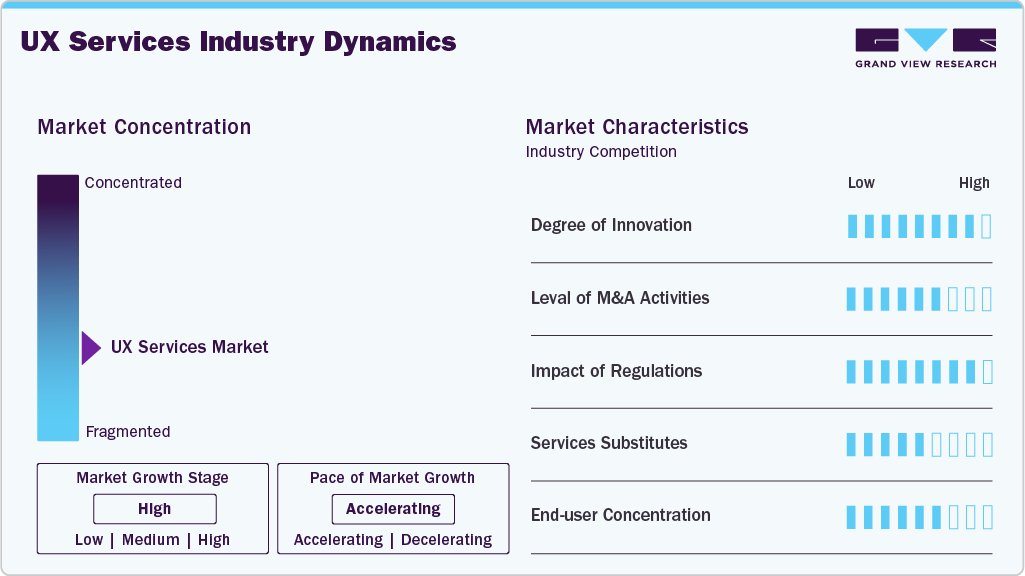
The UX services market is moderately fragmented, with global IT services and consulting firms competing alongside specialized UX agencies, digital experience providers, and independent design studios. Large technology and consulting companies benefit from extensive client relationships, global delivery capabilities, and integrated digital transformation portfolios, while specialized providers compete through domain expertise, design capabilities, and highly focused UX offerings. The market is characterized by increasing differentiation across UX research, UX design, usability testing, UX strategy and consulting, accessibility, and AI-enabled experience design. Competitive intensity is increasing as service providers expand AI capabilities, develop specialized design practices, and integrate UX services into broader digital transformation engagements.
 To learn more about this report, Download Free Sample Report
 The market is also characterized by high customization requirements and project-based service delivery, with providers adapting methodologies, design approaches, and engagement models to specific client applications and industries. Demand is increasingly shifting toward end-to-end, continuous engagements that cover research, design, testing, optimization, and experience strategy, rather than standalone design projects. Larger providers are strengthening their competitive positions through acquisitions, partnerships, global talent networks, and integrated technology capabilities, while boutique firms maintain differentiation through specialized expertise and agile delivery. As AI automates routine design activities, strategic consulting, complex UX research, human-AI interaction design, and industry-specific expertise are becoming increasingly important sources of competitive differentiation.
Analyst Perspective
The UX Services Market is evolving from a design-focused function into a strategic digital transformation capability, with enterprises increasingly linking UX investments to customer engagement and business performance. The adoption of generative AI, agentic interfaces, personalization, and multimodal experiences is expanding the scope of UX services and creating demand for specialized expertise. Large enterprises will remain key revenue contributors, while SMEs are expected to grow rapidly as outsourced and AI-assisted UX services become more accessible. North America is likely to retain its leadership, while Asia Pacific is positioned for faster growth driven by mobile digitalization, e-commerce, fintech, and AI adoption. Overall, providers with strong capabilities in UX strategy, AI-enabled design, research, testing, and accessibility are well positioned to capture rising enterprise demand.
Service Type Insights
The UX design segment dominated the market, accounting for over 30.0% of global revenue in 2025, driven by increasing enterprise investments in digital product development and modernization of web, mobile, and software interfaces. Rising demand for intuitive, visually consistent, and personalized digital experiences is encouraging organizations to strengthen UX design capabilities across customer and employee-facing applications. The expansion of AI-enabled products, e-commerce platforms, and mobile applications is further increasing the need for specialized interaction design, prototyping, and design-system development. Growing emphasis on customer engagement, usability, accessibility, and conversion is also encouraging businesses to integrate UX design more deeply into product-development and digital-transformation initiatives. As organizations increasingly link digital experience quality with business performance, demand for end-to-end UX design services is expected to remain a key contributor to market growth.
The UX strategy and consulting segment is predicted to foresee significant growth in the forecast period, owing to increasing enterprise focus on aligning digital experiences with broader business objectives and digital transformation strategies. Growing adoption of AI-enabled applications and emerging technologies is driving organizations to seek strategic UX expertise to redesign complex customer and employee journeys. Rising demand for personalized, omnichannel, and customer-centric experiences is further encouraging enterprises to invest in UX strategy and consulting services. Organizations are also increasingly integrating UX research, design, usability testing, accessibility, and journey optimization into broader transformation programs, strengthening demand for strategic advisory capabilities. As UX becomes increasingly linked to customer engagement, product adoption, conversion, and business performance, strategy and consulting services are expected to gain a larger share of enterprise UX spending.
Enterprise Size Insights
The large enterprises segment accounted for a significant market revenue share of over 65.0% in 2025, driven by the increasing adoption of large-scale digital transformation initiatives, modernization of legacy applications, and deployment of complex customer-facing digital platforms. Growing investments in AI-enabled applications, omnichannel experiences, design systems, and personalized digital journeys are encouraging large organizations to engage specialized UX service providers. The need to deliver consistent user experiences across multiple business units, geographies, and digital touchpoints is further increasing demand for enterprise-level UX research, design, testing, and consulting services. Large enterprises are also allocating greater budgets toward accessibility, usability optimization, and continuous experience improvement to strengthen customer engagement and digital adoption. Consequently, the expanding scale and complexity of enterprise digital transformation programs are expected to sustain strong demand for UX services among large organizations.
The SMEs segment is projected to grow significantly over the forecast period, driven by the increasing adoption of cloud-based software, mobile applications, e-commerce platforms, and digital customer engagement channels. Growing competition among smaller businesses is spurring investments in intuitive, differentiated digital experiences to strengthen customer acquisition and retention. The availability of cost-effective UX tools, outsourced design services, and flexible engagement models is further enabling SMEs to access specialized UX capabilities without maintaining large in-house teams. The increasing adoption of AI-assisted design and usability testing is also reducing the time and cost associated with UX development, making advanced services more accessible to smaller organizations. Consequently, the growing emphasis on digital presence, customer experience, and cost-efficient product development is expected to accelerate the adoption of UX services among SMEs.
Application Insights
The web applications segment accounted for a significant market revenue share of over 30.0% in 2025, supported by the widespread adoption of web-based digital platforms across enterprises, increasing migration from legacy systems to modern web applications, and growing demand for seamless online customer experiences. The expansion of e-commerce, digital banking, SaaS platforms, and enterprise portals is further driving organizations to invest in intuitive and responsive web interfaces. Rising demand for personalized, accessible, and cross-device experiences is encouraging businesses to continuously enhance the usability and functionality of web applications. The increasing integration of AI-powered features, real-time personalization, and interactive capabilities is also creating additional requirements for UX research, design, and usability testing. Consequently, the continued expansion and modernization of web-based digital ecosystems are expected to sustain strong demand for UX services for web applications.
The mobile applications segment is projected to experience substantial growth, owing to the rapid expansion of smartphone adoption, increasing reliance on mobile-first digital services, and growing demand for seamless and personalized mobile experiences. The proliferation of mobile banking, e-commerce, healthcare, entertainment, and on-demand applications is encouraging businesses to continuously improve interface usability and customer journeys. Rising expectations for faster navigation, intuitive interfaces, personalization, and cross-device consistency are further driving investments in mobile UX research, design, and usability testing. The integration of AI-powered recommendations, voice interfaces, biometric authentication, and location-based functionality is also increasing the complexity of mobile experiences and strengthening demand for specialized UX services. Consequently, the continued expansion of mobile digital ecosystems is expected to accelerate UX services adoption across mobile applications.
End Use Insights
The finance segment accounted for the largest market revenue share of over 26.0% in 2025, driven by the rapid digitization of banking and financial services, increasing adoption of mobile banking and fintech platforms, and growing demand for seamless digital customer journeys. Rising competition among financial institutions is encouraging investments in intuitive interfaces, personalized experiences, and simplified digital transactions to improve customer acquisition and retention. The increasing integration of AI, digital payments, wealth-management platforms, and self-service banking is further expanding the need for UX research, design, usability testing, and continuous experience optimization. Growing regulatory and accessibility requirements are also encouraging financial institutions to strengthen usability, transparency, and inclusive design across digital channels. Consequently, the continued transformation of financial services and increasing emphasis on customer-centric digital experiences are expected to sustain strong demand for UX services in the finance sector.
 To learn more about this report, Download Free Sample Report
 The healthcare segment is expected to experience substantial growth during the forecast period, driven by the rapid digitization of healthcare services, increasing adoption of telehealth and patient-facing applications, and growing demand for intuitive digital healthcare experiences. The expansion of electronic health records, patient portals, remote-care platforms, and digital health applications is increasing the need for user-centric interface design and simplified patient journeys. The rising emphasis on accessibility, usability, and the secure handling of sensitive health information is further encouraging healthcare organizations to invest in specialized UX research, design, and usability testing. The integration of AI-enabled diagnostics, personalized care platforms, and digital health tools is also driving demand for UX services that translate complex technologies into accessible, intuitive experiences. Consequently, continued digital transformation in healthcare and an increasing focus on patient-centric technology adoption are expected to accelerate demand for UX services across the healthcare sector.
Regional Insights
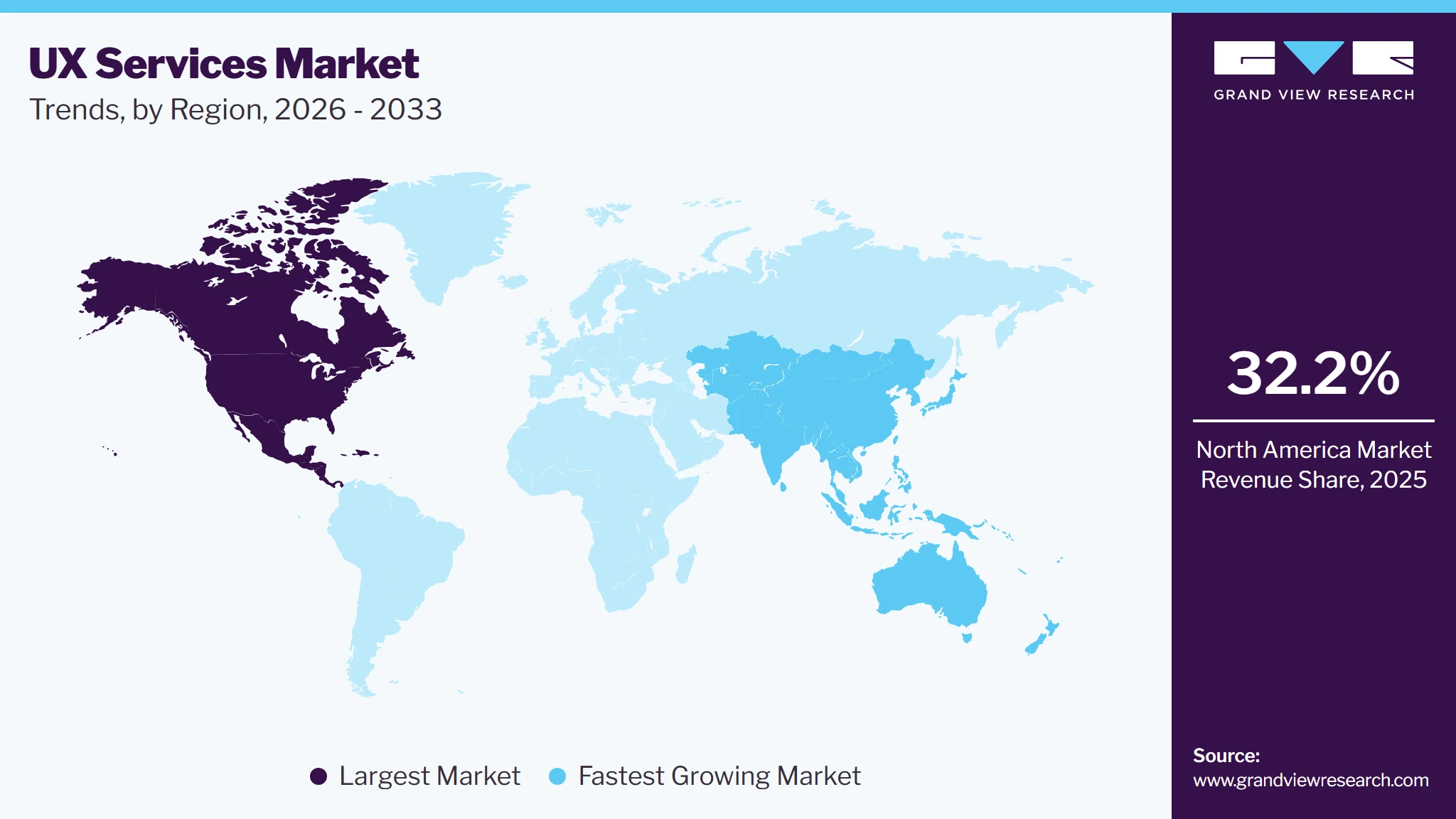
North America UX services market accounted for the largest revenue share of 32.2% in 2025, driven by rapid digital transformation, high enterprise technology spending, and strong adoption of AI-enabled digital experiences. The region’s mature software, e-commerce, financial services, healthcare, and technology sectors are increasing demand for UX research, design, usability testing, and experience optimization. Rising investment in personalized, accessible, and AI-driven digital products is expected to further strengthen demand for UX services across the region.
 To learn more about this report, Download Free Sample Report
 U.S. UX Services Market Trends
The U.S. UX services market is being propelled by rapid digital transformation, widespread AI adoption, and sustained enterprise investment in digital product development. Strong demand across technology, financial services, healthcare, retail, and e-commerce is driving higher spending on UX research, UX design, usability testing, and experience optimization. The growing need for personalized, accessible, and seamless digital experiences is further accelerating the adoption of UX services across U.S. enterprises.
Europe UX Services Market Trends
The Europe UX services market is witnessing robust growth, driven by rapid digital transformation, increasing adoption of AI-enabled technologies, and growing emphasis on customer-centric digital experiences. Strong demand across financial services, healthcare, retail, automotive, and technology sectors is driving investment in UX research, design, usability testing, and accessibility. Increasing regulatory focus on digital accessibility, privacy, and inclusive design is further accelerating the adoption of UX services across European enterprises.
Asia Pacific UX Services Market Trends
The Asia Pacific UX services market is expected to grow at the fastest CAGR over the forecast period, driven by accelerating smartphone penetration, mobile-first digital adoption, expanding e-commerce and digital payments, and rapid growth of digital services across emerging economies. Increasing adoption of super apps, fintech platforms, and mobile commerce is driving demand for localized UX design, usability testing, and seamless mobile experiences. The region’s expanding digital consumer base and rising enterprise investment in AI-enabled and personalized applications are further accelerating UX services adoption.
Key UX Services Company Insights
Some key companies in the UX services industry are Accenture PLC, IBM Corporation, Tata Consultancy Services Limited, Capgemini SE, Cognizant Technology Solutions Corporation. and among others.
-
IBM offers UX and experience-design services through IBM iX, combining strategy, design, technology, data, and AI to transform customer and employee experiences. Its capabilities include UX research, UX design, prototyping, product and service design, UX audits, usability testing, and design-system consulting. The integration of human-centered design with AI and digital engineering gives IBM a strong position in enterprise UX transformation.
-
TCS provides experience strategy, service design, digital experience, customer-journey optimization, and technology implementation services through its customer-experience and interactive practices. Its offerings combine design, technology, analytics, and strategy to create and optimize digital products and experiences across multiple channels. The company's global delivery capabilities and broad industry expertise support large-scale UX and digital-experience engagements.
Key UX Services Market Company
The following key companies have been profiled for this study on the UX services market.
-
Accenture PLC
-
IBM Corporation
-
Tata Consultancy Services Limited
-
Capgemini SE
-
Cognizant Technology Solutions Corporation
-
EPAM Systems Inc.
-
Globant SA
-
Publicis Sapient
-
IDEO LLC
-
Frog Design Inc.
-
Designit A/S
-
UserTesting Inc.
Competitive Benchmarking
Operating Strategies
Competitive Edge
Weaknesses
Mature Players: Accenture PLC, IBM Corporation, Tata Consultancy Services (TCS), Capgemini SE, Cognizant Technology Solutions
- Mature players focus on expanding end-to-end UX capabilities across UX research, design, usability testing, digital experience transformation, UX strategy, and AI-enabled experience design through large enterprise engagements.
- Their competitive advantage lies in extensive global delivery networks, established enterprise relationships, multidisciplinary consulting capabilities, broad technology portfolios, and the ability to integrate UX services with large-scale digital transformation programs.
- These companies face challenges related to higher operating costs, complex organizational structures, longer project cycles, and competition from specialized UX firms offering more focused and agile services.
Emerging Players: EPAM Systems Inc., Globant SA, Publicis Sapient, IDEO LLC, Frog Design Inc., Designit A/S, UserTesting Inc.
- Emerging players focus on specialized UX design, digital product engineering, experience strategy, user research, usability testing, service design, and AI-enabled experience solutions to capture growing demand for specialized digital experiences.
- Their strengths include specialized design expertise, agile delivery models, strong innovation capabilities, customer-centric methodologies, and the ability to address complex UX requirements with focused service offerings.
- Smaller scale compared with global IT service providers, limited geographic coverage in some markets, dependence on project-based engagements, and increasing competition from large integrated consulting firms may constrain expansion.
Recent Developments
-
In March 2026, Google launched an enhanced version of Stitch, an AI-native software design canvas that enables users to create, iterate, and collaborate on high-fidelity UI designs using natural-language prompts. The platform introduces AI-assisted design agents, interactive prototyping, real-time design critiques, and user-journey development, directly supporting key activities within UX design services. The launch highlights the growing integration of generative AI into UX workflows and the shift toward faster, AI-assisted UI design and prototyping
-
In March 2026, UserTesting introduced an expanded approach to UX research for AI, moving beyond traditional usability metrics to evaluate trust, transparency, consistency, emotional responses, and perceived user control. The development incorporates behavioral analysis, emotional-response tracking, and evaluation of AI outputs to assess how users interact with and perceive AI-powered experiences. This strengthens UserTesting’s UX research and usability-testing services for AI-enabled products and reflects the growing need for specialized human-centered AI evaluation.
UX Services Market Report Scope
Report Attribute
Details
Market size in 2025
USD 6.4 billion
Estimated market size in 2026
USD 8.3 billion
Projected market size by 2033
USD 58.7 billion
Growth rate
CAGR of 32.2% from 2026 to 2033
Base year for estimation
2025
Actual data
2021 - 2024
Forecast period
2026 - 2033
Quantitative units
Revenue in USD million/million and CAGR from 2026 to 2033
Report coverage
Revenue forecast, company ranking, competitive landscape, growth factors, and trends
Segments covered
Service type, enterprise size, application, end use, and regional.
Regional scope
North America; Europe; Asia Pacific; Latin America; MEA
Country scope
U.S.; Canada; Mexico; UK; Germany; France; China; Japan; India; South Korea; Australia; Brazil; KSA; UAE; South Africa
Key companies profiled
Accenture PLC; IBM Corporation; Tata Consultancy Services Limited; Capgemini SE; Cognizant Technology Solutions Corporation; EPAM Systems Inc.; Globant SA; Publicis Sapient; IDEO LLC; Frog Design Inc.; Designit A/S; UserTesting Inc.
Customization scope
Free report customization (equivalent up to 8 analysts working days) with purchase. Addition or alteration to country, regional & segment scope.
Pricing and purchase options
Avail customized purchase options to meet your exact research needs. Explore purchase options
Global UX Services Market Report Segmentation
This report forecasts revenue growth at global, regional, and country levels and provides an analysis of the latest industry trends in each of the sub-segments from 2021 to 2033. For this study, Grand View Research has segmented the global UX services market report based on service type, enterprise size, application, end use, and region.
-
Service Type Outlook (Revenue, USD Million, 2021 - 2033)
-
UX Research
-
UX Design
-
UX Audit
-
UX Training
-
UX Strategy and Consulting
-
UX Testing & Usability Testing
-
Others
-
-
Enterprise Size Outlook (Revenue, USD Million, 2021 - 2033)
-
SMEs
-
Large Enterprises
-
-
Application Outlook (Revenue, USD Million, 2021 - 2033)
-
Web Applications
-
Mobile Applications
-
Software Products
-
E-commerce Platforms
-
Others
-
-
End Use Outlook (Revenue, USD Million, 2021 - 2033)
-
IT & Telecom
-
Finance
-
Advertising
-
Healthcare
-
Manufacturing
-
Others
-
-
Regional Outlook (Revenue, USD Million, 2021 - 2033)
-
North America
-
U.S.
-
Canada
-
Mexico
-
-
Europe
-
UK
-
Germany
-
France
-
-
Asia Pacific
-
China
-
Japan
-
India
-
South Korea
-
Australia
-
-
Latin America
-
Brazil
-
Middle East and Africa (MEA)
-
KSA
-
UAE
-
South Africa
-
-
Research Methodology
The UX services market figures in this report are based on a proven research process that combines executive interviews with secondary research from proprietary databases, company filings, and recognized regulatory and institutional sources. Market size is built through value-chain sizing-reconciling supply-side and demand-side estimates-and triangulated with bottom-up and top-down approaches. Every estimate passes multiple levels of expert validation before publication, with each UX services segment quantified using the revenue-capture definitions in the table below.
Segment Definition
Service Type
Revenue capture definition
UX Research
The segment covers services focused on understanding user needs, behaviors, preferences, motivations, and pain points through qualitative and quantitative research methods. This segment includes user interviews, surveys, field studies, persona development, journey research, and behavioral analysis.
UX Design
The segment focuses on creating and refining the structure, interaction, navigation, and visual elements of digital products to improve the overall user experience. This segment covers wireframing, prototyping, interaction design, interface design, information architecture, and design-system development.
UX Audit
The segment involves evaluating an existing digital experience to identify usability gaps, accessibility issues, navigation problems, and opportunities for improvement. This segment typically incorporates heuristic evaluations, interface reviews, accessibility assessments, and actionable improvement recommendations.
UX Training
The segment comprises educational and capability-building services designed to strengthen UX knowledge and practical skills among employees and professionals. This segment includes workshops, structured courses, design-thinking programs, tool training, and methodology-based learning.
UX Strategy and Consulting
The segment represents advisory services that connect user-experience initiatives with product objectives, customer needs, and broader business strategies. This segment spans experience strategy, service design, customer-journey optimization, digital transformation advisory, and UX governance.
UX Testing & Usability Testing
The segment assesses how effectively users interact with a digital product, interface, or workflow under defined testing conditions. This segment includes usability studies, user validation, A/B testing, accessibility testing, task-based evaluations, and other experience-performance assessments.
Others
The segment captures specialized UX activities that fall outside the primary research, design, audit, training, consulting, and testing categories. This segment may include UX operations, UX content, experience optimization, and other emerging or niche services.
Enterprise Size
Revenue capture definition
SMEs
The segment represents UX service demand generated by small and medium-sized organizations seeking to develop, enhance, or optimize their digital products and customer experiences. This segment commonly includes outsourced UX projects, targeted design engagements, and flexible consulting assignments undertaken within comparatively smaller organizational structures.
Large Enterprises
The segment comprises organizations with extensive operations, larger employee bases, multiple business units, and broad digital ecosystems that require enterprise-scale UX capabilities. This segment encompasses large transformation programs, multi-product design initiatives, global experience standardization, and continuous UX optimization.
Application
Revenue capture definition
Web Applications
The segment covers browser-based digital applications developed to support business, productivity, communication, information, and service-related activities. This segment includes UX work for enterprise portals, SaaS interfaces, customer platforms, and other non-commerce web applications.
Mobile Applications
The segment comprises applications primarily designed for smartphones and tablets, where navigation, interaction, performance, and screen-level usability are optimized for mobile environments. This segment includes consumer, enterprise, financial, healthcare, entertainment, and other mobile experiences, excluding applications classified specifically as e-commerce platforms.
Software Products
The segment captures UX services associated with packaged, SaaS, enterprise, desktop, and other software offerings in which software functionality represents the primary purpose. This segment addresses product usability, workflows, interfaces, information architecture, and interaction patterns across software environments.
E-commerce Platforms
The segment refers to digital commerce environments designed primarily to facilitate product discovery, online transactions, payments, and purchasing activities. This segment includes online marketplaces, digital storefronts, shopping platforms, product pages, checkout journeys, and post-purchase experiences irrespective of whether they operate through web or mobile channels.
Others
The segment includes digital interfaces and experiences that cannot be classified within the primary application categories above. This segment covers kiosks, wearables, connected-device interfaces, automotive systems, digital signage, and other specialized user environments.
End Use
Revenue capture definition
IT & Telecom
The segment reflects UX service demand from technology, software, cloud, telecommunications, and IT-enabled businesses seeking to improve digital products and customer interfaces. This segment covers enterprise software, telecom applications, cloud platforms, technology portals, and other technology-driven experiences.
Finance
The segment encompasses financial institutions and technology-enabled financial businesses that require intuitive and secure digital interactions across their service portfolios. This segment includes banking applications, fintech platforms, payment interfaces, insurance portals, investment services, and wealth-management experiences.
Advertising
The segment captures UX requirements arising from advertising, marketing, media, and digital communications businesses focused on improving audience interaction with digital campaigns and platforms. This segment covers advertising interfaces, marketing platforms, campaign experiences, digital content environments, and customer-engagement touchpoints.
Healthcare
The segment represents UX applications across healthcare delivery, digital health, pharmaceuticals, medical technology, and related services where usability is critical to patient and professional interactions. This segment includes telehealth platforms, patient portals, healthcare applications, medical interfaces, and digital care journeys.
Manufacturing
The segment covers UX requirements within industrial and manufacturing environments where employees, operators, customers, or engineers interact with digital systems and connected equipment. This segment includes industrial software, machine interfaces, manufacturing platforms, connected-device applications, and enterprise operational systems.
Others
The segment accounts for UX service demand originating from industries outside the five primary end-use categories. This segment includes retail, education, automotive, travel and tourism, hospitality, government, media, and other sectors adopting digital products and services.
Estimation Model
Layer Name
Key Questions
Description
Digital Experience Demand Layer
Who creates demand for UX services?
Identify organizations investing in digital products, applications, e-commerce, and customer experience. This layer assesses digital transformation and modernization activities driving UX demand.
UX Investment Layer
Who invests in UX capabilities?
Assess spending on UX research, design, testing, accessibility, and experience optimization. This layer determines the portion of digital investments allocated to UX activities.
UX Service Adoption Layer
Which UX services are adopted?
Measure adoption of UX research, design, audit, training, strategy, consulting, and usability testing. This layer evaluates adoption across applications, industries, enterprise sizes, and engagement models.
UX Services Revenue Realization Layer
How much revenue is generated from UX services?
Estimate revenue captured by UX service providers across service types, applications, industries, enterprise sizes, and regions. This layer establishes the final market revenue pool.
Customization Table
Client Request
Customization Delivered
Value Adds
UX Service & Capability Landscape Assessment
Analyzed UX research, UX design, UX audit, UX training, UX strategy and consulting, and UX testing & usability testing across key markets and service providers.
Helps identify high-value service areas, competitive positioning, capability gaps, and opportunities for portfolio expansion within the UX services market.
Application-Specific UX Demand Analysis
Assessed UX service adoption across web applications, mobile applications, software products, e-commerce platforms, and other digital interfaces.
Provides insights into application-level demand, evolving user-experience requirements, technology adoption, and growth opportunities to support service prioritization and market expansion.
Industry & Enterprise UX Adoption Assessment
Evaluated UX service demand across IT & Telecom, Finance, Advertising, Healthcare, Manufacturing, and other industries, with separate analysis of SMEs and large enterprises.
Supports identification of high-potential customer segments, industry-specific UX requirements, enterprise spending patterns, and targeted go-to-market strategies.
Frequently Asked Questions About This Report
Asia Pacific is the fastest-growing region over the forecast period.
The large enterprises segment led with a 65.9% revenue share in 2025, while the SMEs segment is the fastest-growing.
The global UX services market size was valued at USD 6.4 billion in 2025 and is estimated at USD 8.3 billion for 2026.
The global UX services market is expected to grow at a CAGR of 32.2% from 2026 to 2033, reaching USD 58.7 billion by 2033.
The UX design segment led with over 30.0% revenue share in 2025, while UX strategy and consulting is the fastest-growing segment.
North America dominated the market, with over 32.0% of revenue in 2025, driven by rapid digital transformation and strong demand for personalized, user-centric digital experiences.
Key factors driving the UX services market growth include rapid digital transformation, increasing adoption of digital products and mobile applications, growing demand for personalized and user-centric experiences, rising integration of AI and other emerging technologies, and a growing focus on accessibility and inclusive design.
Some key players operating in the UX services market include Accenture PLC, IBM Corporation, Tata Consultancy Services Limited, Capgemini SE, Cognizant Technology Solutions Corporation, EPAM Systems Inc., Globant SA, Publicis Sapient, IDEO LLC, Frog Design Inc., Designit A/S, UserTesting Inc.,
The web applications segment led with over 30.0% of revenue in 2025, while mobile applications were the fastest-growing segment.
The finance segment led with over 26.0% revenue share in 2025, while healthcare is the fastest-growing segment.
About the Author(s)
IT Services & Applications Research Team
Technology · IT Services & ApplicationsThis report was authored by the it services & applications research team at Grand View Research - comprising two research analysts, one senior research analyst, and one industry expert - with specialized expertise in the it services & applications segment of the technology industry. All findings are based on proprietary technology databases, executive interviews, and regulatory analysis, subject to internal peer review prior to publication.
Last Updated:
Speak to Analyst

Customize this report to your needs - add regions, segments, or data points, with 20% free customization.
Or view our licence options:


ISO 9001:2015 & 27001:2022 Certified
We are GDPR and CCPA compliant! Your transaction & personal information is safe and secure. For more details, please read our privacy policy.


