
- Home
- »
- Automotive & Transportation
- »
-
Van Market Size, Share, Growth & Trends Report, 2026-2033GVR Report cover

Van Market (2026 - 2033)
Size, Share & Trends Analysis Report By Tonnage Capacity (Up To 2 Tons, 2 To 3 Tons, 3 To 5.5 Tons), By Propulsion (Electric, Hybrid, Internal Combustion Engine), By End Use (Commercial, Personal), By Region, And Segment Forecasts
Market Size, 2025
$169.6BMarket Estimate, 2026
$178.5BMarket Forecast, 2033
$262.6BCAGR, 2026–2033
5.7%Van Market Summary
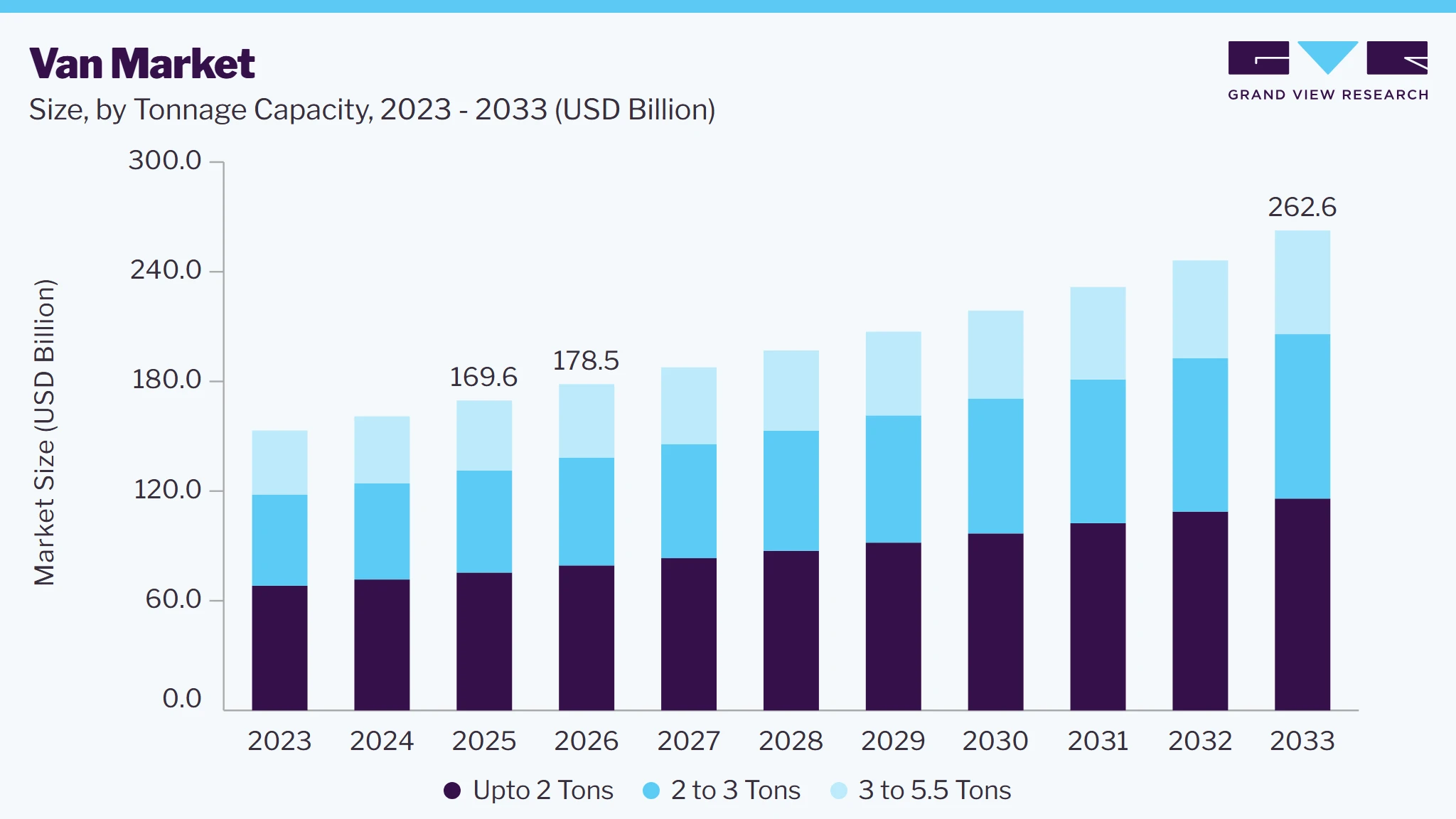
The global Van market size was valued at USD 169.6 billion in 2025 and is projected to grow from USD 178.5 billion in 2026 to USD 262.6 billion by 2033, at a CAGR of 5.7% from 2026 to 2033. The market in North America dominated with a revenue share of 32.5% in 2025. The market’s growth is driven by several factors, including the boom in e-commerce and last-mile delivery and the shift toward electric vans.
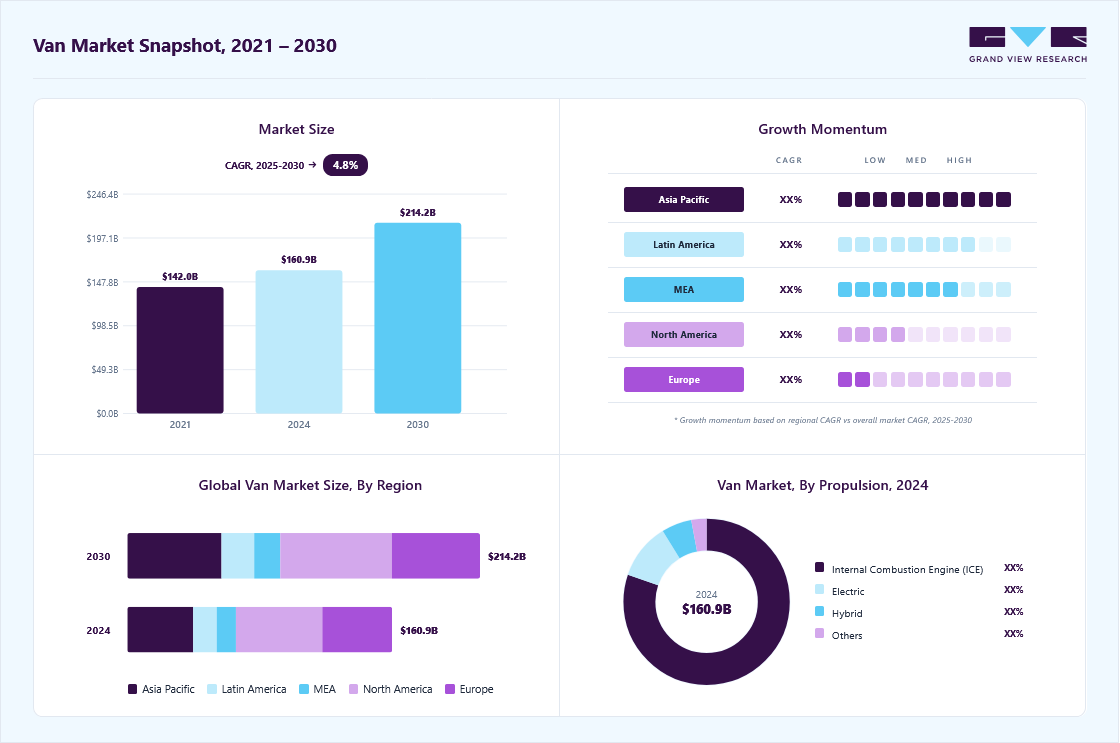 Source: Grand View Research, IR Documents, Primary Interviews, Paid DatabasesTo learn more about this report,
 Download Free Sample Report
 Key Market Trends & Insights
- By tonnage capacity: Up to 2 Tons segment held the largest market share of 44.5% in 2025.
- By propulsion: Internal combustion engine (ICE) segment held the largest market share of 79.7% in 2025.
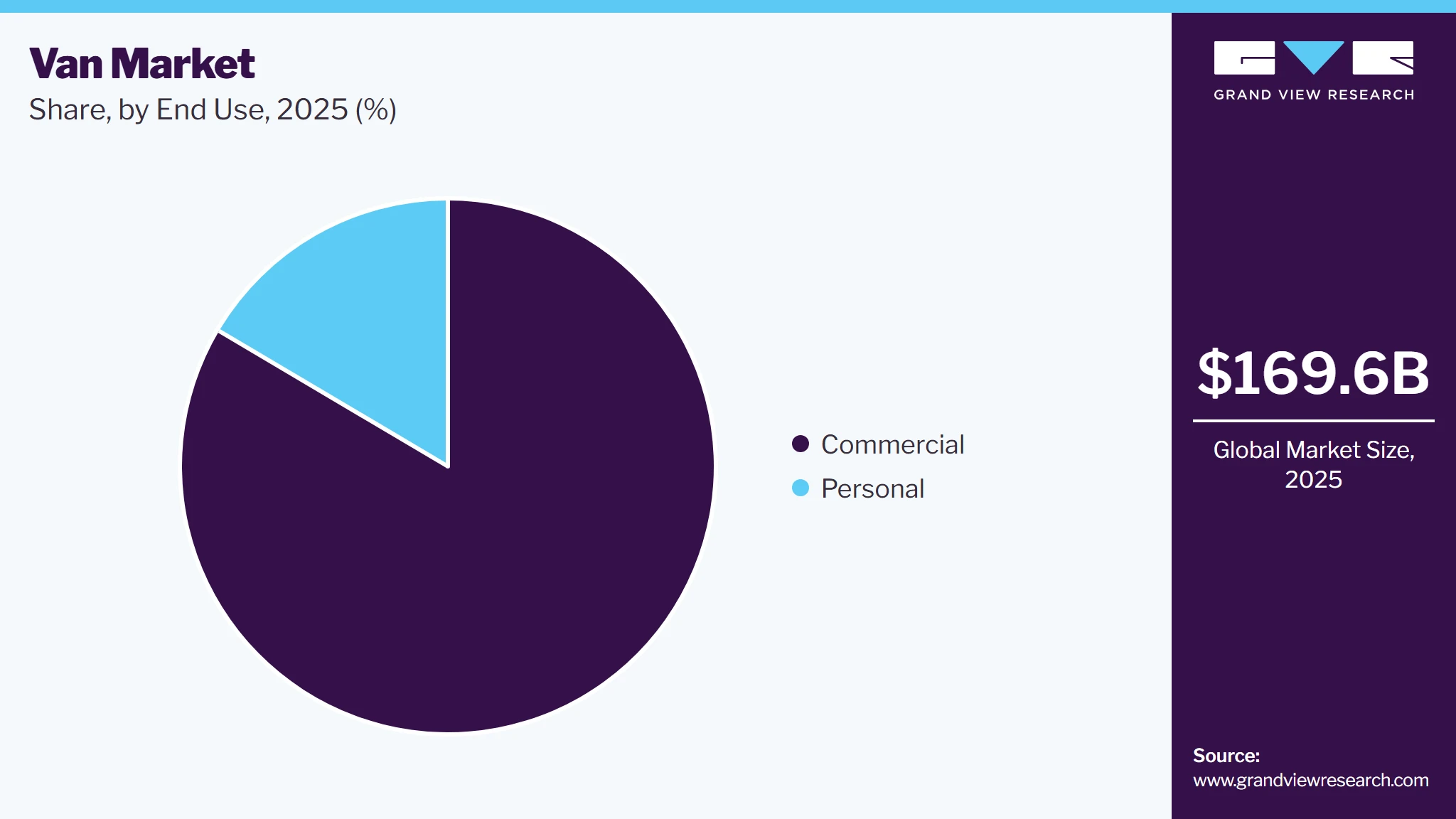
- By end use: Commercial segment held the largest market share of 83.5% in 2025.
Regional Highlights
- Largest regional market: North America (32.5% revenue share, 2025)
- Fastest-growing regional market: Asia Pacific (highest CAGR, 2026-2033)
- By country: U.S. held the largest market share in 2025.
Market Size & Forecast
- Market size in 2025: USD 169.6 Billion
- Estimated market size in 2026: USD 178.5 Billion
- Projected market size by 2033: USD 262.6 Billion
- CAGR (2026-2033): 5.7%
Three ways to get this report
Buy it, customize it, or ask a question.Ask an Analyst
Analyst response in 1 business day
- AccessReport author, directly
- Reply timeWithin 1 working day
- No sales callDirect answer only
- FormatEmail reply
- CostFree, no cost
Get the Full Report
What the study covers
- FormatsPDF · Excel · Dashboard
- Timeline2026–2033 annual, 2025 base
- Coverage20+ countries, 5 regions
- Companies10+ key players profiled
Customize the Report
20% free customization
- IncludeCountries, segments, points
- TailorTo your product definition
- ExtendDeeper competitor detail
- OrA fully bespoke study
- Turnaround5–10 working days
Compact and versatile vans are increasingly preferred for urban freight transport and shared mobility applications due to their fuel efficiency and maneuverability. Moreover, infrastructure development in emerging markets, such as the expansion of road networks and industrialization in regions such as Asia Pacific and Latin America, are boosting van sales for commercial applications. The rising preference for electric vans is driving the growth of the global van industry as businesses and governments prioritize sustainability and carbon emission reduction. According to the European Automobile Manufacturers’ Association (ACEA), in 2023, electric van sales surged by 56.8% in the European Union (EU) from 2022. Regulatory policies, subsidies, and incentives for electric vehicles (EVs) have encouraged fleet operators to adopt electric vans, particularly in the logistics and delivery sectors. Additionally, advancements in battery technology and the expansion of charging infrastructure have improved the affordability and practicality of electric vans. These factors, combined with rising fuel costs and increasing awareness of environmental impacts, are accelerating the transition to electric vans globally.The growing demand for urban mobility solutions is propelling the global van industry’s growth as cities increasingly prioritize efficient and compact transportation for goods and passengers. Vans, particularly those with smaller tonnage capacities, are ideal for navigating congested urban environments and meeting the needs of last-mile delivery, ride-sharing, and on-demand services. Rising e-commerce activities and the need for flexible logistics solutions further amplify this demand. Additionally, urban-focused policies promoting sustainable transportation are encouraging the adoption of eco-friendly vans, including electric and hybrid models.
 To learn more about this report, Download Free Sample Report
 Technological advancements are driving the growth of the global market by enhancing vehicle efficiency, safety, and connectivity. Features like telematics, driver assistance systems, and IoT-enabled monitoring improve fleet management and reduce operational costs, making vans more appealing to businesses. In October 2023, Amazon.com, Inc. implemented AI-powered Automated Vehicle Inspection (AVI) technology to enhance the safety and efficiency of its delivery van fleet. By conducting rapid, detailed scans of vans, AVI identifies issues like tire deformities, undercarriage wear, and body damage in seconds, helping Delivery Service Partners (DSPs) prevent on-road problems, improve van safety, and minimize delivery delays for customers.
Customization for business needs is trending in the global van industry as businesses increasingly demand tailored solutions to meet their specific operational requirements. Vans are being designed with modular interiors, specialized storage compartments, and custom features to support industries like logistics, healthcare, retail, and construction. This adaptability enhances efficiency and functionality, making vans an ideal choice for small and medium enterprises (SMEs) and niche service providers. The growing emphasis on purpose-built vehicles is also encouraging manufacturers to offer more flexible and scalable van models.
Market Dynamics
The van market is shaped by structural shifts in urban logistics, expanding requirements for small-business mobility, and regulatory emphasis on emissions reduction. Growth is supported by rising last-mile delivery volumes, fleet modernization initiatives, and advancements in vehicle electrification and connectivity. OEMs are increasingly focusing on modular vehicle platforms, enhanced payload efficiency, and digital fleet management integration. At the same time, cost pressures, infrastructure readiness, and regulatory divergence across regions continue to influence adoption patterns. Moreover, the market is moving toward more efficient, purpose-built, and technology-enabled van solutions.
The expansion of e-commerce, on-demand services, and organized retail distribution has significantly increased the volume and frequency of urban freight movement. Vans are increasingly preferred for city logistics due to their maneuverability, payload flexibility, and ability to operate within congestion and access-restricted zones. Businesses across retail, food delivery, healthcare distribution, and parcel logistics rely on vans to meet tight delivery timelines while maintaining operational efficiency. This structural reliance on vans has positioned them as a critical asset in urban supply chains.
Van manufacturers are responding by offering optimized cargo configurations, higher payload-to-size ratios, and enhanced fuel efficiency across tonnage classes. Integration of telematics, route optimization, and driver-assist features has improved fleet utilization and reduced operating costs for logistics operators. These enhancements directly align van capabilities with last-mile operational requirements, accelerating procurement cycles and supporting sustained market growth.
The total cost of ownership for vans, particularly electric and technology-equipped models, remains a key restraint for widespread adoption. Higher upfront vehicle prices, battery costs, and investments in charging or maintenance infrastructure create financial barriers for small and medium fleet operators. Additionally, uncertainty in residual value for newer propulsion technologies affects purchasing confidence across several markets.
This restraint disproportionately affects price-sensitive segments, such as small commercial fleets and emerging economies, where access to financing is limited. Regions with underdeveloped charging or service infrastructure face slower adoption of advanced vans, constraining market expansion. As a result, procurement cycles are extended, and fleet upgrades are delayed, moderating overall growth momentum.
Stricter emission regulations, urban low-emission zones, and government incentives are creating a favorable environment for electric and hybrid vans. Municipal mandates and corporate sustainability commitments are accelerating the transition of delivery and service fleets toward cleaner propulsion systems. Technological improvements in battery density, charging speed, and vehicle range are further enabling this shift.
OEMs with scalable electric platforms and strong regional partnerships are well positioned to capture this opportunity. Light- and medium-tonnage vans used in urban and regional delivery represent the highest near-term growth potential. Vendors offering integrated vehicles, charging, and fleet management solutions are expected to gain a competitive advantage as electrification adoption deepens.
Analyst Perspective
The van market is currently in a transition phase, driven by logistics demand expansion and regulatory pressure for cleaner mobility. Electrification, connectivity, and modular vehicle architecture are reshaping competitive dynamics and product strategies. Investment activity is increasingly directed toward electric platforms, digital fleet solutions, and regional manufacturing localization. Established OEMs are strengthening partnerships and expanding electric portfolios, while competitive intensity is rising in urban delivery segments. Over the medium term, technology differentiation and cost optimization will be critical to sustaining market leadership.
Tonnage Capacity Insights
Based on tonnage capacity, the up to 2 Tons segment led the market with the largest revenue share of 44.5% in 2025. The segment's growth is driven by the rising demand for compact, fuel-efficient, and cost-effective vehicles, especially for last-mile delivery and urban logistics. These vans are ideal for navigating congested city streets and offer businesses the flexibility to transport smaller loads efficiently. Additionally, the growth of e-commerce and same-day delivery services has significantly increased the need for lightweight vans in logistics operations. Their lower operating costs and versatility make them a preferred choice for small and medium enterprises (SMEs) and service-based industries.
The 2 to 3 tons segment is expected to grow at the fastest CAGR during the forecast period. The segment's growth is driven by the increasing need for medium-duty vans that provide a greater payload capacity while still being versatile enough for urban and regional logistics. Unlike the up to 2 tons segment, this category caters to businesses that require a higher load capacity for more diverse applications, such as bulk deliveries, equipment transportation, and service-based industries like plumbing or electrical work. These vans strike a balance between the compact size of lighter vans and the higher efficiency of larger vehicles, making them ideal for companies looking to scale operations without compromising maneuverability.
Propulsion Insights
Based on propulsion, the Internal Combustion Engine (ICE) segment led the market with the largest revenue share of 79.7% in 2025. The growth of the segment is driven by the continued demand for reliable, cost-effective, and widely available vehicles. ICE-powered vans offer well-established infrastructure, including fueling stations, which makes them a practical choice for businesses operating in regions with limited electric vehicle (EV) charging networks. Additionally, the upfront cost of ICE vans is often lower than that of electric or hybrid models, making them more attractive to small and medium enterprises (SMEs) and fleet operators with budget constraints. Despite the rise of alternative energy sources, ICE vans continue to dominate markets where range, fuel availability, and purchase price remain key decision-making factors.
The electric segment is expected to register the fastest CAGR during the forecast period. The segment's growth is driven by the increasing demand for eco-friendly and sustainable transportation solutions, especially in urban logistics and e-commerce. Electric vans offer advantages such as reduced emissions, government incentives, and a long-term reduction in maintenance costs compared to internal combustion engine (ICE) vans. As the charging infrastructure expands and battery technology improves, electric vans are becoming more practical for businesses seeking to meet sustainability goals. Although the upfront cost may be higher than ICE vans, the lower operating and fuel costs over time make electric vans an attractive long-term investment, particularly for companies focused on reducing their environmental footprint.
End-use Insights
Based on end use, the commercial segment led the market with the largest revenue share of 83.5% in 2025. The growth of the commercial segment is driven by the increasing demand for vans in logistics, e-commerce, and various service-based industries. Vans are essential for businesses requiring efficient transportation solutions for goods, deliveries, and personnel, particularly in urban areas. The rapid expansion of online retail, along with the need for last-mile delivery solutions, has significantly boosted the demand for commercial vans. Additionally, the flexibility and customization options of vans make them a preferred choice for diverse commercial applications, from delivery services to construction and maintenance operations.
 To learn more about this report, Download Free Sample Report
 The personal segment is anticipated to grow significantly during the forecast period. The segment's growth is driven by the increasing consumer preferences for spacious and versatile vehicles for family and recreational use. Vans offer ample seating capacity and storage space, making them ideal for large families, road trips, and outdoor activities. The rising popularity of camper vans and van conversions for travel and leisure further fuels this segment's expansion. Additionally, advancements in comfort, safety features, and customization options have made vans more appealing to individual buyers seeking multi-purpose vehicles.
Regional Insights
North America dominated the global van market with the largest revenue share of 32.5% in 2025. This growth is driven by the region's strong infrastructure, coupled with a high rate of urbanization, which supports the growing need for efficient transportation solutions in densely populated areas. Additionally, the popularity of recreational vans for road trips and outdoor activities is rising, particularly in the U.S. and Canada, where travel culture is prominent. Government incentives for electric vehicles and the adoption of advanced technologies in fleet management are also key factors driving the market in North America.
 To learn more about this report, Download Free Sample Report
 U.S. Van Market Trends
The van market in the U.S. held the largest share in the North America region in 2025. The growth is driven by the increasing demand for versatile vehicles tailored to the country's diverse industries, including agriculture, construction, and small businesses. The rise of van customization services has enabled businesses and individuals to adapt vans for unique purposes, such as mobile offices, food trucks, and specialized service vehicles. Additionally, the cultural trend of "van life" has gained significant traction in the U.S., with many individuals converting vans into mobile homes for travel and minimalistic living. Virginia, U.S.-based VanLife LLC is a veteran-owned family business that offers an adventurous and convenient VanLife experience. The company provides a fleet of well-equipped rental vans designed to give travelers the freedom to explore the open road.
Europe Van Market Trends
The van market in Europe is expected to grow at a significant CAGR from 2026 to 2033. The growth is driven by stringent environmental regulations encouraging the adoption of low-emission and electric vans, particularly in urban areas with low-emission zones. The region's strong focus on sustainability and green logistics has pushed businesses to invest in eco-friendly transportation solutions. Additionally, Europe's dense network of small and medium-sized enterprises (SMEs) heavily relies on vans for localized deliveries and operations. The popularity of compact vans suited for narrow city streets, coupled with government incentives for electric and hybrid vehicles, is further fueling the market's expansion in the region.
The growth of the van market in the UK is driven by the surging demand for home delivery services, fueled by the rapid expansion of e-commerce and grocery delivery. Additionally, the UK's transition to electric vehicles is driven by government-backed initiatives, such as grants for electric van purchases and the phasing out of petrol and diesel vehicles by 2030. The increasing adoption of vans for tradespeople, such as plumbers and electricians, who require compact yet spacious vehicles for tools and materials, also contributes significantly to the market's growth.
The Germany van market held a substantial market share in 2025. The market growth is driven by the country’s strong industrial and manufacturing sectors, which rely on vans for efficient transportation of goods and equipment. Germany’s leadership in automotive innovation has spurred the development of high-performance vans equipped with advanced technologies, such as driver-assistance systems and telematics.
Asia Pacific Van Market Trends
The Asia Pacific van industry is anticipated to grow at the fastest CAGR during the forecast period. The growth is driven by the rapid expansion of e-commerce and last-mile delivery services in emerging economies like India and Southeast Asia. The region’s high population density and growing urbanization have increased the demand for compact and fuel-efficient vans for intra-city logistics. Additionally, the rise of small and medium-sized enterprises (SMEs) in the region has created a need for cost-effective transportation solutions for goods and services.
Japan's van market is expected to grow at a moderate CAGR during the forecast period. The growth is driven by the country's focus on precision logistics and the increasing demand for small, fuel-efficient vans for urban delivery in densely populated areas. Japan's advanced automotive manufacturing industry is fostering the development of technologically sophisticated vans. Additionally, the aging population and shrinking workforce are prompting logistics companies to adopt compact vans that are easier to operate and maintain.
The van market in China held a substantial revenue share in 2025, driven by the rapid expansion of its e-commerce sector, which has fueled the demand for efficient last-mile delivery solutions across urban and rural areas. Additionally, China’s vast logistics network and growing export-oriented industries rely heavily on versatile and durable vans to support supply chain operations. Innovations in connected vehicle technology, such as fleet management systems tailored for large-scale delivery operations, are also contributing to the market’s growth.
Key Van Company Insights
Some of the key companies in the van industry include Mercedes-Benz Group AG, Mercedes-Benz Group AG, Stellantis NV, and Nissan Motor Co., Ltd. Organizations are focusing on integrating advanced technologies into their offerings to maintain competitive advantages. Therefore, key players are taking several strategic initiatives, such as new product launches, mergers and acquisitions, and partnerships.
-
Mercedes-Benz Group AG is a key player in the global van market, known for its premium offerings such as the Sprinter and Vito models. The company focuses on innovation, including electric vans, to meet growing demand in logistics, transportation, and mobility sectors worldwide.
-
Volkswagen Group is a prominent global van manufacturer, offering a diverse range of models, including the Transporter and Crafter. The company is advancing in electric mobility with its ID. Buzz electric van, aiming to meet increasing demand for sustainable and efficient commercial and personal transportation solutions worldwide.
Key Van Companies:
The following key companies have been profiled for this study on the van market.
-
Ford Motor Company
-
Mercedes-Benz Group AG
-
Volkswagen Group
-
Renault Group
-
TOYOTA MOTOR CORPORATION
-
Nissan Motor Co., Ltd.
-
Hyundai Motor Company
-
MITSUBISHI MOTORS CORPORATION
-
ISUZU MOTORS LIMITED
-
Stellantis NV
Competitive Benchmarking
Category
Operating Strategies
Competitive Edge
Weakness
Established Players (Ford Motor Company, Mercedes-Benz Group AG, Volkswagen Group, TOYOTA MOTOR CORPORATION)
- These players are focused on broad global manufacturing footprint, strong fleet sales focus, continuous product refresh cycles
- These players have extensive dealer networks, strong brand equity, and diversified propulsion portfolios.
- Higher cost structures and slower platform standardization.
Emerging Players (ISUZU MOTORS LIMITED, Hyundai Motor Company, Stellantis NV)
- These players are focused on targeted regional expansion, platform sharing, and growing electric van investments.
- These players have cost competitiveness, improving electric offerings, and flexible architecture.
- Limited presence in certain mature fleet markets.
Recent Developments
-
In December 2024, Mercedes-Benz Group AG announced the introduction of the VAN.EA platform, advancing its electrification strategy, is set to underpin all medium and large vans starting in 2026. This new modular electric architecture will cater to both luxury private vans and premium commercial vans, incorporating cutting-edge technologies like the Mercedes-Benz Operating System (MB.OS), 800-volt charging, and 22 kW AC charging to meet diverse customer needs.
-
In March 2024, Volkswagen Group introduced the ID. Buzz GTX, featuring a 4MOTION all-wheel-drive system with dual electric motors. Available in two wheelbases and with two battery sizes, the ID. Buzz GTX offers high towing capacity, fast charging, and an enhanced design, making it a versatile and powerful electric vehicle.
Van Market Report Scope
Report Attribute
Details
Market size in 2025
USD 169.6 billion
Estimated market size in 2026
USD 178.5 billion
Projected market size by 2033
USD 262.6 billion
Growth rate
CAGR of 5.7% from 2026 to 2033
Base year for estimation
2025
Historical data
2021 - 2024
Forecast period
2026 - 2033
Quantitative units
Revenue in USD billion and CAGR from 2026 to 2033
Report coverage
Revenue forecast, company market share, competitive landscape, growth factors, and trends
Segments covered
Tonnage capacity, propulsion, end use, region
Regional scope
North America; Europe; Asia Pacific; Central & South America; MEA
Country scope
U.S.; Canada; Mexico; Germany; U.K.; France; China; Japan; India; South Korea; Australia; Brazil; Saudi Arabia; UAE; and South Africa
Key companies profiled
Ford Motor Company; Mercedes-Benz Group AG; Volkswagen Group; Renault Group; TOYOTA MOTOR CORPORATION; Nissan Motor Co., Ltd.; Hyundai Motor Company; MITSUBISHI MOTORS CORPORATION; ISUZU MOTORS LIMITED; Stellantis NV
Customization scope
Free report customization (equivalent up to 8 analysts' working days) with purchase. Addition or alteration to country, regional & segment scope.
Pricing and purchase options
Avail customized purchase options to meet your exact research needs. Explore purchase options
Global Van Market Report Segmentation
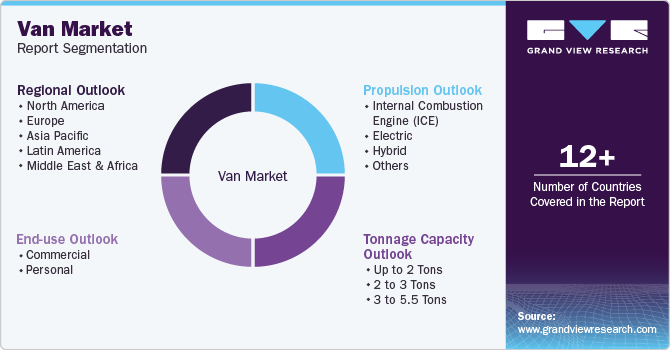
This report forecasts revenue growth at global, regional, and country levels and provides an analysis of the latest industry trends in each of the sub-segments from 2021 to 2033. For this study, Grand View Research has segmented the global van market report based on tonnage capacity, propulsion, end-use, and region:
 To learn more about this report, Download Free Sample Report
 -
Tonnage Capacity Outlook (Revenue, USD Million, 2021 - 2033)
-
Up to 2 Tons
-
2 to 3 Tons
-
3 to 5.5 Tons
-
-
Propulsion Outlook (Revenue, USD Million, 2021 - 2033)
-
Internal Combustion Engine (ICE)
-
Electric
-
Hybrid
-
Others
-
-
End-use Outlook (Revenue, USD Million, 2021 - 2033)
-
Commercial
-
Personal
-
-
Regional Outlook (Revenue, USD Million, 2021 - 2033)
-
North America
-
U.S.
-
Canada
-
Mexico
-
-
Europe
-
Germany
-
UK
-
France
-
-
Asia Pacific
-
China
-
Japan
-
India
-
South Korea
-
Australia
-
-
Latin America
-
Brazil
-
-
Middle East and Africa (MEA)
-
KSA
-
UAE
-
South Africa
-
-
Research Methodology
The van market figures in this report are based on a proven research process that combines executive interviews with secondary research from proprietary databases, company filings, and recognized regulatory and institutional sources. Market size is built through value-chain sizing - reconciling supply-side and demand-side estimates - and triangulated with bottom-up and top-down approaches. Every estimate passes multiple levels of expert validation before publication, with each van segment quantified using the revenue-capture definitions in the table below.
Segment Definition
Segment - Tonnage Capacity
Revenue capture definition
Up to 2 Tons
Revenue from sales of light-duty vans, including base vehicle sales, optional cargo configurations, infotainment systems, and aftersales services targeted at urban delivery and personal use.
2 to 3 Tons
Revenue from mid-duty vans covering vehicle sales, powertrain options, telematics integration, financing, and maintenance contracts for commercial fleet operations.
3 to 5.5 Tons
Revenue from heavy-duty vans, including chassis sales, specialized body builds, fleet customization, extended warranties, and long-term service agreements.
Segment - Propulsion
Revenue capture definition
Internal Combustion Engine (ICE)
Vans powered by ICE or diesel engines, generating revenue from vehicle sales equipped with conventional powertrains, associated transmission systems, emission-control components, and ICE-specific aftersales services such as engine maintenance and spare parts.
Electric
Vans powered exclusively by battery-electric drivetrains, with revenue captured from vehicle sales, battery systems, onboard charging equipment, software-enabled energy management features, and related charging and maintenance services
Hybrid
Vans combining internal combustion engines with electric motors, generating revenue from integrated powertrain systems, regenerative braking components, battery packs, and hybrid-specific control software and servicing.
Others
Vans utilizing alternative propulsion technologies such as compressed natural gas (CNG), liquefied petroleum gas (LPG), or hydrogen fuel cells, with revenue derived from vehicle sales, specialized fuel systems, and niche infrastructure-dependent service offerings.
Segment - End use
Revenue capture definition
Commercial
Vans are deployed by businesses for logistics, passenger transport, utilities, and service delivery operations.
Personal
Vans purchased for individual use, including family transport, recreation, and personal mobility needs.
Estimation Model
Layer Name
Key Question
Description
Macro Vehicle Market
What is the size of the global vehicle market relevant to vans?
This layer establishes the total addressable vehicle market by region, focusing on commercial and light-duty vehicles. It filters out non-relevant categories such as passenger cars and heavy trucks. Regional production, sales volumes, and regulatory frameworks are considered.
Van Penetration
What proportion of vehicles are vans?
This layer isolates vans by tonnage, body type, and application. Adoption rates across commercial and personal use cases are assessed. Regional differences in logistics intensity and urbanization are incorporated.
Technology & Propulsion Split
How is revenue distributed by propulsion and technology?
Revenue is segmented by ICE, electric, and hybrid vans. Pricing differentials, technology adoption rates, and incentive impacts are applied to refine estimates.
Revenue Realization
What is the final market value?
This layer aggregates vehicle sales, optional features, and aftersales revenue. Adjustments are made for fleet contracts, replacement cycles, and regional pricing variations.
Delivered Customizations
This report has been delivered with the following In-depth customizations
Client Request
Customization Delivered
Value Adds
Regional Van Market Opportunity Assessment
Country/region-wise market sizing and forecasts
Analysis of demand, adoption trends, and regulatory landscape
Identification of high-growth regions and investment hotspots
Identified region-specific growth opportunities
Supported expansion and go-to-market strategy
Enabled informed regional investment decisions
Cross-Segmentation Analysis for the Van Market
Criss-cross market analysis by tonnage capacity, propulsion, end use
Demand and adoption assessment across key segments
Segment attractiveness and growth potential benchmarking
Identified high-potential market segments
Supported targeted product positioning and marketing strategy
Improved customer and segment prioritization
Competitive Benchmarking and Strategic Positioning in the Van Market
Benchmarking of key competitors across products, pricing, partnerships, and innovation
Comparative assessment of market share, capabilities, and strategies
Analysis of competitive strengths, gaps, and differentiation areas
Identified competitive white spaces and growth gaps
Supported strategic positioning and differentiation
Enabled data-driven competitive strategy development
Frequently Asked Questions About This Report
The global van market is expected to grow at a CAGR of 5.7% from 2026 to 2033, reaching USD 262.6 billion by 2033.
Up to 2 Tons segment dominated the market, with a revenue share of 44.5% in 2025. The segment's growth is driven by the rising demand for compact, fuel-efficient, and cost-effective vehicles, especially for last-mile delivery and urban logistics.
North America dominated the global market with the largest revenue share of 32.5% in 2025. This growth is driven by the region's robust infrastructure and high rate of urbanization, which support the growing need for efficient transportation solutions in densely populated areas.
Asia Pacific is the fastest-growing region over the forecast period.
Internal Combustion Engine (ICE) segment held the largest market share of 79.7% in 2025, while electric is the fastest growing segment.
Commercial segment accounted for the largest revenue share of 83.5% in 2025 and it is the fastest CAGR during the forecast period.
The global van market size was valued at USD 169.6 billion in 2025 and is estimated at USD 178.5 billion for 2026.
Some key players operating in the van market include Ford Motor Company; Mercedes-Benz Group AG; Volkswagen Group; Renault Group; TOYOTA MOTOR CORPORATION; Nissan Motor Co., Ltd.; Hyundai Motor Company; MITSUBISHI MOTORS CORPORATION; ISUZU MOTORS LIMITED; Stellantis NV
The market’s growth is driven by several factors, including boom in e-commerce and last-mile delivery and the shift toward electric vans.
About the Author(s)
Automotive & Transportation Research Team
Technology · Automotive & TransportationThis report was authored by the automotive & transportation research team at Grand View Research - comprising two research analysts, one senior research analyst, and one industry expert - with specialized expertise in the automotive & transportation segment of the technology industry. All findings are based on proprietary technology databases, executive interviews, and regulatory analysis, subject to internal peer review prior to publication.
Last Updated:
Speak to Analyst

Customize this report to your needs - add regions, segments, or data points, with 20% free customization.
Or view our licence options:


ISO 9001:2015 & 27001:2022 Certified
We are GDPR and CCPA compliant! Your transaction & personal information is safe and secure. For more details, please read our privacy policy.


