
- Home
- »
- Next Generation Technologies
- »
-
VCSEL Market Size, Share And Growth Report, 2026-2033GVR Report cover

VCSEL Market (2026 - 2033)
Size, Share & Trends Analysis Report By Type (Single-mode VCSEL, Multi-mode VCSEL), By Material (Gallium Arsenide (GaAs), Gallium Nitride (GaN)), By Wavelength, By Application, By End-use, By Region, And Segment Forecasts
Market Size, 2025
$2.6BMarket Estimate, 2026
$2.8BMarket Forecast, 2033
$5.7BCAGR, 2026–2033
10.6%VCSEL Market Summary
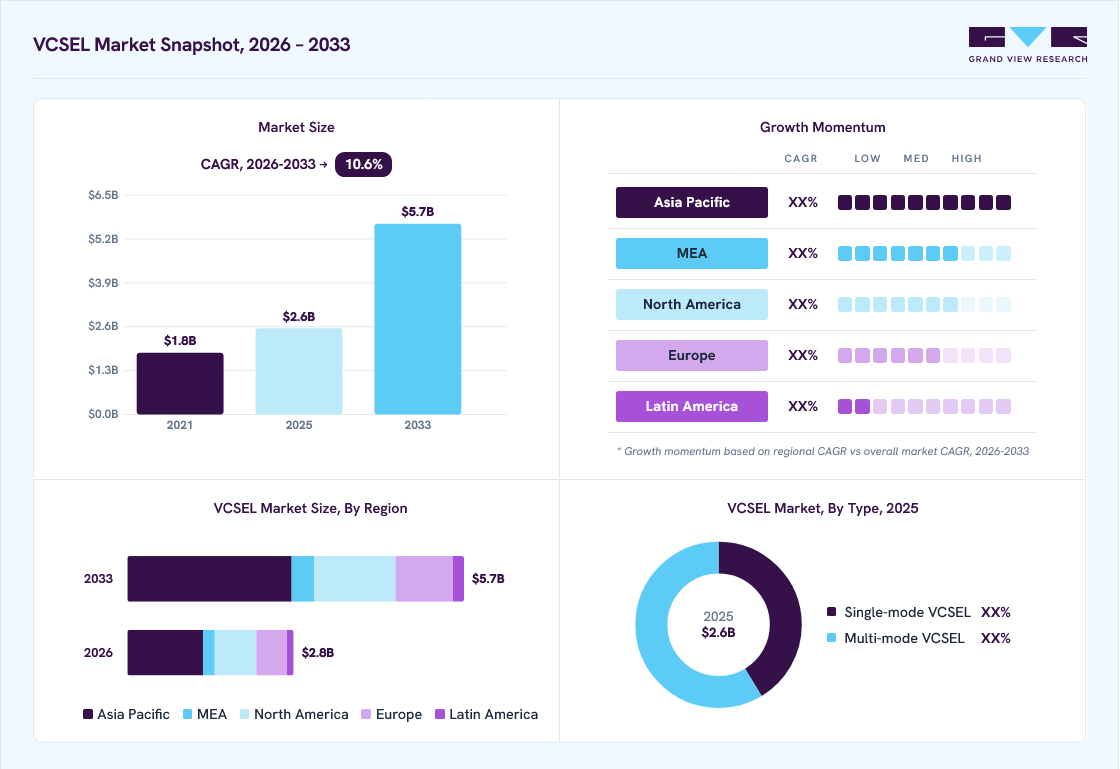
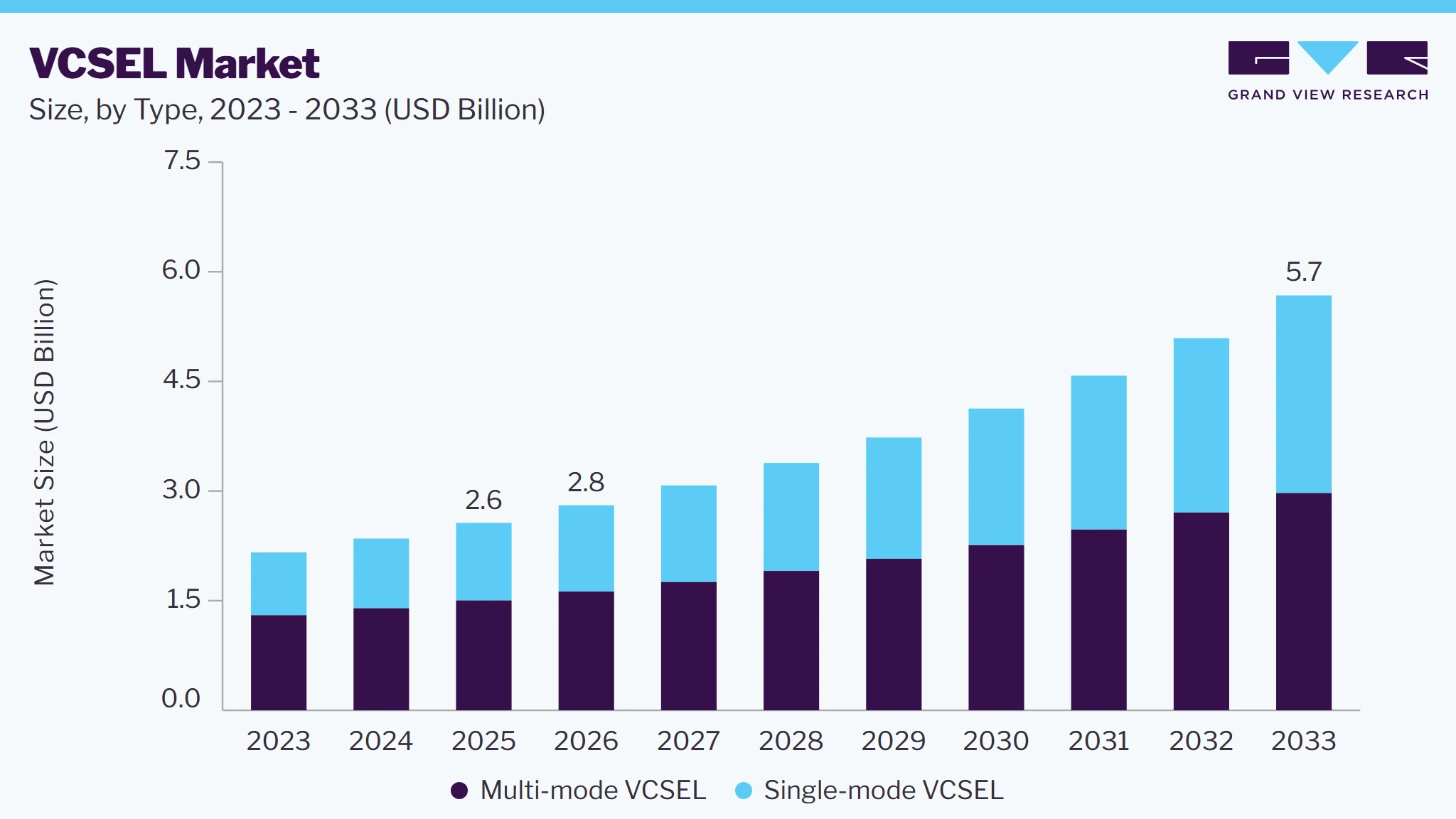
The global VCSEL market size was valued at USD 2.6 billion in 2025 and is projected to grow from USD 2.8 billion in 2026 to USD 5.7 billion by 2033, at a CAGR of 10.6% from 2026 to 2033. Asia Pacific dominated the market, accounting for a revenue share of 45.2% in 2025. Industry growth is primarily driven by the expansion of AI-enabled data centers and high-speed optical interconnects, increasing adoption of 3D sensing in smartphones and consumer electronics, growing use of vertical-cavity surface-emitting lasers (VCSELs) in automotive LiDAR and advanced sensing systems, and continuous technological advancements toward high-power, compact, and energy-efficient VCSEL devices.
 Source: Grand View Research, IR Documents, Primary Interviews, Paid DatabasesTo learn more about this report,
 Download Free Sample Report
 Key Market Trends & Insights
- By Type: Multi-mode VCSEL segment held the largest market share of 58.7% in 2025.
- By Material: Gallium Arsenide (GaAs) segment held the largest market revenue share in 2025.
- By Wavelength: Near-Infrared (NIR) segment led the market with the largest revenue share in 2025.
- By Application: Data Communication segment held the largest market revenue share in 2025.
- By End use: Telecom & Data Centers segment led the market with the largest revenue share in 2025.
Regional Highlights
- Largest regional market: Asia Pacific (45.2% revenue share, 2025)
- By country: China held the largest share in 2025
Market Size & Forecasts
- Market size in 2025: USD 2.6 billion
- Estimated market size in 2026: USD 2.8 billion
- Projected market size by 2033: USD 5.7 billion
- CAGR (2026-2033): 10.6%
Three ways to get this report
Buy it, customize it, or ask a question.Ask an Analyst
A direct answer, usually in 1 working day
- AccessReport author, directly
- Reply timeWithin 1 working day
- No sales callDirect answer only
- FormatEmail reply
- CostFree, no cost
Get the Full Report
What the study covers
- FormatsPDF · Excel · Dashboard
- Timeline2026–2033 annual, 2025 base
- Coverage20+ countries, 5 regions
- Companies10+ key players profiled
Customize the Report
20% free customization
- IncludeCountries, segments, points
- TailorTo your product definition
- ExtendDeeper competitor detail
- OrA fully bespoke study
- Turnaround5–10 working days
AI training and inference systems require increasingly high bandwidth for communication between GPUs, servers, and networking equipment, encouraging the transition toward higher-speed optical links. The continued scaling of AI clusters and next-generation optical interconnects is therefore expected to remain a major growth driver for the VCSEL industry.
Additionally, the increasing deployment of 3D sensing technologies in smartphones, tablets, wearables, and other consumer electronics is driving demand for VCSEL-based illumination sources. VCSELs provide precise, compact, and energy-efficient infrared emission required for applications such as facial recognition, gesture recognition, proximity detection, autofocus assistance, and depth measurement. The expansion of biometric authentication and advanced imaging capabilities, together with growing consumer demand for sophisticated device features, is supporting continued adoption of VCSELs. NIR VCSELs remain particularly important due to their established use in 3D sensing and consumer device applications.
 To learn more about this report, Download Free Sample Report
 Furthermore, the automotive industry is emerging as a key growth avenue for VCSEL manufacturers, as automakers increasingly deploy LiDAR, advanced driver-assistance systems (ADAS), driver monitoring, and in-cabin sensing. VCSEL arrays can provide compact, high-power, and precisely controlled optical sources for depth sensing and object detection, supporting the development of increasingly sophisticated vehicle perception systems. The relatively early adoption of VCSELs in automotive applications, compared with consumer electronics and data communication, provides substantial room for expansion. Consequently, automotive is expected to record one of the fastest growth rates among VCSEL end-use industries over the forecast period.
Moreover, a major technology trend is the development of high-power, multi-junction VCSEL arrays that deliver higher optical output while maintaining compact form factors and improved efficiency. These architectures are particularly relevant to demanding applications such as automotive LiDAR, 3D sensing, industrial sensing, and high-performance optical communication. Manufacturers are also pursuing improvements in beam control, thermal management, modulation speed, wafer-scale manufacturing, and packaging to increase device performance and reduce costs. These advances are broadening the range of applications that can use VCSEL technology and strengthening its competitiveness relative to alternative laser sources.
Market Dynamics
The VCSEL industry is evolving toward broader diversification of applications, supported by improvements in device efficiency, power output, beam control, and manufacturing scalability. Additionally, the increasing competition among laser technologies and the ongoing development of customized VCSEL solutions are influencing product innovation and pricing. Furthermore, intensifying competition, supply-chain considerations, and the need for cost-effective, high-yield manufacturing are shaping supplier strategies and influencing the overall market landscape.
The rapid expansion of AI computing, cloud services, and hyperscale data centers is increasing the need for high-bandwidth and energy-efficient optical interconnects. VCSELs are well-suited for short-reach optical communication because of their high modulation speed, compact size, low power consumption, and suitability for parallel optical links. As data-center operators upgrade networking infrastructure to support increasingly intensive AI workloads and higher data-transfer rates, demand for VCSEL-based optical transceivers and modules is expected to increase. This expansion of next-generation data-center infrastructure is therefore creating a sustained demand base for VCSEL manufacturers.
VCSEL manufacturing involves sophisticated semiconductor fabrication, epitaxial growth, wafer processing, testing, and precision packaging, making production quality and yield critical to overall costs. Higher-power VCSEL arrays can also generate substantial heat, which may affect optical efficiency, device lifetime, and reliability if thermal management is inadequate. These challenges become more pronounced in demanding applications such as LiDAR and high-density optical systems, where devices must deliver greater output while maintaining stable performance. Consequently, the need for advanced fabrication processes and thermal-management solutions can increase production costs and limit adoption in cost-sensitive applications.
VCSEL technology is progressively expanding beyond established NIR data communication and consumer 3D sensing applications into SWIR sensing, healthcare, industrial automation, machine vision, and other specialized applications. SWIR VCSELs are attracting interest for sensing applications requiring enhanced material and environmental detection capabilities, while healthcare applications are using NIR VCSELs for non-invasive monitoring and diagnostic functions. Furthermore, industrial automation and precision sensing are creating opportunities for compact, efficient optical sources. This diversification is reducing dependence on traditional application areas and creating additional long-term growth opportunities for VCSEL manufacturers.
Market Concentration & Characteristics
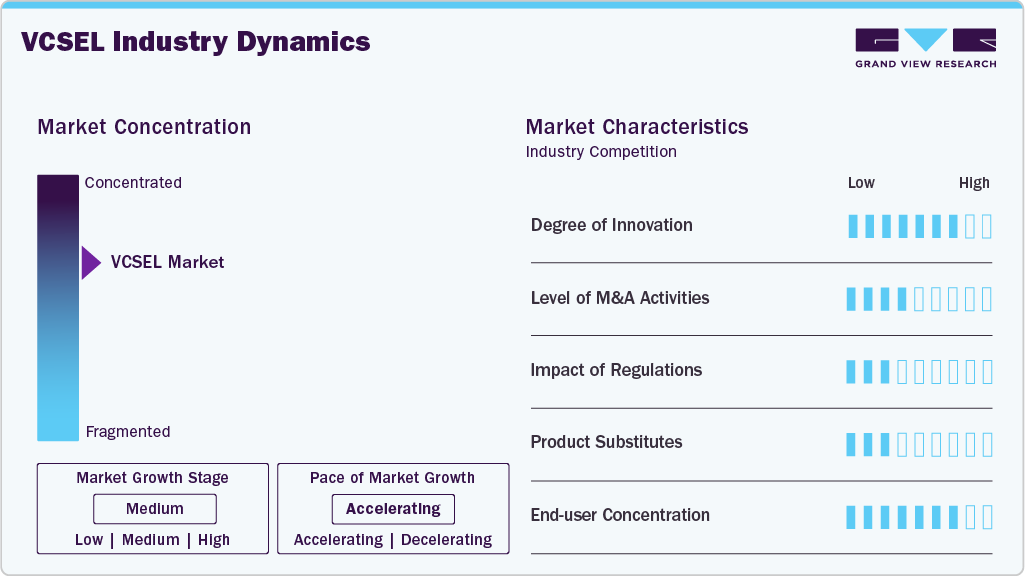
The VCSEL market is moderately concentrated, with established semiconductor and photonics companies competing on technological expertise, manufacturing scalability, optical performance, reliability, and application-specific solutions. Innovation is high, driven by advances in high-speed, high-power, multi-junction VCSELs, thermal management, and wafer-level manufacturing, while M&A activity remains moderate as companies seek complementary laser technologies and intellectual property.
 To learn more about this report, Download Free Sample Report
 Regulatory impact is low to moderate, mainly affecting manufacturing, environmental compliance, and technology transfers. Substitution is moderate, with LEDs and edge-emitting lasers serving as alternatives in selected applications. End-user concentration is high, particularly among major consumer electronics, data center, telecom, and automotive companies, creating strong qualification and pricing pressures and significant barriers to entry.
Analyst Perspective
The VCSEL market is evolving from conventional laser sources toward high-speed, compact, energy-efficient, and application-specific optical solutions. Increasing adoption of VCSELs in 3D sensing, data communication, LiDAR, optical connectivity, and industrial applications, along with advancements in high-power arrays, multi-junction structures, wavelength expansion, thermal management, and wafer-level manufacturing, is improving performance and scalability. Furthermore, growing demand from consumer electronics, data centers, automotive, telecom, healthcare, and industrial applications is broadening the addressable market and supporting continued innovation in VCSEL technologies.
Type Insights
The multi-mode VCSEL segment dominated the market with a share of 58.7% in 2025, fueled by their relatively high optical power, efficient coupling with multimode fiber, lower manufacturing complexity, and cost-effectiveness, making them well-suited to high-volume data-center deployments. The rapid expansion of hyperscale and AI-oriented data centers is increasing demand for high-bandwidth optical interconnects, while the transition toward higher data rates is encouraging advances in VCSEL arrays, modulation speeds, and power efficiency.
The Single-mode VCSEL segment is expected to register the highest growth rate of 12.6% from 2026 to 2033, driven by the increasing demand for high-performance optical communication and precision sensing applications requiring narrow spectral width, low beam divergence, and improved signal quality. In addition, growing adoption in automotive sensing and LiDAR is creating new opportunities for single-mode devices, particularly where beam quality and precise optical control are critical.
Material Insights
The Gallium Arsenide (GaAs) segment dominated the market in 2025. The segment growth is driven by its mature manufacturing ecosystem, strong optical performance, high efficiency, and established compatibility with 850-940 nm VCSEL applications. GaAs-based devices are widely used in data communication and 3D sensing, benefiting from well-established epitaxial growth, wafer fabrication, packaging, and supply chain capabilities. Moreover, the continued investment in data centers, optical networking, consumer electronics sensing, and automotive applications is sustaining demand for GaAs-based VCSELs despite the emergence of alternative material platforms.
The Gallium Nitride (GaN) segment is expected to register the highest CAGR from 2026 to 2033, owing to the rapid advances in wide-bandgap semiconductor technology, which expand VCSEL applications toward shorter wavelengths and higher-performance sensing and photonic applications. GaN's wide bandgap enables operation in blue, violet, and ultraviolet regions, creating opportunities in high-density optical systems, displays, biological sensing, and specialized industrial applications. The broader industry trend toward higher-efficiency and application-specific laser sources is expected to support investment in GaN VCSEL technology.
Wavelength Insights
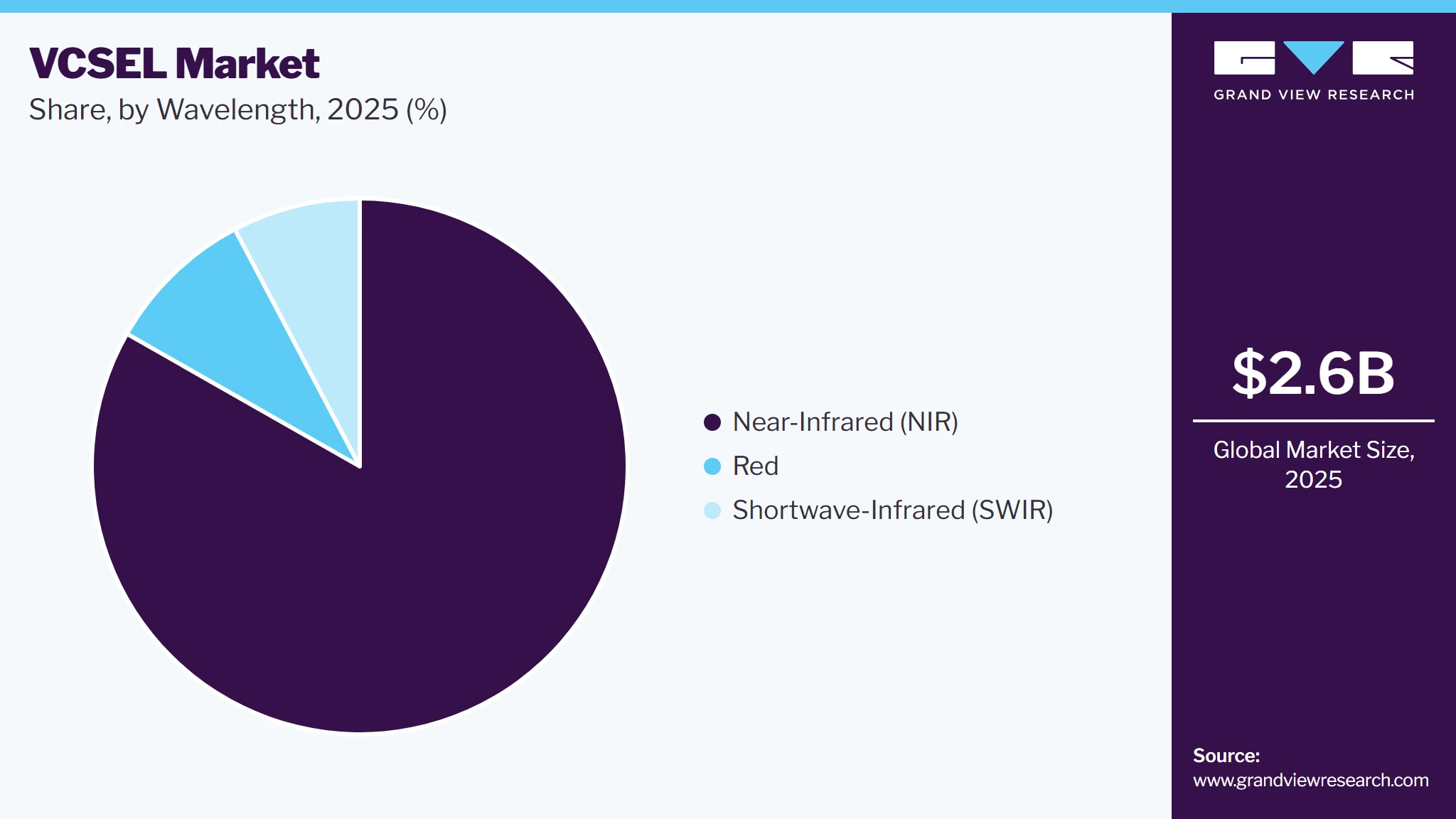
The Near-Infrared (NIR) segment dominated the market in 2025, as they combine mature manufacturing technology with broad deployment across data communication, 3D sensing, facial recognition, optical interconnects, and other sensing applications. Wavelengths around 850 nm are particularly important for data-center optical links, while approximately 940 nm devices are widely used for depth sensing and illumination. Continued growth in cloud computing, AI data centers, smartphones, wearables, and automotive sensing is expected to maintain strong demand for NIR devices throughout the forecast period.
 To learn more about this report, Download Free Sample Report
 Shortwave-Infrared (SWIR) is expected to register the highest CAGR from 2026 to 2033, driven by the expansion of SWIR-based machine vision, industrial inspection, spectroscopy, biometric sensing, and emerging automotive applications. The sensing applications increasingly require improved material discrimination, depth perception, and performance under challenging environmental conditions. Manufacturers seek compact, efficient, and highly integrated light sources for advanced sensing, thereby making SWIR VCSEL development an important technology trend, although its commercial ecosystem remains less mature than that of NIR.
Application Insights
The data communication segment dominated the market in 2025. VCSELs provide a combination of high-speed transmission, low power consumption, compact size, reliability, and cost-effective integration with optical transceivers. Their extensive use in short-reach data-center interconnects makes them particularly important as hyperscale cloud facilities, and AI computing infrastructure expand and require increasingly high bandwidth between servers, switches, and GPU clusters. The industry's continued transition from electrical to optical interconnects for bandwidth-intensive workloads is expected to remain a major growth driver for VCSEL-based data communication.
The LiDAR segment is expected to register the highest CAGR from 2026 to 2033, fueled by the increasing adoption of LiDAR-based sensing in advanced driver-assistance systems (ADAS), autonomous vehicles, and next-generation automotive safety systems, along with growing demand for high-resolution, long-range 3D perception. The development of solid-state and flash LiDAR systems is further supporting VCSEL adoption due to their compact size, high-speed modulation, low power consumption, and ability to integrate multiple emitters in dense arrays. In addition, declining sensor costs, technological advances in VCSEL arrays, and increasing regulatory and safety requirements are encouraging automakers to integrate LiDAR into a wider range of vehicle models.
End Use Insights
The telecom and data centers segment dominated the market in 2025. The expansion of cloud computing, 5G infrastructure, AI workloads, hyperscale facilities, and high-performance computing is driving demand for greater bandwidth and higher-density optical interconnects. VCSEL-based transceivers remain particularly attractive for short- and medium-reach links owing to their compact form factor, low power consumption, scalability, and compatibility with multimode fiber. Furthermore, the development of higher-speed VCSELs and multi-emitter arrays capable of supporting increasing bandwidth per optical link, particularly as AI clusters create substantial communication requirements between GPUs and networking equipment.
The automotive segment is expected to register the highest CAGR from 2026 to 2033, fueled by the rapid adoption of advanced driver-assistance systems (ADAS), increasing penetration of electric and connected vehicles, growing integration of AI and autonomous-driving technologies, and rising demand for enhanced vehicle safety, connectivity, and automation. The shift toward software-defined vehicles, 5G-enabled connectivity, over-the-air (OTA) updates, and intelligent mobility solutions is further accelerating technology adoption across passenger and commercial vehicles. In addition, stringent vehicle safety regulations and growing consumer preference for technologically advanced vehicles are expected to create significant growth opportunities for automotive applications throughout the forecast period.
Regional Insights
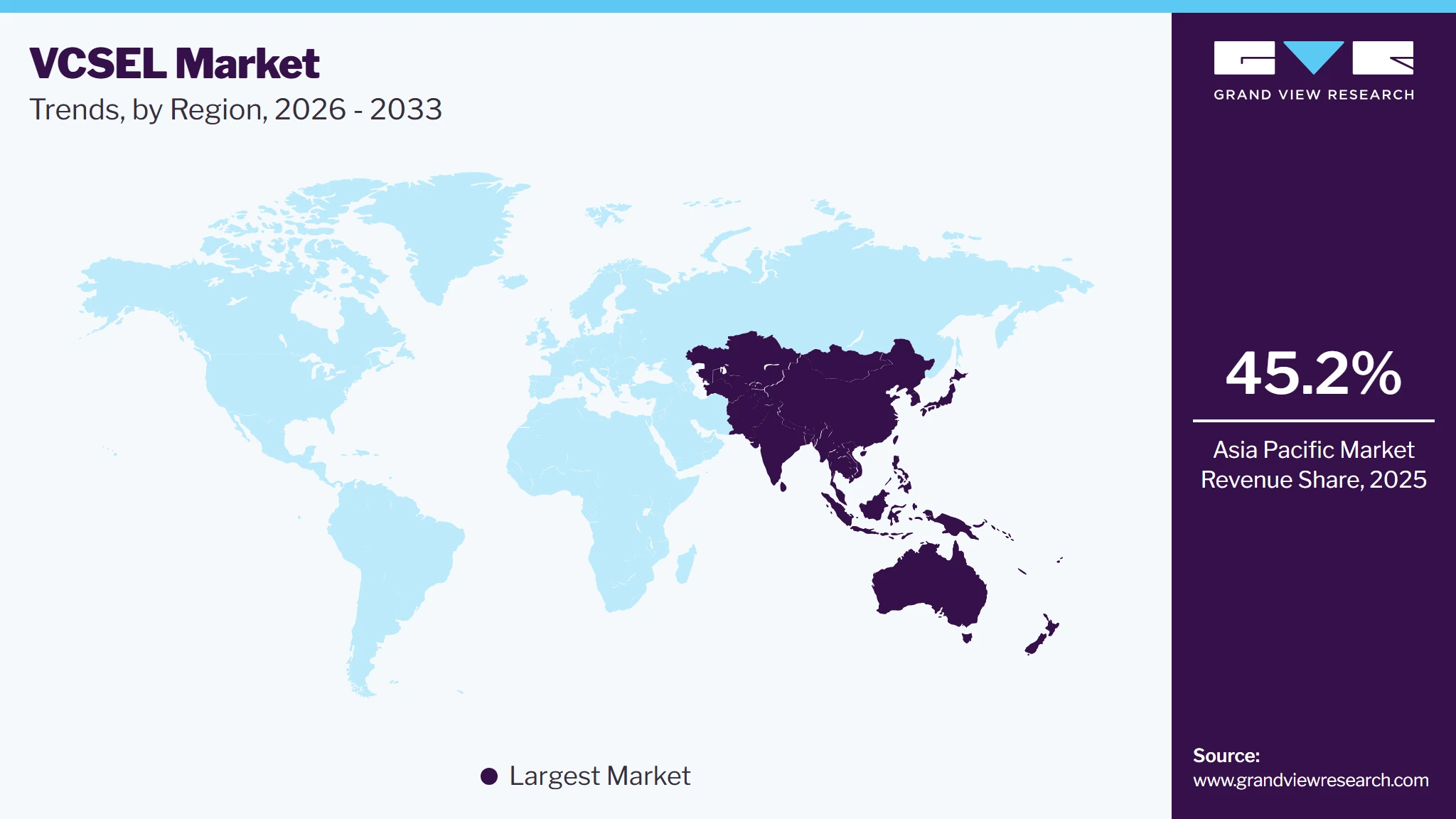
Asia Pacific held a dominant position in the VCSEL market, capturing 45.2% revenue share in 2025. The region is also expected to grow at the highest CAGR of 11.7% from 2026 to 2033, driven by the rapid expansion of data center infrastructure, rising demand for high-speed optical communication, and increasing adoption of 3D sensing technologies. The region's large consumer electronics manufacturing base is creating significant opportunities for VCSELs in smartphones, biometric systems, augmented and virtual reality devices, and other consumer applications. Strong semiconductor manufacturing capabilities and the presence of major electronics and optical component manufacturers further support regional market development.
 To learn more about this report, Download Free Sample Report
 The China VCSEL market is strongly influenced by rapid expansion of data centers, telecommunications infrastructure, consumer electronics manufacturing, and advanced sensing applications. The country's growing focus on semiconductor localization and development of domestic optoelectronic manufacturing capabilities is also encouraging investment across the VCSEL supply chain. Furthermore, increasing deployment of industrial automation, robotics, and autonomous technologies is creating additional applications for VCSEL-based sensing solutions.
The VCSEL market in Japan is supported by its advanced semiconductor, electronics, automotive, and precision manufacturing industries. The increasing adoption of optical sensing technologies in consumer electronics, industrial automation, robotics, and automotive applications is driving new demand for VCSELs. In addition, the growing demand for data center connectivity and high-speed computing infrastructure is expected to drive the adoption of VCSEL-based optical modules, while Japan's focus on robotics and smart manufacturing provides further opportunities for VCSEL-enabled sensing applications.
North America VCSEL Market Trends
The VCSEL market in North America accounted for a significant share of 25.2% in 2025. The regional growth is supported by the strong presence of hyperscale data centers, cloud service providers, and advanced optical networking infrastructure. The increasing deployment of high-speed data transmission technologies is driving demand for VCSELs in short-reach optical interconnects, particularly in data centers and high-performance computing environments. In addition, continued investments in artificial intelligence (AI), machine learning, and accelerated computing infrastructure are increasing requirements for high-bandwidth and energy-efficient optical connectivity. The region's established semiconductor ecosystem, strong R&D capabilities, and presence of leading technology companies further support the adoption of advanced VCSEL solutions.
The VCSEL market in the U.S. led the regional market in 2025, fueled by the rapid expansion of hyperscale and AI-focused data centers and growing deployment of high-speed optical interconnects. Furthermore, investments in cloud computing, AI infrastructure, autonomous technologies, and advanced sensing systems are expected to create additional opportunities for VCSEL manufacturers and component suppliers in the U.S.
Europe VCSEL Market Trends
The VCSEL market in Europe is growing significantly, supported by increasing adoption of optical communication technologies, industrial automation, and advanced sensing applications. Growing investments in data center infrastructure and high-performance computing are creating demand for energy-efficient optical interconnect solutions. The region's strong automotive and industrial manufacturing base, combined with ongoing investments in automation and digitalization, is supporting the expansion of VCSEL applications beyond conventional communication systems.
The Germany VCSEL market presents strong growth opportunities owing to the country's advanced automotive and industrial manufacturing ecosystem. Increasing adoption of LiDAR, 3D sensing, machine vision, and industrial automation technologies is driving demand for high-performance VCSEL components. In addition, Germany's emphasis on Industry 4.0, robotics, and smart manufacturing is encouraging the integration of optical sensing technologies into production and inspection systems, supporting continued VCSEL adoption.
Key VCSEL Company Insights
Some of the key players operating in the VCSEL market include Coherent Corp, and Lumentum Operations LLC, among others.
-
Coherent Corp. is a photonics and semiconductor company, that offers VCSELs for data communications, 3D sensing, automotive, and industrial applications. Its broad product portfolio, strong manufacturing capabilities, and global customer base position it as a mature player in the VCSEL market, particularly as demand grows for high-speed optical connectivity and AI-driven data centers.
-
Lumentum Operations LLC is a major photonics company providing VCSELs and other optical components for communications, sensing, and industrial applications. The company benefits from extensive R&D capabilities, global manufacturing operations, and established relationships across data center and consumer electronics markets, supporting its strong position in the VCSEL industry.
Some of the prominent players include VERTILAS GmbH and Verilite Co., Ltd., among others.
-
VERTILAS GmbH is a Germany-based specialist in long-wavelength VCSEL technology, offering laser solutions for gas sensing, spectroscopy, optical communications, and industrial applications. Its focus on NIR VCSELs and specialized sensing technologies differentiates the company from larger diversified photonics manufacturers.
-
Vertilite Co., Ltd. is a China-based VCSEL manufacturer focused on VCSEL chips and modules for consumer electronics, automotive, and optical communication applications. With capabilities spanning epitaxial wafer growth, chip manufacturing, packaging, and testing, the company is expanding its presence across international VCSEL markets.
Key VCSEL Companies
The following key companies have been profiled for this study on the VCSEL Market.
-
Broadcom Inc.
-
Coherent Corp
-
Hamamatsu Photonics K.K.
-
Lumentum Operations LLC
-
MKS Instruments, Inc
-
Santec Holdings Corporation
-
The ams OSRAM Group
-
TRUMPF SE + Co. KG
-
VERTILAS GmbH
-
Vertilite Co., Ltd
Competitive Benchmarking
Operating Strategies
Competitive Edge
Weaknesses
Mature Players: Coherent Corp, and Lumentum Operations LLC
- Focus on investing in high-speed vessels, advanced optical interconnects, 3D sensing, and next-generation photonic technologies.
- These companies expand VCSEL applications across AI and data centers, consumer electronics, automotive sensing, industrial automation, and optical communications.
- Strong R&D capabilities, established global manufacturing infrastructure, and long-standing relationships with customers.
- Their ability to develop high-performance VCSEL arrays, optical modules, and integrated photonic solutions provides a strong competitive advantage in high-bandwidth communication and advanced sensing applications.
- Face high capital requirements associated with semiconductor fabrication, advanced packaging, and photonics manufacturing.
- They are exposed to fluctuations in data center and consumer electronics demand.
Emerging Players: VERTILAS GmbH and Verilite Co., Ltd
- Focus on specialized VCSEL technologies for sensing, optical communications, automotive, industrial, and consumer applications.
- These companies are developing application-specific vessels, arrays, and modules for emerging applications such as lidar, 3D sensing, and high-speed optical connectivity.
- Specialized technical expertise in targeted VCSEL wavelengths, sensing technologies, and customized optical solutions.
- Their relatively agile operating models enable them to respond quickly to changing customer requirements and pursue niche applications.
- These companies generally have smaller production capacities, financial resources, and global manufacturing footprints compared with major VCSEL manufacturers.
- Limited distribution networks may constrain their ability to compete for large-scale global contracts.
Recent Developments
-
In March 2026, Broadcom, Inc. announced its expanded AI infrastructure portfolio for OFC 2026, including a 3.2T VCSEL-based Near-Packaged Optics (NPO) solution designed to deliver high efficiency, field-proven reliability, and high escape-bandwidth density.
-
In January 2026, Lumentum showcased its 3D sensing VCSEL portfolio at SPIE Photonics West 2026, highlighting VCSEL solutions designed for depth sensing, object detection, and driver-assistance systems.
-
In September 2025, Coherent Corp. introduced next-generation 2D VCSEL and photodiode arrays designed to accelerate AI-driven optical interconnects.
VCSEL Market Report Scope
Report Attribute
Details
Market size in 2025
USD 2.6 billion
Estimated market size in 2026
USD 2.8 billion
Projected market size by 2033
USD 5.7 billion
Growth rate
CAGR of 10.6% from 2026 to 2033
Actual data
2021 - 2025
Forecast period
2026 - 2033
Quantitative units
Revenue in USD billion and CAGR from 2026 to 2033
Report coverage
Revenue forecast, company share, competitive landscape, growth factors, and trends
Segments covered
Type, material, wavelength, application, end use, region
Regional scope
North America; Europe; Asia Pacific; Latin America; Middle East and Africa
Country scope
U.S.; Canada; Mexico; UK; Germany; France; China; Japan; India; South Korea; Australia; Brazil; UAE; KSA; South Africa
Key companies profiled
Broadcom Inc.; Coherent Corp; Hamamatsu Photonics K.K.; Lumentum Operations LLC; MKS Instruments, Inc; Santec Holdings Corporation; The ams OSRAM Group; TRUMPF SE + Co. KG; VERTILAS GmbH; Vertilite Co., Ltd
Customization scope
Free report customization (equivalent to up to 8 analyst working days) with purchase. Addition or alteration to country, regional & segment scope.
Pricing and purchase options
Avail customized purchase options to meet your exact research needs. Explore purchase options
Global VCSEL Market Report Segmentation
This report forecasts revenue growth at global, regional, and country levels and provides an analysis of the latest industry trends in each of the sub-segments from 2021 to 2033. For this study, Grand View Research has segmented the global VCSEL market report based on type, material, wavelength, application, end use, and region.
-
Type Outlook (Revenue, USD Billion, 2021 - 2033)
-
Single-Mode VCSEL
-
Multi-mode VCSEL
-
-
Material Outlook (Revenue, USD Billion, 2021 - 2033)
-
Gallium Arsenide (GaAs)
-
Gallium Nitride (GaN)
-
Indium Phosphide (InP)
-
Others
-
-
Wavelength Outlook (Revenue, USD Billion, 2021 - 2033)
-
Red
-
Near-Infrared (NIR)
-
Shortwave-Infrared (SWIR)
-
-
Application Outlook (Revenue, USD Billion, 2021 - 2033)
-
Data Communication
-
3D Sensing
-
LiDAR
-
Industrial Heating & Laser Printing
-
Infrared Illumination
-
Others
-
-
End Use Outlook (Revenue, USD Billion, 2021 - 2033)
-
Consumer Electronics
-
Telecom & Data Centers
-
Automotive
-
Industrial
-
Healthcare
-
Aerospace & Defense
-
Others
-
-
Regional Outlook (Revenue, USD Billion, 2021 - 2033)
-
North America
-
U.S.
-
Canada
-
Mexico
-
-
Europe
-
UK
-
Germany
-
France
-
-
Asia Pacific
-
China
-
Japan
-
India
-
South Korea
-
Australia
-
-
Latin America
-
Brazil
-
-
Middle East and Africa
-
UAE
-
KSA
-
South Africa
-
-
Research Methodology
The VCSEL market figures in this report are based on a proven research process that combines executive interviews with secondary research from proprietary databases, company filings, and recognized regulatory and institutional sources. Market size is built through value-chain sizing-reconciling supply-side and demand-side estimates-and triangulated with bottom-up and top-down approaches. Every estimate passes multiple levels of expert validation before publication, with each VCSEL segment quantified using the revenue-capture definitions in the table below.
Segment Definition
Type
Revenue Capture Definition
Single-Mode VCSEL
Revenue is generated through the sale of single-mode VCSELs designed for high-precision, low-divergence optical transmission and sensing applications.
Multi-mode VCSEL
Revenue is generated through the sale of multi-mode VCSELs used in high-speed data communication, 3D sensing, illumination, and other high-volume applications.
Material
Revenue Capture Definition
Gallium Arsenide (GaAs)
Revenue is generated through the sale of GaAs-based VCSELs offering high efficiency, high-speed operation, and suitability for optical communication and sensing applications.
Gallium Nitride (GaN)
Revenue is generated through the sale of GaN-based VCSELs developed for applications requiring higher power handling, shorter wavelengths, and enhanced thermal performance.
Indium Phosphide (InP)
Revenue is generated through the sale of InP-based VCSELs targeting longer-wavelength optical communication, sensing, and specialized photonic applications.
Others
Revenue is generated through the sale of VCSELs manufactured using other semiconductor materials for specialized wavelength, performance, or application requirements.
Wavelength
Revenue Capture Definition
Red
Revenue is generated through the sale of red-wavelength VCSELs used in optical sensing, displays, positioning, illumination, and specialized industrial applications.
Near-Infrared (NIR)
Revenue is generated through the sale of NIR VCSELs used primarily in 3D sensing, facial recognition, optical communication, LiDAR, and infrared illumination.
Shortwave-Infrared (SWIR)
Revenue is generated through the sale of SWIR VCSELs used for advanced sensing, industrial inspection, spectroscopy, LiDAR, and other applications requiring longer infrared wavelengths.
Application
Revenue Capture Definition
Data Communication
Revenue is generated through the sale of VCSELs used as high-speed optical transmitters in data centers, enterprise networks, telecommunications, and short-reach optical links.
3D Sensing
Revenue is generated through the sale of VCSELs used as light sources in structured-light and time-of-flight systems for facial recognition, depth sensing, gesture recognition, and spatial mapping.
LiDAR
Revenue is generated through the sale of VCSELs used as pulsed or modulated optical sources for LiDAR systems in automotive, robotics, industrial, and mapping applications.
Industrial Heating & Laser Printing
Revenue is generated through the sale of VCSELs used for localized heating, material processing, printing, marking, and other industrial laser applications.
Infrared Illumination
Revenue is generated through the sale of VCSELs used to provide controlled infrared illumination for cameras, surveillance systems, biometric devices, machine vision, and sensing equipment.
Others
Revenue is generated through the sale of VCSELs for specialized applications such as medical devices, spectroscopy, optical encoders, and scientific instrumentation.
End Use
Revenue Capture Definition
Consumer Electronics
Revenue is generated through the sale of VCSELs incorporated into smartphones, wearables, AR/VR devices, biometric systems, cameras, and other consumer electronic products.
Telecom & Data Centers
Revenue is generated through the sale of VCSELs used in optical transceivers, high-speed networking equipment, fiber-optic links, and data-center communication infrastructure.
Automotive
Revenue is generated through the sale of VCSELs used in automotive LiDAR, driver monitoring, occupant sensing, gesture recognition, and other advanced sensing systems.
Industrial
Revenue is generated through the sale of VCSELs used in industrial automation, machine vision, inspection, sensing, laser printing, heating, and measurement systems.
Healthcare
Revenue is generated through the sale of VCSELs used in medical imaging, diagnostic equipment, monitoring devices, therapeutic systems, and biometric or physiological sensing applications.
Aerospace & Defense
Revenue is generated through the sale of VCSELs used in secure optical communication, range finding, LiDAR, sensing, targeting, navigation, and other aerospace and defense systems.
Others
Revenue is generated through the sale of VCSELs for applications across research, energy, security, education, and other specialized industries.
Estimation Model
Layer
Key Questions
Description
End-User Adoption Layer
Who are the potential adopters?
Identifies consumer electronics manufacturers, data center operators, telecom companies, automotive OEMs and Tier-1 suppliers, industrial automation companies, healthcare device manufacturers, aerospace & defense organizations, and research institutions that use VCSELs for high-speed optical communication, 3D sensing, LiDAR, infrared illumination, industrial processing, and other photonic applications.
VCSEL Supplier Layer
Who supplies VCSELs and related solutions?
Evaluates VCSEL manufacturers, semiconductor companies, photonic component suppliers, optical transceiver manufacturers, and specialized laser technology providers offering single-mode and multi-mode VCSELs across different materials and wavelength ranges. This layer considers suppliers providing VCSEL chips, arrays, packaged devices, modules, and application-specific optical solutions.
VCSEL Deployment Layer
Where are VCSELs being used?
Maps VCSEL deployment across consumer electronics, telecom and data centers, automotive systems, industrial equipment, healthcare devices, aerospace & defense systems, and other specialized applications. It assesses use in smartphones and wearables, optical communication networks, 3D sensing modules, LiDAR systems, machine vision, laser printing, infrared illumination, and medical and defense equipment.
Technology & Performance Layer
What technologies influence adoption?
Evaluates single-mode and multi-mode VCSEL architectures, GaAs, GaN and InP material platforms, red/NIR/SWIR wavelength technologies, VCSEL arrays, high-power VCSELs, high-speed modulation, advanced packaging, beam shaping, thermal management, and wafer-level manufacturing. This layer assesses improvements in optical power, efficiency, wavelength stability, modulation speed, reliability, miniaturization, and manufacturing scalability that influence VCSEL adoption.
Delivered Customizations
This report has been delivered with the following in-depth customizations
Client Request
Customization Delivered
Value Adds
Market Sizing, Segmentation & Growth Opportunity Assessment
Assessed the global VCSEL Market size, historical trends, forecast growth outlook, and detailed segmentation by type (Single-mode VCSEL, Multi-mode VCSEL), material (GaAs, GaN, InP, Others), wavelength (Red, NIR, SWIR), application (Data Communication, 3D Sensing, LiDAR, Industrial Heating & Laser Printing, Infrared Illumination, Others), and end-use industry (Consumer Electronics, Telecom & Data Centers, Automotive, Industrial, Healthcare, Aerospace & Defense, Others).
Enables VCSEL manufacturers, semiconductor companies, photonic component suppliers, and end-use companies to identify high-growth segments, prioritize product development and capacity expansion, target emerging applications, and capture new revenue opportunities.
Competitive Landscape & Strategic Positioning Analysis
Evaluated major VCSEL manufacturers, semiconductor companies, photonic component suppliers, and laser technology providers, comparing product portfolios, VCSEL architectures, material and wavelength capabilities, manufacturing capacity, application coverage, geographic presence, technological innovation, partnerships, investments, and recent developments.
Enables companies to benchmark competitive positioning, identify product and technology gaps, assess differentiation opportunities, prioritize R&D and manufacturing investments, strengthen strategic partnerships, and improve positioning across data communication, 3D sensing, LiDAR, automotive, consumer electronics, industrial, and healthcare applications.
Regional Market Demand & Growth Opportunity Assessment
Assessed VCSEL demand across North America, Europe, Asia Pacific, Latin America, and Middle East & Africa, considering the development of data centers and optical communication infrastructure, consumer electronics manufacturing, automotive sensing and LiDAR adoption, industrial automation, healthcare applications, aerospace & defense requirements, and advancements in photonic and semiconductor technologies.
Provides insights into regional growth opportunities, investment hotspots, market-entry priorities, and demand patterns, enabling companies to prioritize high-potential geographies, strengthen regional capabilities, and align product portfolios with local adoption trends.
Frequently Asked Questions About This Report
The global VCSEL market size was valued at USD 2.6 billion in 2025 and is projected to reach USD 2.8 billion in 2026.
The global vertical-cavity surface-emitting lasers (VCSEL) market is expected to reach USD 5.7 billion by 2033, growing at a CAGR of 10.6% from 2026 to 2033.
By type, the Multi-mode VCSEL segment held the largest market share of 58.7% in 2025.
Asia Pacific accounted for the largest share of 45.2% in 2025.
The expansion of AI-enabled data centers and high-speed optical interconnects, increasing adoption of 3D sensing in smartphones and consumer electronics, growing use of VCSELs in automotive LiDAR and advanced sensing systems, and continuous technological advancements toward high-power, compact, and energy-efficient VCSEL devices are the key factors driving the market growth.
Broadcom Inc.; Coherent Corp; Hamamatsu Photonics K.K.; Lumentum Operations LLC; MKS Instruments, Inc; Santec Holdings Corporation; The ams OSRAM Group; TRUMPF SE + Co. KG; VERTILAS GmbH; Vertilite Co., Ltd are the key players operating in the VCSEL market.
Gallium Arsenide (GaAs) segment held the largest market revenue share in 2025.
Near-Infrared (NIR) segment led the market with the largest revenue share in 2025.
Data Communication segment held the largest market revenue share in 2025.
About the Author(s)
Next Generation Technologies Research Team
Technology · Next Generation TechnologiesThis report was authored by the next generation technologies research team at Grand View Research - comprising two research analysts, one senior research analyst, and one industry expert - with specialized expertise in the next generation technologies segment of the technology industry. All findings are based on proprietary technology databases, executive interviews, and regulatory analysis, subject to internal peer review prior to publication.
Last Updated:
Speak to Analyst

Customize this report to your needs - add regions, segments, or data points, with 20% free customization.
Or view our licence options:


ISO 9001:2015 & 27001:2022 Certified
We are GDPR and CCPA compliant! Your transaction & personal information is safe and secure. For more details, please read our privacy policy.


