
- Home
- »
- Distribution & Utilities
- »
-
Virtual Microgrids Market Size And Share Report, 2026-2033GVR Report cover
![Virtual Microgrids Market (2026 - 2033)Report]()
Virtual Microgrids Market (2026 - 2033)
Size, Share & Trends Analysis Report By Component (Hardware, Software, Services), By Energy Source (Solar PV, Wind), By Application (Commercial & Industrial, Residential, Utility), By Region, And Segment Forecasts
Market Size, 2025
$2.5BMarket Estimate, 2026
$3.0BMarket Forecast, 2033
$10.2BCAGR, 2026–2033
19.0%Virtual Microgrids Market Summary
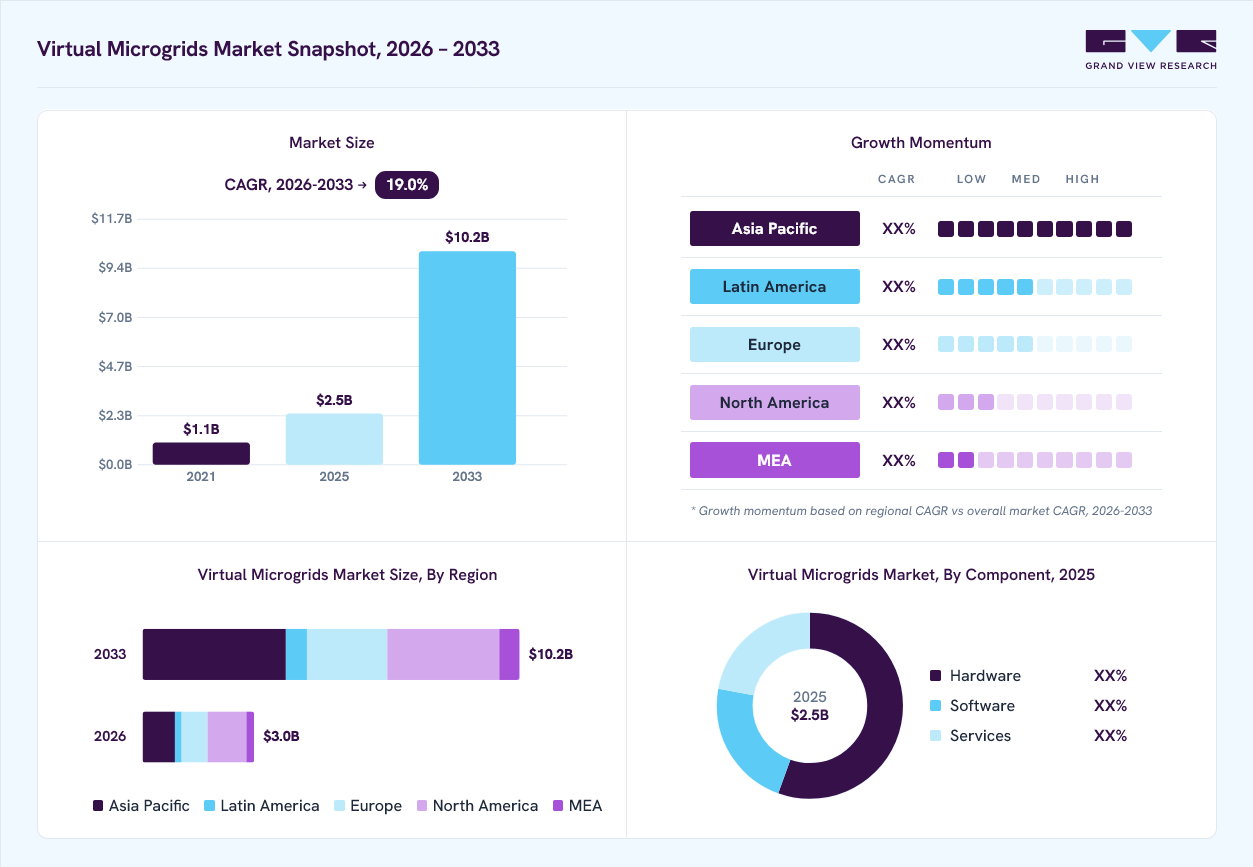
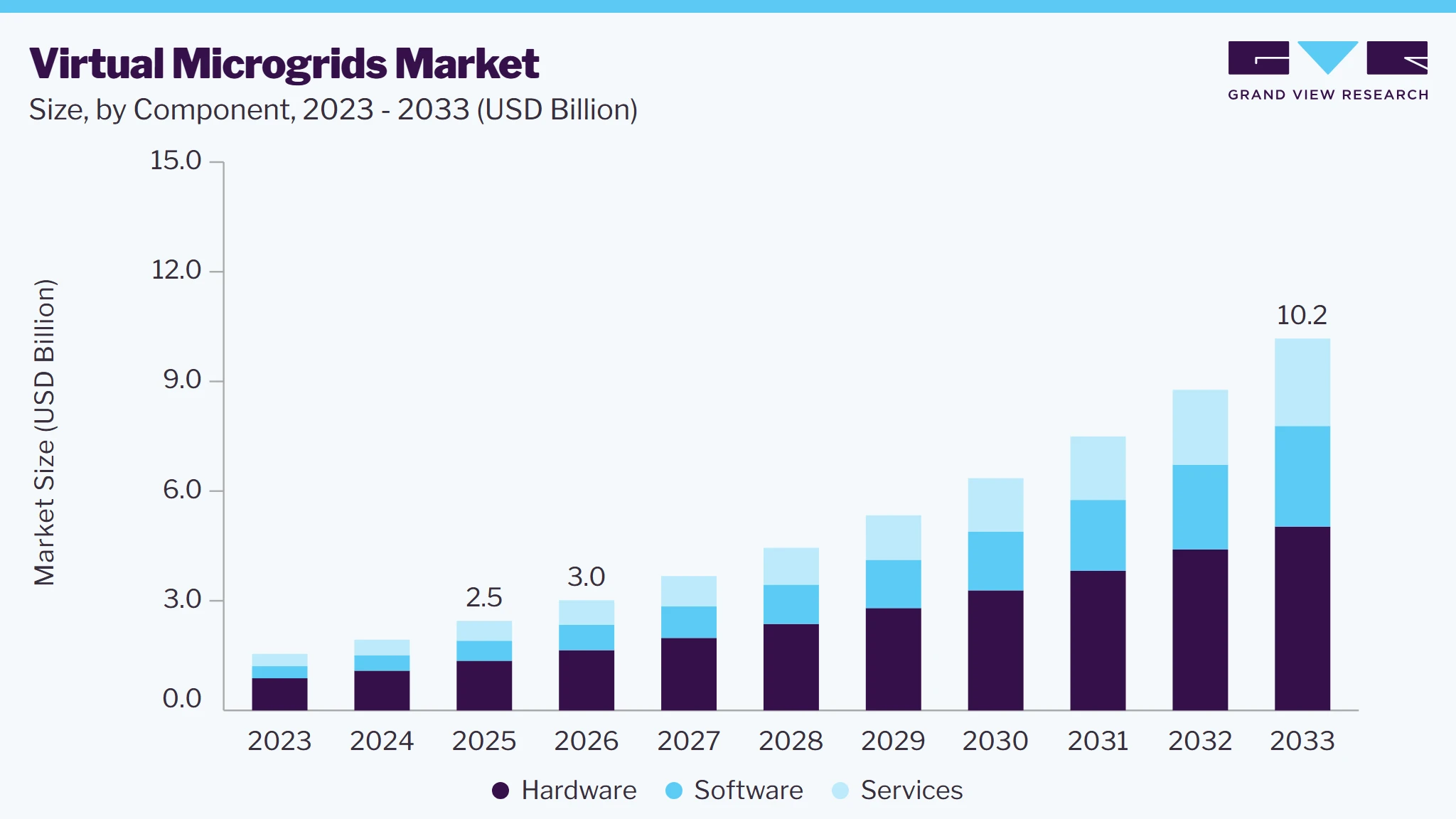
The global virtual microgrids market size was valued at USD 2.5 billion in 2025 and is projected to grow from USD 3.0 billion in 2026 to USD 10.2 billion by 2033, at a CAGR of 19.0% from 2026 to 2033. The market in North America dominated with a revenue share of 35.5% in 2025. The growing integration of distributed renewable energy, battery storage, and flexible loads is driving demand for virtual microgrids that can optimize decentralized power resources in real time.
Key Market Trends & Insights
- By component: Hardware segment held the largest market share of 55.4% in 2025.
- By energy source: Solar PV segment held the largest market share of 34.3% in 2025.
- By application: Commercial & industrial segment held the largest market share of 42.9% in 2025.
Regional Highlights
- Largest regional market: North America (35.5% revenue share, 2025)
- Fastest-growing regional market: Asia Pacific (highest CAGR, 2026-2033)
- By country: The U.S. held the largest market share in 2025
Market Size & Forecast
- Market size in 2025: USD 2.5 Billion
- Estimated market size in 2026: USD 3.0 Billion
- Projected market size by 2033: USD 10.2 Billion
- CAGR (2026-2033): 19.0%
Increasing focus on grid resilience, energy cost reduction, and decentralized energy management is further accelerating market adoption.Market Dynamics
The virtual microgrids industry is growing as businesses and communities seek more reliable, flexible, and cost-effective energy systems. Increasing adoption of distributed energy resources such as solar panels, battery storage, and electric vehicles is creating demand for digital platforms that can coordinate these assets. Rising grid instability, power outages, and the need to integrate renewable energy are further supporting market growth. High implementation costs, cybersecurity concerns, and complex grid integration can limit adoption. Advances in smart-grid technologies and energy management software are creating new opportunities for market expansion.
The growing need for reliable and uninterrupted power is driving the virtual microgrids industry. Virtual microgrids can coordinate distributed energy resources such as solar, batteries, and flexible loads to maintain power during grid disruptions. They also help utilities manage changing electricity demand and reduce the impact of extreme weather events. This makes them increasingly useful for critical facilities and communities seeking greater energy resilience.
For instance, in June 2025, the U.S. Department of Energy selected 14 microgrid projects under its Community Microgrid Assistance Partnership, including initiatives focused on advanced controls and monitoring software to improve microgrid performance. The Hughes project aims to enhance the integration and interoperability of diesel, solar PV, and battery assets through an improved microgrid controller, enabling more coordinated and flexible energy management.
The high implementation complexity of virtual microgrids is a key restraint on market growth. These systems require advanced software, communication networks, smart controls, and real-time coordination of multiple distributed energy resources. Integrating these technologies with existing grid infrastructure can be technically challenging and costly. Utilities may also need skilled personnel to operate and maintain these digital systems. Such technical and financial challenges can slow adoption, particularly among smaller utilities and communities.
The growing integration of solar power, battery storage, electric vehicles, and flexible loads creates new opportunities for virtual microgrid providers. Businesses can offer software platforms that coordinate these distributed energy resources as a single, flexible energy system. Such platforms can help utilities balance electricity demand, reduce peak loads, and improve grid reliability. Service providers can also generate revenue through energy management, demand response, and grid-support services.
Analyst Perspective
The market for virtual microgrids is moving toward software-driven energy management, as utilities increasingly seek to coordinate distributed energy resources across multiple locations. A key trend is the integration of AI, advanced controls, and real-time monitoring to optimize solar, battery storage, and flexible loads. This shift can improve grid flexibility while reducing reliance on costly infrastructure upgrades. However, adoption is likely to remain dependent on interoperability, cybersecurity, and integration costs. Overall, the market is expected to gain momentum as decentralized energy systems become more digitally connected.
Component Insights
The hardware segment held the largest revenue share of 55.4% in 2025, driven by the growing deployment of physical infrastructure required to establish and operate virtual microgrids, including distributed energy resources, smart meters, sensors, controllers, power conversion equipment, and communication devices. Increasing investments in distributed renewable generation, battery energy storage, and grid modernization are further supporting demand for hardware components, as utilities, commercial facilities, and industrial users deploy virtual microgrid systems to improve energy reliability, flexibility, and real-time power management.
The software segment is anticipated to register the fastest CAGR of 21.8% during the forecast period, driven by the increasing adoption of advanced energy management systems, real-time monitoring platforms, predictive analytics, and AI-enabled optimization tools for managing distributed energy resources. Growing integration of renewable energy, battery storage, electric vehicles, and flexible loads is further increasing the need for intelligent software solutions that enable automated control, demand response, energy forecasting, and efficient coordination of virtual microgrid assets.
Energy Source Insights
The solar PV segment held the largest revenue share of 34.3% in 2025, owing to the growing adoption of solar photovoltaic systems as a key distributed energy resource in virtual microgrids. Increasing investments in renewable energy, declining solar PV costs, supportive government policies, and the need for decentralized and reliable power generation are driving the integration of solar PV into virtual microgrid systems across residential, commercial, and industrial applications.
The battery energy storage is anticipated to register the fastest CAGR of 22.8% for the forecast period. This segment’s growth is driven by the increasing need for energy storage to balance intermittent renewable generation, improve grid flexibility, and ensure reliable power supply within virtual microgrids. Growing deployment of solar PV, declining battery costs, advancements in battery technologies, and rising demand for peak-load management and energy resilience are further accelerating the adoption of battery energy storage systems.
Application Insights
The commercial & industrial segment held the largest share of 42.9% in 2025, driven by the growing demand for reliable, flexible, and cost-effective energy management solutions across commercial buildings and industrial facilities. Increasing adoption of distributed renewable energy, battery storage, demand response, and real-time energy management systems is encouraging businesses to deploy virtual microgrids to reduce energy costs, improve power reliability, and optimize electricity consumption.
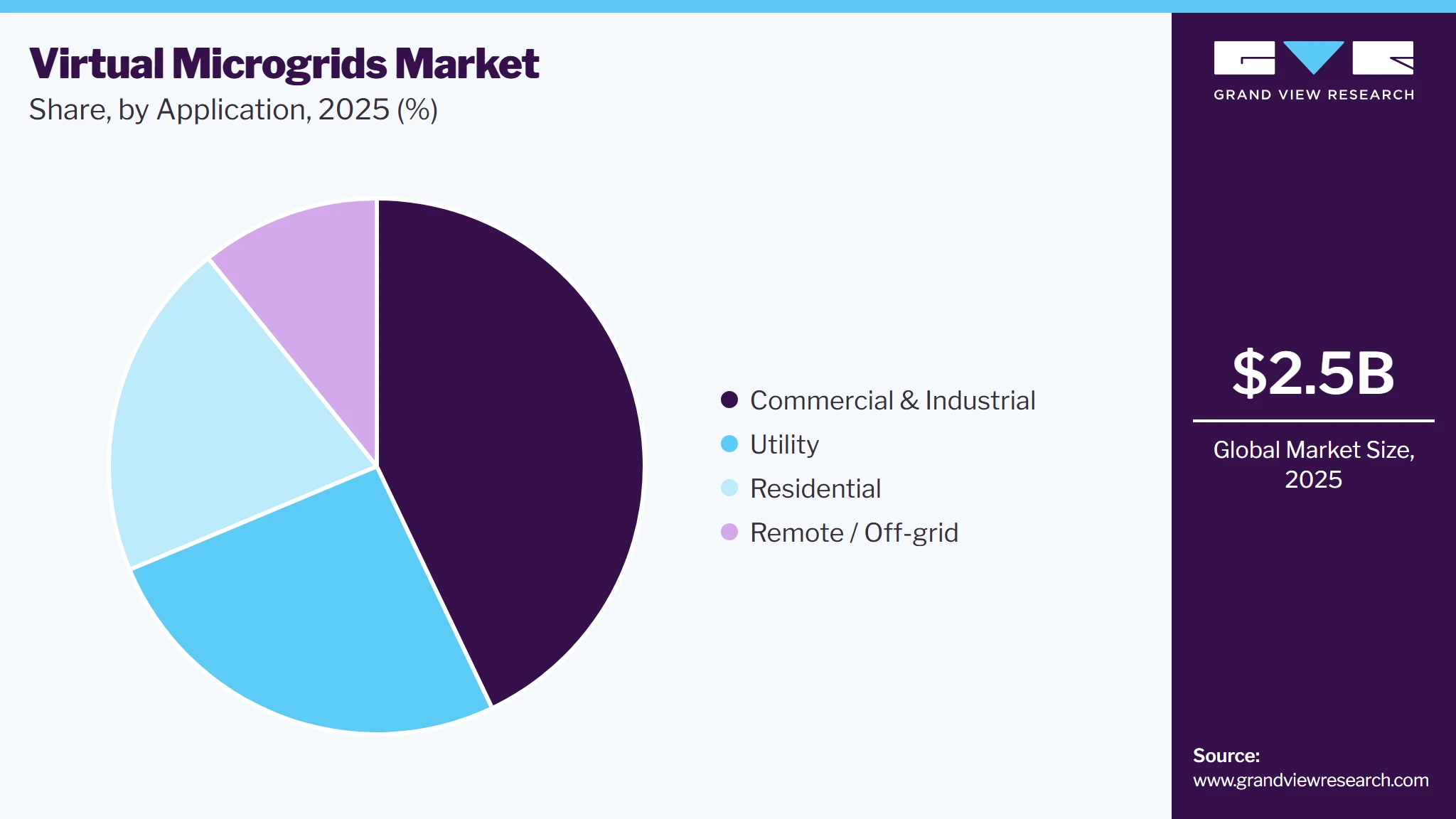
The residential segment is expected to register the fastest CAGR of 21.1% during the forecast period, supported by increasing household adoption of rooftop solar PV, battery energy storage, and smart energy management technologies. Rising electricity costs, growing interest in energy independence, increasing demand for backup power, and the expansion of distributed energy resources are encouraging households to adopt virtual microgrid solutions for improved energy efficiency, reliability, and resilience.
Regional Insights
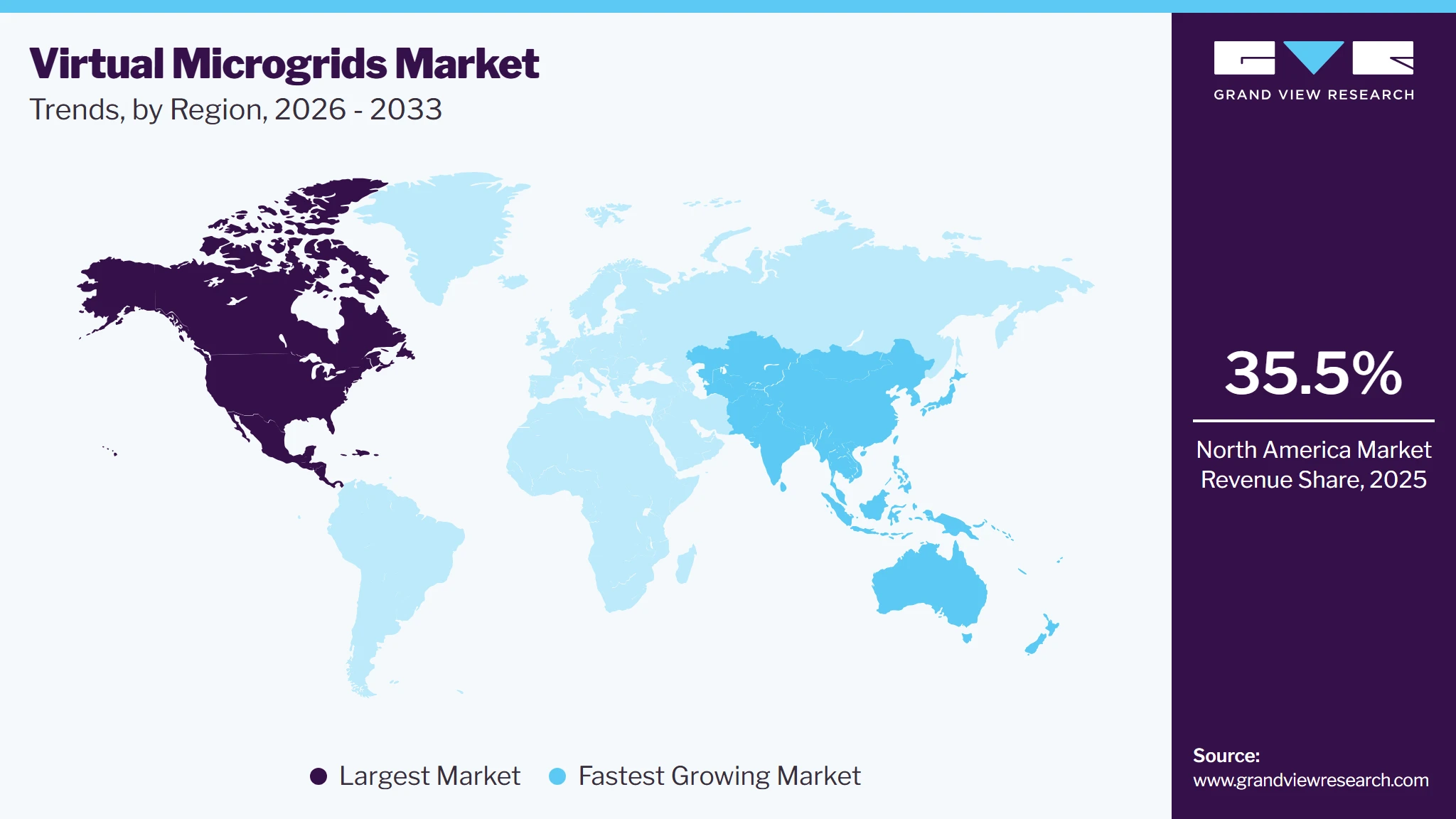
North America virtual microgrids industry was the leading market in 2025 with a revenue share of 35.5%. This growth is supported by growing investments in grid modernization, distributed energy resources, and renewable power integration. Increasing demand for reliable electricity and resilience against extreme weather events is encouraging utilities and businesses to adopt digitally managed energy systems. The region’s established microgrid infrastructure and growing deployment of battery storage further support market development. The increasing use of advanced controls, real-time monitoring, and energy management software is also creating opportunities for virtual microgrid solutions.
U.S. Virtual Microgrids Market Trends
The U.S. virtual microgrids industry is expanding as utilities and businesses seek greater grid flexibility, reliability, and integration of distributed energy resources. The increasing deployment of solar, battery storage, and smart energy management systems is creating demand for digitally coordinated microgrid solutions. Investments in grid modernization and resilience are further supporting adoption, particularly in areas exposed to extreme weather and power disruptions. The growing use of advanced controls and real-time monitoring is also creating opportunities for virtual microgrid providers.
Europe Virtual Microgrids Market Trends
Europe’s virtual microgrids industry is growing as the region increases its use of renewable energy, battery storage, and decentralized power systems. The growing need to balance variable renewable generation is creating demand for digital platforms that can coordinate distributed energy resources across multiple locations. Increasing grid modernization and smart energy initiatives are also supporting the adoption of advanced monitoring, control, and energy management solutions. This trend is creating opportunities for virtual microgrids to improve grid flexibility, reliability, and efficient energy use.
The UK virtual microgrids industry is developing as the country focuses on integrating renewable energy, battery storage, and distributed energy resources into a more flexible power system. Increasing pressure to manage variable renewable generation and local grid constraints is creating demand for digital platforms that can coordinate distributed assets in real time. Investments in smart-grid infrastructure and flexible energy management are further supporting market development. The UK’s growing focus on decentralized and digitally managed energy systems is expected to create opportunities for virtual microgrid solutions.
Asia Pacific Virtual Microgrids Market Trends
The Asia Pacific virtual microgrids industry is anticipated to register the fastest CAGR of 23.7% during the forecast period. The market is expanding due to rising electricity demand, rapid renewable energy deployment, and the need to modernize power grids. The growing integration of solar power and battery storage is increasing the need for digital platforms that can coordinate distributed energy resources efficiently. Investments in smart-grid infrastructure and decentralized energy systems are further supporting adoption. The region’s focus on improving power reliability and managing variable renewable generation is expected to create strong growth opportunities for virtual microgrid solutions.
Latin America Virtual Microgrids Market Trends
The Latin America virtual microgrids industry is developing as countries seek to improve power reliability, expand renewable energy use, and serve remote or underserved areas. Growing deployment of solar power and battery storage is creating demand for digital solutions that can coordinate distributed energy resources. Investments in grid modernization and decentralized power systems are also supporting market development. Virtual microgrids can help utilities manage variable renewable generation, reduce dependence on conventional power sources, and improve the flexibility of local electricity networks.
Middle East & Africa Virtual Microgrids Market Trends
The Middle East & Africa virtual microgrids industry is expected to witness steady growth, driven by rising demand for reliable and decentralized power solutions. Increasing renewable energy deployment, particularly solar power, is encouraging the integration of virtual microgrids to improve grid flexibility and energy management. The region’s remote communities, industrial facilities, and critical infrastructure are also creating demand for resilient power systems. In addition, digital energy management platforms and battery storage are supporting the adoption of virtual microgrids across the region.
Key Virtual Microgrids Company Insights
Some of the key players operating in the global virtual microgrids industry include GE Vernova and Siemens, among others.
-
GE Vernova is a major technology provider in the market, offering grid software, distributed energy management, and digital solutions that enable utilities and commercial and industrial customers to monitor, optimize, and coordinate distributed energy resources. Through its GridOS portfolio and related grid-edge capabilities, the company supports the integration of renewable generation, energy storage, demand response, and other distributed assets into flexible and intelligent microgrid environments. Its expertise in grid modernization, digitalization, and power management, combined with a broad global presence, positions GE Vernova as a key participant in the evolving virtual microgrids industry.
-
Siemens is a prominent technology provider in the market, offering digital energy management, automation, and grid solutions that support the monitoring, control, and optimization of distributed energy resources. Its microgrid solutions integrate renewable energy, energy storage, distributed generation, and intelligent control systems to improve energy efficiency, reliability, and grid flexibility across commercial, industrial, and utility applications. Siemens' strong capabilities in electrification, automation, and digitalization, along with its extensive global customer base and technology portfolio, position the company as a key participant in the development of virtual and digitally enabled microgrid systems.
Key Virtual Microgrids Companies:
The following key companies have been profiled for this study on the virtual microgrids market:
-
ABB
-
Bloom Energy
-
DNV
-
Eaton
-
FUERGY
-
GE Vernova
-
HexEMS
-
Honeywell International Inc.
-
Schneider Electric
-
Siemens
-
Tesla
Competitive Benchmarking
Category
Operating Strategies
Competitive Edge
Weakness
Established Players (ABB, Bloom Energy, Eaton, GE Vernova, Honeywell International Inc., Schneider Electric, Siemens, Tesla)
- Leverage extensive global operations, established customer relationships, and broad technology portfolios to provide integrated virtual microgrid, energy management, and distributed energy solutions.
- Invest in advanced digital platforms, AI-enabled energy management, grid software, and automation technologies to improve real-time monitoring, optimization, and control of distributed energy resources.
- Expand strategic partnerships with utilities, technology providers, renewable energy developers, and commercial and industrial customers to accelerate deployment of virtual microgrid solutions.
- Benefit from strong global brands, large installed customer bases, and long-standing relationships with utilities, industrial customers, and energy service providers.
- Offer end-to-end capabilities spanning power equipment, energy storage, automation, software, controls, and energy management, enabling integrated solution delivery.
- Possess significant financial and R&D resources to develop advanced digital energy platforms, AI capabilities, and next-generation grid technologies.
- Operate complex and diversified business structures that can make virtual microgrid solutions less specialized than those offered by focused technology providers.
- Face longer deployment cycles and higher implementation costs for integrated solutions, particularly for customized enterprise and utility-scale projects.
- Depend on legacy infrastructure and established product portfolios, which can reduce flexibility compared with smaller, software-focused competitors.
Emerging Players (DNV, FUERGY, HexEMS)
- Focus on specialized energy management, software platforms, AI-based optimization, and digital controls to address specific virtual microgrid requirements.
- Develop flexible and scalable solutions that integrate distributed energy resources, battery storage, renewable generation, and flexible loads through centralized digital platforms.
- Form partnerships with utilities, energy developers, technology providers, and commercial customers to expand market access without requiring extensive physical infrastructure.
- Offer specialized and flexible technologies designed specifically for energy optimization, virtual microgrid management, and distributed energy resource coordination.
- Benefit from leaner organizational structures that enable faster product development, customization, and response to changing customer requirements.
- Leverage cloud-based platforms, AI, automation, and data analytics to provide real-time energy optimization with comparatively lower infrastructure requirements.
- Have smaller financial resources, geographic footprints, and installed customer bases compared with established multinational energy and electrical-equipment companies.
- Face challenges in securing large-scale utility and industrial projects due to limited track records and lower brand recognition.
- Depend more heavily on strategic partnerships and third-party hardware providers to deliver complete virtual microgrid solutions.
Recent Developments
-
In November 2025, OPAL-RT highlighted the use of real-time simulation and Hardware-in-the-Loop (HIL) testing to virtually validate microgrid designs, controllers, and protection systems before physical deployment. The approach enables engineers to create high-fidelity digital models of microgrids and test them under scenarios such as generator failures, battery faults, load surges, and grid-islanding events without exposing physical equipment to risk. The technology supports the optimization of energy-management strategies, control settings, and protection systems while reducing commissioning risks, potential equipment damage, and project delays.
Virtual Microgrids Market Report Scope
Report Attribute
Details
Market Definition
The market size represents the revenue generated from the sale of virtual microgrid hardware, software, control, and energy management platforms, system integration, and related services by virtual microgrid solution providers.
Market size in 2025
USD 2.5 billion
Estimated market size in 2026
USD 3.0 billion
Projected market size by 2033
USD 10.2 billion
Growth rate
CAGR of 19.0% from 2026 to 2033
Base year for estimation
2025
Historical data
2021 - 2024
Forecast period
2026 - 2033
Quantitative Units
Revenue in USD billion, Volume in MW, and CAGR from 2026 to 2033
Report coverage
Revenue forecast, competitive landscape, growth factors, and trends
Segments covered
Component, energy source, application, and region
Regional scope
North America; Europe; Asia Pacific; Latin America; Middle East & Africa
Country scope
U.S.; Canada; Mexico; Germany; UK; France; Italy; Spain; China; India; Japan; South Korea; Australia; Brazil; Argentina; UAE; Saudi Arabia; South Africa
Key companies profiled
ABB; Bloom Energy; DNV; Eaton; FUERGY; GE Vernova; HexEMS; Honeywell International Inc.; Schneider Electric; Siemens; Tesla
Customization scope
Free report customization (equivalent up to 8 analysts working days) with purchase. Addition or alteration to country, regional & segment scope.
Pricing and purchase options
Avail customized purchase options to meet your exact research needs. Explore purchase options
Global Virtual Microgrids Market Report Segmentation
This report forecasts revenue growth at global, regional, and country levels and provides an analysis of the latest industry trends in each of the sub-segments from 2021 to 2033. For this study, Grand View Research has segmented the global virtual microgrids market report based on component, energy source, application, and region.
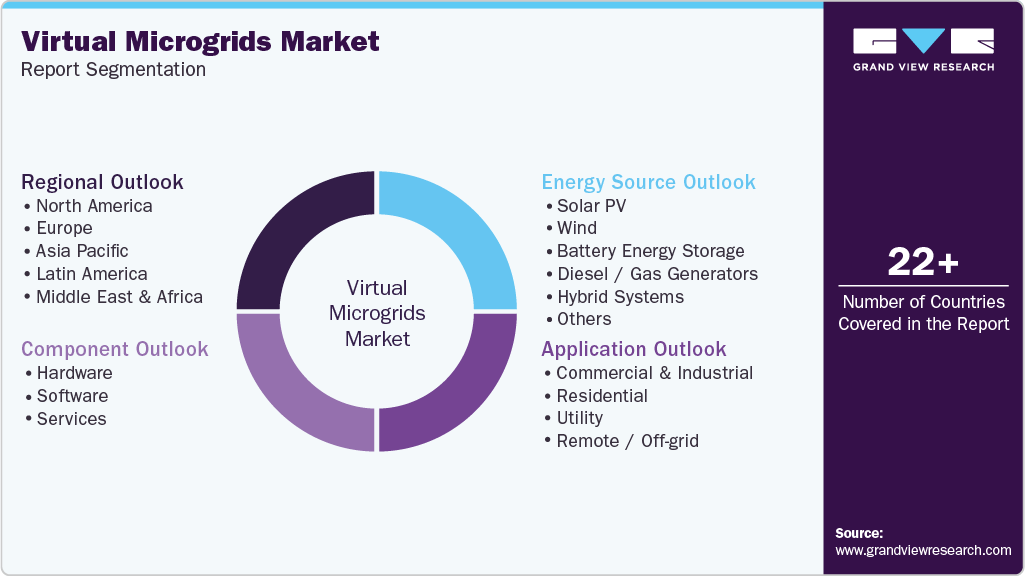
-
Component Outlook (Volume, MW; Revenue, USD Billion, 2021 - 2033)
-
Hardware
-
Software
-
Services
-
-
Energy Source Outlook (Volume, MW; Revenue, USD Billion, 2021 - 2033)
-
Solar PV
-
Wind
-
Battery Energy Storage
-
Diesel / Gas Generators
-
Hybrid Systems
-
Others
-
-
Application Outlook (Volume, MW; Revenue, USD Billion, 2021 - 2033)
-
Commercial & Industrial
-
Residential
-
Utility
-
Remote / Off-grid
-
-
Regional Outlook (Volume, MW; Revenue, USD Billion, 2021 - 2033)
-
North America
-
U.S.
-
Canada
-
Mexico
-
-
Europe
-
Germany
-
UK
-
France
-
Italy
-
Spain
-
-
Asia Pacific
-
China
-
India
-
Japan
-
South Korea
-
Australia
-
-
Latin America
-
Brazil
-
Argentina
-
-
Middle East & Africa
-
Saudi Arabia
-
UAE
-
South Africa
-
-
Research Methodology
The virtual microgrids market figures in this report are based on a proven research process that combines executive interviews with secondary research from proprietary databases, company filings, and recognized regulatory and institutional sources. Market size is built through value-chain sizing-reconciling supply-side and demand-side estimates-and triangulated with bottom-up and top-down approaches. Every estimate passes multiple levels of expert validation before publication, with each virtual microgrids segment quantified using the revenue-capture definitions in the table below.
Segment Definition
Segment - Component
Revenue capture definition
Hardware
Includes revenue generated from the sale of physical equipment used to establish and operate virtual microgrids, including energy storage systems, power conversion equipment, controllers, meters, inverters, communication devices, and other grid-edge hardware.
Software
Covers revenue from software platforms used to monitor, control, coordinate, forecast, and optimize distributed energy resources within virtual microgrid environments, including energy management, DER management, analytics, and digital control platforms.
Services
Captures revenue from services supporting virtual microgrid deployment and operation, including system integration, installation, commissioning, consulting, maintenance, monitoring, optimization, and technical support services.
Segment - Energy Source
Revenue capture definition
Solar PV
Includes revenue generated from virtual microgrid solutions integrating solar photovoltaic generation as a distributed energy resource for local electricity generation, energy optimization, and grid support.
Wind
Covers revenue from virtual microgrid solutions incorporating wind power generation as a distributed energy resource, including systems that digitally coordinate wind generation with loads, storage, and other energy assets.
Battery Energy Storage
Captures revenue from virtual microgrid solutions incorporating battery energy storage systems to store electricity, balance supply and demand, provide backup power, and optimize distributed energy resource utilization.
Diesel / Gas Generators
Includes revenue from virtual microgrid solutions integrating diesel or natural gas generators as dispatchable or backup generation sources to support reliability, peak demand management, and continuous power supply.
Hybrid Systems
Covers revenue from virtual microgrid solutions combining two or more energy sources, such as solar PV, wind, battery storage, and conventional generators, with digital platforms coordinating their operation.
Others
Captures revenue from virtual microgrid solutions integrating other distributed energy sources, including fuel cells, biomass, geothermal, small hydro, and other generation technologies not classified under the primary energy-source categories.
Segment - Application
Revenue capture definition
Commercial & Industrial
Includes revenue generated from virtual microgrid solutions deployed across commercial and industrial facilities to coordinate distributed energy resources, reduce electricity costs, improve energy efficiency, and enhance power reliability.
Residential
Covers revenue from virtual microgrid solutions serving residential customers by coordinating household solar PV, battery storage, electric vehicles, flexible loads, and other distributed energy resources.
Utility
Captures revenue from virtual microgrid solutions deployed or operated by utilities to aggregate and coordinate distributed energy resources, improve grid flexibility, manage peak demand, and support grid stability.
Remote / Off-grid
Includes revenue from virtual microgrid solutions serving remote or off-grid locations by digitally coordinating distributed generation, energy storage, and loads to provide reliable electricity where conventional grid connectivity is limited or unavailable.
Estimation Model
Layer Name
Key Question
Description
Component Layer
Which components contribute to virtual microgrid market revenue?
Assess revenue across hardware, software, and services. Analyze adoption based on demand for energy storage, power conversion and control equipment, energy management platforms, DER optimization software, system integration, maintenance, and technical services.
Energy Source Layer
Which energy sources drive virtual microgrid deployment?
Evaluate virtual microgrid adoption across solar PV, wind, battery energy storage, diesel/gas generators, hybrid systems, and other energy sources. Analyze demand based on renewable penetration, energy storage deployment, grid flexibility requirements, reliability needs, energy costs, and availability of distributed energy resources.
Application Layer
Which applications generate the highest demand for virtual microgrids?
Assess demand across commercial & industrial, residential, utility, and remote/off-grid applications. Analyze adoption based on electricity demand, energy cost optimization, grid resilience, distributed energy resource integration, demand response requirements, and the need for decentralized energy management.
Revenue Layer
How is market revenue generated?
Market revenue is quantified through the sale of virtual microgrid hardware and software and the provision of related services across commercial & industrial, residential, utility, and remote/off-grid applications. Revenue is influenced by distributed energy resource deployment, energy storage adoption, software and digitalization requirements, system integration costs, electricity prices, grid modernization investments, and demand for resilient and flexible energy systems.
Delivered Customizations
This report has been delivered with the following In-depth customizations
Client Request
Customization Delivered
Value Adds
Energy Source-Level Opportunity Assessment
Market analysis was performed across solar PV, wind, battery energy storage, diesel/gas generators, hybrid systems, and other energy sources by evaluating deployment levels, integration requirements, energy costs, grid flexibility, storage needs, and reliability requirements.
Enabled identification of the most attractive energy-source combinations based on deployment potential, technological maturity, grid requirements, and long-term growth opportunities.
Application-Level Opportunity Assessment
A detailed assessment was conducted across commercial & industrial, residential, utility, and remote/off-grid applications by evaluating electricity demand, distributed energy resource penetration, energy costs, resilience requirements, and adoption of digital energy management solutions.
Identified the highest-potential application segments and customer groups, supporting market-entry strategies, sales prioritization, and resource allocation.
Regional Opportunity Assessment
Country-level analysis was conducted to assess virtual microgrid adoption based on grid modernization initiatives, renewable energy penetration, distributed energy resource deployment, energy storage investments, electricity prices, resilience requirements, and regulatory support across key regions.
Identified high-growth countries with strong virtual microgrid adoption potential, increasing DER deployment, supportive policies, and favorable investment opportunities.
Frequently Asked Questions About This Report
The global virtual microgrids market size was valued at USD 2.5 billion in 2025 and is estimated at USD 3.0 billion for 2026.
The global virtual microgrids market is expected to grow at a CAGR of 19.0% from 2026 to 2033, reaching USD 10.2 billion by 2033.
The virtual microgrids market is driven by the increasing integration of renewable energy and distributed energy resources, rising demand for reliable and resilient power supply, and growing adoption of energy storage and advanced energy management technologies.
The North America region dominated the virtual microgrids market with a revenue share of 35.5% in 2025.
The U.S. dominated the North America region market with a revenue share of 85.8% in 2025.
Asia Pacific is anticipated to register the fastest CAGR of 23.7% over the forecast period.
Based on energy source, the solar PV segment accounted for largest revenue share of 34.3% in 2025.
Based on application, the commercial & industrial segment accounted for largest revenue share of 42.9% in 2025.
The key players operating in the virtual microgrids market are ABB, Bloom Energy, DNV, Eaton, FUERGY, GE Vernova, HexEMS, Honeywell International Inc., Schneider Electric, Siemens, Tesla, and others.
About the Author(s)
Distribution & Utilities Research Team
Energy & Power · Distribution & UtilitiesThis report was authored by the distribution & utilities research team at Grand View Research - comprising two research analysts, one senior research analyst, and one industry expert - with specialized expertise in the distribution & utilities segment of the energy & power industry. All findings are based on proprietary energy & power databases, executive interviews, and regulatory analysis, subject to internal peer review prior to publication.
Last Updated:
Speak to Analyst


Customize this report to your needs — add regions, segments, or data points, with 20% free customization.
Or view our licence options:


ISO 9001:2015 & 27001:2022 Certified
We are GDPR and CCPA compliant! Your transaction & personal information is safe and secure. For more details, please read our privacy policy.


