
- Home
- »
- Next Generation Technologies
- »
-
Virtual Router Market Size, Share And Trends Report, 2033GVR Report cover
![Virtual Router Market (2026 - 2033)Report]()
Virtual Router Market (2026 - 2033)
Size, Share & Trends Analysis Report By Component (Solution, Services), By Deployment Mode, By Application (SD-WAN & WAN Edge, Data Center & Cloud Networking), By End-use, By Region, And Segment Forecasts
Market Size, 2025
$479.2MMarket Estimate, 2026
$579.1MMarket Forecast, 2033
$2,578.1MCAGR, 2026–2033
23.8%Virtual Router Market Summary
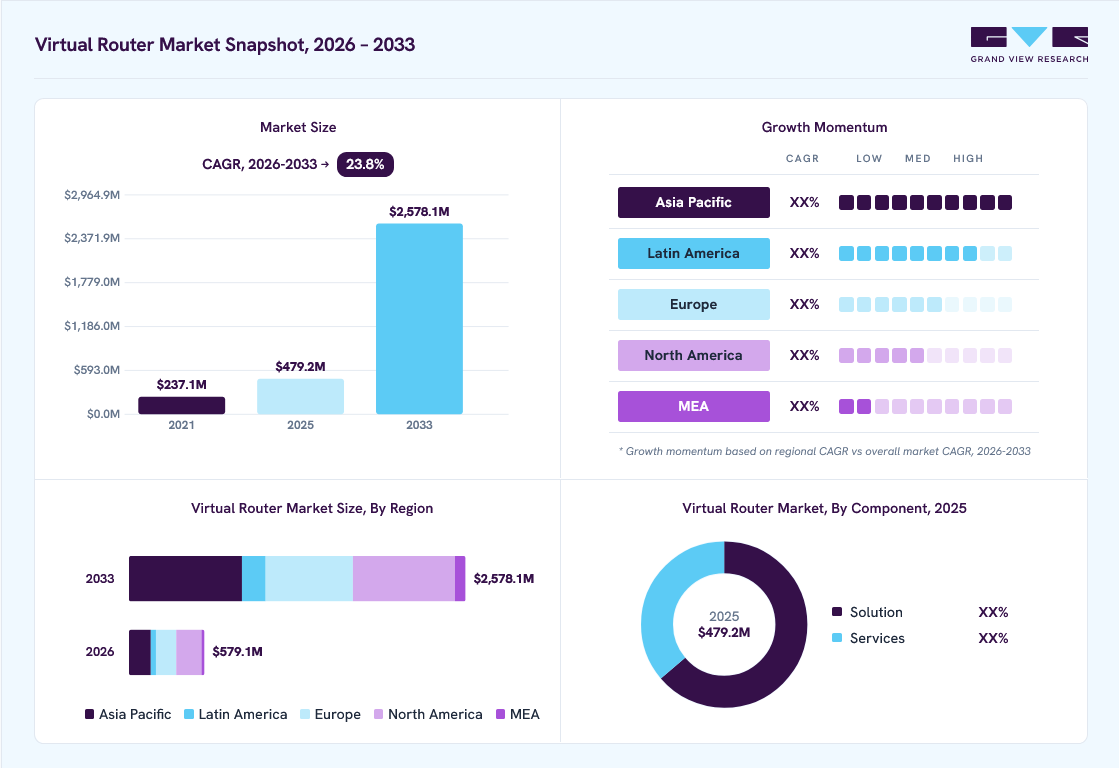
The global virtual router market size was valued at USD 479.2 million in 2025 and is projected to grow from USD 579.1 million in 2026 to USD 2,578.1 million by 2033, at a CAGR of 23.8% from 2026 to 2033. North America dominated the market, accounting for the largest revenue share of 33.8% in 2025. The market growth is driven by the increasing adoption of network virtualization, rising deployment of cloud-based services, and growing demand for flexible and scalable network infrastructure.
Key Market Trends & Insights
- By component: Solution segment held the highest revenue share of 63.7% in 2025.
- By deployment mode: Cloud-based segment accounted for the largest share of 63.4% in 2025.
- By application: SD-WAN & WAN edge segment dominated the market in 2025.
- By end use: Service providers segment held the largest market share in 2025.
Regional Highlights
- Largest regional market: North America (33.8% revenue share in 2025)
- Fastest growing regional market: Asia Pacific (highest CAGR 26.4%, 2026-2033)
- By Country: The U.S. held the largest share of North America in 2025.
Market Size & Forecast
- Market size in 2025: USD 479.2 Million
- Estimated market size in 2026: USD 579.1 Million
- Projected market size by 2033: USD 2,578.1 Million
- CAGR (2026-2033): 23.8%
The growth of the virtual router market is driven by the increasing complexity of enterprise network environments, rising demand for uninterrupted connectivity across distributed locations, and the growing need for centralized network control and traffic management. The expansion of remote and hybrid work environments, proliferation of branch offices and distributed endpoints, increasing use of containerized applications, and growing emphasis on network resilience are encouraging enterprises, telecom operators, cloud service providers, and data centers to adopt virtual routing solutions that enable flexible network provisioning, efficient traffic distribution, simplified operations, and improved service continuity.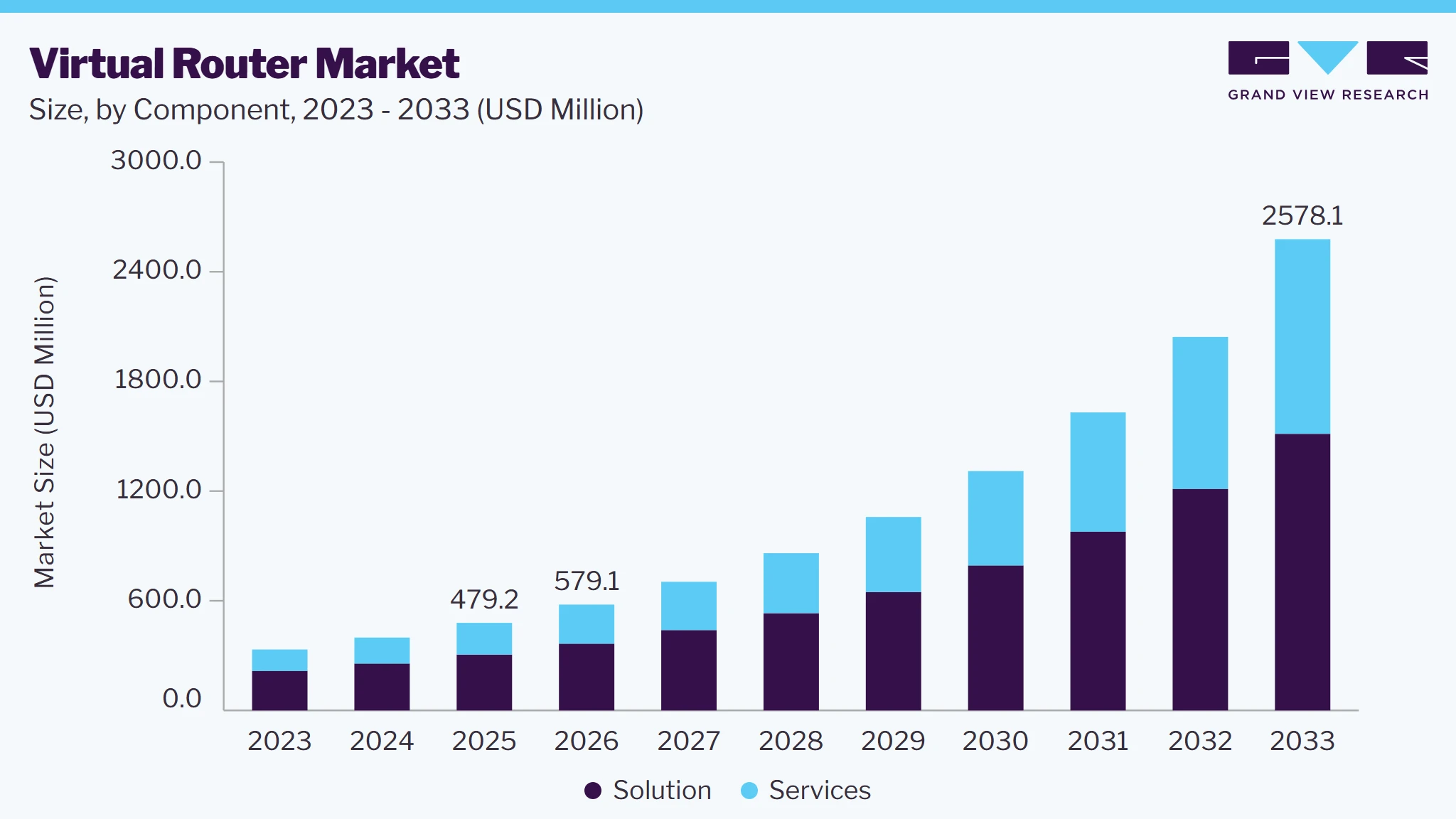
The increasing complexity of enterprise IT environments, rising demand for seamless connectivity across geographically dispersed operations, and growing reliance on real-time digital applications are strengthening demand for virtual router solutions. Enterprises are increasingly deploying virtualized routing to connect branch offices, remote locations, private networks, and cloud environments while improving network flexibility and reducing dependence on physical routing appliances. The expansion of distributed enterprise architectures, multi-site operations, and digital business processes is encouraging organizations to adopt software-based routing solutions that can be provisioned and modified according to changing connectivity requirements.
Additionally, the rapid expansion of network automation, artificial intelligence-driven IT operations, and centralized network orchestration is accelerating innovation in the virtual router market. Network operators are increasingly integrating virtual routing with automated provisioning, real-time traffic analysis, policy-based routing, and centralized monitoring capabilities to simplify network administration and improve operational visibility. These developments enable service providers and enterprises to dynamically allocate network resources, identify traffic bottlenecks, automate configuration changes, and respond more efficiently to changing network conditions, supporting greater operational efficiency across complex infrastructure environments.
Moreover, the increasing adoption of multi-cloud architectures, application modernization, and container-based workloads is creating new requirements for dynamic routing capabilities. Organizations are distributing applications and workloads across multiple cloud platforms, private infrastructure, and on-premises environments, increasing the need for consistent traffic management and connectivity across heterogeneous networks. Virtual routers provide software-based routing functions that can be deployed across these environments, enabling organizations to establish flexible network architectures, support application mobility, simplify interconnection between infrastructure platforms, and accommodate rapidly changing workload requirements.
Market Dynamics
The virtual router market is experiencing significant growth, driven by the increasing complexity of modern network architectures, rising demand for scalable connectivity across distributed IT environments, and growing emphasis on infrastructure flexibility. Enterprises and service providers are increasingly moving toward software-based network architectures that can support changing traffic requirements without extensive hardware modifications. The increasing need for rapid network provisioning, simplified infrastructure upgrades, improved resource utilization, and greater deployment flexibility is prompting organizations to incorporate virtual routing capabilities into enterprise, telecom, and data center environments.
The increasing shift toward resource-efficient network architectures is driving demand for virtual routers as organizations seek to consolidate routing functions onto shared computing infrastructure. Virtual routers enable multiple network functions to operate on common hardware resources, improving infrastructure utilization while reducing the need for dedicated appliances. This approach also supports more flexible allocation of processing capacity according to traffic requirements, making virtualized routing increasingly relevant for organizations managing diverse network workloads.
The ability to deploy routing functions through software is also encouraging organizations to modernize infrastructure provisioning practices. Virtual routers can be instantiated, relocated, or reconfigured without replacing physical routing equipment, allowing network resources to be adjusted as operational requirements change. This flexibility supports more responsive infrastructure management while reducing hardware dependencies. As organizations prioritize efficient utilization of existing computing resources, virtualized routing is becoming an increasingly practical component of modern network architectures.
Performance variability remains a key restraint for the virtual router market, particularly when routing workloads compete for shared processing, memory, or network resources. Unlike dedicated routing appliances, virtual routers depend on the underlying server infrastructure, hypervisor configuration, virtual switching layer, and resource allocation policies. Network virtualization research identifies performance improvement, quality-of-service assurance, network-function placement, and testing as important technical challenges, which can complicate deployment for performance-sensitive routing requirements.
The additional virtualization layers can increase the complexity of diagnosing latency, throughput, and packet-processing issues. Administrators may need to monitor interactions among virtual machines, host resources, virtual switches, network interfaces, and routing software to identify bottlenecks. Ensuring consistent service levels can therefore require specialized expertise, performance monitoring tools, and careful resource planning. These requirements can increase implementation complexity, particularly for organizations transitioning from established physical routing architectures to virtualized environments.
The increasing integration of network orchestration, programmable infrastructure, and automated service provisioning presents a significant opportunity for virtual router providers. Software-based routing functions can be incorporated into automated workflows that dynamically configure network services, allocate resources, and modify routing policies according to changing requirements. The broader evolution toward programmable network architectures creates opportunities for vendors to enhance virtual routers with centralized orchestration, policy automation, analytics, and application-aware traffic management capabilities.
Virtual routers can become important components of automated service chains where routing is coordinated with other virtualized network functions. Such architectures allow multiple network functions to be deployed and managed as software components rather than isolated physical appliances, supporting more adaptable infrastructure configurations. Further development of orchestration frameworks, standardized interfaces, and intelligent placement mechanisms can enable virtual router vendors to offer more automated, interoperable, and dynamically managed solutions across increasingly complex virtualized network environments.
Market Concentration & Characteristics
The virtual router market is moderately concentrated, comprising global networking vendors, telecommunications equipment providers, cloud networking companies, software-defined networking specialists, and specialized virtual network function providers competing across enterprise, telecommunications, cloud, data center, and service provider environments. The market is shaped by the increasing virtualization of network infrastructure, the demand for software-based routing, the expansion of distributed computing architectures, and the need for flexible network resource management. Strategic collaborations, technology integrations, open networking initiatives, and investments in cloud-native networking are enabling vendors to strengthen their portfolios and expand their presence across diverse deployment environments.
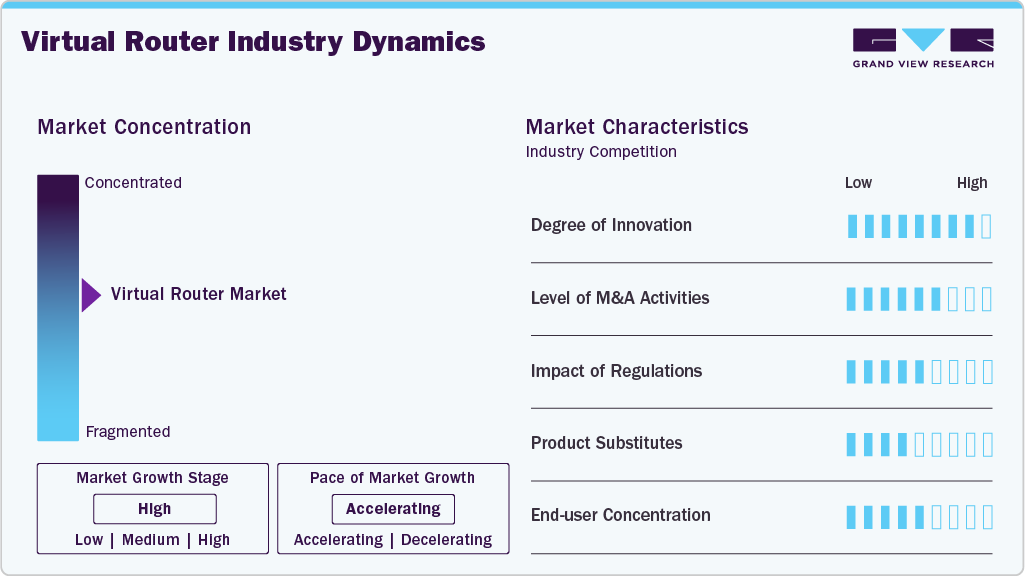
The market is characterized by a high degree of innovation, supported by continuous advancements in cloud-native routing, programmable networking, network automation, containerized network functions, high-performance packet processing, and centralized orchestration. The market is witnessing moderate merger and acquisition activity, as established networking companies acquire specialized software, security, cloud networking, and automation providers to broaden their technology capabilities. Competition from physical routers, white-box networking, integrated switching solutions, and cloud-native networking services remains moderate, while increasing adoption of automated network management, open networking architectures, and software-based infrastructure continues to strengthen product differentiation and competitive positioning.
Analyst Perspective
The virtual router market is advancing through the increasing virtualization of network infrastructure, rising adoption of cloud-native architectures, and growing requirements for scalable, programmable, and hardware-independent routing capabilities. Vendors are strengthening portfolios through high-performance packet processing, network automation, centralized orchestration, multi-cloud connectivity, and support for distributed workloads. The expansion of 5G, edge computing, AI-intensive infrastructure, and software-defined networking is encouraging organizations to modernize routing architectures, improve resource utilization, simplify network operations, and deploy routing functions more flexibly across increasingly complex network environments.
Component Insights
The solution segment accounted for the largest market share of 63.7% in 2025, propelled by increasing adoption of network virtualization, rising demand for software-defined infrastructure, and growing deployment of virtualized routing functions across telecom and enterprise networks. Organizations are increasingly implementing virtual router solutions to support SD-WAN, cloud connectivity, network security, data-center networking, and flexible traffic management. Reduced dependence on dedicated hardware, faster network provisioning, improved scalability, and centralized control continue to reinforce the segment’s leadership in the virtual router industry.
The services segment is expected to witness the highest CAGR of over 25% from 2026 to 2033. The segment is driven by increasing requirements for network migration, virtualization integration, managed networking, and technical support. Service providers are increasingly engaging providers for virtual router deployment, configuration, interoperability testing, cybersecurity integration, and ongoing maintenance. The growing complexity of hybrid and multi-cloud environments, shortage of specialized networking expertise, and rising demand for managed network operations are expected to accelerate the adoption of professional and managed services.
Deployment Mode Insights
The cloud-based segment accounted for the largest market share of 63.4% in 2025, fueled by increasing enterprise adoption of cloud infrastructure, rising demand for scalable network resources, and a growing preference for remotely managed networking environments. Organizations are increasingly deploying cloud-based virtual routers to support multi-cloud connectivity and rapid service provisioning without extensive hardware investments. Expanding cloud workloads, distributed branch operations, and the adoption of software-defined networking continue to strengthen demand for cloud-based virtual routing solutions.
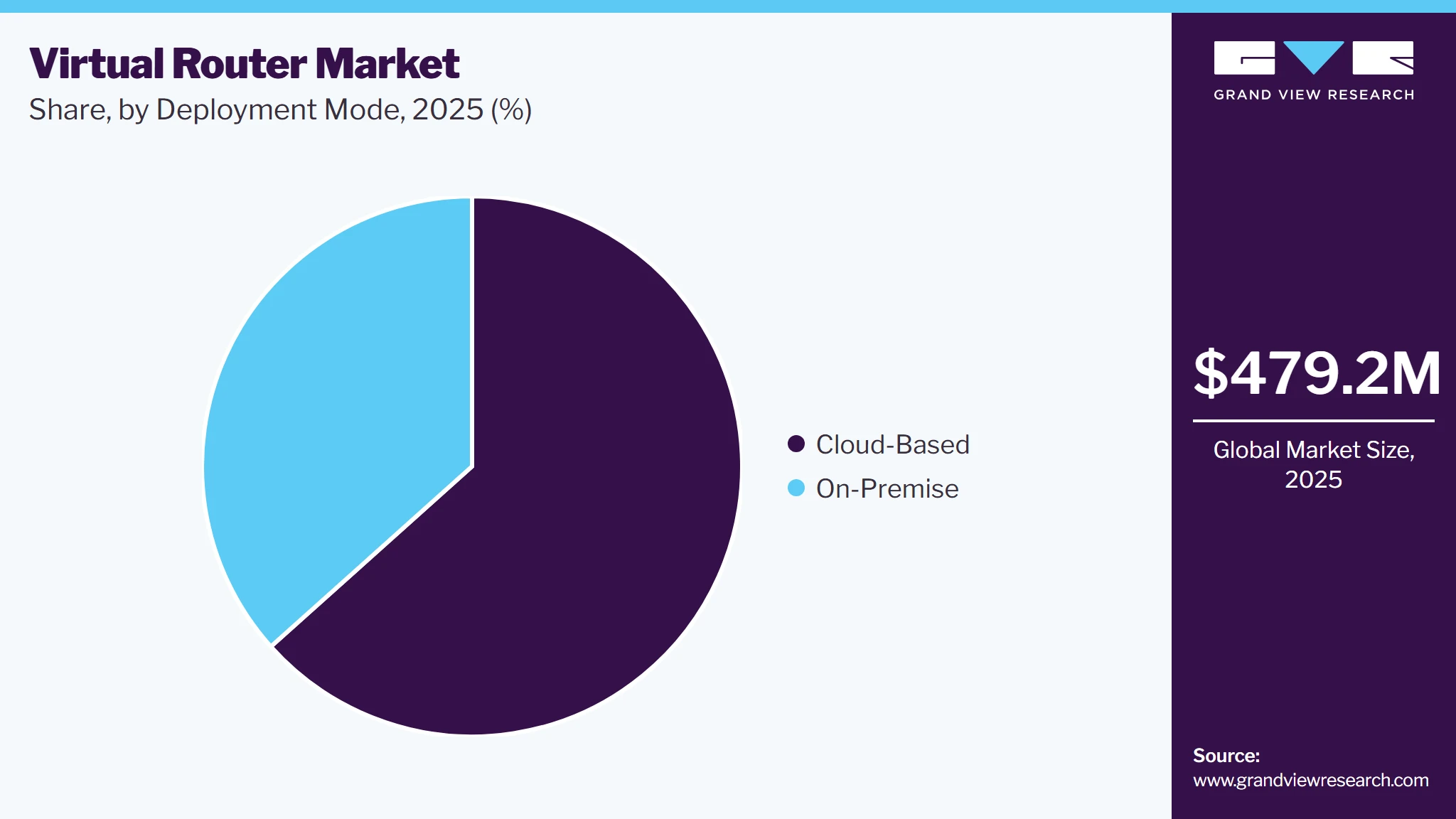
The on-premises segment is expected to witness a significant CAGR from 2026 to 2033, driven by rising requirements for greater network control, stringent data security policies, and increasing demand for customized routing environments. Enterprises, financial institutions, government organizations, and critical infrastructure operators are deploying on-premise virtual routers to maintain direct control over network traffic, comply with data governance requirements, and integrate routing functions with existing infrastructure. Growing cybersecurity concerns, regulatory requirements, and demand for dedicated network performance are supporting continued adoption of on-premise deployments.
Application Insights
The SD-WAN & WAN edge segment accounted for the largest market share, at 27.2%, in 2025, driven by increasing enterprise adoption of software-defined networking, rising demand for centralized network management, and growing requirements for flexible connectivity. Organizations are increasingly deploying virtual routers to optimize traffic routing, support multi-cloud connectivity, improve application performance, simplify branch networking, and reduce dependence on dedicated hardware. Rising adoption of hybrid work models, cloud applications, and geographically distributed operations continues to strengthen demand for virtualized WAN infrastructure.
The edge computing segment is expected to witness the highest CAGR from 2026 to 2033, driven by increasing deployment of distributed computing infrastructure, rising demand for low-latency data processing, and expansion of 5G-enabled edge networks. Enterprises, telecom operators, manufacturers, and digital infrastructure providers are increasingly deploying virtual routers at edge locations to manage localized traffic, connect distributed workloads, support real-time applications, and improve network responsiveness. Growing adoption of IoT, autonomous systems, industrial automation, and latency-sensitive applications is further accelerating the virtual routing industry.
End-use Insights
The service providers segment accounted for the largest market share, at 39.2% in 2025, driven by increasing adoption of network virtualization, rising demand for scalable telecom infrastructure, and growing deployment of software-defined networking across communication networks. Telecom operators are increasingly adopting virtual routers to support 5G network functions, network slicing, traffic optimization, and flexible bandwidth management. The need to reduce hardware dependency, improve network resource utilization, and accelerate service provisioning continues to strengthen the service providers segment.
The data center segment is expected to witness the highest CAGR from 2026 to 2033, driven by rapid data-center expansion, increasing cloud workload deployment, and rising demand for high-performance virtualized networking infrastructure. Data-center operators are increasingly implementing virtual routers to enable dynamic traffic management, workload mobility, and scalable east-west traffic routing. The growing adoption of edge data centers, distributed computing architectures, and cloud-native applications is further accelerating demand for virtual routing capabilities in modern data-center environments.
Regional Insights
North America virtual router market held the largest share of 33.8% in 2025, driven by the rapid expansion of hyperscale data centers, increasing adoption of multi-cloud architectures, and strong demand for high-performance connectivity across geographically distributed computing environments. The region has a mature ecosystem of cloud service providers, telecommunications operators, and large enterprises that are increasingly deploying software-based networking infrastructure to manage complex workloads. Rising investments in AI-oriented computing infrastructure and high-capacity data-center networks are further driving the need for flexible routing architectures capable of supporting intensive, distributed traffic flows.

U.S. Virtual Router Market Trends
The U.S. virtual router market dominated, with an 81.3% share in 2025, driven by the rapid deployment of AI infrastructure, the increasing virtualization of enterprise networks, and the expanding adoption of cloud-native application architectures. Large technology companies and cloud providers are investing heavily in data-center capacity to support AI workloads, creating demand for scalable networking infrastructure capable of managing high-volume traffic between computing resources. The increasing deployment of application-based network management and programmable infrastructure is encouraging organizations to shift toward software-based routing solutions that can be integrated with automated network environments.
Europe Virtual Router Market Trends
Europe virtual router market is expected to grow at a significant CAGR of 23.2% from 2026 to 2033. The market growth is driven by increasing modernization of telecommunications infrastructure, expanding deployment of private 5G networks, and the region's emphasis on open, interoperable digital infrastructure. Telecommunications operators are adopting network virtualization to improve infrastructure flexibility and introduce new services without relying exclusively on dedicated hardware. These developments are strengthening demand for virtualized routing across telecommunications, enterprise connectivity, data centers, and distributed computing environments.
The UK virtual router market is expected to grow significantly in the coming years, driven by the increasing adoption of hybrid cloud infrastructure, the expansion of managed network services, and the modernization of enterprise connectivity. Organizations are increasingly distributing applications between private infrastructure and public cloud platforms, creating demand for routing solutions that can provide consistent connectivity across heterogeneous environments. The country's strong financial services, technology, and professional services sectors are also encouraging investment in flexible network architectures that support geographically distributed operations, application modernization, and increasingly software-centric IT environments.
The Germany virtual router market is supported by the country's increasing deployment of connected manufacturing infrastructure and the growing requirement for reliable connectivity across distributed production environments. The country's manufacturing sector is increasingly integrating automation, industrial IoT, edge computing, and connected production systems, creating more complex communication requirements between facilities and computing resources. The deployment of private wireless networks and edge infrastructure is further encouraging organizations to adopt flexible routing architectures.
Asia Pacific Virtual Router Market Trends
The Asia Pacific virtual router market is expected to grow at the highest CAGR of 26.4% from 2026 to 2033, driven by rapid 5G deployment, expanding data center infrastructure, industrial digitalization, and increasing adoption of cloud-based services across emerging economies. Countries throughout the region are investing heavily in telecommunications modernization and digital infrastructure, while manufacturers are deploying connected production systems that require scalable network architectures. The combination of expanding mobile connectivity, private 5G deployment, cloud adoption, and industrial automation is creating strong requirements for virtualized routing across telecommunications and enterprise environments.
The Japan virtual router market is gaining traction owing to increasing adoption of edge computing, advanced telecommunications infrastructure, and digital transformation across manufacturing and enterprise environments. Japanese companies are increasingly deploying connected factories, robotics, industrial automation, and real-time data processing systems, requiring routing capabilities that can operate closer to distributed workloads. The country's focus on advanced network technologies, including next-generation mobile infrastructure, is also encouraging telecommunications providers and enterprises to adopt software-based network functions, which offer greater flexibility in managing distributed computing and connectivity requirements.
The China virtual router market is expanding rapidly, driven by large-scale telecommunications infrastructure investments, extensive data-center development, and accelerated industrial digitalization. Strong deployment of cloud computing, 5G connectivity, smart manufacturing, and connected industrial systems is increasing the complexity of national and enterprise networks. Domestic technology development and the presence of major telecommunications equipment providers are also supporting the adoption of locally developed networking technologies. Increasing requirements for high-capacity connectivity across industrial facilities, cloud platforms, and large-scale digital services are creating additional demand for virtualized routing architectures.
Key Virtual Router Company Insights
Some of the key players operating in the market are Cisco Systems, Inc., and Juniper Networks, Inc., among others.
-
Cisco Systems, Inc. maintains a strong position in the virtual router market through its broad portfolio of software-defined networking, network virtualization, and routing solutions. The company serves enterprises, telecommunications providers, cloud operators, and data-center customers with technologies designed to support virtualized network functions, automated network management, and scalable connectivity. Its extensive installed customer base, global distribution network, strong networking expertise, and continued investment in programmable infrastructure reinforce its competitive position across diverse virtual routing applications.
-
Juniper Networks, Inc. holds a prominent position in the virtual router industry by providing software-based routing capabilities for telecommunications, cloud, enterprise, and data-center environments. Its vMX virtual router enables routing functions to operate across standard computing infrastructure and cloud environments, supporting flexible deployment, traffic management, and network service delivery. The company's established routing technology, service provider relationships, and focus on automated, programmable networking solutions strengthen its ability to address evolving requirements of virtualized infrastructure.
6WIND and Arrcus, Inc. are some of the emerging market participants in the virtual router market.
-
6WIND is gaining traction in the virtual router market through its focus on high-performance software networking solutions for telecommunications providers, cloud environments, and enterprise networks. The company offers virtualized routing functions covering border routing, provider-edge connectivity, broadband gateway applications, virtual customer-premises equipment, and security gateways. Its ability to support bare-metal, virtual-machine, container, private-cloud, and public-cloud deployments provides customers with flexible infrastructure options while strengthening its position within the virtual router industry.
-
Arrcus, Inc. is establishing its presence in the virtual router industry through cloud-native routing technologies designed for data centers, edge networks, telecommunications infrastructure, and 5G environments. The company's software-based routing architecture emphasizes distributed networking, automation, scalability, and open interfaces across core, edge, metro, and aggregation networks. Its focus on disaggregated networking architectures and high-capacity routing offers an alternative to conventional hardware-centric infrastructure, supporting its adoption by organizations pursuing more flexible network deployments.
Key Virtual Router Companies:
The following key companies have been profiled for this study on the virtual router market.
-
Cisco Systems, Inc.
-
Juniper Networks, Inc.
-
Huawei Technologies Co., Ltd.
-
Nokia Corporation
-
Hewlett Packard Enterprise Development LP
-
6WIND
-
Arrcus, Inc.
-
Telefonaktiebolaget LM Ericsson
-
ZTE Corporation
-
Net gear Inc.
Competitive Benchmarking
Category
Operating Strategies
Competitive Edge
Weakness
Established Players (Cisco Systems, Inc., Juniper Networks, Inc., Huawei Technologies Co., Ltd.)
- Focus on expanding virtualized routing portfolios through partnerships in cloud, SDN, NFV, and automation.
- Invest heavily in R&D to deliver scalable, secure, high-performance routing solutions across network environments.
- Strong global presence established customer relationships, and extensive networking expertise support market leadership.
- Ability to provide scalable, secure, and integrated virtual routing solutions for complex network infrastructures.
- Dependence on complex legacy networking portfolios can slow migration toward cloud-native routing architectures.
- Large organizational structures may reduce agility compared with specialized virtual routing software providers.
Emerging Players (6WIND, Arrcus, Inc., ZTE Corporation)
- Emerging players are focusing on developing cloud-native virtual routing solutions for telecom, data center, and enterprise networks.
- Invest in software innovation, open networking, and automation to address evolving routing requirements.
- Flexible architectures, specialized technologies, and rapid product development enable differentiation against established networking vendors.
- Ability to deliver scalable, software-based routing solutions tailored to specific deployment and performance requirements.
- Limited global presence and smaller customer bases can constrain adoption across large-scale networking deployments.
- Lower financial resources and smaller portfolios may limit investments in extensive infrastructure and support networks.
Recent Developments
-
In June 2026, Cisco Systems, Inc. updated its IOS XRv 9000 virtual router documentation, reinforcing support for virtualized routing on x86-based infrastructure across VMware ESXi and KVM environments. The IOS XRv 9000 supports virtualized provider-edge routing and virtual route-reflector capabilities, strengthening Cisco’s software-based routing portfolio for cloud and network-function virtualization deployments.
-
In March 2026, Huawei Technologies Co., Ltd introduced new AI-powered networking and infrastructure solutions at MWC Barcelona, including technologies designed to support intelligent connectivity and AI-oriented network infrastructure. The company is increasingly combining intelligent automation, high-bandwidth networking, and cloud infrastructure capabilities, thereby strengthening its technology portfolio for software-driven, highly distributed network environments relevant to virtualized routing deployments.
-
In February 2026, Juniper Networks, Inc. introduced updates to its Mist AI platform that expanded VRF configuration capabilities across switching and campus-fabric environments. The development strengthens Juniper’s broader software-defined networking ecosystem by improving centralized configuration and management of virtualized network environments, supporting more flexible segmentation and routing operations across enterprise infrastructure.
Virtual Router Market Report Scope
Report Attribute
Details
Market size in 2025
USD 479.2 million
Estimated market size in 2026
USD 579.1 million
Projected market size by 2033
USD 2,578.1 million
Growth rate
CAGR of 23.8% from 2026 to 2033
Base year for estimation
2025
Historical data
2021 - 2024
Forecast period
2026 - 2033
Quantitative units
Revenue in USD million, and CAGR from 2026 to 2033
Report Product
Revenue forecast, company ranking, competitive landscape, growth factors, and trends
Segments covered
Component, deployment mode, application, end-use, region
Region scope
North America, Europe, Asia Pacific, Latin America, Middle East & Africa
Country scope
U.S.; Canada; Mexico; UK; Germany; France; China; Japan; India; South Korea; Australia; Brazil; Saudi Arabia; UAE; South Africa
Key companies profiled
Cisco Systems, Inc.; Juniper Networks, Inc.; Huawei Technologies Co., Ltd.; Nokia Corporation; Hewlett Packard Enterprise Development LP; 6WIND; Arrcus, Inc.; Telefonaktiebolaget LM Ericsson; ZTE Corporation; Net gear Inc.
Customization scope
Free report customization (equivalent to up to 8 analyst’s working days) with purchase. Addition or alteration to country, regional & segment scope.
Pricing and purchase options
Avail customized purchase options to meet you exact research needs. Explore purchase options
Global Virtual Router Market Report Segmentation
This report forecasts revenue growth at global, regional, and country levels and provides an analysis of the latest technological trends in each of the sub-segments from 2021 to 2033. For this study, Grand View Research has segmented the virtual router market report based on component, deployment mode, application, end use, and region:
-
Component Outlook (Revenue, USD Million, 2021 - 2033)
-
Solution
-
Services
-
-
Deployment Mode Outlook (Revenue, USD Million, 2021 - 2033)
-
Cloud-Based
-
On-Premise
-
-
Market Application Outlook (Revenue, USD Million, 2021 - 2033)
-
SD-WAN & WAN Edge
-
Data Center & Cloud Networking
-
Virtual Customer Premises Equipment (vCPE)
-
Network Security & VPN
-
Edge Computing
-
Others
-
-
End Use Outlook (Revenue, USD Million, 2021 - 2033)
-
Service Providers
-
Enterprises
-
Data Center
-
Others
-
-
Regional Outlook (Revenue, USD Million, 2021 - 2033)
-
North America
-
U.S.
-
Canada
-
Mexico
-
-
Europe
-
UK
-
Germany
-
France
-
-
Asia Pacific
-
China
-
Japan
-
India
-
South Korea
-
Australia
-
-
Latin America
-
Brazil
-
-
Middle East and Africa (MEA)
-
Saudi Arabia
-
UAE
-
South Africa
-
-
Research Methodology
The virtual router market figures in this report are based on a proven research process that combines executive interviews with secondary research from proprietary databases, company filings, and recognized regulatory and institutional sources. Market size is built through value-chain sizing-reconciling supply-side and demand-side estimates-and triangulated with bottom-up and top-down approaches. Every estimate passes multiple levels of expert validation before publication, with each virtual router segment quantified using the revenue-capture definitions in the table below.
Segment Definition
Segment - Component
Revenue capture definition
Solution
Revenue is generated from software-based virtual router platforms that perform routing, traffic forwarding, network segmentation, and connectivity functions without requiring dedicated physical routing hardware. This segment includes virtual routing software deployed across cloud, enterprise, telecommunications, data center, and edge environments.
Services
Revenue is captured through professional services, integration, deployment, maintenance, technical support, consulting, and managed services associated with virtual router solutions. This segment supports organizations in implementing, configuring, monitoring, upgrading, and optimizing virtualized routing infrastructure across complex network environments.
Segment - Deployment Mode
Revenue capture definition
Cloud-Based
Revenue is generated from virtual router solutions deployed within public, private, or hybrid cloud environments, enabling software-based routing across distributed infrastructure. This segment supports scalable connectivity, dynamic resource allocation, multi-cloud networking, workload mobility, and centralized network management.
On-Premise
Revenue is captured through virtual router solutions deployed on an organization's own servers, private infrastructure, or data center facilities. This segment serves organizations requiring greater control over routing infrastructure, network policies, security configurations, data management, and customized deployment environments.
Segment - Application
Revenue capture definition
SD-WAN & WAN Edge
Revenue is generated from virtual routing solutions used to manage wide-area connectivity across branch offices, remote locations, cloud platforms, and distributed enterprise networks. This segment supports traffic optimization, application-aware routing, centralized management, connectivity flexibility, and efficient WAN resource utilization.
Data Center & Cloud Networking
Revenue is captured through virtual routers used to connect servers, virtual machines, containers, cloud resources, and network segments within data center and cloud environments. This segment supports scalable traffic management, workload mobility, network segmentation, and software-defined infrastructure architectures.
Virtual Customer Premises
Equipment (vCPE)
Revenue is generated from virtual router functions deployed as software-based customer premises equipment at enterprise or subscriber locations. This segment enables service providers to deliver routing, connectivity, and network functions remotely while reducing dependence on dedicated customer-site hardware.
Network Security & VPN
Revenue is captured through virtual routing solutions that incorporate secure connectivity, VPN routing, traffic isolation, access control, and network segmentation. This segment supports secure communication between offices, remote users, cloud environments, data centers, and geographically distributed networks.
Edge Computing
Revenue is generated from virtual routers deployed near users, devices, applications, and distributed computing resources to manage localized traffic. This segment supports low-latency communication, distributed workloads, IoT environments, and geographically dispersed edge infrastructure.
Others
Revenue is generated from virtual router deployments for specialized applications not included in the major categories, such as network testing, research environments, specialized telecommunications infrastructure, industrial networks, and other software-defined networking applications.
Segment - End Use
Revenue capture definition
Service Providers
Revenue is generated from virtual router solutions deployed by telecommunications operators, internet service providers, managed network providers, and other connectivity providers. This segment supports broadband networks, 5G infrastructure, WAN services, network virtualization, traffic management, and large-scale customer connectivity.
Enterprises
Revenue is generated through virtual router deployments for businesses that require connectivity among offices, branches, cloud platforms, remote users, and internal networks. This segment supports hybrid networking, branch connectivity, WAN optimization, network segmentation, infrastructure flexibility, and centralized network management.
Data Center
Revenue is generated from virtual router solutions deployed by data center operators to manage traffic between servers, virtual machines, storage systems, cloud resources, and network segments. This segment supports high-volume traffic management, workload mobility, scalable connectivity, and software-defined data center architectures.
Others
Revenue is captured from virtual router adoption across government organizations, educational institutions, financial institutions, healthcare organizations, research facilities, and other specialized users requiring flexible, secure, and software-based network connectivity.
Estimation Model
Layer Name
Key Question
Description
End-User Adoption Layer
Who are the potential adopters?
Identifies enterprises, telecommunications operators, cloud service providers, data center operators, managed service providers, government organizations, financial institutions, and other organizations requiring scalable, software-based routing infrastructure.
Product Enablement Layer
Who can provide virtual router solutions?
Deployment depends on networking equipment manufacturers, virtual networking software providers, cloud infrastructure companies, telecommunications technology vendors, SDN/NFV specialists, network security providers, and specialized virtual routing solution developers supporting diverse networking environments.
Network Deployment Layer
Where are virtual routers currently used?
Virtual routers are deployed across enterprise networks, telecommunications infrastructure, cloud environments, data centers, branch offices, edge computing locations, 5G networks, service provider networks, and hybrid or multi-cloud architectures to manage routing and connectivity requirements.
Revenue Generation Layer
How is revenue generated?
Revenue is generated through virtual router software licenses, subscription-based offerings, cloud-based deployments, software support services, maintenance contracts, managed networking services, professional services, upgrades, customization, and integrated network infrastructure solutions.
Delivered Customizations
This report has been delivered with the following In-depth customizations
Client Request
Customization Delivered
Value Adds
Virtual Router Deployment Strategy Assessment
Evaluated virtual router deployment across enterprises, telecom networks, cloud environments, and data centers, assessing virtualization architecture, routing workloads, infrastructure compatibility, scalability requirements, and deployment models.
Improves deployment efficiency, scalability, infrastructure utilization, and routing performance.
Cloud-Native Routing Architecture Evaluation
Assessed cloud-native virtual routing architectures across public, private, and hybrid cloud environments, analyzing software-based routing, containerized network functions, workload mobility, interoperability, automation, and network orchestration requirements.
Enables flexible routing, simplifies cloud integration, and supports distributed workloads.
5G Network Virtualization Strategy
Evaluated virtual routing requirements within 5G networks, focusing on network slicing, edge connectivity, traffic segmentation, service orchestration, routing scalability, and integration with virtualized network functions across telecommunications infrastructure.
Supports scalable 5G connectivity, network flexibility, traffic management, and service deployment.
Frequently Asked Questions About This Report
The global virtual router market size was valued at USD 479.2 million in 2025 and is estimated at USD 579.1 million in 2026.
The global virtual router market is expected to grow at a compound annual growth rate of 23.8% from 2026 to 2033 to reach USD 2,578.1 million by 2033.
The solution segment dominated with a 63.7% revenue share in 2025.
North America dominated the virtual router market with a share of 33.8% in 2025.
Some key players operating in the virtual router market include Cisco Systems, Inc., Juniper Networks, Inc., Huawei Technologies Co., Ltd., Nokia Corporation, Hewlett Packard Enterprise Development LP, 6WIND, Arrcus, Inc., Telefonaktiebolaget LM Ericsson, ZTE Corporation, Net gear Inc.
Key factors that are driving the market growth include increasing adoption of network virtualization, rising deployment of cloud-based services, and growing demand for flexible and scalable network infrastructure. The expansion of 5G networks, network function virtualization (NFV), SD-WAN, and edge computing is further accelerating demand for virtual routers.
The SD-WAN & WAN edge segment dominated with a 27.3% revenue share in 2025.
The service providers segment dominated the market with a share of 39.2% in 2025.
The Asia Pacific is the fastest-growing region with a CAGR of over 26% from 2026 to 2033.
About the Author(s)
Next Generation Technologies Research Team
Technology · Next Generation TechnologiesThis report was authored by the next generation technologies research team at Grand View Research - comprising two research analysts, one senior research analyst, and one industry expert - with specialized expertise in the next generation technologies segment of the technology industry. All findings are based on proprietary technology databases, executive interviews, and regulatory analysis, subject to internal peer review prior to publication.
Last Updated:
Speak to Analyst


Customize this report to your needs — add regions, segments, or data points, with 20% free customization.
Or view our licence options:


ISO 9001:2015 & 27001:2022 Certified
We are GDPR and CCPA compliant! Your transaction & personal information is safe and secure. For more details, please read our privacy policy.


