
- Home
- »
- Advanced Interior Materials
- »
-
Waste-to-Fiber Technologies Market Size Report, 2026-2033GVR Report cover

Waste-to-Fiber Technologies Market (2026 - 2033)
Size, Share & Trends Analysis Report By Waste Type (Textile Waste, Plastic Waste, Agricultural Waste), By Technology (Mechanical Recycling, Chemical Recycling, Biological Recycling), By End Use, By Region, And Segment Forecasts
Market Size, 2025
$14.2BMarket Estimate, 2026
$15.2BMarket Forecast, 2033
$25.1BCAGR, 2026–2033
7.4%Waste-to-Fiber Technologies Market Summary
The global waste-to-fiber technologies market size was estimated at USD 14.2 billion in 2025 and is projected to grow from USD 15.2 billion in 2026 to USD 25.1 billion by 2033, at a CAGR of 7.4% from 2026 to 2033. Asia Pacific dominated the market, accounting for the largest revenue share of 49.6% in 2025. The market is gaining importance as textile manufacturers, brands, recyclers, and governments seek alternatives to virgin raw materials and conventional waste-management practices.
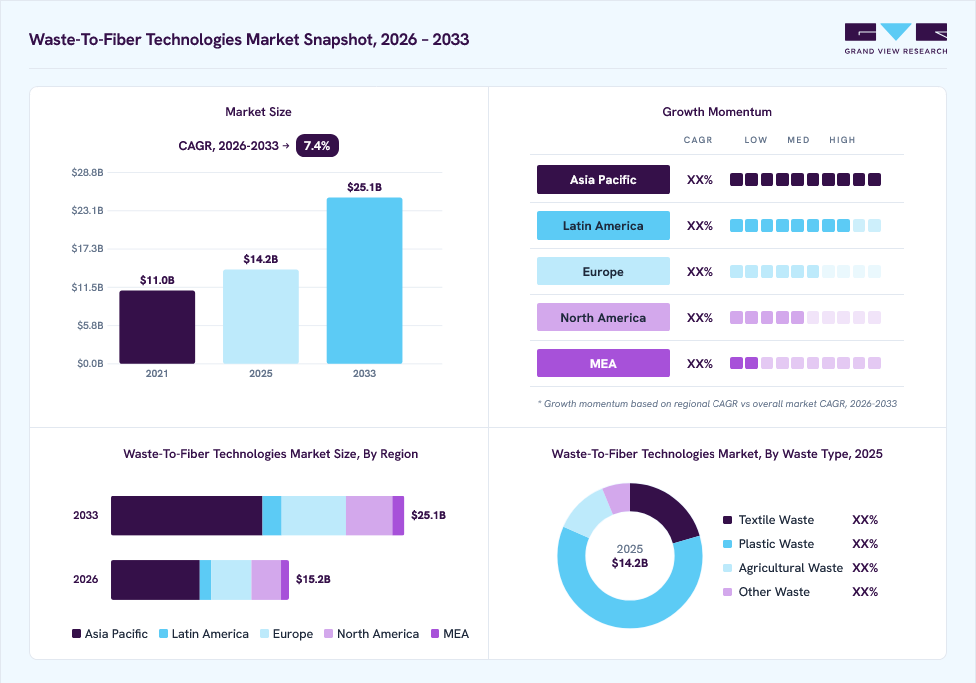 Source: Grand View Research, IR Documents, Primary Interviews, Paid DatabasesTo learn more about this report,
 Download Free Sample Report
Key Market Trends & Insights
- By waste type: The textile waste segment is expected to grow at a CAGR of 8.0% over the forecast period.
- By end use: The apparel & garments segment dominated the market with a revenue share of 54.9% in 2025.
- By technology: The biological recycling segment is projected to register a CAGR of 8.4% from 2026 to 2033.
Regional Highlights
- Largest regional market: Asia Pacific (49.6% revenue share, 2025)
- By country: China held the largest market share in 2025
Market Size & Forecast
- Market size in 2025: USD 14.2 Billion
- Estimated market size in 2026: USD 15.2 Billion
- Projected market size by 2033: USD 25.1 Billion
- CAGR (2026-2033): 7.4%
GVR research-powered AIAsk Prism AI about the Waste-to-Fiber technologies marketGet cited answers from GVR research on market growth, segments, regulations and forecasts.Start with✓ Source-linked answers ✓ Market-specific context ✓ Traceable figuresExplore Prism AI ↗
Increasing volumes of post-consumer and pre-consumer textile waste are creating demand for technologies that can recover usable fibers from discarded garments, production scraps, blended textiles, and other difficult-to-recycle materials. The market encompasses mechanical recycling, chemical recycling, thermomechanical processing, fiber separation, purification, and advanced sorting technologies.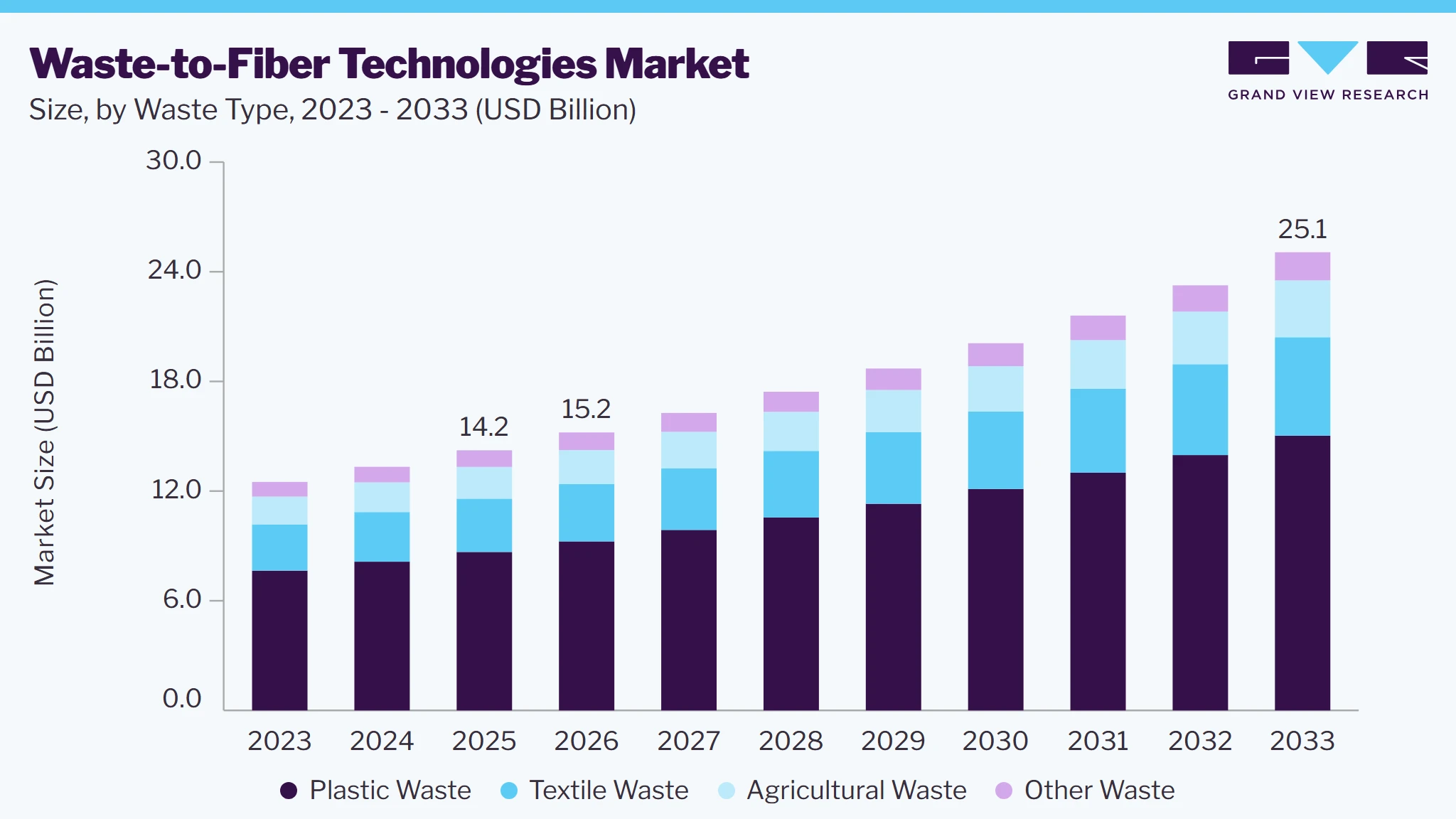 To learn more about this report, Download Free Sample Report
A major factor supporting market development is the growing requirement to improve resource efficiency across the textile value chain. Conventional mechanical recycling remains important for relatively clean and homogeneous textile waste, while chemical and hybrid technologies are being developed to address polyester, cotton, elastane, and blended materials that are difficult to process mechanically. Advances in automated identification, hyperspectral imaging, near-infrared sensing, artificial intelligence, and robotic sorting are helping recyclers improve feedstock quality before fiber recovery.
Technological innovation is shifting the market from basic fiber recovery toward integrated waste-to-fiber systems that combine sorting, preprocessing, separation, purification, recycling, and digital traceability. AI-enabled and multisensor sorting systems are being developed to identify fiber composition and direct materials toward the most appropriate recovery route, while chemical and thermomechanical technologies are being refined for mixed textile streams. European research projects are also combining digital material or product passports with recycling technologies to improve feedstock matching and supply-chain transparency.
Market Dynamics
The waste-to-fiber technologies market is being shaped by the transition from linear textile production toward circular material systems, with increasing emphasis on converting discarded textiles into new, usable fibers rather than downcycling or disposing of them. Market dynamics are influenced by the growing availability of post-consumer and post-industrial textile waste, stricter policies supporting separate collection and recycling, and rising demand for recycled fibers from textile manufacturers and brands. Meanwhile, the market is undergoing rapid technological development across mechanical recycling, chemical recycling, fiber separation, automated sorting, and preprocessing technologies, particularly to address blended and contaminated textiles.
The increasing availability of textile waste is strengthening the need for technologies capable of converting discarded materials into usable fibers and secondary raw materials. European textile-recycling initiatives indicate that large quantities of textile waste remain outside high-value recycling pathways, while a significant portion of recovered material is still downcycled into lower-value applications. This creates a substantial technological gap between waste collection and the production of textile-grade recycled fibers.
Demand is also being supported by the shift from linear textile production toward circular material flows. Mechanical recycling can provide relatively straightforward recovery for suitable textile streams, whereas chemical, thermomechanical, and hybrid processes can potentially address more complex materials and blended fabrics. Projects such as PESCO-UP are demonstrating approaches that combine automated sorting, purification, separation, and downstream processing for cotton-polyester waste.
The heterogeneous nature of textile waste remains a major constraint on technology deployment. Garments may contain multiple fiber types, dyes, finishes, elastane, coatings, buttons, zippers, and other components that complicate sorting and recycling. Mechanical processes can experience quality deterioration when fibers are repeatedly shortened, while chemical processes can require more sophisticated purification, separation, chemical management, and process controls. The economic viability of recycling therefore depends heavily on the quality and consistency of incoming feedstock, processing yields, energy and chemical requirements, and the ability to sell the resulting fibers at competitive prices.
The integration of AI, hyperspectral imaging, near-infrared sensing, multisensor systems, and digital product information represents a major opportunity for the market. More accurate identification of fiber composition can improve sorting quality and ensure that waste is directed toward the most appropriate recycling process. Digital Product Passports and related traceability systems could further provide recyclers with information on material composition and product characteristics before processing. This combination of digital identification and physical recycling technology can reduce contamination, improve feedstock matching, increase process efficiency, and support higher-value fiber-to-fiber recycling.
Market Concentration & Characteristics
The waste-to-fiber technologies market is relatively fragmented, as it combines several distinct technology areas rather than a single standardized recycling process. The competitive landscape includes mechanical recyclers, chemical recycling technology developers, textile sorting specialists, equipment manufacturers, fiber producers, research organizations, and vertically integrated textile companies. Established recycling technologies coexist with emerging companies developing proprietary chemical, thermomechanical, separation, and purification processes. The market is also characterized by pilot plants and demonstration projects, indicating that several technologies are still progressing toward large-scale commercialization.
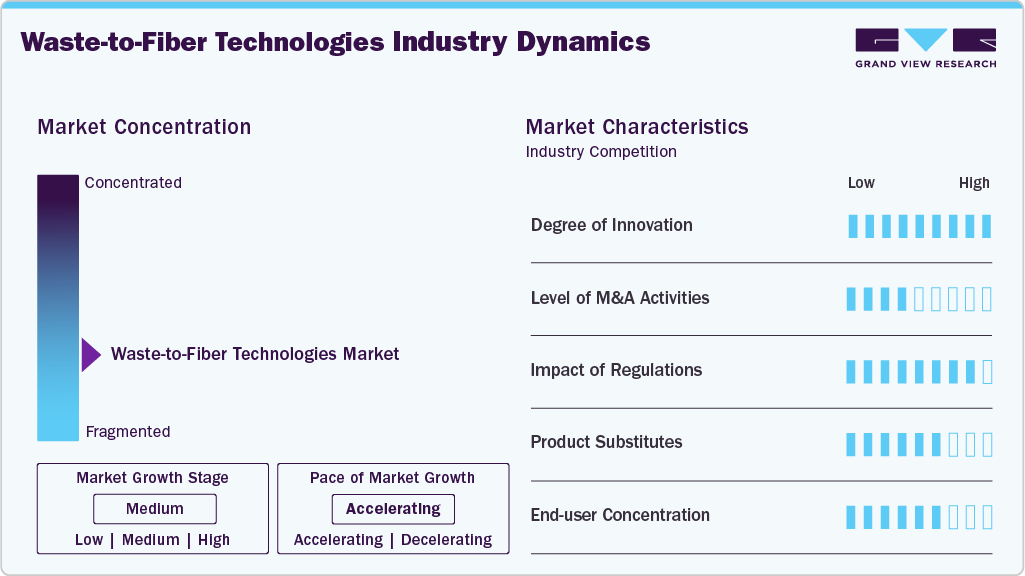 To learn more about this report, Download Free Sample Report
The primary substitutes for waste-to-fiber technologies are virgin fiber production, conventional recycled-fiber technologies, downcycling, reuse, and other waste-management routes such as incineration. Virgin cotton and synthetic fibers remain widely available and can offer predictable quality, established supply chains, and consistent processing characteristics. Reuse and repair can also divert textiles away from recycling altogether, while mechanical recycling may substitute for more complex chemical processes when the feedstock is suitable.
Analyst Perspective
The waste-to-fiber technologies market is transitioning from a niche recycling activity toward a strategically important component of the circular materials economy, supported by rising textile waste volumes, increasing demand for recycled fibers, and regulatory pressure to improve material recovery. From an analyst perspective, the strongest growth potential lies in technologies that can process difficult waste streams such as blended textiles, contaminated post-consumer materials, and mixed polymer-fiber products while producing fibers with consistent quality suitable for higher-value applications. Mechanical recycling is expected to remain important for relatively homogeneous waste, while chemical, biological, and hybrid technologies offer greater long-term potential for challenging feedstocks.
Waste Type Insights
The plastic waste segment held the highest revenue share of 60.9% in 2025, supported by the large availability of recyclable polyester and PET-based waste streams and the established infrastructure for converting these materials into textile-grade fibers. Plastic-derived feedstocks can be processed through established mechanical and advanced chemical recycling pathways, enabling the production of recycled polyester fibers for apparel, home textiles, nonwovens, and industrial applications. The availability of relatively consistent PET feedstock and growing demand for recycled polyester further support the segment's commercial position.
The textile waste segment is expected to grow at a CAGR of 8.0% over the forecast period, as the industry increasingly shifts from conventional waste management and downcycling toward textile-to-textile fiber recovery. Rising post-consumer textile waste, increasing collection and sorting initiatives, and the development of technologies capable of processing blended and contaminated textiles are expanding the addressable feedstock base. Recent research particularly highlights the need for improved recycling solutions for mixed-fiber textiles, creating opportunities for advanced mechanical, chemical, and biological waste-to-fiber technologies.
Technology Insights
The mechanical recycling segment held the highest revenue share of 65.3% in 2025, due to its established commercial application, relatively straightforward processing requirements, and ability to convert suitable textile waste into reusable fibers without fundamentally changing the material's chemical structure. Processes such as shredding, opening, carding, blending, and respinning are already widely used for textile waste recovery, particularly for relatively homogeneous pre-consumer materials. Its comparatively lower processing complexity and established infrastructure continue to support its market position, although fiber degradation and limitations with blended textiles create opportunities for complementary recycling technologies.
The biological recycling segment is expected to grow at a CAGR of 8.4% over the forecast period, as research and commercialization efforts increasingly explore enzymes, microorganisms, and other biological processes for selectively recovering valuable components from textile waste. Biological approaches offer potential advantages for treating complex materials under comparatively mild conditions and are being investigated for the recovery of cellulose and polyester components from challenging textile streams. Continued research into enzyme efficiency, process scalability, treatment time, and integration with other recycling processes is expected to improve the commercial potential of biological waste-to-fiber technologies.
End Use Insights
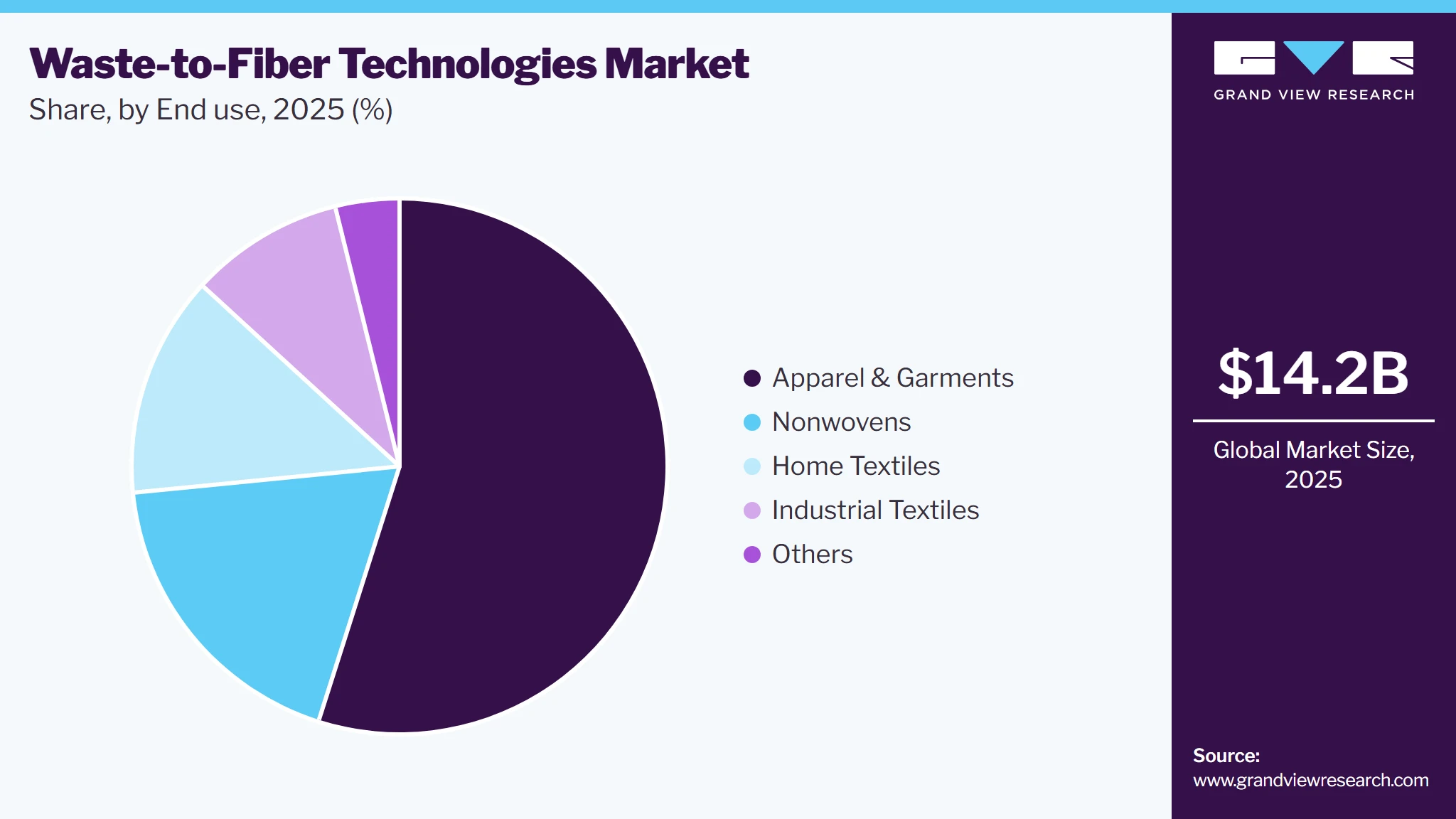
The apparel & garments segment held the highest revenue market share of 54.9% in 2025, due to apparel represents the largest and most direct downstream application for recycled and regenerated fibers. Waste-derived fibers can be incorporated into yarns and fabrics for clothing, enabling brands and manufacturers to increase recycled content while reducing reliance on virgin raw materials. Growing interest in circular apparel supply chains and fiber-to-fiber recycling is further strengthening demand for recycled fibers that can meet apparel-grade requirements for quality, consistency, durability, and appearance.
 To learn more about this report, Download Free Sample Report
The nonwovens segment is expected to grow at a CAGR of 8.2% over the forecast period, as recycled fibers provide a practical feedstock for applications where exact fiber length, appearance, and textile aesthetics are less restrictive than in apparel. Recovered textile fibers can be processed into nonwoven materials for insulation, filtration, automotive components, construction materials, padding, and other technical applications. This creates an important outlet for fibers that may not achieve the quality required for closed-loop apparel production, supporting higher utilization of waste streams and improving the overall economics of waste-to-fiber recycling.
Regional Insights
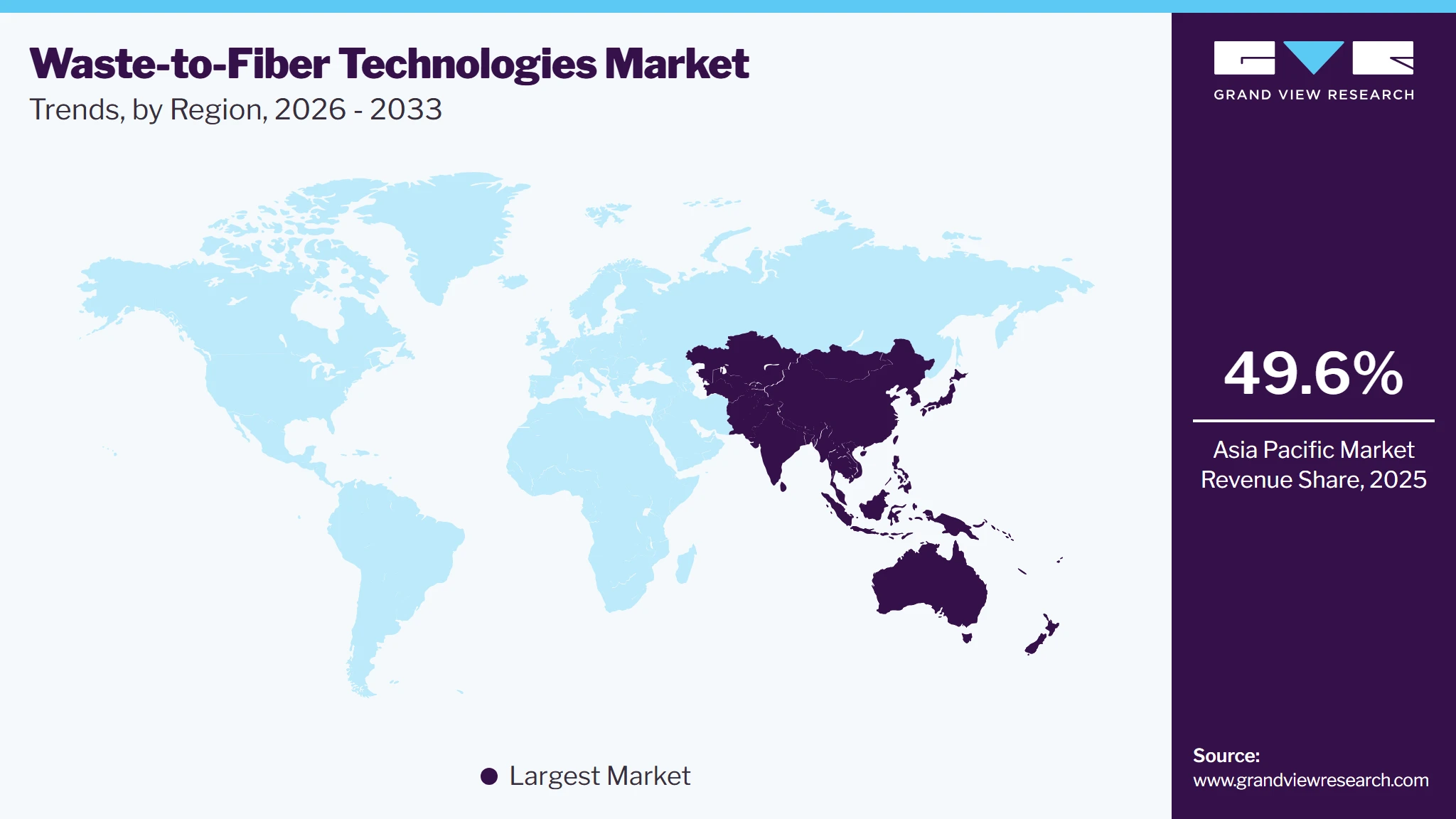
Asia Pacific waste-to-fiber technologies market dominated the global market and accounted for the largest revenue share of 49.6% in 2025, owing to its large textile manufacturing base, extensive garment-processing ecosystem, and availability of both pre-consumer and post-consumer textile waste. The region combines substantial fiber and apparel production with growing sustainability requirements from international brands sourcing from Asian manufacturers. Countries with established textile industries can benefit from locating recycling facilities close to manufacturing clusters, reducing transportation requirements for production waste.
 To learn more about this report, Download Free Sample Report
Waste-to-fiber technologies market in China represents a significant market growth due to its extensive textile and apparel manufacturing ecosystem and large domestic material-processing capacity. The country's established synthetic-fiber, spinning, chemical-processing, and textile machinery industries provide an industrial base that can support the development and scaling of advanced recycling technologies. Increasing attention toward resource efficiency and circular manufacturing is encouraging manufacturers to explore greater utilization of textile waste and recycled materials.
North America Waste-to-Fiber Technologies Market Trends
North America is developing as an important market for waste-to-fiber technologies due to increasing corporate sustainability commitments, demand for recycled textile inputs, and efforts to establish domestic circular supply chains. Apparel brands and textile manufacturers are increasingly interested in technologies capable of transforming post-consumer and post-industrial textile waste into usable fibers. The region's technology ecosystem also supports innovation in chemical recycling, automated sorting, material identification, and digital traceability.
U.S. Waste-to-Fiber Technologies Market Trends
The U.S. market is supported by the presence of major apparel brands, textile manufacturers, technology developers, recyclers, and research institutions involved in circular-material initiatives. Demand for recycled fibers is encouraging investment in technologies that can convert difficult textile waste streams into higher-value raw materials. The market is particularly suited to advanced sorting, chemical recycling, and automated processing due to the need to improve the economics of collecting and processing dispersed post-consumer textile waste. Partnerships between brands, recyclers, fiber producers, and technology companies are becoming increasingly important for creating reliable feedstock and offtake arrangements.
Europe Waste-to-Fiber Technologies Market Trends
Europe is among the leading regions for waste-to-fiber technology development driven by strong circular-economy policies, textile sustainability regulations, and investment in recycling research. The European regulatory framework increasingly emphasizes textile durability, recyclability, recycled content, separate collection, and traceability, creating structural demand for recycling technologies. European research programs are also actively developing automated sorting, chemical and mechanical recycling, purification, separation, and digital product-passport systems.
Waste-to-fiber technologies market in Germany is an important European market due to its advanced industrial infrastructure, strong recycling ecosystem, engineering capabilities, and emphasis on resource efficiency. The country's textile and waste-management industries provide a favorable environment for automated sorting, material identification, mechanical recycling, and advanced separation technologies. German companies can also benefit from integration between recycling equipment manufacturers, textile producers, research institutions, and circular-economy initiatives.
Central & South America Waste-to-Fiber Technologies Market Trends
Central and South America offers emerging opportunities for waste-to-fiber technologies as textile manufacturing and apparel consumption expand alongside growing interest in sustainable production. Countries with established textile industries can benefit from technologies that process factory cutting waste, defective garments, and post-consumer textiles into secondary fibers. The region's proximity to major apparel and textile production centers can make localized recycling economically attractive, particularly where collection and processing infrastructure is improving.
Middle East & Africa Waste-to-Fiber Technologies Market Trends
The Middle East & Africa market remains comparatively emerging but presents opportunities for waste-to-fiber technologies as governments, textile manufacturers, and sustainability-focused businesses seek improved waste-management and resource-efficiency solutions. Textile production clusters in selected countries can provide concentrated sources of pre-consumer waste that are easier to collect and process than dispersed post-consumer waste. The region can also benefit from investment in modern sorting, recycling, and fiber-processing infrastructure as part of broader circular-economy development.
Key Waste-to-Fiber Technologies Company Insights
Some of the key players operating in the market include BlockTexx and Circ, Inc.
-
BlockTexx is an Australian clean-technology company focused on recovering valuable materials from end-of-life textiles and clothing. Its S.O.F.T. (Separation of Fibre Technology) chemically separates polyester and cellulose from difficult-to-recycle textile blends, enabling the recovered materials to be returned to textile and other industrial applications.
-
Circ is a textile recycling technology company focused particularly on polyester-cotton blended textiles. Its hydrothermal technology is designed to separate and recover both polyester and cellulose from polycotton waste, allowing both components to be reused in new textile products rather than losing one material during conventional recycling.
Infinited Fiber Company and Evrnu are some of the emerging market participants in the waste-to-fiber technologies market.
-
Infinited Fiber Company is a Finnish textile-to-textile recycling technology company that converts cotton-rich textile waste into Infinna, a regenerated cellulose fiber. Its process separates cellulose from textile waste and regenerates it into a new fiber designed for applications including apparel, home textiles, and nonwovens.
-
Evrnu is a textile material innovation company developing Nucycl, a regenerated fiber produced from cotton-rich textile waste. Its technology converts discarded textiles into engineered fibers that can be regenerated repeatedly, targeting applications across apparel, footwear, and home textiles.
Key Waste-to-Fiber Technologies Companies
The following key companies have been profiled for this study on the waste-to-fiber technologies market.
-
BlockTexx
-
Circ, Inc.
-
Worn Again Technologies
-
Ambercycle Inc.
-
Carbios
-
SYRE AB
-
Evrnu
-
Infinited Fiber Company
-
Recover
-
SaXcell
Competitive Benchmarking
Category
Operating Strategies
Competitive Edge
Weakness
Established Players BlockTexx, Circ, Inc., Worn Again Technologies, Ambercycle Inc., Carbios, SYRE AB
- Invest in advanced textile-to-fiber recycling technologies to convert post-consumer and post-industrial textile waste, blended textiles, and synthetic materials into recovered fibers or fiber-grade raw materials.
- Expand processing and production capacity through partnerships with apparel brands, textile manufacturers, waste-management companies, recyclers, and material suppliers.
- Focus on improving fiber quality, recovery yields, process efficiency, traceability, and scalability to support commercial fiber-to-fiber recycling.
- Strong technological expertise across chemical, enzymatic, molecular, and advanced separation-based recycling processes.
- Established relationships with brands, textile manufacturers, and strategic partners support technology commercialization and market adoption.
- Proprietary recycling processes and capabilities for difficult-to-recycle waste streams provide differentiation from conventional mechanical recycling.
- High capital requirements for pilot plants, demonstration facilities, commercial-scale recycling infrastructure, and technology scale-up.
- Variability in waste composition, contamination, dyes, finishes, elastane, and blended fibers can affect processing efficiency and output quality.
- Dependence on reliable waste collection, feedstock availability, strategic partnerships, and successful commercialization can influence the pace of expansion.
Emerging Players Evrnu, Infinited Fiber Company, Recover, SaXcell
- Develop next-generation recycling technologies capable of converting cotton-rich textiles, discarded garments, textile scraps, and other recoverable waste into regenerated or mechanically recycled fibers.
- Expand through partnerships with apparel brands, textile manufacturers, recyclers, retailers, and sustainability-focused organizations to increase commercial adoption.
- Prioritize improvements in fiber quality, recycled content, feedstock flexibility, process efficiency, traceability, and production scalability.
- Strong specialization in next-generation textile recycling and regenerated-fiber technologies.
- Proprietary processes enable higher-value recovery of textile waste and provide alternatives to virgin fiber production.
- Strong sustainability positioning and collaborations with downstream textile and apparel companies support market differentiation and accelerate customer adoption.
- Relatively smaller production scale and geographic footprint compared with large established fiber producers and chemical companies.
- Greater dependence on financing, strategic partnerships, feedstock availability, and successful transition from pilot or demonstration facilities to commercial-scale production.
- Challenges remain around collection and sorting, processing costs, feedstock consistency, fiber performance, scalability, and price competitiveness against virgin fibers.
Recent Developments
-
In March 2026, Worn Again Technologies started operations of its Textile-to-Fibre Accelerator plant in Winterthur, Switzerland, providing a platform to demonstrate and validate its chemical recycling process for polycotton and other textile feedstocks before commercial scale-up.
-
In May 2025, Circ, Inc. announced a $500 billion textile recycling plant in France, designed to recover both cotton and polyester from textile waste. The facility is targeted to begin operations in 2028, with planned capacity of 70,000 tonnes annually.
Waste-to-Fiber Technologies Market Report Scope
Report Attribute
Details
Market size in 2025
USD 14.2 billion
Estimated market size in 2026
USD 15.2 billion
Projected market size by 2033
USD 25.1 billion
Growth rate
CAGR of 7.4% from 2026 to 2033
Base year for estimation
2025
Actual estimates/Historical data
2021 - 2024
Forecast period
2026 - 2033
Quantitative units
Revenue in USD billion and CAGR from 2026 to 2033
Report coverage
Revenue forecast, company ranking, competitive landscape, growth factors, and trends
Segments covered
Waste type, technology, end use, region
Regional scope
North America; Europe; Asia Pacific; Central & South America; Middle East & Africa
Country scope
U.S.; Canada; Mexico; Germany; UK; France; Italy; Spain; China; Japan; India; South Korea; Brazil; Saudi Arabia
Key companies profiled
BlockTexx; Circ, Inc.; Worn Again Technologies; Ambercycle Inc.; Carbios; SYRE AB; Evrnu; Infinited Fiber Company; Recover; SaXcell
Customization scope
Free report customization (equivalent up to 8 analysts working days) with purchase. Addition or alteration to country, regional & segment scope.
Pricing and purchase options
Avail customized purchase options to meet your exact research needs. Explore purchase options
Global Waste-to-Fiber Technologies Market Report Segmentation
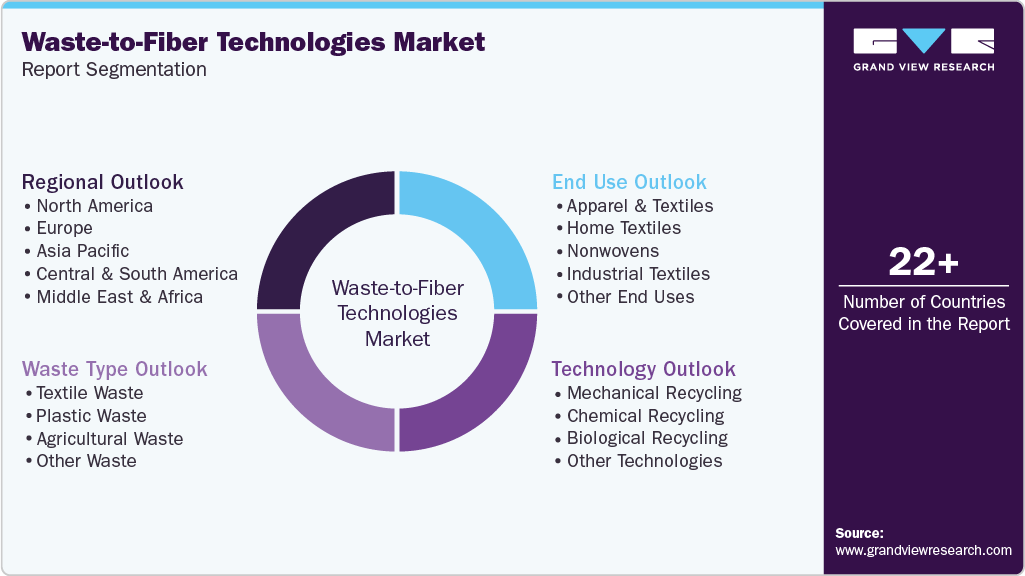
This report forecasts revenue growth at global, regional & country levels and provides an analysis on the industry trends in each of the sub-segments from 2021 to 2033. For this study, Grand View Research has segmented the global waste-to-fiber technologies market report based on waste type, technology, end use, and region:
 To learn more about this report, Download Free Sample Report
-
Waste Type Outlook (Revenue, USD Billion, 2021 - 2033)
-
Textile Waste
-
Plastic Waste
-
Agricultural Waste
-
Other Waste
-
-
Technology Outlook (Revenue, USD Billion, 2021 - 2033)
-
Mechanical Recycling
-
Chemical Recycling
-
Biological Recycling
-
Other Technologies
-
-
End Use Outlook (Revenue, USD Billion, 2021 - 2033)
-
Apparel & Textiles
-
Home Textiles
-
Nonwovens
-
Industrial Textiles
-
Other End Uses
-
-
Regional Outlook (Revenue, USD Billion, 2021 - 2033)
-
North America
-
U.S.
-
Canada
-
Mexico
-
-
Europe
-
UK
-
Germany
-
France
-
Italy
-
Spain
-
-
Asia Pacific
-
China
-
Japan
-
India
-
South Korea
-
-
Central and South America
-
Brazil
-
-
Middle East and Africa
-
Saudi Arabia
-
-
Research Methodology
The waste-to-fiber technologies marketfigures in this report are based on a proven research process that combines executive interviews with secondary research from proprietary databases, company filings, and recognized regulatory and institutional sources. Market size is built through value-chain sizing-reconciling supply-side and demand-side estimates-and triangulated with bottom-up and top-down approaches. Every estimate passes multiple levels of expert validation before publication, with eachwaste-to-fiber technologies segment quantified using the revenue-capture definitions in the table below.
Segment Definition
Segment - Waste Type
Revenue capture definition
Textile Waste
Revenue generated from the sale of textile fibers produced from pre-consumer and post-consumer textile waste, including discarded garments, fabric scraps, yarn waste, cutting waste, and other textile materials processed through waste-to-fiber technologies.
Plastic Waste
Revenue generated from the sale of textile fibers produced from recovered plastic waste, including PET bottles, plastic containers, packaging materials, and other suitable plastic feedstocks processed into fiber-grade materials.
Agricultural Waste
Revenue generated from the sale of textile fibers produced from agricultural waste and residues, including crop stalks, leaves, husks, plant residues, and other biomass-derived feedstocks processed into natural or regenerated textile fibers.
Other Waste
Revenue generated from the sale of textile fibers produced from other recoverable waste streams, including paper-based waste, food-processing residues, animal-derived waste, and other non-conventional feedstocks that are converted into fiber materials through waste-to-fiber technologies.
Segment - Technology
Revenue capture definition
Mechanical Recycling
Revenue generated from the sale of textile fibers produced by mechanically processing waste materials through operations such as shredding, cutting, tearing, opening, carding, grinding, and respinning without substantially altering the chemical structure of the original material.
Chemical Recycling
Revenue generated from the sale of textile fibers produced by chemically processing waste materials through dissolution, depolymerization, solvolysis, hydrolysis, or other chemical processes that break down or separate the original material before regenerating it into new fibers.
Biological Recycling
Revenue generated from the sale of textile fibers produced using biological processes, including enzymatic treatment, microbial processing, fermentation, and other biotechnology-based methods that break down or transform waste materials into fiber-forming components.
Other Technologies
Revenue generated from the sale of textile fibers produced using other waste-conversion technologies, including thermomechanical, thermo-chemical, thermal, hybrid, and other emerging processes that transform waste feedstocks into fiber-grade materials.
Segment - End Use
Revenue capture definition
Apparel & Textiles
Revenue generated from the sale of waste-derived textile fibers used in the production of apparel and general textile products, including clothing, fashion garments, yarns, fabrics, and other textile-based consumer products.
Home Textiles
Revenue generated from the sale of waste-derived textile fibers used in home textile applications, including bedding, towels, curtains, upholstery, carpets, rugs, household fabrics, and other interior textile products.
Nonwovens
Revenue generated from the sale of waste-derived fibers used to manufacture nonwoven products through processes such as bonding, needle punching, thermal bonding, or other nonwoven-forming techniques for applications including filtration, insulation, hygiene, and construction materials.
Industrial Textiles
Revenue generated from the sale of waste-derived textile fibers used in industrial and technical textile applications, including automotive textiles, geotextiles, protective materials, filtration media, reinforcement materials, insulation, and other performance-oriented products.
Other End Uses
Revenue generated from the sale of waste-derived textile fibers used in other applications, including footwear, accessories, packaging, composite materials, handicrafts, and other products that incorporate recycled or waste-derived fiber materials.
Estimation Model
Layer Name
Key Question
Description
Parent Market Analysis
What is the overall size and growth outlook of the global textile fibers, recycled fibers, sustainable materials, waste management, and textile recycling markets?
The estimation begins by evaluating the broader textile fibers, recycled textile fibers, sustainable textile materials, textile waste management, and textile recycling markets. Global fiber production and consumption, textile and apparel manufacturing, plastic and agricultural waste generation, textile waste volumes, recycling infrastructure, fiber demand, and investments in circular and sustainable materials are analyzed to establish the total addressable market for waste-to-fiber technologies.
Waste-to-Fiber Technology Penetration Analysis
What proportion of the overall textile recycling, plastic recycling, agricultural waste conversion, and sustainable fiber market is represented by waste-to-fiber technologies across waste sources and processing methods?
This layer estimates the penetration of waste-to-fiber technologies within the broader recycled and sustainable fiber market. Adoption is assessed across textile waste, plastic waste, agricultural waste, and other recoverable waste streams. Penetration is further evaluated across mechanical recycling, chemical recycling, biological recycling, and other emerging conversion technologies to determine the contribution of waste-derived fiber production to the overall market.
Regional & End-use Demand Assessment
Which regions and end-use industries contribute the highest demand for waste-to-fiber technologies?
Market demand is evaluated across major regions based on textile and apparel manufacturing capacity, availability of recyclable waste, waste collection infrastructure, recycling capacity, sustainability regulations, circular economy initiatives, and adoption of recycled materials. Demand is further assessed across apparel and textiles, home textiles, nonwovens, industrial textiles, and other end-use applications to determine regional and application-level penetration.
Company Revenue Validation & Market Forecasting
How is the final market size validated and forecast?
Final estimates are validated using company revenues, waste-to-fiber technology production capacities, recycling and processing capacities, waste collection volumes, fiber production volumes, product portfolios, manufacturing facilities, technology deployment, sustainability partnerships, certifications, investments, and announced capacity expansions. Bottom-up and top-down approaches are triangulated using company-level, technology-level, waste-stream, and industry-level data to generate reliable market estimates and forecasts for waste-to-fiber technologies.
Delivered Customizations
This report has been delivered with the following In-depth customizations
Client Request
Customization Delivered
Value Adds
Waste Feedstock Availability & Recycling Potential Assessment
Analyze the availability of textile, plastic, agricultural, and other waste streams, including collection channels, feedstock composition, contamination levels, sorting requirements, geographic availability, and suitability for conversion into fibers.
Helps assess the availability and quality of potential feedstocks and identifies the key raw-material constraints and opportunities affecting the scalability of waste-to-fiber technologies.
Technology & Fiber Conversion Assessment
Evaluate mechanical, chemical, biological, and emerging waste-to-fiber technologies based on feedstock compatibility, processing requirements, technology maturity, fiber yield, quality, scalability, energy requirements, and commercialization status.
Helps technology developers and manufacturers identify the most suitable recycling routes for different waste streams and assess opportunities for improving fiber recovery, process efficiency, and commercial scalability.
Circular Economy & Regulatory Opportunity Assessment
Evaluate the impact of textile recycling policies, recycled-content requirements, extended producer responsibility, separate waste collection, circular economy initiatives, and sustainability commitments on the adoption of waste-to-fiber technologies.
Helps identify regulatory-driven demand, emerging compliance requirements, and market opportunities created by the transition toward circular and resource-efficient textile value chains.
Frequently Asked Questions About This Report
The waste-to-fiber technologies market size was estimated at USD 14.2 billion in 2025 and is expected to reach USD 15.2 billion in 2026.
The waste-to-fiber technologies market is expected to grow at a compound annual growth rate of 7.4% from 2026 to 2033 to reach USD 25.1 billion by 2033.
The plastic waste segment accounted for the highest revenue share of 60.9% in 2025, driven by the widespread availability of PET-based feedstock and its established conversion into recycled polyester fibers.
Asia Pacific held the highest revenue market share of 49.6% in 2025, driven by its large textile manufacturing base, abundant waste feedstock, and expanding recycling infrastructure.
Key factors driving the waste-to-fiber technologies market include rising waste generation, increasing demand for recycled fibers, stricter circularity regulations, growing brand sustainability commitments, and advances in recycling and fiber-recovery technologies.
Some key players in the waste-to-fiber technologies market include BlockTexx, Circ, Inc., Worn Again Technologies, Ambercycle Inc., Carbios, SYRE AB, Evrnu, Infinited Fiber Company, SaXcell, and Recover.
The textile waste is the fastest-growing waste type in the waste-to-fiber technologies market.
The nonwovens segment is the fastest growing end use in the waste-to-fiber technologies market.
The mechanical recycling segment accounted for the largest revenue share of 65.3% in 2025, supported by its established commercial use, relatively simple processing, and broad applicability across textile waste streams.
About the Author(s)
Advanced Interior Materials Research Team
Advanced Materials · Advanced Interior MaterialsThis report was authored by the advanced interior materials research team at Grand View Research - comprising two research analysts, one senior research analyst, and one industry expert - with specialized expertise in the advanced interior materials segment of the advanced materials industry. All findings are based on proprietary advanced materials databases, executive interviews, and regulatory analysis, subject to internal peer review prior to publication.
Last Updated:
Speak to Analyst

Customize this report to your needs - add regions, segments, or data points, with 20% free customization.
Or view our licence options:


ISO 9001:2015 & 27001:2022 Certified
We are GDPR and CCPA compliant! Your transaction & personal information is safe and secure. For more details, please read our privacy policy.


