
- Home
- »
- Advanced Interior Materials
- »
-
Waterless Textile Dyeing Market Size Report, 2026-2033GVR Report cover
![Waterless Textile Dyeing Market (2026 - 2033)Report]()
Waterless Textile Dyeing Market (2026 - 2033)
Size, Share & Trends Analysis Report By Technology (Supercritical CO2 Dyeing, Foam Dyeing, Air Dyeing), By Fiber Type (Polyester, Cotton, Nylon, Wool), By Dye Type (Pigments), By End-use Industry, By Region, And Segment Forecasts
Market Size, 2025
$483.7MMarket Estimate, 2026
$554.3MMarket Forecast, 2033
$1,501.9MCAGR, 2026–2033
15.3%Waterless Textile Dyeing Market Summary
The global waterless textile dyeing market size was valued at USD 483.7 million in 2025 and is projected to grow from USD 554.3 million in 2026 to USD 1,501.9 million by 2033, at a CAGR of 15.3% from 2026 to 2033. Asia Pacific dominated the market, accounting for the largest revenue share of 34.9% in 2025. The demand for waterless textile dyeing is rising as the textile industry faces increasing pressure to reduce water consumption and minimize environmental pollution.

Key Market Trends & Insights
- By technology: Supercritical CO₂ dyeing segment held the highest revenue share of 55.6% in 2025.
- By fiber type: Polyester segment dominated the market with a revenue share of 63.4% in 2025.
- By dye type: Disperse dyes segment held the highest revenue market share of 63.6% in 2025.
- By end use: Apparel & fashion segment dominated the market with a revenue share of 53.9% in 2025.
Regional Highlights
- Largest regional market: Asia Pacific (34.9% revenue share, 2025)
- By country: India held the largest market share in 2025.
Market Size & Forecast
- Market size in 2025: USD 483.7 Million
- Estimated market size in 2026: USD 554.3 Million
- Projected market size by 2033: USD 1,501.9 Million
- CAGR (2026-2033): 15.3%
Conventional dyeing processes consume large quantities of freshwater and generate significant volumes of wastewater containing dyes, salts, and chemicals that require costly treatment. Waterless dyeing technologies provide an effective solution by eliminating or drastically reducing water usage while maintaining high-quality color performance.The market is primarily driven by stringent environmental regulations governing industrial wastewater discharge and water conservation. Governments across major textile-producing countries are implementing stricter pollution control measures that encourage manufacturers to adopt sustainable dyeing technologies. Waterless dyeing significantly reduces wastewater treatment requirements, lowers chemical consumption, and improves resource efficiency. Leading textile manufacturers are increasingly modernizing production facilities to comply with evolving environmental standards while improving operational efficiency.

Continuous technological innovation is transforming the waterless textile dyeing market through advanced supercritical carbon dioxide dyeing, foam dyeing, digital coloration, and low-chemical processing technologies. Manufacturers are developing equipment capable of improving dye penetration, color consistency, and production efficiency while eliminating water consumption. Automation, digital process monitoring, and AI-enabled production optimization are enhancing operational performance across textile manufacturing facilities.
Market Dynamics
The waterless textile dyeing market is experiencing strong growth due to increasing environmental concerns, stricter wastewater regulations, and the global textile industry's transition toward sustainable manufacturing. Waterless dyeing technologies significantly reduce freshwater consumption, eliminate wastewater generation, and improve production efficiency while maintaining high-quality textile coloration. Rising investments in sustainable apparel manufacturing and continuous technological advancements are expected to strengthen market growth over the coming years.
The primary driver of the market is the growing emphasis on sustainable textile manufacturing and responsible water management. Conventional textile dyeing remains one of the most water-intensive industrial processes, prompting governments and textile manufacturers to adopt technologies that minimize environmental impact. Waterless dyeing technologies reduce freshwater consumption, wastewater treatment costs, and chemical discharge while improving production efficiency.
Another important growth driver is the increasing sustainability commitments of global apparel brands and retailers. Companies are actively transforming their supply chains to reduce environmental footprints and achieve ESG objectives. Waterless dyeing technologies help manufacturers meet these goals by improving resource efficiency, reducing emissions, and supporting environmentally responsible textile production.
The major restraint is the high capital investment associated with specialized dyeing equipment and production line modifications. Many textile manufacturers, particularly small and medium-sized enterprises, continue using conventional dyeing systems because transitioning to waterless technologies requires significant investment, technical expertise, and workforce training. Limited compatibility with certain textile materials also presents commercialization challenges.
Growing investments in sustainable manufacturing technologies and circular textile production present significant opportunities for market expansion. Continuous improvements in supercritical carbon dioxide dyeing systems, foam dyeing technologies, advanced dye chemistry, and automated textile processing are increasing commercial viability across a wider range of textile applications. Rising adoption of recycled fibers and technical textiles further strengthens future growth opportunities.
Market Concentration & Characteristics
The waterless textile dyeing market is moderately consolidated, with a limited number of specialized technology providers, textile machinery manufacturers, and innovative textile processing companies leading commercialization. Competition primarily focuses on technological advancement, equipment efficiency, intellectual property development, and strategic collaborations with textile mills and apparel brands. Major participants continue investing in research and development to improve scalability, operational efficiency, and compatibility with different textile fibers.
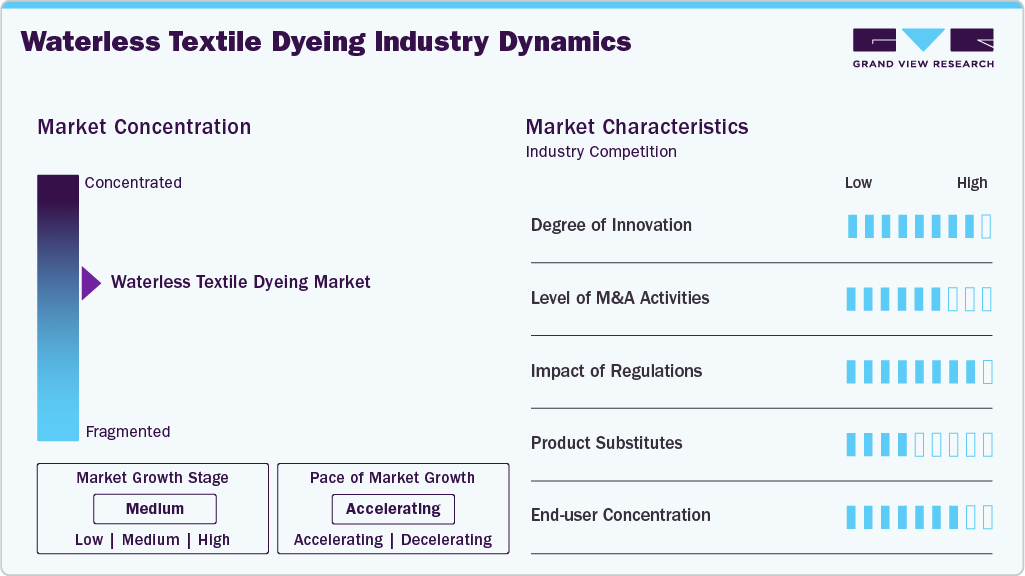
Traditional aqueous textile dyeing remains the largest substitute due to its widespread industrial adoption, established infrastructure, and lower initial investment requirements. Low-liquor-ratio dyeing systems, digital textile printing, solution dyeing, and improved conventional dyeing technologies also provide alternative methods for reducing water and chemical consumption. While these alternatives improve environmental performance compared to conventional dyeing, they generally do not eliminate water usage entirely.
Analyst Perspective
The waterless textile dyeing market is expected to witness strong long-term growth as the global textile industry accelerates its transition toward sustainable and resource-efficient manufacturing. Increasing pressure to reduce water consumption, wastewater discharge, and carbon emissions is encouraging manufacturers to adopt advanced dyeing technologies such as supercritical CO₂, foam, and air dyeing. While high capital investment and technology adoption barriers may limit short-term penetration, continuous innovation, supportive environmental regulations, and growing sustainability commitments from global apparel brands are expected to drive commercialization.
Technology Insights
The supercritical CO₂ dyeing segment held the highest revenue share of 55.6% in 2025, due to its ability to eliminate water usage while delivering high dye penetration, excellent color consistency, and reduced processing time. The technology is widely adopted for polyester textiles, where it demonstrates superior dye uptake and operational efficiency. Growing investments in sustainable textile manufacturing and increasing environmental regulations have further accelerated its commercialization.
The foam dyeing segment is expected to grow at a CAGR of 16.0% over the forecast period, owing to its ability to drastically reduce water, chemical, and energy consumption compared to conventional dyeing methods. The technology offers high process efficiency while maintaining uniform dye application across various textile materials. Increasing demand for sustainable textile production and continuous innovation in foam application technologies are supporting wider commercial adoption.
Fiber Type Insights
The polyester segment held the highest revenue share of 63.4% in 2025, as polyester remains the most widely used synthetic fiber in apparel, sportswear, and technical textile manufacturing. Waterless dyeing technologies, particularly supercritical CO₂ dyeing, are highly compatible with polyester, providing superior color fastness and efficient dye penetration without water. Rising production of performance textiles and growing demand for sustainable synthetic fiber processing continue to support market dominance. Increasing global polyester consumption further reinforces the segment's leadership.
The cotton segment is expected to grow at a CAGR of 15.2% over the forecast period, due to increasing research into waterless dyeing technologies compatible with natural fibers. Rising consumer preference for sustainable cotton apparel and expanding demand for environmentally responsible textile production are encouraging manufacturers to adopt innovative dyeing solutions. Continuous advancements in dye chemistry and processing technologies are improving commercial feasibility for cotton applications.
Dye Type Insights
The disperse dyes segment held the highest revenue market share of 63.6% in 2025, owing to its widespread use in dyeing polyester and other synthetic fibers, which represent a major application area for waterless dyeing technologies. These dyes exhibit excellent compatibility with supercritical CO₂ dyeing processes, delivering high color intensity, durability, and processing efficiency. Strong demand from the apparel and sportswear industries has further supported segment growth. Continuous improvements in disperse dye formulations are enhancing overall process performance.
The pigments segment is expected to grow at a CAGR of 15.9% over the forecast period, due to increasing adoption of pigment-based coloration technologies that reduce water and chemical consumption. Pigment systems offer versatility across different fiber types while supporting sustainable textile manufacturing initiatives. Growing demand for digital textile printing and environmentally friendly coloration processes is driving investment in advanced pigment technologies.
End Use Industry Insights
The apparel & fashion segment held the highest revenue market share of 53.9% in 2025, due to the growing adoption of sustainable manufacturing practices by global fashion brands and garment manufacturers. Increasing consumer demand for environmentally responsible clothing and stricter sustainability targets are encouraging the transition toward waterless dyeing technologies. High production volumes and continuous product innovation further support the segment's dominance.

The technical textiles segment is expected to grow at a CAGR of 16.3% over the forecast period, as industries increasingly require high-performance fabrics manufactured through sustainable production processes. Applications across automotive, healthcare, industrial, aerospace, and protective textiles are driving demand for advanced coloration technologies that minimize environmental impact. Waterless dyeing provides improved process efficiency and supports stringent sustainability requirements for specialized textile products. Expanding investment in high-value technical textile manufacturing is expected to create significant growth opportunities for this segment.
Regional Insights
Asia Pacific dominated the global waterless textile dyeing market and accounted for the largest revenue share of 34.9% in 2025, due to its extensive textile manufacturing industry, growing environmental regulations, and increasing investments in sustainable production technologies. Countries across the region are modernizing textile processing facilities to reduce water consumption and industrial pollution. Strong apparel exports, expanding textile production capacity, and increasing adoption of green manufacturing practices continue to support regional market leadership. Government initiatives promoting water conservation and cleaner industrial production are further accelerating technology adoption.

China Waterless Textile Dyeing Market Trends
China leads the regional market owing to its position as the world's largest textile manufacturing hub and its increasing investment in environmentally sustainable industrial technologies. Government policies promoting pollution control, water conservation, and industrial modernization are encouraging manufacturers to adopt advanced dyeing systems.
North America Waterless Textile Dyeing Market Trends
North America is witnessing steady market growth due to increasing sustainability commitments among apparel manufacturers and textile producers. Companies are investing in environmentally responsible manufacturing technologies to reduce water consumption and improve operational efficiency. Growing adoption of sustainable performance textiles and advanced manufacturing systems supports technology deployment across the region. Corporate ESG initiatives and increasing environmental regulations further encourage investment in waterless dyeing solutions.
The U.S. waterless textile dyeing market represents the largest market in North America due to its advanced textile research capabilities and growing investment in sustainable industrial technologies. Textile manufacturers are increasingly adopting innovative dyeing systems to improve environmental performance and meet corporate sustainability objectives. Continuous technological development, strong research infrastructure, and growing demand for premium sustainable textiles support market expansion.
Europe Waterless Textile Dyeing Market Trends
Europe remains a major market due to stringent environmental regulations, ambitious sustainability targets, and widespread implementation of circular economy initiatives. Textile manufacturers across the region are investing in cleaner production technologies that reduce water usage and chemical emissions. Strong consumer preference for sustainable fashion products encourages apparel companies to adopt environmentally friendly manufacturing processes.
Germany waterless textile dyeing market leads the European market through its advanced textile machinery industry and strong engineering expertise. Manufacturers are investing heavily in sustainable industrial technologies that improve resource efficiency and reduce environmental impact. Collaboration between research institutions, machinery manufacturers, and textile companies continues to accelerate innovation in waterless dyeing technologies.
Central and South America Waterless Textile Dyeing Market Trends
Central and South America is gradually adopting waterless textile dyeing technologies as textile manufacturers modernize production facilities and improve environmental performance. Growing awareness regarding water conservation, increasing exports of apparel products, and rising industrial sustainability initiatives are supporting market expansion.
Middle East & Africa Waterless Textile Dyeing Market Trends
The Middle East & Africa market is experiencing gradual growth due to increasing investments in textile manufacturing and sustainable industrial development. Water scarcity in several countries is encouraging industries to adopt technologies that minimize freshwater consumption. Governments are promoting resource-efficient manufacturing practices to support long-term industrial sustainability.
Key Waterless Textile Dyeing Company Insights
Some of the key players operating in the market include DyeCoo and Deven Supercriticals
-
DyeCoo is a Netherlands-based technology company specializing in waterless textile dyeing using supercritical carbon dioxide (CO₂) technology. The company develops sustainable dyeing systems that eliminate water usage and significantly reduce chemical consumption, helping textile manufacturers improve environmental performance and production efficiency.
-
Deven Supercriticals is an India-based company specializing in supercritical fluid technologies, including supercritical CO₂ dyeing solutions for the textile industry. The company focuses on developing environmentally friendly processing technologies that reduce water consumption, wastewater generation, and overall environmental impact in textile manufacturing.
Huntsman Corporation and Archroma are some of the emerging market participants in the waterless textile dyeing market.
-
Huntsman Corporation is a global manufacturer of specialty chemicals and advanced textile dyes, offering innovative coloration and textile processing solutions. The company emphasizes sustainable dye chemistries, resource-efficient manufacturing, and high-performance textile chemicals that help manufacturers improve product quality and environmental compliance.
-
Archroma is a global specialty chemicals company focused on sustainable textile dyes, color management, and chemical solutions for the textile industry. The company develops eco-advanced dyeing technologies, specialty colorants, and process chemicals designed to reduce water, energy, and chemical consumption while supporting sustainable textile production.
Key Waterless Textile Dyeing Companies
The following key companies have been profiled for this study on the waterless textile dyeing market.
-
DyeCoo
-
Deven Supercriticals
-
Alchemie Technology
-
Imogo
-
NTX
-
eCO2Dye
-
Archroma
-
Huntsman Corporation
-
DyStar Group
-
Kornit Digital
Competitive Benchmarking
Category
Operating Strategies
Competitive Edge
Weakness
Established Players (DyeCoo, Deven Supercriticals, Alchemie Technology, Imogo, NTX, eCO2Dye)
- Invest in advanced waterless textile dyeing technologies such as supercritical CO₂, foam dyeing, and air dyeing to improve dyeing efficiency, color consistency, and resource utilization.
- Expand manufacturing capabilities and global commercialization through strategic partnerships with textile mills, apparel brands, machinery manufacturers, and technology licensing agreements.
- Strengthen sustainability initiatives by reducing water consumption, chemical usage, energy requirements, and carbon emissions while expanding solutions compatible with a wider range of textile fibers and dye chemistries.
- Strong technological expertise and established intellectual property portfolios in sustainable textile dyeing solutions.
- Long-standing relationships with global textile manufacturers, apparel brands, and industrial partners supported by well-developed commercialization networks.
- Significant investment capabilities in research & development, pilot-scale validation, regulatory compliance, and advanced textile processing technologies.
- High capital investment requirements for developing and commercializing advanced dyeing systems.
- Long technology adoption cycles as textile manufacturers continue utilizing existing conventional dyeing infrastructure.
- Dependence on customer willingness to invest in production line modernization and specialized processing equipment may limit short-term market penetration.
Emerging Players (Archroma, Huntsman Corporation, DyStar Group, Kornit Digital)
- Focus on developing innovative dye formulations, digital coloration technologies, sustainable textile chemicals, and specialized water-saving dyeing solutions compatible with next-generation dyeing systems.
- Expand market presence through collaborations with textile manufacturers, fashion brands, research institutes, and sustainability initiatives to accelerate commercial adoption.
- Develop customized dye chemistries and integrated textile processing solutions that improve color performance, process efficiency, chemical optimization, and compatibility across multiple fiber types.
- Strong specialization in textile dyes, specialty chemicals, digital textile technologies, and sustainable coloration solutions with continuous product innovation.
- Greater operational flexibility enables faster commercialization of innovative products and rapid response to changing customer requirements.
- Well-positioned to benefit from growing demand for sustainable fashion, environmentally responsible textile processing, and next-generation dyeing technologies.
- Limited presence in proprietary large-scale waterless dyeing equipment manufacturing compared to specialized technology providers.
- Relatively lower market penetration in complete waterless dyeing systems due to dependence on partnerships with equipment manufacturers.
- Exposure to evolving regulatory requirements, technology standardization challenges, and customer adoption uncertainties associated with emerging sustainable dyeing technologies.
Recent Developments
-
In April 2024, Alchemie Technology opened its first commercial Endeavour digital textile dyeing production and demonstration hub in Taiwan, enabling large-scale low-carbon and low-water textile dyeing.
-
In October 2024, Archroma launched the NTR Printing System, enabling commercial bio-based pigment textile printing using renewable feedstocks and safer chemistry to improve sustainable textile coloration.
Waterless Textile Dyeing Market Report Scope
Report Attribute
Details
Market size in 2025
USD 483.7 million
Estimated market size in 2026
USD 554.3 million
Projected market size by 2033
USD 1,501.9 million
Growth Rate
CAGR of 15.3% from 2026 to 2033
Base year for estimation
2025
Actual estimates/Historical data
2021 - 2024
Forecast period
2026 - 2033
Quantitative units
Revenue in USD million and CAGR from 2026 to 2033
Report coverage
Revenue forecast, company ranking, competitive landscape, growth factors, and trends
Segments covered
Technology, fiber type, dye type, end-use industry, region.
Regional scope
North America, Asia Pacific, Europe, Central & South America, Middle East & Africa
Country scope
U.S.; Canada; Mexico; Germany; UK; France; Italy; Spain; China; Japan; India; South Korea; Brazil; Saudi Arabia
Key companies profiled
DyeCoo; Deven Supercriticals; Alchemie Technology; Imogo; NTX; eCO2Dye; Archroma; Huntsman Corporation; DyStar Group; Kornit Digital
Customization scope
Free report customization (equivalent up to 8 analysts working days) with purchase. Addition or alteration to country, regional & segment scope.
Pricing and purchase options
Avail customized purchase options to meet your exact research needs. Explore purchase options
Global Waterless Textile Dyeing Market Report Segmentation
This report forecasts revenue growth at regional & country levels and provides an analysis on the industry trends in each of the sub-segments from 2021 to 2033. For the purpose of this study, Grand View Research has segmented the global waterless textile dyeing market report on the basis of technology, fiber type, dye type, end use industry, and region:
-
Technology Outlook (Revenue, USD Million, 2021 - 2033)
-
Supercritical CO₂ Dyeing
-
Foam Dyeing
-
Air Dyeing
-
Others
-
-
Fiber Type Outlook (Revenue, USD Million, 2021 - 2033)
-
Polyester
-
Cotton
-
Nylon
-
Wool
-
Other Fibers
-
-
Dye Type Outlook (Revenue, USD Million, 2021 - 2033)
-
Disperse Dyes
-
Reactive Dyes
-
Pigments
-
Acid Dyes
-
Others
-
-
End Use Industry Outlook (Revenue, USD Million, 2021 - 2033)
-
Apparel & Fashion
-
Home Textiles
-
Technical Textiles
-
Automotive
-
Industrial
-
Others
-
-
Regional Outlook (Revenue, USD Million, 2021 - 2033)
-
North America
-
U.S.
-
Canada
-
Mexico
-
-
Europe
-
UK
-
Germany
-
France
-
Italy
-
Spain
-
-
Asia Pacific
-
China
-
Japan
-
India
-
South Korea
-
-
Central and South America
-
Brazil
-
-
Middle East and Africa
-
Saudi Arabia
-
-
Research Methodology
The waterless textile dyeing market figures in this report are based on a proven research process that combines executive interviews with secondary research from proprietary databases, company filings, and recognized regulatory and institutional sources. Market size is built through value-chain sizing-reconciling supply-side and demand-side estimates-and triangulated with bottom-up and top-down approaches. Every estimate passes multiple levels of expert validation before publication, with each waterless textile dyeing segment quantified using the revenue-capture definitions in the table below.
Segment Definition
Segment - Technology
Revenue capture definition
Supercritical CO₂ Dyeing
Revenue generated from the sale of waterless textile dyeing systems utilizing supercritical carbon dioxide as the dyeing medium. This includes revenues from equipment, processing technologies, and dyeing services designed to eliminate water usage while improving dye penetration, color consistency, and production efficiency.
Foam Dyeing
Revenue generated from the sale of waterless textile dyeing solutions utilizing foam-based dye application technologies. This includes revenues from foam dyeing equipment, specialty chemical formulations, and processing services that minimize water consumption while ensuring uniform dye distribution and reduced chemical usage.
Air Dyeing
Revenue generated from the sale of waterless textile dyeing technologies that use air as the primary dye transfer medium. This includes revenues from air-assisted dyeing equipment, proprietary dye application systems, and related processing services designed to reduce water usage, energy consumption, and wastewater generation.
Others
Revenue generated from the sale of other emerging waterless textile dyeing technologies, including plasma-assisted dyeing, solvent-based dyeing, and other innovative low-water or water-free coloration processes. This includes associated equipment, technologies, and commercial dyeing services.
Segment - Fiber Type
Revenue capture definition
Polyester
Revenue generated from the sale of waterless textile dyeing solutions used for polyester fibers. This includes revenues from dyeing equipment, processing technologies, and dye formulations specifically developed to achieve efficient coloration, durability, and color consistency in polyester textiles.
Cotton
Revenue generated from the sale of waterless textile dyeing solutions used for cotton fibers. This includes revenues from advanced dyeing technologies, specialized dye chemistries, and processing systems designed to improve dye uptake while minimizing water and chemical consumption.
Nylon
Revenue generated from the sale of waterless textile dyeing solutions designed for nylon fibers. This includes revenues from compatible dyeing equipment, dye formulations, and processing technologies that deliver high-quality coloration, improved fiber performance, and sustainable manufacturing.
Wool
Revenue generated from the sale of waterless textile dyeing technologies developed for wool fibers. This includes revenues from specialized dyeing processes, equipment, and dye systems that preserve fiber quality while reducing water usage and environmental impact.
Other Fibers
Revenue generated from the sale of waterless textile dyeing solutions for other natural, regenerated, and synthetic fibers, including acrylic, rayon, viscose, hemp, bamboo, and blended fabrics. This includes revenues from customized dyeing technologies and associated processing services.
Segment - Dye Type
Revenue capture definition
Disperse Dyes
Revenue generated from the sale of waterless textile dyeing solutions utilizing disperse dyes. This includes revenues from dye formulations, compatible dyeing technologies, and processing systems primarily designed for synthetic fibers such as polyester.
Reactive Dyes
Revenue generated from the sale of waterless textile dyeing solutions utilizing reactive dyes. This includes revenues from specialized dye chemistries, advanced processing technologies, and equipment developed for efficient coloration of cellulosic fibers with minimal water consumption.
Pigments
Revenue generated from the sale of waterless textile coloration technologies utilizing pigment-based systems. This includes revenues from pigment formulations, binder technologies, application equipment, and processing services designed to deliver durable and environmentally sustainable coloration.
Acid Dyes
Revenue generated from the sale of waterless textile dyeing solutions utilizing acid dyes. This includes revenues from dye formulations, processing technologies, and specialized equipment developed for dyeing protein fibers and polyamide materials while minimizing water usage.
Others
Revenue generated from the sale of other dye types used in waterless textile dyeing, including vat dyes, sulfur dyes, basic dyes, and specialty colorants. This includes revenues from compatible dye formulations, application technologies, and related processing solutions.
Segment - End-use Industry
Revenue capture definition
Apparel & Fashion
Revenue generated from the sale of waterless textile dyeing technologies used in apparel and fashion manufacturing. This includes revenues from dyeing equipment, processing services, and sustainable coloration solutions for garments, sportswear, casual wear, luxury fashion, and other clothing products.
Home Textiles
Revenue generated from the sale of waterless textile dyeing solutions used in home textile manufacturing. This includes revenues from technologies and services for dyeing bed linens, curtains, upholstery fabrics, towels, carpets, and other household textile products.
Technical Textiles
Revenue generated from the sale of waterless textile dyeing technologies used in technical textile production. This includes revenues from coloration solutions for medical textiles, protective clothing, filtration fabrics, geotextiles, aerospace textiles, and other high-performance textile applications.
Automotive
Revenue generated from the sale of waterless textile dyeing solutions used in automotive textile manufacturing. This includes revenues from dyeing technologies for seat fabrics, interior trims, carpets, headliners, and other textile components used in passenger and commercial vehicles.
Industrial
Revenue generated from the sale of waterless textile dyeing technologies used in industrial textile applications. This includes revenues from coloration solutions for conveyor belts, industrial fabrics, coated textiles, reinforcement materials, and other specialized industrial textile products.
Others
Revenue generated from the sale of waterless textile dyeing technologies used across other end-use industries, including healthcare, defense, hospitality, marine, agriculture, and specialty textile applications. This includes revenues from customized dyeing solutions, equipment, and processing services.
Estimation Model
Layer Name
Key Question
Description
Parent Market Analysis
What is the overall size and growth outlook of the global textile dyeing, textile processing, and sustainable textile manufacturing market?
The estimation begins by evaluating the broader textile dyeing, textile processing, and sustainable textile manufacturing market. Macroeconomic indicators, global textile production, apparel manufacturing activity, sustainability initiatives, water conservation regulations, and investments in advanced textile processing technologies are analyzed to establish the total addressable market for waterless textile dyeing.
Technology Penetration Analysis
What proportion of the textile dyeing market is represented by waterless textile dyeing across different dyeing technologies and fiber types?
This layer estimates the penetration of supercritical CO₂ dyeing, foam dyeing, air dyeing, and other waterless dyeing technologies by assessing their adoption across polyester, cotton, nylon, wool, and other fiber types. Adoption trends across apparel, home textiles, technical textiles, automotive, and industrial textile manufacturing are analyzed to determine technology penetration.
Regional & End-use Industry Demand Assessment
Which regions and end-use industries contribute the highest demand for waterless textile dyeing?
Market demand is evaluated across major regions based on textile manufacturing capacity, environmental regulations, water conservation initiatives, sustainable fashion adoption, and investment in advanced textile processing. Demand is further segmented across apparel & fashion, home textiles, technical textiles, automotive, industrial, and other end-use industries to determine overall revenue contribution.
Company Revenue Validation & Market Forecasting
How is the final market size validated and forecast?
The final market estimates are validated using company revenues, manufacturing capacities, technology portfolios, equipment installations, strategic partnerships, trade analysis, sustainability initiatives, and secondary research. Bottom-up and top-down approaches are triangulated to generate reliable market size estimates and long-term forecasts for the waterless textile dyeing market.
Delivered Customizations
This report has been delivered with the following In-depth customizations
Client Request
Customization Delivered
Value Adds
Technology Landscape Analysis
Comprehensive assessment of emerging waterless textile dyeing technologies, including supercritical CO₂ dyeing, foam dyeing, air dyeing, and other advanced coloration processes. The analysis covers technology maturity, innovation trends, patent activity, R&D investments, commercialization status, scalability, and future technology roadmap across the textile value chain.
Enables clients to evaluate technology readiness, identify innovation opportunities, benchmark emerging solutions, prioritize R&D investments, and develop long-term technology adoption strategies.
Regional Demand Assessment
Detailed evaluation of regional demand across all major regions based on textile manufacturing capacity, apparel exports, sustainability initiatives, water conservation policies, end-use industry demand, and technology adoption trends. The analysis also identifies high-growth countries and emerging investment hotspots.
Helps clients prioritize target markets, optimize regional expansion strategies, forecast demand, allocate resources efficiently, and identify countries offering the strongest commercial opportunities for waterless textile dyeing technologies.
Regulatory Impact Analysis
Comprehensive analysis of global and regional environmental regulations governing textile manufacturing, including wastewater discharge standards, industrial water conservation policies, chemical management regulations, sustainability frameworks, carbon reduction initiatives, and green manufacturing guidelines influencing the adoption of waterless textile dyeing technologies.
Assists companies in ensuring regulatory compliance, minimizing operational and investment risks, aligning products with evolving sustainability requirements, and developing market entry strategies that meet regional environmental standards.
Frequently Asked Questions About This Report
The waterless textile dyeing market size was estimated at USD 483.7 million in 2025 and is expected to reach USD 554.3 million in 2026.
The waterless textile dyeing market is expected to grow at a compound annual growth rate of 15.3% from 2026 to 2033 to reach USD 1,501.9 million by 2033.
The disperse dyes segment accounted for the highest revenue share of 63.6% in 2025, owing to its widespread use in dyeing polyester and other synthetic fibers, which represent a major application area for waterless dyeing technologies.
Asia Pacific held the highest revenue market share of 34.9% in 2025, due to its large textile manufacturing base, increasing adoption of sustainable dyeing technologies, and supportive environmental regulations.
Key factors driving the waterless textile dyeing market include growing emphasis on sustainable textile manufacturing and stringent water conservation regulations.
Some key players in the waterless textile dyeing market include DyeCoo, Deven Supercriticals, Alchemie Technology, Imogo, NTX, eCO2Dye, Archroma, Huntsman Corporation, Kornit Digital, and DyStar Group.
The foam dyeing segment is the fastest-growing technology in the waterless textile dyeing market.
The technical textiles segment is the fastest growing end use industry in the waterless textile dyeing market.
The apparel & fashion segment accounted for the largest revenue share of 53.9% in 2025, due to the growing adoption of sustainable manufacturing practices by global fashion brands and garment manufacturers.
About the Author(s)
Advanced Interior Materials Research Team
Advanced Materials · Advanced Interior MaterialsThis report was authored by the advanced interior materials research team at Grand View Research - comprising two research analysts, one senior research analyst, and one industry expert - with specialized expertise in the advanced interior materials segment of the advanced materials industry. All findings are based on proprietary advanced materials databases, executive interviews, and regulatory analysis, subject to internal peer review prior to publication.
Last Updated:
Speak to Analyst


Customize this report to your needs — add regions, segments, or data points, with 20% free customization.
Or view our licence options:


ISO 9001:2015 & 27001:2022 Certified
We are GDPR and CCPA compliant! Your transaction & personal information is safe and secure. For more details, please read our privacy policy.


