
- Home
- »
- Next Generation Technologies
- »
-
Wireless Condition Monitoring Systems Market Report, 2033GVR Report cover
![Wireless Condition Monitoring Systems Market Size, Share & Trends Report]()
Wireless Condition Monitoring Systems Market (2025 - 2033) Size, Share & Trends Analysis Report By Component, By Monitoring Technique, By Connectivity Type, By Deployment, By End Use (Manufacturing, Oil & Gas), By Region, And Segment Forecasts
- Report ID: GVR-4-68040-823-1
- Number of Report Pages: 100
- Format: PDF
- Historical Range: 2021 - 2023
- Forecast Period: 2025 - 2033
- Industry: Technology
- Report Summary
- Table of Contents
- Segmentation
- Methodology
- Download FREE Sample
-
 Download Sample Report
Wireless Condition Monitoring Systems Market Summary
The global wireless condition monitoring systems market size was estimated at USD 802.39 million in 2024 and is projected to reach USD 2,248.71 million by 2033, growing at a CAGR of 12.5% from 2025 to 2033. The wireless condition monitoring systems industry is driven by rising digitalization of industrial operations, demand for predictive maintenance, and increasing deployment of IIoT-enabled sensors.
Key Market Trends & Insights
- North America dominated the global wireless condition monitoring systems market with the largest revenue share of 34.3% in 2024.
- The wireless condition monitoring systems industry in the U.S. accounted for the largest market revenue share in North America in 2024.
- By component, the hardware segment led the market with the largest revenue share of 49.3% in 2024.
- By monitoring technique, the vibration monitoring segment accounted for the largest market revenue share in 2024.
- By connectivity type, the Wi-Fi segment accounted for the largest market revenue share in 2024.
Market Size & Forecast
- 2024 Market Size: USD 802.39 Million
- 2033 Projected Market Size: USD 2,248.71 Million
- CAGR (2025-2033): 12.5%
- North America: Largest market in 2024
- Asia Pacific: Fastest growing market
Growing focus on asset optimization, reduced downtime, and cost-efficient real-time monitoring further accelerates adoption across manufacturing, energy, and heavy industries. The wireless condition monitoring systems industry is significantly supported by the expansion of remote, distributed, and hazardous-area industrial operations where traditional wired systems are costly, difficult, or unsafe to deploy. Industries such as oil & gas, mining, and power generation increasingly require continuous tracking of equipment health in geographically dispersed sites, pushing demand for rugged wireless sensor networks capable of long-range communication and low-power operation. The shift toward energy decentralization, offshore assets, and remote pipeline infrastructure further amplifies the need for wireless solutions that can operate reliably in harsh conditions, thereby improving situational awareness and operational safety for critical industrial assets.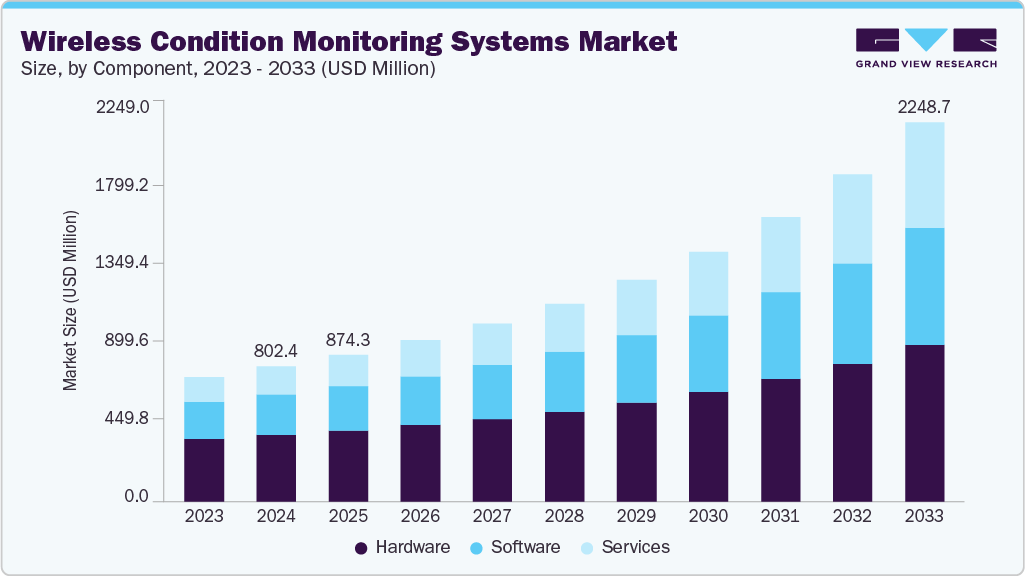
Rapid advancements in wireless communication technologies, including LoRaWAN, NB-IoT, LTE-M, and 5G, are creating a favorable environment for high-density sensor deployments and long-range, low-power industrial monitoring. Due to the growth of edge-processing capabilities, wireless condition monitoring systems can now perform real-time diagnostics, vibration analysis, and anomaly detection directly at the device level, reducing latency and lowering data-transfer costs. This technological evolution enables industries to rapidly and efficiently scale their predictive capabilities without requiring major infrastructure upgrades. As wireless standards evolve and become more interoperable, organizations are increasingly integrating multi-protocol sensor architectures that enhance system resilience, flexibility, and long-term scalability.
Regulatory pressure related to equipment reliability, worker safety, and environmental risk management is driving organizations to adopt advanced wireless monitoring solutions to ensure compliance and prevent unplanned failures. Sectors such as pharmaceuticals, power utilities, food & beverage, and chemicals are under consistent scrutiny to maintain auditability and asset-performance transparency, which wireless systems enable through continuous data capture and automated reporting. Enterprises are also prioritizing risk-mitigation strategies to avoid costly shutdowns, product quality degradation, and safety incidents. Wireless condition monitoring frameworks enable companies to establish proactive maintenance regimes and enhance governance across complex operations, thereby directly supporting regulatory compliance and reducing the likelihood of critical asset failures.
Component Insights
The hardware segment led the market with the largest revenue share of 49.3% in 2024, primarily driven by the growing demand for high-performance sensors, rugged edge devices, and energy-efficient monitoring modules that enable real-time visibility of crucial industrial assets. The increasing deployment of IIoT-enabled equipment across manufacturing, oil & gas, power generation, and mining is accelerating investments in advanced sensors for vibration, temperature, pressure, and acoustic monitoring. The shift toward predictive maintenance, coupled with the need to reduce unplanned downtime and optimize asset lifecycles, further strengthens hardware adoption. In addition, advancements in low-power wireless chips and multi-sensor integration are expanding hardware scalability across harsh and remote environments.
The services segment is expected to register at the fastest CAGR over the forecast period. The services component of the wireless condition monitoring systems industry is being driven by increasing demand for predictive and preventive maintenance programs, which reduce unplanned downtime and optimize asset life cycles. As companies digitize operations, they rely on expert onboarding, integration, and data analytics consulting to derive actionable insights from sensor data. In addition, managed services, such as remote monitoring and cloud-based diagnostics, enable asset-intensive industries to outsource expertise and leverage real-time anomaly detection. This shift towards outcome-oriented maintenance, paired with the expanding remote-asset footprint in various sectors such as oil & gas and power generation, underpins robust services growth.
Monitoring Technique Insights
The vibration monitoring segment accounted for the largest market revenue share in 2024, driven by its ability to provide precise, real-time insights into equipment health, enabling early detection of mechanical faults across rotating assets such as motors, pumps, turbines, and compressors. Growing adoption of predictive maintenance strategies, combined with the shift toward Industry 4.0 and wireless IoT sensor networks, is accelerating demand for vibration-based monitoring. Its high diagnostic accuracy, compatibility with edge analytics, and suitability for harsh or remote environments further strengthen deployment. In addition, industries are prioritizing reduced downtime, improved asset reliability, and lower maintenance costs, making vibration monitoring a preferred technique within wireless condition monitoring systems.
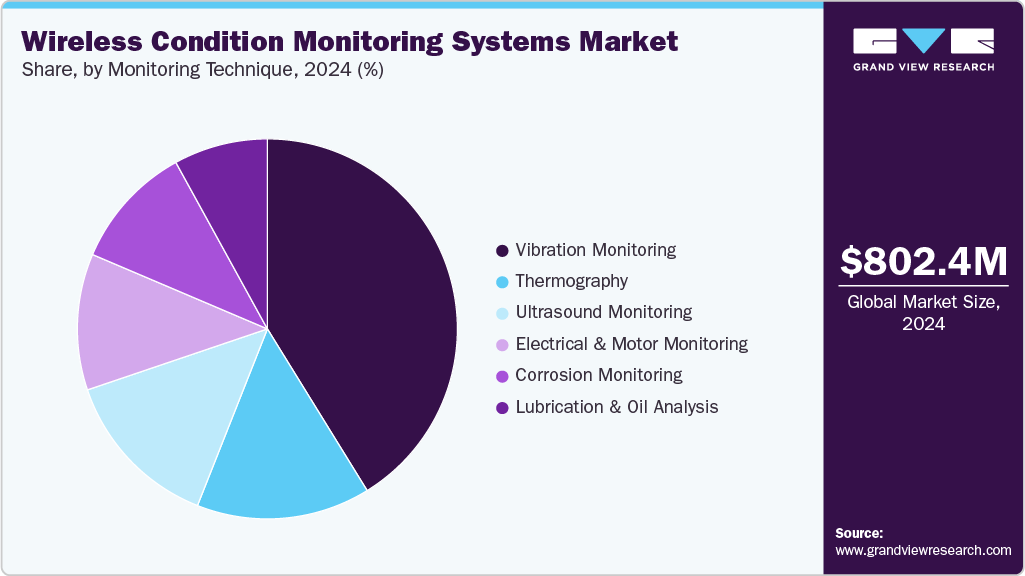
The electrical & motor monitoring segment is expected to register at the fastest CAGR over the forecast period, driven by the growing need to reduce unplanned downtime and improve asset reliability across energy-intensive industries. The increasing deployment of IIoT-enabled sensors, coupled with the higher adoption of wireless technologies, enables the real-time tracking of motor temperature, vibration, insulation health, and electrical anomalies without physical wiring constraints. Rising motor failures, linked to overload, imbalance, and inefficient power quality, are prompting industries to adopt predictive maintenance tools that reduce operating costs. In addition, the expansion of automated manufacturing facilities and aging electrical infrastructure further accelerates demand for wireless motor-monitoring solutions.
Connectivity Type Insights
The Wi-Fi segment accounted for the largest market revenue share in 2024, primarily driven by its ability to deliver high-bandwidth, low-latency data transmission, which is essential for real-time asset health insights in manufacturing, automotive, and pharmaceutical environments. Growing investments in Industry 4.0, plant digitalization, and smart factory upgrades are accelerating the adoption of Wi-Fi-enabled sensors and gateways. Organizations prefer Wi-Fi due to its cost-effectiveness, ease of integration with existing enterprise networks, and compatibility with edge analytics platforms. In addition, the expansion of Wi-Fi 6/6E capabilities supports higher device densities, making Wi-Fi a scalable choice for complex industrial facilities.
The LoRaWAN, NB-IoT (LPWAN) segment is expected to register at the fastest CAGR over the forecast period, primarily driven by the rising need for long-range, low-power asset monitoring across remote and hard-to-reach industrial environments. Increasing digitalization in oil & gas, mining, utilities, and power generation is accelerating demand for scalable networks that support high device densities with minimal energy consumption and low operational costs. Enterprises are adopting LPWAN to enable predictive maintenance, reduce unplanned downtime, and extend sensor battery life. Meanwhile, governments and operators are expanding nationwide LPWAN infrastructure, thereby strengthening ecosystem maturity and accelerating large-scale industrial deployments.
Deployment Insights
The on-premises segment accounted for the largest market revenue share in 2024, driven by industries’ need for greater data control, low-latency processing, and enhanced cybersecurity for critical assets. Manufacturing, oil & gas, and power generation operators prioritize on-site data storage due to strict compliance requirements and the sensitivity of operational data. On-premises architectures also enable real-time analysis, seamless integration with existing SCADA, PLC, and MES systems, and reduced dependency on external networks in remote or hazardous environments. In addition, organizations with legacy infrastructure continue to adopt on-premises solutions to maintain operational continuity while modernizing monitoring capabilities.
The cloud segment is expected to register at the fastest CAGR over the forecast period, driven by enterprises’ growing need for scalable data management, real-time asset visibility, and reduced infrastructure costs. Cloud platforms enable seamless integration of large sensor networks, advanced analytics, and remote equipment monitoring across distributed facilities. The increasing adoption of IIoT, predictive maintenance, and AI-driven diagnostics is strengthening the shift toward cloud-hosted solutions, while subscription-based models are improving affordability for mid-sized manufacturers. In addition, cloud deployment accelerates response time, enhances operational continuity, and supports multi-site standardization, making it a preferred choice for organizations pursuing digital transformation and data-centric maintenance strategies.
End Use Insights
The manufacturing segment accounted for the largest market revenue share in 2024, driven by rising demand for predictive maintenance, the need to reduce unplanned downtime, and ongoing digital transformation across industrial plants. Manufacturers are rapidly adopting wireless condition monitoring to enhance asset visibility, optimize maintenance schedules, and improve overall equipment effectiveness (OEE). The growing integration of IIoT platforms, combined with the cost benefits of wireless systems, supports faster deployment across both legacy and new facilities. In addition, increasing focus on worker safety, energy efficiency, and real-time production analytics further accelerates wireless adoption in discrete and process manufacturing environments.
The mining & metals segment is expected to register at the fastest CAGR over the forecast period, driven by the rapid digitalization of extraction and processing operations, the need to improve asset reliability in harsh and remote environments, and growing pressure to reduce unplanned downtime across high-value equipment such as conveyors, crushers, and haul trucks. Increasing deployment of LPWAN, rugged sensors, and real-time analytics enables continuous monitoring of vibration, temperature, and structural health, supporting predictive maintenance strategies. In addition, workforce safety requirements and rising ESG expectations are accelerating investments in remote monitoring to minimize site exposure and enhance operational efficiency.
Regional Insights
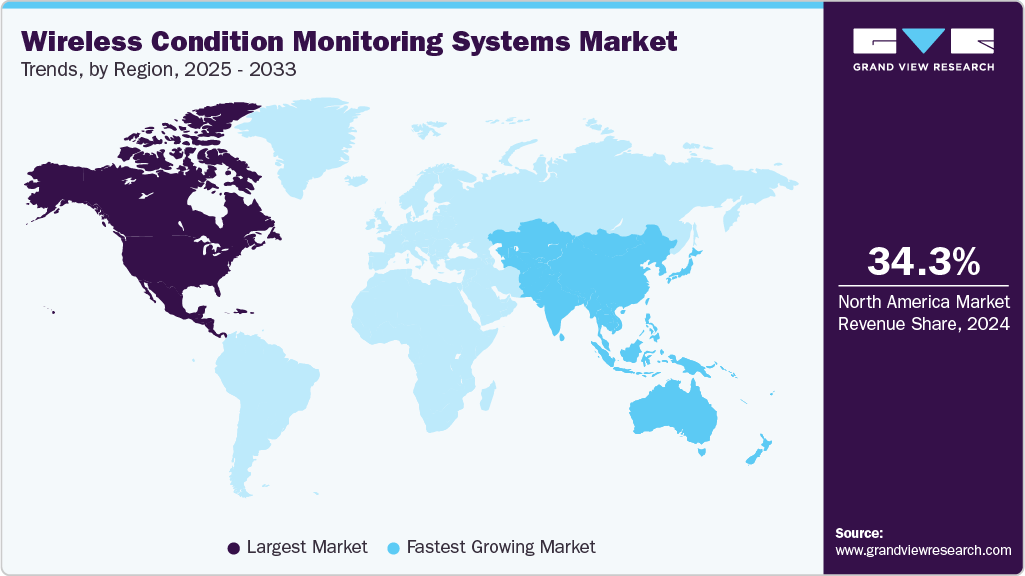
North America dominated the global wireless condition monitoring systems market with the largest revenue share of 34.3% in 2024, driven by the rapid shift toward predictive maintenance across manufacturing, oil & gas, and power sectors, supported by strong IIoT adoption and advanced industrial automation maturity in the U.S. and Canada. Expanding investments in smart factories, the presence of major OEMs offering integrated sensor and software ecosystems, and stringent regulatory requirements for equipment safety and uptime further accelerate demand. In addition, the region benefits from a robust connectivity infrastructure, including 5G, private LTE, and industrial Wi-Fi, which enhances real-time asset monitoring and facilitates the faster deployment of wireless condition monitoring solutions.
U.S. Wireless Condition Monitoring Systems Market Trends
The wireless condition monitoring systems market in the U.S. accounted for the largest market revenue share in North America in 2024, primarily driven by the rapid expansion of smart manufacturing initiatives, increasing emphasis on predictive maintenance to reduce unplanned downtime, and strong adoption of Industrial IoT across industrial facilities. Growing investments in automation, particularly in oil & gas, power generation, and discrete manufacturing, are accelerating the shift from traditional wired systems to scalable wireless architectures. In addition, advancements in low-power sensors, improved connectivity reliability, and rising pressure to optimize operational efficiency and asset utilization are compelling industries to modernize maintenance practices, thereby supporting market growth.
Europe Wireless Condition Monitoring Systems Market Trends
The wireless condition monitoring systems market in Europe is expected to grow at a significant CAGR over the forecast period, driven by the region’s accelerating shift toward predictive maintenance, stringent industrial safety regulations, and strong adoption of Industry 4.0 frameworks across manufacturing, automotive, and energy sectors. Rising investments in smart factories, coupled with widespread deployment of IIoT sensors and cloud-enabled analytics, are enhancing demand for continuous, real-time asset monitoring. In addition, Europe’s aging industrial infrastructure needs to reduce unplanned downtime, and increasing emphasis on energy efficiency are pushing enterprises to replace legacy systems with advanced wireless solutions that offer scalability, lower installation costs, and improved operational visibility.
Asia Pacific Wireless Condition Monitoring Systems Market Trends
The wireless condition monitoring systems market in the Asia Pacific is anticipated to grow at the fastest CAGR over the forecast period, driven by rapid industrial digitalization, expanding manufacturing capacity, and the accelerating adoption of predictive maintenance across critical industries such as automotive, power generation, oil & gas, and mining. Governments in China, India, Japan, and South Korea are actively promoting Industry 4.0 programs, which are increasing the deployment of wireless sensors, edge analytics, and IoT-enabled maintenance platforms. In addition, the region’s large base of remote industrial assets, such as mines, pipelines, utilities, and renewable energy sites, supports strong uptake of LPWAN- and cellular-based monitoring solutions. Growing demand for uptime, safety compliance, and cost-efficient asset optimization further reinforces market expansion.
Key Wireless Condition Monitoring SystemsCompany Insights
Some key companies in the global wireless condition monitoring systems industry are Emerson Electric Co. and Siemens.
-
Emerson Electric Co., through Bently Nevada, is a key global provider of advanced wireless vibration and asset-health monitoring solutions. Its portfolio spans sensors, wireless gateways, edge analytics, and enterprise software, enabling real-time diagnostics for rotating equipment across oil & gas, power, and industrial plants.
-
Siemens offers an integrated wireless condition monitoring ecosystem combining industrial IoT sensors, edge devices, and MindSphere analytics. Its solutions support predictive maintenance across manufacturing, energy, and infrastructure operations. Deep automation capabilities, strong digitalization platforms, and extensive customer penetration position Siemens as a key player driving scalable, connected industrial monitoring.
Key Wireless Condition Monitoring Systems Companies:
The following are the leading companies in the wireless condition monitoring systems market. These companies collectively hold the largest market share and dictate industry trends.
- Emerson Electric Co.
- Siemens
- ABB Ltd.
- Honeywell International Inc.
- General Electric Company
- Schneider Electric
- Rockwell Automation
- SKF
- Baker Hughes Company
- Parker Hannifin Corp
Recent Developments
-
In November 2025, Emerson Electric Co. introduced AMS Machine Works v2.1, incorporating enhanced Wi-Fi and edge-connectivity features for wireless condition monitoring. The release supports faster diagnostics through “Store on Alert,” improves automated fault detection, and enables scalable data transfer for facilities transitioning to predictive and connected maintenance programs.
-
In October 2025, GE Vernova, an energy technology company, partnered with Verizon Business, a telecommunications and enterprise connectivity provider, to launch the MDS Orbit industrial wireless platform, delivering secure, resilient communications for utilities. The initiative enhances remote monitoring, SCADA connectivity, and grid automation capabilities, enabling utilities to modernize operations and improve data reliability across their dispersed assets.
-
In October 2025, MISTRAS Group, a structural health monitoring solutions provider, collaborated with Villari, a technology company, to integrate Villari’s wireless crack-detection technology into its structural-health monitoring portfolio. The initiative expands real-time fatigue and crack growth monitoring for steel assets, providing industrial and infrastructure operators with deeper asset health visibility and reducing dependence on manual inspections and unplanned downtime.
Wireless Condition Monitoring Systems Market Report Scope
Report Attribute
Details
Market size value in 2025
USD 874.34 million
Revenue forecast in 2033
USD 2,248.71 million
Growth rate
CAGR of 12.5% from 2025 to 2033
Base year for estimation
2024
Historical data
2021 - 2023
Forecast period
2025 - 2033
Quantitative units
Revenue in USD million/billion and CAGR from 2025 to 2033
Report coverage
Revenue forecast, company ranking, competitive landscape, growth factors, and trends
Segments covered
Component, monitoring technique, connectivity type, deployment, end use, region
Regional scope
North America; Europe; Asia Pacific; Latin America; MEA
Country scope
U.S.; Canada; Mexico; Germany; UK; France; China; India; Japan; Australia; South Korea; Brazil; UAE; South Africa; KSA
Key companies profiled
Emerson Electric Co.; Siemens; ABB Ltd.; Honeywell International Inc.; General Electric Company; Schneider Electric; Rockwell Automation; SKF; Baker Hughes Company; Parker Hannifin Corp
Customization scope
Free report customization (equivalent up to 8 analysts working days) with purchase. Addition or alteration to country, regional & segment scope.
Pricing and purchase options
Avail customized purchase options to meet your exact research needs. Explore purchase options
Global Wireless Condition Monitoring Systems Market Report Segmentation
This report forecasts revenue growth at global, regional, and country levels and provides an analysis of the latest industry trends in each of the sub-segments from 2021 to 2033. For this study, Grand View Research has segmented global wireless condition monitoring systems market report based on component, monitoring technique, connectivity type, deployment, end use, and region.
-
Component Outlook (Revenue, USD Million, 2021 - 2033)
-
Hardware
-
Software
-
Services
-
-
Monitoring Technique Outlook (Revenue, USD Million, 2021 - 2033)
-
Vibration Monitoring
-
Thermography
-
Ultrasound Monitoring
-
Lubrication & Oil Analysis
-
Corrosion Monitoring
-
Electrical & Motor Monitoring
-
-
Connectivity Type Outlook (Revenue, USD Million, 2021 - 2033)
-
Bluetooth Low Energy
-
Wi-Fi
-
LoRaWAN, NB-IoT (LPWAN)
-
Zigbee & WirelessHART
-
Cellular
-
-
Deployment Outlook (Revenue, USD Million, 2021 - 2033)
-
On-premises
-
Cloud
-
Hybrid
-
-
End Use Outlook (Revenue, USD Million, 2021 - 2033)
-
Manufacturing
-
Oil & Gas
-
Power Generation
-
Automotive
-
Pharmaceutical
-
Mining & Metals
-
Others
-
-
Regional Outlook (Revenue, USD Million, 2021 - 2033)
-
North America
-
U.S.
-
Canada
-
Mexico
-
-
Europe
-
Germany
-
UK
-
France
-
-
Asia Pacific
-
China
-
Japan
-
India
-
South Korea
-
Australia
-
-
Latin America
-
Brazil
-
-
Middle East and Africa (MEA)
-
UAE
-
KSA
-
South Africa
-
-
Frequently Asked Questions About This Report
b. The global wireless condition monitoring systems market size was estimated at USD 802.4 million in 2024 and is expected to reach USD 874.3 million in 2025.
b. The global wireless condition monitoring systems market is expected to grow at a compound annual growth rate of 12.5% from 2025 to 2033 to reach USD 2,248.7 million by 2033.
b. North America dominated the wireless condition monitoring systems market with a share of 34.3% in 2024. This is attributable to the the rapid shift toward predictive maintenance across manufacturing, oil & gas, and power sectors, supported by strong IIoT adoption and advanced industrial automation maturity in the U.S. and Canada. Expanding investments in smart factories, the presence of major OEMs offering integrated sensor and software ecosystems, and stringent regulatory requirements for equipment safety and uptime further accelerate demand. Additionally, the region benefits from robust connectivity infrastructure, including 5G, private LTE, and industrial Wi-Fi, which enhances real-time asset monitoring and drives faster deployment of wireless condition monitoring solutions.
b. Some key players operating in the wireless condition monitoring systems market include Emerson Electric Co.; Siemens; ABB Ltd.; Honeywell International Inc.; General Electric Company; Schneider Electric; Rockwell Automation; SKF; Baker Hughes Company; and Parker Hannifin Corp.
b. Key factors that are driving the wireless condition monitoring systems market growth include rising digitalization of industrial operations, demand for predictive maintenance, and increasing deployment of IIoT-enabled sensors. Growing focus on asset optimization, reduced downtime, and cost-efficient real-time monitoring further accelerates adoption across manufacturing, energy, and heavy industries.


Share this report with your colleague or friend.
Need a Tailored Report?
Customize this report to your needs — add regions, segments, or data points, with 20% free customization.


ISO 9001:2015 & 27001:2022 Certified
We are GDPR and CCPA compliant! Your transaction & personal information is safe and secure. For more details, please read our privacy policy.
Trusted market insights - try a free sample
See how our reports are structured and why industry leaders rely on Grand View Research. Get a free sample or ask us to tailor this report to your needs.













