
- Home
- »
- Consumer F&B
- »
-
Yogurt Market Size, Share And Growth Report, 2026-2033GVR Report cover

Yogurt Market (2026 - 2033)
Size, Share & Trends Analysis Report By Type (Dairy, Non-Dairy), By Flavor (Plain, Flavored), By Distribution Channel (Hypermarkets & Supermarkets, Convenience Stores, Online), By Region, And Segment Forecasts
Market Size, 2025
$147.9BMarket Estimate, 2026
$153.4BMarket Forecast, 2033
$209.1BCAGR, 2026–2033
4.5%Yogurt Market Summary
The global yogurt market size was valued at USD 147.9 billion in 2025 and is projected to grow from USD 153.4 billion in 2026 to USD 209.1 billion by 2033, at a CAGR of 4.5% from 2026 to 2033. Asia Pacific dominated the market, accounting for a revenue share of 52.6%. The market is driven by rising demand for convenient, nutritious and versatile food products that fit into everyday diets.
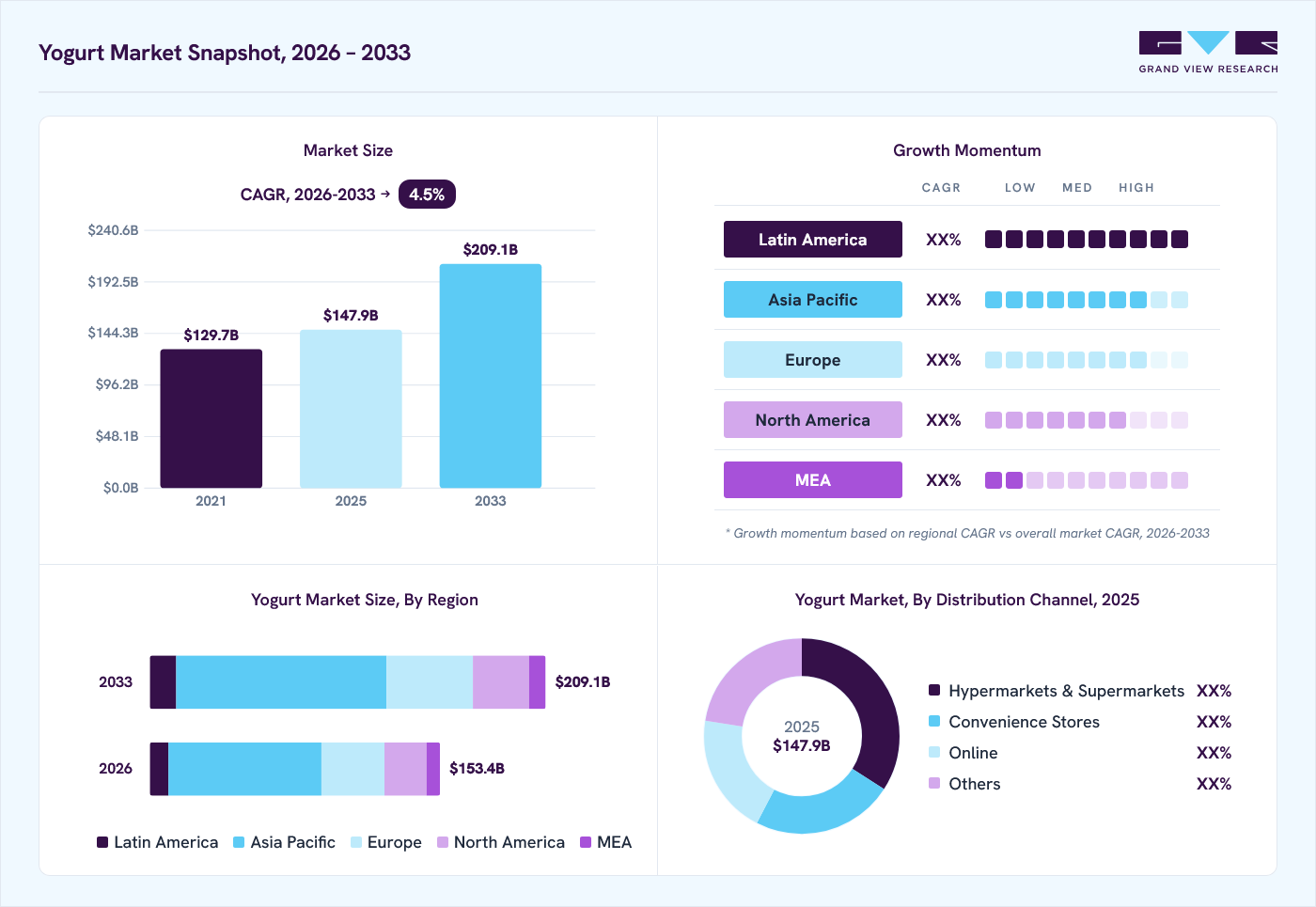 Source: Grand View Research, IR Documents, Primary Interviews, Paid DatabasesTo learn more about this report,
 Download Free Sample Report
Key Market Trends & Insights
- By type: Dairy yogurt led the market and accounted for a share of 97.5% in 2025.
- By flavor: Flavored yogurt is anticipated to register the fastest CAGR of 4.7% from 2026 to 2033.
- By distribution channel: Hypermarket & supermarket dominated the market and accounted for a share of 34.1% in 2025.
Regional Highlights
- Largest region market: Asia Pacific (52.6% revenue share, 2025)
- Fastest growing region: Central & South America (highest CAGR, 2026-2033)
- By country: China held the largest market share in 2025.
Market Size & Forecast
- Market Size in 2025: USD 147.9 Billion
- Estimated Market Size in 2026: USD 153.4 Billion
- Projected Market Size by 2033: USD 209.1 Billion
- CAGR (2026-2033): 4.5%
Prism AI by Grand View Research Free to tryAsk a question about the yogurt marketTry asking✓Every figure cited from GVR research Prefer the report? Download free sample →
Consumers are increasingly choosing yogurt for its protein content, calcium, probiotics and suitability for breakfast, snacking and meal preparation. Product innovation across dairy and non-dairy yogurt, including greek, drinkable, lactose-free and plant-based varieties, is expanding consumer choice and catering to different dietary preferences. Flavors such as strawberry, vanilla, peach and blueberry continue to support product variety, while plain yogurt appeals to consumers seeking less sugar and greater control over ingredients.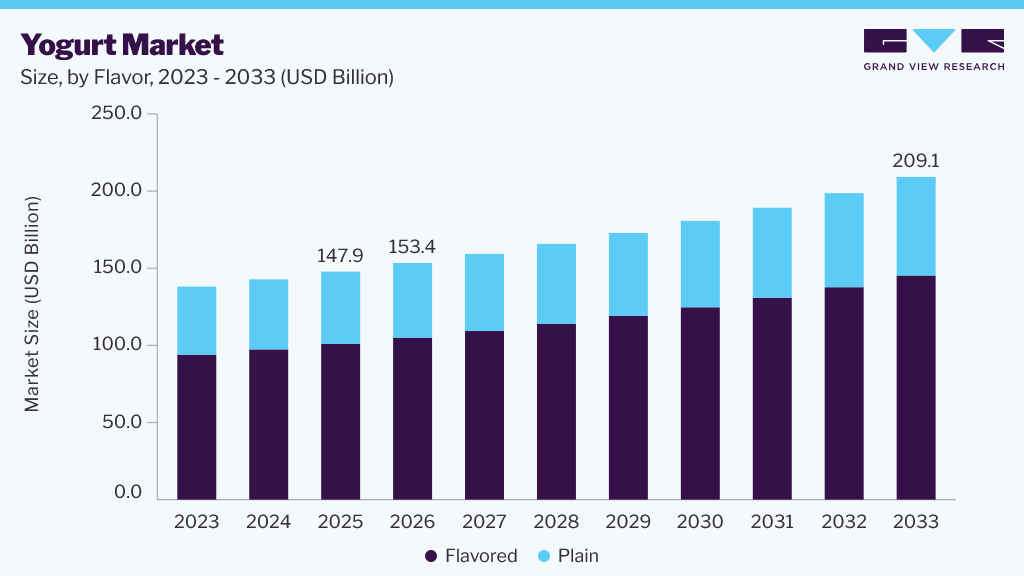 To learn more about this report, Download Free Sample Report
These demand patterns are further supported by growing consumer interest in digestive health, high-protein diets and products with reduced added sugar. Manufacturers are responding by incorporating live cultures, probiotic strains and protein-rich ingredients into yogurt formulations while improving taste and texture to encourage regular consumption. The shift toward convenient nutrition is driving the development of drinkable yogurt, single-serve packs and resealable formats suited to busy lifestyles, workplace consumption and on-the-go snacking. Plant-based innovation is also expanding consumer choice, with brands developing alternatives from soy, almond, coconut and oats to accommodate dairy avoidance and varied dietary preferences.
Hypermarkets and supermarkets provide consumers with access to a broad assortment of conventional, Greek, lactose-free and plant-based yogurt varieties, while convenience stores cater to impulse purchases and demand for portable formats. Online grocery platforms are further improving access to specialty products, enabling consumers to compare brands and arrange home delivery. Product visibility, promotional offers and the availability of chilled storage also influence purchasing decisions and brand selection. At the same time, clean-label positioning, transparent ingredient lists and expanded flavor options are gaining relevance as consumers seek yogurt products that align with their nutritional needs and taste preferences.
Market Dynamics
Demand for plant-based yogurt is being supported by consumers seeking dairy-free products because of dietary preferences, lactose avoidance or interest in plant-derived foods. Manufacturers are broadening the category beyond traditional soy-based products by using ingredients such as coconut, almond and oats, while improving protein content, texture and flavor. Product development that addresses the nutritional gaps sometimes associated with dairy-free yogurt is helping brands appeal to consumers who want plant-based alternatives that offer more than a substitute for conventional yogurt.
For instance, in July 2026, Danone announced the launch of Silk Protein Yogurt, a plant-based yogurt providing at least 12 grams of complete plant protein and 4 grams of fiber per serving. The products were introduced in four flavors, including vanilla, strawberry, peach and mixed berry, and began rolling out through major grocery retailers in the U.S.
Lactose malabsorption can limit the consumption of conventional dairy products among consumers who experience digestive symptoms after consuming lactose. Although yogurt may be better tolerated than milk by some individuals because of its fermentation process and live cultures, tolerance varies from person to person. This can restrict regular yogurt consumption among certain consumer groups and encourage demand for lactose-free or plant-based alternatives, requiring manufacturers to invest in additional formulations and production processes.
Yogurt manufacturers can improve production efficiency and product consistency by adopting membrane filtration technologies, including ultrafiltration and reverse osmosis. These processes help concentrate milk proteins and adjust the solids content of yogurt, enabling manufacturers to produce Greek-style, high-protein and other concentrated varieties with greater control over texture and composition. Depending on the process design, filtration can also reduce reliance on added milk powder, improve raw-material utilization and create opportunities to develop products with simpler ingredient lists. Investment in suitable filtration equipment can therefore support product differentiation while helping processors manage production costs.
For instance, Tetra Pak has developed membrane filtration solutions for yogurt production that allow manufacturers to control protein and fat levels while retaining proteins during concentration. The company explains that ultrafiltration can produce yogurt with different compositions using a single filtration unit, offering flexibility across product varieties and the potential to reduce or avoid added milk powder in certain formulations.
Analyst Perspective
The yogurt market is shifting from a volume-driven dairy category toward a value-driven nutrition market, where differentiation depends on protein density, digestive health benefits, product formulation, and consumption occasions. The central competitive advantage will belong to manufacturers that balance functional nutrition with affordable pricing and familiar taste, while expanding beyond traditional refrigerated yogurt into high-protein, lactose-free, and plant-based alternatives. Long-term market positioning will depend less on product variety alone and more on the ability to secure repeat purchases through measurable nutritional value, accessible pricing, and efficient cold-chain distribution.
Consumer Insights
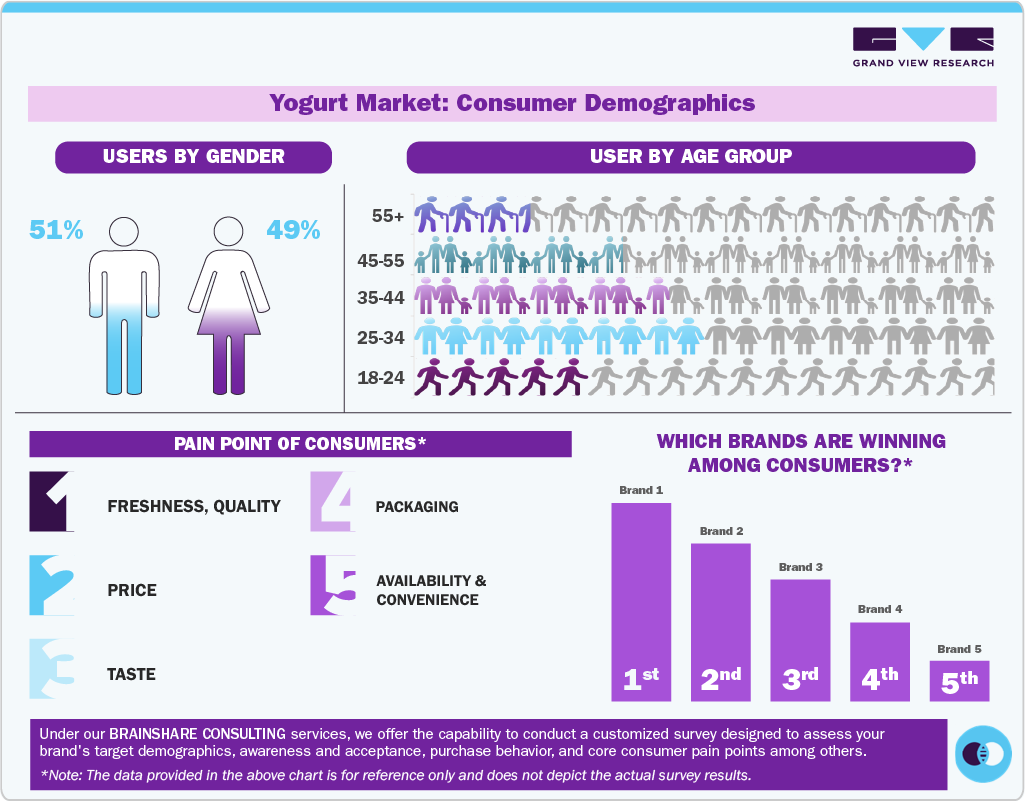
Consumer purchasing behavior in the global yogurt market is influenced by household eating habits, cultural food preferences and the perceived suitability of yogurt for different age groups. In many markets, yogurt is consumed as part of traditional meals and breakfast routines, while in others it serves as a snack or a base for sauces, marinades, dips and desserts. Parents may select yogurt as a convenient food for children, whereas adults may incorporate it into meal preparation or use it as an alternative to heavier desserts. These varied consumption occasions help maintain demand across different household types and contribute to yogurt’s versatility beyond standalone consumption.
 To learn more about this report, Download Free Sample Report
The yogurt market is also influenced by expectations for distinctive eating experiences, especially among younger consumers and families. Texture, presentation and interactive eating experiences can help brands differentiate their products beyond conventional flavors and nutritional claims. Products designed around playful textures may attract children and encourage parents to consider yogurt as a snack option, if taste, ingredient quality and nutritional value meet their expectations.
For instance, in January 2026, Lactalis Canada launched iÖGO nanö Bubbles, a yogurt product featuring a creamy texture with fruit-flavored bubbles that burst in the mouth. Made with Canadian milk and real fruit, the 100-gram cups were introduced in three varieties: orange cream with mango bubbles, mixed berries with strawberry bubbles, and banana with mango bubbles. This development highlights how manufacturers are using novel textures and interactive product experiences to create new consumption occasions and distinguish yogurt products in a competitive food category.
Consumer adoption of yogurt continues to reflect its versatility across meal occasions, age groups and regional food traditions. Manufacturers that combine consistent product quality with locally relevant formats, appealing sensory experiences and competitive pricing can strengthen consumer engagement and encourage repeat purchases across diverse markets.
Type Insights
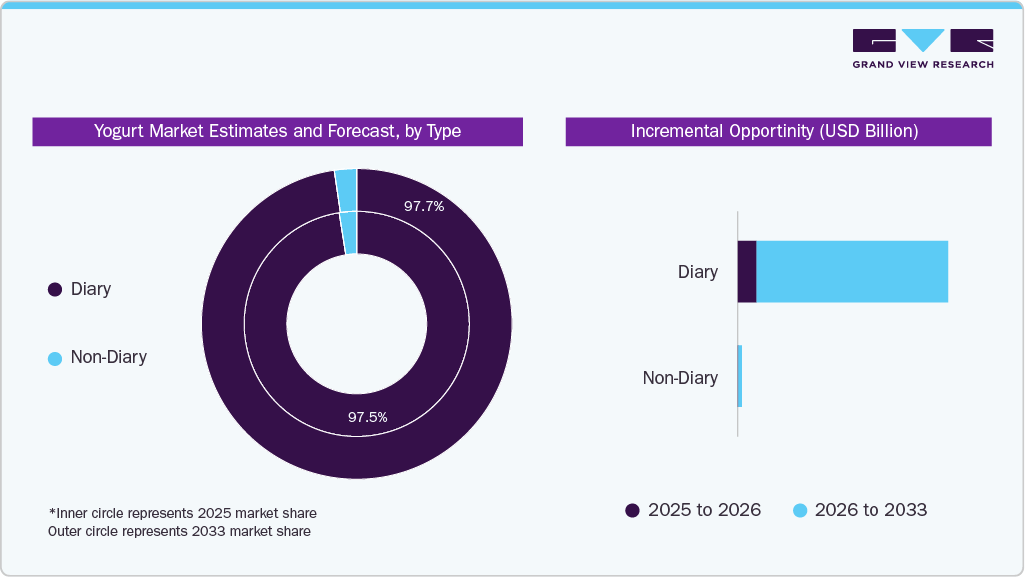
Dairy yogurt accounted for a revenue share of 97.5% for the global yogurt industry in 2025, supported by its established consumption patterns, nutritional composition and wide availability. It is produced by fermenting milk with suitable bacterial cultures and provides nutrients such as protein, calcium and vitamin B12, depending on the formulation. Consumers incorporate dairy yogurt into breakfast, snacks and traditional meals, while its use in sauces, dips and desserts supports demand across different culinary applications. The availability of plain, flavored, Greek-style and strained varieties allow manufacturers to cater to diverse preferences related to taste, texture and protein content. Familiarity with dairy-based products, established production infrastructure and broad retail availability continue to support the segment.
 To learn more about this report, Download Free Sample Report
Non-dairy yogurt is expected to grow at a CAGR of 3.5% from 2026 to 2033. Manufacturers are creating opportunities by using locally sourced plant ingredients and simplifying formulations to meet consumer interest in products with recognizable ingredients. For instance, in February 2025, REWE Group’s Ja! Natürlich brand introduced an organic oat yogurt in Austria made with locally grown organic oats, without exotic vegetable oils and with a short ingredient list. This product development highlights an opportunity for manufacturers to differentiate plant-based yogurt through regional sourcing and simpler formulations while addressing consumer expectations for taste and texture.
Flavor Insights
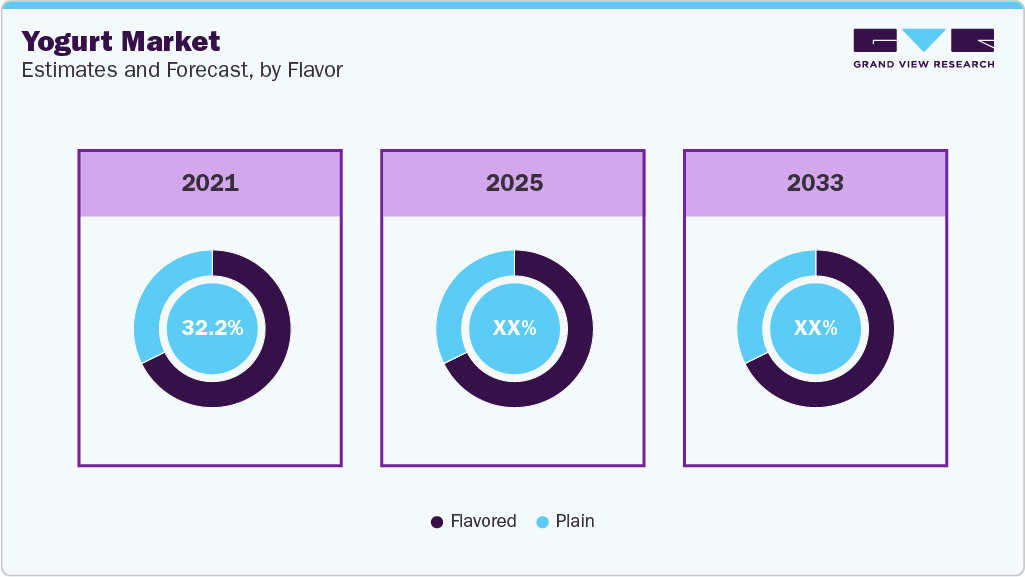
Plain yogurt accounted for a revenue share of 31.7% for the global yogurt market in 2025, supported by its use as both a standalone food and a versatile cooking ingredient. Its unsweetened profile allows consumers to control sweetness by adding fruit, honey or other ingredients, while its natural acidity makes it suitable for sauces, dips, marinades and traditional dishes. Manufacturers are also developing thicker, strained varieties to attract consumers seeking a richer texture without added flavoring. For instance, in April 2025, Yoplait introduced SKYR Natural in the UK, drawing on the Icelandic-style yogurt tradition. The product was positioned as a thick, creamy, naturally fat-free yogurt with a high protein content, highlighting how manufacturers can differentiate plain yogurt through texture and nutritional composition.
 To learn more about this report, Download Free Sample Report
Flavored yogurt market is expected to grow at a CAGR of 4.7% from 2026 to 2033. It appeals to consumers who prefer a ready-to-eat product with a defined taste, allowing manufacturers to differentiate their offerings through fruit combinations, dessert-inspired profiles and seasonal varieties. Familiar options such as strawberry, vanilla and peach remain common, while combinations that blend fruit with creamy or indulgent notes provide opportunities for product innovation. For instance, in August 2025, Hiland Dairy refreshed its yogurt range with updated packaging across seven low-fat and seven fat-free flavors, including key lime pie, Boston cream pie, black cherry, strawberry banana and cherry vanilla. The range demonstrates how manufacturers can maintain familiar flavor choices while using broader assortments and packaging updates to keep products appealing to consumers.
Distribution Channel Insights
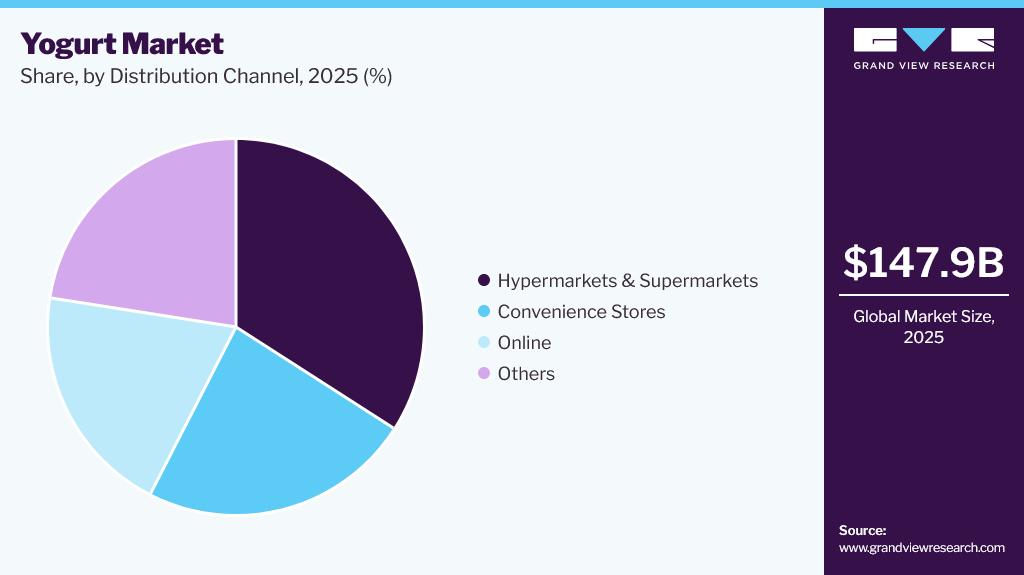
Sales of yogurt through hypermarkets & supermarkets accounted for a revenue share of 34.1% in 2025, supported by their broad product assortments, established chilled-food sections and ability to serve both routine household purchases and individual snacking needs. These stores offer consumers access to dairy-based, plant-based, plain, flavored, Greek and drinkable yogurt varieties across different brands, pack sizes and price points. Refrigerated display units help maintain product quality, while in-store promotions and multi-pack offers encourage repeat purchases. For instance, in June 2025, NORR Organic announced the expansion of its yogurt range into all 70 Fresh Thyme Market stores across the U.S. Midwest, covering plain, vanilla, raspberry and mixed-berry varieties. This shows how supermarket distribution can help yogurt brands extend retail availability and reach a wider customer base.
 To learn more about this report, Download Free Sample Report
Sales of yogurt through online are expected to grow with a CAGR of 5.1% from 2026 to 2033, as grocery e-commerce and quick-commerce services make chilled products easier to order for home delivery. Digital platforms allow consumers to compare brands, flavors, pack sizes and prices without visiting physical stores, while scheduled deliveries and repeat-order features can simplify regular household purchases. Online channels also provide an additional route for specialty products, including high-protein, lactose-free and plant-based yogurt varieties that may have limited availability in some local stores. For example, Epigamia products are available through its own online store and third-party platforms including JioMart, BigBasket and Swiggy, giving consumers several digital purchasing options.
Regional Insights
The yogurt market in North America held over 14.5% of the global revenue in 2025, supported by established dairy consumption, diverse food traditions and differences in purchasing behavior across Canada and Mexico. In Canada, demand benefits from the popularity of flavored yogurt and its use as a snack or accompaniment to meals, while multicultural food habits support consumption across different household groups. In Mexico, drinking yogurt has a strong presence in everyday consumption, supported by its portability and suitability for quick meals and refreshments. Consumers are also showing interest in lactose-free options, simpler ingredient lists and products adapted to local taste preferences. Retail distribution through supermarkets, convenience stores, neighborhood grocery shops and online platforms help manufacturers reach consumers across different shopping environments, while local dairy production and cross-border trade contribute to product availability throughout the region.
U.S. Yogurt Market Trends
The yogurt industry in the U.S. is expected to grow at a CAGR of 4.0% from 2026 to 2033. The market is supported by established demand for everyday dairy products, expanding product variety and the use of yogurt across breakfast, snacking and meal preparation. Consumers purchase yogurt in different formats, ranging from conventional cups and family-sized tubs to drinkable products and multipacks, while familiar fruit flavors continue to appeal to a broad customer base. Growing interest in plant-based alternatives is creating additional opportunities for manufacturers to cater to consumers seeking options beyond conventional dairy.
Europe Yogurt Market Trends
The Europe market held over 21.7% of the global revenue in 2025. The market is supported by long-standing consumption of fermented dairy products, regional food traditions and demand for products that combine familiar taste with distinct textures and ingredient profiles. Consumer preferences vary across countries, with skyr and strained yogurt appealing to shoppers seeking thicker textures, while natural yogurt remains suitable for breakfast, cooking and use in sauces and desserts. Interest in organic products and clearly labelled ingredients is also influencing product selection, particularly among consumers who prioritize production standards and ingredient transparency.
The yogurt industry in U.K. held over significant market share of the regional revenue in 2025. The market is influenced by changing attitudes toward dairy processing, demand for premium products and the growing role of yogurt in both sweet and savory food preparation. Consumers seeking richer taste and texture are creating opportunities for full-fat natural yogurt, while premium varieties allow brands to differentiate through creaminess, product quality and versatility. Yogurt is also used beyond breakfast, including as an ingredient in dips, dressings, marinades and desserts, broadening its role in household cooking. In addition, packaging improvements are helping brands address environmental concerns associated with single-use plastics.
For instance, in March 2025, Yoplait UK introduced recyclable PET bottles for its yogurt drinks, incorporating recycled plastic and attached caps designed to support collection and recycling. This development highlights how packaging design and recyclability are becoming areas of product differentiation in the U.K. yogurt market.
Asia Pacific Yogurt Market Trends
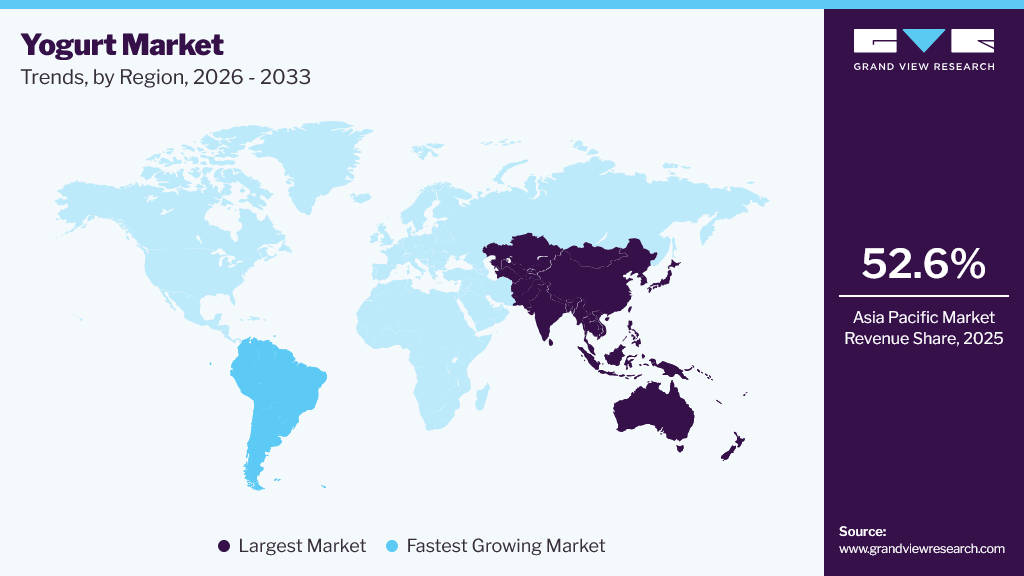
The yogurt market in the Asia Pacific holds the largest market share of 52.6% in 2025. The market is shaped by diverse regional food traditions, the popularity of drinkable fermented dairy products and the development of flavors suited to local tastes. In India, yogurt is closely associated with daily meals and traditional foods such as dahi and lassi, whereas Japan has an established market for cultured dairy products developed around specific bacterial strains and fermentation techniques. Across Southeast Asia, portable yogurt drinks provide an alternative to spoonable products, while manufacturers in several markets are experimenting with fruit, cereal and locally familiar flavor combinations. Product development also reflects differences in sweetness preferences, packaging sizes and retail infrastructure, requiring companies to adapt their offerings to individual countries rather than rely on a uniform regional approach.
 To learn more about this report, Download Free Sample Report
The yogurt industry in China held over significant market share of the regional revenue in 2025, influenced by demand for products with distinctive milk profiles, localized flavors and fermentation-based attributes. Consumers can choose from ambient drinking yogurt, chilled spoonable varieties and products positioned around specific bacterial cultures, with manufacturers adapting formulations to local preferences. Competition is also encouraging brands to differentiate through regional ingredient sourcing and flavor development rather than relying solely on conventional fruit varieties.
Central & South America Yogurt Market Trends
The yogurt industry in Central & South America is expected to grow at a CAGR of about 5.1% from 2026 to 2033, driven by regional dairy production, consumer preference for fruit-flavored formulations and the adaptation of products to local tastes. Brazil plays an important role in the regional market, with manufacturers offering a variety of spoonable and drinkable yogurts in flavors suited to local consumers. Product differentiation increasingly involves packaging formats, texture and nutritional positioning, allowing brands to expand beyond conventional yogurt cups. Manufacturers are also responding to competition from other dairy snacks by refreshing product portfolios and developing formats suited to different retail environments.
Middle East & Africa Yogurt Market Trends
The yogurt industry in the Middle East & Africa is expected to grow at a CAGR of about 2.8% from 2026 to 2033. In Middle Eastern markets, yogurt is widely used alongside meals and as an ingredient in sauces, dips and other traditional dishes, supporting demand for natural and plain varieties. Across Africa, product affordability, pack size and accessibility influence purchasing decisions, particularly in markets where consumers rely on neighborhood retailers and informal distribution networks. Manufacturers are adapting products to local food habits and retail conditions, while improvements in dairy processing, packaging and cold-chain infrastructure can help extend distribution beyond major urban centers. These regional differences create opportunities for both traditional yogurt products and commercially packaged varieties suited to local consumption patterns.
Key Yogurt Company Insights
The yogurt market is characterized by competitive dynamics shaped by a combination of factors, including product innovation, regional production capabilities, and evolving consumer preferences. Leading manufacturers invest in R&D and technological advancements to provide cost-effective and quality products.
Market players are entering into joint ventures, partnerships, mergers, agreements, and acquisitions to strengthen their market position and expand their geographical reach. Companies are also focusing on raising consumer awareness of the ambiguity of the types used while strictly adhering to international regulatory standards.
Key Yogurt Companies
The following key companies have been profiled for this study on the yogurt market.
-
Danone
-
Nestlé
-
Lactalis Group
-
Yili Group
-
China Mengniu Dairy
-
Unternehmensgruppe Theo Müller (Müller Group)
-
Chobani, LLC
-
Fonterra Co-operative Group
-
Arla Foods
-
FAGE International S.A.
Competitive Benchmarking
Category
Operating Strategies
Competitive Edge
Weakness
Established Players (Danone, Nestlé, Lactalis Group, Yili Group, China Mengniu Dairy, Müller Group, Fonterra Co-operative Group, Arla Foods)
- Expand product portfolios across dairy-based, functional, probiotic, and high-protein yogurt to address diverse consumer preferences.
- Strengthen manufacturing and distribution networks while investing in product innovation, operational efficiency, and market expansion.
- Established brand recognition, extensive retail distribution, and strong manufacturing capabilities support broad market reach.
- Integrated dairy supply chains and diversified product portfolios enable consistent supply, cost efficiencies, and access to multiple consumer segments.
- Large-scale operations and complex supply chains can increase operating costs and limit flexibility in responding to changing consumer preferences.
- Dependence on dairy input prices, cold-chain infrastructure, and established product portfolios exposes companies to cost fluctuations and slower adaptation.
Emerging Players (Chobani, LLC, FAGE International S.A.)
- Focus on differentiated yogurt offerings, including Greek-style, high-protein, and premium products, to establish distinct market positions.
- Build brand awareness through targeted marketing, product innovation, and selective expansion into new retail channels and geographic markets.
- Specialized product positioning and strong product identity help attract consumers seeking distinctive textures, nutritional benefits, and premium quality.
- More focused product portfolios support faster innovation and targeted responses to evolving dietary preferences.
- Comparatively narrower geographic reach and distribution networks can constrain market penetration against multinational dairy producers.
- Greater reliance on selected product categories and retail partnerships may increase exposure to competitive pressure, supply costs, and shifts in consumer demand.
Recent Developments
-
In July 2026, Danone announced the expansion of its Silk Protein range with plant-based yogurt containing at least 12 grams of protein per serving, addressing demand for protein-rich foods that also provide fiber and suit on-the-go consumption.
-
In January 2026, Lactalis Canada launched iÖGO nanö Bubbles, a yogurt product featuring a creamy texture with fruit-flavored bubbles that burst in the mouth. Made with Canadian milk and real fruit, the 100-gram cups were introduced in three varieties: Orange Cream with Mango Bubbles, Mixed Berries with Strawberry Bubbles, and Banana with Mango Bubbles.
-
In February 2025, Danone Canada introduced Oikos PRO in both Greek yogurt and drinkable yogurt formats. The range combined high protein content with multiple flavors, offering consumers options for different consumption occasions
Yogurt Market Report Scope
Report Attribute
Details
Market Size in 2025
USD 147.9 billion
Estimated Market Size in 2026
USD 153.4 billion
Projected Market Size by 2033
USD 209.1 billion
Growth Rate (Revenue)
CAGR of 4.5% from 2026 to 2033
Actuals
2021 - 2025
Forecast period
2026 - 2033
Quantitative units
Revenue in USD Million/Billion, and CAGR from 2026 to 2033
Report coverage
Revenue forecast, company ranking, competitive landscape, growth factors, and trends
Segments covered
Processing type, distribution channel, distribution channel, region
Regional scope
North America; Europe; Asia Pacific; Central & South America; Middle East & Africa
Country scope
U.S.; Canada; Mexico; Germany; U.K.; France; Italy; Spain; China; Japan; India; Australia & New Zealand; South Korea; Brazil; South Africa
Key companies profiled
Danone; Nestlé; Lactalis Group; Yili Group; China Mengniu Dairy; Müller Group; Fonterra Co-operative Group; Arla Foods, Chobani, LLC; FAGE International S.A.)
Customization scope
Free report customization (equivalent up to 8 analysts working days) with purchase. Addition or alteration to country, regional & segment scope.
Pricing and purchase options
Avail customized purchase options to meet your exact research needs. Explore purchase options
Global Yogurt Market Report Segmentation
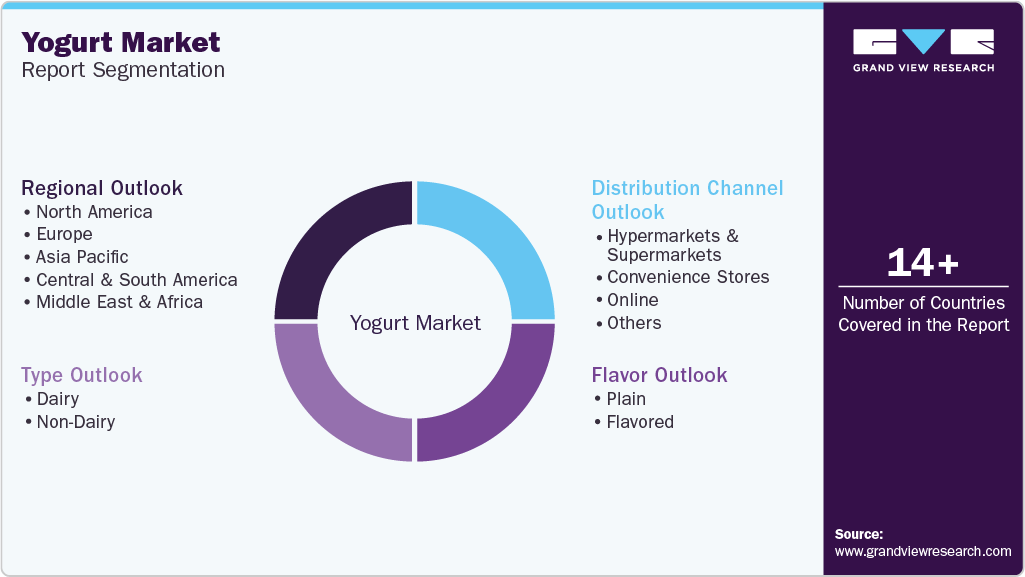
This report forecasts revenue growth at the global, regional, and country levels and provides an analysis of the latest industry trends and opportunities in each of the sub-segments from 2021 to 2033. For this study, Grand View Research has segmented the global yogurt market report based on type, flavor, distribution channel, and region.
 To learn more about this report, Download Free Sample Report
-
Type Outlook (Revenue in USD Billion, 2021 - 2033)
-
Dairy
-
Non-Dairy
-
-
Flavor Outlook (Revenue in USD Billion, 2021 - 2033)
-
Plain
-
Flavored
-
Strawberry
-
Vanilla
-
Peach
-
Blueberry
-
Others
-
-
-
Distribution Channel Outlook (Revenue, USD Billion; 2021 - 2033)
-
Hypermarkets & Supermarkets
-
Convenience Stores
-
Online
-
Others
-
-
Regional Outlook (Revenue, USD Billion, 2021 - 2033)
-
North America
-
U.S.
-
Canada
-
Mexico
-
-
Europe
-
U.K.
-
Germany
-
France
-
Italy
-
Spain
-
-
Asia Pacific
-
China
-
Japan
-
India
-
South Korea
-
Australia & New Zealand
-
-
Central & South America
-
Brazil
-
-
Middle East & Africa
-
South Africa
-
-
Research Methodology
The yogurt market figures in this report are based on a proven research process that combines executive interviews with secondary research from proprietary databases, company filings, and recognized regulatory and institutional sources. Market size is built through value-chain sizing-reconciling supply-side and demand-side estimates-and triangulated with bottom-up and top-down approaches. Every estimate passes multiple levels of expert validation before publication, with each yogurt segment quantified using the revenue-capture definitions in the table below.
Segment Definition
Segment - Type
Revenue capture definition
Dairy
This segment includes the sales of yogurt produced from animal milk, including cow, buffalo, goat, and sheep milk. Revenue is generated through plain, flavored, Greek, and other dairy-based yogurt products.
Non-Dairy
This segment includes the sales of yogurt made from plant-based ingredients such as soy, coconut, almond, and oat. Revenue is generated through plain and flavored alternatives catering to consumers seeking dairy-free options.
Estimation Model
Layer
Key Question
Description
Consumption Profile Layer
Who purchases yogurt?
Demand is shaped by household consumption patterns, growing interest in protein-rich foods, breakfast habits, and the use of yogurt as a snack, ingredient, or meal accompaniment.
Market Reach Layer
Where is yogurt purchased?
Products reach consumers through supermarkets, convenience stores, independent retailers, online platforms, and food-service channels, with availability shaped by cold-chain infrastructure and regional distribution.
Innovation & Differentiation Layer
How do products differentiate?
Manufacturers differentiate through dairy and non-dairy formulations, plain and flavored varieties, Greek-style and high-protein products, probiotic positioning, and packaging formats suited to different consumption occasions.
Value Generation Layer
How is market revenue generated?
Revenue depends on sales volume, average selling prices, product mix, premium variants, pack sizes, and the balance between retail purchases and bulk demand from food-service and industrial customers.
Delivered Customizations
This report has been delivered with the following In-depth customizations
Client Request
Customization Delivered
Value Adds
Global Yogurt Consumer Preferences & Consumption Landscape
Assessed consumer preferences across dairy and non-dairy yogurt, flavor choices, nutritional attributes, protein content, sugar levels, and probiotic positioning.
Identifies high-demand product attributes and supports consumer-specific product positioning across target markets.
Global Yogurt Product Types, Flavors & Distribution Assessment
Evaluated product categories, including dairy and non-dairy yogurt, plain and flavored variants, different packaging formats, and distribution channels such as supermarkets, convenience stores, and online retail.
Supports portfolio optimization, channel prioritization, and identification of product and distribution opportunities.
Global Yogurt Market Pricing, Premiumization & Competitive Landscape
Examined pricing tiers, private-label competition, premium yogurt positioning, and differentiation opportunities across conventional, Greek-style, high-protein, and plant-based yogurt products.
Enables pricing strategy development, premium product positioning, and stronger competitive differentiation across consumer segments.
Frequently Asked Questions About This Report
The global yogurt market size was estimated at USD 147.9 billion in 2025 and is estimated at USD 153.4 billion in 2026.
The market is expected to grow at a CAGR of 4.5% from 2026 to 2033, reaching USD 209.1 billion by 2033.
Some of the major participants in the yogurt industry include: Danone; Nestlé; Lactalis Group; Yili Group; China Mengniu Dairy; Müller Group; Fonterra Co-operative Group; Arla Foods, Chobani, LLC; FAGE International S.A.
By type, dairy yogurt led the market and accounted for a share of 97.5% in 2025.
Asia Pacific dominated the market with a share of 52.6% in 2025.
The market is driven by rising demand for convenient, nutritious and versatile food products that fit into everyday diets.
By flavor, flavored yogurt is anticipated to register the fastest CAGR of 4.7% from 2026 to 2033.
Sales of yogurt through online are expected to grow with the fastest CAGR of 5.1% from 2026 to 2033.
About the Author(s)
Consumer F&B Research Team
Consumer Goods · Consumer F&BThis report was authored by the consumer f&b research team at Grand View Research - comprising two research analysts, one senior research analyst, and one industry expert - with specialized expertise in the consumer f&b segment of the consumer goods industry. All findings are based on proprietary consumer goods databases, executive interviews, and regulatory analysis, subject to internal peer review prior to publication.
Last Updated:
Speak to Analyst

Customize this report to your needs - add regions, segments, or data points, with 20% free customization.
Or view our licence options:


ISO 9001:2015 & 27001:2022 Certified
We are GDPR and CCPA compliant! Your transaction & personal information is safe and secure. For more details, please read our privacy policy.


