- Home
- »
- Market Trend Reports
- »
-
Neurology Clinical Trials: Current Dynamics And Pipeline Outlook
![Neurology Clinical Trials: Current Dynamics And Pipeline OutlookReport]()
Neurology Clinical Trials: Current Dynamics And Pipeline Outlook
- Published: Jul, 2025
- Report ID: GVR-MT-100401
- Format: PDF/Excel databook
- No. of Pages/Datapoints: 30
- Report Coverage: 2024 - 2030
Report Overview
The neurology clinical trials landscape is witnessing rapid growth, driven by increasing burden of central nervous system (CNS) disorders, Alzheimer's, Parkinson's, and epilepsy, a rising trend toward outsourcing, and a growing volume of clinical and decentralized trials. Advancements in technology and the rising demand for disease-modifying therapies are further fueling market expansion. In addition, the increasing prevalence of neurological conditions is boosting the need for innovative therapeutic solutions. Besides, ongoing R&D efforts aimed at core competencies are expected to contribute significantly to market growth. The cost-effectiveness of outsourcing trials, compared to in-house research, also continues to support industry demand.
In addition, innovations in genomics, biomarkers, and digital health technologies are facilitating more precise and efficient trials. Besides, biopharmaceutical companies, academic institutions, and CROs are actively pursuing new therapeutic options, including gene and RNA-based treatments. In addition, regulatory agencies are promoting innovation by offering expedited approval processes and adaptive trial designs. Moreover, the rise of decentralized and virtual trials is enhancing patient access and streamlining data collection.
Moreover, the field of neurology is experiencing a transformative shift towards personalized medicine and gene therapies, offering new avenues for treating complex neurological disorders. In addition, advancements in genomics, biotechnology, and precision medicine are enabling the development of targeted therapies to individual genetic profiles. This approach is promising in treating rare and genetically defined neurological conditions, where traditional treatments have been limited or ineffective. By focusing on the underlying genetic causes of diseases, personalized medicine aims to provide more effective and individualized treatment options, potentially improving patient outcomes and quality of life.
Neurology Clinical Trials: Current Dynamics & Pipeline Outlook Report Coverage
Market Outlook
Prevalence Trends Analysis
R&D Investment & Funding Analysis
Industry Ecosystem Analysis
Market Dynamics
Regulatory Framework
List of Top 200 Active Trials by Phase, Sponsor, and Indication
Emerging Clinical Trial Model Analysis
Global Neurology Clinical Trials, by Phase & Study Design
Global Neurology Clinical Trials, by key Indications, By Region
Moreover, the adoption of novel technologies that enhance the way studies are designed, conducted, and monitored is expected to drive the market. Advanced digital tools such as wearable sensors, remote monitoring devices, and mobile health applications are enabling continuous, real-time data collection directly from patients in their natural environments. This shift has significantly enhanced the precision and detail of neurological assessments while simultaneously easing the burden on patients and boosting retention rates throughout clinical trials. Artificial intelligence & machine learning algorithms are being deployed to analyze complex datasets, predict disease progression, and identify patient subgroups that may respond better to specific treatments. In addition, decentralized clinical trials, supported by telemedicine platforms, have become increasingly viable, allowing participants to engage from remote locations. These technological advancements have accelerated the trial timelines and have improved the precision of endpoints in neurology studies, further paving the way for more personalized therapeutic approaches.
Furthermore, regulatory oversight in neurology clinical trials is essential due to the nature of neurological disorders. Besides, regulatory organizations such as the FDA in the U.S. and the EMA in Europe offer specific guidelines for studies focusing on conditions like Alzheimer’s, Parkinson’s, and epilepsy. These regulations are designed to protect patient safety, uphold ethical standards, and ensure the scientific validity of the research. Moreover, innovative neurology treatments, especially those for rare or severe conditions, may qualify for expedited pathways such as Fast Track, Orphan Drug, and Breakthrough Therapy designations. Besides, regulators are increasingly endorsing adaptive trial designs, digital endpoints, and decentralized approaches to enhance efficiency. Efforts for global harmonization are also underway to facilitate the approval processes for multi-regional neurology trials. Such factors are expected to drive the market over the estimated time period.

Funding for neurology clinical trials has witnessed rising growth as investors’ strong interest in therapies and technologies aimed at brain health. Besides, companies are securing significant capital to develop brain-computer interfaces designed to assist individuals with neurological disorders. In addition, advancements in both pharmaceuticals and medical devices, such as wearable monitors and implantable systems, captivate investors supporting the market. Thus, venture funding supports the clinical trial process, facilitating quicker access to groundbreaking neurology treatments for patients.
Neurology Clinical Trials Dynamic Scenario
The landscape of neurology clinical trials is undergoing significant transformation, fueled by advancements in precision medicine, neurotechnology, and digital health innovations. The neurology clinical trials are focusing on emphasizing conditions such as Alzheimer’s, Parkinson’s, ALS, and rare genetic disorders. Besides, trial designs, including adaptive and decentralized approaches, are enhancing efficiency further supporting market growth. Moreover, the integration of emerging technologies such as AI for patient matching, digital biomarkers, and wearable monitoring devices is improving data quality and fostering greater patient engagement. Regulatory bodies are actively promoting accelerated approval pathways for groundbreaking therapies, including gene and cell-based interventions. However, challenges in areas such as participant recruitment, measurement of endpoints, and the high rates of trial failures. Thus, the field is moving toward a more patient-focused, technology-driven, and collaborative environment.

Neurology clinical trials progress through distinct phases, each playing a crucial role in the development and production of neurological therapies. Phase I trials are increasing focused on assessing safety and determining the appropriate dosage, setting the groundwork for potential mass production of drugs or devices. Besides, Phase II is increasing driven by candidates undergoing evaluation to assess their effectiveness and side effects, which to identify formulations and initiate early manufacturing processes. Phase III entails large-scale testing, essential for confirming product consistency and preparing for commercial production. Moreover, successful approval, Phase IV, or post-marketing studies, is conducted to monitor and optimize real-world product performance. Each trial phase corresponds with rising levels of production planning, quality assurance, and regulatory preparedness for market entry.
Neurology Clinical Trials Pipeline Analysis
The pipeline for neurology clinical trials is rapidly expanding, driven by the increasing global prevalence of neurological disorders, rising R&D investments, and the growing unmet medical needs associated with diseases such as Alzheimer’s, Parkinson’s, and ALS. Recent advancements in neuroscience, genetics, and digital health are increasing focusing on more precise and innovative treatments, including gene therapies, cell therapies, neuromodulation devices, and drugs that modify disease progression. Regulatory bodies are promoting this growth by providing fast-track designations and incentives for orphan drugs, motivating more companies to explore this field. Moreover, enhancements in clinical trial technologies are making trials more efficient and more accommodating for patients, accelerating the transition from initial discovery to advanced stages of development.
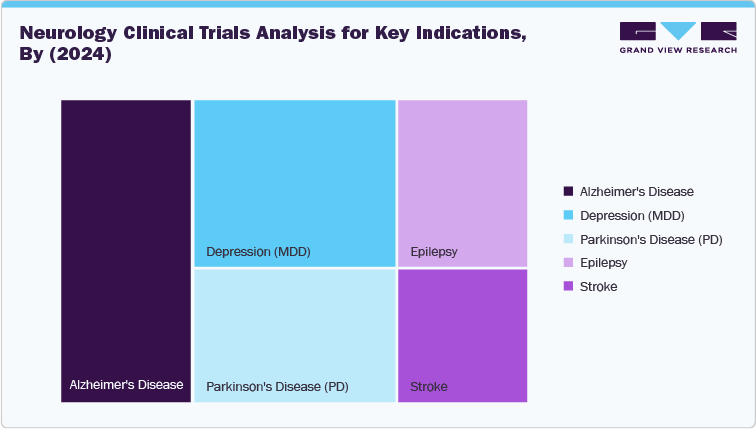
Clinical trials in neurology focusing on Alzheimer's disease, major depressive disorder (MDD), Parkinson's disease (PD), epilepsy, and stroke play a crucial role in enhancing treatment options for these challenging conditions. Clinical trials for Alzheimer’s are concentrated on developing disease-modifying therapies, particularly those targeting amyloid and tau proteins, as well as cognitive enhancers. Besides major depressive disorders research is increasingly exploring rapid-acting treatments such as ketamine, psilocybin, and various neurostimulation devices. In addition, the Parkinson’s research highlights therapies that include dopaminergic agents, gene therapy, and neuromodulation techniques to manage both motor and non-motor symptoms. Besides, clinical trials for epilepsy are investigating anti-seizure medications, dietary approaches, and device-based interventions, with a notable focus on rare and drug-resistant forms of the condition. Moreover, stroke clinical studies are looking into neuroprotective drugs, clot retrieval methods, and rehabilitation strategies, incorporating innovations like robotics and brain-computer interfaces. Hence in these indication areas, there is a rising integration of biomarkers, imaging technologies, and digital health platforms aimed at enhancing trial efficacy and optimizing patient selection. Thus, these trials represent an expanding pipeline dedicated to addressing significant unmet medical needs and advancing neurological health outcomes.

North America is driven by increasing prevalence of neurodegenerative disorders such as Alzheimer’s, Parkinson’s, and multiple sclerosis. Besides, the presence of established outsourcing companies, and stringent regulatory scenarios supports market growth. Moreover, the rising need for various drugs and medical devices to enhance neuroimaging, biomarkers, and digital health technologies drive the market growth. Also, Europe region is benefited from advanced technologies and well-established infrastructure. Besides, companies outsourcing to CROs & investigator sites/clinical sites are witnessing significant progress in neurological research, enhancing both diagnosis and treatment options. In addition, Asia Pacific is the fastest-growing market driven by various factors such as large and diverse patients of neurological disorders, an aging population, and changing lifestyle. Besides, the presence of multinational companies in countries like China, India, and South Korea is increasingly focusing on both in-house innovations and the use of outsourcing facilities such as CROs and investigator sites/clinical sites for clinical trials, which are anticipated to fuel the market over the estimated time period.


The ecosystem of neurology clinical trials is rapidly changing driven by advancements in neuroscience, an increasing prevalence of neurological disorders, and a growing demand for innovative treatments, including gene and cell therapies. Key players in this ecosystem encompass pharmaceutical and biotechnology companies, academic research institutions, contract research organizations (CROs), and regulatory bodies. These entities work together to navigate the high-risk and high-cost terrain of developing neurological therapies for conditions such as Alzheimer’s, Parkinson’s, multiple sclerosis, and rare genetic disorders.
CROs are vital, providing specialized services like neuroimaging, cognitive assessments, biomarker analysis, and capabilities for decentralized trials. Regulatory agencies, including the FDA and EMA, are increasingly endorsing adaptive trial designs and expedited approval processes to enhance innovation. The incorporation of emerging technologies such as AI for patient recruitment, digital biomarkers, and wearable devices is transforming trial efficiency and patient engagement. Nevertheless, challenges remain, including high failure rates, placebo effects, and difficulties in endpoint measurement. Besides, North America maintains its position in the ecosystem due to its robust research and development infrastructure, while the Asia-Pacific region is experiencing rapid growth fueled by cost-effective trial execution and an expanding patient base. In summary, the neurology clinical trials market is becoming increasingly collaborative, data-oriented, and patient-centered, creating an environment ripe for therapeutic advancements in challenging neurological conditions.

Innovative clinical trial designs in neurology are revolutionizing the development of treatments for complex brain disorders. Since around 2004, adaptive trial designs have been implemented, allowing researchers to adjust trials in real-time based on patient responses, which enhances efficiency. By 2011, silico trials emerged, utilizing computer-simulated models to virtually assess therapies, thereby minimizing the need for early human trials. Starting in 2015, hybrid trials, which integrate in-person visits with remote monitoring, became increasingly prevalent, particularly for conditions like epilepsy and multiple sclerosis. The rise of decentralized trials in 2017 helped connect with patients suffering from rare neurological diseases through telemedicine and home delivery options. In 2019, platform trials such as MND-SMART and OCTOPUS were launched, enabling the simultaneous testing of multiple therapies under a single umbrella protocol. The COVID-19 pandemic accelerated the adoption of virtual trials, incorporating tools like eConsent and mobile applications. Recently, the use of Bayesian designs and global adaptive trials has been introduced in stroke and Alzheimer’s research, facilitating more intelligent, rapid, and adaptable approaches to neurology studies.
List of Major Active Trials by Phase, Sponsor, and Indication, A Key Example:
Clinical Trial Study Title
Tocotrienols in Parkinson's Disease (PD)
Study Status
Recruiting
Phase
Phase II
Study Type
Interventional
Sponsor
National Neuroscience Institute
Number of Patients (Enrollment)
100
Start Date
1/4/2021
Primary Completion Date
7/2025
Completion Date
31/7/2025
Locations
National Neuroscience Institute, Singapore,
Singapore General Hospital, SingaporeOther aspects that shall be analyzed will include the market overview, clinical trials by study design, by key indications, by region, and list of key clinical trials, sponsors, among several other factors.
Pricing & Purchase Options
Service Guarantee
-
Insured Buying
This report has a service guarantee. We stand by our report quality.
-
Confidentiality
We are in compliance with GDPR & CCPA norms. All interactions are confidential.
-
Custom research service
Design an exclusive study to serve your research needs.
-
24/5 Research support
Get your queries resolved from an industry expert.


We are committed towards customer satisfaction, and quality service.
Client Testimonials

"The quality of research they have done for us has been excellent..."
ISO Certified