
- Home
- »
- Advanced Interior Materials
- »
-
Pressure Vessels Market Size And Share Report, 2026-2033GVR Report cover
![Pressure Vessels Market (2026 - 2033)Report]()
Pressure Vessels Market (2026 - 2033)
Size, Share & Trends Analysis Report By Material (Titanium, Steel), By Product Type (Boiler, Nuclear Reactor), By End-use (Oil & Gas, Power Generation), By Region, And Segment Forecasts
Market Size, 2025
$62.4BMarket Estimate, 2026
$64.8BMarket Forecast, 2033
$86.7BCAGR, 2026–2033
4.3%Pressure Vessels Market Summary
The global pressure vessels market size was valued at USD 62.4 billion in 2025 and is projected to grow from USD 64.8 billion in 2026 to USD 86.7 billion by 2033, growing at a CAGR of 4.3% from 2026 to 2033. The Asia Pacific market held the largest share of 35.2% of the global market in 2025. This growth is attributed to the expansion of the chemical and petrochemical industries significantly increases the demand for pressure vessels, as they are essential for various processes including storage and transportation of chemicals.

Key Market Trends & Insights
- By material: The steel segment led the market with the largest revenue share of 30.1% in 2025.
- By product type: The boiler segment led the market with the largest revenue share of 60% in 2025.
- By end use: The chemicals & petrochemicals segment led the market with the largest revenue share of 39.1% in 2025.
Regional Highlights
- Largest regional market: Asia Pacific (35.2% revenue share, 2025)
- By country: The China held the largest market share in 2025.
Market Size & Forecast
- Market size in 2025: USD 62.4 Billion
- Estimated market size in 2026: USD 64.8 Billion
- Projected market size by 2033: USD 86.7 Billion
- CAGR (2026-2033): 4.3%
In addition, the rising need for energy, particularly in the oil and gas sector, alongside stricter safety regulations, is propelling market growth. Furthermore, advancements in renewable energy technologies and investments in infrastructure are also contributing to the increasing demand for pressure vessels globally.
The integration of sensors and Internet of Things (IoT) technology into pressure vessels significantly enhances safety and operational efficiency, while also creating new market opportunities. Continuous monitoring of critical parameters such as pressure and temperature allows for immediate detection of any deviations from normal conditions. In cases of abnormal readings, these systems can send instant alerts to operators, facilitating quick responses to avert potential accidents.
In addition, the ability to connect pressure vessels with other IoT-enabled equipment streamlines operations and improves overall system performance. Remote monitoring and control capabilities reduce the need for on-site personnel, thereby increasing flexibility. Furthermore, the oil and gas industry is a major driver of demand for pressure vessels, as they are crucial for various upstream activities including the separation, storage, and transportation of extracted resources. Advanced techniques in enhanced oil recovery require specialized vessels that can withstand high pressures and temperatures.

Moreover, as global demand for chemicals rises across multiple industries, the need for pressure vessels in production facilities continues to grow, prompting expansions in existing plants and the establishment of new ones.
Market Dynamics
The pressure vessels market is influenced by industrial expansion across oil & gas, chemicals, power generation, food processing, pharmaceuticals, and water treatment sectors, where pressurized storage and processing equipment are essential. Demand is shaped by capital investments in process industries, energy infrastructure development, and increasing adoption of hydrogen, carbon capture, and renewable energy projects. Market growth is also affected by stringent safety and design standards, advancements in corrosion-resistant materials and fabrication technologies, and replacement requirements for aging industrial equipment. Additionally, fluctuations in steel prices, manufacturing costs, and industrial production activity play a significant role in influencing market dynamics.
The pressure vessels market is significantly driven by increasing investments in oil & gas, petrochemical, and refinery infrastructure across both developed and developing economies. Expansion of refining capacity, petrochemical production facilities, LNG terminals, and downstream processing operations continues to generate strong demand for high-pressure storage, separation, heat exchange, and reaction equipment. Rapid industrialization, rising energy consumption, and growing demand for chemicals and fuels are encouraging governments and private operators to invest in large-scale industrial processing projects. In addition, modernization of aging refinery infrastructure and growing focus on energy security are further supporting demand for technologically advanced and high-capacity pressure vessels across global energy and process industries.
Fluctuations in steel, alloy, and specialty material prices remains a significant restraint for the pressure vessels market due to the high raw material intensity of vessel fabrication processes. Pressure vessel manufacturing relies heavily on carbon steel, stainless steel, nickel alloys, and other corrosion-resistant materials, making production costs highly sensitive to commodity price movements and supply chain disruptions. Variations in raw material pricing can significantly affect project profitability, increase procurement uncertainty, and delay large-scale industrial investments. Moreover, rising costs associated with specialty metals required for high-temperature, high-pressure, and corrosive-service applications may further increase overall manufacturing expenses and pricing pressure for pressure vessel suppliers.
The transition toward low-carbon energy systems is creating significant opportunities for pressure vessel manufacturers, as renewable fuel and clean energy projects increasingly require specialized storage, processing, and transportation equipment. Applications such as hydrogen production and storage, renewable natural gas (RNG), sustainable aviation fuel (SAF), biogas upgrading, and carbon capture facilities rely on pressure vessels to safely handle gases and fluids under high-pressure conditions. As governments and industries invest in energy transition initiatives and decarbonization projects, demand for advanced pressure vessels with enhanced pressure ratings, corrosion resistance, and safety features is expected to increase across emerging clean energy value chains.
Analyst Perspective
The pressure vessel market is expected to witness steady growth, supported by increasing investments in process industries such as oil & gas, chemicals, power generation, and pharmaceuticals, where pressurized storage and processing equipment are critical to operations. Growing demand for LNG infrastructure, hydrogen production facilities, and petrochemical capacity expansions is creating new opportunities for pressure vessel manufacturers worldwide. In addition, stringent safety regulations and the need for enhanced operational efficiency are encouraging end users to invest in technologically advanced, corrosion-resistant, and high-performance pressure vessels. Emerging trends such as energy transition projects, carbon capture facilities, and renewable fuel production are further expanding the market's application scope.
Material Insights
Based on material, the steel segment led the market with the largest revenue share of 30.1% in 2025. This growth is attributed to its cost-effectiveness and robust properties. In addition, steel, particularly carbon and stainless steel, offers excellent corrosion resistance, high tensile strength, and durability, making it a preferred choice for various industries. Furthermore, its recyclability and ability to withstand extreme conditions further enhance its appeal. As industrial activities expand globally, the demand for steel pressure vessels in sectors such as oil and gas, chemicals, and power generation continues to rise, driving market growth.
The titanium segment is expected to grow at a CAGR of 4.8% over the forecast period, owing to its exceptional strength-to-weight ratio and resistance to corrosion and high temperatures. These properties make titanium an ideal material for pressure vessels used in harsh environments, particularly in the oil and gas and chemical industries. Furthermore, the increasing focus on safety and compliance with stringent regulations necessitates the use of high-quality materials such as titanium. Moreover, the growing adoption of advanced manufacturing techniques enhances the feasibility of using titanium in pressure vessels, thereby expanding its market opportunities.
Product Type Insights
Based on product type, the boiler segment led the market with the largest revenue share of 60% in 2025, primarily driven by the increasing demand for efficient energy generation and industrial processes. In addition, boilers are essential for various applications, including power generation and heating, and their ability to operate under high pressure enhances their performance. Furthermore, the rising focus on supercritical power generation technologies and the expansion of thermal power plants also contribute to the demand for advanced boiler systems, solidifying their position as a key product type in the market.
The nuclear reactor segment is expected to grow at the fastest CAGR of 5.4% from 2025 to 2030, due to the growing need for clean and sustainable energy sources. As countries seek to reduce carbon emissions and enhance energy security, investments in nuclear power plants are increasing. Furthermore, nuclear reactors require specialized pressure vessels that can withstand extreme conditions, ensuring safe and efficient energy production. Moreover, the global push for energy diversification and the rising acceptance of nuclear power as a viable alternative to fossil fuels are significant factors propelling the growth of this segment within the pressure vessel market.
End-use Insights
Based on end use, the chemicals & petrochemicals segment led the market with the largest revenue share of 39.1% in 2025, driven by the rising demand for various chemicals and plastics. In addition, as the industry expands, pressure vessels are essential for processes such as chemical reactions, distillation, and storage, ensuring safety and efficiency. Furthermore, stricter safety regulations also necessitate high-quality pressure vessels that can withstand corrosive substances and extreme conditions, further propelling market growth.

The power generation sector is expected to grow at a CAGR of 5.0% over the forecast period, owing to the need for efficient energy production and sustainability. Pressure vessels are critical components in thermal and nuclear power plants, facilitating processes such as steam generation and heat exchange. In addition, the global shift towards cleaner energy sources and the expansion of renewable energy projects are driving investments in new power generation facilities, thereby boosting the demand for advanced pressure vessels that meet stringent safety and performance standards.
Regional Insights
Asia Pacific dominated the pressure vessels market with the largest revenue share of 35.2% in 2025. This growth is attributed to the rapid industrialization and increasing energy demands. In addition, countries such as India and China are heavily investing in energy infrastructure, particularly in power generation and chemical processing facilities, which drives the demand for pressure vessels. Furthermore, the expansion of the oil and gas sector, along with investments in renewable energy projects, also propels market growth as these industries require reliable pressure vessels for various applications.

China Pressure Vessels Market Trends
The pressure vessels market in China held the largest share in the Asia Pacific region in 2025, driven by its status as a global manufacturing hub. The government's commitment to enhancing energy infrastructure, especially in coal and nuclear power generation, is driving demand for high-quality pressure vessels. Furthermore, advancements in technology and increased foreign investments are fostering local production capabilities, making China a key player in the global pressure vessel market.
Middle East & Africa Pressure Vessels Market Trends
The Middle East and Africa pressure vessels market is expected to grow at the fastest CAGR of 4.5% over the forecast period, owing to the expansion of the oil and gas sector. In addition, increased investments in refining and petrochemical facilities are boosting the demand for pressure vessels, which are essential for safe storage and transportation of hydrocarbons. Furthermore, ongoing infrastructure development projects and government initiatives aimed at diversifying economies are further propelling market growth. Moreover, the region's focus on renewable energy sources also creates new opportunities for pressure vessel applications in emerging energy sectors.
Europe Pressure Vessels Market Trends
The pressure vessels market in Europe held the significant revenue share in 2024, due to stringent safety regulations and a focus on upgrading aging infrastructure. Furthermore, the region's commitment to sustainability and renewable energy sources is also contributing to market expansion, as new power generation facilities require advanced pressure vessels. Moreover, the chemical and petrochemical sectors are thriving in Europe, further driving demand for high-quality pressure vessels.
North America Pressure Vessels Market Trends
North America pressure vessels market is expected to experience a substantial growth over the forecast period, primarily due to rising industrial activities across sectors such as oil and gas, chemicals, and power generation. In addition, the increasing adoption of natural gas as a cleaner fuel alternative is driving demand for specialized pressure vessels. Furthermore, ongoing investments in nuclear power generation facilities enhance market opportunities as these reactors require high-quality pressure vessels to ensure safety and efficiency.
The growth of the pressure vessels market in the U.S. is expected to be driven by significant investments in energy infrastructure and industrial activities. The country's focus on enhancing its oil and gas production capabilities drives demand for reliable pressure vessels. Furthermore, the increasing emphasis on safety regulations within industries such as chemicals and power generation further propels the need for advanced pressure vessels that meet stringent standards.
Key Pressure Vessels Company Insights
Key companies in the global pressure vessels industry include Babcock & Wilcox Enterprises, Inc., Samuel, Son & Co., Alloy Products Corp., and others. These companies are employing numerous strategies focused on new product developments and strategic partnerships to enhance their competitive edge. In addition, these firms are investing in research and development to innovate advanced pressure vessel designs that meet evolving industry standards.
-
Samuel, Son & Co. specializes in the fabrication of a wide range of pressure vessels and tanks for various industrial applications. The company manufactures products that cater to sectors such as oil and gas, chemicals, and power generation. With advanced engineering capabilities, the company focuses on producing custom and standard pressure vessels, ensuring compliance with industry standards. Their extensive product offerings include air receivers, process tanks, and specialized vessels designed to meet diverse operational requirements.
-
Abbott Pressure Vessels provides high-quality solutions tailored to meet the needs of various industries. The company focuses on the design and manufacturing of pressure vessels used in applications such as chemical processing, oil and gas, and water treatment. Company’s expertise lies in creating custom-engineered pressure vessels that adhere to stringent safety regulations and quality standards.
Key Pressure Vessels Companies:
The following key companies have been profiled for this study on the pressure vessels market.
-
IHI Corporation
-
Babcock & Wilcox Enterprises, Inc.
-
Pressure Vessels (India)
-
MITSUBISHI HEAVY INDUSTRIES, LTD.
-
Samuel, Son & Co.
-
Alloy Products Corp.
-
Abbott Pressure Vessels
-
Doosan Corporation
-
Bharat Heavy Electricals Limited
-
LARSEN & TOUBRO LIMITED
-
MERSEN PROPERTY
-
Xylem
-
Tinita Engg Pvt. Ltd
-
WCR Inc.
Competitive Benchmarking
Category
Operating Strategies
Competitive Edge
Weakness
Established Players (e.g., LARSEN & TOUBRO LIMITED, MITSUBISHI HEAVY INDUSTRIES, LTD.)
- Mature market participants focus on large-scale industrial contracts, expansion of engineered-to-order pressure vessel capabilities, investment in advanced fabrication technologies, and strengthening global project execution and certification capabilities.
- They divert their resources toward compliance with international pressure equipment standards and long-term relationships with EPC contractors and industrial end users.
- Strong engineering expertise, broad product portfolios, established certifications and regulatory compliance capabilities, extensive global project experience, and strong relationships with oil & gas, chemical, and power industry customers provide mature players with significant competitive advantages.
- Established relationships with EPC firms and multinational energy companies also support repeat contract acquisition.
- High capital requirements, exposure to cyclical industrial investment trends, and lengthy project execution timelines may affect profitability and operational flexibility.
- In addition, mature players may experience slower responsiveness in low-volume customized projects due to operational complexity and rigid manufacturing structures.
Emerging & Regional Players (e.g., GMM Pfaudler, Samuel, Son & Co, regional players)
- Emerging participants in the pressure vessel market generally focus on regional industrial demand, modular fabrication capabilities, and cost-competitive manufacturing strategies.
- They typically target mid-sized process industries, localized refinery projects, industrial gas applications, food processing, and renewable energy infrastructure where shorter lead times and flexible customization are prioritized.
- Competitive pricing, operational flexibility, faster customization capabilities, and growing presence in regional industrial sectors support the market positioning of emerging players. Their ability to address localized project requirements also strengthens competitiveness in developing markets.
- Their growing participation in hydrogen, biogas, compressed natural gas (CNG), and modular process system applications also provides access to developing industrial segments that are less dominated by traditional large-scale vessel fabricators.
- Emerging players often possess limited large-scale fabrication infrastructure, narrower international certification coverage, and lower capability in handling highly complex high-pressure or corrosive-service applications.
- Their participation in large EPC-led projects may also be constrained by lower brand recognition, smaller engineering teams, and limited financial capacity for executing multi-year industrial contracts
Recent Developments
-
In April 2024, Babcock & Wilcox (B&W) announced a significant contract to upgrade renewable energy boilers in Southeast Asia, valued at over USD 7 million. This project involves enhancing three waste-fueled boilers at a waste-to-energy power plant, focusing on new pressure parts and advanced combustion equipment to boost steam production and efficiency while minimizing emissions. The upgrade reflects B&W's commitment to supporting sustainable energy solutions and improving operational longevity in the region's waste-to-energy sector.
-
In June 2023, Larsen & Toubro (L&T) established a cutting-edge Heavy Wall Pressure Vessel facility, in aligned with the Saudi Vision 2030 and IKTVA initiative, in Saudi Arabia. This state-of-the-art facility, located in the Royal Commission Jubail Industrial Area, aims to enhance local manufacturing capabilities for heavy wall thicknesses and complicated metallurgy.
Pressure Vessels Market Report Scope
Report Attribute
Details
Market size value in 2025
USD 62.4 billion
Estimated market size in 2026
USD 64.8 billion
Projected market size by 2033
USD 86.7 billion
Growth rate
CAGR of 4.3% from 2026 to 2033
Base year for estimation
2025
Historical data
2021 - 2024
Forecast period
2026 - 2033
Quantitative units
Revenue in USD billion and CAGR from 2026 to 2033
Report coverage
Revenue forecast, company ranking, competitive landscape, growth factors, and trends
Segments covered
Material, product type, end use, region
Regional scope
North America; Europe; Asia Pacific; Latin America; Middle East & Africa
Country scope
U.S.; Canada; Mexico; UK; Germany; Russia; Spain; Italy; China; India; Japan; Australia; South Korea; Brazil; Saudi Arabia; UAE
Key companies profiled
Langley Holding plc; Maillis Group; Rovema GmbH; Douglas Machine Inc.; KHS Group; SIG; Tetra Laval International S.A.; Krones AG; I.M.A. Industria Macchine Automatiche S.p.A.; Syntegon Technology GmbH; ProMach; GEA Group Aktiengesellschaf; Sacmi; Coesia S.p.A.; Duravant
Customization scope
Free report customization (equivalent up to 8 analysts' working days) with purchase. Addition or alteration to country, regional & segment scope.
Pricing and purchase options
Avail customized purchase options to meet your exact research needs. Explore purchase options
Global Pressure Vessels Market Report Segmentation
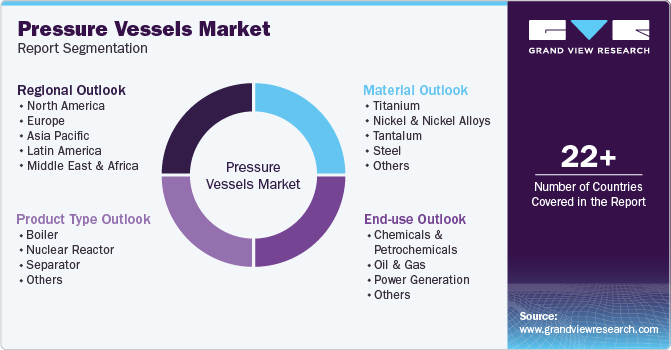
This report forecasts revenue growth at global, regional, and country levels and analyzes the latest industry trends in each sub-segment from 2021 to 2033. For this study, Grand View Research has segmented the global pressure vessels market report based on material, product type, end-use, and region.
-
Material Outlook (Revenue, USD Million, 2021 - 2033)
-
Titanium
-
Nickel & Nickel Alloys
-
Tantalum
-
Steel
-
Carbon Steel
-
Stainless Steel
-
-
Others
-
-
Product Type Outlook (Revenue, USD Million, 2021 - 2033)
-
Boiler
-
Nuclear Reactor
-
Separator
-
Others
-
-
End-use Outlook (Revenue, USD Million, 2021 - 2033)
-
Chemicals & Petrochemicals
-
Oil & Gas
-
Power Generation
-
Others
-
-
Regional Outlook (Revenue, USD Million, 2021 - 2033)
-
North America
-
U.S.
-
Canada
-
Mexico
-
-
Europe
-
UK
-
Italy
-
Germany
-
Spain
-
France
-
-
Asia Pacific
-
China
-
India
-
Japan
-
South Korea
-
Australia
-
-
Latin America
-
Brazil
-
Argentina
-
-
Middle East and Africa
-
Saudi Arabia
-
South Africa
-
UAE
-
-
Research Methodology
Segment Definition
Segment - Material
Revenue Capture Definition
Titanium
This segment captures revenue generated from pressure vessels manufactured using titanium and titanium alloys, primarily supplied for highly corrosive processing environments in chemical, desalination, pharmaceutical, and specialty industrial applications.
Nickel & Nickel Alloys
This segment includes revenue derived from pressure vessels fabricated from nickel-based alloys for high-temperature and corrosion-intensive applications across chemical processing, petrochemical, energy, and specialty manufacturing industries.
Tantalum
This segment comprises revenue generated from tantalum-based pressure vessels used in highly specialized chemical processing applications requiring exceptional resistance to aggressive acids and corrosive media.
Steel
This segment captures revenue from pressure vessels manufactured using steel-based materials and represents the broadest material category across industrial storage, processing, reaction, and separation applications. This segment is further divided into carbon steel and stainless steel.
Others
This segment captures revenue generated from pressure vessels manufactured using alternative materials such as copper & copper alloys, zirconium, carbon fiber composites, fluoropolymers, cast iron, and reinforced concrete. These materials are primarily utilized in specialized applications requiring unique corrosion resistance, weight reduction, thermal performance, or structural characteristics.
Segment - Product Type
Revenue Capture Definition
Boiler
This segment comprises revenue generated from pressure vessels designed for steam generation and hot water production used across industrial processing, district heating, and power generation facilities
Nuclear Reactor
This segment captures revenue from pressure vessel systems utilized within nuclear power plants for reactor containment and associated nuclear process applications
Separator
This segment includes revenue generated from pressure vessels designed to separate gas, liquid, and solid phases in oil & gas, chemical processing, petrochemical, and industrial production operations.
Others
This segment comprises revenue generated from pressure-containing equipment such as storage tanks, fractional distillation columns, and heat exchangers used across industrial processing, storage, separation, and thermal management applications.
Segment - End Use
Revenue Capture Definition
Chemicals & Petrochemicals
This segment captures revenue generated from pressure vessels supplied to chemical and petrochemical facilities for processing, reaction, storage, separation, and heat transfer applications.
Oil & Gas
This segment comprises revenue from pressure vessels utilized across upstream, midstream, and downstream oil & gas operations, including production, transportation, refining, storage, and gas processing activities.
Power Generation
This segment includes revenue generated from pressure vessels deployed in thermal, nuclear, and other power generation facilities for steam generation, heat transfer, cooling, and energy conversion processes.
Others
This segment captures revenue generated from pressure vessels supplied to industries including mining, pulp & paper, water treatment, HVAC & refrigeration, pharmaceutical manufacturing, and specialized applications such as submarine and spacecraft habitats. Demand is driven by the need for pressurized storage, processing, containment, and environmental control systems across these sectors..
Estimation Model
Layer Name
Key Question
Description
Industrial Process Demand Layer
Where are pressure vessels required?
Analyze demand across key end-use industries including oil & gas, chemicals & petrochemicals, power generation, food & beverages, pharmaceuticals, water treatment, and industrial manufacturing. Assess process requirements involving storage, separation, heat exchange, and pressurized operations to establish the addressable demand base.
Industrial Investment & Capacity Expansion Layer
Where is new pressure vessel demand being created?
Evaluate investments in refineries, chemical plants, power plants, LNG facilities, hydrogen projects, and industrial processing units. Assess greenfield and brownfield projects, facility expansions, and modernization activities that require new pressure vessel installations.
Equipment Adoption Layer
Which pressure vessel types are being deployed?
Segment demand by vessel type, material type, pressure range, and end-use application. Apply adoption rates based on operating pressure requirements, corrosion resistance needs, industry regulations, and process specifications. Assess the impact of advanced materials and safety standards on equipment selection.
Revenue Layer
How much market revenue is generated?
Estimate annual pressure vessel demand by type, capacity, and industry. Apply average selling prices based on vessel size, pressure rating, material composition, and customization requirements.
Delivered Customizations
This report has been delivered with the following In-depth customizations
Client Request
Customization Delivered
Value Adds
Regional Segmentation
Delivered regional and country-level analysis covering macro-economic industrialization trends, refinery and petrochemical capacity expansion, power generation investments, hydrogen and clean energy infrastructure development, technological advancements in pressure vessel manufacturing, and competitive presence of global and regional market participants across key regions and countries.
Delivered regional and country-level analysis covering macro-economic industrialization trends, refinery and petrochemical capacity expansion, power generation investments, hydrogen and clean energy infrastructure development, technological advancements in pressure vessel manufacturing, and competitive presence of global and regional market participants across key regions and countries.
Vendor Landscape
Delivered vendor landscape analysis covering pressure vessel manufacturers, raw material suppliers, industrial fabricators, EPC (Engineering, Procurement, and Construction) contractors, and end-user industries.
Delivered vendor landscape analysis covering pressure vessel manufacturers, raw material suppliers, industrial fabricators, EPC (Engineering, Procurement, and Construction) contractors, and end-user industries.
Frequently Asked Questions About This Report
The global pressure vessels market size was estimated at USD 62.4 billion in 2025 and is expected to be USD 64.8 billion in 2026.
The global pressure vessels market, in terms of revenue, is expected to grow at a compound annual growth rate of 4.3% from 2026 to 2033 to reach USD 86.7 billion by 2033.
The boiler segment accounted for the largest revenue share of 60.0% in 2025.
Some key players operating in the pressure vessel market include IHI Corporation, Babcock & Wilcox Enterprises, Inc., Mitsubishi Hitachi Power Systems, Ltd., Samuel, Son & Co., Alloy Products Corp., Doosan Heavy Industries & Construction, and Bharat Heavy Electricals Limited.
Key factors that are driving the pressure vessel market growth include significant growth of the chemical & petrochemical industry along with the growing adoption of supercritical power generation technology.
Asia Pacific dominated the pressure vessels market with the largest revenue share of 35.2% in 2025.
Asia Pacific is anticipated to be one of the fastest-growing regional markets over the forecast period, driven by expanding industrial infrastructure, chemical processing capacity additions, and increasing energy investments.
The steel segment led the market with the largest revenue share of 30.1% in 2025.
The chemicals & petrochemicals segment led the market with the largest revenue share of 39.1% in 2025.
About the Author(s)
Advanced Interior Materials Research Team
Advanced Materials · Advanced Interior MaterialsThis report was authored by the advanced interior materials research team at Grand View Research - comprising two research analysts, one senior research analyst, and one industry expert - with specialized expertise in the advanced interior materials segment of the advanced materials industry. All findings are based on proprietary advanced materials databases, executive interviews, and regulatory analysis, subject to internal peer review prior to publication.
Last Updated:
Speak to Analyst

Need a Tailored Report?
Customize this report to your needs — add regions, segments, or data points, with 20% free customization.
Or view our licence options:


ISO 9001:2015 & 27001:2022 Certified
We are GDPR and CCPA compliant! Your transaction & personal information is safe and secure. For more details, please read our privacy policy.












