
- Home
- »
- Next Generation Technologies
- »
-
Accelerated Processing Unit Market Size Report, 2026-2033GVR Report cover

Accelerated Processing Unit Market (2026 - 2033)
Size, Share & Trends Analysis Report By Product (System Integration, Architectural Integration), By CPU Cores (Quad Core, Hexa Core), By Devices, By Application, By End Use, By Region, And Segment Forecasts
Market Size, 2025
$19.0BMarket Estimate, 2026
$22.3BMarket Forecast, 2033
$72.5BCAGR, 2026–2033
18.4%Accelerated Processing Unit Market Summary
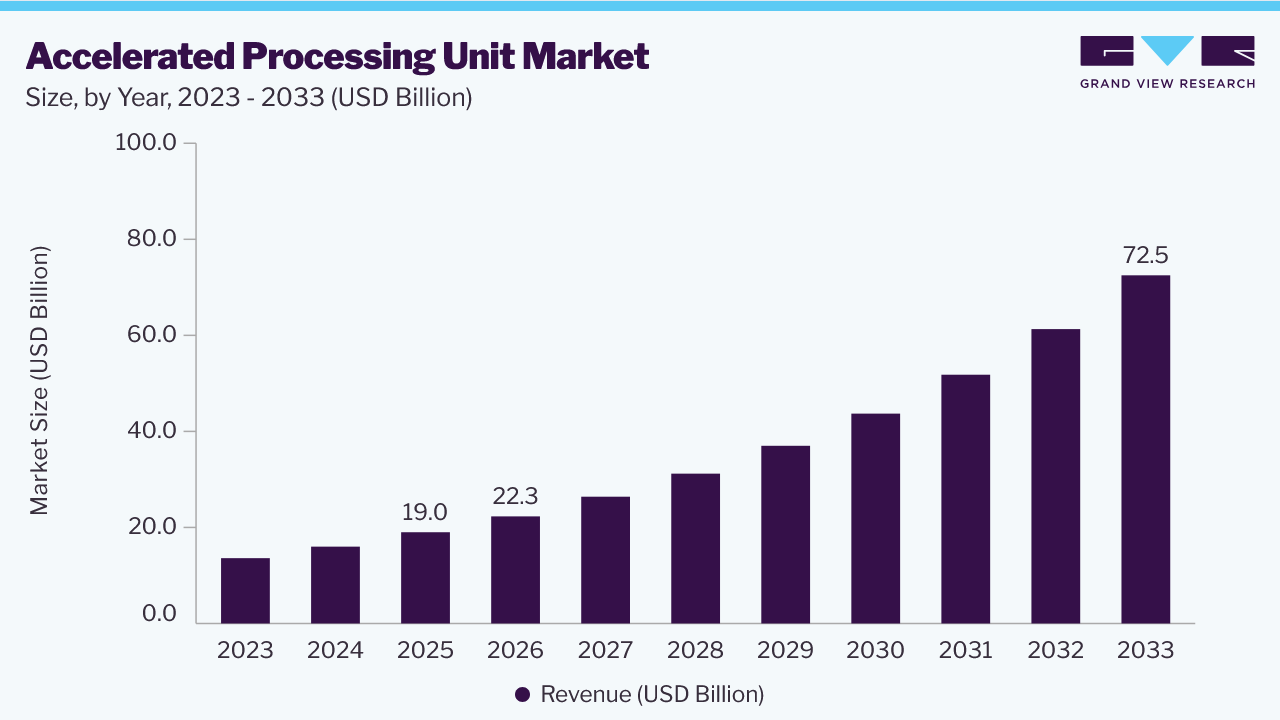
The global accelerated processing unit market size was valued at USD 19.0 billion in 2025 and is projected to grow from USD 22.3 billion in 2026 to USD 72.5 billion by 2033, at a CAGR of 18.4% from 2026 to 2033. North America dominated the global market, accounting for the largest revenue share of 40.0% in 2025. The market growth is driven by rising demand for high-performance computing in AI, machine learning, gaming, and HPC, where the Accelerated Processing Unit (APU) optimizes performance by integrating CPU and GPU functions on a single chip.
Key Market Trends & Insights
- By product: The system integration segment led the market and accounted for over 50.0% of the global revenue in 2025 .
- By CPU cores: The quad-core segment led the APU market in 2025 due to its balance of performance and energy efficiency.
- By devices: The laptop segment accounted for the largest market revenue share in 2025 due to growing demand for portable, energy-efficient computing solutions.
- By application: The gaming segment led the APU market in 2025 due to the growing demand for high-performance graphics and cost-effective solutions.
- By end use: The media and entertainment segment led the market in 2025 due to its high demands for robust processing power in tasks such as video editing, rendering, and streaming.
Regional Highlights
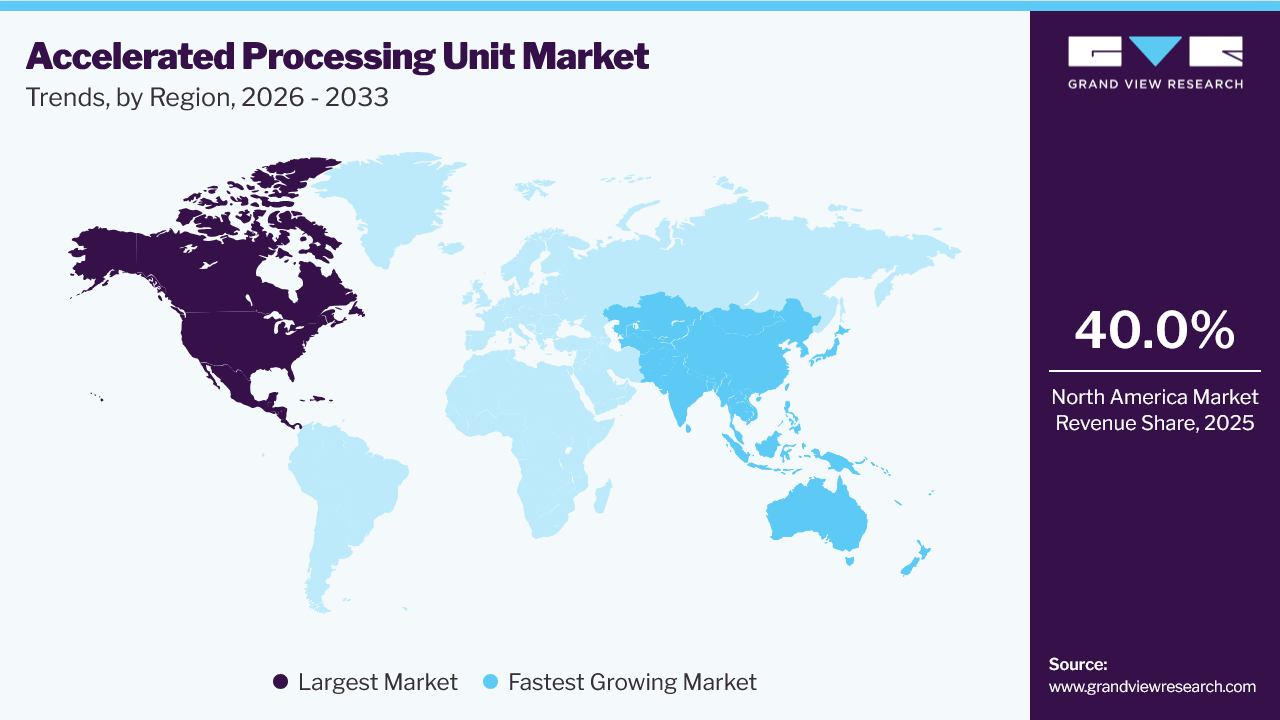
- Largest regional market: North America (40.0% revenue share, 2025)
- Fastest-growing regional market: Asia Pacific (highest CAGR, 2026-2033)
Market Size & Forecast
- Market size in 2025: USD 19.0 Billion
- Estimated market size in 2026: USD 22.3 Billion
- Projected market size by 2033: USD 72.5 Billion
- CAGR (2026-2033): 18.4%
Three ways to get this report
Buy it, customize it, or ask a question.Ask an Analyst
A direct answer, usually in 1 working day
- AccessReport author, directly
- Reply timeWithin 1 working day
- No sales callDirect answer only
- FormatEmail reply
- CostFree, no cost
Get the Full Report
What the study covers
- FormatsPDF · Excel · Dashboard
- Timeline2026–2033 annual, 2025 base
- Coverage20+ countries, 5 regions
- Companies10+ key players profiled
Customize the Report
20% free customization
- IncludeCountries, segments, points
- TailorTo your product definition
- ExtendDeeper competitor detail
- OrA fully bespoke study
- Turnaround5–10 working days
The gaming industry and multimedia applications are significant drivers of demand for Accelerated Processing Units (APUs), as they provide cost-effective solutions for rendering high-definition graphics. APUs are increasingly adopted in portable devices such as laptops and smartphones due to their power efficiency and improved thermal management.
 Source: Grand View Research, IR Documents, Primary Interviews, Paid DatabasesTo learn more about this report,
 Download Free Sample Report
 The expansion of 5G networks is further driving the adoption of APUs in mobile devices and edge computing, as these units can handle the heavy computational and graphical demands of real-time gaming, Virtual Reality (VR), and Augmented Reality (AR). In the automotive sector, APUs are essential for advanced driver-assistance systems (ADAS), autonomous vehicles, and in-car entertainment, enabling real-time data processing and high-definition graphics. The integrated designs of CPUs and GPUs contribute to energy efficiency and cost savings, making APUs valuable for battery-powered devices and industries such as data centers. Additionally, APUs effectively balance performance and power consumption, making them suitable for high-performance tasks in portable electronics.
As cloud computing and virtualization continue to grow, APUs are gaining traction by providing the necessary compute and graphics capabilities for virtual desktops and cloud-based gaming. In healthcare, APUs support medical imaging systems by delivering the processing power required for complex 3D data analysis. Their application in AI and deep learning is also expanding, as APUs offer parallel processing capabilities that accelerate model training. Government investments in digital transformation and smart cities are increasing demand for APUs in sectors such as industrial automation and robotics, where real-time decision-making and efficiency are crucial.
Analyst Perspective
The accelerated processing unit (APU) market is gaining prominence as devices increasingly require higher performance and greater energy efficiency. By combining CPU and GPU functions into a single chip, APUs help improve processing speed while reducing power consumption and hardware complexity. Demand is growing across gaming systems, laptops, artificial intelligence applications, and other high-performance devices. Companies with strong chip design capabilities, advanced manufacturing expertise, and partnerships with device makers are likely to strengthen their market position. Over time, the market is expected to favor solutions that deliver better performance, efficient power usage, and smooth support for graphics-intensive and data-heavy applications across both consumer and enterprise devices.
Product Insights
The system integration segment led the market, accounting for over 50.0% of global revenue in 2025, driven by increasing demand for efficient, cost-effective solutions. APUs, which integrate both CPU and GPU functions on a single chip, reduce the need for separate components, benefiting system integrators in industries such as consumer electronics, automotive, and IoT. This integration simplifies system design, enhances energy efficiency, and lowers costs, benefiting applications ranging from laptops to autonomous vehicles. System integrators also recognize the scalability and flexibility of APUs, allowing for optimized solutions across diverse sectors.
The optimized platform segment within the APU market is expected to grow significantly over the forecast period due to its ability to provide tailored solutions for industries such as gaming, AI, automotive, and data centers. These platforms offer a balance of high-performance computing and power efficiency, which is useful for portable electronics, edge computing, and autonomous vehicles. APUs integrated into optimized platforms deliver the real-time processing and parallel computing required for tasks such as AI workloads, sensor fusion, and immersive gaming experiences. The streamlined development and deployment process further drives their adoption, reducing time-to-market and design complexity.
CPU Cores Insights
The quad-core segment led the APU market in 2025 due to its balance of performance and energy efficiency. These APUs are widely used in devices such as laptops, desktops, and gaming consoles, offering enough processing power for multitasking and everyday applications without excessive power consumption. Their cost-effectiveness is well-suited to mid-range computing devices, delivering solid performance at a lower price than higher-core alternatives. Quad-core APUs are also gaining traction in portable devices, IoT, and automotive systems, where moderate processing power and energy efficiency are essential.
The octa-core segment is anticipated to experience a significant CAGR over the forecast period, due to rising demand for high-performance computing across industries such as gaming, AI, and HPC. With eight processing cores, octa-core APUs are well-suited for intensive workloads and multithreaded applications, allowing for efficient multitasking in areas such as video editing, 3D rendering, and scientific computing. Their ability to handle the processing demands of 4K and 8K media consumption drives their adoption in smart TVs, streaming devices, and professional media production. Advancements in semiconductor technology, such as 7nm and 5nm processes, have enabled more powerful and energy-efficient octa-core APUs.
Devices Insights
The laptop segment accounted for the largest market revenue share in 2025, driven by growing demand for portable, energy-efficient computing solutions. APUs, which combine CPU and GPU capabilities on a single chip, are ideal for laptops, offering compact performance and enhanced thermal management, both of which are crucial for long battery life and efficient operation. The rise in gaming laptops, remote work, and online education has further fueled demand for APUs, which support both productivity and high-performance gaming. APUs also provide a cost-effective solution for manufacturers, reducing production costs in mid-range and budget laptops.
The smartphone segment is expected to witness a notable CAGR over the forecast period due to rising demand for high-performance and feature-rich mobile devices. APUs, efficiency, enhanced multimedia experiences, 5G capabilities, and advanced photography features contribute to improved user experiences. The surge in mobile gaming, augmented reality (AR), and multimedia consumption further drives the need for APUs, enabling smoother gaming experiences, enhanced video playback, and advanced photography. Additionally, the compact, integrated design of APUs supports innovative smartphone features such as foldable and dual-screen phones, contributing to their widespread adoption and market growth.
Application Insights
The gaming segment led the APU market in 2025 due to the growing demand for high-performance graphics and cost-effective solutions. APUs offer reduced latency and improved performance, making them useful for gaming, especially in mid-range and entry-level systems. The rise of mobile and casual gaming has increased the need for efficient, integrated processing units in devices such as laptops, tablets, and consoles. Advances in APU technology, enhancing processing power and graphics performance, have made them capable of handling more demanding games. Additionally, the growth of e-sports and streaming has driven the adoption of APUs, providing affordable and powerful solutions for both gaming and content creation.
The gesture & facial recognition segment is likely to experience significant growth due to the increasing demand for enhanced user interfaces and security. With their integrated CPU and GPU capabilities, APUs handle the complex algorithms required for real-time facial and gesture recognition. The rise of AI and machine learning has further driven the need for APUs with advanced processing capabilities to improve recognition accuracy and efficiency. As smart devices and IoT expand, APUs are increasingly used for their ability to manage multiple tasks, including advanced interaction methods.
End Use Insights
The media and entertainment segment led the market in 2025 due to the high demand for robust processing power for tasks such as video editing, rendering, and streaming. APUs are well-suited for efficiently handling these media-intensive tasks, driving their widespread adoption in this sector. The growth of streaming services, content creation, and multimedia technologies such as VR and AR has further fueled the need for powerful processing solutions, with APUs offering the necessary performance. Their suitability for high-definition content, gaming, and interactive media has established them as a preferred solution for these applications. Additionally, the cost-effectiveness of integrating CPU and GPU functions into a single chip enhances performance while reducing overall system costs, making APUs beneficial for media and entertainment purposes.
The automotive segment is expected to grow significantly over the forecast period. The increasing adoption of Advanced Driver Assistance Systems (ADAS) requires advanced processing for features such as adaptive cruise control and lane-keeping, which APUs are well-equipped to handle. Additionally, the rise of advanced in-car infotainment systems and the development of autonomous vehicles demand high-performance processing for real-time data and sensor fusion. APUs also support enhanced vehicle connectivity and integration, including vehicle-to-everything communication and over-the-air updates. As electric vehicles become more prevalent, APUs are integral to managing control systems and energy efficiency, driving the sector's expansion.
Regional Insights
The North America accelerated processing unit industry accounted for over 40.0% of the market share in 2025, driven by the region's leadership in technological innovation and research, which fuels the adoption of APUs across various applications, including consumer electronics, gaming, and automotive technologies. North America's substantial consumer electronics market, combined with a strong gaming and entertainment industry, further boosts APU demand.
 To learn more about this report, Download Free Sample Report
 Moreover, the region's focus on AI and machine learning, along with the presence of major tech companies, supports significant market growth. For instance, in January 2026, AMD introduced its new Ryzen AI 400 Series and Ryzen AI Max processors at CES 2026, designed to deliver advanced AI processing, high-performance computing, and graphics capabilities for consumer PCs, gaming systems, and professional devices. The processors integrate AI acceleration features with improved CPU and GPU performance, supporting applications such as AI workloads, content creation, and gaming, highlighting North America’s strong position in semiconductor innovation and the growing adoption of APUs in advanced computing.
U.S. Accelerated Processing Unit Market Trends
The accelerated processing unit industry in the U.S. is expected to grow significantly over the forecast period. The country’s strong technology ecosystem, led by major companies such as Advanced Micro Devices, Inc., Intel Corporation, and NVIDIA Corporation, fosters innovation and boosts APU adoption. The expansion of the gaming and entertainment sectors further fuels demand for APUs by requiring enhanced graphics and processing power. Additionally, the U.S. automotive industry’s rapid integration of advanced driver assistance systems and autonomous technologies also contributes to market growth.
Europe Accelerated Processing Unit Market Trends
The accelerated processing unit industry in Europe is expected to gain significant traction in the coming years. Digital transformation initiatives across sectors such as government, healthcare, and finance are spurring investment in advanced processing solutions, including APUs. European Union funding programs, such as Horizon Europe and Digital Europe, further support the development and adoption of these technologies. The presence of major automotive manufacturers and a focus on green technology align with APUs' energy efficiency and processing capabilities.
In addition, the growth of smart home technologies and the European gaming industry, associated with a strong R&D ecosystem, continues to drive the demand for APUs across the region. For instance, in August 2025, CORSAIR launched its AI workstation 300 desktop PC in Europe, powered by AMD Ryzen AI Max 300 Series processors. The system is designed for AI developers, engineers, and professionals, featuring integrated AI acceleration capabilities and high-performance computing support for advanced workloads such as generative AI, content creation, and local AI processing. This launch reflects the growing adoption of advanced processing solutions in Europe, driven by increasing demand for AI computing, energy-efficient architectures, and digital transformation across industries.
Asia Pacific Accelerated Processing Unit Market Trends
The accelerated processing unit industry in the Asia Pacific is poised to experience the fastest growth. The region's technological advancement, led by countries such as China, South Korea, Japan, and India, fuels the demand for cutting-edge processing solutions. Government initiatives and investments, such as China's "Made in China 2025" plan and India's smart city projects, create substantial opportunities for APUs in various applications. APAC's strong manufacturing base supports the production and distribution of APUs, enhancing their accessibility and affordability. Additionally, the rise of 5G technology in the region boosts the demand for APUs in edge devices and network infrastructure, further driving market expansion.
In April 2026, MediaTek launched its Dimensity 9600 flagship chipset in Taiwan, featuring enhanced AI processing capabilities, improved graphics performance, and advanced computing efficiency for next-generation smartphones and edge devices. The chipset integrates a dedicated AI processing architecture to support on-device AI applications, high-performance computing, and connectivity-driven experiences, reflecting the growing adoption of advanced processing solutions across the Asia Pacific region. This development highlights the region’s strong semiconductor ecosystem and increasing demand for AI-enabled processors in consumer electronics and connected devices.
Key Accelerated Processing Unit Company Insights
Key players in the industry have strengthened their market presence through a strategic mix of product launches, expansions, mergers and acquisitions, contracts, partnerships, and collaborations. These initiatives serve as vital tools for enhancing market penetration and strengthening their competitive edge within the industry. For instance, in January 2025, Advanced Micro Devices, Inc. introduced its Ryzen AI Max Series processors at CES 2025, featuring integrated CPU, GPU, and AI acceleration capabilities for next-generation AI PCs, gaming systems, and professional workstations. The processors combine AMD Zen 5 CPU cores, Radeon graphics, and XDNA 2 AI engines to deliver high-performance computing in compact devices, enabling applications such as AI workloads, content creation, and advanced gaming. This launch highlights how APU manufacturers are strengthening their market position through advanced processor development and AI-focused product innovation.
Key Accelerated Processing Unit Companies
The following key companies have been profiled for this study on the accelerated processing unit market:
-
Arm Limited
-
Advanced Micro Devices, Inc.
-
Broadcom
-
Intel Corporation
-
IBM Corporation
-
Imagination Technologies
-
Marvell
-
NVIDIA Corporation
-
NXP Semiconductors.
-
Qualcomm Technologies, Inc.
Recent Developments
- In May 2026, NVIDIA Corporation introduced new RTX AI PC technologies and expanded its AI computing ecosystem, enabling advanced AI workloads through accelerated GPU and AI processing capabilities. The company highlighted developments focused on local AI execution, generative AI applications, and high-performance computing, supporting the growing demand for integrated acceleration solutions across consumer and enterprise devices.
- In January, 2025, Qualcomm Technologies, Inc. introduced the Snapdragon X platform as part of its Snapdragon X Series portfolio. The platform combined Qualcomm’s Oryon CPU, integrated GPU, and dedicated NPU capabilities to support AI-powered PCs and on-device AI experiences. The launch expanded Qualcomm’s presence in accelerated computing by enabling efficient AI processing in laptops and compact computing devices.
- In October 2024, Intel Corporation launched the Intel Core Ultra 200S Series desktop processors, introducing the company’s first enthusiast desktop AI PC platform with integrated neural processing unit (NPU) capabilities. The processors combine CPU, GPU, and AI acceleration technologies to enhance performance across gaming, content creation, and AI-enabled applications, reflecting ongoing advancements in hybrid computing architectures that integrate multiple processing engines.
Accelerated Processing Unit Market Report Scope
Report Attribute
Details
Market size in 2025
USD 19.0 billion
Estimated market size in 2026
USD 22.3 billion
Projected market size by 2033
USD 72.5 billion
Growth rate
CAGR of 18.4% from 2026 to 2033
Base year for estimation
2025
Historical data
2021 - 2024
Forecast period
2026 - 2033
Quantitative units
Revenue in USD billion and CAGR from 2026 to 2033
Report coverage
Revenue forecast, company ranking, competitive landscape, growth factors, and trends
Segments covered
Product, CPU cores, devices, application, end use, region
Regional Scope
North America; Europe; Asia Pacific; Latin America; and MEA
Country Scope
U.S.; Canada; Mexico; UK; Germany; France; China; Japan; India; Australia; South Korea; Brazil; UAE; KSA; South Africa
Key companies profiled
Arm Limited; Advanced Micro Devices, Inc.; Broadcom; Intel Corporation; IBM Corporation; Imagination Technologies; Marvell; NVIDIA Corporation; NXP Semiconductors.; Qualcomm Technologies, Inc.
Customization scope
Free report customization (equivalent up to 8 analysts working days) with purchase. Addition or alteration to country, regional & segment scope.
Pricing and purchase options
Avail of customized purchase options to meet your exact research needs. Explore purchase options
Global Accelerated Processing Unit Market Report Segmentation
This report forecasts revenue growth at global, regional, and country levels and provides an analysis of the latest industry trends in each of the sub-segments from 2021 to 2033. For this study, Grand View Research has segmented the global accelerated processing unit market report by product, CPU cores, devices, applications, end use , and region.
-
Product Outlook (Revenue, USD Billion, 2021 - 2033)
-
System Integration
-
Architectural Integration
-
Optimized Platform
-
-
CPU Cores Outlook (Revenue, USD Billion, 2021 - 2033)
-
Single Core
-
Dual Core
-
Quad Core
-
Hexa Core
-
Octa Core
-
-
Devices Outlook (Revenue, USD Billion, 2021 - 2033)
-
Tablets
-
Smartphones
-
Personal Computers
-
Laptops
-
Gaming Consoles
-
Others
-
-
Application Outlook (Revenue, USD Billion, 2021 - 2033)
-
Gaming
-
Gesture & Facial Recognition
-
Visual & Audio Data Processing
-
3D Rendering
-
Others
-
-
End Use Outlook (Revenue, USD Billion, 2021 - 2033)
-
Automotive
-
IT & Telecommunications
-
Electronics & Semiconductor
-
Healthcare
-
Media & Entertainment
-
Industrial
-
Others
-
-
Regional Outlook (Revenue, USD Billion, 2021 - 2033)
-
North America
-
U.S.
-
Canada
-
Mexico
-
-
Europe
-
UK
-
Germany
-
France
-
-
Asia Pacific
-
China
-
India
-
Japan
-
Australia
-
South Korea
-
-
Latin America
-
Brazil
-
-
MEA
-
UAE
-
South Africa
-
KSA
-
-
Frequently Asked Questions About This Report
The global accelerated processing unit market size was valued at USD 19.0 billion in 2025 and is estimated at USD 22.3 billion for 2026.
The global accelerated processing unit market is expected to grow at a CAGR of 18.4% from 2026 to 2033, reaching USD 72.5 billion.
North America dominated with an approximately 40.0% revenue share in 2025.
Some key players operating in the APU market include Arm Limited; Advanced Micro Devices, Inc.; Broadcom; Intel Corporation; IBM Corporation; Imagination Technologies; Marvell; NVIDIA Corporation; NXP Semiconductors.; Qualcomm Technologies, Inc.
The system integration segment led the market and accounted for over 50.0% of the global revenue in 2025, driven by the increasing demand for efficient and cost-effective solutions.
About the Author(s)
Next Generation Technologies Research Team
Technology · Next Generation TechnologiesThis report was authored by the next generation technologies research team at Grand View Research - comprising two research analysts, one senior research analyst, and one industry expert - with specialized expertise in the next generation technologies segment of the technology industry. All findings are based on proprietary technology databases, executive interviews, and regulatory analysis, subject to internal peer review prior to publication.
Last Updated:
Speak to Analyst

Customize this report to your needs - add regions, segments, or data points, with 20% free customization.
Or view our licence options:


ISO 9001:2015 & 27001:2022 Certified
We are GDPR and CCPA compliant! Your transaction & personal information is safe and secure. For more details, please read our privacy policy.


