
- Home
- »
- Plastics, Polymers & Resins
- »
-
Acrylic Resins Market Size, Growth Report, 2026-2033GVR Report cover

Acrylic Resins Market (2026 - 2033)
Size, Share & Trends Analysis Report By Chemistry (Acrylates), By Property (Thermoplastic Acrylic Resins), By Solvency, By Application (Paints & Coatings), By End-use, By Region, And Segment Forecasts
Market Size, 2025
$24.3BMarket Estimate, 2026
$25.4BMarket Forecast, 2033
$35.9BCAGR, 2026–2033
5.0%Acrylic Resins Market Summary
The global acrylic resins market size was valued at USD 24.3 billion in 2025 and is projected to grow from USD 25.4 billion in 2026 to USD 35.9 billion by 2033, at a CAGR of 5.0% from 2026 to 2033. Asia Pacific dominated the global market, accounting for the largest revenue share of 47.2% in 2025.. The market growth is expected to be driven by the continued shift toward water-based and low-VOC formulations, in line with increasingly stringent environmental laws.
 Source: Grand View Research, IR Documents, Primary Interviews, Paid DatabasesTo learn more about this report,
 Download Free Sample Report
 Key Market Trends & Insights
- By chemistry: Hybrid acrylics segment is expected to grow at a considerable CAGR of 8.0% from 2026 to 2033 in terms of revenue.
- By application: Adhesives & sealants segment is expected to grow at the fastest CAGR of 7.7% from 2026 to 2033 in terms of revenue.
Regional Highlights
- Largest regional market: Asia Pacific (47.2% revenue share, 2025)
- By country: The China acrylic resins industry is a major contributor to the global market.
Market Size & Forecast
- Market size in 2025: USD 24.3 Billion
- Estimated market size in 2026: USD 25.4 Billion
- Projected market size by 2033: USD 35.9 Billion
- CAGR (2026-2033): 5.0%
Three ways to get this report
Buy it, customize it, or ask a question.Ask an Analyst
Analyst response in 1 business day
- AccessReport author, directly
- Reply timeWithin 1 working day
- No sales callDirect answer only
- FormatEmail reply
- CostFree, no cost
Get the Full Report
What the study covers
- FormatsPDF · Excel · Dashboard
- Timeline2026–2033 annual, 2025 base
- Coverage20+ countries, 5 regions
- Companies10+ key players profiled
Customize the Report
20% free customization
- IncludeCountries, segments, points
- TailorTo your product definition
- ExtendDeeper competitor detail
- OrA fully bespoke study
- Turnaround5–10 working days
This shift is expected to boost the demand for acrylic resins that offer durability, weather resistance, and a low environmental impact. The acrylic resins market is primarily categorized by chemistry into acrylates, methacrylates, hybrid acrylics, and various other specialty chemistries, each designed to meet distinct performance and application needs.
 To learn more about this report, Download Free Sample Report
 Acrylates are widely used in coatings and adhesives due to their flexibility, while methacrylates are preferred for applications that require greater durability and clarity. Hybrid acrylics combine different resin systems to improve performance, while other chemistries cater to specific or specialized end-use requirements across various industries.
Drivers, Opportunities & Restraints
The demand for acrylic resins is largely driven by strong demand from the paints and coatings industry, especially in construction and automotive applications. Urbanization, infrastructure expansion, and growth in industrial production are driving higher consumption. Furthermore, the sector is benefiting from a fundamental shift toward water-based and low-VOC formulations, driven by environmental regulations and sustainability goals, leading to increased replacement demand across various end-use sectors.
New opportunities are arising from the increasing use of high-performance and hybrid acrylic systems, which offer improved durability, weather resistance, and superior adhesion. Growth in sectors such as packaging, electronics, and advanced coatings, alongside rising demand for eco-friendly, bio-based resins, is opening new avenues for innovation. Additionally, emerging markets in Asia Pacific and Latin America offer substantial growth prospects driven by accelerating industrialization and consumption.
The market is constrained by fluctuations in the prices of raw materials, especially petrochemical-based feedstocks like acrylic acid and its derivatives, which affect profit margins. Furthermore, the progressive elimination of solvent-based systems due to strict environmental regulations can create challenges for manufacturers during the transition. Competition from other resin systems, such as polyurethane and epoxy, in high-performance applications also restricts growth in some areas.
Market Concentration & Characteristics
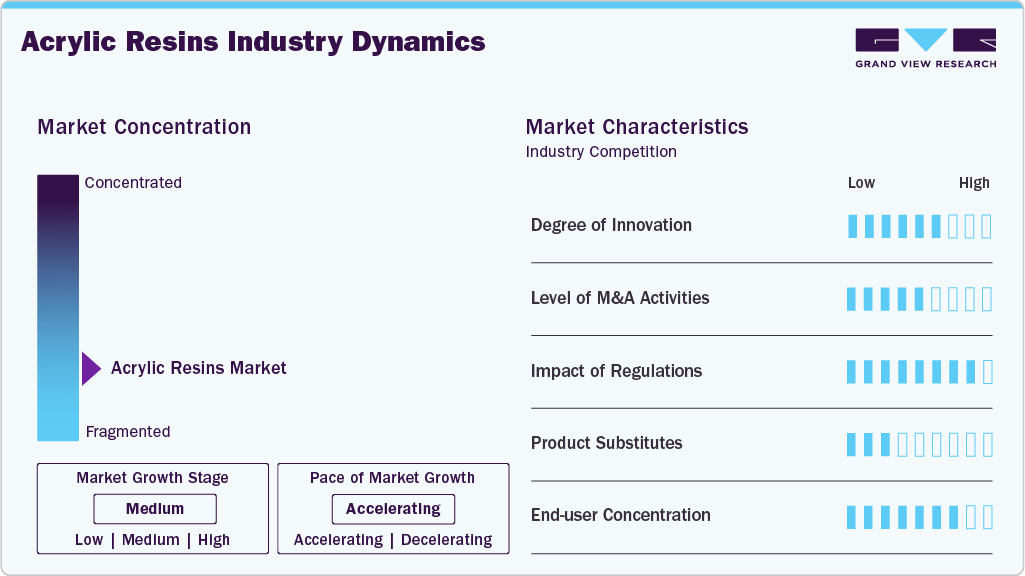
The acrylic resins market exhibits moderate to high levels of innovation, focusing on water-based formulations, low-VOC options, and high-performance hybrid systems. Businesses are focusing on enhancing formulations (durability, adhesion, sustainability) rather than making significant changes in chemistry. Mergers and acquisitions are consistent and strategically planned, as companies seek to broaden their regional presence by enhancing their specialty product lines and incorporating downstream coating or adhesive functions.
Tightened environmental regulations, particularly concerning VOC emissions, are accelerating the shift to water-based, environmentally friendly acrylic systems, transforming product offerings. Concurrently, alternative materials such as polyurethanes, epoxies, and polyesters exert competitive pressure in high-performance applications, constraining the use of acrylics in some industrial sectors.
 To learn more about this report, Download Free Sample Report
 The acrylic resins industry shows a moderate level of concentration among end users, with a large portion related to paints and coatings in both the construction and automotive industries. At the same time, sectors like packaging, consumer products, and electronics offer some diversification. The demand is widespread, yet the overall performance remains closely tied to construction trends and levels of industrial activity.
Chemistry Insights
In 2025, the acrylates segment of the acrylic resins market accounted for the largest revenue share of 59.6%. This can be attributed to its adaptability, cost-effectiveness, and suitability for a wide range of applications, especially in paints & coatings and adhesives. Its excellent combination of characteristics, such as adhesion, flexibility, weather resistance, and ease of formulation in water-based systems, makes it suitable for high-volume applications, such as architectural coatings.
The hybrid acrylics segment is expected to grow at the fastest CAGR of 8.0% over the forecast period. This growth is driven by a rising need for formulations tailored to specific applications and enhanced performance. By combining acrylics with other compatible chemistries, such as polyurethane, epoxy, or silicone, these systems provide exceptional mechanical strength, chemical resistance, and durability, especially in rigorous industrial and protective coating settings.
Property Insights
The thermoplastic acrylic resins segment led the acrylic resins industry, accounting for the largest revenue share of 63.8% in 2025. The segment growth is driven by their significant use in high-demand applications such as architectural coatings, adhesives, and general industrial finishes. Their widespread use is linked to a favorable blend of cost-effectiveness, ease of processing, and compatibility with water-based formulations, which aligns with changing regulatory preferences. Furthermore, they offer well-rounded performance attributes such as clarity, UV resistance, and flexibility, making them suitable for a wide array of end uses.
The thermosetting acrylic resins segment is projected to grow at the fastest CAGR over the forecast period, driven by rising demand for high-performance, durable coatings. Their crosslinking properties deliver exceptional chemical resistance, heat stability, and mechanical strength, making them ideal for automotive, industrial, and protective coating applications. The growing focus on longer service life, reduced maintenance requirements, and compliance with strict environmental standards is further driving their adoption.
Solvency Insights
In terms of revenue, the water-based acrylic resins segment accounted for the largest revenue share of 59.1% in 2025, fueled by their widespread use in paints, coatings, and adhesives. Their leading status is bolstered by low volatile organic compound (VOC) emissions, regulatory compliance, and suitability for architectural and packaging applications. The ongoing transition towards eco-friendly, sustainable formulations is projected to strengthen their position.
In the coming years, solvent-based acrylic resins are expected to grow steadily, driven by their use in applications that demand excellent film formation, adhesion, and durability in challenging environments. They continue to hold significance in industrial, marine, and protective coatings where the performance standards are high.
Application Insights
The paints & coatings segment dominated the acrylic resins market, accounting for the largest revenue share of 59.2% in 2025. With rising demand from the construction, automotive, and industrial sectors, the paints and coatings category is expected to be a significant driver of acrylic resin demand. Acrylic resins are widely used for their exceptional properties, making them ideal for both ornamental and protective coatings. In the upcoming years, the acrylic resin market is anticipated to grow due to the increased need for high-performance coatings brought on by increasing urbanization, infrastructure development, and increased automobile production.
The adhesives and sealants segment of the acrylic resin industry is anticipated to grow at a significant CAGR of 7.7% over the forecast period. Owing to their exceptional bonding strength, flexibility, durability, and resistance to environmental factors such as moisture and temperature changes, acrylic resins are frequently used in adhesives and sealants.
End-use Insights
The building & construction segment led the acrylic resins market in 2025, accounting for 33.7% of revenue. The segment growth is driven by its vast scale, need for durability, and ongoing cycles of infrastructure investment. The demand is largely fueled by the growth in residential and commercial construction, urban development, and extensive infrastructure initiatives like roads, bridges, tunnels, and water management systems.
 To learn more about this report, Download Free Sample Report
 The packaging segment of the acrylic resin industry is predicted to grow at the fastest CAGR of 7.6% over the forecast period. The adoption of low-VOC, water-based acrylic solutions, encouraged by increased regulatory scrutiny over food safety and environmental impact, especially in food-contact and primary packaging applications, is expected to boost the consumption of acrylic resins across packaging applications.
Regional Insights
The Asia Pacific acrylic resins market accounted for the dominant revenue share of 47.2% in 2025. The market is anchored by its huge population base, fast urbanization, and strong manufacturing ecosystem. Moreover, the region benefits from cost-competitive production, a wide range of raw materials, and increasing expenditures in industrial growth and infrastructure. Additionally, favorable government laws across the region are promoting manufacturing expansion and sustainability initiatives, resulting in the acceleration of the usage of innovative and eco-friendly materials.
 To learn more about this report, Download Free Sample Report
 China Acrylic Resins Market Trends
The China acrylic resins market is expected to grow significantly over the forecast period, owing to its vast manufacturing base, substantial infrastructure development, and robust domestic consumption. Government-backed industrial growth and rising investments in high-performance and sustainable materials are likely to contribute to the country's market growth.
North America Acrylic Resins Market Trends
The North American acrylic resins industry is expected to rise steadily, led by strong demand in the construction, packaging, and automotive industries, as well as ongoing infrastructure upgrades and home remodeling operations. Furthermore, the growing emphasis on sustainable materials, recycling programs, and regulatory compliance is accelerating the adoption of innovative, environmentally friendly solutions. The strong presence of established manufacturers, as well as ongoing technical innovation, aid to drive market growth.
The U.S. acrylic resins marketis likely to remain a key growth driver in North America, owing to ongoing investments in infrastructure upgrades, residential development, and innovative manufacturing. Strong demand from the packaging, automotive, and industrial sectors, along with increased adoption of sustainable, high-performance materials, is driving market growth. Furthermore, the presence of major manufacturers and continual innovation in material technologies further strengthens the country's position.
Europe Acrylic Resins Market Trends
The Europe acrylic resins industry is experiencing significant growth, driven by strong regulatory frameworks and a heavy emphasis on sustainability and circular economy initiatives. Furthermore, innovation-driven economies such as Germany, France, and the Nordics promote stable growth through technological advancements and premium product applications.
Key Acrylic Resins Company Insights
Key companies are adopting a range of growth strategies, such as new product development, mergers & acquisitions, and joint ventures, to maintain and expand their market share.
-
In July 2025, Engineered Polymer Solutions (EPS) introduced EPS 2436, a new self-crosslinking acrylic dispersion designed as a binder for high-quality wood treatments. EPS 2436 is part of the EPS 2400 family, a collection of aqueous acrylic resins that wood coating formulators can employ to create high-performance solutions for industrial applications, cabinetry, furniture, and flooring. This new substance is exceptionally transparent when dried and has high block resistance.
-
In January 2025, Cortec announced the development of bio-based anticorrosion coatings for metal with the launching of EcoLine 3860, Cortec's first water-based acrylic coating containing renewably derived polymers. EcoLine 3860 contains 27% USDA-certified bio-based content and is intended for industrial users seeking to improve their use of renewable materials. It is a significant step toward increasing sustainable solutions in the specialty field of corrosion-inhibiting paints.
Key Acrylic Resins Companies:
The following key companies have been profiled for this study on the acrylic resins market
- Guangdong Yinyang Environment-Friendly New Materials Co., Ltd. (Yinyang)
- Sichuan Decision New Material Technology Co., Ltd
- Anhui Elite Industrial Co., Ltd
- Xiamen WangQin Chemical Technology Co., Ltd.
- BASF SE
- Arkema
- Evonik Industries AG
- Mitsubishi Chemical Group
- Kamsons
- Orson Chemicals
Acrylic Resins Market Report Scope
Report Attribute
Details
Market size in 2025
USD 24.3 billion
Estimated Market size in 2026
USD 25.4 billion
Projected Market size by 2033
USD 35.9 billion
Growth rate
CAGR of 5.0% from 2026 to 2033
Historical data
2021 - 2025
Forecast period
2026 - 2033
Quantitative Units
Revenue in USD million/billion, volume in kilotons and CAGR from 2026 to 2033
Report coverage
Volume forecast, revenue forecast, competitive landscape, growth factors, and trends
Segments covered
Chemistry, property, solvency, application, end-use, region
Regional scope
North America; Europe; Asia Pacific; Central & South America; Middle East & Africa
Country scope
U.S.; Canada; Mexico; Germany; UK; France; Italy; Spain; China; India; Japan; South Korea; Australia; Brazil; Argentina; Saudi Arabia; UAE; South Africa
Key companies profiled
Guangdong Yinyang Environment-Friendly New Materials Co., Ltd. (Yinyang); Sichuan Decision New Material Technology Co., Ltd; Anhui Elite Industrial Co.,ltd; Xiamen WangQin Chemical Technology Co., Ltd.; BASF SE; Arkema; Evonik Industries AG; Mitsubishi Chemical Group; Kamsons; Orson Chemicals
Customization scope
Free report customization (equivalent up to 8 analysts working days) with purchase. Addition or alteration to country, regional & segment scope.
Pricing and purchase options
Avail customized purchase options to meet your exact research needs. Explore purchase options
Global Acrylic Resins Market Report Segmentation
This report forecasts volume & revenue growth at the global, regional, and country levels and analyzes the latest industry trends and opportunities across sub-segments from 2021 to 2033. For this study, Grand View Research has segmented the global acrylic resins market report based on chemistry, property, solvency, application, end-use, and region:
-
Chemistry Outlook (Volume, Kilotons, Revenue, USD Million, 2021 - 2033)
-
Acrylates
-
Methacrylates
-
Hybrid acrylics
-
Other Chemistries
-
-
Property Outlook (Volume, Kilotons, Revenue, USD Million, 2021 - 2033)
-
Thermoplastic Acrylic Resins
-
Thermosetting Acrylic Resins
-
Other properties
-
-
Solvency Outlook (Volume, Kilotons, Revenue, USD Million, 2021 - 2033)
-
Water-based Acrylic Resins
-
Solvent-based Acrylic Resins
-
Other solvencies
-
-
Application Outlook (Volume, Kilotons, Revenue, USD Million, 2021 - 2033)
-
Paints & Coatings
-
Adhesives & Sealants
-
Elastomers
-
DIY / Decorative Coatings
-
Other applications
-
-
End-use Outlook (Volume, Kilotons, Revenue, USD Million, 2021 - 2033)
-
Building & Construction
-
Automotive
-
Paper & Paperboard
-
Consumer Goods
-
Electrical & Electronics
-
Packaging
-
Other applications
-
-
Regional Outlook (Volume, Kilotons, Revenue, USD Million, 2021 - 2033)
-
North America
-
U.S.
-
Canada
-
Mexico
-
-
Europe
-
Germany
-
France
-
UK
-
Italy
-
Spain
-
-
Asia Pacific
-
China
-
India
-
Japan
-
South Korea
-
Australia
-
-
Central & South America
-
Brazil
-
Argentina
-
-
Middle East & Africa
-
Saudi Arabia
-
UAE
-
South Africa
-
-
Frequently Asked Questions About This Report
The global acrylic resins market size was valued at USD 24.3 billion in 2025 and is estimated at USD 25.4 billion for 2026.
The acrylic resin market growth is predicted to be driven by the continued shift toward water-based and low-VOC formulations, in accordance with increasingly rigorous environmental laws. This shift is expected to boost demand for acrylic resins, which offer characteristics such as durability, weather resistance, and low environmental impact.
Acrylates segment led with a 59.6% revenue share in 2025, while hybrid acrylics is the fastest-growing chemistry.
The paints & coatings segment led with a 59.2% revenue share in 2025.
The thermoplastic acrylic resins segment led with a 63.8% revenue share in 2025, while thermosetting acrylic resins is the fastest-growing property.
Water-based segment held the largest share (over 59.0%) in 2025.
Building & construction segment led with a 33.7% revenue share in 2025, while packaging is the fastest-growing segment.
Asia Pacific emerged as the largest regional segment, accounting for 47.2% of the market in 2025. The Asia-Pacific market is anchored by its large population, rapid urbanization, and robust manufacturing ecosystem. Moreover, the region benefits from cost-competitive production, a wide range of raw materials, and increasing expenditures in industrial growth and infrastructure.
Key players include Guangdong Yinyang Environment-Friendly New Materials Co., Ltd. (Yinyang); Sichuan Decision New Material Technology Co., Ltd; Anhui Elite Industrial Co.,ltd; Xiamen WangQin Chemical Technology Co., Ltd.; BASF SE; Arkema; Evonik Industries AG; Mitsubishi Chemical Group; Kamsons; Orson Chemicals.
The global acrylic resins market is expected to grow at a CAGR of 5.0% from 2026 to 2033, reaching USD 35.9 billion by 2033.
About the Author(s)
Plastics, Polymers & Resins Research Team
Bulk Chemicals · Plastics, Polymers & ResinsThis report was authored by the plastics, polymers & resins research team at Grand View Research - comprising two research analysts, one senior research analyst, and one industry expert - with specialized expertise in the plastics, polymers & resins segment of the bulk chemicals industry. All findings are based on proprietary bulk chemicals databases, executive interviews, and regulatory analysis, subject to internal peer review prior to publication.
Last Updated:
Speak to Analyst

Customize this report to your needs - add regions, segments, or data points, with 20% free customization.
Or view our licence options:


ISO 9001:2015 & 27001:2022 Certified
We are GDPR and CCPA compliant! Your transaction & personal information is safe and secure. For more details, please read our privacy policy.


