
- Home
- »
- Plastics, Polymers & Resins
- »
-
Elastic Adhesives Market Size, Growth Report, 2026-2033GVR Report cover

Advanced HDPE Resins Market (2026 - 2033)
Size, Share & Trends Analysis Report By Product (Metallocene HDPE, Bimodal HDPE, Multimodal HDPE), By Application (Metallocene HDPE Applications, Bimodal HDPE Applications), By Region, And Segment Forecasts
Market Size, 2025
$27.9BMarket Estimate, 2026
$29.9BMarket Forecast, 2033
$48.0BCAGR, 2026–2033
7.0%Advanced HDPE Resins Market Summary
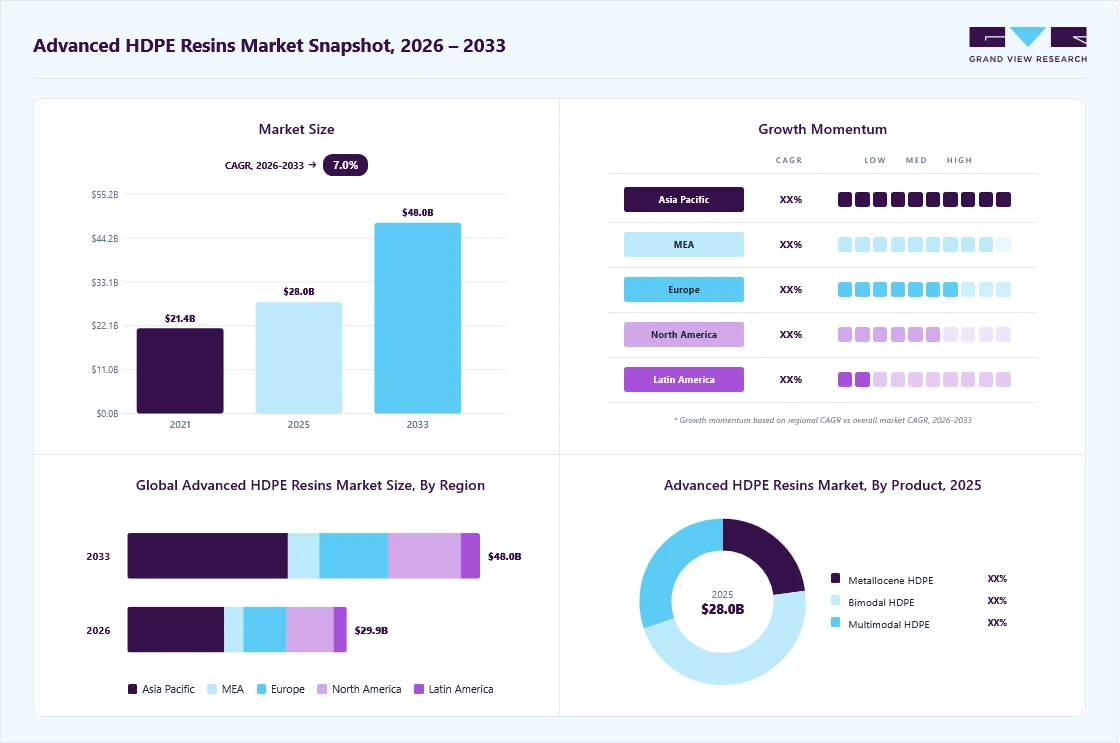
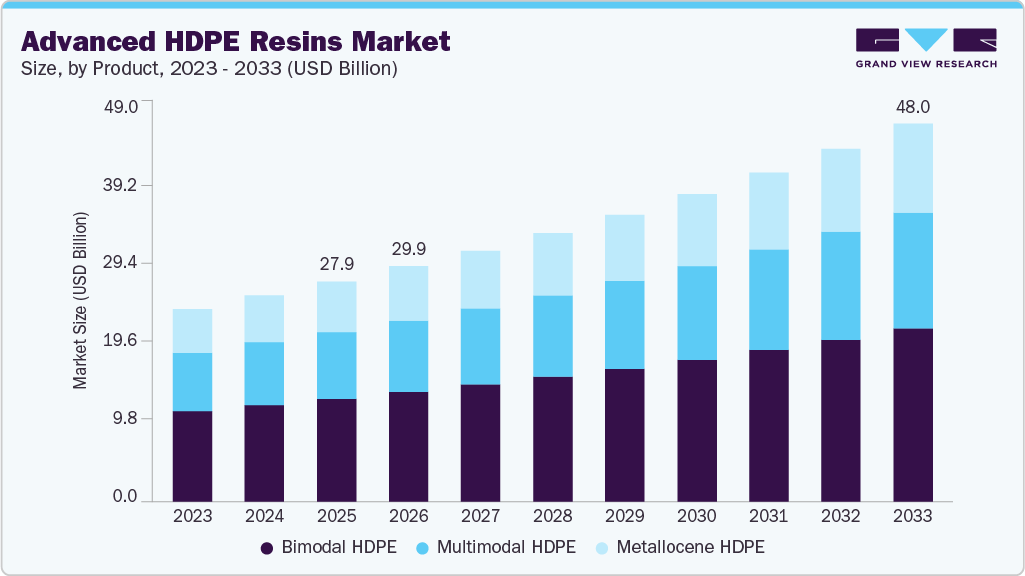
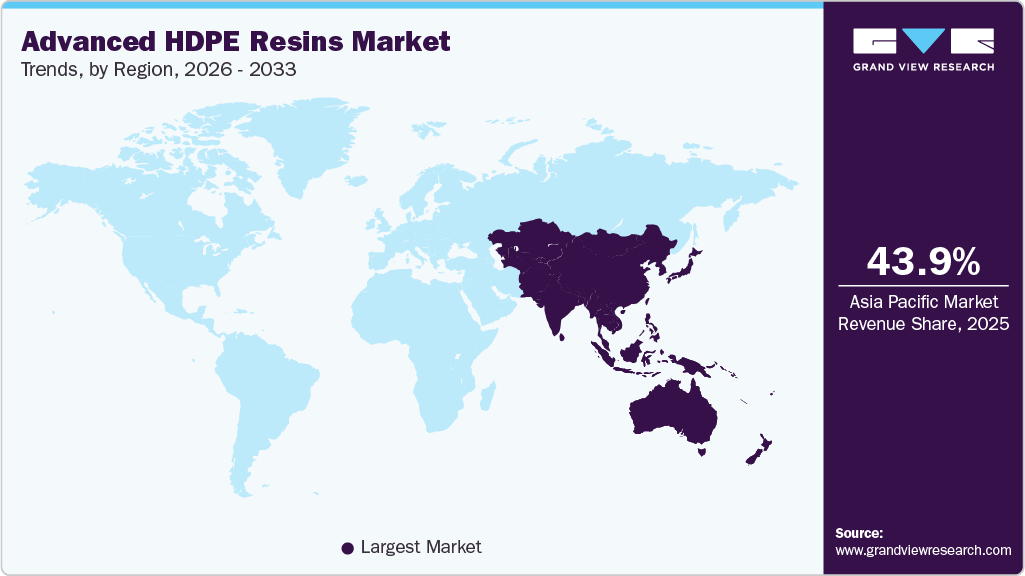
The global advanced HDPE resins market size was valued at USD 27.9 billion in 2025 and is projected to grow from USD 29.9 billion in 2026 to USD 48.0 billion by 2033, at a CAGR of 7.0% from 2026 to 2033. Asia Pacific dominated the global market, accounting for the largest revenue share of 43.9% in 2025. The growing demand from the packaging, building and construction, agriculture, and automotive sectors is driving the market.
 Source: Grand View Research, IR Documents, Primary Interviews, Paid DatabasesTo learn more about this report,
 Download Free Sample Report
 Key Market Trends & Insights
- By product: Bimodal HDPE dominated the industry across the product segmentation in terms of revenue, accounting for a revenue share of 46.85% in 2025.
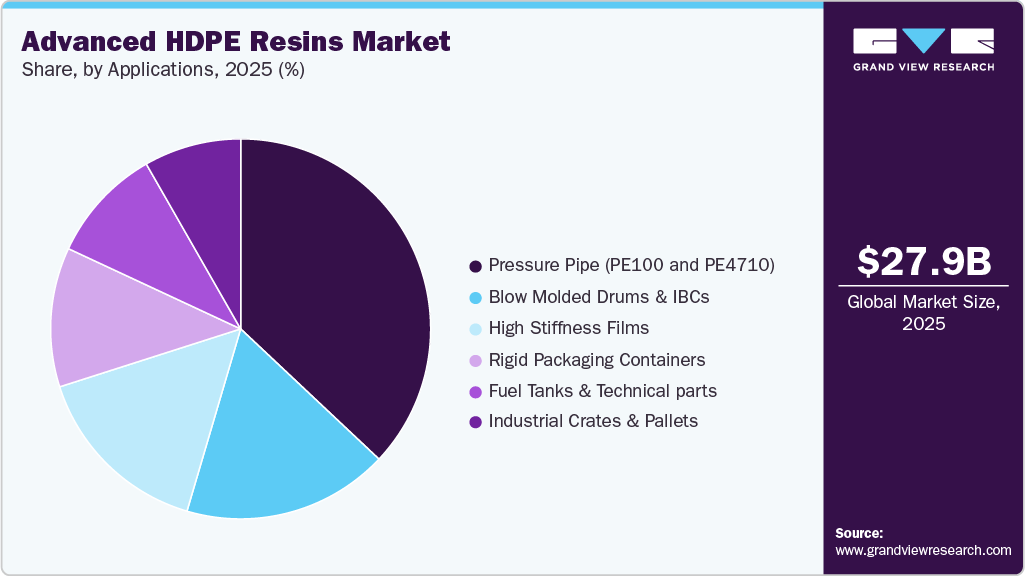
- By application: Pressure pipe (PE100 and PE4710) dominated the Bimodal HDPE Applications segmentation in terms of revenue, accounting for a market share of 37.01% in 2025.
Regional Highlights
- Largest regional market: Asia Pacific (43.9% revenue share, 2025)
- By country: The China advanced HDPE resins industry is a major contributor to the global market.
Market Size & Forecast
- Market size in 2025: USD 27.9 Billion
- Estimated market size in 2026: USD 29.9 Billion
- Projected market size by 2033: USD 48.0 Billion
- CAGR (2026-2033): 7.0%
Three ways to get this report
Buy it, customize it, or ask a question.Ask an Analyst
Analyst response in 1 business day
- AccessReport author, directly
- Reply timeWithin 1 working day
- No sales callDirect answer only
- FormatEmail reply
- CostFree, no cost
Get the Full Report
What the study covers
- FormatsPDF · Excel · Dashboard
- Timeline2026–2033 annual, 2025 base
- Coverage20+ countries, 5 regions
- Companies10+ key players profiled
Customize the Report
20% free customization
- IncludeCountries, segments, points
- TailorTo your product definition
- ExtendDeeper competitor detail
- OrA fully bespoke study
- Turnaround5–10 working days
The demand for chemically resistant, high-modulus materials in specialized industries such as medical devices, specialty coatings, and high-performance industrial tubing is fueling growth in advanced high-density polyethylene (HDPR) resins.
Bimodal HDPE resins combine two distinct molecular weight fractions to deliver a high-performance balance of strength and processability. The high-molecular-weight fraction imparts long-term hydrostatic strength and creep resistance, while the low-molecular-weight fraction improves melt strength and extrusion behavior. Penetration is highest in infrastructure piping where PE100 and similar standards are essential, and in heavy-duty drums and intermediate bulk containers that require strong stiffness and slow crack growth resistance.
 To learn more about this report, Download Free Sample Report
 Metallocene HDPE offers enhanced clarity, toughness, and film softness, making it suitable for flexible packaging films and select rigid packaging applications. Penetration is currently strongest in specialty film segments, where sealability, downgauging, and improved optics are key. Adoption of caps and some blow-molded containers is also increasing as converters seek smoother processing and more stable bubble performance.
Multimodal HDPE features engineered molecular weight distributions that deliver high stiffness along with strong toughness, making it ideal for demanding industrial applications. It has notable penetration in advanced pressure pipe systems and geomembranes, and usage is rising in heavy-duty industrial films and engineered closures where burst strength and environmental stress crack resistance are essential. Growth prospects are strong across infrastructure, mining, waste containment, and energy applications that require long-term reliability under stress.
Drivers, Opportunities & Restraints
The rapid expansion of e-commerce is a significant driver of demand for advanced HDPE resins. Online retail growth increases parcel volumes, short delivery cycles, and the need for lightweight, damage-resistant packaging. Retailers and marketplaces push for faster packing lines, higher automation, and consistent material quality. At the same time, sustainability requirements and return logistics raise demand for recyclable, mono-material solutions. These trends generate steady, high-volume demand for specialty HDPE grades that strike a balance between low weight, strength, and processability, while meeting brand and regulatory expectations.
Feedstock price volatility is a key restraint for the advanced HDPE industry, as raw material costs significantly influence resin margins and pricing cycles. Ethylene and comonomer prices fluctuate in response to changes in crude oil, natural gas, cracker outages, and seasonal demand for fuels and petrochemicals. Sudden feedstock spikes force producers to choose between absorbing the costs, passing them on to customers, or reducing production. Volatility increases working capital needs for converters, complicates long-term contracting, and slows investment in new specialty grades when margin visibility is poor.
However, the market for Advanced HDPE (High-Density Polyethylene) resins is set to experience substantial growth, fueled by increasing demand for lightweight, strong, and chemically resistant materials in sectors like packaging, automotive, construction, and industrial use. Advancements in metallocene and bimodal HDPE grades are providing enhanced performance features, such as better impact resistance, increased stiffness, and improved processability. The growing focus on sustainable and recyclable materials further enhances opportunities, as HDPE’s recyclability aligns with worldwide circular economy efforts. Moreover, the expansion of applications in high-performance piping, flexible packaging, and automotive fuel systems offers promising prospects for manufacturers and suppliers aiming to increase their market presence.
Market Concentration & Characteristics
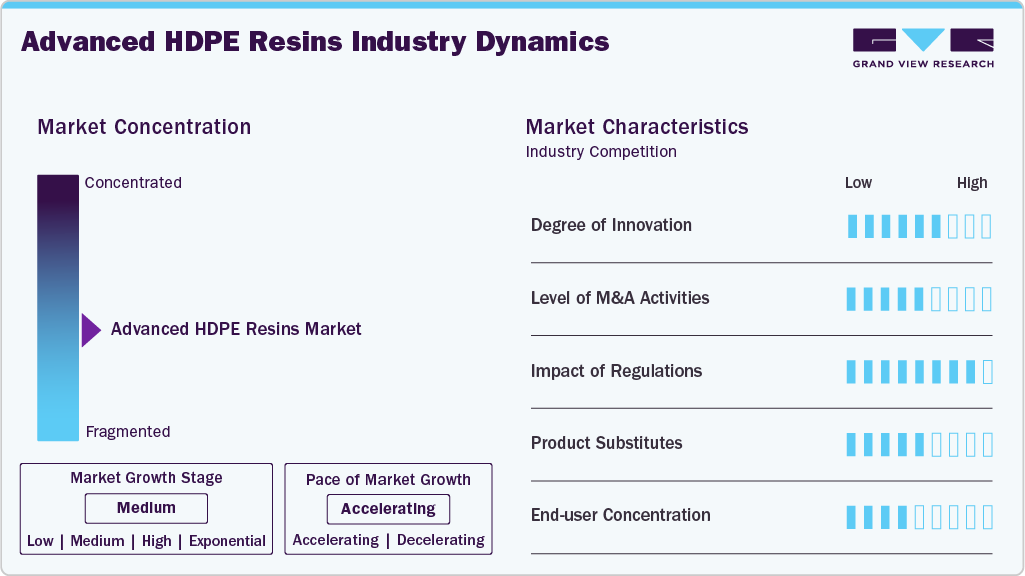
The industry for advanced high density polyethylene resins is fragmented owing to the presence of key companies, such as LyondellBasell Industries N.V., Exxon Mobil Corporation, SABIC, Reliance Industries Limited, INEOS Group, Braskem S.A., Chevron Phillips Chemical Company LLC, LG Chem, Ltd., and others. These companies have adopted various strategies, such as new product launches, partnerships, capacity expansions, and collaborations, to expand their market presence. For instance, in January 2025, LyondellBasell Industries N.V. and Indian Oil Corporation Ltd. (IOCL) partnered to supply IOCL with its Hostalen Advanced Cascade Process (Hostalen ACP) technology for a new 500,000-ton per year HDPE plant in Paradip, India. The facility was integrated into IOCL's large refinery-petrochemical complex, supporting India's growing polymer market.
The industry for advanced HDPE resins is experiencing a mix of moderate and significant innovation, as companies are concentrating on creating specialized grades with enhanced mechanical, thermal, and chemical attributes. At the same time, mergers and acquisitions are influencing the competitive environment, with major players purchasing regional manufacturers or tech startups to diversify their portfolios, improve production capabilities, and reach new markets.
 To learn more about this report, Download Free Sample Report
 Strict environmental regulations regarding plastic usage, recycling requirements, and sustainability standards are impacting the advanced HDPE industry, pushing manufacturers toward more environmentally friendly and recyclable options. Furthermore, the shift toward alternative polymers like PP, PET, or biodegradable plastics creates competitive pressure, urging HDPE manufacturers to innovate and distinguish their products.
The market exhibits a moderate concentration of end-users, with major demand coming from industries such as packaging, automotive, construction, and consumer goods. Significant purchasing influence resides with large industrial buyers and multinational packaging firms, affecting pricing, product specifications, and long-term supply contracts.
Product Insights
Bimodal HDPE dominated the industry across the product segmentation in terms of revenue, accounting for a revenue share of 46.85% in 2025. Bimodal HDPE resins combine two distinct molecular weight fractions to deliver a high-performance balance of strength and processability. The high-molecular-weight fraction imparts long-term hydrostatic strength and creep resistance, while the low-molecular-weight fraction improves melt strength and extrusion behavior. This makes bimodal grades the go-to choice for PE100 and PE4710 pressure piping, blow-molded drums, rigid containers, and heavy-duty film, where thin walls, reliability, and weldability are key considerations.
The Metallocene HDPE segment is anticipated to grow at the fastest CAGR of 7.4% through the forecast period. Metallocene HDPE resins are produced using single-site catalysts, which provide tight control over molecular architecture and comonomer incorporation during both gas-phase and slurry polymerization. Manufacturers tune hydrogen levels, reactor staging, and catalyst ligand structures to hit narrow molecular weight distributions and precise branching, which produces superior clarity, consistent melt flow, and enhanced sealability.
Application Insights
Pressure pipe (PE100 and PE4710) dominated the Bimodal HDPE Applications segmentation in terms of revenue, accounting for a market share of 37.02% in 2025, and is forecasted to grow at a 7.1% CAGR from 2026 to 2033. Bimodal HDPE underpins PE100 and PE4710 pipe systems by delivering long-term hydrostatic strength and reliable joint integrity. Its two-fraction architecture enables thinner walls while meeting strict pressure and safety standards, lowering material and transport costs. Utilities favor these grades for proven service life, predictable elongation, and resistance to slow crack growth. The result is lower whole-life cost, easier installation, and simplified asset management for water, gas, and industrial distribution networks.
 To learn more about this report, Download Free Sample Report
 The blow-molded drums and IBCs application in the bimodal HDPE segment market is expected to expand at a substantial CAGR of 6.8% through the forecast period. Bimodal HDPE offers the mechanical resilience required for UN-rated drums and intermediate bulk containers used across chemicals and food ingredients. The higher molecular weight fraction provides impact and chemical resistance, while the lower fraction improves parison stability for uniform wall thickness. This balance enables lighter, safer containers that meet the demands of regulatory testing and repeated handling. Producers benefit from higher throughput, fewer defects, and lower cost per cycle for returnable or refillable bulk packaging systems.
Metallocene HDPE has a wide array of applications due to its enhanced toughness, uniform molecular structure, and superior processing capabilities. In flexible and agricultural films, metallocene HDPE offers greater strength, puncture resistance, and opportunities for downgauging. When it comes to pressure pipes, it exhibits excellent resistance to stress cracking and robust long-term durability. Moreover, its reliable performance is ideal for producing high-quality blow molded containers, caps, closures, and injection molded consumer goods, where consistent dimensional stability, impact strength, and dependable processing are essential.
Multimodal HDPE is a type of high-density polyethylene that is manufactured using cutting-edge metallocene or Ziegler-Natta catalysts, resulting in a polymer that has various molecular weight distributions. This composition merges the high stiffness and tensile strength from the high-molecular-weight portion with the excellent processability and impact resistance of the low-molecular-weight portion. Consequently, multimodal HDPE is extensively utilized in applications such as pressure pipes, blow-molded containers, caps and closures, and films, delivering enhanced performance, improved toughness, and greater durability when compared to standard HDPE.
Regional Insights
The advanced HDPE resins market in Asia Pacific held the largest share of 43.96% in 2025 and is expected to grow at the fastest CAGR of 7.5% over the forecast period due to rapid urbanization, industrial expansion, and rising consumer demand for packaged goods. Urban population growth fuels the construction of housing, transport, and utilities, while industrialization expands manufacturing, e-commerce, and food processing that need robust packaging. These structural shifts increase demand for pipes, geomembranes, films, and rigid packaging, where advanced HDPE’s durability and downgauging potential add value. Urbanization trends across the region also raise municipal spending on water and waste infrastructure, reinforcing long-term offtake.
 To learn more about this report, Download Free Sample Report
 China Advanced HDPE Resins Market Trends
China’s advanced HDPE market is large and growth-oriented, driven by the country’s extensive manufacturing base and sustained construction investment. High volumes of industrial production and infrastructure projects create steady demand for pressure piping, geomembranes, heavy-duty films, and packaging, where advanced HDPE’s durability and downgauging benefits add clear value. Producers benefit from localized access to feedstock and scale, which support investment in premium metallocene, bimodal, and multimodal grades.
North America Advanced HDPE Resins Market Trends
North America is a mature, high-volume market for advanced HDPE resins driven by broad industrial demand and strong downstream manufacturing. The region’s large automotive sector and sustained infrastructure spending create steady needs for high-performance pipes, fuel-system components, wire jacketing, and durable packaging. Producers in North America benefit from scale, localized technical support, and close relationships with major converters and OEMs that require validated, high-reliability polymer solutions.
The advanced HDPE market in the U.S. is anchored by a large automotive and electronics ecosystem that creates steady demand for high-performance polymers used in fuel-system components, under-hood parts, cable jacketing, and electronic housings. Auto manufacturers and tier suppliers require validated grades that meet crash, permeability, and thermal requirements, while electronics and semiconductor equipment makers need durable, clean polymers for cable protection and tooling.
Europe Advanced HDPE Resins Market Trends
The advanced HDPE resins market in Europe is a sophisticated, high-value market for advanced HDPE resins driven by strong automotive engineering and premium OEM demand. European vehicle makers require materials that meet strict lightweighting, safety, and recyclability targets. This premium auto focus raises demand for specialized resins used in fuel-system parts, under-hood components, cable jacketing, and high-performance interior fittings. Suppliers in the region compete on technical support, local qualification, and proven low-emissions or circular-feedstock credentials to win long-term OEM business.
Key Advanced HDPE Resins Market Company Insights
Key players operating in the advanced HDPE resins market are undertaking various initiatives to strengthen their presence and increase the reach of their products and services. Strategies such as expansion activities and partnerships are key in propelling the market growth.
Key Advanced HDPE Resins Companies:
The following are the leading companies in the advanced HDPE resins market. These companies collectively hold the largest market share and dictate industry trends.
- LyondellBasell Industries N.V.
- Exxon Mobil Corporation
- SABIC
- Reliance Industries Limited
- INEOS Group
- Braskem S.A.
- Chevron Phillips Chemical Company LLC
- LG Chem, Ltd.
- Borealis GmbH
- Dow, Inc.
- Japan Polyethylene Corporation
- Lotte Chemical Titan Holding Berhad
- Formosa Plastics Corporation
- China National Petroleum Corporation (CNPC)
- Sinopec Group
Recent Developments
-
In August 2025, TPiA and Glencore, through their joint venture Aster Chemicals and Energy, acquired Chevron Phillips Singapore Chemicals' HDPE plant on Jurong Island, Singapore. The plant has an annual production capacity of 400,000 metric tons and is a key supplier of HDPE used in packaging, construction, and other industries.
-
In May 2025, Univation Technologies announced the launch of a new world-scale PE production process design with a capacity of 800,000 tons per year, significantly increasing from its previous 650,000-ton benchmark. This new design enables producers to achieve higher output, greater product flexibility, including unimodal and bimodal HDPE, LLDPE, and metallocene PE, and improved cost efficiency due to economies of scale.
Advanced HDPE Resins Market Report Scope
Report Attribute
Details
Market size in 2025
USD 27.9 billion
Estimated Market size in 2026
USD 29.9 billion
Projected Market size by 2033
USD 48.0 billion
Growth rate
CAGR of 7.0% from 2026 to 2033
Historical data
2021 - 2024
Forecast period
2026 - 2033
Quantitative units
Volume in kilotons, revenue in USD million/billion, and CAGR from 2026 to 2033
Report coverage
Volume & revenue forecast, competitive landscape, growth factors, and trends
Segments covered
Product, application, region
Regional scope
North America; Europe; Asia Pacific; Central & South America; Middle East & Africa
Country scope
U.S.; Canada; Mexico; Germany; France; UK; Spain; Italy; China; Japan; India; South Korea; Australia; Brazil; Argentina; Saudi Arabia; South Africa; UAE
Key companies profiled
LyondellBasell Industries N.V.; Exxon Mobil Corporation; SABIC; Reliance Industries Limited; INEOS Group; Braskem S.A.; Chevron Phillips Chemical Company LLC; LG Chem, Ltd.; Borealis GmbH; Dow, Inc.; Japan Polyethylene Corporation; Lotte Chemical Titan Holding Berhad; Formosa Plastics Corporation; China National Petroleum Corporation (CNPC); Sinopec Group
Customization scope
Free report customization (equivalent up to 8 analyst’s working days) with purchase. Addition or alteration to country, regional & segment scope
Pricing and purchase options
Avail customized purchase options to meet your exact research needs. Explore purchase options
Global Advanced HDPE Resins Market Report Segmentation
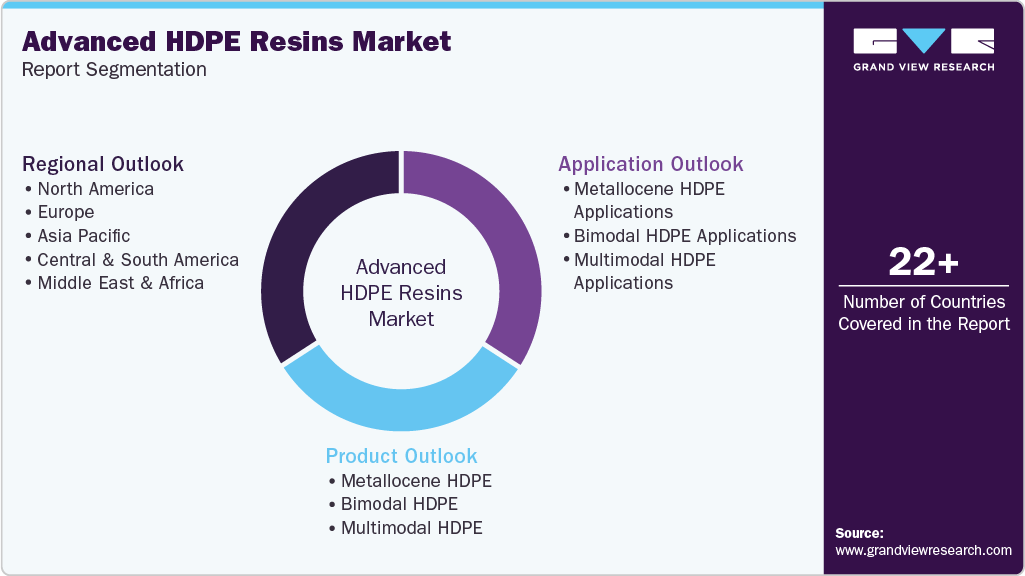
This report forecasts volume & revenue growth at the global, regional, and country levels, providing an analysis of the latest industry trends in each sub-segment from 2021 to 2033. For this study, Grand View Research has segmented the global advanced HDPE resins market report on the basis of product, application, and region:
 To learn more about this report, Download Free Sample Report
 -
Product Outlook (Volume, Kilotons; Revenue, USD Million, 2021 - 2033)
-
Metallocene HDPE
-
Bimodal HDPE
-
Multimodal HDPE
-
-
Application Outlook (Volume, Kilotons; Revenue, USD Million, 2021 - 2033)
-
Metallocene HDPE Applications
-
Flexible packaging films
-
Agricultural films
-
Pressure pipe
-
Blow-molded containers
-
Caps and closures
-
Injection molded consumer products
-
-
Bimodal HDPE Applications
-
Pressure pipe (PE100 and PE4710)
-
Blow-molded drums and IBCs
-
Rigid packaging containers
-
High stiffness films
-
Fuel tanks and technical parts
-
Industrial crates and pallets
-
-
Multimodal HDPE Applications
-
Advanced pressure pipe systems
-
Heavy-duty industrial films
-
Chemical containers and barrels
-
Caps, closures, and engineered components
-
Geomembranes and liners
-
Wire and cable jacketing
-
-
-
Regional Outlook (Volume, Kilotons; Revenue, USD Million, 2021 - 2033)
-
North America
-
U.S.
-
Canada
-
Mexico
-
-
Europe
-
Germany
-
UK
-
France
-
Italy
-
Spain
-
-
Asia Pacific
-
China
-
India
-
Japan
-
South Korea
-
Australia
-
-
Central & South America
-
Brazil
-
Argentina
-
-
Middle East & Africa
-
Saudi Arabia
-
South Africa
-
UAE
-
-
Frequently Asked Questions About This Report
The demand for chemically resistant, high-modulus materials in specialized industries such as medical devices, specialty coatings, and high-performance industrial tubing is fueling growth in advanced HDPR resins.
Asia Pacific dominated with a 43.9% revenue share in 2025.
The pressure pipe (PE100 and PE4710) segment led with a 37.0% revenue share in 2025.
The global advanced HDPE resins market size was valued at USD 27.9 billion in 2025 and is estimated at USD 29.9 billion for 2026.
The global advanced HDPE resins market is expected to grow at a CAGR of 7.0% from 2026 to 2033, reaching USD 48.0 billion by 2033.
Bimodal HDPE dominated the market across the product segmentation in terms of revenue, accounting for a market share of 46.9% in 2025, and is forecasted to grow at a 6.7% CAGR from 2026 to 2033.
Key players include LyondellBasell Industries N.V.; Exxon Mobil Corporation; SABIC; Reliance Industries Limited; INEOS Group; Braskem S.A.; Chevron Phillips Chemical Company LLC; LG Chem, Ltd.; Borealis GmbH; Dow, Inc.; Japan Polyethylene Corporation; Lotte Chemical Titan Holding Berhad; Formosa Plastics Corporation; China National Petroleum Corporation (CNPC); Sinopec Group.
About the Author(s)
Plastics, Polymers & Resins Research Team
Bulk Chemicals · Plastics, Polymers & ResinsThis report was authored by the plastics, polymers & resins research team at Grand View Research - comprising two research analysts, one senior research analyst, and one industry expert - with specialized expertise in the plastics, polymers & resins segment of the bulk chemicals industry. All findings are based on proprietary bulk chemicals databases, executive interviews, and regulatory analysis, subject to internal peer review prior to publication.
Last Updated:
Speak to Analyst

Customize this report to your needs - add regions, segments, or data points, with 20% free customization.
Or view our licence options:


ISO 9001:2015 & 27001:2022 Certified
We are GDPR and CCPA compliant! Your transaction & personal information is safe and secure. For more details, please read our privacy policy.


