
- Home
- »
- Power Generation & Storage
- »
-
Americas Battery Energy Storage System Market Report 2033GVR Report cover

Americas Battery Energy Storage System Market (2025 - 2033) Size, Share & Trends Analysis Report By Battery Type (Flywheel, Lead Acid, Lithium-Ion), By End-use (Data Center, Medical), By Region, And Segment Forecasts
Americas Battery Energy Storage System Market Summary
The Americas battery energy storage system market size was estimated at USD 39.27 billion in 2024 and is projected to reach USD 138.47 billion by 2033, growing at a CAGR of 14.5% from 2025 to 2033. Regional market growth is primarily driven by increasing renewable energy integration, grid modernization efforts, and government-backed incentives to promote clean energy infrastructure.
Key Market Trends & Insights
- North America battery energy storage system market held the largest share of 74.70% of the Americas market in 2024.
- The Americas battery energy storage system (BESS) market in the U.S. is expected to grow significantly over the forecast period.
- By battery type, Lithium-Ion held the highest market share of 51.54% in 2024.
- Based on the end use, the Industrial segment held the highest market share in 2024.
Market Size & Forecast
- 2024 Market Size: USD 39.27 Billion
- 2033 Projected Market Size: USD 138.47 Billion
- CAGR (2025-2033): 14.5%
Three ways to get this report
Buy it, customize it, or ask a question.Ask an Analyst
Analyst response in 1 business day
- AccessReport author, directly
- Reply timeWithin 1 working day
- No sales callDirect answer only
- FormatEmail reply
- CostFree, no cost
Get the Full Report
What the study covers
- FormatsPDF · Excel · Dashboard
- Timeline2025–2033 annual, 2024 base
- Coverage20+ countries, 5 regions
- Companies10+ key players profiled
Customize the Report
20% free customization
- IncludeCountries, segments, points
- TailorTo your product definition
- ExtendDeeper competitor detail
- OrA fully bespoke study
- Turnaround5–10 working days
With a growing emphasis on decarbonization, Battery Energy Storage System (BESS) technologies have become central to stabilizing renewable power systems, supporting frequency regulation, and enhancing energy reliability. The rise of distributed energy resources (DERs) and electric vehicle (EV) adoption is further catalyzing demand, particularly as utilities and commercial players seek flexible, cost-efficient solutions for energy management.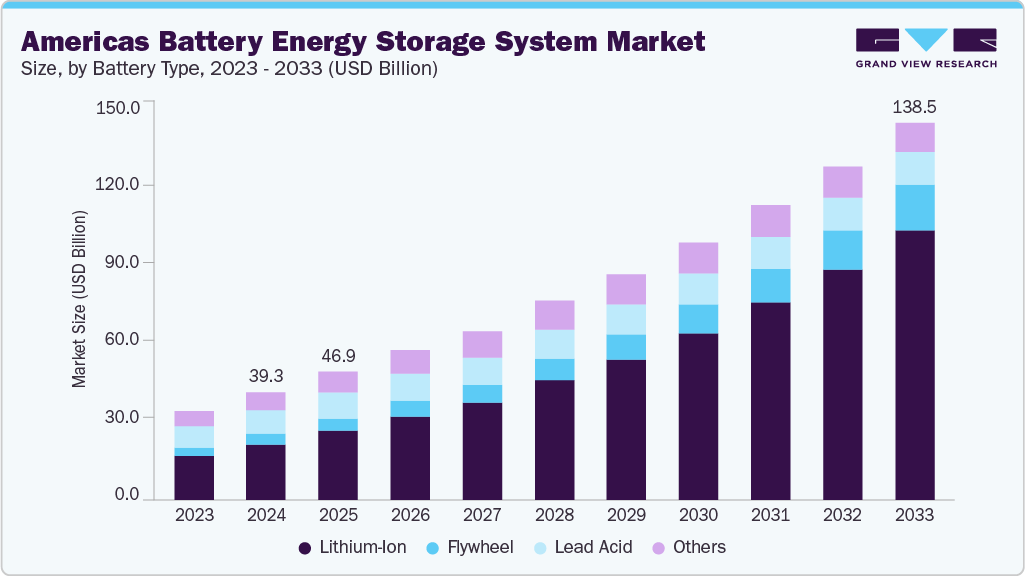 Source: Grand View Research, IR Documents, Primary Interviews, Paid DatabasesTo learn more about this report,
 Download Free Sample Report
 In the United States, strong policy support, including the Inflation Reduction Act (IRA) and federal tax credits under the Investment Tax Credit (ITC), continues to bolster market growth. Utilities are deploying large-scale BESS systems to manage grid congestion, while residential and commercial adoption is rising amid frequent weather-related disruptions and peak load concerns. States such as California, Texas, and New York lead the country’s storage capacity additions, supported by regional incentives and mandates for renewable integration. Continuous R&D investments in advanced chemistries, particularly lithium-ion and flow batteries, also expand system efficiency, energy density, and lifecycle performance, reinforcing the country’s leadership in the market.
Across Latin America, countries such as Brazil, Chile, and Mexico are witnessing rapid BESS adoption, primarily driven by renewable energy expansion and grid reliability initiatives. Brazil, with its vast hydropower base, is incorporating battery energy storage system to balance intermittent solar and wind inputs, while Chile is advancing hybrid solar-plus-storage projects in the Atacama region. Mexico’s industrial sector increasingly deploys storage to reduce energy costs and ensure supply stability amid ongoing energy reforms. As governments and utilities across the region prioritize clean energy transitions and resilience improvements, the Latin American market is expected to grow steadily, contributing significantly to overall regional market expansion.
Drivers, Opportunities & Restraints
The accelerating transition toward renewable energy primarily drives the Americas BESS industry, the growing need for grid stability, and increasing investments in energy infrastructure modernization. Countries across the region, particularly the U.S., Canada, and Brazil, are adopting large-scale storage solutions to support intermittent renewable power sources such as solar and wind. Policy measures like the U.S. Inflation Reduction Act (IRA) and state-level incentives, including storage-specific tax credits and renewable portfolio standards (RPS), are spurring utility-scale and distributed energy storage deployments. In addition, the growing penetration of electric vehicles (EVs), coupled with rising demand for backup power and peak load management in commercial and residential sectors, continues to drive adoption. Technological advancements in lithium-ion, flow, and hybrid battery systems further improve performance, lifecycle, and safety, expanding the market’s applicability across diverse energy storage needs.
The Americas BESS industry opportunities are expanding rapidly as the region embraces grid decarbonization and energy digitalization. The increasing focus on microgrids, renewable integration, and virtual power plants (VPPs) creates new avenues for distributed storage deployment. The growth of solar-plus-storage and wind-plus-storage hybrid projects across the U.S., Canada, Chile, and Brazil underscores the growing alignment between renewable energy expansion and storage capacity additions. Moreover, advancements in second-life battery applications, vehicle-to-grid (V2G) technologies, and AI-based energy management systems enable more flexible and efficient energy utilization. The rising demand from data centers, industrial facilities, and telecommunication networks for uninterrupted power supply strengthens market prospects, especially as businesses prioritize energy resilience and decarbonization.
However, several challenges restrain the market’s full-scale potential. High upfront capital costs, complex permitting procedures, and supply chain dependencies for raw materials such as lithium and cobalt remain significant hurdles. The lack of standardized interconnection rules, regulatory fragmentation, and inadequate transmission infrastructure further limit large-scale deployment. In Latin America, policy instability and financing constraints for renewable-plus-storage projects also present risks. Moreover, battery safety concerns, recycling challenges, and lifecycle management issues require ongoing technological and policy improvements. Despite these restraints, continuous innovation, supportive regulation, and declining battery costs are expected to mitigate these challenges and sustain long-term market growth across the Americas.
Battery Type Insights
The lithium-ion segment dominated the market in 2024, accounting for over 51.54% of total revenue. This dominance reflects technology’s superior energy density, high efficiency, and rapidly declining costs, making lithium-ion batteries the preferred choice for grid-scale and distributed storage applications. Their wide adoption across utility, residential, and commercial sectors is driven by the need for reliable, high-performance energy storage that supports renewable integration, peak shaving, and backup power. In the U.S., large-scale projects such as those in California and Texas rely heavily on lithium-ion systems due to their proven scalability, flexibility, and favorable cost structure. Furthermore, technology’s adaptability across multiple chemistries, including lithium iron phosphate (LFP) and nickel-manganese-cobalt (NMC), allows for tailored solutions that balance performance, safety, and lifespan for diverse end use requirements.
The segment’s growth is also fueled by continuous advancements in battery management systems (BMS), enhanced thermal control technologies, and improvements in battery recycling and second-life applications, which are extending operational lifespans and improving environmental sustainability. Ongoing investments from leading manufacturers such as Tesla, Fluence, LG Energy Solution, and BYD have further strengthened the regional lithium-ion supply chain and boosted manufacturing capacity. In Latin America, technology is gaining traction in renewable-plus-storage hybrid projects and off-grid energy systems, especially in regions with unreliable grid access. Lithium-ion technology continues to evolve, offering higher energy efficiency and lower total cost of ownership. It remains the market cornerstone, supporting the region’s broader shift toward clean, resilient, and flexible energy systems.
End Use Insights
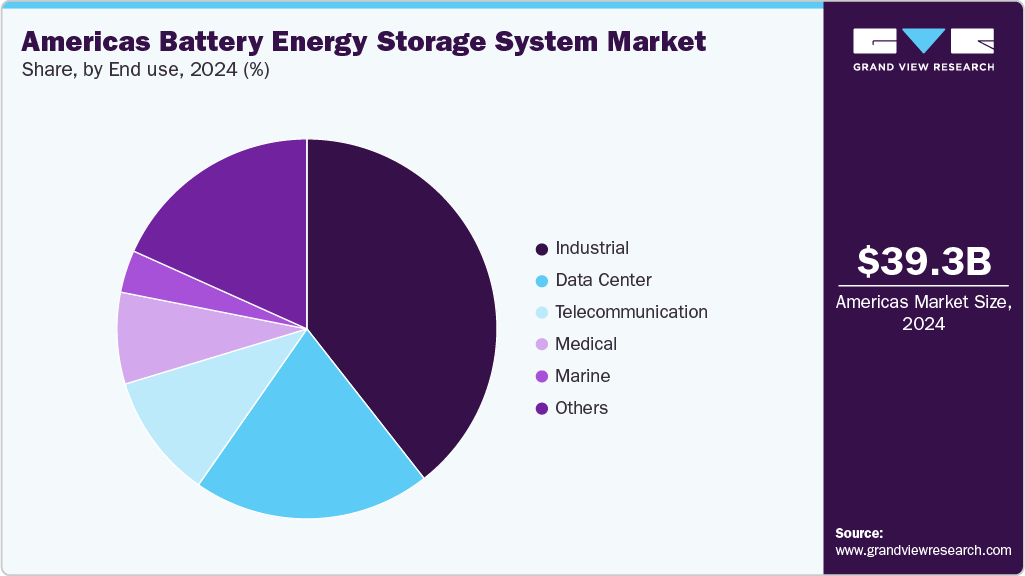
The industrial segment accounted for the largest market share of 39.42% in 2024, driven by rising demand for reliable, high-capacity energy storage solutions to support continuous operations and power stability. Industries such as manufacturing, mining, oil & gas, and data centers are increasingly deploying BESS to manage energy costs, mitigate downtime risks, and ensure resilience against grid fluctuations. As energy-intensive sectors face stricter emission reduction mandates and rising electricity prices, battery storage systems have become critical for peak load management, renewable energy integration, and backup power applications. In the U.S., large industrial facilities and microgrids are leading adoption, leveraging BESS to improve operational efficiency and meet corporate sustainability goals.
 To learn more about this report, Download Free Sample Report
 Across Latin America, industrial adoption is accelerating as countries such as Brazil, Chile, and Mexico expand their renewable portfolios and seek greater energy independence. Industrial users are turning to BESS to stabilize voltage, support remote operations, and offset intermittent renewable generation, particularly in off-grid and hybrid energy systems. The growing presence of renewable-powered industrial parks and distributed generation initiatives amplifies storage demand. Modular and scalable BESS design advancements enable flexible deployment across various industrial settings, from small manufacturing units to large-scale production complexes. As industries across the Americas prioritize energy efficiency, cost savings, and sustainability, the industrial segment is expected to maintain its leading position in driving the region’s market growth over the forecast period.
Regional Insights
North America held over 74.70% revenue share of the Americas BESS market in 2024, driven by large-scale renewable energy integration, strong policy support, and growing investments in grid modernization. Utilities, independent power producers (IPPs), and commercial users increasingly deploy battery energy storage systems to enhance grid stability, support peak load management, and integrate renewable energy sources. Technological advancements in lithium-ion, flow, hybrid storage systems, and solar-plus-storage and wind-plus-storage projects are accelerating adoption. Federal and state-level incentives, including the Inflation Reduction Act (IRA), Investment Tax Credit (ITC), and renewable portfolio standards (RPS), further enhance the region’s growth prospects.
U.S. Battery Energy Storage System Market Trends
The BESS market in the United States is the largest single-country market within North America, accounting for most regional BESS revenue. Strong federal policies, state-level incentives, and corporate sustainability commitments drive adoption across utility, industrial, and commercial sectors. Large-scale projects in California, Texas, and New York demonstrate extensive deployment of lithium-ion and flow batteries, with applications spanning grid stabilization, frequency regulation, and renewable energy integration. The combination of technological advancements, abundant capital investment, and favorable regulatory support ensures that the U.S. will remain the dominant market in the Americas.
Canada battery energy storage system market contributes significantly to North America through provincial-level incentives, renewable integration programs, and investments in microgrids and distributed energy projects. Adoption is particularly strong in industrial facilities, remote communities, and commercial applications where storage improves reliability and cost efficiency. The government’s focus on clean energy transitions and grid modernization provides additional impetus for storage deployment.
The battery energy storage system market in Mexicois gaining momentum as utilities and commercial players increasingly adopt storage solutions to support renewable integration and enhance grid reliability. Energy reforms and policy incentives for distributed energy and hybrid renewable projects encourage private-sector investment. Lithium-ion and modular storage systems are being deployed across industrial and commercial segments, with growing interest in behind-the-meter applications.
Latin America Battery Energy Storage System Market Trends
The BESS market in Latin America is emerging as a high-growth market for BESS deployment due to expanding renewable energy capacity, improving regulatory frameworks, and growing industrial and commercial adoption. Countries like Brazil and Argentina are at the forefront, leveraging battery storage to balance intermittent renewable generation, improve grid reliability, and reduce dependence on fossil fuels. Regional initiatives to modernize energy infrastructure, international financing, and public-private partnerships support market development. While market maturity is lower than in North America, rising renewable penetration and energy transition policies position Central & South America as a key growth frontier for BESS systems.
Brazil battery energy storage system market leads Latin America, driven by its expansive hydropower base and growing solar and wind capacity. Battery storage systems balance intermittent generation, support remote industrial zones, and enhance energy resilience. National energy policies and distributed generation initiatives encourage utility-scale and behind-the-meter storage deployments.
The battery energy storage system market in Argentina is emerging as a key market in South America, with renewable energy projects increasingly integrating battery storage. Industrial, commercial, and utility users are adopting BESS to manage peak loads, stabilize voltage, and reduce reliance on fossil-based electricity. Policy reforms and international funding support further strengthen the market, positioning Argentina as a growing BESS hub.
Key Americas Battery Energy Storage System Company Insights
Some key market players include AES Energy Storage, Altair Nanotechnologies Inc., Beckett Energy Systems, CATL (Contemporary Amperex Technology Co. Limited), EnerSys, Exide Technologies, Fluence Energy, Inc., General Electric (GE), GS Yuasa Corporation, Hitachi Ltd., Imergy Power Systems Inc., LG Energy Solution, Powin Energy, Samsung SDI Co., Ltd., Sungrow Power Supply Co., Ltd., and Tesla, Inc. These companies heavily invest in research and development, large-scale utility and commercial energy storage projects, advanced lithium-ion and flow battery technologies, microgrid solutions, and software-driven energy management systems.
Key Americas Battery Energy Storage System Companies:
- AES Energy Storage
- Altair Nanotechnologies Inc.
- Beckett Energy Systems
- CATL (Contemporary Amperex Technology Co. Limited)
- EnerSys
- Exide Technologies
- Fluence Energy, Inc.
- General Electric (GE)
- GS Yuasa Corporation
- Hitachi Ltd.
- Imergy Power Systems Inc.
- LG Energy Solution
- Powin Energy
- Samsung SDI Co., Ltd.
- Sungrow Power Supply Co., Ltd.
- Tesla, Inc.
Recent Developments
-
In April 2025, Fluence Energy, LLC announced the commissioning of a new utility-scale lithium-ion battery energy storage system in Texas, United States. The facility is designed to provide 500 MW / 2,000 MWh of grid-scale storage capacity, supporting renewable energy integration, peak load management, and frequency regulation across the regional grid. This deployment is expected to enhance grid reliability, reduce reliance on fossil-fuel peaking plants, and contribute to lowering greenhouse gas emissions by an estimated 350,000 metric tons of CO₂ equivalent annually.
Americas Battery Energy Storage System Market Report Scope
Report Attribute
Details
Market size value in 2025
USD 46.97 billion
Revenue forecast in 2033
USD 138.47 billion
Growth rate
CAGR of 14.5% from 2025 to 2033
Base year for estimation
2024
Historical data
2021 - 2023
Forecast period
2025 - 2033
Quantitative Units
Revenue in USD million/billion, and CAGR from 2025 to 2033
Report coverage
Revenue forecast, competitive landscape, growth factors, and trends
Segments covered
Battery type, end use, region
Regional scope
North America; Latin America
Country scope
U.S.; Canada; Mexico; Brazil; Argentina
Key companies profiled
AES Energy Storage; Altair Nanotechnologies Inc.; Beckett Energy Systems; CATL (Contemporary Amperex Technology Co. Limited); EnerSys; Exide Technologies; Fluence Energy, Inc.; General Electric (GE); GS Yuasa Corporation; Hitachi Ltd.; Imergy Power Systems Inc.; LG Energy Solution; Powin Energy; Samsung SDI Co., Ltd.; Sungrow Power Supply Co., Ltd.; Tesla, Inc.
Customization scope
Free report customization (equivalent up to 8 analysts working days) with purchase. Addition or alteration to country, regional & segment scope.
Pricing and purchase options
Avail customized purchase options to meet your exact research needs. Explore purchase options
Americas Battery Energy Storage System Market Report Segmentation
This report forecasts revenue growth at regional and country levels and provides an analysis of the latest industry trends in each of the sub-segments from 2021 to 2033. For this study, Grand View Research has segmented the Americas battery energy storage system market report based on battery type, end use, and region:
-
Battery Type Outlook (Revenue, USD Million, 2021 - 2033)
-
Flywheel
-
Lead Acid
-
Lithium-Ion
-
Others
-
-
End Use Outlook (Revenue, USD Million, 2021 - 2033)
-
Telecommunication
-
Data Center
-
Medical
-
Industrial
-
Marine
-
Others
-
-
Regional Outlook (Revenue, USD Million, 2021 - 2033)
-
North America
-
U.S.
-
Canada
-
Mexico
-
-
Latin America
-
Brazil
-
Argentina
-
-
Frequently Asked Questions About This Report
The Americas battery energy storage system market size was estimated at USD 39.27 billion in 2024 and is expected to reach USD 46.97 billion in 2025.
The Americas battery energy storage system market is expected to grow at a compound annual growth rate of 14.5% from 2025 to 2033 to reach USD 138.47 billion by 2033.
Based on the battery type segment, Lithion-Ion held the largest revenue share of more than 51.54% in 2024.
Some of the key players operating in the Americas Battery Energy Storage System (BESS) market include AES Energy Storage, Altair Nanotechnologies Inc., Beckett Energy Systems, CATL (Contemporary Amperex Technology Co. Limited), EnerSys, Exide Technologies, Fluence Energy, Inc., General Electric (GE), GS Yuasa Corporation, Hitachi Ltd., Imergy Power Systems Inc., LG Energy Solution, Powin Energy, Samsung SDI Co., Ltd., Sungrow Power Supply Co., Ltd., and Tesla, Inc.
The key factors driving the Americas Battery Energy Storage System (BESS) market include the growing need to integrate intermittent renewable energy sources, enhance grid reliability, and support decarbonization across power, industrial, and commercial sectors. Increasing adoption of electric vehicles, distributed energy resources, and microgrid solutions, coupled with strong government incentives, renewable portfolio standards, and tax credits, is accelerating BESS deployment across North, Central, and South America.
About the Author(s)
Power Generation & Storage Research Team
Energy & Power · Power Generation & StorageThis report was authored by the power generation & storage research team at Grand View Research - comprising two research analysts, one senior research analyst, and one industry expert - with specialized expertise in the power generation & storage segment of the energy & power industry. All findings are based on proprietary energy & power databases, executive interviews, and regulatory analysis, subject to internal peer review prior to publication.
Last Updated:
Speak to Analyst

Customize this report to your needs - add regions, segments, or data points, with 20% free customization.
Or view our licence options:


ISO 9001:2015 & 27001:2022 Certified
We are GDPR and CCPA compliant! Your transaction & personal information is safe and secure. For more details, please read our privacy policy.


