
- Home
- »
- Plastics, Polymers & Resins
- »
-
Amorphous Polyethylene Terephthalate Market Report, 2026-2033GVR Report cover
![Amorphous Polyethylene Terephthalate Market (2026 - 2033)Report]()
Amorphous Polyethylene Terephthalate Market (2026 - 2033)
Size, Share & Trends Analysis Report By Applications (Bottles, Food Packaging), By End-use (Food & Beverage, Pharmaceuticals), By Region, And Segment Forecasts
Market Size, 2025
$52.2BMarket Estimate, 2026
$56.1BMarket Forecast, 2033
$99.1BCAGR, 2026–2033
8.5%Amorphous Polyethylene Terephthalate Market Summary
The global amorphous polyethylene terephthalate market size was valued at USD 52.2 billion in 2025 and is projected to grow from USD 56.1 billion in 2026 to USD 99.1 billion by 2033, at a CAGR of 8.5% from 2026 to 2033. The Asia Pacific held the largest share of 50.6% of the global market in 2025. The superior processing efficiency of amorphous PET in high-speed thermoforming operations is driving the market.

Key Market Trends & Insights
- By application: Bottles segment accounting for a 46.00% market share in 2025.
- By end-use: Food & beverage segment accounting for a market share of 58.41% in 2025.
Regional Highlights
- Largest regional market: Asia Pacific (50.6% revenue share, 2025)
- By country: The China led the Asia Pacific market in 2025.
Market Size & Forecast
- Market size in 2025: USD 52.2 Billion
- Estimated market size in 2026: USD 56.1 Billion
- Projected market size by 2033: USD 99.1 Billion
- CAGR (2026-2033): 8.5%
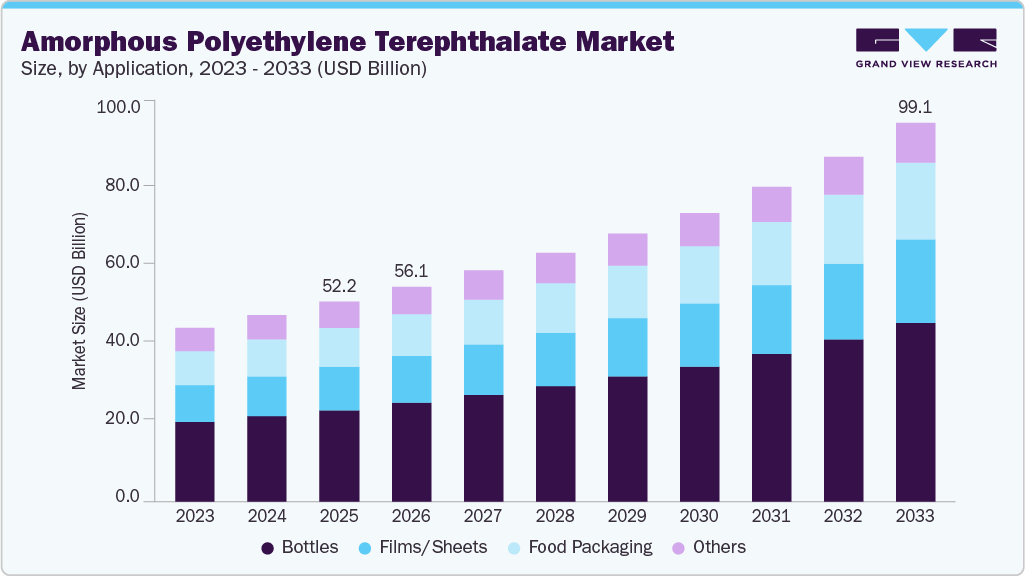
Its lower crystallization tendency reduces cycle times and scrap rates, helping converters improve throughput, cost control, and consistency in large-scale packaging production. The market is shifting from commodity PET to value-added amorphous PET grades driven by premium packaging demand and thermoforming growth. Manufacturers are prioritizing high-clarity, low-crystallinity APET for display-ready trays, clamshells, and lightweight bottles. At the same time, adoption of recycled PET content and mono-PET formats is accelerating to meet brand sustainability targets. This structural move toward recyclable, high-visual-impact formats is reshaping product mixes and capital investment plans across the value chain.
Drivers, Opportunities & Restraints
End-market growth in food and beverage, personal care, and e-commerce packaging is a primary driver of APET demand. The polymer’s combination of optical clarity, impact resistance, and excellent thermoformability makes it preferable for transparent, tamper-evident, and retail-display packaging. Rising consumer preference for convenience packaging and manufacturers’ need for lighter, shatter-resistant solutions are driving increased APET consumption. Regulatory and retailer sustainability requirements further push brands to specify recyclable PET variants.
There is a clear commercial upside in higher recycled-content APET blends, bio-based feedstock integration, and functional surface treatments. Technology improvements in washing, decontamination, and compatibilization increase usable rPET yields and enable premium-grade, circular APET. Niche growth exists in barrier-coated APET for extended-shelf-life foods and in precision substrates for medical and consumer electronics applications. Firms that secure feedstock partnerships and deploy targeted R&D can capture premium margins and regulatory-driven procurement demand.
Widespread adoption faces headwinds from limited recycling infrastructure, contamination of waste streams, and comparatively higher processing costs for APET grades. Inconsistent rPET quality forces downgrading and adds sorting expense. Volatility in upstream feedstock prices and energy costs compress margins for thermoforming and sheet producers. In addition, escalating regulatory scrutiny on single-use plastics creates uncertainty for certain end uses, prompting brands to re-evaluate material choices and lifecycle costs.
Market Concentration & Characteristics
The market growth stage is moderate, and the pace of growth is accelerating. The market exhibits fragmentation, with key players dominating the industry landscape. Major companies such as JBF Industries Ltd., Reliance Industries Limited, China Petroleum & Chemical Corporation, Covestro AG, and others play a significant role in shaping the market dynamics. These leading players often drive innovation within the market, introducing new products, technologies, and end use to meet the evolving demands of the industry.
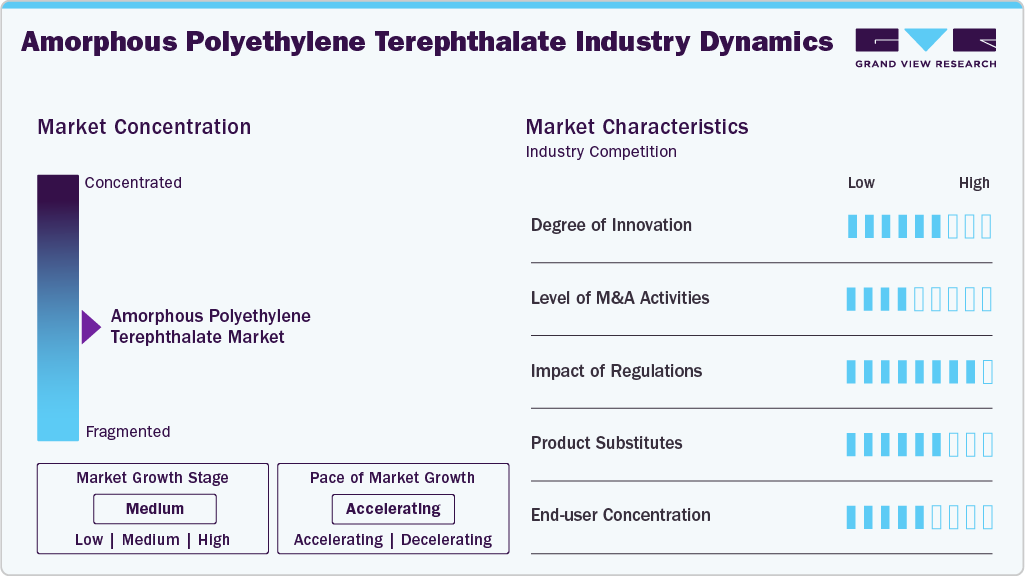
Innovation in the industry is concentrated on circularity, specialty surface treatments, and process intensification. Advances in mechanical and chemical recycling improve rPET yield and purity, enabling higher recycled-content APET suitable for food contact. Surface functionalization and barrier coatings extend shelf life while preserving clarity. Processing upgrades reduce cycle times and scrap in thermoforming lines. These developments are altering product economics and positioning APET relative to the crystalline polyethylene terephthalate market in applications requiring heat stability.
APET competes with glass and aluminum where barrier and premium perception matter, and with CPET for heat-resistant trays and ovenable formats. PETG, PVC, and polystyrene remain technical substitutes for clarity and formability in selected niches. Bio-based PLA and multi-layer film laminates are chosen where compostability or a tailored barrier is prioritized. Material selection is driven by recyclability mandates, thermal performance needs, and total cost of ownership across the supply chain.
Application Insights
Bottles dominated the application segment in terms of revenue, accounting for a 46.00% market share in 2025. A primary driver of the market in bottles is lightweighting paired with optical performance. Brands are shifting to APET and modified PET grades to reduce package weight while maintaining clarity for on-shelf appeal. This supports cost savings in logistics and higher line speeds on filler lines. Premium water, ready-to-drink beverages, and personal care bottles are the principal adopters, driving stable volume growth for sheet- and blow-molding feedstocks.
The food packaging segment is anticipated to grow at a substantial CAGR of 9.1% through the forecast period. Food converters are driving APET uptake by increasing demand for high-visibility, recyclable trays and clamshells that meet shelf display and food-safety requirements. Retailers prioritize mono-material formats that simplify recycling targets, prompting food pack designers to specify APET for clear thermoformed trays and lidding films. The result is faster specification cycles for APET sheets and stronger procurement commitments from large food brands seeking traceable, circular packaging.
End-use Insights
Food & beverage dominated the market across the end use segmentation in terms of revenue, accounting for a market share of 58.41% in 2025, and is forecast to grow at an 8.8% CAGR from 2026 to 2033. In the food and beverage sector, the driver is twofold: product protection and brand differentiation. APET provides optical clarity for premium labels and barrier-enhanced constructions for fresh products. Beverage producers value APET for its clarity and stiffness, which improve perceived quality while enabling lightweight formats. Growth in single-serve, chilled, and convenience formats is increasing APET demand across trays, preform alternatives, and hybrid packaging, where recyclability remains a procurement prerequisite.
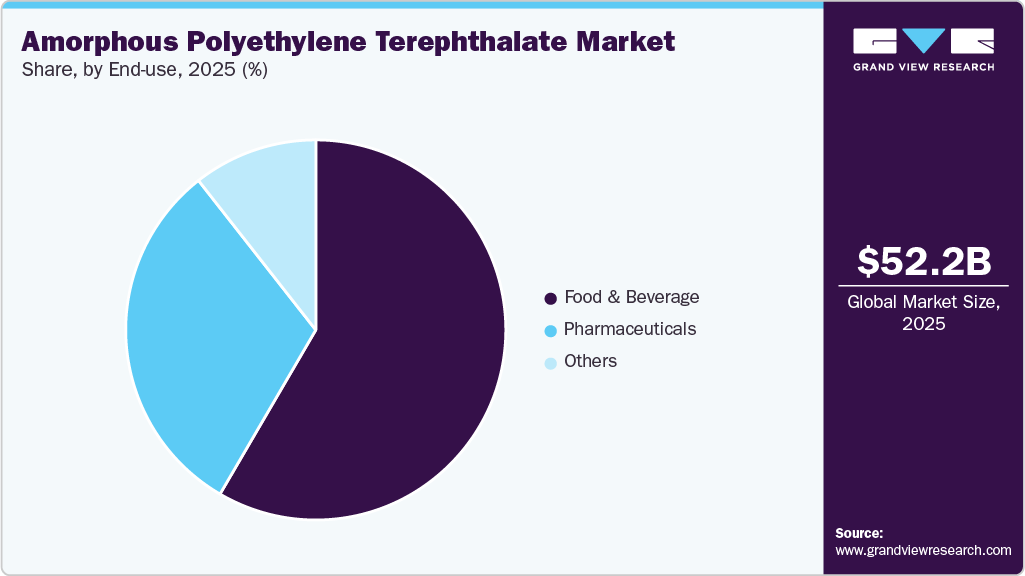
The pharmaceuticals segment is expected to expand at a robust 8.4% CAGR over the forecast period. Pharmaceutical adoption of APET is driven by regulatory demand for validated, inert, and tamper-evident substrates for blister packs and medical trays. Converters favor APET for its process consistency, dimensional stability during thermoforming, and compatibility with sterilization processes. Growth in outpatient therapies and cold chain logistics increases demand for sterile, clear packaging that allows visual inspection. This creates a higher-margin, quality-sensitive segment for APET sheet and film producers.
Regional Insights
The Asia Pacific amorphous polyethylene terephthalate market held the largest share, accounting for 50.60% of the revenue in 2025, and is expected to grow at the fastest CAGR of 9.3% over the forecast period. APET demand in Asia Pacific is being driven by the rapid expansion of organized retail, e-commerce fulfillment, and chilled food supply chains that prioritize visibility and lightweight transportable packaging. Converters favor amorphous polyethylene terephthalate for high-clarity trays, clamshells, and lidding that improve on-shelf appeal and reduce logistics costs. Investments in local thermoforming capacity and growing foodservice channels are scaling APET consumption, while incremental improvements in regional recycling systems support higher recycled-content specifications.
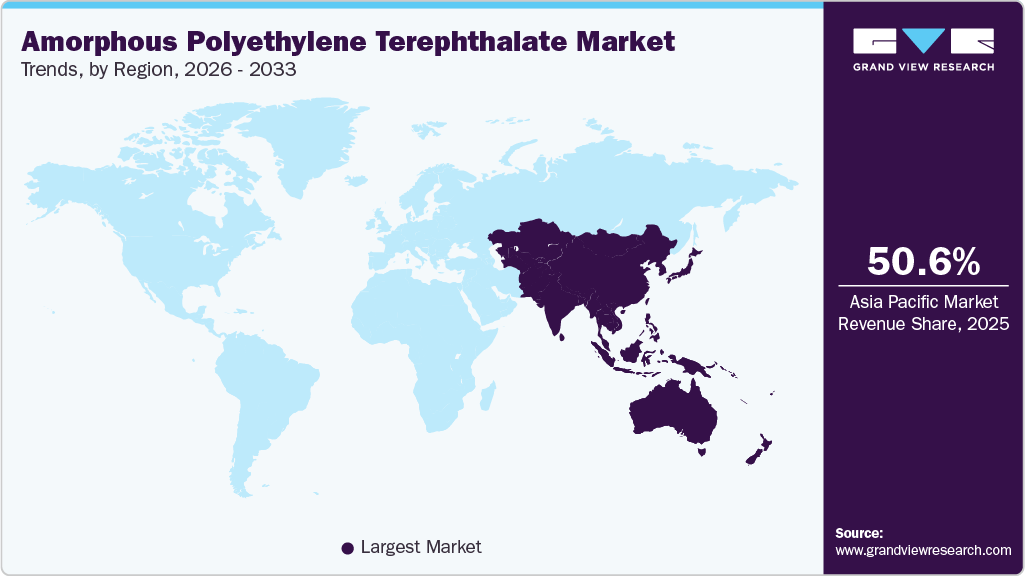
The amorphous polyethylene terephthalate industry in China presents promising opportunities as the Asian giant’s dominance as the largest PET producer and exporter underpins strong domestic APET demand. Rapid urbanization, expanded cold-chain infrastructure, and a booming e-commerce food economy are increasing the need for clear, robust packaging. Local capacity for PET chip and sheet production keeps costs competitive, while strategic moves by recyclers and chemical recyclers are improving the availability of compliant rPET for food-grade APET applications. Export orientation also drives quality upgrades to meet international buyer specifications.
North America Amorphous Polyethylene Terephthalate Market Trends
The amorphous polyethylene terephthalate industry in North America has gained momentum from sustainability-led specifications from large retail and CPG buyers. Procurement policies now favor recyclable mono-materials and measurable recycled content, increasing APET adoption for clear retail packaging. Converters benefit from process efficiencies in high-speed thermoforming lines, which lower the total cost of ownership compared to alternative substrates. Growing investment in mechanical and chemical recycling capacity is improving feedstock availability for premium rPET-blended APET grades.
U.S. Amorphous Polyethylene Terephthalate Market Trends
The U.S. amorphous polyethylene terephthalate industry is pushed by corporate sustainability commitments and the reshoring of packaging supply chains that prioritize domestic quality control and shorter lead times. Brands are specifying amorphous PET for its clarity, recyclability, and compatibility with lightweighting targets. State and corporate recycled-content targets are prompting capital investment in bottle-to-sheet and decontamination technologies, which increases demand for food-grade APET sheet and film sourced from domestic rPET streams.
Europe Amorphous Polyethylene Terephthalate Market Trends
The amorphous polyethylene terephthalate industry in Europe is principally shaped by stringent regulatory targets and circularity mandates that force material substitution toward mono-PET solutions. The single-use plastics and recycled-content rules are accelerating the specification of APET for clear retail and food packaging. At the same time, structural stress in the recycling sector and policy shifts toward verified recycled inputs are changing supply economics, prompting converters to secure certified rPET and invest in higher-value APET product lines.
Key Amorphous Polyethylene Terephthalate Company Insights
The industry is highly competitive, with several key players dominating the landscape. Major companies include JBF Industries Ltd., Reliance Industries Limited, and China Petroleum & Chemical Corporation, among others. The market is characterized by a competitive landscape with several key players driving innovation and market growth. Major companies in this sector are investing heavily in research and development to enhance the performance, cost-effectiveness, and sustainability of their products.
Key Amorphous Polyethylene Terephthalate Companies:
The following key companies have been profiled for this study on the amorphous polyethylene terephthalate market.
- JBF Industries Ltd.
- Reliance Industries Limited
- China Petroleum & Chemical Corporation
- Covestro AG
- Jiangsu Sanfangxiang Group Co., Ltd.
- M&G Chemicals
- Petro Polymer Shargh
- Quadrant group of companies
- LOTTE Chemical CORPORATION
- Polisan Holding
- TEIJIN LIMITED
- Equipolymers
- Alpek Polyester
Recent Developments
-
In May 2025, Kao Corporation announced a cross-industry collaboration to expand PET chemical recycling feedstocks for non-food applications. The partnership aims to scale chemically recycled inputs and improve feedstock reliability for APET producers and converters targeting circular material flows.
-
In April 2024, Far Eastern New Century (FENC) broke ground on the FE GREEN PET project in Malacca, Malaysia, to build a 50,000 ton-per-year food-grade rPET resin line. The facility targeted a mid-2025 start-up and aimed to secure circular feedstock for APET and related packaging applications.
Amorphous Polyethylene Terephthalate Market Report Scope
Report Attribute
Details
Market size in 2025
USD 52.2 billion
Estimated market size in 2026
USD 56.1 billion
Projected market size by 2033
USD 99.1 billion
Growth rate
CAGR of 8.5% from 2026 to 2033
Historical data
2021 - 2024
Forecast period
2026 - 2033
Quantitative units
Revenue in USD million/billion, volume in kilotons, and CAGR from 2026 to 2033
Report coverage
Revenue forecast, competitive landscape, growth factors, and trends
Segments covered
Application, end-use, region
Regional scope
North America; Europe; Asia Pacific; Central & South America; Middle East & Africa
Country Scope
U.S.; Canada; Mexico; Germany; UK; Italy; France; Spain; China; India; Japan; South Korea; Australia; Brazil; Argentina; South Africa; Saudi Arabia
Key companies profiled
JBF Industries Ltd.; Reliance Industries Limited; China Petroleum & Chemical Corporation; Covestro AG; Jiangsu Sanfangxiang Group Co., Ltd.; M&G Chemicals; Petro Polymer Shargh; Quadrant Group of Companies; LOTTE Chemical CORPORATION; Polisan Holding; TEIJIN LIMITED; Equipolymers; Alpek Polyester
Customization scope
Free report customization (equivalent to up to 8 analyst working days) with purchase. Addition or alteration to country, regional & segment scope
Pricing and purchase options
Avail customized purchase options to meet your exact research needs. Explore purchase options
Global Amorphous Polyethylene Terephthalate Market Report Segmentation
This report forecasts revenue growth at global, regional, and country levels and provides an analysis of the latest industry trends in each of the sub-segments from 2021 to 2033. For this study, Grand View Research has segmented the global amorphous polyethylene terephthalate market report based on application, end-use, and region:
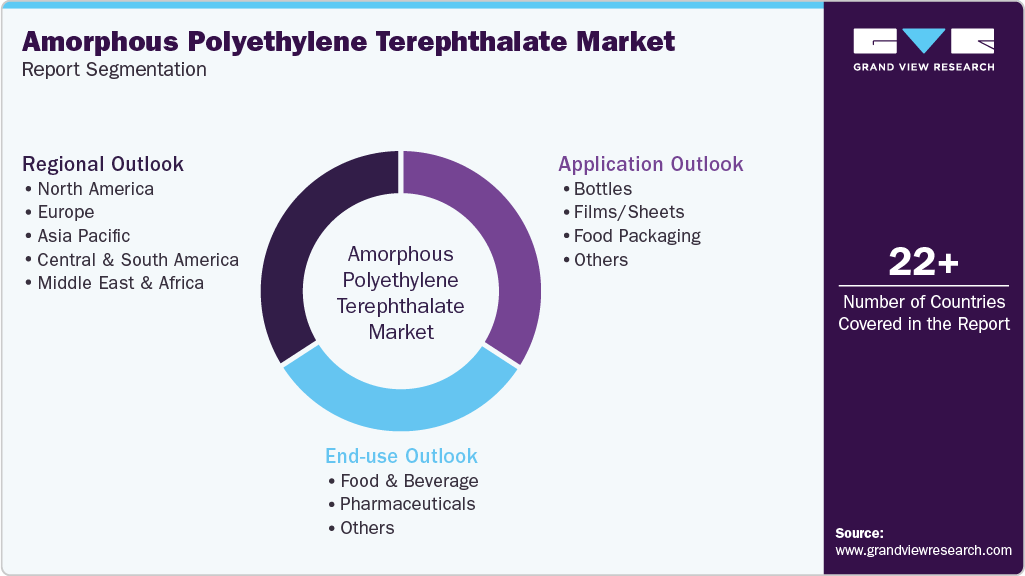
-
Application Outlook (Volume, Kilotons; Revenue, USD Million, 2021 - 2033)
-
Bottles
-
Films/Sheets
-
Food Packaging
-
Others
-
-
End-use Outlook (Volume, Kilotons; Revenue, USD Million, 2021 - 2033)
-
Food & Beverage
-
Pharmaceuticals
-
Others
-
-
Regional Outlook (Volume, Kilotons; Revenue, USD Million, 2021 - 2033)
-
North America
-
U.S.
-
Canada
- Mexico
-
-
Europe
-
Germany
-
UK
-
Italy
-
France
-
Spain
-
-
Asia Pacific
-
China
-
India
-
Japan
-
South Korea
-
Australia
-
-
Central & South America
-
Brazil
-
Argentina
-
-
Middle East & Africa
-
South Africa
-
Saudi Arabia
-
-
Frequently Asked Questions About This Report
Food & beverage held the largest revenue share 58.4% in 2025.
Asia Pacific dominated with a 50.6% revenue share in 2025.
The global amorphous polyethylene terephthalate market size was estimated at USD 52.2 billion in 2025 and is expected to reach USD 56.1 billion in 2026.
The global amorphous polyethylene terephthalate market is expected to grow at a compound annual growth rate of 8.5% from 2026 to 2033 to reach USD 99.1 billion by 2033.
The bottles segment led with a 46.0% revenue share in 2025 and is forecasted to grow at a 9.1% CAGR from 2026 to 2033.
Some key players operating in the amorphous polyethylene terephthalate market include JBF Industries Ltd., Reliance Industries Limited, China Petroleum & Chemical Corporation, Covestro AG, Jiangsu Sanfangxiang Group Co., Ltd., M&G Chemicals, Petro Polymer Shargh, Quadrant group of companies, LOTTE Chemical CORPORATION, Polisan Holding, TEIJIN LIMITED, and Equipolymers, Alpek Polyester.
The superior processing efficiency of amorphous PET in high-speed thermoforming operations is driving the market. Its lower crystallization tendency reduces cycle times and scrap rates, helping converters improve throughput, cost control, and consistency in large-scale packaging production.
About the Author(s)
Plastics, Polymers & Resins Research Team
Bulk Chemicals · Plastics, Polymers & ResinsThis report was authored by the plastics, polymers & resins research team at Grand View Research - comprising two research analysts, one senior research analyst, and one industry expert - with specialized expertise in the plastics, polymers & resins segment of the bulk chemicals industry. All findings are based on proprietary bulk chemicals databases, executive interviews, and regulatory analysis, subject to internal peer review prior to publication.
Last Updated:
Speak to Analyst


Customize this report to your needs — add regions, segments, or data points, with 20% free customization.
Or view our licence options:


ISO 9001:2015 & 27001:2022 Certified
We are GDPR and CCPA compliant! Your transaction & personal information is safe and secure. For more details, please read our privacy policy.


