
- Home
- »
- Next Generation Technologies
- »
-
AI Operating System Market Size & Share Report, 2026-2033GVR Report cover

AI Operating System Market (2026 - 2033)
Size, Share & Trends Analysis Report By Model Integration Approach (On-Device AI OS, Cloud-Native AI OS, Hybrid AI OS), By Application (Consumer AI OS, Enterprise AI OS), By Deployment, By Region, And Segment Forecasts
Market Size, 2025
$12.9BMarket Estimate, 2026
$16.7BMarket Forecast, 2033
$107.6BCAGR, 2026–2033
30.5%AI Operating System Market Summary
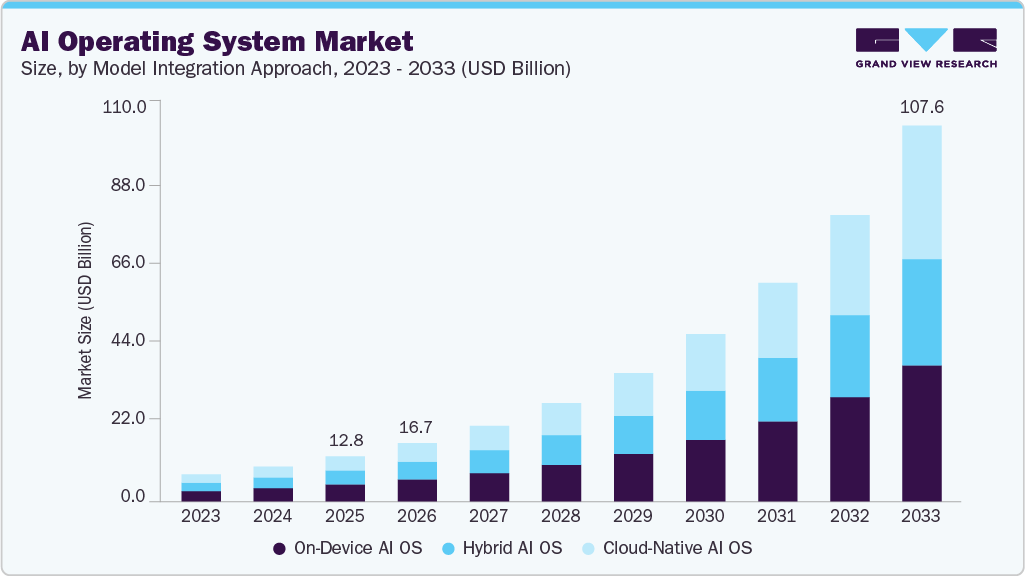
The global AI operating system market size was valued at USD 12.9 billion in 2025 and is projected to grow from USD 16.7 billion in 2026 to USD 107.6 billion by 2033, at a CAGR of 30.5% from 2026 to 2033. The market in North America dominated with a revenue share of 33.3% in 2025. An AI Operating System (AI OS) revolutionizes computing by integrating adaptive intelligence, natural language interaction, and self-optimizing resource management.
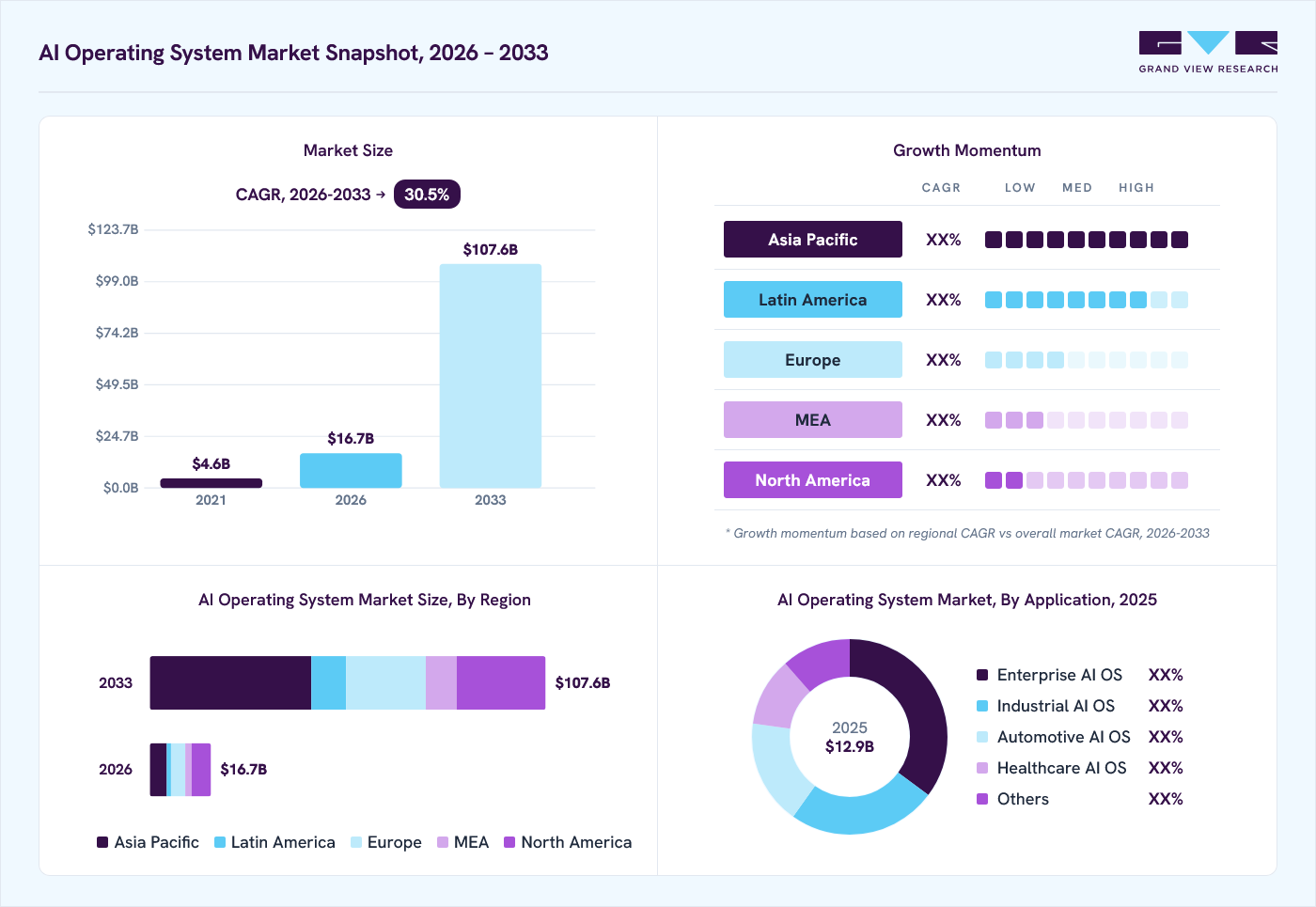 Source: Grand View Research, IR Documents, Primary Interviews, Paid DatabasesTo learn more about this report,
 Download Free Sample Report
 Key Market Trends & Insights
- By model integration approach: The on-device AI OS segment led the market, holding the largest revenue share of 37.8% in 2025.
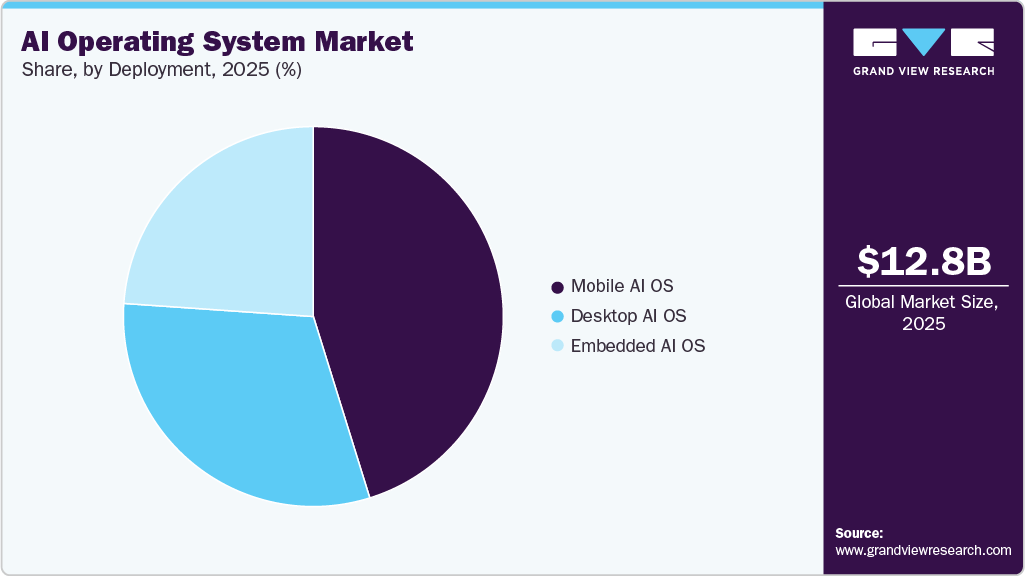
- By deployment: The mobile OS segment held the dominant position in the market and accounted for the leading revenue share of 45.2% in 2025.
- By application: The consumer AI OS segment accounted for the largest market revenue share in 2025.
Regional Highlights
- Largest regional market: North America (33.3% revenue share, 2025)
- Fastest-growing regional market: Asia Pacific (highest CAGR, 2026-2033)
- The AI operating system industry in the U.S. held the largest revenue share in 2025.
Market Size & Forecast
- Market size in 2025: USD 12.9 Billion
- Estimated market size in 2026: USD 16.7 Billion
- Projected market size by 2033: USD 107.6 Billion
- CAGR (2026-2033): 30.5%
Three ways to get this report
Buy it, customize it, or ask a question.Ask an Analyst
A direct answer, usually in 1 working day
- AccessReport author, directly
- Reply timeWithin 1 working day
- No sales callDirect answer only
- FormatEmail reply
- CostFree, no cost
Get the Full Report
What the study covers
- FormatsPDF · Excel · Dashboard
- Timeline2026–2033 annual, 2025 base
- Coverage20+ countries, 5 regions
- Companies10+ key players profiled
Customize the Report
20% free customization
- IncludeCountries, segments, points
- TailorTo your product definition
- ExtendDeeper competitor detail
- OrA fully bespoke study
- Turnaround5–10 working days
Unlike conventional operating systems, it utilizes deep learning and shared memory to support AI agents, enabling seamless multitasking and automation. With broad applications across healthcare, finance, and smart cities, an AI OS enhances security, decision-making, and operational efficiency, positioning itself as the foundation of next-generation intelligent computing.Significant innovation, investments and product launches in AI OS industry by major players are significantly propelling the market growth. For instance, Rabbit Inc. has raised an additional US $10 million in a Series A round to develop its first standalone hardware device (“r1”) powered by its purpose-built OS (“Rabbit OS”) based on what it terms a Large Action Model (LAM). Rabbit’s LAM concept suggests that future OS layers may embed “agentic” capabilities not simply providing apps but orchestrating them on behalf of the user. This enables a new operating paradigm where the OS is not just a shell, but an active executor of user intent.
 To learn more about this report, Download Free Sample Report
 The emergence of AI operating systems (OS) signifies a shift from static, command-driven interfaces to dynamic, goal-oriented ecosystems. By embedding large language models and cognitive agents into the system core, AI OS can interpret high-level user objectives-such as scheduling meetings, generating reports, or managing workflows-and coordinate across multiple software environments to achieve desired outcomes. This level of contextual awareness and automation enhances productivity, reduces operational complexity, and enables personalized digital experiences.
Furthermore, Artificial Intelligence Operating Systems (AI OS) represent a transformative evolution in computing, redefining how users and machines interact. Unlike conventional operating systems that rely on manual navigation and application switching, AI OS platforms integrate intelligent agents capable of understanding intent, context, and user behavior to autonomously execute tasks. These systems combine natural language processing, multimodal understanding, and predictive analytics to deliver seamless, adaptive computing environments that continuously learn and optimize performance.
Model Integration Approach Insights
The on-device AI OS segment led the market in 2025, accounting for 37.8% of global revenue. The growth is driven due to the rising demand for privacy, faster processing, and reduced cloud dependency. These systems enable real-time decision-making directly on edge devices, enhancing performance in smartphones, wearables, and autonomous systems. Major tech players are investing in on-device AI frameworks to optimize power efficiency and personalization without constant internet access. For instance, June 2025, Apple announced the launch of its on-device AI framework and development tools, marking a significant leap toward the next generation of intelligent operating systems. The new framework integrates large language model capabilities directly into Apple silicon, enabling real-time, privacy-preserving AI processing without cloud dependency. By embedding advanced AI functions within its OS architecture and development environment, Apple is empowering developers to build adaptive, context-aware applications that seamlessly interact with system intelligence.
The cloud-native AI OS segment is expected to grow at the fastest CAGR during the forecast period. Cloud-native AI operating systems are emerging as a foundational layer in the next wave of intelligent computing, driven by the integration of AI capabilities directly into scalable cloud environments. These systems utilize containerization, microservices, and serverless architectures to deliver adaptive, self-optimizing intelligence across enterprise operations. By embedding AI within the core infrastructure, cloud-native AI OS platforms enable seamless orchestration of data, models, and applications, ensuring agility, interoperability, and faster deployment cycles. The growing reliance on hybrid and multi-cloud ecosystems further supports this evolution, allowing AI-driven operating systems to function efficiently across distributed environments. As enterprises adopt AI-first strategies, cloud-native AI OS solutions are becoming the backbone of digital transformation enhancing operational resilience, enabling autonomous decision-making, and driving the convergence of intelligent infrastructure and software ecosystems.
Application Insights
The consumer AI OS segment accounted for the largest market revenue share in 2025, the segment is witnessing strong momentum as users increasingly adopt intelligent, personalized, and privacy-focused digital ecosystems. The shift toward on-device processing, edge intelligence, and user-owned data frameworks is fueling growth in this segment. Major initiatives are also fueling market growth. For instance, in October 2025, mEinstein unveiled its new Edge AI consumer operating system, designed to give users greater privacy, control, and independence from cloud-based data ecosystems. The platform integrates on-device intelligence that processes data locally, ensuring secure and personalized digital experiences without external data sharing. By combining privacy-first design with real-time edge computing, mEinstein’s OS empowers consumers to manage their digital interactions and AI applications directly from their devices.
The industrial AI OS segment is expected to grow at the fastest CAGR over the forecast period. The concept of a “individual AI operating system” (AI OS) is gaining traction as individual users increasingly seek intelligent environments that go beyond traditional apps and interfaces. This next-generation OS learns user behaviour, tailors interactions across devices and platforms, and automates tasks like email triage, dynamic scheduling, content generation and device coordination. This evolution reflects a shift from passive user interaction (clicking icons) to proactive, intent-based computing where the OS acts as a persistent, adaptive agent. By orchestrating workflows across smartphones, wearable devices, home systems and cloud services, the individual AI OS expands the market scope from enterprise automation to the individual consumer. For businesses, this trend signals new opportunities: monetization through agent-driven services, subscriptions for personalized OS layers, and ecosystems built around plug-in agents that serve individual user needs.
Deployment Insights
The mobile AI OS segment accounted for the largest market revenue share of 45.2% in 2025, driven by the widespread integration of AI capabilities across smartphones and connected devices. The proliferation of intelligent assistants, on-device processing, and context-aware personalization has accelerated adoption among consumers and enterprises alike. Advancements in edge computing and neural processing units (NPUs) are enabling real-time AI functionalities-such as voice recognition, predictive automation, and adaptive user interfaces directly within mobile ecosystems.
 To learn more about this report, Download Free Sample Report
 The desktop AI OS segment is anticipated to grow at the fastest CAGR during the forecast period. The desktop AI OS segment is experiencing steady growth as traditional computing environments evolve into intelligent, context-aware ecosystems. Integration of AI capabilities within desktop operating systems enhances productivity, automates workflows, and enables adaptive resource management. With growing adoption of generative AI tools, virtual assistants, and cognitive automation at the enterprise level, desktops are transforming into intelligent workstations capable of learning user behavior and optimizing system performance.
Regional Insights
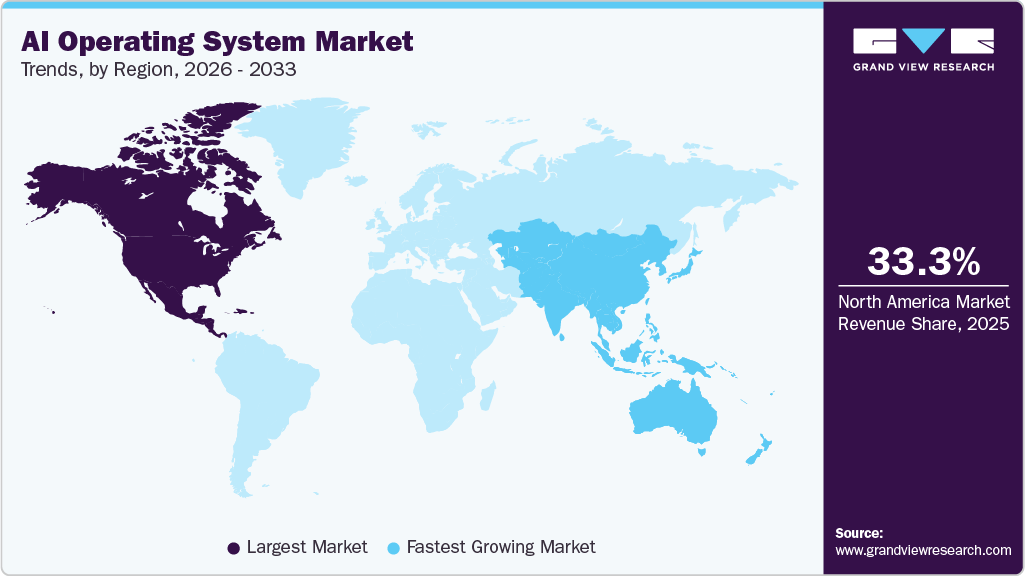
North America AI operating system market dominated the global market with a revenue share of 33.3% in 2025. AI-based operating systems are rapidly expanding in North America due to strong technological infrastructure, high enterprise adoption, and continuous innovation by major technology companies.
 To learn more about this report, Download Free Sample Report
 The region benefits from significant investments in artificial intelligence research and development by companies such as Microsoft, Google, and IBM, which are embedding AI capabilities directly into operating system platforms. Increasing demand for intelligent automation, personalized user experiences, and real-time analytics is accelerating the integration of machine learning and generative AI into desktop, mobile, and enterprise operating systems.
U.S. AI Operating System Market Trends
The U.S. AI operating system industry is expected to grow significantly in 2025, fueled by rapid innovation in generative AI, automation frameworks, and AI-driven computing architectures. Strong collaboration between tech giants, startups, and research institutions is propelling advancements in both enterprise and consumer-grade AI operating systems. The country’s focus on developing on-device intelligence, secure data frameworks, and AI-first ecosystems is accelerating market adoption
Europe AI Operating System Market Trends
The Europe AI operating system industry is witnessing steady growth over the forecast period,growth is driven by a strong emphasis on data privacy, ethical AI, and sustainable digital transformation. European nations are adopting AI operating systems to enhance efficiency in enterprise operations, public services, and connected devices. With active participation from regional tech firms and regulatory frameworks supporting trustworthy AI development, Europe is shaping a balanced approach that blends innovation with governance in the evolution of AI-driven operating systems.
Asia Pacific AI Operating System Market Trends
The AI operating system industry in the Asia Pacific region is anticipated to register the fastest CAGR over the forecast period led by strong government support for AI innovation, rising smartphone penetration, and growing demand for intelligent automation. Countries such as China, Japan, and South Korea are leading in the development of on-device and edge-based AI systems that enhance consumer experiences and industrial efficiency. The region’s thriving electronics and semiconductor sectors further accelerate integration of AI OS across mobile and enterprise ecosystems, positioning Asia Pacific as a key hub for scalable AI infrastructure.
Key AI Operating System Company Insights
Some key companies in the AI OS industry are VAST Data; Begine Fusion; Implement AI; Apple Inc. & more.
-
Begine Fusion is a Calgary-based digital services firm founded on the belief that digital adoption need not be complex or wasteful many organizations end up layering tools without clarity or measurable effect. In AI operating system space, Begine Fusion offers “AI Operating System” a governed, coordinated layer that connects data, workflows, decision-logic and agents across the enterprise. Their AI OS offering is structured around five core components: a system of record (memory), an orchestration layer (conductor), reasoning logic (brain), a knowledge base (context) and governance (safety net).
-
VAST Data positions itself as a key “AI Operating System” company, delivering a global data platform designed for intelligent agents to store, think, communicate and act. Their core offering, the VAST AI Operating System, is built on what they describe as their DASE (Distributed and Shared Everything) architecture an infrastructure redesign tailored to the exponential scale, speed and complexity of next-gen AI workloads.
Key AI Operating System Companies:
The following key companies have been profiled for this study on the AI operating system market.
- VAST Data
- Begine Fusion
- Implement AI
- Apple Inc.
- Humain
- AI Future Group
- MultiCortex
- WealthAi
Recent Developments
-
In May 2025, VAST Data unveiled its AI operating system designed to power the next generation of "thinking machines." This new platform unifies data, compute, messaging, and reasoning to support distributed AI agents operating at global scale, enabling real-time data capture, analytics, and AI-driven workflows. Built on VAST's pioneering Disaggregated Shared-Everything architecture, the OS aims to democratize AI computing by consolidating legacy IT technologies into a single, modern system.
-
In June 2025, Apple unveiled its new operating system, iOS 26, featuring expanded AI capabilities and a streamlined design interface across all Apple devices. Key updates include real-time language translation in iMessages, image identification, and enhanced phone screening to filter unknown callers. The OS standardizes the design based on the release year, offering developers advanced AI tools to build innovative software.
AI Operating System Market Report Scope
Report Attribute
Details
Market size in 2025
USD 12.9 billion
Estimated market size in 2026
USD 16.7 billion
Projected market size by 2033
USD 107.6 billion
Growth rate
CAGR of 30.5% from 2026 to 2033
Base year for estimation
2025
Actual data
2021 - 2025
Forecast period
2026 - 2033
Quantitative units
Market revenue in USD billion & CAGR from 2026 to 2033
Report coverage
Revenue forecast, company ranking, competitive landscape, growth factors, and trends
Segments covered
Model integration approach, application, deployment, region
Regional scope
North America; Europe; Asia Pacific; Latin America; MEA
Country scope
U.S.; Canada; UK; Germany; France; China; India; Japan; South Korea; Australia; Brazil; Mexico; KSA; UAE; South Africa
Key companies profiled
VAST Data; Begine Fusion; Implement AI; Apple Inc.; Humain; AI Future Group; MultiCortex; WealthAi
Customization scope
Free report customization (equivalent up to 8 analysts working days) with purchase. Addition or alteration to country, regional, and segment scope.
Pricing and purchase options
Avail customized purchase options to meet your exact research needs. Explore purchase options
Global AI Operating System Market Report Segmentation
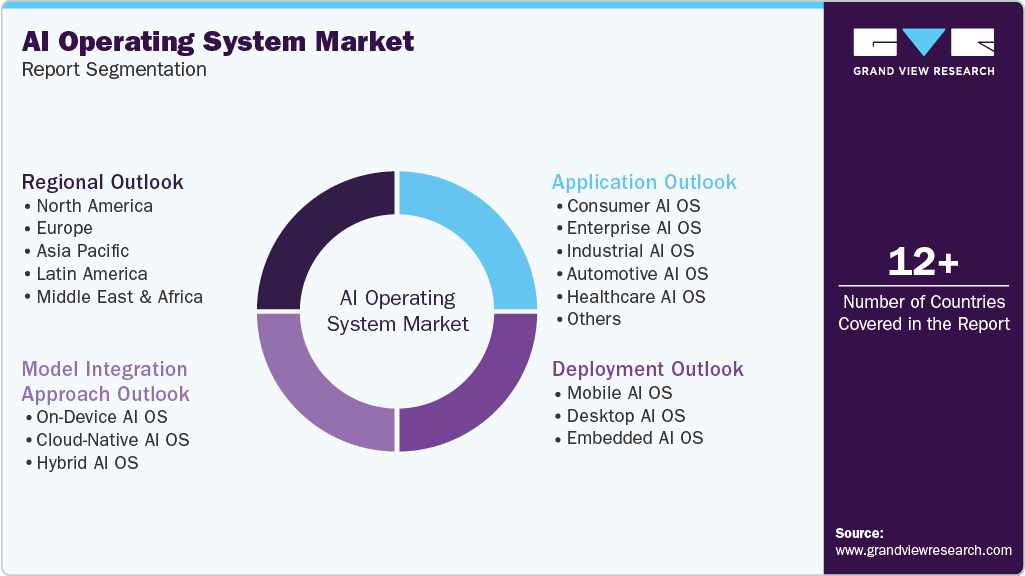
This report forecasts revenue growth on global, regional, and country levels and provides an analysis of the industry trends in each of the sub-segments from 2021 to 2033. For this study, Grand View Research has segmented the global AI OS market report based on the model integration approach, application, deployment, and region:
 To learn more about this report, Download Free Sample Report
 -
Model Integration Approach Outlook (Revenue, USD Billion, 2021 - 2033)
-
On-Device AI OS
-
Cloud-Native AI OS
-
Hybrid AI OS
-
-
Application Outlook (Revenue, USD Billion, 2021 - 2033)
-
Consumer AI OS
-
Enterprise AI OS
-
Industrial AI OS
-
Automotive AI OS
-
Healthcare AI OS
-
Others
-
-
Deployment Outlook (Revenue, USD Billion, 2021 - 2033)
-
Mobile AI OS
-
Desktop AI OS
-
Embedded AI OS
-
-
Regional Outlook (Revenue, USD Billion, 2021 - 2033)
-
North America
-
U.S.
-
Canada
-
Mexico
-
-
Europe
-
UK
-
Germany
-
France
-
-
Asia Pacific
-
China
-
India
-
Japan
-
South Korea
-
Australia
-
-
Latin America
-
Brazil
-
-
Middle East and Africa
-
KSA
-
UAE
-
South Africa
-
-
Frequently Asked Questions About This Report
The on-device AI OS segment led with a 37.8% revenue share in 2025
The consumer AI OS segment held the largest revenue share in 2025, while the industrial AI OS segment is the fastest-growing segment.
Asia Pacific is the fastest-growing region over the forecast period.
The global AI operating system market size was estimated at USD 12.9 billion in 2025 and is expected to reach USD 16.7 billion in 2026.
The global AI operating system market is expected to grow at a compound annual growth rate of 30.5% from 2026 to 2033 to reach USD 107.6 billion by 2033.
North America dominated the AI operating system market with a share of 33.3% in 2025
Some key players operating in the AI operating system market include VAST Data; Begine Fusion; Implement AI; Apple Inc.; Humain; AI Future Group; MultiCortex; WealthAi
Key factors that are driving the market growth include by integrating adaptive intelligence, natural language interaction, and self-optimizing resource management with broad applications across healthcare, finance, and smart cities, an AI OS enhances security, decision-making, and operational efficiency
About the Author(s)
Next Generation Technologies Research Team
Technology · Next Generation TechnologiesThis report was authored by the next generation technologies research team at Grand View Research - comprising two research analysts, one senior research analyst, and one industry expert - with specialized expertise in the next generation technologies segment of the technology industry. All findings are based on proprietary technology databases, executive interviews, and regulatory analysis, subject to internal peer review prior to publication.
Last Updated:
Speak to Analyst

Customize this report to your needs - add regions, segments, or data points, with 20% free customization.
Or view our licence options:


ISO 9001:2015 & 27001:2022 Certified
We are GDPR and CCPA compliant! Your transaction & personal information is safe and secure. For more details, please read our privacy policy.


