
- Home
- »
- Biotechnology
- »
-
Aseptic Sampling Market Size & Share Report, 2026-2033GVR Report cover

Aseptic Sampling Market (2026 - 2033)
Size, Share & Trends Analysis Report By Type (Manual Aseptic Sampling), By Technique, By Application (Downstream Processing, Upstream Processing), By End-use, By Region, And Segment Forecasts
Market Size, 2025
$1.1BMarket Estimate, 2026
$1.2BMarket Forecast, 2033
$2.0BCAGR, 2026–2033
8.0%Aseptic Sampling Market Summary
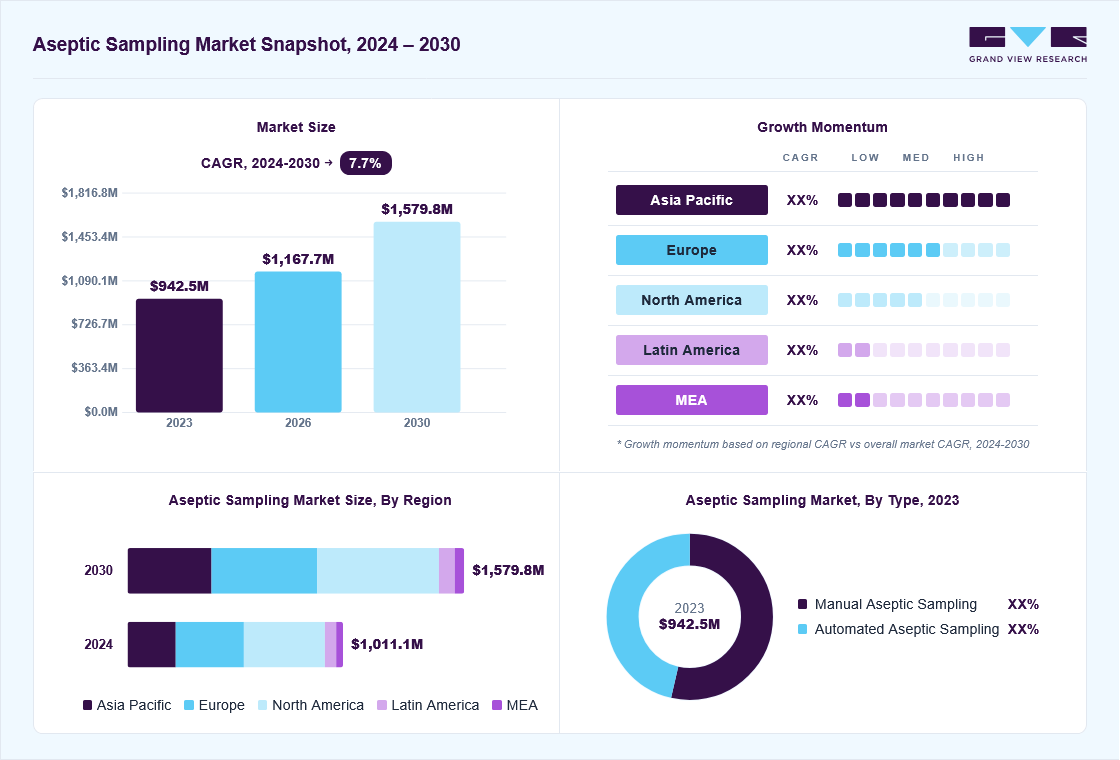
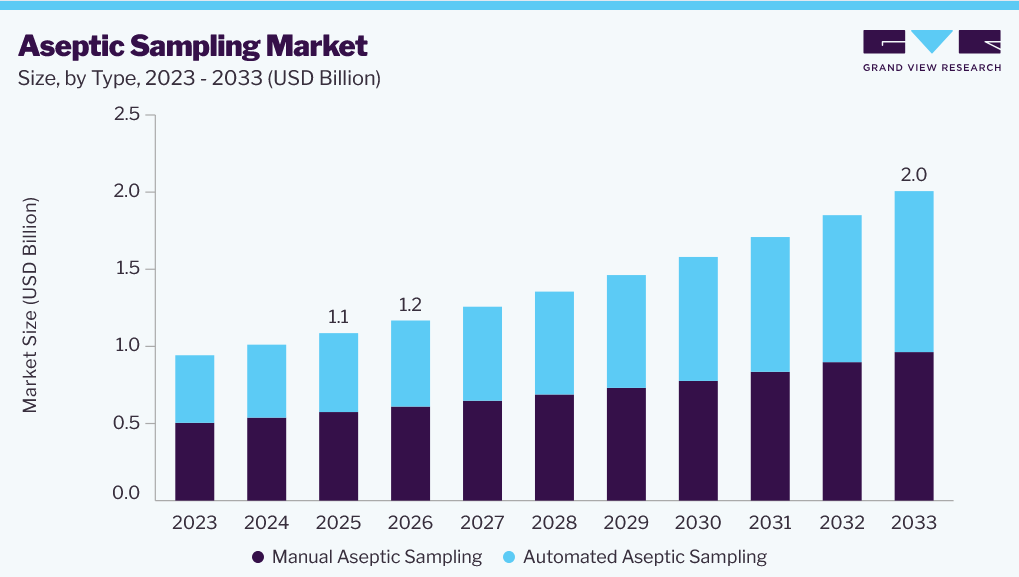
The global aseptic sampling market size was valued at USD 1.1 billion in 2025 and is projected to grow from USD 1.2 billion in 2026 to USD 2.0 billion by 2033, at a CAGR of 8.0% from 2026 to 2033. North America dominated the market, accounting for the largest revenue share of 38.5% in 2025. Growing population across the globe, the rising demand for personalized medicines, and the growing technological development are anticipated to boost the market growth of aseptic sampling.
 Source: Grand View Research, IR Documents, Primary Interviews, Paid DatabasesTo learn more about this report,
 Download Free Sample Report
 Key Market Trends & Insights
- By type: Manual aseptic sampling segment held the largest share of 52.9% in 2025.
- By technique: In-line sampling technique segment led the market share in 2025.
- By application: Downstream processing segment dominated the market share in 2025.
- By end use: Pharmaceutical & biotechnology companies segment held the largest revenue share of 49.3% in 2025.
Regional Highlights
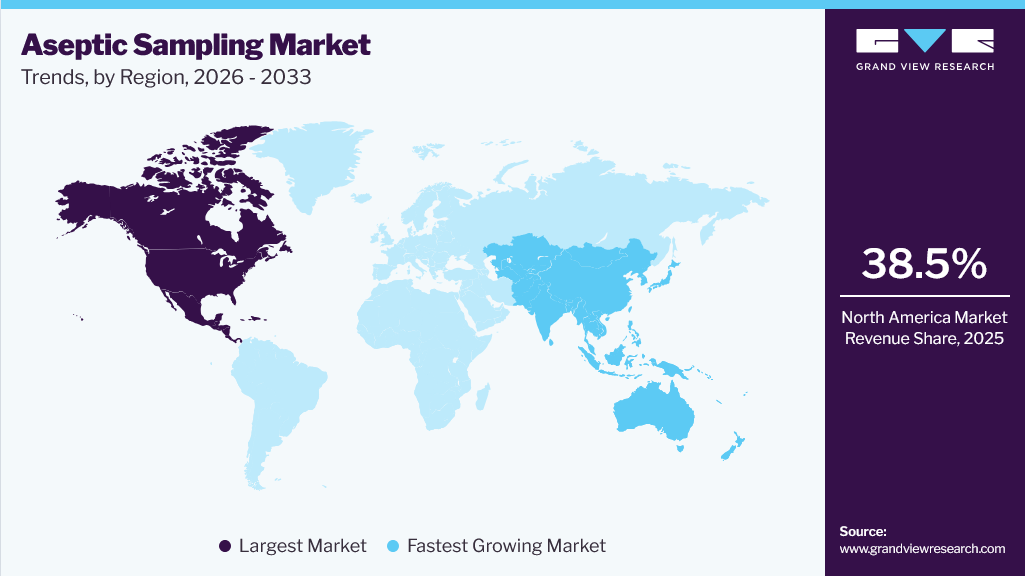
- Largest regional market: North America (38.5% revenue share, 2025)
- Fastest-growing regional market: Asia Pacific (highest CAGR, 2026-2033)
- By country: The U.S. held the largest market share in 2025
Market Size & Forecast
- Market size in 2025: USD 1.1 Billion
- Estimated market size in 2026: USD 1.2 Billion
- Projected market size by 2033: USD 2.0 Billion
- CAGR (2026-2033): 8.0%
Three ways to get this report
Buy it, customize it, or ask a question.Ask an Analyst
A direct answer, usually in 1 working day
- AccessReport author, directly
- Reply timeWithin 1 working day
- No sales callDirect answer only
- FormatEmail reply
- CostFree, no cost
Get the Full Report
What the study covers
- FormatsPDF · Excel · Dashboard
- Timeline2026–2033 annual, 2025 base
- Coverage20+ countries, 5 regions
- Companies10+ key players profiled
Customize the Report
20% free customization
- IncludeCountries, segments, points
- TailorTo your product definition
- ExtendDeeper competitor detail
- OrA fully bespoke study
- Turnaround5–10 working days
 To learn more about this report, Download Free Sample Report
 Market Dynamics
The aseptic sampling market is experiencing steady growth, supported by increasing biopharmaceutical manufacturing activities, stringent regulatory requirements for contamination control, and rising demand for sterile process monitoring. Expansion of biologics and cell and gene therapy production and increasing investments in pharmaceutical manufacturing infrastructure are further contributing to market expansion. Moreover, the shift toward automated and closed-system sampling solutions and the growing emphasis on process efficiency and product quality are expected to sustain market growth over the forecast period.
The increasing adoption of single-use bioprocessing systems is driving the aseptic sampling market by reducing contamination risks, minimizing cleaning and sterilization requirements, and improving operational flexibility in biopharmaceutical manufacturing. As single-use bags, bioreactors, and fluid-handling assemblies gain global adoption, demand for compatible aseptic sampling solutions is increasing to support sterile and reliable process monitoring.
For instance, in June 2025, Sartorius expanded its manufacturing and R&D capacities in France, nearly doubling cleanroom space at its Aubagne site to increase production capacity for 2D and 3D single-use bags. The expansion reflected growing demand for single-use bioprocessing solutions and supported the broader adoption of single-use technologies in biopharmaceutical manufacturing.
The risk of sampling errors and contamination is a key restraint in the aseptic sampling market, as improper sampling procedures, inadequate equipment handling, or operator errors can compromise sample integrity and affect the accuracy of process monitoring. Contamination during sampling may result in batch rejection, product loss, production delays, and increased manufacturing costs, particularly in high-value biopharmaceutical manufacturing processes.
Moreover, aseptic sampling requires strict adherence to validated procedures, controlled environmental conditions, and comprehensive operator training to minimize contamination risks. The complexity of maintaining sterility throughout the sampling process can increase operational and quality-control requirements. These restraints may limit adoption, particularly among smaller manufacturers with constrained resources and limited access to specialized technical expertise.
The growing adoption of closed-system sampling technologies is creating significant opportunities for the aseptic sampling market by reducing contamination risks and minimizing direct operator intervention during sample collection. These systems facilitate sterile and representative sampling while improving process integrity, operational efficiency, and compliance with stringent quality standards, particularly in biopharmaceutical and advanced therapy manufacturing.
For instance, in June 2025, Merck conducted a webinar focused on closed sampling for aseptic processing, addressing key aspects such as regulatory considerations, sampling assembly qualification, system integrity, and good sampling practices. The initiative highlighted the increasing industry emphasis on closed sampling approaches to strengthen contamination control, maintain product quality, and improve regulatory compliance, thereby supporting demand for advanced aseptic sampling solutions in biopharmaceutical manufacturing.
Market Concentration & Characteristics
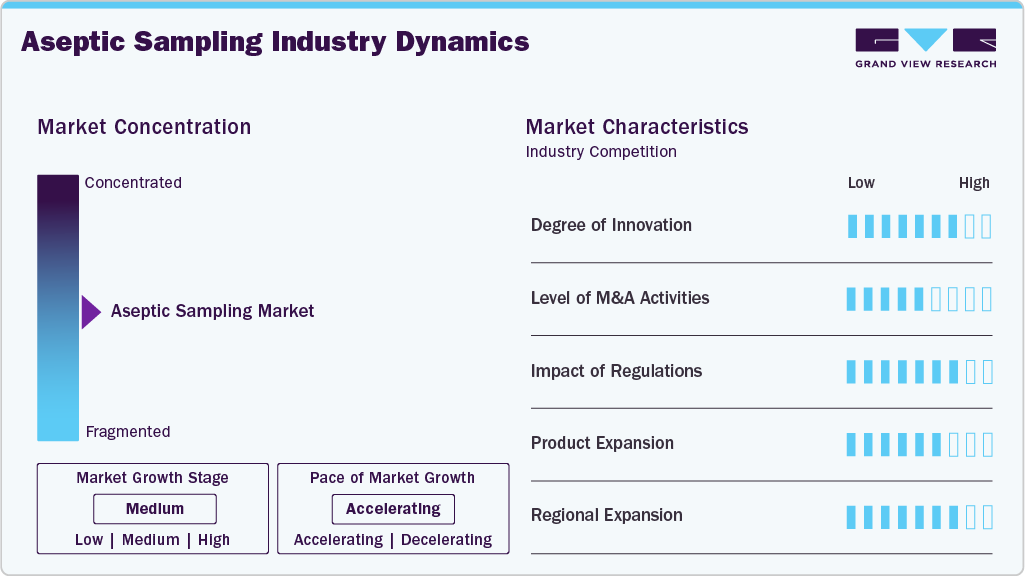
The aseptic sampling industry is characterized by a high degree of innovation, driven by the development of preassembled, presterilized, single-use, and flexible sampling solutions that improve sterility assurance and simplify biopharmaceutical workflows. Sartorius's TakeOne Aseptic Sampling Solutions integrate with single-use assemblies through aseptic connectors or weldable tubing and support sampling across different process scales, reflecting continued innovation toward flexible and contamination-controlled sampling technologies.
The aseptic sampling industry is witnessing a moderate level of strategic collaborations and partnerships, as companies seek to expand their bioprocessing capabilities and strengthen complementary technology portfolios. For instance, in June 2023, Sartorius expanded its collaboration with Waters Corporation to deliver comprehensive bioanalytics for downstream biomanufacturing, reflecting the broader trend of strategic partnerships aimed at integrating complementary technologies across biopharmaceutical workflows.
 To learn more about this report, Download Free Sample Report
 The regulatory impact on the aseptic sampling industry is significant, as stringent requirements for sterility assurance, contamination control, process validation, and product quality influence the design and adoption of sampling technologies. Increasing regulatory emphasis on contamination control strategies and validated aseptic processes is encouraging manufacturers to adopt reliable and compliant sampling solutions.
The aseptic sampling industry has witnessed moderate product expansion, supported by demand for closed-system, single-use, and presterilized sampling solutions that improve operational efficiency and reduce contamination risks. For instance, in June 2025, Sartorius expanded its single-use fluid management portfolio with the launch of the Flexsafe 2D and 3D bags, strengthening its offering for biopharmaceutical processing and supporting demand for compatible aseptic sampling technologies.
The aseptic sampling market is experiencing rapid expansion, driven by increasing biopharmaceutical manufacturing capacity, growing adoption of single-use technologies, rising investments in pharmaceutical infrastructure, and expanding biotechnology and advanced therapy production in emerging markets.
Analyst Perspective
The aseptic sampling market is expected to witness steady growth, driven by the expanding biopharmaceutical manufacturing sector, stringent regulatory requirements, and increasing focus on contamination control. Rising production of biologics, vaccines, and advanced therapies is fueling demand for reliable sampling solutions, while advancements in automated and single-use technologies are supporting market expansion. Market participants are focusing on innovation and integrated solutions to enhance process efficiency, product safety, and regulatory compliance.
Type Insights
The manual aseptic sampling segment accounted for the largest revenue share of 52.9% in 2025, owing to its global adoption across biopharmaceutical and pharmaceutical manufacturing facilities, cost-effectiveness, operational flexibility, and suitability for routine sampling applications. Its established use in quality control and process monitoring, particularly in small- and medium-scale manufacturing operations, further supported segment growth.
The automated aseptic sampling segment is expected to register the fastest CAGR over the forecast period, attributed to the growing adoption of automated and closed sampling technologies, increasing emphasis on contamination control, and the need for efficient and consistent sample collection. Rising demand for process automation and reduced manual intervention in biopharmaceutical manufacturing are expected to drive segment growth.
Technique Insights
The in-line sampling technique segment accounted for the largest revenue share of 38.9% in 2025, owing to its ability to enable continuous and direct monitoring of bioprocess parameters while minimizing contamination risks and manual intervention. Its growing adoption across biopharmaceutical manufacturing and process control applications further supported segment growth.
The on-line sampling technique segment is expected to register the fastest CAGR from 2026 to 2033, driven by its ability to facilitate timely process monitoring without requiring complete sample removal from the production environment. Increasing emphasis on process efficiency, reduced contamination risks, and real-time quality control in biopharmaceutical manufacturing is expected to accelerate the adoption of on-line sampling techniques.
Application Insights
The downstream processing segment dominated the market in 2025 with a share of 77.0% and is expected to grow at the fastest CAGR during the forecast period. The segment growth is driven by the increasing production of biologics and complex therapeutic products, rising adoption of single-use bioprocessing systems, and growing emphasis on contamination control, product quality, and efficient process monitoring across downstream manufacturing operations.
The upstream processing segment is expected to register a significant CAGR over the forecast period. The growth can be attributed to the increasing biopharmaceutical production, rising adoption of cell culture and fermentation processes, and growing demand for continuous monitoring of critical process parameters. The increasing use of single-use bioreactors and advanced upstream manufacturing workflows is further expected to support segment growth.
End Use Insights
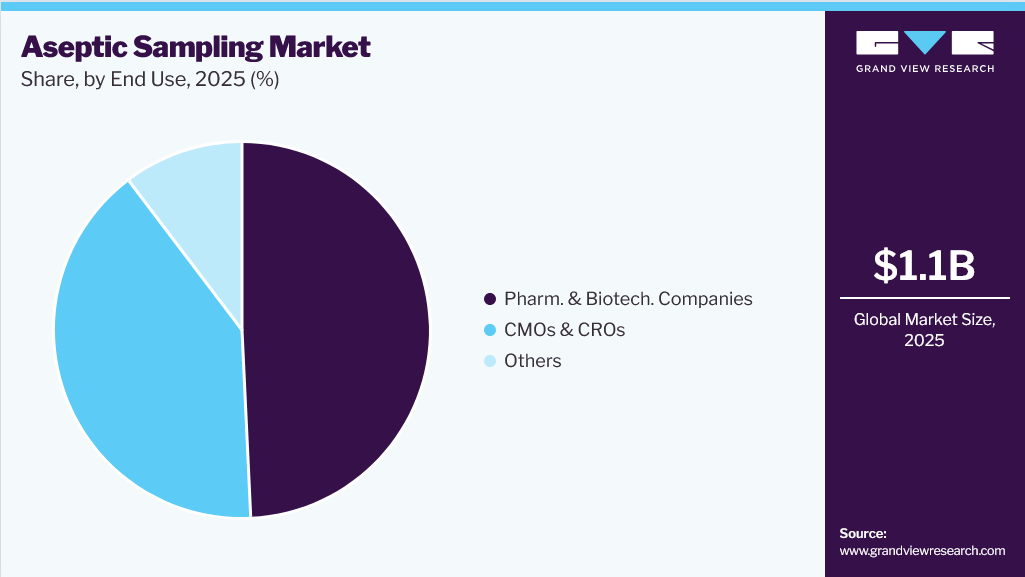
The pharmaceutical & biotechnology companies segment dominated the market, accounting for the largest revenue share of 49.3% in 2025. This is attributed to the extensive adoption of aseptic sampling solutions for contamination control, quality assurance, and process monitoring across biopharmaceutical manufacturing operations. Increasing biologics production, expanding manufacturing capacities, and rising investments in advanced bioprocessing technologies further supported segment growth.
 To learn more about this report, Download Free Sample Report
 The CMOs & CROs segment is projected to witness the fastest CAGR from 2026 to 2033, due to pharmaceutical and biotechnology companies are increasingly outsourcing drug development, clinical research, and manufacturing activities to specialized service providers. Rising demand for flexible production capabilities, cost-efficient bioprocessing, and scalable aseptic manufacturing solutions is expected to further drive the adoption of aseptic sampling technologies across CMOs and CROs.
Regional Insights
North America aseptic sampling market dominated the global industry, accounting for the largest revenue share of 38.5% in 2025, supported by its well-established biopharmaceutical manufacturing base, advanced life science infrastructure, and strong adoption of single-use processing technologies. For instance, in March 2025, the Government of Canada committed CAD 49.9 million to support STEMCELL Technologies' CAD 222 million biomanufacturing project, which includes the establishment of two facilities for producing inputs used in vaccines, therapeutics, and diagnostics, reflecting continued regional investment in biomanufacturing infrastructure.
 To learn more about this report, Download Free Sample Report
 U.S. Aseptic Sampling Market Trends
The aseptic sampling industry in the U.S. is expected to grow over the forecast period, driven by high biopharmaceutical production volumes, stringent contamination-control requirements, and increasing adoption of closed and single-use sampling solutions. The country's extensive biologics manufacturing infrastructure and presence of major pharmaceutical and biotechnology companies are further expected to support market growth.
Europe Aseptic Sampling Market Trends
The aseptic sampling market in Europe was identified as a lucrative region in this industry, supported by stringent regulatory requirements for sterile manufacturing, a strong biologics ecosystem, and increasing emphasis on contamination control and validated processing practices. Growing investments in pharmaceutical manufacturing and advanced bioprocessing technologies are expected to further drive demand for aseptic sampling solutions.
The UK aseptic sampling market held a significant share, attributed to the investments in domestic pharmaceutical manufacturing and advanced life science infrastructure. For instance, in March 2026, the UK Government announced a £23 million investment to expand pharmaceutical production at Norgine's facility in Hengoed, Wales, highlighting continued efforts to strengthen domestic medicine manufacturing capacity and supporting demand for associated aseptic processing and sampling technologies.
Aseptic sampling market in Germany is witnessing significant growth, owing to its established pharmaceutical manufacturing base, strong biopharmaceutical R&D ecosystem, and stringent quality standards. The country's advanced production infrastructure and increasing focus on efficient and contamination-controlled manufacturing processes are expected to support the adoption of aseptic sampling technologies.
Asia Pacific Aseptic Sampling Market Trends
Aseptic sampling market in Asia-Pacific is expected to grow at the fastest CAGR of 8.7% during the forecast period, driven by expanding biopharmaceutical manufacturing capacity, increasing investments in healthcare infrastructure, and growing adoption of single-use technologies. For instance, in December 2025, Thermo Fisher Scientific expanded its Bioprocess Design Center network across Asia by launching a new center in Hyderabad, India, and expanding facilities in Incheon, South Korea, and Singapore. The expansion strengthened regional capabilities in process design, optimization, and single-use bioprocessing, supporting the growing biopharmaceutical manufacturing ecosystem and demand for advanced aseptic processing and sampling solutions.
The China aseptic sampling market is growing significantly, supported by the expansion of domestic biopharmaceutical manufacturing, increasing investments in biologics production, and modernization of pharmaceutical facilities. Growing emphasis on manufacturing quality and contamination control is expected to encourage the adoption of advanced aseptic sampling solutions.
The aseptic sampling market in Japan is witnessing rapid growth, supported by its sophisticated pharmaceutical industry, established GMP framework, and increasing focus on high-quality biopharmaceutical manufacturing. The country's advanced life science research capabilities and growing adoption of innovative manufacturing technologies are expected to further contribute to market development.
Latin America Aseptic Sampling Market Trends
The Latin America aseptic sampling market is growing steadily, supported by increasing investments in pharmaceutical manufacturing and expansion of regional biopharmaceutical production capabilities. For instance, in April 2025, Novo Nordisk announced an investment of approximately USD 1.09 billion to expand its manufacturing facility in Minas Gerais, Brazil, increasing production capacity for injectable medicines and strengthening the country's role as a pharmaceutical manufacturing and export hub. The expansion of large-scale injectable drug manufacturing is expected to create opportunities for aseptic processing and sampling technologies across the region.
MEA Aseptic Sampling Market Trends
The aseptic sampling industry in MEA is expected to witness gradual growth, driven by efforts to strengthen local pharmaceutical manufacturing, improve healthcare infrastructure, and reduce dependence on imported medicines. However, limited advanced biomanufacturing capabilities, high technology costs, and uneven access to specialized infrastructure are expected to constrain market penetration.
Key Aseptic Sampling Company Insights
Several prominent companies operate in the aseptic sampling market, supported by broad product portfolios, advanced sampling technologies, and strong global distribution networks. Key players, including Danaher Corporation, Thermo Fisher Scientific Inc., Merck KGaA, Sartorius AG, Eppendorf SE, Lonza, GEA Group, KEOFITT A/S, Qualitru Sampling Systems, and W. L. Gore & Associates, Inc., are strengthening their market positions through product innovation, single-use and closed-system sampling solutions, and investments in biopharmaceutical manufacturing technologies. The increasing demand for contamination control, process monitoring, and sterile sampling solutions is encouraging companies to expand their offerings and strengthen their presence across global bioprocessing markets.
Key Aseptic Sampling Companies
The following key companies have been profiled for this study on the aseptic sampling market.
-
Danaher Corporation
-
Thermo Fisher Scientific Inc.
-
Merck KGaA
-
Sartorius AG
-
Eppendorf SE
-
Lonza
-
GEA Group
-
KEOFITT A/S
-
Qualitru Sampling Systems
-
W. L. Gore & Associates, Inc.
Competitive Benchmarking
Category
Operating Strategies
Competitive Edge
Weakness
Established Players (Danaher Corporation, Thermo Fisher Scientific Inc., Merck KGaA, Sartorius AG, etc.)
- Focus on developing integrated aseptic sampling solutions, including single-use and automated sampling technologies, to support contamination-free biopharmaceutical and pharmaceutical manufacturing.
- Extensive expertise in sterile processing, single-use technologies, and regulatory-compliant solutions that support reliable and efficient manufacturing workflows.
- Exposure to supply chain disruptions, stringent regulatory requirements, and high competition from specialized aseptic sampling providers.
Emerging Players (KEOFITT A/S, Qualitru Sampling Systems, W. L. Gore & Associates, Inc.)
- Focus on specialized aseptic sampling systems and customized solutions designed for sterile pharmaceutical and bioprocessing applications.
- Strong technical expertise and specialization in aseptic sampling, enabling customized solutions for specific process requirements.
- Narrower product portfolios and greater vulnerability to pricing pressure and competition from integrated bioprocessing solution providers.
Recent Developments
-
In June 2025, IMA Group acquired ProSys to strengthen its global aseptic sampling solutions portfolio. The acquisition expanded IMA Group’s capabilities in sterile manufacturing technologies and broadened its product offerings, supporting increased demand for advanced aseptic processing and sampling solutions across pharmaceutical applications.
-
In October 2024, BD and ten23 health partnered to advance efficiency and quality in aseptic manufacturing through RFID-enabled prefillable syringes. The collaboration focused on improving manufacturing traceability, process efficiency, and quality control, supporting enhanced operational standards across pharmaceutical manufacturing workflows.
-
In March 2024, Argonaut Manufacturing Services expanded its aseptic pharmaceutical fill-finish capabilities through a USD 45 million equity investment from NewVale Capital and Telegraph Hill Partners. The investment strengthened manufacturing capacity and supported increased demand for sterile pharmaceutical production and aseptic processing services.
Aseptic Sampling Market Report Scope Table
Report Attribute
Details
Market size in 2025
USD 1.1 billion
Estimated market size in 2026
USD 1.2 billion
Projected market size by 2033
USD 2.0 billion
Growth rate
CAGR of 8.0% from 2026 to 2033
Actual data
2021 - 2025
Forecast period
2026 - 2033
Quantitative units
Revenue in USD billion, and CAGR from 2026 to 2033
Report coverage
Revenue forecast, company ranking, competitive landscape, growth factors, and trends
Segments covered
Type, technique, application, end use, region
Regional scope
North America; Europe; Asia Pacific; Latin America; MEA
Country scope
U.S.; Canada; Mexico; UK; Germany; France; Italy; Spain; Norway; Denmark; Sweden; China; Japan; India; South Korea; Australia; Thailand; Brazil; Argentina; Saudi Arabia; South Africa; UAE; Kuwait
Key companies profiled
Danaher Corporation; Thermo Fisher Scientific Inc.; Merck KGaA; Sartorius AG; Eppendorf SE; Lonza; GEA Group; KEOFITT A/S; Qualitru Sampling Systems; W. L. Gore & Associates, Inc.
Customization scope
Free report customization (equivalent up to 8 analysts' working days) with purchase. Addition or alteration to country, regional & segment scope.
Pricing and purchase options
Avail customized purchase options to meet your exact research needs. Explore purchase options
Global Aseptic Sampling Market Report Segmentation
This report forecasts revenue growth and provides an analysis on the latest trends in each of the sub-segments from 2021 to 2033. For this report, Grand View Research has segmented the global aseptic sampling market report based on type, technique, application, end use, and region
-
Type Outlook (Revenue, USD Billion, 2021 - 2033)
-
Manual Aseptic Sampling
-
Valve
-
Bags
-
Bottle
-
Other Accessories
-
-
Automated Aseptic Sampling
-
-
Technique Outlook (Revenue, USD Billion, 2021 - 2033)
-
In-line Sampling Technique
-
On-line Sampling Technique
-
Off-line Sampling Technique
-
-
Application Outlook (Revenue, USD Billion, 2021 - 2033)
-
Downstream Processing
-
Upstream Processing
-
-
End Use Outlook (Revenue, USD Billion, 2021 - 2033)
-
Pharmaceutical & Biotechnology Companies
-
CMOs & CROs
-
Others
-
-
Regional Outlook (Revenue, USD Billion, 2021 - 2033)
-
North America
-
U.S.
-
Canada
-
Mexico
-
Europe
-
-
UK
-
Germany
-
France
-
Italy
-
Spain
-
Denmark
-
Sweden
-
Norway
-
-
Asia Pacific
-
Japan
-
China
-
India
-
Australia
-
Thailand
-
South Korea
-
-
Latin America
-
Brazil
-
Argentina
-
-
Middle East and Africa (MEA)
-
South Africa
-
Saudi Arabia
-
UAE
-
Kuwait
-
-
Research Methodology
The aseptic sampling market figures in this report are based on a proven research process that combines executive interviews with secondary research from proprietary databases, company filings, and recognized regulatory and institutional sources. Market size is built through value-chain sizing-reconciling supply-side and demand-side estimates-and triangulated with bottom-up and top-down approaches. Every estimate passes multiple levels of expert validation before publication, with each aseptic sampling segment quantified using the revenue-capture definitions in the table below.
Segment Definition
Segment- Type
Revenue Capture Definition
Manual Aseptic Sampling
Revenue generated from manually operated aseptic sampling solutions used to collect representative samples from bioprocessing systems while maintaining sterility and minimizing contamination risks. This segment includes valves, sampling bags, bottles, and other accessories used across upstream and downstream processing workflows for quality control, process monitoring, and product testing.
Automated Aseptic Sampling
This segment captures income from automated sampling systems designed to collect and transfer process samples with minimal or no direct operator intervention. These solutions support consistent sampling, reduce contamination risks and operator exposure, and enable improved process monitoring and data collection across biopharmaceutical manufacturing operations.
Segment- Technique
Revenue Capture Definition
Off-line Sampling Technique
Revenue originates from aseptic sampling approaches in which samples are manually or automatically withdrawn from a bioprocess and transferred to separate laboratory environments for subsequent analysis. These techniques are commonly used for periodic testing and quality assessment during biopharmaceutical production.
On-line Sampling Technique
This segment reflects earnings from sampling approaches that enable process samples to be diverted to analytical systems or monitoring equipment for evaluation without requiring complete removal from the manufacturing workflow. These solutions facilitate more frequent process monitoring and support timely assessment of critical quality parameters.
In-line Sampling Technique
Market value in this category stems from sampling systems integrated directly into the process stream, allowing measurements or sample collection to occur within the production line with minimal process interruption. These approaches support continuous or near-real-time monitoring of bioprocess parameters while maintaining aseptic conditions.
Segment- Application
Revenue Capture Definition
Downstream Processing
Revenue generated from aseptic sampling solutions utilized during downstream bioprocessing activities, including purification, clarification, filtration, chromatography, and formulation. These systems enable sterile sample collection for monitoring product quality, process performance, purity, and contamination throughout biologics manufacturing workflows.
Upstream Processing
This segment captures income from aseptic sampling products used during cell culture and fermentation processes to monitor parameters such as cell growth, nutrient consumption, metabolite levels, and product formation. Sampling solutions support process optimization and quality control while preserving the sterility of bioreactors and other production systems.
Segment- End Use
Revenue Capture Definition
Pharmaceutical & Biotechnology Companies
Revenue generated from aseptic sampling systems purchased and utilized by pharmaceutical and biotechnology companies for research, process development, clinical manufacturing, and commercial production of biologics, vaccines, cell and gene therapies, and other sterile products.
CMOs & CROs
This segment represents income derived from aseptic sampling solutions used by contract manufacturing organizations (CMOs) and contract research organizations (CROs) providing outsourced bioprocess development, analytical testing, clinical manufacturing, and commercial production services to pharmaceutical and biotechnology clients.
Others
Includes revenue generated from aseptic sampling solutions utilized by academic and research institutes, government laboratories, diagnostic organizations, and other specialized facilities involved in bioprocessing, biological research, and sterile sample analysis.
Estimation Model
Section
Heading
Content
Top-Down
Commodity Flow Analysis
Market size was estimated by analyzing revenues generated by key asset sampling equipment, systems, and consumable manufacturers, supported by company annual reports, investor presentations, product portfolios, distributor insights, and premium industry databases. Revenue contributions from private and regional companies were assessed through secondary research and validated through primary interviews to derive the overall market value.
Parent Market
Parent Market & Penetration-Based Analysis
The aseptic sampling market was evaluated within the broader biotechnology market. Adoption rates of aseptic sampling technologies across biopharmaceutical manufacturing, biologics production, cell and gene therapy, vaccine manufacturing, and research applications were analyzed alongside bioprocessing capacity, production volumes, and regulatory requirements to estimate the addressable market and segment-level opportunities.
Segmentation
Country-Level Segment Share Modeling
Market shares for type, technique, application, and end-use segments were derived using country-specific biotechnology investments, biopharmaceutical manufacturing capacity, biologics production activity, GMP infrastructure, and adoption of single-use and automated bioprocessing technologies. Weighted average calculations were applied to determine regional and global segment distributions.
Validation
Data Triangulation & Validation Model
Market estimates were validated through triangulation of secondary research, primary interviews, company-level revenue assessments, biopharmaceutical production capacity, biotechnology investments, and end-user adoption analysis to ensure consistency and accuracy across all market segments and geographies.
Forecasting
Forecasting & CAGR Modeling
Market forecasts were developed using historical demand trends, growth in biopharmaceutical manufacturing, expansion of biologics and advanced therapies, increasing adoption of single-use technologies, stringent regulatory requirements for contamination control, and investments in biotechnology infrastructure. Regression-based analysis and trend modeling were applied to project future market growth and CAGR.
Delivered Customizations
This report has been delivered with the following In-depth customizations
Client Request
Customization Delivered
Value Adds
Cross-Segmentation Analysis Across Sampling Type and Application
Detailed cross-segmentation analysis across sampling type and application, including manual and automated sampling solutions across upstream and downstream processing workflows. The analysis evaluates segment-level market size, growth trends, adoption patterns, and demand dynamics to identify the most attractive combinations of sampling technologies and bioprocessing applications.
Enables clients to identify high-growth segment combinations, assess demand patterns across different bioprocessing stages, uncover opportunities for automation and advanced sampling solutions, and prioritize high-potential product and application segments.
Regional & Country-Level Demand Assessment for Aseptic Sampling Solutions
Customized regional and country-level analysis across North America, Europe, Asia Pacific, Latin America, and Middle East & Africa, with detailed assessment of market size, growth outlook, biopharmaceutical manufacturing activity, adoption of advanced sampling technologies, and demand across upstream and downstream processing applications.
Helps clients identify high-growth geographic markets, evaluate country-specific demand potential, prioritize expansion opportunities, and align commercialization strategies with regional biopharmaceutical manufacturing trends.
Competitive Benchmarking & Technology Assessment
Comprehensive benchmarking of key aseptic sampling market participants based on product portfolios, manual versus automated sampling offerings, sampling techniques, application coverage, geographic presence, partnerships, product innovation, and strategic initiatives.
Supports clients in evaluating competitive positioning, identifying technology and portfolio gaps, benchmarking innovation strategies, and developing informed decisions related to product differentiation, partnerships, market entry, and expansion.
Frequently Asked Questions About This Report
North America dominated with a 38.5% revenue share in 2025.
Key players include Danaher Corporation; Thermo Fisher Scientific; Merck KGaA; Sartorius AG; Eppendroff; Lonza Group; GEA Group; KEOFITT A/S; Qualitru Sampling Systems; W. L. Gore & Associates
Asia Pacific is the fastest-growing region over the forecast period.
The manual aseptic sampling segment led with a 52.9% revenue share in 2025.
The in-line sampling technique segment led with a 38.9% revenue share in 2025.
The downstream processing segment led with a 77.0% revenue share in 2025.
The global aseptic sampling market is expected to grow at a CAGR of 8.0% from 2025 to 2033, reaching USD 1,579.8 million by 2030.
The global aseptic sampling market size was valued at USD 1.1 billion in 2025 and is estimated at USD 1.2 billion for 2026.
Key factors that are driving the aseptic sampling market growth include the increasing demand for biopharmaceuticals due to growing need of biologics, the technological advancements, and rising need for product safety and quality. Furthermore, the growing investments in research & development activities, and growing number of vaccines & drug development, as well as rising awareness towards risks of contamination are further projected to impel the growth of the market over the forecast period.
About the Author(s)
Biotechnology Research Team
Healthcare · BiotechnologyThis report was authored by the biotechnology research team at Grand View Research - comprising two research analysts, one senior research analyst, and one industry expert - with specialized expertise in the biotechnology segment of the healthcare industry. All findings are based on proprietary healthcare databases, executive interviews, and regulatory analysis, subject to internal peer review prior to publication.
Last Updated:
Speak to Analyst

Customize this report to your needs - add regions, segments, or data points, with 20% free customization.
Or view our licence options:


ISO 9001:2015 & 27001:2022 Certified
We are GDPR and CCPA compliant! Your transaction & personal information is safe and secure. For more details, please read our privacy policy.


