
- Home
- »
- Next Generation Technologies
- »
-
Augmented Reality In E-Commerce Market Size Report 2033GVR Report cover

Augmented Reality In E-Commerce Market (2026 - 2033)
Size, Share & Trends Analysis Report By Component (Hardware, Software), By Display (HMD, Smart Glass, HUD), By Application, By Region, And Segment Forecasts
Market Size, 2025
$8.3BMarket Estimate, 2026
$11.7BMarket Forecast, 2033
$57.4BCAGR, 2026–2033
25.6%AR In E-Commerce Market Summary
The global augmented reality in e-commerce market size was valued at USD 8.3 billion in 2025 and is projected to grow from USD 11.7 billion in 2026 to USD 57.4 billion in 2033, at a CAGR of 25.6% from 2026 to 2033. North America dominated the market, accounting for a revenue share of 35.0% in 2025. The widespread adoption of smartphones and AR-enabled devices is making AR more accessible to both consumers and retailers. Significant investments by e-commerce giants and tech companies in AR infrastructure and platforms are accelerating market expansion.
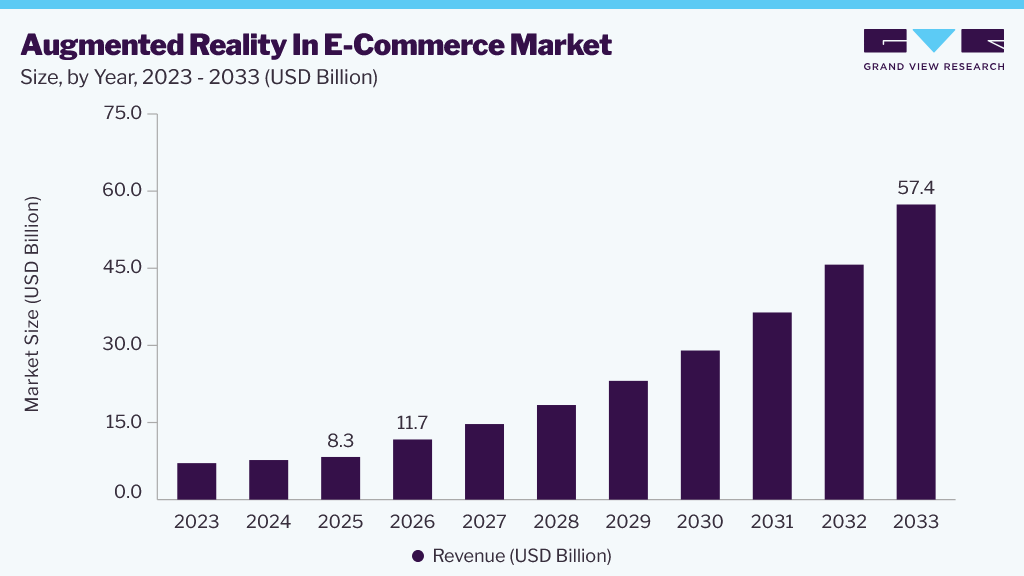 Source: Grand View Research, IR Documents, Primary Interviews, Paid DatabasesTo learn more about this report,
 Download Free Sample Report
Key Market Trends & Insights
- By component: The hardware segment dominated the market with a share of over 55.0% in 2025.
- By display: The head-mounted display (HMD) segment accounted for the largest market share of over 55.0% in 2025.
- By application: The virtual try-on solutions segment accounted for the largest market share of over 30.0% in 2025.
Regional Highlights
- Largest regional market: North America (35.0% revenue share, 2025)
- Fastest-growing regional market: Asia Pacific (highest CAGR, 2026-2033)
Market Size & Forecast
- Market size in 2025: USD 8.3 Billion
- Estimated market size in 2026: USD 11.7 Billion
- Projected market size by 2033: USD 57.4 Billion
- CAGR (2026-2033): 25.6%
Three ways to get this report
Buy it, customize it, or ask a question.Ask an Analyst
Analyst response in 1 business day
- AccessReport author, directly
- Reply timeWithin 1 working day
- No sales callDirect answer only
- FormatEmail reply
- CostFree, no cost
Get the Full Report
What the study covers
- FormatsPDF · Excel · Dashboard
- Timeline2026–2033 annual, 2025 base
- Coverage20+ countries, 5 regions
- Companies10+ key players profiled
Customize the Report
20% free customization
- IncludeCountries, segments, points
- TailorTo your product definition
- ExtendDeeper competitor detail
- OrA fully bespoke study
- Turnaround5–10 working days
The growing consumer preference for personalized and interactive shopping is prompting brands to adopt augmented reality (AR)-based product visualization tools. The integration of AR with social media and influencer-driven e-commerce is transforming how consumers discover and interact with products online, further spurring the growth of augmented reality in the e-commerce industry.A key factor influencing the adoption of AR in e-commerce is the increased focus on enhancing the customer experience and reducing product return rates. Retailers are implementing AR tools that allow customers to visualize products in real time, enabling actions such as trying on clothes, previewing furniture in their homes, or seeing how makeup looks on their faces. These capabilities improve buyer confidence and satisfaction, thereby decreasing the likelihood of returns and enhancing operational efficiency across e-commerce platforms, ultimately driving growth in the augmented reality industry.
In addition, the rapid advancement and affordability of AR-enabled smartphones and devices are further contributing to the growth of the market. AR features are becoming standard on mid-range and premium devices, giving more consumers access to these immersive experiences. This trend is bolstered by improvements in mobile processors and 5G connectivity, which enable smoother and more responsive AR applications, fueling the growth of augmented reality in e-commerce.
Furthermore, the integration of augmented reality into social commerce is accelerating AR's expansion in the e-commerce market. Platforms such as Instagram, Snapchat, and TikTok are increasingly incorporating AR-powered try-on and product interaction features. Influencers and brands are leveraging these tools to promote products in more engaging and interactive ways, driving higher conversion rates and fostering brand loyalty among younger demographics.
Moreover, the increasing investment from major technology companies and retailers in AR software development and infrastructure is further fueling market growth. Companies are creating proprietary AR platforms, Software Development Kits (SDKs), and Application Programming Interfaces (APIs) to enhance functionality and enable seamless integration across devices and applications. These strategic initiatives are facilitating the scalable, cost-effective deployment of AR solutions and supporting widespread adoption across the e-commerce landscape.
Analyst Perspective
The augmented reality in e-commerce market is expanding as retailers use immersive technologies to enhance online shopping and reduce purchase uncertainty. AR allows consumers to try on clothing and accessories virtually, visualize furniture in their homes, and preview products through smartphones and other connected devices. Growing smartphone adoption, advances in computer vision, and increasing demand for personalized shopping experiences are encouraging retailers and brands to integrate AR into their digital platforms. The technology can also help reduce product returns by giving customers a better understanding of product size, appearance, and fit. Companies with strong AR capabilities, seamless e-commerce integration, and engaging digital experiences are likely to strengthen their market position.
Component Insights
The hardware segment dominated the market with a share of over 55.0% in 2025, owing to the rising adoption of AR-enabled devices such as smartphones, tablets, AR glasses, and head-mounted displays. Consumers demand immersive and interactive online shopping experiences, and retailers are investing in robust hardware infrastructure to support high-performance AR applications. The surge in demand for AR-compatible devices, advancements in sensors and optics, and the growing integration of spatial computing are fueling the expansion of the hardware segment in the augmented reality of the e-commerce industry.
The software segment is expected to witness a significant CAGR from 2026 to 2033. This growth is attributed to the rising adoption of AR-powered platforms that enhance customer engagement and improve the online shopping experience. Retailers are increasingly investing in AR software to offer features such as virtual try-ons, 3D product visualization, and interactive user interfaces that personalize the shopping journey. Integrating AI and machine learning into AR software enables smarter product recommendations and real-time personalization. Businesses seek to differentiate themselves in a competitive e-commerce landscape, and demand for scalable, customizable AR software solutions continues to drive growth in this segment.
Display Insights
The head-mounted display (HMD) segment accounted for the largest market share in 2025, owing to the significant role in enabling virtual try-ons and in-store navigation, offering customers a hands-free, first-person perspective of products in real environments. It enhances customer engagement and satisfaction, especially in sectors such as fashion, home décor, and luxury retail. The growing demand for personalized shopping and experiential commerce, coupled with advancements in wearable AR hardware and decreasing device costs, is encouraging widespread adoption. Major brands and e-commerce platforms are leveraging HMDs for virtual showrooms and live product demonstrations, thereby solidifying this segment's leading position in the market.
The smart glass segment is expected to witness the fastest CAGR from 2026 to 2033. The growing demand for immersive and hands-free online shopping experiences is driving the adoption of AR-powered smart glasses. Advancements in lightweight, stylish, and more affordable smart glasses are expanding accessibility for consumers. Tech companies and retailers collaborate to create exclusive AR shopping apps for smart glasses, accelerating market penetration. The push for omnichannel retail experiences and the integration of AI-powered personalization features further support the rapid growth of the smart glasses segment in the augmented reality e-commerce industry.
Application Insights
The virtual try-on solutions segment accounted for the largest market share in 2025, driven by the growing consumer demand for immersive and personalized online shopping experiences. E-commerce continues to disrupt traditional retail, and virtual try-on technologies have become essential tools for brands in the fashion, eyewear, cosmetics, and footwear sectors. These solutions enable customers to visualize products in real-time, reducing uncertainty and enhancing purchasing confidence. The rise of AI-powered facial and body recognition technologies has significantly improved the accuracy and realism of virtual try-ons, leading to higher customer satisfaction and lower return rates, thereby positioning virtual try-on solutions as a transformative force in the segment.
The personalized shopping experience segment is expected to witness the fastest CAGR from 2026 to 2033. Businesses increasingly integrate advanced augmented reality (AR) solutions to deliver tailored and immersive e-commerce interactions. Rising consumer expectations for individualized product exploration, such as virtual try-ons, room-scale product placement, and facial-recognition-based suggestions, are prompting retailers to adopt AR tools to enhance online engagement. The widespread use of smartphones and AR-enabled apps is making it easier for brands to offer real-time personalization based on user preferences, browsing behavior, and purchase history. These technologies increase customer satisfaction and conversion rates, fueling the segmental growth.
Regional Insights
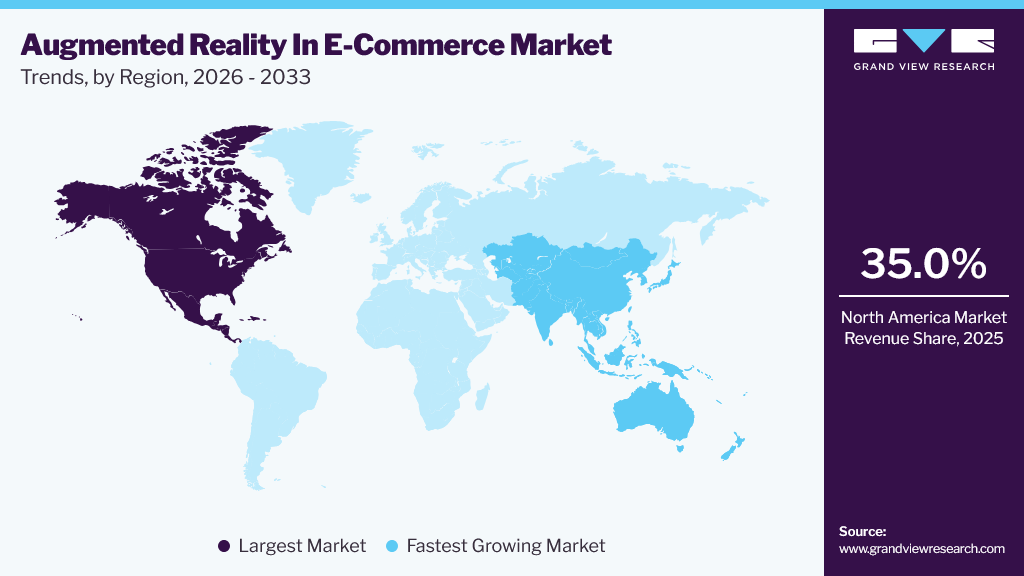
The augmented reality in e-commerce industry in North America accounted for the largest share in 2025, exceeding 35.0%, primarily driven by the region’s robust digital infrastructure, high internet penetration, and early adoption of advanced retail technologies. Leading e-commerce companies in the U.S. and Canada are investing heavily in augmented reality to differentiate the customer experience and reduce return rates. The presence of major AR tech providers and startups, coupled with rising consumer expectations for personalized, immersive shopping, is significantly driving growth in the region's augmented reality industry.
 To learn more about this report, Download Free Sample Report
U.S. Augmented Reality In E-Commerce Market Trends
The augmented reality in e-commerce industry in the U.S. is expected to grow at a notable CAGR from 2026 to 2033, driven by the country’s strong focus on innovation and technological advancement. The growth of startups and the increasing adoption of digital transformation strategies by established companies contribute to the rising demand for augmented reality in U.S. e-commerce. Rising consumer expectations for personalized and immersive online shopping experiences, particularly in sectors such as fashion, home décor, and electronics, are driving U.S.-based retailers to adopt augmented reality tools that enable virtual product trials, ultimately improving user satisfaction and influencing purchasing decisions.
Asia Pacific Augmented Reality In E-Commerce Market Trends
The augmented reality in e-commerce industry in Asia Pacific is expected to grow at the fastest CAGR from 2026 to 2033, driven by rapid urbanization, the exponential growth of the e-commerce sector, and increasing penetration of mobile technologies. The region’s expanding digital infrastructure and widespread adoption of smart devices create a fertile environment for AR integration within online retail. A young, digitally native consumer demographic, combined with proactive digital transformation initiatives by retailers, is fostering significant demand for immersive and personalized shopping experiences. Asia Pacific continues to solidify its position as a strategic growth hub for augmented reality in the e-commerce industry.
Japan’s augmented reality in e-commerce industry is driven by the use of augmented reality in Japan's e-commerce market, fueled by the country's technological prowess, particularly in sectors such as automotive, robotics, and electronics. Japan’s e-commerce platforms increasingly integrate AR to provide interactive product experiences, especially in the fashion and consumer electronics sectors. The country's high level of consumer sophistication and digital literacy also contributes to the rapid adoption of AR technologies, a key means of enhancing customer engagement and streamlining purchasing decisions.
The augmented reality market in China's e-commerce sector is rapidly expanding. China’s rapid digitalization and focus on next-generation retail technologies are significant drivers of the augmented reality market in e-commerce. The widespread use of mobile payment systems and super apps such as WeChat have created an ecosystem where AR-based shopping experiences can be seamlessly embedded. This trend is further supported by substantial investments from domestic tech giants and a competitive retail landscape, which drive continuous innovation and adoption of augmented reality in the e-commerce industry.
Key Augmented Reality In E-Commerce Company Insights
The augmented reality market in e-commerce is characterized by global, regional, and niche solution providers competing through technological innovation, strategic partnerships, acquisitions, and product portfolio expansion.
- Google LLC is a global technology company renowned for its innovations in internet-related services and products. In the augmented reality of the e-commerce market, Google plays a pivotal role through its ARCore platform, which enables developers to create immersive AR experiences across millions of Android devices. The company integrates AR into Google Search and Shopping, allowing users to visualize products such as shoes, furniture, or cosmetics in their real environment before purchasing. Google’s investment in AI, cloud infrastructure, and spatial computing, along with its strategic partnerships with leading retailers and brands, positions it as a key player in driving innovation and scalability of augmented reality in e-commerce.
- Apple Inc. is a technology company known for its hardware, software, and digital services ecosystem. In the augmented reality space in e-commerce, Apple stands out with its ARKit framework, which enables developers to build high-performance AR applications for iOS devices. Through seamless integration with its high-end hardware, Apple provides retailers with tools to offer AR-based product visualization, virtual try-ons, and interactive 3D shopping experiences, making it a major force in advancing AR adoption in e-commerce.
Shopify Inc. and Houzz Inc. are among the emerging market participants in e-commerce augmented reality.
- Shopify Inc. is an emerging e-commerce and augmented reality technology company that empowers small to mid-sized businesses with innovative digital retail solutions. The company offers a robust suite of tools for 3D product modeling and AR integration directly within merchant storefronts, enabling shoppers to visualize products in real-world environments before purchase. The company’s scalable, plug-and-play AR solutions position it as a transformative force in democratizing immersive e-commerce technologies.
- Houzz Inc. is an emerging player in the augmented reality in e-commerce industry, specializing in home design and furniture visualization. The company offers a unique AR-powered feature, “View in My Room,” which allows users to place virtual furniture and decor into their physical spaces via smartphones or tablets. Houzz combines its deep expertise in interior design with advanced AR and 3D modeling technologies to enhance consumer engagement and purchasing confidence. Its commitment to user-friendly design tools, visual shopping experiences, and mobile-first functionality makes Houzz a standout innovator in AR-driven home and lifestyle e-commerce.
Key Augmented Reality In E-Commerce Companies
The following key companies have been profiled for this study on the augmented reality in e-commerce market:
-
Google LLC
-
Inter IKEA Systems B.V.
-
Apple Inc.
-
Meta Platforms, Inc.
-
Amazon.com, Inc.
-
Snap Inc.
-
Microsoft
-
Houzz Inc.
-
L'Oréal Paris
-
Shopify Inc.
Recent Developments
- In June 2024, Snap introduced new generative AI-powered augmented reality experiences and tools through its Lens Studio platform, including a real-time image-generation model and GenAI Suite for creating custom AR assets and machine-learning models. The enhancements expand the capabilities of brands and retailers developing immersive applications, such as virtual product visualization and try-on experiences.
Augmented Reality In E-Commerce Market Report Scope
Report Attribute
Details
Market size in 2025
USD 8.3 billion
Estimated market size in 2026
USD 11.7 billion
Projected market size by 2033
USD 57.4 billion
Growth rate
CAGR of 25.6% from 2026 to 2033
Base year for estimation
2025
Historical data
2021 - 2025
Forecast period
2026 - 2033
Quantitative units
Revenue in USD billion and CAGR from 2026 to 2033
Report coverage
Revenue forecast, company ranking, competitive landscape, growth factors, and trends
Segments covered
Component, display, application, region
Regional Scope
North America; Europe; Asia Pacific; Latin America; Middle East & Africa
Country Scope
U.S.; Canada; Mexico; UK; Germany; France; China; Japan; India; South Korea; Australia; Brazil; South Africa; Saudi Arabia; UAE
Key companies profiled
Google LLC; Inter IKEA Systems B.V.; Apple Inc.; Meta Platforms, Inc.; Amazon.com, Inc.; Snap Inc.; Microsoft; Houzz Inc.; L'Oréal Paris; Shopify Inc.
Customization scope
Free report customization (equivalent to 8 analyst working days) with purchase. Addition or alteration to country, regional & segment scope.
Pricing and purchase options
Avail of customized purchase options to meet your exact research needs. Explore purchase options
Augmented Reality in the E-Commerce Market Report Segmentation
This report forecasts revenue growth at the global, regional, and country levels and provides an analysis of the latest industry trends and opportunities across each sub-segment from 2021 to 2033. For this study, Grand View Research has segmented the global augmented reality in e-commerce market report based on component, display, application, and region:
- Component Outlook (Revenue, USD Billion, 2021 - 2033)
- Hardware
- Software
- Display Outlook (Revenue, USD Billion, 2021 - 2033)
- HMD (Head-Mounted Display)
- Smart Glass
- Head-up Display (HUD)
- Handheld Devices
- Application Outlook (Revenue, USD Billion, 2021 - 2033)
- Virtual Try-On Solutions
- Product Visualization
- AR Advertising and Marketing
- Personalized Shopping Experience
- Virtual Showrooms
- Others
- Regional Outlook (Revenue, USD Billion, 2021 - 2033)
- North America
- U.S.
- Canada
- Mexico
- Europe
- UK
- Germany
- France
- Asia Pacific
- China
- Japan
- India
- South Korea
- Australia
- Latin America
- Brazil
- Middle East & Africa
- Saudi Arabia
- South Africa
- UAE
- North America
Frequently Asked Questions About This Report
The global augmented reality in e-commerce market size was valued at USD 8.3 billion in 2025 and is estimated at USD 11.7 billion in 2026.
The hardware segment accounted for the largest revenue share of over 55.0% in 2025.
The global augmented reality in e-commerce market is expected to grow at a CAGR of 25.6% from 2026 to 2033, reaching USD 57.4 billion.
The North America region dominated the global augmented reality in e-commerce market with over 35.0% revenue share in 2025.
Key players in the market include Google LLC; Inter IKEA Systems B.V.; Apple Inc.; Meta Platforms, Inc.; Amazon.com, Inc.; Snap Inc.; Microsoft; Houzz Inc.; L'Oréal Paris; Shopify Inc., and others.
About the Author(s)
Next Generation Technologies Research Team
Technology · Next Generation TechnologiesThis report was authored by the next generation technologies research team at Grand View Research - comprising two research analysts, one senior research analyst, and one industry expert - with specialized expertise in the next generation technologies segment of the technology industry. All findings are based on proprietary technology databases, executive interviews, and regulatory analysis, subject to internal peer review prior to publication.
Last Updated:
Speak to Analyst

Customize this report to your needs - add regions, segments, or data points, with 20% free customization.
Or view our licence options:


ISO 9001:2015 & 27001:2022 Certified
We are GDPR and CCPA compliant! Your transaction & personal information is safe and secure. For more details, please read our privacy policy.


