
- Home
- »
- Automotive & Transportation
- »
-
Automotive Door Hinges Market Size Report, 2026-2033GVR Report cover

Automotive Door Hinges Market (2026 - 2033)
Size, Share & Trends Analysis Report By Hinge Type (Ladder Frame, Monocoque), By Material Type, By Vehicle Type (Passenger Car, Commercial Vehicle), By Application, By Region, And Segment Forecasts
Market Size, 2025
$14.3BMarket Estimate, 2026
$15.7BMarket Forecast, 2033
$30.8BCAGR, 2026–2033
10.1%Automotive Door Hinges Market Summary
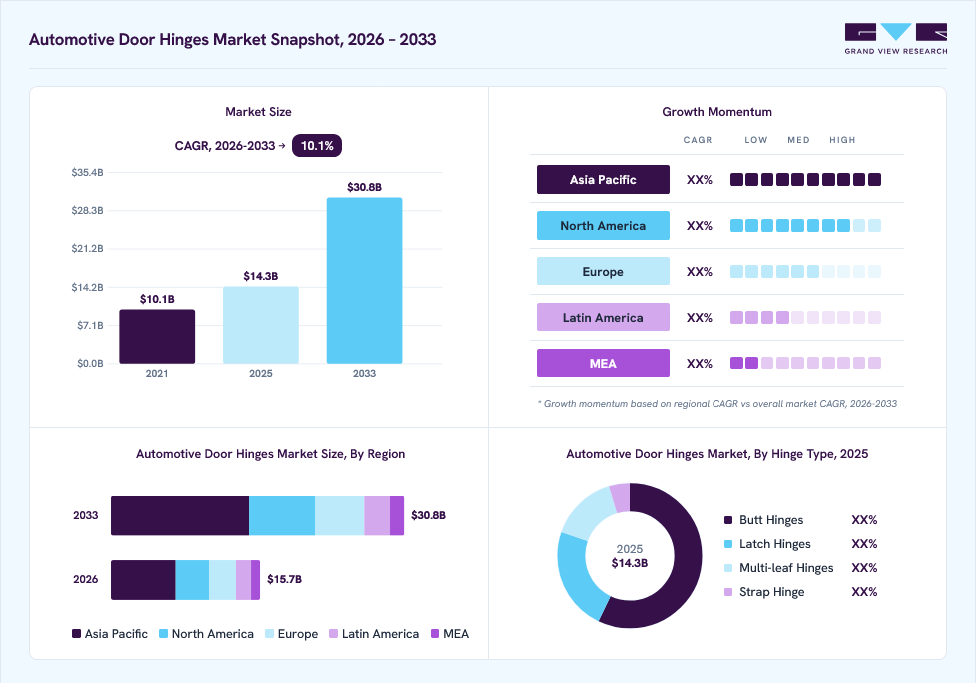
The global automotive door hinges market size was valued at USD 14.3 billion in 2025 and is projected to grow from USD 15.7 billion in 2026 to USD 30.8 billion by 2033, at a CAGR of 10.1% from 2026 to 2033. Asia Pacific dominated the market, accounting for revenue share of 42.8% in 2025. The expansion of global vehicle production directly increases the OEM requirement for door hinges because virtually every vehicle requires multiple hinge assemblies across its doors and access panels.
 Source: Grand View Research, IR Documents, Primary Interviews, Paid DatabasesTo learn more about this report,
 Download Free Sample Report
 Key Market Trends & Insights
- By Hinge type: Butt Hinges segment led the market and accounted for 57.0% of the global revenue in 2025.
- By material type: Steel segment led the market and accounted for 77.0% of the global revenue in 2025.
- By vehicle type: Passenger cars segment led the market and accounted for the global revenue in 2025.
- By application: Front Door Hinge segment led the market and accounted for the global revenue in 2025.
Regional Highlights
- Largest regional market: Asia Pacific (42.8% revenue share, 2025)
- By country: China held the largest market share in 2025.
Market Size & Forecast
- Market Size in 2025: USD 14.3 Billion
- Estimated market size in 2026: USD 15.7 Billion
- Projected Market size by 2033: USD 30.8 Billion
- CAGR (2026-2033): 10.1%
Three ways to get this report
Buy it, customize it, or ask a question.Ask an Analyst
A direct answer, usually in 1 working day
- AccessReport author, directly
- Reply timeWithin 1 working day
- No sales callDirect answer only
- FormatEmail reply
- CostFree, no cost
Get the Full Report
What the study covers
- FormatsPDF · Excel · Dashboard
- Timeline2026–2033 annual, 2025 base
- Coverage20+ countries, 5 regions
- Companies10+ key players profiled
Customize the Report
20% free customization
- IncludeCountries, segments, points
- TailorTo your product definition
- ExtendDeeper competitor detail
- OrA fully bespoke study
- Turnaround5–10 working days
The increasing adoption of electric and hybrid vehicles is driving demand for lightweight and application-optimized automotive door hinge systems that can support changing vehicle architectures, battery packaging, and redesigned body structures. Electrification is increasing the importance of vehicle weight optimization, encouraging automakers to reduce mass across body and closure components while maintaining structural strength and durability. Door hinges are therefore being optimized through material selection, geometry, load distribution, and manufacturing processes to achieve the required strength with lower component weight. In addition, EV manufacturers are increasingly incorporating powered tailgates, front trunks, frameless doors, and other redesigned access systems, creating opportunities for specialized hinge architectures. The continued transition toward electrified mobility is consequently encouraging hinge manufacturers to develop lightweight, compact, durable, and functionally integrated hinge solutions.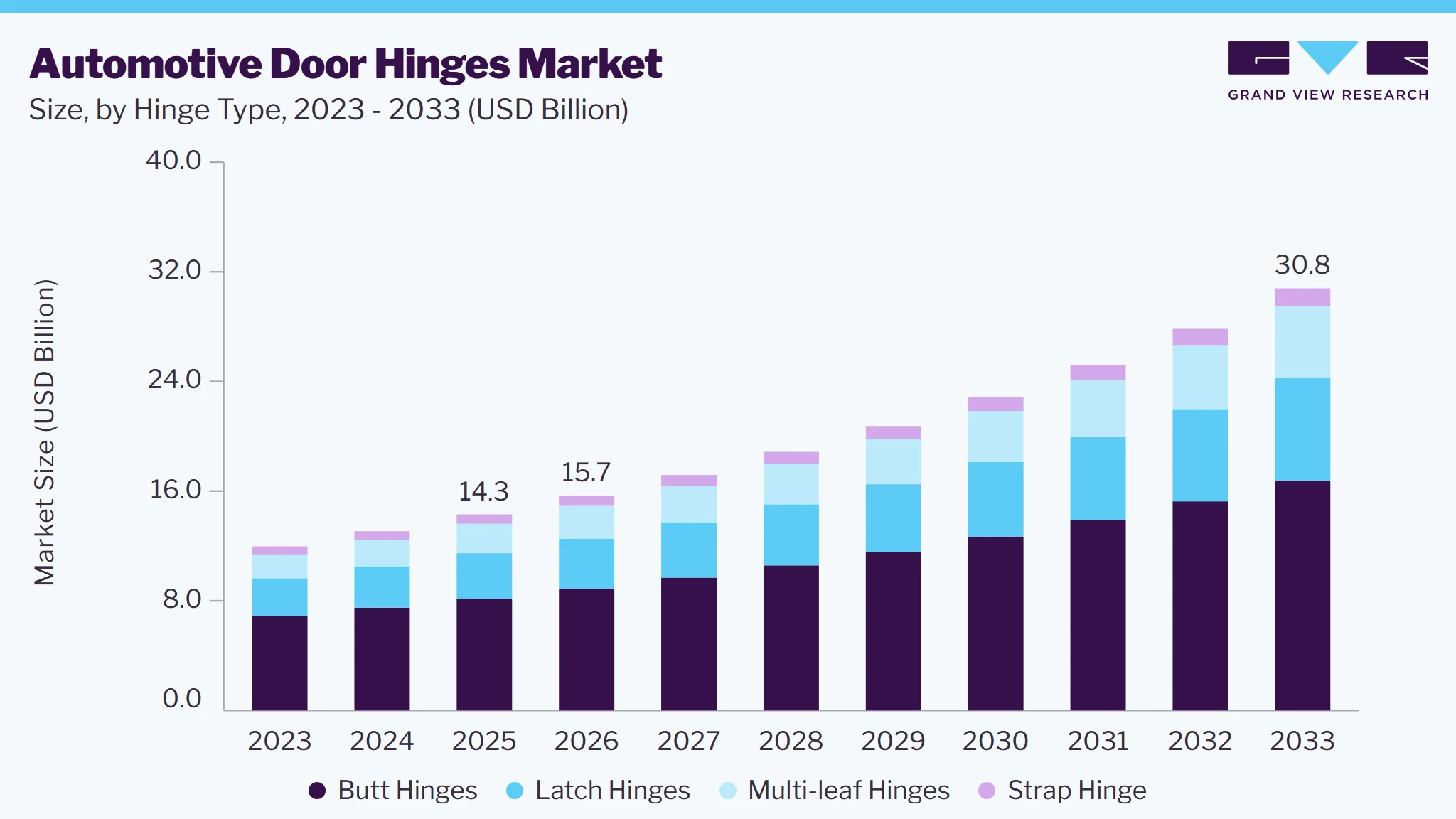 To learn more about this report, Download Free Sample Report
 The increasing adoption of powered doors, powered liftgates, soft-close mechanisms, electronic latching, and intelligent access systems is emerging as an important trend in the automotive door hinges market. Automakers are increasingly integrating mechanical hinge functions with actuators, sensors, latches, dampers, and electronic control systems to improve passenger convenience, door movement, accessibility, and vehicle design flexibility. This transition is particularly visible in premium vehicles, SUVs, luxury vehicles, and EVs, where advanced access functions are increasingly used to differentiate vehicle models. Hinge manufacturers are consequently moving beyond conventional mechanical components toward integrated and mechatronic door-access solutions. This evolution can increase the technical complexity and value content of individual hinge assemblies while creating opportunities for suppliers with capabilities in precision manufacturing, actuation, electronics integration, and lightweight materials.
Market Dynamics
The automotive door hinges market is being influenced by vehicle electrification, increasing vehicle production, lightweighting requirements, and the growing integration of advanced vehicle-access technologies. Rising demand for improved vehicle safety, durability, convenience, and design flexibility is encouraging manufacturers to develop more advanced hinge architectures. At the same time, the adoption of powered doors, liftgates, frunks, electronic latching, sensors, and motion-control technologies is expanding the functional scope of conventional hinge systems. These developments are supporting a shift from traditional mechanical hinges toward lightweight, high-strength, integrated, and increasingly mechatronic door-hinge solutions.
Increasing regulatory and OEM emphasis on vehicle safety, door retention, structural integrity, durability, and occupant protection is influencing the design requirements of automotive door hinges. Door hinges must maintain reliable attachment and controlled movement under repeated operating cycles, vibration, vehicle loads, and crash conditions. Regulatory requirements governing vehicle doors and door-retention systems, including UNECE Regulation No. 11, place requirements on door latches and retention components to reduce the risk of doors opening unintentionally during vehicle operation or collisions. These requirements increase the importance of hinge and closure-system strength, dimensional accuracy, fatigue resistance, corrosion resistance, and manufacturing consistency. As vehicle architectures and door designs become more complex, hinge suppliers are therefore required to undertake increasingly rigorous engineering, validation, testing, and quality-control processes.
The increasing emphasis on vehicle lightweighting creates a significant engineering challenge for door-hinge manufacturers. Reducing hinge weight through thinner sections, optimized geometries, aluminum, or other lightweight materials must be achieved without compromising load-bearing capacity, fatigue life, crash performance, or door alignment. Door hinges are subjected to repeated opening and closing cycles as well as vibration and vehicle-body loads, making durability particularly important. The challenge becomes more pronounced for larger SUVs, commercial vehicles, powered doors, and tailgates, where hinge loads can be considerably higher. Consequently, manufacturers need to balance weight reduction, structural strength, durability, manufacturability, and cost, which can increase development complexity.
The increasing focus on vehicle lightweighting and electrification is creating opportunities for manufacturers to develop high-strength, lightweight hinge systems using optimized steel grades, aluminum, composites, and other advanced materials. Automakers need to reduce vehicle mass without compromising hinge strength, fatigue resistance, crash performance, corrosion resistance, and door alignment. Leading suppliers are already developing lightweight hinge technologies, including aluminum and composite hinge solutions. Gestamp/Edscha has developed hinge systems using aluminum, high-strength steel and carbon-fiber-reinforced plastic, while Magna highlights lightweight hinge designs using specialized metal alloys.
Market Concentration & Characteristics
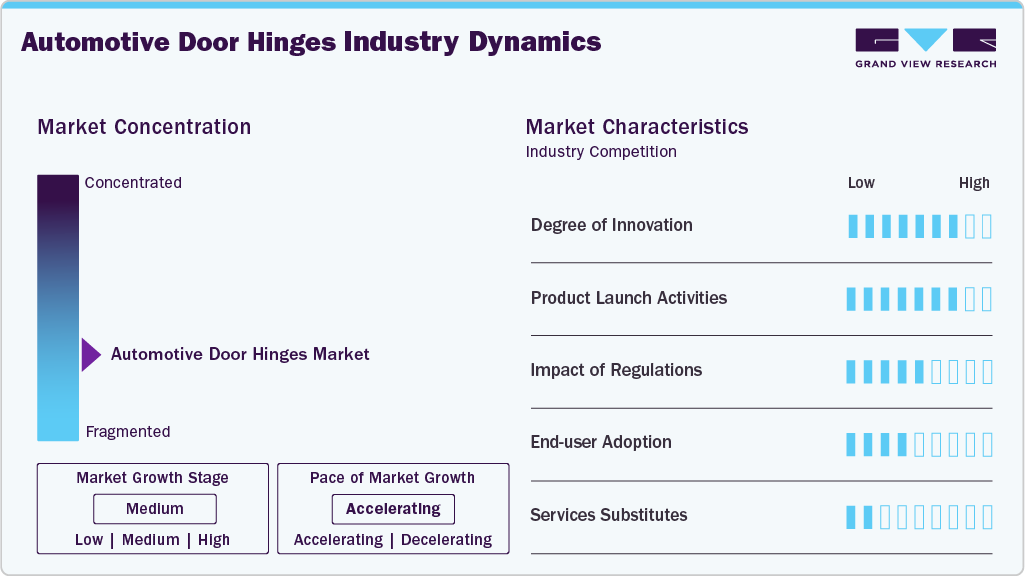
The automotive door hinges market is moderately consolidated, with a combination of major global automotive suppliers and specialized regional manufacturers. Leading companies have established capabilities in door hinges, hood hinges, tailgate/liftgate hinges, door checks, latches, and integrated vehicle-access systems, supported by strong relationships with vehicle manufacturers and extensive global production networks. At the same time, the presence of multiple suppliers across different hinge types, applications, materials, and vehicle categories prevents the market from being fully concentrated. Competition is primarily influenced by product quality, engineering capabilities, manufacturing precision, cost efficiency, lightweight materials, durability, and the ability to develop integrated hinge solutions for electric and next-generation vehicles.
 To learn more about this report, Download Free Sample Report
 The market demonstrates a high degree of innovation, while partnerships and collaborations remain relatively strong, with companies increasingly working with automakers to develop lightweight, compact, durable, and integrated hinge systems. The impact of regulations is medium-to-high, particularly due to vehicle safety, door-retention, durability, and performance requirements, which encourage manufacturers to improve hinge strength, fatigue resistance, corrosion protection, and dimensional precision. Substitutes have a low-to-moderate impact, as door hinges are essential vehicle components, although alternative materials, hinge architectures, and integrated mechatronic technologies can replace conventional solutions. End-user adoption is relatively high, supported by increasing demand for vehicle safety, convenience, lightweighting, premium features, and advanced vehicle-access functions. Moreover, the market is in a growth and technology-transition phase, driven by vehicle electrification, increasing vehicle production, lightweighting requirements, and the growing integration of powered and intelligent door-access technologies.
Analyst Perspective
The automotive door hinges market is progressing toward higher-value, lightweight, and increasingly integrated hinge systems, supported by vehicle electrification, evolving vehicle architectures, and growing demand for advanced vehicle-access functions. Demand for stronger yet lighter hinge structures is encouraging greater use of advanced materials, optimized geometries, and precision manufacturing processes. The integration of actuators, sensors, electronic latching, and motion-control technologies is expected to further expand the functional scope of door-hinge and closure systems. Investment is likely to remain focused on lightweight hinge designs, powered door and liftgate systems, EV-specific access solutions, and intelligent vehicle-access technologies. Competitive positioning is expected to increase depend on engineering capabilities, system integration, manufacturing scale, cost efficiency, and the ability to support multiple vehicle platforms and advanced door architectures.
Hinge Type Insights
Based on Hinge type, the Butt Hinges segment accounted for 57.0%, the largest share of global revenue in 2025. The demand for butt hinges in automotive applications is supported by their established use in conventional vehicle door and access-panel assemblies, particularly where simple construction, structural strength, durability, and cost efficiency are important. Butt-hinge designs can be manufactured using established stamping, forming, machining, and welding processes, allowing suppliers to achieve high-volume production and application-specific customization. Their relatively simple mechanical architecture also supports reliable operation and ease of integration with conventional vehicle body structures. Automotive suppliers continue to offer butt-type and conventional hinge solutions for vehicle doors and related applications, including side-door and other automotive access systems.
The Latch Hinges segment is projected to grow at the highest CAGR over the forecast period. The demand for latch hinges in the automotive door hinges market is supported by the increasing requirement for door systems that combine secure retention, controlled opening/closing, structural support, and reliable vehicle access. Latch-hinge configurations can provide an integrated approach to managing door movement and retention, making them relevant for applications where both hinge functionality and secure door positioning are important. The continued production of passenger cars, SUVs, commercial vehicles, and utility vehicles provides a broad underlying demand base for such systems. Automotive hinge manufacturers also increasingly offer customized door-hinge assemblies to meet specific OEM vehicle and door-architecture requirements
Material Type Insights
Based on material type, the steel segment accounted for 77.0%, the largest share of global revenue in 2025. The demand for steel hinges in the automotive door hinges market is supported by the material's combination of high strength, fatigue resistance, durability, cost efficiency, and established automotive manufacturing infrastructure. Steel remains well suited for door-hinge applications that require reliable load-bearing performance and repeated opening and closing cycles, particularly across high-volume passenger vehicles, SUVs, and commercial vehicles. Automotive hinge manufacturers continue to use stamped and formed steel components for door-hinge assemblies, supported by established tooling, forming, welding, and assembly capabilities.
The aluminum are projected to grow at the high CAGR over the forecast period. The demand for aluminum hinges in the automotive door hinges market is supported primarily by the increasing emphasis on vehicle lightweighting, electrification, and improved energy efficiency. Aluminum offers a substantially lower density than steel, enabling hinge manufacturers to reduce component weight while maintaining the required structural and functional performance through optimized designs. Research on automotive door-hinge redesign has demonstrated the potential for significant weight reduction through aluminum-based hinge components while maintaining durability and safety requirements.
Vehicle Type Insights
Based on vehicle type, the passenger cars segment accounted for the largest share of global revenue in 2025. The demand for automotive door hinges in passenger vehicles is supported by the continued expansion of passenger-vehicle production and the increasing adoption of SUVs, crossovers, premium vehicles, and electrified passenger cars. Passenger vehicles represent a broad application base for door hinges, with multiple hinge assemblies required across front doors, rear doors, tailgates, and bonnets. Global vehicle production increased to approximately 96.4 million units in 2025, with Asia Pacific accounting for more than 61% of global output, providing a strong underlying demand base for automotive components.
The light commercial vehicles are projected to grow at a significant CAGR over the forecast period. The demand for automotive door hinges in commercial vehicles is supported by the increasing use of trucks, vans, buses, trailers, and other utility vehicles that require robust, high-load, and durable hinge systems for frequently operated doors and access panels. Commercial-vehicle doors are often larger and heavier than passenger-vehicle doors and can be exposed to higher levels of vibration, road shock, weather conditions, and repeated opening and closing cycles. This increases the requirement for heavy-duty hinge systems with high load-bearing capacity, corrosion resistance, reliable operation, and long service life. Suppliers are developing dedicated commercial-vehicle hinge solutions, including rear cargo-door and side-door hinges designed for high durability and load-bearing applications.
Application Insights
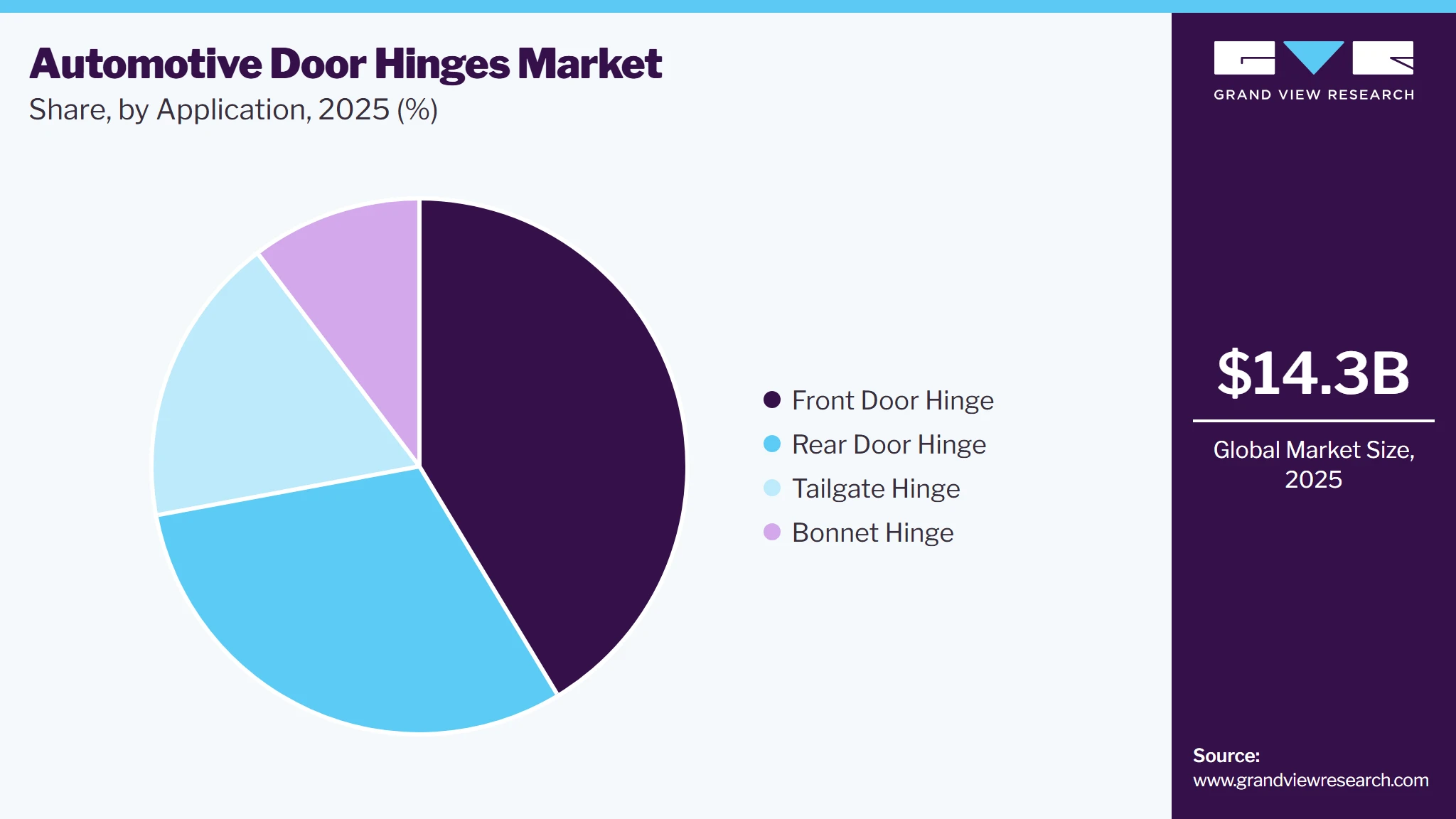
Based on application, the front door hinge segment accounted for the largest share of global revenue in 2025. The demand for front door hinges is supported by the continued production of passenger cars, SUVs, crossovers, and commercial vehicle and, controlled opening and closing. Increasing vehicle safety, durability, and fit-and-finish requirements are encouraging automakers to use hinge systems with improved load-bearing capacity, dimensional accuracy, fatigue resistance, corrosion protection, and door alignment. These requirements are particularly relevant because front-door hinge performance can influence door operation, sealing, NVH performance, and overall vehicle body quality.
 To learn more about this report, Download Free Sample Report
 The demand for tailgate hinges in the automotive door hinges market is supported by the increasing adoption of SUVs, crossovers, hatchbacks, and utility vehicles, where tailgates provide important rear access for passenger and cargo loading. These applications require hinge systems capable of supporting relatively large and heavy panels while providing smooth movement, reliable positioning, structural durability, and long operating life. The growing use of larger rear openings and higher tailgate functionality is therefore increasing the requirement for robust and application-specific hinge designs. Automotive suppliers such as Magna offer hinge solutions for decklid and liftgate mechanisms, while specialized manufacturers provide dedicated rear-door and tailgate hinge assemblies.
Regional Insights
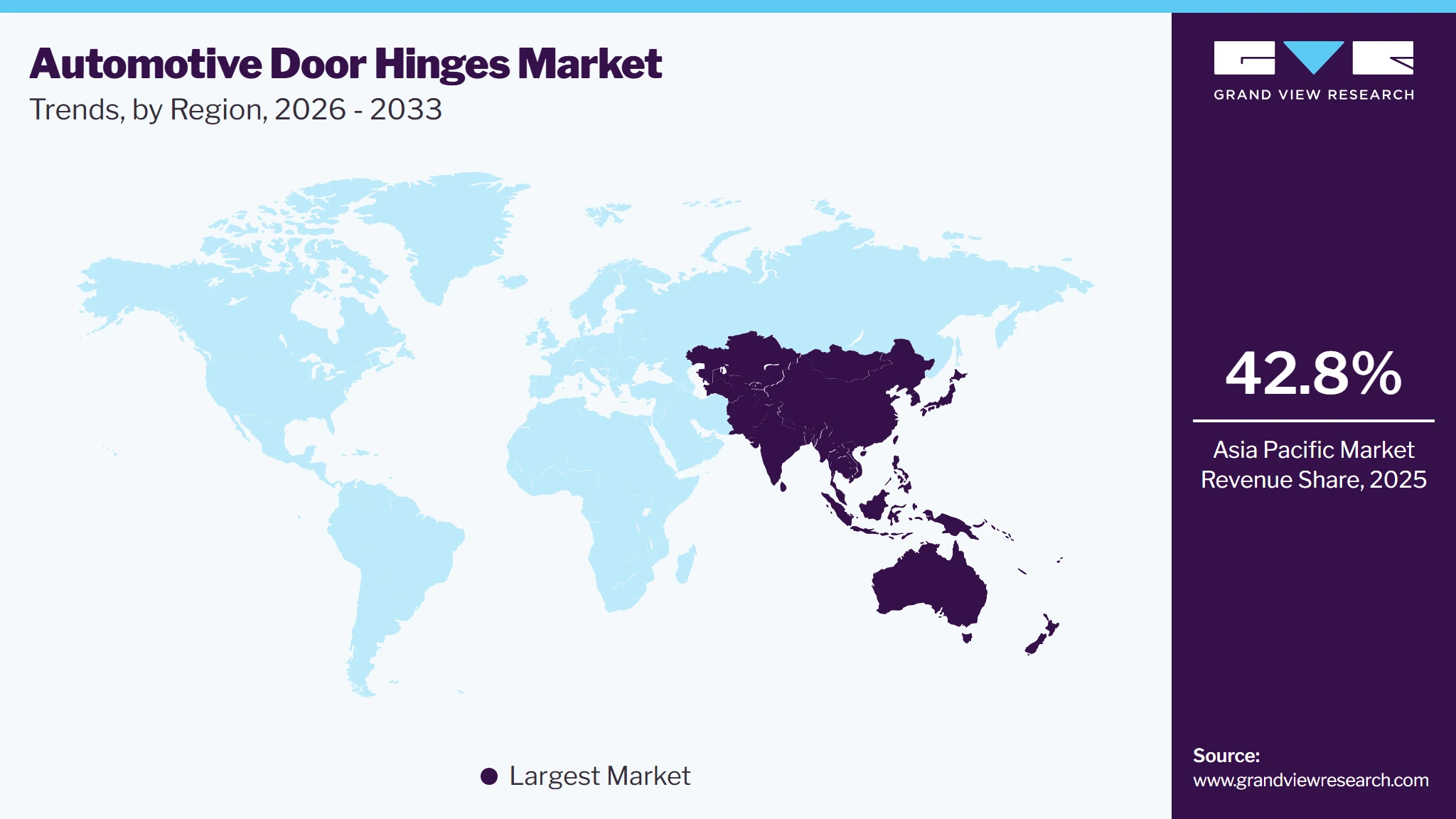
The Asia Pacific automotive door hinges market led the global market and accounted for 42.8% of the global revenue in 2025 and is expected to register the fastest growth from 2026 to 2033. The APAC automotive door hinges market is being driven by the region's strong vehicle manufacturing base and continued expansion of automotive production, particularly across China, India, Japan, South Korea, and Southeast Asia. Asia-Oceania produced approximately 59.2 million vehicles in 2025, accounting for more than 61% of global vehicle production, creating a substantial underlying demand base for automotive door hinges. The increasing production of EVs, SUVs, passenger cars, and commercial vehicles is further supporting demand for lightweight, durable, and application-specific hinge systems. China's expanding EV production and India's growing vehicle manufacturing base are particularly supporting regional demand for advanced door and closure components. In addition, increasing adoption of powered liftgates, advanced door-access systems, and lightweight vehicle architectures is creating opportunities for higher-value hinge solutions across the region.
 To learn more about this report, Download Free Sample Report
 China Automotive Door Hinges Market Trends
The China automotive door hinges market is being driven by the country's large and expanding vehicle manufacturing base, with total vehicle production reaching approximately 34.5 million units in 2025. The rapid expansion of new-energy vehicle production is further supporting demand for lightweight and application-specific door-hinge systems. Chinese automakers are increasingly introducing SUVs, EVs, premium vehicles, powered tailgates, and advanced vehicle-access features, creating opportunities for higher-value hinge solutions. The country's extensive automotive supply chain and large domestic OEM ecosystem also support localized production of hinges and related closure components. In addition, increasing emphasis on vehicle lightweighting and manufacturing efficiency is encouraging suppliers to optimize hinge materials, geometry, and production processes.
The India automotive door hinges market is being driven by increasing vehicle production, growing passenger-vehicle demand, and the expansion of the domestic automotive manufacturing ecosystem. India produced approximately 6.49 million vehicles in 2025, including more than 5.3 million passenger cars and over 1.1 million commercial vehicles. The increasing penetration of SUVs, utility vehicles, EVs, and premium passenger vehicles is creating demand for durable, lightweight, and increasingly sophisticated door-hinge systems. India's growing role as an automotive manufacturing and export hub is also encouraging greater localization of components and development of domestic supplier capabilities. Rising vehicle ownership and the expanding vehicle parc are additionally supporting replacement and aftermarket demand for door hinges.
Europe Automotive Door Hinges Market Trends
The European automotive door hinges market is being driven by the region's established vehicle manufacturing base, increasing electrification, and growing demand for lightweight and advanced vehicle-access systems. Europe produced approximately 14.1 million passenger cars in 2025, while the EU and UK together accounted for approximately 12.6 million units, providing a substantial OEM demand base for door-hinge components. The increasing production of EVs, premium vehicles, SUVs, and technologically advanced vehicle platforms is supporting demand for lightweight, durable, and higher-value hinge systems. European automakers are also increasingly incorporating powered doors, liftgates, electronic latching, and other advanced access technologies, creating opportunities for integrated hinge solutions. In addition, stringent European vehicle safety, durability, efficiency, and environmental requirements are encouraging suppliers to improve hinge design, material efficiency, and manufacturing precision.
The UK automotive door hinges market is supported by its established vehicle manufacturing and component-supplier ecosystem, with 717,371 cars and 47,344 commercial vehicles produced in 2025. The increasing share of electrified vehicle production is creating opportunities for lightweight and application-specific door-hinge systems, with electrified vehicles accounting for more than two-fifths of UK car production in 2025. The UK's strong export orientation, particularly toward European markets, further supports OEM demand for locally manufactured automotive components. In addition, the presence of premium and performance-oriented vehicle manufacturing creates opportunities for advanced hinge solutions that support lightweighting, design flexibility, and enhanced door functionality. Continued investment in new EV models and next-generation vehicle production is expected to support future demand for advanced door-access components.
The Germany automotive door hinges market is being driven by the country's large automotive manufacturing base, strong premium-vehicle presence, and rapid transition toward electrified vehicle production. Germany produced approximately 4.15 million passenger cars in 2025, making it one of Europe's largest vehicle-production centers. The country also produced approximately 1.67 million electric passenger cars in 2025, representing around 40% of domestic passenger-car production, increasing the requirement for lightweight and application-specific vehicle-access components. Germany's strong automotive engineering and Tier-1 supplier ecosystem further supports development of advanced hinges incorporating lightweight materials, optimized geometries, powered mechanisms, and integrated access technologies. The continued focus on premium vehicles, EV platforms, vehicle efficiency, and advanced body architectures is expected to support demand for higher-performance door-hinge systems.
North America Automotive Door Hinges Market Trends
The North American automotive door hinges market is being driven by the region's large vehicle manufacturing base, strong demand for SUVs, pickups, light trucks, and commercial vehicles, and continued investment in vehicle electrification. North America produced approximately 15.6 million vehicles in 2025, with the U.S., Mexico, and Canada forming an integrated automotive manufacturing and supply-chain ecosystem. The high penetration of larger vehicles is supporting demand for high-load, durable, and corrosion-resistant hinge systems, particularly for side doors, tailgates, hoods, and cargo doors. Increasing adoption of EVs, hybrid vehicles, powered liftgates, and advanced vehicle-access technologies is also creating opportunities for lightweight and integrated hinge solutions. In addition, regional OEM localization and supply-chain development are encouraging automotive component manufacturers to establish or expand local production capabilities.
The U.S. automotive door hinges market is supported by its large vehicle production and sales base, with approximately 10.24 million vehicles produced in 2025, making the country the largest vehicle-production market in North America. The strong presence of SUVs, pickup trucks, light commercial vehicles, and premium vehicles increases demand for robust hinge systems capable of handling larger and heavier doors and access panels. Growing production of EVs and hybrid vehicles is additionally encouraging OEMs and suppliers to pursue lightweight hinge designs and advanced door-access technologies. The U.S. also has a well-developed automotive supplier ecosystem, supporting innovation in powered doors, liftgates, electronic latching, and integrated closure systems.
Key Automotive Door Hinges Company Insights
Key players operating in the automotive door hinges market include Scissor Doors Inc., Midlake Products & MFG. CO, INC., Dura Automotive System LLC, Multimatic Inc., Eberhard Manufacturing, ER Wagner., Aisin Seiki Co., Ltd. Key players in the automotive door hinges market are focusing on expanding lightweight hinge portfolios, developing integrated door-access systems, strengthening electric vehicle hinge capabilities, increasing production capacity, and securing long-term supply agreements with automotive manufacturers. Companies are also emphasizing advanced materials, optimized hinge architectures, manufacturing automation, powered door and liftgate technologies, and system-level integration to improve product performance and strengthen their competitive positioning.
-
Scissor Doors Inc. is a specialized manufacturer of automotive door-conversion and hinge systems. In the automotive door hinges market, Scissor Doors Inc. provides customized hinge solutions for vehicle doors, including hinges used for suicide/scissor-door conversions and applications requiring modification of the factory door-hinge arrangement. Its solutions involve customized hinge positioning, fabrication, alignment, and installation, with the company providing application-specific hinge configurations based on the vehicle door structure.
-
Midlake Products & MFG. Co., Inc. is a sheet-metal fabrication and custom-hinge manufacturer providing engineered hinge solutions across multiple applications. In the automotive door hinges market, the company offers custom integrated door hinges and sheet-metal hinge assemblies, supported by capabilities such as laser cutting, forming, welding, secondary assembly, and finishing. Midlake manufactures hinges to customer-specific specifications and can integrate hinge curls directly into sheet-metal components, enabling customized hinge geometries and production designs.
Key Automotive Door Hinges Companies
The following key companies have been profiled for this study on the automotive door hinges market.
-
Scissor Doors Inc.
-
Midlake Products & MFG. CO, INC.
-
Dura Automotive System LLC
-
Multimatic Inc.
-
Eberhard Manufacturing
-
ER Wagner
-
Aisin Seiki Co., Ltd
-
Gestamp Automoción, S.A.
-
Magna International Inc.
-
Pacific Industrial Co., Ltd.
Competitive Benchmarking
Operating Strategies
Competitive Edge
Weaknesses
Mature Players: DURA Automotive Systems LLC, Multimatic Inc., AISIN Seiki Co., Ltd., Gestamp Automoción, S.A., Magna International Inc.
- Mature players in the automotive door hinges market are focused on broadening hinge portfolios, expanding global manufacturing networks, securing long-term OEM programs, developing platform-based hinge solutions, and increasing integration of lightweight materials and advanced door-access technologies.
- Mature players gain a competitive advantage through strong global presence, extensive engineering capabilities, diversified customer bases, large-scale manufacturing capacity, established OEM relationships, and broad door-hinge product portfolios covering door, tailgate, liftgate, and bonnet applications.
- These companies often face challenges related to high operational complexity and capital requirements that can increase development and manufacturing costs, while large global footprints and established production structures can make business operations less flexible.
Emerging Players: Scissor Doors Inc., Midlake Products & MFG. Co., Inc.,
- Emerging players in the automotive door hinges market are focused on expanding hinge technology capabilities, strengthening regional and global OEM relationships, developing application-specific and integrated hinge systems, and increasing participation in electrified and advanced vehicle platforms.
- Emerging players gain market traction through strong capabilities in selected hinge technologies, competitive manufacturing bases, established automotive relationships, customization capabilities, and opportunities to expand into higher-value lightweight and integrated door-access systems.
- Emerging players face limitations due to their comparatively narrower global door-hinge presence or portfolio breadth, which can limit scale and customer diversification against the largest established automotive suppliers.
Recent Developments
- In August 2026, Genesis announced the launch of GV90 in 2027. The car is full-size flagship SUV in the into the ultra-luxury segment. The company also stated that it has developed a dual-motion hinge system for the GV90 in which the rear door moves outward before rotating open. This launch of new vehicle is expected to increase the adoption of new advanced hinge system supporting the company growth in the market.
Automotive Door Hinges Market Report Scope
Report Attribute
Details
Market size in 2025
USD 14.3 billion
Estimated market size in 2026
USD 15.7 billion
Projected Market size by 2033
USD 30.8 billion
Growth rate
CAGR of 10.1% from 2026 to 2033
Base year for estimation
2025
Historical data
2021 - 2024
Forecast period
2026 - 2033
Quantitative units
Revenue in USD million/billion and CAGR from 2026 to 2033
Report coverage
Revenue forecast, company ranking, competitive landscape, growth factors, and trends
Segments covered
Hinge type, material type, vehicle type, application, region
Regional scope
North America; Europe; Asia Pacific; Latin America; MEA
Country scope
U.S.; Canada; Mexico; Germany; UK; France; China; Japan; India; South Korea; Australia; Brazil; KSA; UAE; South Africa
Key companies profiled
Scissor Doors Inc.; Midlake Products & MFG. CO, INC.; Dura Automotive System LLC; Multimatic Inc.; Eberhard Manufacturing; ER Wagner; Aisin Seiki Co., Ltd; Gestamp Automoción, S.A.; Magna International Inc.; Pacific Industrial Co., Ltd.
Customization scope
Free report customization (equivalent up to 8 analysts working days) with purchase. Addition or alteration to country, regional & segment scope.
Pricing and purchase options
Avail customized purchase options to meet your exact research needs. Explore purchase options
Global Automotive Door Hinges Market Segmentation
The report forecasts revenue growth at global, regional, and country levels and provides an analysis of the latest industry trends in each of the sub-segments from 2021 to 2033. For this study, Grand View Research has segmented the global automotive door hinges market report based on hinge type, material type, vehicle type, application, and region:
-
Hinge Type Outlook (Revenue, USD Billion, 2021 - 2033)
-
Ladder Frame
-
Monocoque
-
Multi-leaf Hinges
-
Strap Hinge
-
-
Material Type Outlook (Revenue, USD Billion, 2021 - 2033)
-
Steel
-
Aluminum
-
Others
-
-
Vehicle Type Outlook (Revenue, USD Billion, 2021 - 2033)
-
Passenger Cars
-
Commercial Vehicles
-
-
Application Outlook (Revenue, USD Billion, 2021 - 2033)
-
Front Door Hinge
-
Rear Door Hinge
-
Tailgate Hinge
-
Bonnet Hinge
-
-
Regional Outlook (Revenue, USD Billion, 2021 - 2033)
- North America
-
U.S.
-
Canada
-
Mexico
-
- Europe
-
Germany
-
UK
-
France
-
- Asia Pacific
-
China
-
India
-
Japan
-
South Korea
-
Australia
-
-
Latin America
-
Brazil
-
- Middle East & Africa (MEA)
-
UAE
-
Kingdom of Saudi Arabia (KSA)
-
South Africa
-
- North America
Research Methodology
The automotive door hinges market figures in this report are based on a proven research process that combines executive interviews with secondary research from proprietary databases, company filings, and recognized regulatory and institutional sources. Market size is built through value-chain sizing-reconciling supply-side and demand-side estimates-and triangulated with bottom-up and top-down approaches. Every estimate passes multiple levels of expert validation before publication, with each automotive door hinges segment quantified using the revenue-capture definitions in the table below.
Segment Definition
Segment - Hinge Type
Revenue capture definition
Butt Hinges
The segment revenue is generated from the sale of conventional butt-type hinge assemblies used to connect vehicle doors or access panels to the vehicle body while enabling controlled opening and closing. Revenue includes complete hinge assemblies, hinge leaves, knuckles, pins, and associated components supplied for vehicle production.
Latch Hinges
The segment revenue is generated from the sale of hinge systems incorporating or designed to work with latching and door-retention mechanisms for vehicle access applications. Revenue includes complete hinge assemblies and associated hinge and retention components supplied for vehicle production.
Multi-leaf Hinges
The segment revenue is generated from the sale of multi-leaf hinge assemblies comprising multiple interconnected leaves or plates designed to provide structural support and controlled movement for automotive doors and access panels. Revenue includes complete multi-leaf hinge assemblies and associated pins, leaves, brackets, and mounting components supplied for vehicle production.
Strap Hinge
The segment revenue is generated from the sale of strap-type hinge assemblies using elongated hinge plates or straps to provide structural support and rotational movement for automotive doors and access panels. Revenue includes complete strap hinge assemblies, mounting plates, pins, and associated components supplied for vehicle production.
Segment - Vehicle Type
Revenue capture definition
Passenger Car
The segment revenue is generated from the sale of automotive door hinge assemblies supplied for passenger cars, including hinges used for front doors, rear doors, tailgates, and bonnets. Revenue includes conventional and advanced hinge assemblies installed during passenger-vehicle production.
Commercial Vehicle
The segment revenue is generated from the sale of automotive door hinge assemblies supplied for light and heavy commercial vehicles, including hinges used for cabin doors, cargo doors, rear doors, tailgates, and other vehicle access panels. Revenue includes heavy-duty and application-specific hinge assemblies installed during commercial-vehicle production.
Segment - Material
Revenue capture definition
Steel
The segment revenue is generated from steel-based automotive door hinge assemblies and components, including hinge leaves, knuckles, pins, brackets, and mounting structures designed to provide high strength, durability, fatigue resistance, and reliable door operation.
Aluminum
The segment revenue is generated from aluminum-based automotive door hinge assemblies and components designed to provide lower weight while maintaining the required structural strength, durability, corrosion resistance, and functional performance.
Others
The segment revenue is generated from automotive door hinge assemblies manufactured using materials other than steel and aluminum, including other metals, alloys, composites, and multi-material combinations used for weight reduction, performance optimization, or application-specific requirements.
Segment - Application
Revenue capture definition
Front Door Hinge
The segment revenue is generated from the sale of hinge assemblies used for front-side vehicle doors, enabling controlled opening, closing, positioning, and structural attachment of the front doors to the vehicle body. Revenue includes conventional, lightweight, concealed, and advanced front-door hinge systems supplied for vehicle production.
Rear Door Hinge
The segment revenue is generated from the sale of hinge assemblies used for rear passenger doors, enabling controlled opening, closing, positioning, and structural attachment of rear doors to the vehicle body. Revenue includes conventional and application-specific rear-door hinge systems supplied for vehicle production.
Tailgate Hinge
The segment revenue is generated from the sale of hinge assemblies used for vehicle tailgates, liftgates, and rear access doors, providing structural support and controlled opening and closing of the rear access panel. Revenue includes conventional, heavy-duty, lightweight, and powered-liftgate-compatible hinge systems supplied for vehicle production.
Bonnet Hinge
The segment revenue is generated from the sale of hinge assemblies used for vehicle bonnets or hoods, enabling controlled opening and closing while maintaining secure attachment and positioning of the hood to the vehicle body. Revenue includes conventional, lightweight, safety-oriented, and application-specific bonnet hinge systems supplied for vehicle production.
Estimation Model
Layer No.
Layer Name
Key Question
Description
1
Vehicle Production Base
How many vehicles require automotive door hinges?
The estimation starts with vehicle production volumes across passenger cars and commercial vehicles by region. Vehicle type and door configuration are used to determine the underlying hinge demand.
2
Hinge Content & Configuration
What type and quantity of hinges are required per vehicle?
This layer evaluates hinge types, material composition, and applications across front doors, rear doors, tailgates, and bonnets to determine hinge content per vehicle.
3
Pricing & Revenue Conversion
What revenue is generated from each hinge system?
Estimated hinge volumes are converted into revenue using hinge-level pricing based on hinge type, material, application, and technology complexity.
4
Regional & Market Validation
Does the estimated market size align with industry conditions?
The estimates are validated against regional vehicle production, vehicle mix, electrification, material adoption, OEM sourcing, and industry trends to establish the final market size and forecast.
Delivered Customizations
This report has been delivered with the following In-depth customizations
Client Request
Customization Delivered
Value Adds
Regional Automotive Door Hinges Market Opportunity Assessment
Country/region-wise market sizing and forecasts· Analysis of demand, vehicle production, adoption trends, and regulatory landscape· Identification of high-growth regions and investment hotspots
Identified region-specific growth opportunities· Supported expansion and go-to-market strategy·
Enabled informed regional investment decisions
Cross-Segmentation Analysis for the Automotive Door Hinges Market
Cross-segmentation analysis by hinge type, material, vehicle type, and application·
Demand and adoption assessment across key segments· Segment attractiveness and growth potential assessment
Identified high-potential market segments·
Supported targeted hinge type and application positioning· Improved customer and segment prioritization
Competitive Benchmarking and Strategic Positioning in the Automotive Door Hinges Market
Benchmarking of key competitors across hinge types, product offerings, materials, applications, and innovation·
Comparative assessment of market presence, capabilities, and strategies· Analysis of competitive strengths, gaps, and differentiation areas
Identified competitive white spaces and growth gaps·
Supported strategic positioning and differentiation· Enabled data-driven competitive strategy development
Frequently Asked Questions About This Report
Some key players operating in the automotive market include Scissor Doors Inc., Midlake Products & MFG. CO, INC., Dura Automotive System LLC, Multimatic Inc., Eberhard Manufacturing, ER Wagner, Aisin Seiki Co., Ltd, Gestamp Automoción, S.A., Magna International Inc., Pacific Industrial Co., Ltd.
The U.S. dominated the North America Automotive Door Hinges market by revenue share of 68.3% in 2025.
The global automotive door hinges market size was estimated at USD 14.3 billion in 2025 and is expected to reach USD 15.7 billion in 2026.
The global automotive door hinges market is expected to grow at a compound annual growth rate of 10.1% from 2026 to 2033 to reach USD 30.8 billion by 2033.
The Butt Hinges segment dominated the global Automotive Door Hinges market by revenue share of 57.0% in 2025.
Asia Pacific dominated the automotive door hinges market with a share of 42.8% in 2025. The increasing production of EVs, SUVs, passenger cars, and commercial vehicles is further supporting demand for lightweight, durable, and application-specific hinge systems.
The expansion of global vehicle production directly increases the OEM requirement for door hinges because virtually every vehicle requires multiple hinge assemblies across its doors and access panels.
The passenger car segment dominated the global Automotive Door Hinges market by revenue share of 70.7% in 2025.
The Steel segment dominated the global Automotive Door Hinges market by revenue share of 77.0% in 2025.
About the Author(s)
Automotive & Transportation Research Team
Technology · Automotive & TransportationThis report was authored by the automotive & transportation research team at Grand View Research - comprising two research analysts, one senior research analyst, and one industry expert - with specialized expertise in the automotive & transportation segment of the technology industry. All findings are based on proprietary technology databases, executive interviews, and regulatory analysis, subject to internal peer review prior to publication.
Last Updated:
Speak to Analyst

Customize this report to your needs - add regions, segments, or data points, with 20% free customization.
Or view our licence options:


ISO 9001:2015 & 27001:2022 Certified
We are GDPR and CCPA compliant! Your transaction & personal information is safe and secure. For more details, please read our privacy policy.


