
- Home
- »
- Automotive & Transportation
- »
-
Automotive Flywheel Market Size, Share Report, 2026-2033GVR Report cover

Automotive Flywheel Market (2026 - 2033)
Size, Share & Trends Analysis Report By Flywheel Type (Dual-mass Flywheel, Single-mass Flywheel, Hybrid Flywheel), By Vehicle Type (Passenger Cars, Light Commercial Vehicles), By Powertrain, By Sales Channel, By Region, And Segment Forecasts
Market Size, 2025
$17.2BMarket Estimate, 2026
$17.8BMarket Forecast, 2033
$24.1BCAGR, 2026–2033
4.4%Automotive Flywheel Market Summary
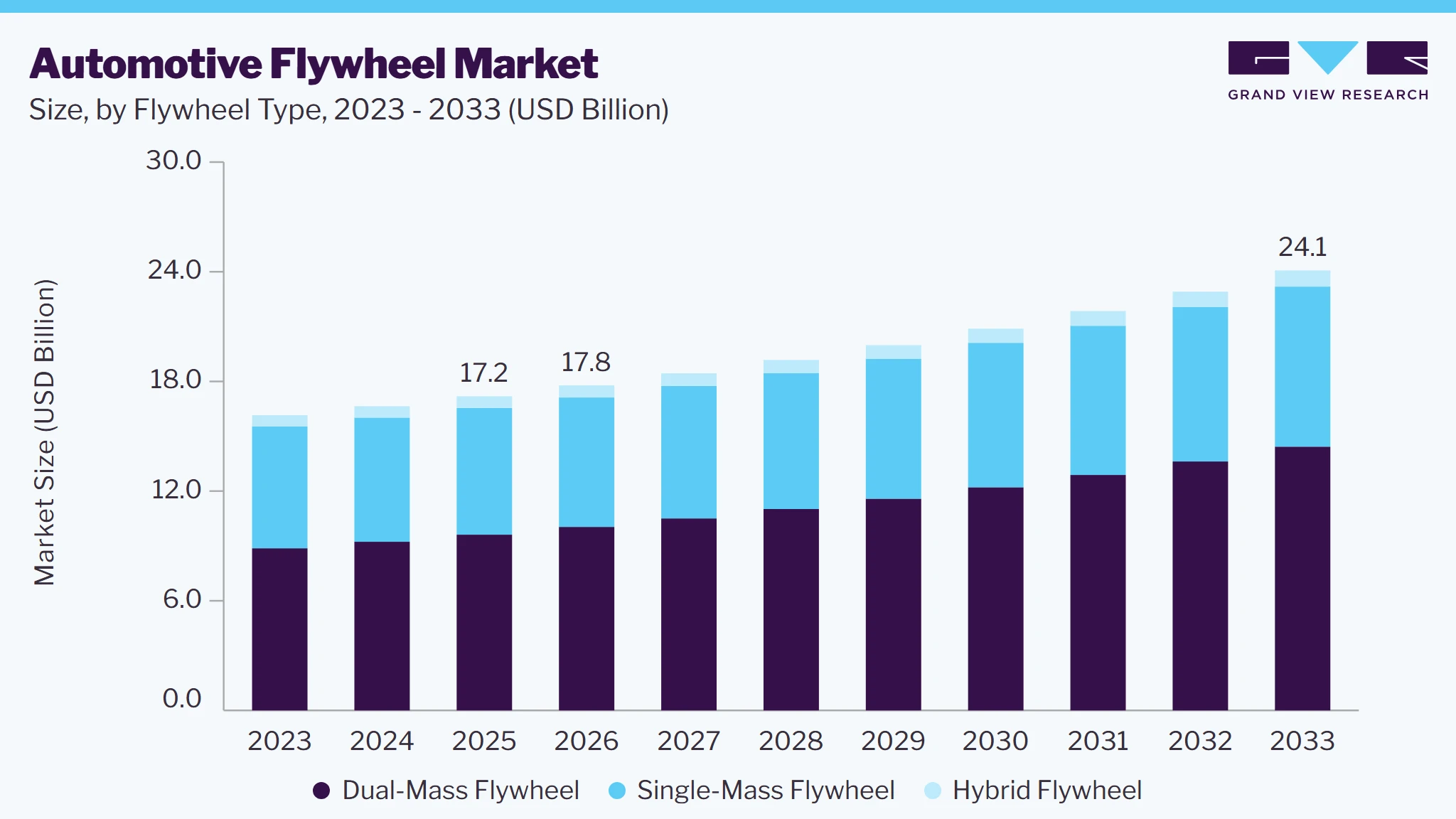
The global automotive flywheel market size was valued at USD 17.2 billion in 2025 and is projected to grow from USD 17.8 billion in 2026 to USD 24.1 billion by 2033, at a CAGR of 4.4% from 2026 to 2033. Asia Pacific dominated the market, accounting for the largest revenue share of 48.0% in 2025. The market is supported by continued global vehicle production, increasing demand for improved powertrain efficiency, growing adoption of advanced transmission systems, and rising emphasis on vibration and drivetrain performance.
 Source: Grand View Research, IR Documents, Primary Interviews, Paid DatabasesTo learn more about this report,
 Download Free Sample Report
Key Market Trends & Insights
- By flywheel type: The dual-mass flywheel segment held the largest market share of 55.9% in 2025.
- By vehicle type: The passenger cars segment held the largest market share of 61.7% in 2025.
- By powertrain: The diesel segment held the largest market share of 49.5% in 2025.
- By sales channel: The aftermarket segment held the largest market share of 56.8% in 2025.
Regional Highlights
- Largest regional market: Asia Pacific (48.0% revenue share, 2025)
- By country: The China dominated the Asia Pacific with the largest share in 2025.
Market Size & Forecast
- Market size in 2025: USD 17.2 Billion
- Estimated market size in 2026: USD 17.8 Billion
- Projected market size by 2033: USD 24.1 Billion
- CAGR (2026-2033): 4.4%
Prism AI by Grand View Research Free to tryAsk a question about the automotive flywheel marketTry asking✓Every figure cited from GVR research Prefer the report? Download free sample →Automotive flywheels play an important role in storing rotational energy, maintaining engine rotational stability, reducing torsional vibrations, and supporting smooth power transmission between the engine and transmission system.
Increasing integration of advanced dual-mass flywheels and lightweight drivetrain components is further influencing product demand across passenger cars, commercial vehicles, and off-highway applications.
The market is also being influenced by the transition toward electrified and hybrid powertrains. While conventional diesel and gasoline vehicles continue to account for a significant share of flywheel demand, hybrid powertrains are creating opportunities for specialized flywheel technologies and drivetrain components designed to accommodate shifting torque characteristics and operating conditions. Manufacturers are increasingly focusing on lightweight materials, improved durability, thermal resistance, and noise, vibration, and harshness (NVH) performance, as well as advanced manufacturing technologies to enhance flywheel efficiency and reliability. The aftermarket remains an important revenue channel owing to replacement demand associated with clutch and drivetrain maintenance.
 To learn more about this report, Download Free Sample Report
The automotive flywheel industry is experiencing steady expansion as vehicle manufacturers and component suppliers continue to improve drivetrain efficiency, durability, and NVH performance. Flywheels remain an important component in conventional internal combustion engine vehicles, particularly in manual and automated manual transmission systems, where they help stabilize engine rotation and facilitate smooth torque transfer. Increasing vehicle production across emerging economies, continued demand for commercial vehicles, and replacement requirements from the installed vehicle base are supporting market revenues.
Technological development is increasingly focused on dual-mass flywheels, lightweight construction, improved torsional vibration damping, and enhanced durability. Dual-mass flywheels are particularly important in modern powertrains because they help isolate engine-generated vibrations from the transmission and improve driving comfort. Increasing engine downsizing, turbocharging, higher torque output, and stricter NVH requirements are encouraging the adoption of advanced flywheel systems capable of managing higher torsional loads.
The transition toward hybrid powertrains is also creating a new area of development for flywheel manufacturers. Hybrid vehicles combine internal combustion engines with electric propulsion systems, resulting in different engine operating cycles, start-stop events, and torque delivery characteristics. These conditions are increasing the demand for drivetrain components capable of handling frequent powertrain transitions and changing operating loads. Meanwhile, aftermarket demand remains strong due to clutch replacement, drivetrain maintenance, vehicle aging, and replacement of worn flywheel assemblies.
Market Dynamics
Increasing global vehicle production remains a key factor supporting demand for automotive flywheels. Passenger cars, commercial vehicles, and off-highway vehicles equipped with internal combustion and hybrid powertrains require drivetrain components capable of managing engine torque, rotational energy, and torsional vibrations. As automotive manufacturers introduce more powerful and efficient engines, the requirement for flywheels with improved vibration damping, durability, and thermal performance is increasing.
The growing adoption of dual-mass flywheels is a key driver of market growth. Modern engines frequently operate at higher torque levels and utilize technologies such as turbocharging and downsizing, which can increase torsional vibration within the drivetrain. Dual-mass flywheels help isolate these vibrations and improve transmission performance and vehicle comfort. This makes them increasingly relevant in passenger vehicles and other applications where NVH performance is an important purchasing consideration.
In addition, rising vehicle ownership in emerging markets is expanding the installed vehicle base, generating both OEM and replacement demand. Growth in commercial transportation and industrial vehicle applications further contributes to demand for durable flywheel systems capable of operating under demanding load conditions.
The accelerating transition toward battery-electric vehicles represents a structural restraint on the automotive flywheel industry. Conventional flywheels are primarily associated with internal combustion engine powertrains, whereas fully electric vehicles generally do not require traditional engine flywheel assemblies because electric motors deliver torque differently and do not require the same rotational energy storage and vibration management functions.
As governments, automakers, and consumers increasingly adopt electric mobility, the long-term addressable market for conventional flywheel applications may face pressure. Battery electric vehicle penetration is particularly relevant in passenger cars, where electrification is progressing rapidly across several major automotive markets.
Furthermore, automotive suppliers must increasingly allocate research and development resources toward hybrid and electrified drivetrain technologies while maintaining competitive conventional product portfolios. This creates additional technology-transition challenges for flywheel manufacturers. However, the restraint is partially offset by continued demand for flywheels in internal combustion engines, hybrid vehicles, commercial vehicles, off-highway equipment, and the large installed vehicle base requiring replacement components.
The increasing adoption of hybrid vehicles presents a significant opportunity for automotive flywheel manufacturers. Hybrid powertrains involve frequent engine start-stop cycles, variable engine operating conditions, and complex interactions between combustion engines and electric motors. These characteristics create opportunities for specialized drivetrain components designed to manage torsional vibrations, transient torque loads, and repeated powertrain transitions.
The development of advanced dual-mass flywheels, lightweight flywheel assemblies, and higher-performance damping systems can enable suppliers to address these evolving requirements. Manufacturers are increasingly investing in materials engineering, precision manufacturing, improved damping mechanisms, and optimized component designs to reduce weight while maintaining durability and performance.
Another opportunity exists in the off-highway vehicle segment, where construction equipment, agricultural machinery, mining vehicles, and other heavy-duty applications require robust drivetrain components capable of operating under high-load and variable-duty conditions. Increasing equipment modernization and hybridization in off-highway applications can further support demand for specialized flywheel technologies.
Market Concentration & Characteristics
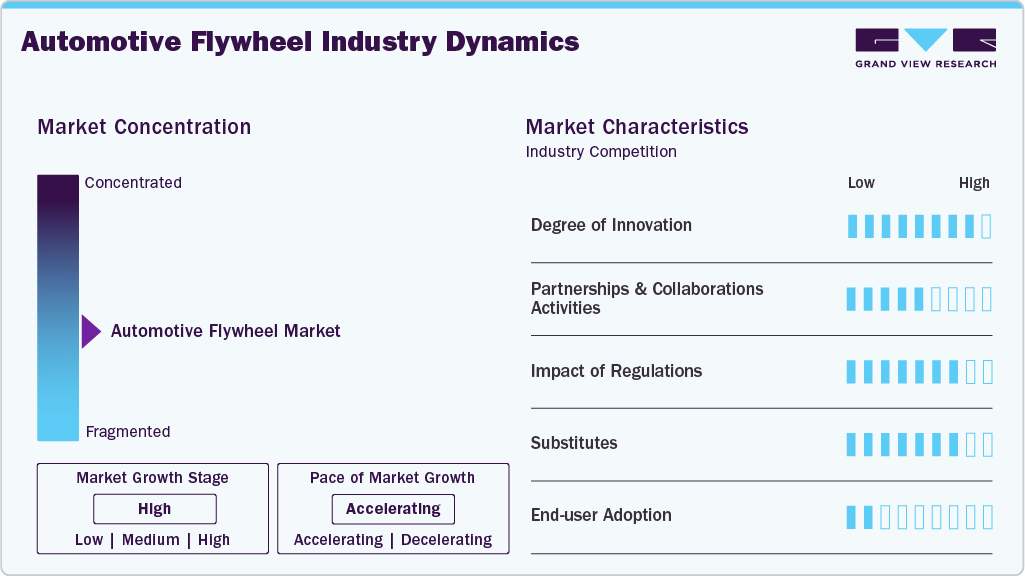
The automotive flywheel industry is characterized by the presence of established automotive component manufacturers with extensive relationships with global vehicle OEMs and aftermarket distributors. Leading participants compete through product durability, precision engineering, NVH performance, lightweight designs, manufacturing scale, technological innovation, and global production capabilities. Companies are increasingly focusing on advanced dual-mass flywheel systems, hybrid-compatible drivetrain components, and manufacturing technologies that improve efficiency and product reliability.
The market also benefits from a strong aftermarket ecosystem, in which replacement demand is driven by clutch wear, drivetrain maintenance, vehicle aging, and repair activities. Suppliers with established distribution networks and broad application coverage can capture recurring replacement demand across multiple vehicle categories.
 To learn more about this report, Download Free Sample Report
Competitive differentiation is increasingly shifting toward advanced damping technologies, lightweight construction, hybrid compatibility, manufacturing efficiency, and product customization. At the same time, electrification is encouraging suppliers to diversify their drivetrain portfolios and develop technologies that remain relevant across hybrid and other evolving powertrain architectures. Companies with strong OEM relationships, broad geographic coverage, engineering expertise, and aftermarket distribution capabilities are expected to maintain competitive advantages throughout the forecast period.
Analyst Perspective
The automotive flywheel market is expected to expand steadily, supported by vehicle production, replacement demand, and drivetrain advancements. Dual-mass flywheels remain a key segment due to their ability to reduce torsional vibrations, noise, and transmission shock. Hybrid powertrain adoption is also creating opportunities for specialized flywheel technologies. Competitive differentiation is increasingly focused on lightweight designs, improved damping, durability, and hybrid compatibility. Leading players such as Schaeffler, Valeo, ZF, Aisin, and EXEDY are strengthening their portfolios and aftermarket presence. Manufacturers are also investing in production efficiency and solutions suited to evolving vehicle architectures.
Flywheel Type Insights
The dual-mass flywheel segment led the market with the largest revenue share of 55.9% in 2025 and is also expected to grow at the fastest CAGR during the forecast period. Dual-mass flywheels are increasingly adopted in modern vehicles because they provide improved torsional vibration damping, smoother power transmission, reduced drivetrain noise, and enhanced driving comfort. The growing use of downsized and turbocharged engines, higher engine torque outputs, and increasingly stringent NVH requirements is supporting demand for advanced dual-mass systems. Their ability to isolate engine-generated vibrations from the transmission makes them particularly suitable for passenger cars and light commercial vehicles. Ongoing innovations in lightweight materials, damping mechanisms, and hybrid-compatible designs are further expanding their application potential.
The single-mass flywheel segment is anticipated to grow at a significant CAGR during the forecast period. Single-mass flywheels continue to see substantial demand due to their relatively simple construction, durability, lower replacement complexity, and suitability for applications where advanced vibration damping is less critical. They remain widely used in commercial vehicles, performance-oriented applications, older vehicle platforms, and cost-sensitive markets. The large installed base of vehicles equipped with single-mass systems also creates recurring replacement demand through the aftermarket. Continued demand for economical drivetrain components, particularly across emerging automotive markets, is expected to sustain the segment throughout the forecast period.
Vehicle Type Insights
The passenger cars segment led the market with the largest revenue share of 61.7% in 2025. Passenger vehicles represent a substantial application base for automotive flywheels due to their high global production volumes and increasing emphasis on driving comfort, drivetrain refinement, fuel efficiency, and NVH performance. Dual-mass flywheels are particularly relevant in passenger cars because they help reduce torsional vibrations and improve transmission smoothness. Increasing production of passenger vehicles across the Asia-Pacific region, together with continued replacement demand from the installed vehicle fleet, is expected to sustain the segment's dominance throughout the forecast period.
The off-highway vehicles segment is expected to grow at the fastest CAGR during the forecast period. Construction machinery, agricultural equipment, mining vehicles, and other off-highway applications require drivetrain components capable of handling high loads, variable operating conditions, and frequent torque fluctuations. Increasing modernization of off-highway equipment, growing adoption of automated and hybrid powertrains, and rising demand for fuel-efficient machinery are creating opportunities for advanced flywheel systems. The development of durable, lightweight flywheels specifically designed for heavy-duty and off-highway applications is expected to further accelerate growth in the segment.
Powertrain Insights
The diesel segment led the market with the largest revenue share of 49.5% in 2025. Diesel powertrains continue to represent an important source of flywheel demand, particularly across commercial vehicles, heavy-duty transportation, off-highway equipment, and regions where diesel-powered vehicles maintain a substantial installed base. Diesel engines generate high torque and significant torsional vibrations, underscoring the importance of drivetrain components capable of effectively managing these forces. Advanced flywheel systems, particularly dual-mass designs, are increasingly used to improve vibration isolation and transmission performance in high-torque diesel applications.
The hybrid segment is expected to grow at the fastest CAGR during the forecast period. Hybrid vehicles combine internal combustion engines with electric propulsion and frequently operate through engine start-stop cycles and changing torque delivery patterns. These characteristics create demand for drivetrain components capable of handling transient loads and torsional vibrations while enabling smooth transitions between propulsion modes. The growing adoption of hybrid vehicles and the continued development of hybrid-compatible dual-mass and lightweight flywheel technologies are expected to create substantial opportunities for suppliers.
Sales Channel Insights
The aftermarket segment led the market with the largest revenue share of 56.8% in 2025 and is anticipated to grow at the fastest CAGR during the forecast period. Aftermarket demand is primarily generated by vehicle aging, clutch and drivetrain maintenance, flywheel wear, replacement requirements, and repair activities. As the global installed vehicle base continues to mature, vehicle owners and repair workshops increasingly require replacement flywheel assemblies to restore drivetrain performance and extend vehicle operating life. The availability of replacement products through independent distributors, specialized automotive workshops, and, increasingly, online channels is further improving aftermarket accessibility. Industry research also identifies replacement demand as an important contributor to aftermarket growth.
 To learn more about this report, Download Free Sample Report
The OEM segment is expected to grow at a significant CAGR during the forecast period. OEM demand is closely linked to new vehicle production and the integration of flywheel systems into original powertrain architectures. Automotive manufacturers increasingly work with component suppliers to develop application-specific flywheels optimized for engine characteristics, transmission configurations, vehicle weight, torque requirements, and NVH targets. Supplier relationships with major vehicle manufacturers, therefore, remain strategically important. Growing vehicle production in the Asia Pacific and continued development of hybrid and advanced internal combustion powertrains are expected to sustain OEM demand throughout the forecast period.
Regional Insights
The automotive flywheel market in North America is expected to maintain a significant share throughout the forecast period, supported by high vehicle ownership, extensive commercial vehicle fleets, and robust aftermarket demand. The U.S. and Canada have extensive installed vehicle populations, generating replacement demand for drivetrain components. Commercial vehicles, pickup trucks, light trucks, and performance-oriented vehicles remain important application areas. Growing demand for improved fuel efficiency and drivetrain durability is encouraging manufacturers to develop lightweight and higher-performance flywheel technologies.
U.S. Automotive Flywheel Market Trends
The automotive flywheel market in the U.S. is the largest contributor to the North American market. Demand is supported by a large passenger-vehicle fleet, the commercial trucking industry, light-truck applications, and extensive aftermarket distribution networks. The replacement market remains important because aging vehicles require clutch and flywheel servicing. The growing development of hybrid vehicles is also creating opportunities for drivetrain suppliers to adapt component technologies to evolving powertrain architectures.
Asia Pacific Automotive Flywheel Market Trends
The Asia Pacific automotive flywheel market held the largest revenue share of 48.0% in 2025 and is also expected to grow at the fastest CAGR during the forecast period. The region's dominance is supported by its large automotive manufacturing base, high vehicle production volumes, expanding commercial vehicle fleets, and growing automotive aftermarket. China, Japan, India, and South Korea represent important manufacturing and consumption centers for automotive drivetrain components. Increasing vehicle production, particularly across passenger cars and commercial vehicles, continues to generate OEM demand for flywheel systems, while the growing installed vehicle base is supporting replacement demand through independent aftermarket channels. The region is also witnessing increasing adoption of dual-mass flywheels as automakers seek improved NVH performance and drivetrain refinement. Industry sources identify Asia Pacific as an important market for both single-mass and dual-mass flywheel applications, with OEM and aftermarket channels serving as key distribution channels.
 To learn more about this report, Download Free Sample Report
The automotive flywheel market in China accounted for the largest market revenue share in the Asia Pacific in 2025, due to its large-scale vehicle manufacturing industry, extensive supplier ecosystem, and substantial commercial vehicle fleet. Demand is supported by passenger vehicle production, commercial transportation, and replacement requirements from the country's large installed vehicle population. Automotive manufacturers and component suppliers are increasingly focusing on lightweight drivetrain components, improved torsional vibration management, and advanced dual-mass flywheel systems. The country's expanding hybrid vehicle market is also creating opportunities for specialized drivetrain components.
The India automotive flywheel market is anticipated to grow at a significant CAGR during the forecast period, driven by expanding passenger vehicle production, increasing commercial vehicle activity, rising vehicle ownership, and rapid development of the automotive aftermarket. Demand for flywheels is supported by both OEM vehicle production and replacement requirements across the large installed fleet. Growth in logistics, e-commerce, construction, and commercial transportation is additionally supporting demand for durable drivetrain components. Increasing adoption of higher-performance engines and advanced transmission systems is expected to create opportunities for dual-mass flywheel technologies.
The automotive flywheel market in Japan is anticipated to grow at a substantial CAGR during the forecast period, owing to its established automotive manufacturing industry, advanced drivetrain technologies, and strong presence of global automotive component suppliers. Japanese manufacturers have historically emphasized light weighting, precision engineering, drivetrain efficiency, and NVH optimization.
Europe Automotive Flywheel Market Trends
The automotive flywheel market in Europe held a significant market share of 23.0% in 2025. The region remains an important market due to its established automotive manufacturing base, high adoption of advanced drivetrain technologies, and strong aftermarket ecosystem. European automakers have historically placed significant emphasis on fuel efficiency, emissions reduction, driving comfort, and NVH performance, supporting the use of advanced dual-mass flywheel systems. Schaeffler notes that its LuK dual-mass flywheel technology was developed specifically to dampen torsional vibrations generated by combustion engines, and that the company supplies DMF applications for passenger cars and commercial vehicles.
The Germany automotive flywheel market is growing rapidly, owing to its extensive automotive manufacturing ecosystem and concentration of vehicle OEMs and Tier 1 component suppliers. Demand for advanced flywheels is supported by premium passenger vehicles, commercial vehicles, and technologically sophisticated powertrain platforms. The increasing emphasis on drivetrain refinement and vibration reduction continues to support the adoption of dual-mass flywheels. The large installed base of European vehicles also creates significant replacement demand through independent repair networks.
The automotive flywheel market in the UK is supported by passenger vehicle and commercial vehicle applications, as well as a well-developed vehicle repair and replacement ecosystem. The country's large installed vehicle fleet generates recurring aftermarket demand for flywheel and clutch replacement components. Growth in vehicle maintenance, independent workshops, and online automotive parts distribution is expected to support aftermarket sales throughout the forecast period.
Key Automotive Flywheel Company Insights
The automotive flywheel industry is characterized by competition among global automotive component manufacturers with strong OEM relationships, engineering capabilities, and aftermarket distribution networks. Companies are increasingly differentiating through advanced dual-mass flywheel technologies, improved torsional vibration damping, lightweight construction, precision manufacturing, and application-specific drivetrain solutions. Schaeffler's LuK portfolio, for instance, includes dual-mass flywheels and repair solutions for passenger cars, light and heavy commercial vehicles, and tractors, demonstrating the broad scope of applications for modern flywheel technologies.
-
Schaeffler AG / LuK is an automotive drivetrain component supplier and the developer of the LuK dual-mass flywheel technology. The company's portfolio includes dual-mass flywheels for passenger cars and commercial vehicles, as well as aftermarket repair solutions. Its extensive product portfolio and technical expertise in torsional vibration damping provide a strong competitive position.
-
Valeo SA competes through its broad powertrain and clutch-system portfolio, serving global automotive OEMs and aftermarket customers. Its drivetrain expertise positions the company to meet evolving requirements for efficient, refined powertrain systems.
Key Automotive Flywheel Companies
The following key companies have been profiled for this study on the automotive flywheel market
-
Schaeffler AG / LuK
-
Valeo SA
-
ZF Friedrichshafen AG / Sachs
-
Aisin Corporation
-
Exedy Corporation
-
BorgWarner Inc.
-
Linamar Corporation
-
American Axle & Manufacturing (AAM)
-
Magna International Inc.
-
Skyway Precision, Inc.
Competitive Benchmarking
Operating Strategies
Competitive Edge
Weaknesses
Mature Players: Schaeffler AG / LuK, Valeo SA, ZF Friedrichshafen AG / Sachs, Aisin Corporation, Exedy Corporation, BorgWarner Inc., Magna International Inc.
Mature players are expanding their automotive flywheel portfolios through advanced dual-mass flywheels, lightweight drivetrain components, improved torsional vibration damping, hybrid-compatible powertrain technologies, precision manufacturing, and expanded aftermarket repair solutions. Strategic priorities include strengthening OEM relationships, developing application-specific drivetrain systems, expanding global production capabilities, improving manufacturing efficiency, and adapting product portfolios to hybrid and evolving powertrain architectures.
Mature companies benefit from strong relationships with global vehicle manufacturers, extensive engineering capabilities, established manufacturing networks, broad product portfolios, global aftermarket distribution, and significant R&D resources. Their ability to integrate flywheel technologies with clutch, transmission, and broader drivetrain systems provides a significant competitive advantage.
Mature players face challenges, including high R&D and tooling requirements, dependence on automotive production cycles, exposure to raw material costs, the increasing electrification of passenger vehicles, stringent emissions requirements, and the need to continuously adapt conventional drivetrain portfolios to hybrid and emerging powertrain technologies.
Emerging Players: Linamar Corporation, American Axle & Manufacturing (AAM), Skyway Precision, Inc.
Emerging and specialized players focus on precision-machined drivetrain components, lightweight manufacturing, application-specific flywheel solutions, advanced materials, cost-efficient production, and flexible customer-specific engineering. Their strategies emphasize strengthening relationships with automotive OEMs and Tier 1 suppliers, expanding manufacturing capabilities, improving component precision, and supporting the evolving requirements of powertrains.
These companies gain competitive advantages through specialized manufacturing expertise, flexible production capabilities, customer-specific engineering, precision machining, competitive cost structures, and the ability to support niche or customized drivetrain applications.
Specialized players face challenges, including comparatively smaller global product portfolios, dependence on selected automotive customers, lower scale than diversified Tier 1 suppliers, exposure to vehicle production cycles, and significant investment requirements for advanced manufacturing and next-generation hybrid-compatible drivetrain technologies.
Recent Developments
-
In July 2026, Schaeffler announced that its Vehicle Lifetime Solutions division will showcase an integrated portfolio covering different drive types and repair solutions at Automechanika Frankfurt 2026. The initiative highlights Schaeffler’s focus on supporting increasingly complex drivetrains and maintaining its aftermarket product portfolio, including LuK dual-mass flywheels, which the company estimates are installed in approximately every second new car and transporter.
-
In February 2026, AISIN announced an investment of approximately ¥32 billion to expand its Indian production footprint and establish a new plant for local production of automatic and continuously variable transmissions. The move supports AISIN’s expansion in India's growing automotive market and reflects the shift from manual-transmission vehicles toward automated drivetrains, influencing the future mix of flywheel and damping technologies used in ICE and hybrid powertrains.
Automotive Flywheel Market Report Scope
Report Attribute
Details
Market size in 2025
USD 17.2 billion
Estimated market size in 2026
USD 17.8 billion
Projected market size by 2033
USD 24.1 billion
Growth rate
CAGR of 4.4% from 2026 to 2033
Base year for estimation
2025
Historical data
2021 - 2024
Forecast period
2026 - 2033
Quantitative units
Revenue in USD billion, and CAGR from 2026 to 2033
Report coverage
Revenue forecast, company ranking, competitive landscape, growth factors, and trends
Segments covered
Flywheel type, vehicle type, powertrain, sales channel, region
Regional scope
North America; Europe; Asia Pacific; Latin America; MEA
Country scope
U.S.; Canada; Mexico; Germany; UK; France; China; Japan; India; South Korea; Australia; Brazil; KSA; UAE; South Africa
Key companies profiled
Schaeffler AG / LuK; Valeo SA; ZF Friedrichshafen AG / Sachs; Aisin Corporation; Exedy Corporation; BorgWarner Inc.; Linamar Corporation; American Axle & Manufacturing (AAM); Magna International Inc.; Skyway Precision, Inc.
Customization scope
Free report customization (equivalent up to 8 analysts working days) with purchase. Addition or alteration to country, regional & segment scope.
Pricing and purchase options
Avail customized purchase options to meet your exact research needs. Explore purchase options
Global Automotive Flywheel Market Report Segmentation
This report forecasts revenue growth at the global, regional, and country levels and provides an analysis of the latest industry trends in each of the sub-segments from 2021 to 2033. For this study, Grand View Research has segmented the global automotive flywheel market report based on flywheel type, vehicle type, powertrain, sales channel, and region.
-
Flywheel Type Outlook (Revenue, USD Billion, 2021 - 2033)
-
Dual-Mass Flywheel
-
Single-Mass Flywheel
-
Hybrid Flywheel
-
-
Vehicle Type Outlook (Revenue, USD Billion, 2021 - 2033)
-
Passenger Cars
-
Medium & Heavy Commercial Vehicles
-
Light Commercial Vehicles
-
Off-Highway Vehicles
-
-
Powertrain Outlook (Revenue, USD Billion, 2021 - 2033)
-
Diesel
-
Gasoline
-
Hybrid
-
-
Sales Channel Outlook (Revenue, USD Billion, 2021 - 2033)
-
Aftermarket
-
OEM
-
-
Regional Outlook (Revenue, USD Billion, 2021 - 2033)
-
North America
-
U.S.
-
Canada
-
Mexico
-
-
Europe
-
Germany
-
UK
-
France
-
-
Asia Pacific
-
China
-
Japan
-
India
-
South Korea
-
Australia
-
-
Latin America
-
Brazil
-
-
Middle East and Africa (MEA)
-
KSA
-
UAE
-
South Africa
-
-
Research Methodology
The automotive flywheel marketfigures in this report are based on a proven research process that combines executive interviews with secondary research from proprietary databases, company filings, and recognized regulatory and institutional sources. Market size is built through value-chain sizing-reconciling supply-side and demand-side estimates-and triangulated with bottom-up and top-down approaches. Every estimate passes multiple levels of expert validation before publication, with eachautomotive flywheel segment quantified using the revenue-capture definitions in the table below.
Segment Definition
Segment - Flywheel Type
Revenue capture definition
Dual-Mass Flywheel
The segment revenue is generated from dual-mass flywheel systems incorporating primary and secondary masses with damping mechanisms to reduce torsional vibration, drivetrain noise, and transmission shock across passenger cars and commercial vehicles, particularly vehicles equipped with modern combustion and hybrid powertrains.
Single-Mass Flywheel
The segment revenue is generated from conventional single-mass flywheel systems used to store rotational energy, stabilize engine operation, and facilitate clutch engagement across passenger cars, commercial vehicles, and selected off-highway applications.
Hybrid Flywheel
The segment revenue is generated from flywheel systems engineered for hybrid powertrains, including solutions designed to manage higher torque fluctuations, improve drivetrain efficiency, and support integration between internal combustion engines and electric propulsion systems.
Segment - Vehicle Type
Revenue capture definition
Passenger Cars
The segment revenue is generated from automotive flywheels installed in passenger vehicles to support engine operation, clutch engagement, vibration damping, and drivetrain performance across conventional and hybrid vehicle platforms.
Medium & Heavy Commercial Vehicles
The segment revenue is generated from flywheel systems used in medium- and heavy-duty trucks and commercial vehicles requiring high torque capacity, durability, vibration control, and reliable drivetrain performance under demanding operating conditions.
Light Commercial Vehicles
The segment revenue is generated from flywheel systems installed in light commercial vehicles, including vans, pickups, and small trucks, supporting efficient power transmission, clutch operation, and drivetrain durability.
Off-Highway Vehicles
The segment revenue is generated from flywheel systems deployed in construction equipment, agricultural machinery, mining vehicles, and other off-highway applications requiring high durability, torque management, and reliable operation under demanding conditions.
Segment - Powertrain
Revenue capture definition
Diesel
The segment revenue is generated from flywheel systems used with diesel powertrains in passenger cars, commercial vehicles, and off-highway equipment to manage engine torque fluctuations, support clutch engagement, and improve drivetrain smoothness.
Gasoline
The segment revenue is generated from flywheel systems deployed in gasoline-powered vehicles to provide rotational energy storage, engine speed stabilization, clutch engagement, and drivetrain vibration management.
Hybrid
The segment revenue is generated from flywheel systems integrated into hybrid powertrains to support torque management and drivetrain performance across vehicles combining internal combustion engines with electric propulsion technologies.
Segment - Sales Channel
Revenue capture definition
Aftermarket
The segment revenue is generated from replacement and retrofit automotive flywheel sales through authorized distributors, independent aftermarket suppliers, repair shops, automotive parts retailers, and online channels serving vehicle owners and service providers.
OEM
The segment revenue is generated from automotive flywheel systems supplied directly to vehicle manufacturers or Tier-1 drivetrain suppliers for factory installation in new passenger cars, commercial vehicles, and off-highway vehicles.
Estimation Model
Layer Name
Key Question
Description
Vehicle Production & Drivetrain Assessment
Where is the demand for automotive flywheels generated?
This layer evaluates global vehicle production, vehicle parc, powertrain mix, transmission configurations, commercial vehicle production, and off-highway equipment volumes to estimate the addressable installation base for automotive flywheel systems across major markets.
Technology & Product Mapping
Which flywheel technologies are being deployed?
This layer analyzes adoption across dual-mass, single-mass, and hybrid flywheel technologies, incorporating vehicle type, powertrain configuration, drivetrain requirements, vibration-damping technologies, and technology migration trends to estimate demand by product category.
OEM & Aftermarket Supply Analysis
How is market supply structured?
This layer evaluates leading flywheel manufacturers, Tier-1 drivetrain suppliers, OEM supply relationships, aftermarket distributors, manufacturing capabilities, product portfolios, pricing structures, and regional distribution networks influencing overall market revenue.
Market Revenue Forecast
What is the future revenue potential of the market?
This layer integrates vehicle production forecasts, powertrain trends, hybrid vehicle penetration, replacement demand, average selling prices, flywheel installation rates, supplier revenues, and regional automotive industry outlooks to estimate market revenue across all major segments and regions.
Delivered Customizations
This report has been delivered with the following In-depth customizations
Client Request
Customization Delivered
Value Adds
Automotive OEM / Vehicle Manufacturer
Evaluation of automotive flywheel demand by vehicle type, powertrain, and transmission configuration
Analysis of dual-mass, single-mass, and hybrid flywheel adoption across passenger cars and commercial vehicles
Assessment of OEM sourcing strategies and supplier capabilities
Supported drivetrain component sourcing and supplier evaluation
Identified opportunities associated with hybrid powertrain adoption
Enabled assessment of flywheel technology requirements across vehicle platforms
Automotive Tier-1 Drivetrain Component Supplier
Benchmarking of flywheel technologies, manufacturing capabilities, and product portfolios
Analysis of OEM and aftermarket demand across major regions
Evaluation of lightweight materials, vibration-damping technologies, and hybrid-compatible flywheel solutions
Identified technology and product expansion opportunities
Supported competitive positioning and portfolio planning
Enabled assessment of high-growth vehicle and powertrain segments
Automotive Aftermarket / Replacement Parts Company
Evaluation of aftermarket flywheel demand by vehicle type and powertrain
Analysis of replacement cycles and demand across major automotive markets
Assessment of product coverage and distribution opportunities for dual-mass and single-mass flywheels
Identified high-potential aftermarket applications
Supported product portfolio expansion and market-entry planning
Enabled prioritization of high-demand vehicle categories and regions
Frequently Asked Questions About This Report
Key factors include increasing vehicle production, growing adoption of dual-mass flywheels, rising demand for improved NVH performance, increasing commercial vehicle activity, expansion of the automotive aftermarket, and development of hybrid powertrains requiring advanced drivetrain components.
The global automotive flywheel market is projected to expand at a CAGR of 4.4% from 2026 to 2033, reaching approximately USD 24.1 billion by 2033.
The global automotive flywheel market was valued at USD 17.2 billion in 2025 and is estimated to reach USD 17.8 billion in 2026.
Asia Pacific dominated the market with a 48.0% share in 2025, supported by its large automotive manufacturing base, high vehicle production volumes, expanding commercial vehicle fleet, and growing automotive aftermarket.
Asia Pacific is expected to register the fastest growth during the forecast period, supported by expanding automotive production, increasing vehicle ownership, aftermarket development, and growing adoption of advanced drivetrain technologies.
The dual-mass flywheel segment accounted for the largest share of 55.9% in 2025 and is also expected to register the fastest CAGR during the forecast period.
Passenger cars accounted for the largest market share in 2025 due to their high global production volumes and extensive installed vehicle base.
Off-highway vehicles are expected to register the fastest growth during the forecast period, supported by demand for durable drivetrain components in construction, agriculture, mining, and other heavy-duty applications.
Major companies include Schaeffler AG / LuK, Valeo SA, ZF Friedrichshafen AG / Sachs, Aisin Corporation, Exedy Corporation, BorgWarner Inc., Linamar Corporation, American Axle & Manufacturing (AAM), Magna International Inc., and Skyway Precision, Inc.
About the Author(s)
Automotive & Transportation Research Team
Technology · Automotive & TransportationThis report was authored by the automotive & transportation research team at Grand View Research - comprising two research analysts, one senior research analyst, and one industry expert - with specialized expertise in the automotive & transportation segment of the technology industry. All findings are based on proprietary technology databases, executive interviews, and regulatory analysis, subject to internal peer review prior to publication.
Last Updated:
Speak to Analyst

Customize this report to your needs - add regions, segments, or data points, with 20% free customization.
Or view our licence options:


ISO 9001:2015 & 27001:2022 Certified
We are GDPR and CCPA compliant! Your transaction & personal information is safe and secure. For more details, please read our privacy policy.


