
- Home
- »
- Automotive & Transportation
- »
-
Automotive Multi-camera System Market Size Report, 2033GVR Report cover
![Automotive Multi-camera System Market (2026 - 2033)Report]()
Automotive Multi-camera System Market (2026 - 2033)
Size, Share & Trends Analysis Report By Vehicle (Passenger Vehicles, Commercial Vehicles), By View (2D View Type, 3D View Type), By Application, By Region, And Segment Forecasts
Market Size, 2025
$3.2BMarket Estimate, 2026
$3.6BMarket Forecast, 2033
$10.7BCAGR, 2026–2033
16.7%Automotive Multi-camera System Market Summary
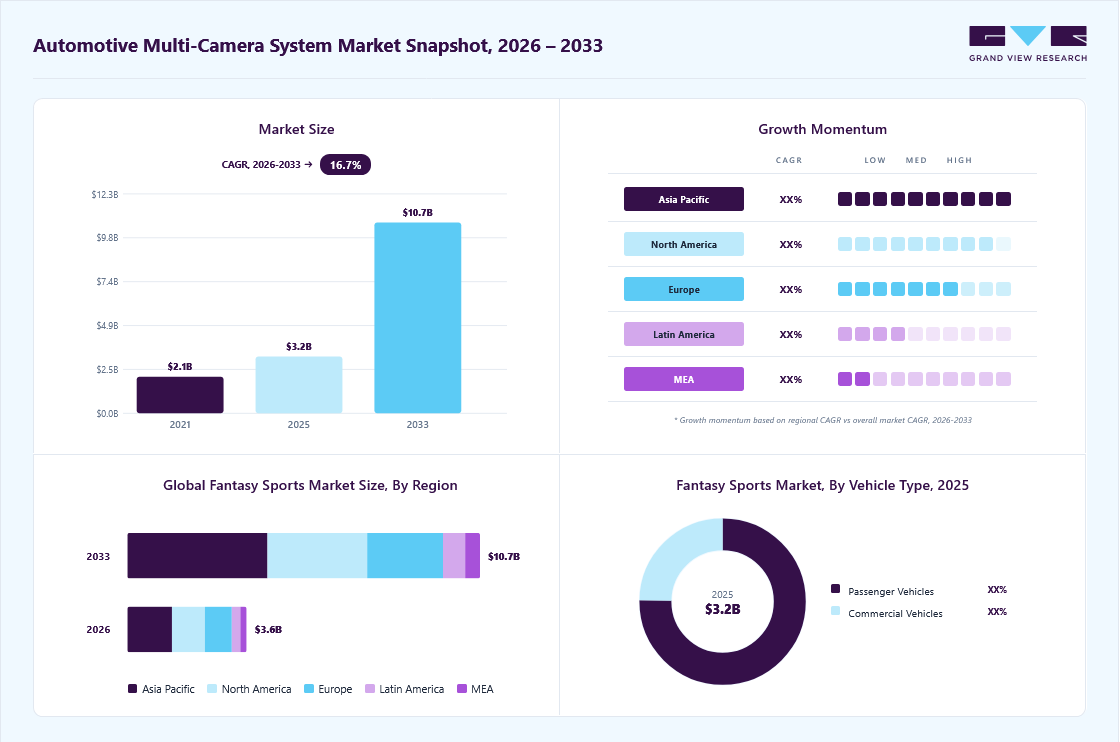
The global automotive multi-camera system market size was valued at USD 3.2 billion in 2025 and is projected to grow from USD 3.6 billion in 2026 to USD 10.7 billion by 2033, at a CAGR of 16.7% from 2026 to 2033. Asia Pacific dominated the global market with the largest revenue share of 37.1% in 2025. The increasing emphasis on Advanced Driver-Assistance Systems (ADAS) is a major factor contributing to the market growth.
Key Market Trends & Insights
- By vehicle: Passenger vehicles segment dominated the market, with a revenue share of 75.2% in 2025.
- By view: 2D view type segment held the largest market share of 59.2% in 2025.
- By application: Parking assist system segment held the largest market share of 31.2% in 2025.
Regional Highlights
- Largest regional market: Asia Pacific (37.1% revenue share, 2025)
- By country: The U.S. held the largest market share in 2025.
Market Size & Forecast
- Market size in 2025: USD 3.2 Billion
- Estimated market size in 2026: USD 3.6 Billion
- Projected market size by 2033: USD 10.7 Billion
- CAGR (2026-2033): 16.7%
These systems rely heavily on multi-camera setups to provide real-time data and enhance safety features such as lane-keeping assistance, adaptive cruise control, and automated parking. As governments worldwide introduce stricter safety regulations, automakers are integrating more sophisticated camera systems to meet these requirements, thereby fueling market expansion. The rising consumer demand for enhanced driving experiences is another key trend propelling the adoption of multi-camera systems. Modern drivers seek vehicles equipped with advanced technology that offers better visibility, easier maneuvering, and a more immersive experience. Multi-camera systems provide comprehensive views around the vehicle, assisting in detecting obstacles, pedestrians, and other vehicles. This significantly improves the overall driving experience and safety, making these systems highly desirable among consumers. Consequently, automakers are incorporating more multi-camera systems into their vehicles to meet this growing demand.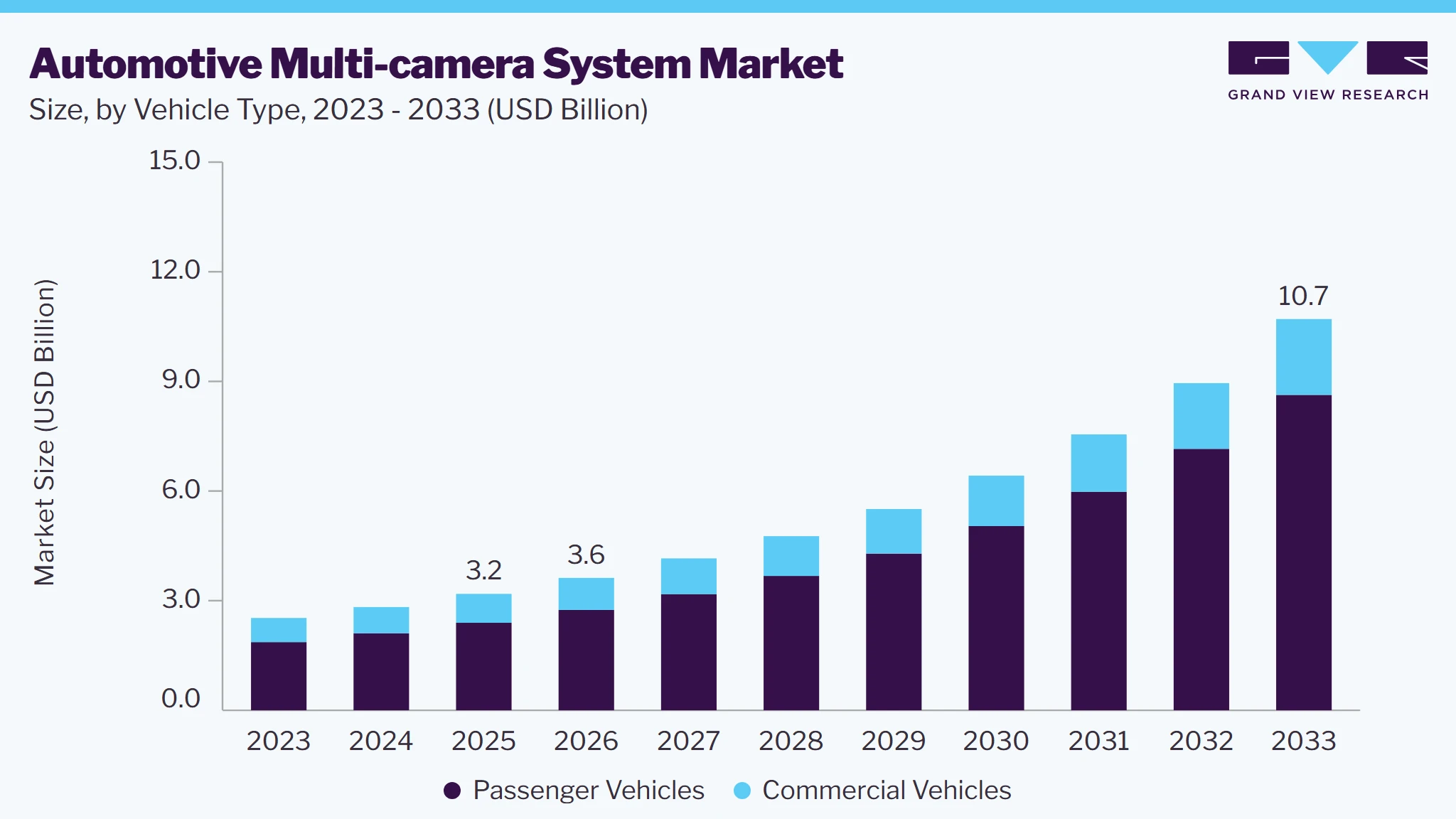
The advent of autonomous vehicles is a crucial trend influencing market growth. Autonomous driving technology requires a multitude of sensors and cameras to navigate and interpret the driving environment accurately. Multi-camera systems are essential for enabling the high-level perception capabilities needed for safe and efficient autonomous vehicle operation. As the development and deployment of autonomous vehicles accelerate, the demand for these camera systems is expected to rise substantially. This trend is driving investment in advanced multi-camera technologies, further boosting market growth.
Technological advancements in camera and image processing technologies are enhancing the capabilities of automotive multi-camera systems. Innovations such as high-definition cameras, improved image sensors, and advanced algorithms for image stitching and processing are making these systems more reliable and effective. These technological improvements are making multi-camera systems more attractive to both manufacturers and consumers. As a result, the adoption of these advanced systems is increasing, driving market growth. In addition, ongoing research and development efforts are expected to bring even more sophisticated camera technologies to the market in the near future.
The growing popularity of electric vehicles (EVs) is contributing to the increased adoption of multi-camera systems. EV manufacturers are keen to differentiate their products with cutting-edge technology, including advanced safety and driver-assistance features. Multi-camera systems are becoming a standard feature in many new EV models, driven by the need to provide a high-tech, safe, and user-friendly driving experience. This trend is expected to continue as the EV market expands, further driving the market growth. The integration of these systems into EVs also aligns with the broader industry push towards smarter, more connected vehicles, which is a key factor in the market's upward trajectory.
Market Dynamics
The automotive multi-camera system market is experiencing strong growth, driven by increasing adoption of advanced driver assistance systems (ADAS), expanding vehicle safety regulations, and the automotive industry's transition toward autonomous and connected mobility. Advances in camera sensors, image processing technologies, artificial intelligence, and computer vision are enabling automakers to deploy sophisticated multi-camera architectures that enhance situational awareness and driving safety. Rising consumer demand for premium safety features, coupled with regulatory mandates for collision-avoidance and driver-assistance technologies, is further accelerating market adoption.
Automotive manufacturers are increasingly integrating ADAS technologies to improve vehicle safety, reduce accident rates, and comply with evolving regulatory requirements. Modern vehicles require comprehensive environmental perception capabilities to support features such as lane-keeping assistance, blind-spot monitoring, automated parking, collision avoidance, and driver-monitoring systems. Traditional single-camera solutions often provide limited field-of-view coverage and may not deliver sufficient situational awareness for advanced safety applications. Consequently, automakers are adopting multi-camera architectures that enable more comprehensive monitoring of the vehicle's surroundings.
Automotive multi-camera systems address these challenges by combining inputs from multiple cameras positioned around the vehicle to create a unified view of the driving environment. Advanced image stitching, object detection, and computer vision algorithms enable enhanced visibility, improved obstacle recognition, and more accurate ADAS functionality. These systems significantly improve vehicle safety performance and support the deployment of increasingly sophisticated driver assistance features. As ADAS penetration continues to rise across both premium and mass-market vehicles, demand for multi-camera systems is expected to accelerate substantially.
The high cost of deploying multi-camera systems restrains the growth of the market. Automotive multi-camera systems require multiple high-resolution cameras, image processing units, sensors, software platforms, wiring architectures, and advanced electronic control units (ECUs). The integration of these components into vehicle platforms often increases overall system complexity and development costs. Additionally, manufacturers must ensure compliance with stringent automotive reliability, safety, and performance standards, further increasing engineering and validation expenses.
This restraint is particularly evident in the economy and entry-level vehicle segments, where cost sensitivity remains a critical purchasing factor. Emerging automotive markets may also experience slower adoption due to affordability constraints and lower consumer willingness to pay for advanced safety technologies. While premium vehicle manufacturers can more easily absorb these costs, broader penetration into mass-market vehicle categories may be constrained until component prices decline and economies of scale improve. These factors can moderate the pace of adoption, particularly in developing regions.
The rapid advancement of autonomous driving technologies presents an opportunity for the automotive multi-camera system market. Autonomous and semi-autonomous vehicles require comprehensive environmental sensing capabilities to navigate complex road conditions and dynamic traffic environments safely. As automakers and technology companies continue investing in higher levels of vehicle automation, the demand for advanced perception systems capable of delivering real-time situational awareness is increasing significantly.
Multi-camera systems play a critical role in autonomous driving architectures by providing high-resolution visual data for object detection, lane recognition, traffic sign identification, pedestrian monitoring, and path planning functions. Vendors offering advanced camera modules, image processors, AI-enabled perception software, and sensor fusion technologies are particularly well-positioned to capitalize on this opportunity. Passenger vehicles equipped with Level 2+, Level 3, and future autonomous driving capabilities are expected to become key growth segments, creating substantial long-term demand for sophisticated multi-camera solutions.
Analyst Perspective
The automotive multi-camera system market is emerging as a critical component of the broader ADAS and autonomous vehicle ecosystem, driven by increasing regulatory emphasis on vehicle safety and growing consumer demand for intelligent driving assistance technologies. Advances in camera resolution, AI-powered image processing, sensor fusion, and computer vision are significantly enhancing system capabilities and enabling more sophisticated safety applications. Automakers are increasingly transitioning from isolated camera deployments to integrated multi-camera architectures that support advanced perception and environmental awareness functions. Competitive activity is intensifying as traditional automotive suppliers, semiconductor companies, and imaging technology providers invest heavily in next-generation vision systems.
Vehicle Insights
Based on vehicle, the passenger vehicles segment led the market with the largest revenue share of 75.2% in 2025. The growing consumer demand for enhanced safety and convenience features is a primary driver contributing to the growth of the segment. ADAS incorporating multi-camera setups are increasingly sought after for their ability to provide comprehensive views around the vehicle and enhance overall driving safety. In addition, the rise of autonomous driving technology is pushing manufacturers to integrate more sophisticated camera systems to support high-level perception capabilities. As a result, the adoption of multi-camera systems in passenger vehicles is on the rise, fuelled by both regulatory requirements and consumer preferences.
The commercial vehicles segment is expected to register at a significant CAGR from 2026 to 2033. Commercial vehicles, such as trucks and buses, benefit greatly from multi-camera setups that enhance driver visibility, reduce blind spots, and prevent accidents. Fleet operators are increasingly investing in these technologies to minimize downtime, lower insurance costs, and improve overall safety records. Moreover, the implementation of regulatory mandates for commercial vehicle safety systems in various regions is driving the uptake of multi-camera systems. The growth of e-commerce and the consequent expansion of delivery and logistics fleets also contribute to the demand for advanced camera systems, as they play a crucial role in ensuring timely and secure deliveries.
View Insights
Based on view, the 2D view type segment led the market with the largest revenue share of 59.2% in 2025. The 2D view segment continues to grow, primarily driven by its cost-effectiveness and adequate performance for basic safety and convenience features. 2D camera systems are widely used in applications such as rearview cameras, blind-spot detection, and lane departure warnings, providing essential visual support to drivers. These systems remain popular in entry-level and mid-range vehicles where affordability is a key consideration. The simplicity and reliability of 2D camera systems make them an attractive option for manufacturers looking to offer safety features without significantly increasing vehicle costs. As a result, while the market is increasingly leaning towards 3D view systems for advanced functionalities, the 2D view segment maintains a strong presence due to its practicality and cost benefits.
The 3D view type segment is expected to grow at a significant CAGR from 2025 to 2033. The increasing demand for advanced visibility while driving and lane parking is a significant factor contributing to the growth of the segment. 3D camera systems offer superior depth perception and spatial awareness, which are crucial for features such as automated parking, 360-degree surround view, and obstacle detection. The rapid advancements in image processing technology and the growing consumer preference for high-tech, safety-oriented vehicle features further boost the adoption of 3D view systems.
Application Insights
Based on application, the parking assist system led the market with the largest revenue share of 31.2% in 2025 and is expected to retain its dominance. Increasing urbanization and the consequent rise in parking challenges are major drivers contributing to the growth of the segment. Consumers are increasingly seeking vehicles equipped with advanced technologies that simplify parking in tight spaces. Multi-camera systems offer superior accuracy and a 360-degree view, making parking assist systems highly desirable. In addition, the integration of automated parking features in mid-range and luxury vehicles is boosting the adoption of these systems, catering to consumer demands for convenience and safety.
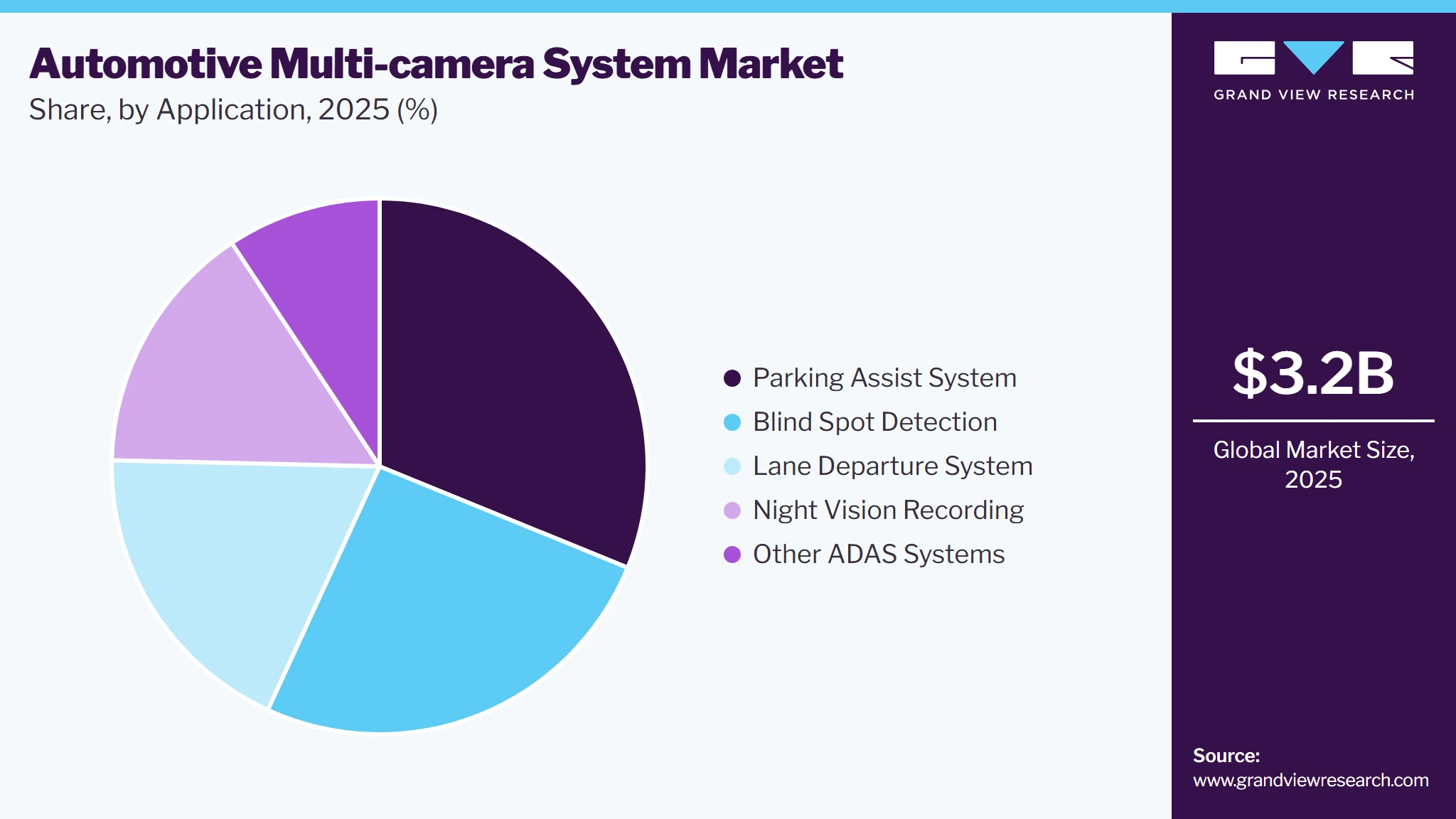
The blind spot detection segment is expected to grow at a significant CAGR from 2026 to 2033. Blind spot detection systems significantly reduce the risk of accidents by alerting drivers to vehicles or obstacles in their blind spots. As safety regulations become more stringent worldwide, automakers are compelled to integrate these systems into their vehicles. The growing consumer awareness and demand for safer driving experiences further propel the adoption of blind spot detection technology. Technological advancements in multi-camera systems, which enhance the accuracy and reliability of blind spot detection, also contribute to the segment's growth, making these systems a standard feature in modern vehicles.
Regional Insights
The automotive multi-camera system market in North America is anticipated to register at a significant CAGR from 2026 to 2033. The high rate of vehicle production and technological innovation in the automotive sector further fuels market growth, with major automakers integrating these systems into both passenger vehicles and commercial fleets. In addition, the emphasis on reducing accidents and enhancing the overall driving experience contributes to the market's prominence, positioning North America as a pivotal hub for advancements and deployments in automotive camera technology.
U.S. Automotive Multi-camera System Market Trends
The automotive multi-camera system market in U.S. is anticipated to register at a significant CAGR from 2026 to 2033. The strong focus on innovation and technological advancements in vehicle safety features further fuels the demand for multi-camera systems. The growing trend of integrating advanced safety features in both premium and mid-range vehicles is a key driver in the U.S. market.
Asia Pacific Automotive Multi-camera System Market Trends
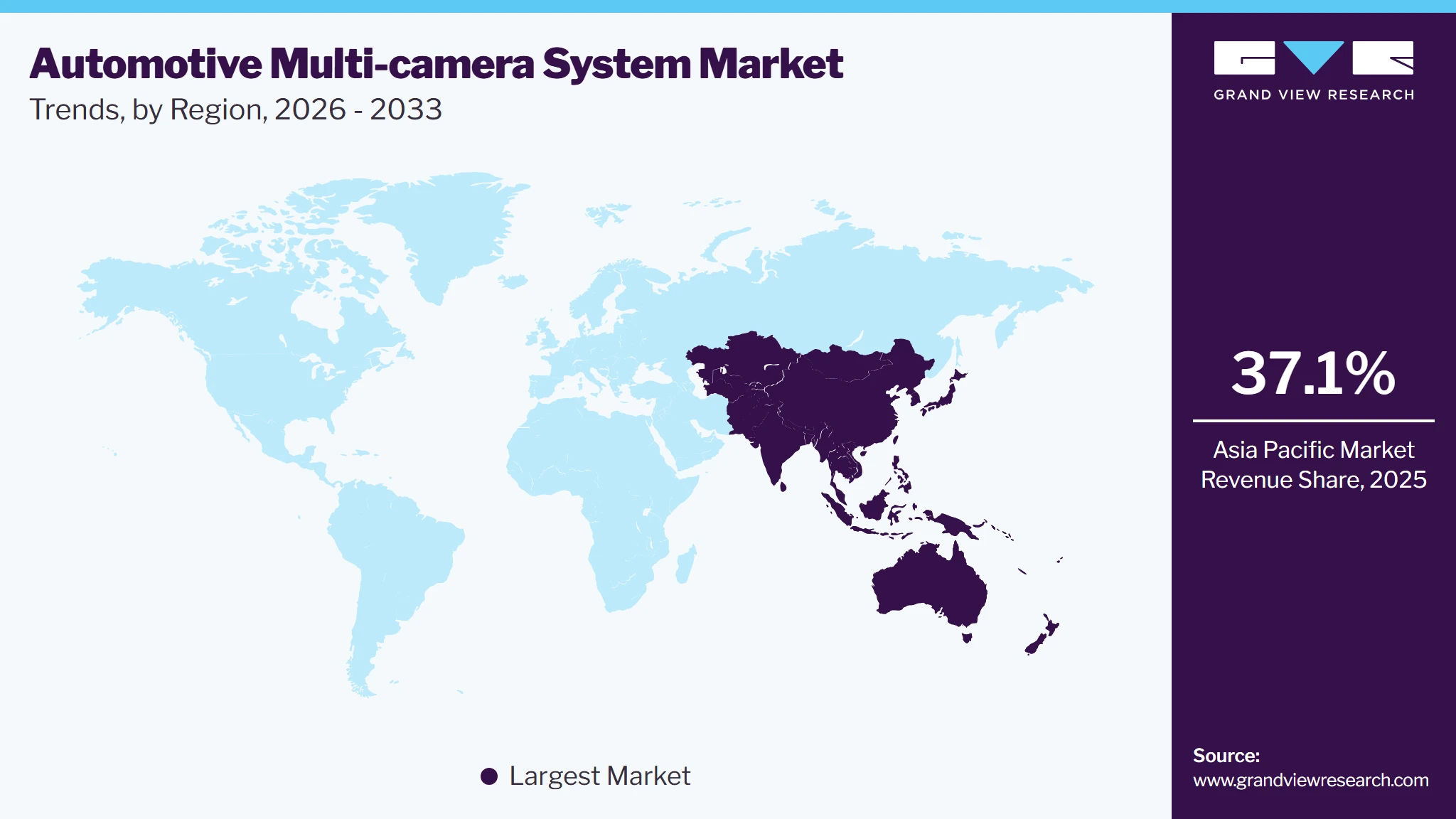
Asia Pacific dominated the global automotive multi-camera system market with the largest revenue share of 37.1% in 2025. The Asia Pacific region registers the largest share in the global market due to its significant automotive manufacturing industry. Countries such as China, Japan, and South Korea are home to some of the world's largest automakers, driving high demand for advanced vehicle technologies. In addition, the growing middle-class population and increasing urbanization in the region are boosting consumer demand for vehicles equipped with advanced safety and convenience features, including multi-camera systems.
Europe Automotive Multi-camera System Market Trends
The automotive multi-camera system market in Europe is anticipated to grow at a significant CAGR from 2026 to 2033. The presence of major automotive manufacturers and a well-established automotive industry further supports the demand for multi-camera systems. In addition, the growing trend towards autonomous driving and the integration of advanced safety features in vehicles are key factors driving the market growth in Europe.
Key Automotive Multi-camera System Company Insights
Key players operating in the global market include Robert Bosch GmbH.,Continental AG, DENSO TEN Limited,Magna International Inc, Motherson, Valeo SA, Faurecia Clarion, NXP Semiconductors., OMNIVISION, and Advanced Micro Devices, Inc. These companies focus on continuous research and development to enhance camera resolution, integration capabilities, and software algorithms for advanced features such as object detection and automated parking. In addition, partnerships with automotive OEMs and technology firms are crucial for expanding market presence and integrating multi-camera systems into next-generation vehicles. Several companies in the market are focusing on introducing advanced multi-camera systems with enhanced features
Key Automotive Multi-camera System Companies:
The following key companies have been profiled for this study on the automotive multi-camera system market.
-
Robert Bosch GmbH
-
Continental AG
-
DENSO TEN Limited
-
Magna International Inc.
-
Motherson
-
Valeo SA
-
Faurecia Clarion
-
NXP Semiconductors
-
OMNIVISION
-
Advanced Micro Devices, Inc.
Competitive Benchmarking
Category
Operating Strategies
Competitive Edge
Weakness
Established Players (Robert Bosch GmbH, Continental AG, Magna International Inc.)
- Focus on expanding ADAS portfolios, camera sensor innovation, AI-powered perception systems, strategic OEM partnerships, sensor fusion technologies, and autonomous driving platforms.
- These companies emphasize end-to-end automotive vision ecosystems and large-scale OEM integration.
- Strong global automotive relationships, extensive product portfolios, advanced R&D capabilities, manufacturing scale, established automotive certifications, and broad expertise in vehicle electronics and safety systems.
- High R&D expenditure requirements, long automotive design cycles, dependence on vehicle production volumes, and increasing competitive pressure from emerging autonomous driving technology providers.
Emerging Players (DENSO TEN Limited)
- Focus on specialized imaging technologies, embedded processing platforms, cockpit electronics integration, AI acceleration technologies, and targeted ADAS innovation.
- These companies emphasize technological differentiation and strategic collaboration with automotive OEMs and Tier-1 suppliers.
- Strong expertise in niche technologies, agile innovation capabilities, advanced processing architectures, and opportunities to leverage specialized competencies within rapidly evolving automotive ecosystems.
- Limited market share in automotive multi-camera systems, narrower product portfolios in certain segments, and lower penetration in global OEM programs compared to market leaders.
Recent Developments
- In March 2023, ZF Friedrichshafen AG launched its latest innovation, the Smart Camera 6. This advanced camera system is designed to enhance the development of automated driving and safety systems for urban and highway environments. It boasts a wide 120-degree field of view and a significant upgrade in image resolution to 8 megapixels, which is more than four times higher than its predecessor. The Smart Camera 6 also features enhanced processing power, enabling it to support sophisticated functions such as 3D surround view and interior monitoring systems
Automotive Multi-camera System Market Report Scope
Report Attribute
Details
Market size in 2025
USD 3.2 billion
Estimated market size in 2026
USD 3.6 billion
Projected market size by 2033
USD 10.7 billion
Growth rate
CAGR of 16.7% from 2026 to 2033
Base year for estimation
2025
Historical data
2021 - 2024
Forecast period
2026 - 2033
Quantitative units
Revenue in USD million/billion and CAGR from 2026 to 2033
Report coverage
Revenue forecast, company ranking, competitive landscape, growth factors, and trends
Segments covered
Vehicle, view, application, region
Regional scope
North America; Europe; Asia Pacific; Latin America; MEA
Country scope
U.S.; Canada; Mexico; U.K.; Germany; France; China; Japan; India; Australia; South Korea; Brazil; Saudi Arabia ; UAE; South Africa
Key companies profiled
Robert Bosch GmbH; Continental AG; DENSO TEN Limited; Magna International Inc.; Motherson; Valeo SA; Faurecia Clarion; NXP Semiconductors; OMNIVISION; Advanced Micro Devices, Inc.
Customization scope
Free report customization (equivalent up to 8 analysts' working days) with purchase. Addition or alteration to country, regional & segment scope.
Pricing and purchase options
Avail customized purchase options to meet your exact research needs. Explore purchase options
Global Automotive Multi-camera System Market Report Segmentation
The report forecasts revenue growth at global, regional, and country levels and provides an analysis of the latest industry trends in each of the sub-segments from 2021 to 2033. For this study, Grand View Research has segmented the global automotive multi-camera system market report based on vehicle, view, application, and region.
-
Vehicle Outlook (Revenue, USD Million, 2021 - 2033)
-
Passenger Vehicles
-
Commercial Vehicles
-
-
View Outlook (Revenue, USD Million, 2021 - 2033)
-
2D View Type
-
3D View Type
-
-
Application Outlook (Revenue, USD Million, 2021 - 2033)
-
Night Vision Recording
-
Parking Assist System
-
Blind Spot Detection
-
Lane Departure System
-
Other ADAS Systems
-
-
Regional Outlook (Revenue, USD Million, 2021 - 2033)
-
North America
-
U.S.
-
Canada
-
Mexico
-
-
Europe
-
UK
-
Germany
-
France
-
-
Asia Pacific
-
China
-
India
-
Japan
-
South Korea
-
Australia
-
-
Latin America
-
Brazil
-
-
Middle East & Africa (MEA)
-
Kingdom of Saudi Arabia (KSA)
-
UAE
-
South Africa
-
-
Research Methodology
The automotive multi-camera system market figures in this report are based on a proven research process that combines executive interviews with secondary research from proprietary databases, company filings, and recognized regulatory and institutional sources. Market size is built through value-chain sizing - reconciling supply-side and demand-side estimates - and triangulated with bottom-up and top-down approaches. Every estimate passes multiple levels of expert validation before publication, with each automotive multi-camera system segment quantified using the revenue-capture definitions in the table below.
Segment Definition
Segment - Vehicle
Revenue capture definition
Passenger Vehicles
Revenue generated from the sale of automotive multi-camera systems integrated into passenger cars, SUVs, crossovers, and luxury vehicles. This includes camera modules, surround-view systems, image processing units, and software licenses.
Commercial Vehicles
Revenue generated from multi-camera systems deployed in trucks, buses, vans, delivery vehicles, construction vehicles, and fleet vehicles. Revenue includes camera hardware, fleet safety solutions, driver assistance systems, and image processing platforms.
Segment - View
Revenue capture definition
2D View Type
A camera visualization system that provides conventional two-dimensional images from individual or multiple vehicle-mounted cameras. These systems support applications such as rear-view monitoring, side-view assistance, and standard parking assistance functionalities.
3D View Type
An advanced camera visualization system that combines inputs from multiple cameras using image stitching and processing algorithms to generate a three-dimensional or bird's-eye view representation of the vehicle's surroundings. These systems provide enhanced situational awareness for parking, maneuvering, and ADAS applications.
Segment - Application
Revenue capture definition
Night Vision Recording
Utilization of multi-camera systems to improve vehicle visibility under low-light and nighttime driving conditions through enhanced imaging technologies and infrared-assisted vision capabilities.
Parking Assist System
Deployment of multiple cameras to provide comprehensive visibility around the vehicle, supporting automated parking, obstacle detection, parking guidance, and maneuvering assistance functions.
Blind Spot Detection
Use of side-mounted and rear-facing cameras to monitor areas not directly visible to the driver and provide alerts regarding nearby vehicles, pedestrians, or obstacles.
Lane Departure System
Application of forward-facing cameras and image processing technologies to detect lane markings, monitor vehicle positioning, and provide warnings or corrective assistance when unintended lane departures occur.
Other ADAS Systems
Includes applications such as collision avoidance, traffic sign recognition, adaptive cruise control support, driver monitoring systems, pedestrian detection, cross-traffic alert systems, and autonomous driving perception functions.
Estimation Model
Layer Name
Key Question
Description
Global Vehicle Production & ADAS Adoption Layer
What is the total addressable market for automotive multi-camera systems?
This layer evaluates global vehicle production volumes, vehicle parc growth, ADAS adoption trends, safety regulations, and autonomous vehicle development initiatives. It assesses demand across passenger and commercial vehicle segments. These factors establish the overall addressable market for multi-camera systems.
Multi-Camera System Penetration Layer
What proportion of vehicles are equipped with multi-camera architectures?
This layer measures adoption rates of multi-camera systems across vehicle categories, regions, and price segments. It evaluates OEM integration trends, regulatory mandates, consumer demand for safety features, and technology penetration levels. Adoption rates are assessed separately for premium and mass-market vehicles.
Application & View-Type Demand Layer
Which applications generate demand for multi-camera systems?
This layer analyzes demand across parking assistance, blind spot detection, lane departure warning, night vision, and other ADAS applications. It also evaluates adoption trends for 2D and 3D view systems. Functional requirements, safety regulations, and technological advancements are incorporated into the analysis.
Revenue Monetization Layer
How is market value generated?
This layer estimates revenue generated from camera modules, image sensors, processors, software platforms, ECU integration, and calibration services. Revenue contributions from hardware, software, and services are aggregated to determine total market value.
Delivered Customizations
This report has been delivered with the following In-depth customizations
Client Request
Customization Delivered
Value Adds
Regional Automotive Multi-Camera System Market Opportunity Assessment
Country/region-wise market sizing and forecasts
Analysis of demand, adoption trends, and regulatory landscape
Identification of high-growth regions and investment hotspots
Identified region-specific growth opportunities
Supported expansion and go-to-market strategy
Enabled informed regional investment decisions
Cross-Segmentation Analysis for the Automotive Multi-Camera System Market
Criss-cross market analysis by vehicle, view, and application
Demand and adoption assessment across key segments
Segment attractiveness and growth potential benchmarking
Identified high-potential market segments
Supported targeted product positioning and marketing strategy
Improved customer and segment prioritization
Competitive Benchmarking and Strategic Positioning in the Automotive Multi-Camera System Market
Benchmarking of key competitors across products, pricing, partnerships, and innovation
Comparative assessment of market share, capabilities, and strategies
Analysis of competitive strengths, gaps, and differentiation areas
Identified competitive white spaces and growth gaps
Supported strategic positioning and differentiation
Enabled data-driven competitive strategy development
Frequently Asked Questions About This Report
The global automotive multi-camera system market size was valued at USD 3.2 billion in 2025 and is estimated at USD 3.6 billion for 2026.
The global automotive multi-camera system market is expected to grow at a CAGR of 16.7% from 2026 to 2033, reaching USD 10.7 billion by 2033.
Asia Pacific dominated with a 37.1% revenue share in 2025.
Some key players operating in the automotive multi-camera system market include Robert Bosch GmbH, Continental AG, DENSO TEN Limited, Magna International Inc, Motherson, Valeo SA, Faurecia Clarion, NXP Semiconductors., OMNIVISION, and Advanced Micro Devices, Inc.
Key factors that are driving the market growth include the increasing emphasis on Advanced Driver-Assistance Systems (ADAS) and the rising consumer demand for enhanced driving experiences.
The passenger vehicles segment led with a 75.2% revenue share in 2025.
The 2D view type segment led with a 59.2% revenue share in 2025.
The parking assist system segment led with a 31.2% revenue share in 2025.
About the Author(s)
Automotive & Transportation Research Team
Technology · Automotive & TransportationThis report was authored by the automotive & transportation research team at Grand View Research - comprising two research analysts, one senior research analyst, and one industry expert - with specialized expertise in the automotive & transportation segment of the technology industry. All findings are based on proprietary technology databases, executive interviews, and regulatory analysis, subject to internal peer review prior to publication.
Last Updated:
Speak to Analyst


Customize this report to your needs — add regions, segments, or data points, with 20% free customization.
Or view our licence options:


ISO 9001:2015 & 27001:2022 Certified
We are GDPR and CCPA compliant! Your transaction & personal information is safe and secure. For more details, please read our privacy policy.


