
- Home
- »
- Advanced Interior Materials
- »
-
Automotive Timing Belt Market Size, Share Report 2026-2033GVR Report cover

Automotive Timing Belt Market (2026 - 2033)
Size, Share & Trends Analysis Report By Type (Dry Belt, Chain, Belt-in-Oil), By Distribution Channel (OEM, Aftermarket), By Vehicle Type, By Region, And Segment Forecasts
Market Size, 2025
$7.7BMarket Estimate, 2026
$8.1BMarket Forecast, 2033
$10.9BCAGR, 2026–2033
4.5%Automotive Timing Belt Market Summary
The global automotive timing belt market size was valued at USD 7.7 billion in 2025 and is projected to grow from USD 8.1 billion in 2026 to USD 10.9 billion by 2033, at a CAGR of 4.5% from 2026 to 2033. The Asia Pacific held the largest share of 35.3% of the global market in 2025. Rising sales of passenger and commercial vehicles, particularly in emerging economies, increase the demand for automotive timing belts used in engine synchronization.
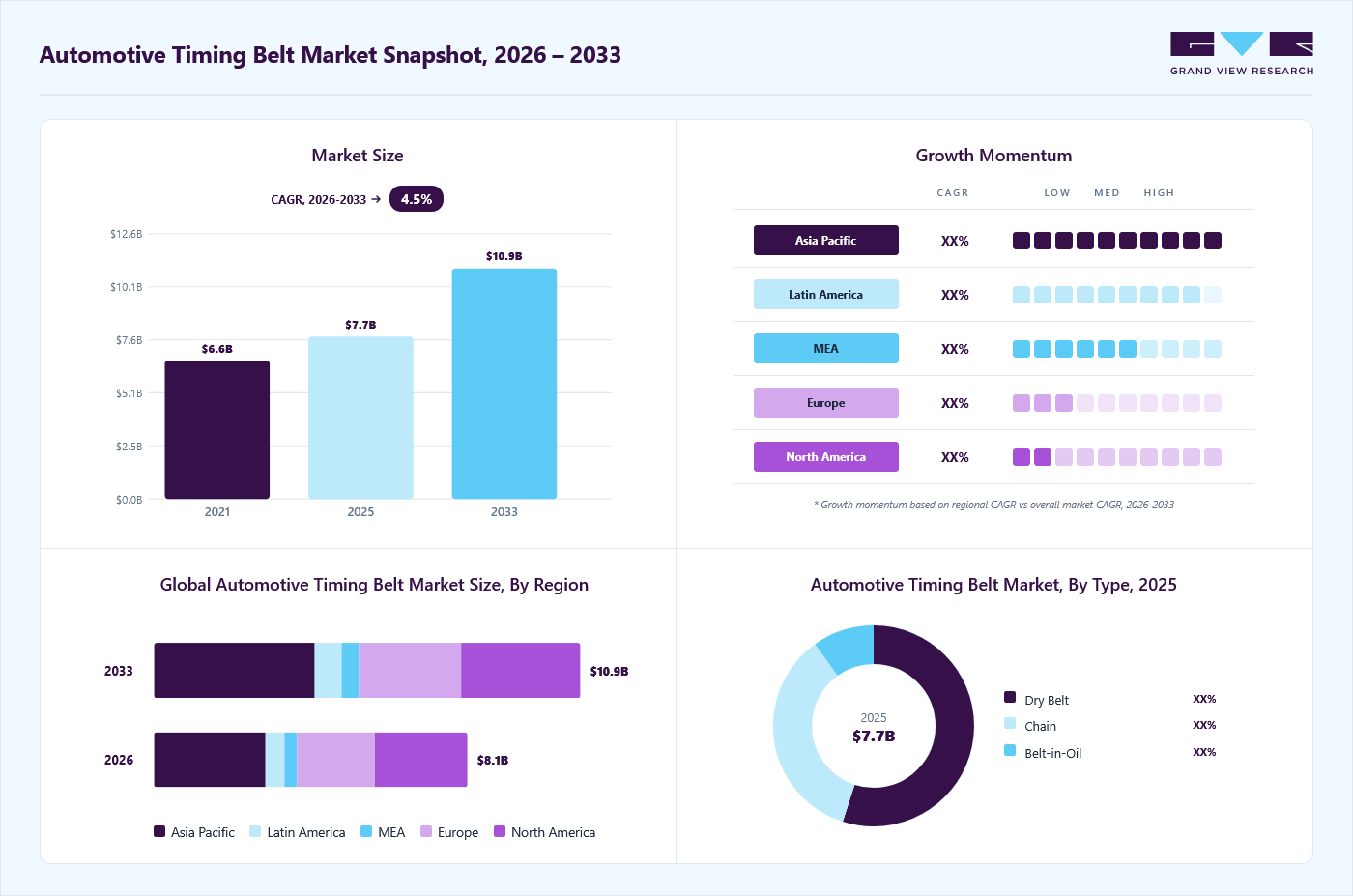 Source: Grand View Research, IR Documents, Primary Interviews, Paid DatabasesTo learn more about this report,
 Download Free Sample Report
 Key Market Trends & Insights
- By type: Dry belt segment held the largest market share of 54.9% in 2025.
- By vehicle type: Passenger vehicles segment held the largest market share of 64.9% in 2025.
- By distribution channel: OEM segment held the largest market share in 2025.
Regional Highlights
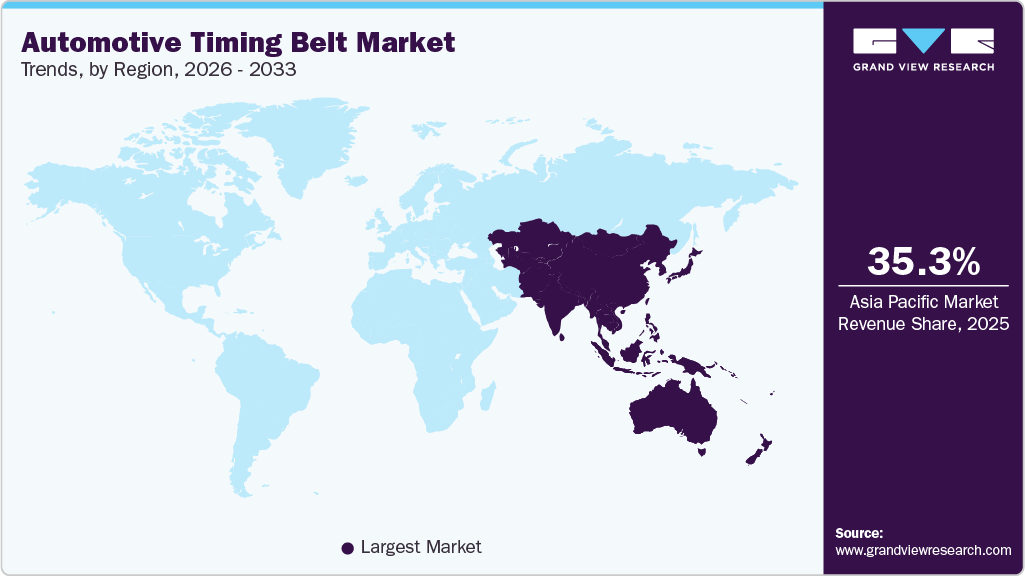
- Largest regional market: Asia Pacific (35.3% revenue share, 2025)
- By country: China held the largest share in 2025
Market Size & Forecast
- Market size in 2025: USD 7.7 Billion
- Estimated market size in 2026: USD 8.1 Billion
- Projected market size by 2033: USD 10.9 Billion
- CAGR (2026-2033): 4.5%
Three ways to get this report
Buy it, customize it, or ask a question.Ask an Analyst
Analyst response in 1 business day
- AccessReport author, directly
- Reply timeWithin 1 working day
- No sales callDirect answer only
- FormatEmail reply
- CostFree, no cost
Get the Full Report
What the study covers
- FormatsPDF · Excel · Dashboard
- Timeline2026–2033 annual, 2025 base
- Coverage20+ countries, 5 regions
- Companies10+ key players profiled
Customize the Report
20% free customization
- IncludeCountries, segments, points
- TailorTo your product definition
- ExtendDeeper competitor detail
- OrA fully bespoke study
- Turnaround5–10 working days
As vehicle production grows, manufacturers require reliable timing belt components, supporting consistent demand for replacement parts and original equipment across expanding automotive markets. In addition, advancements in belt materials, such as high-strength rubber and reinforced fibers, are improving durability and extending service life, encouraging adoption. The expanding automotive aftermarket sector and growing awareness about regular vehicle maintenance are also supporting market growth, as timely replacement of timing belts helps prevent engine damage and costly repairs.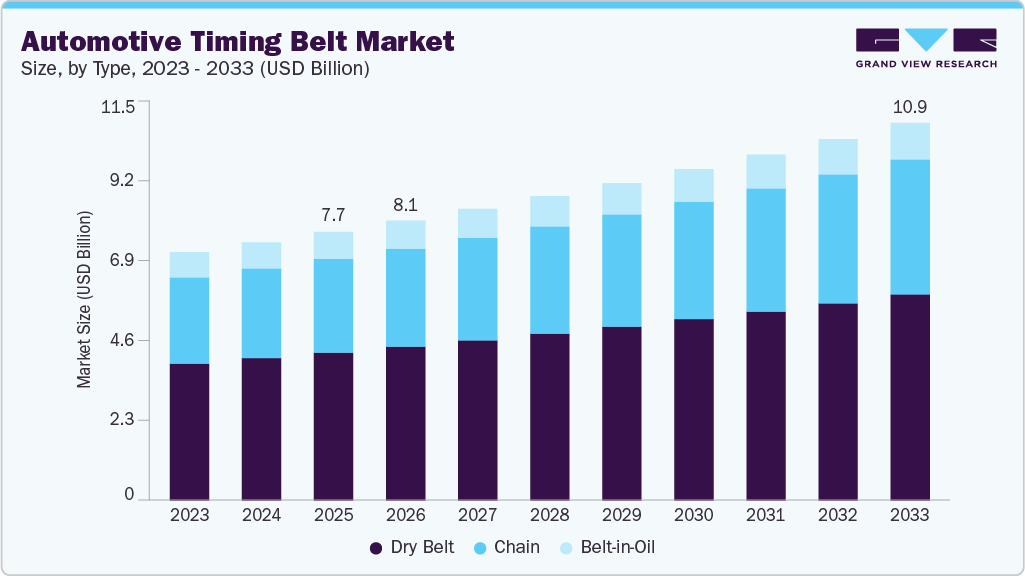 To learn more about this report, Download Free Sample Report
 Market Concentration & Characteristics
The automotive timing belt industry is fragmented due to the presence of numerous global and regional manufacturers supplying products to both OEM and the aftermarket. Large companies compete through technological advancements and durable materials, while smaller regional players focus on cost-effective solutions and local distribution networks.
Manufacturers are developing belts using advanced rubber compounds, fiber reinforcements, and coatings that enhance wear resistance and extend replacement intervals. Efforts are also directed toward lightweight and high-strength materials that support fuel efficiency and engine performance. Integration with modern engine designs, including downsized and turbocharged engines, is further encouraging continuous product development.
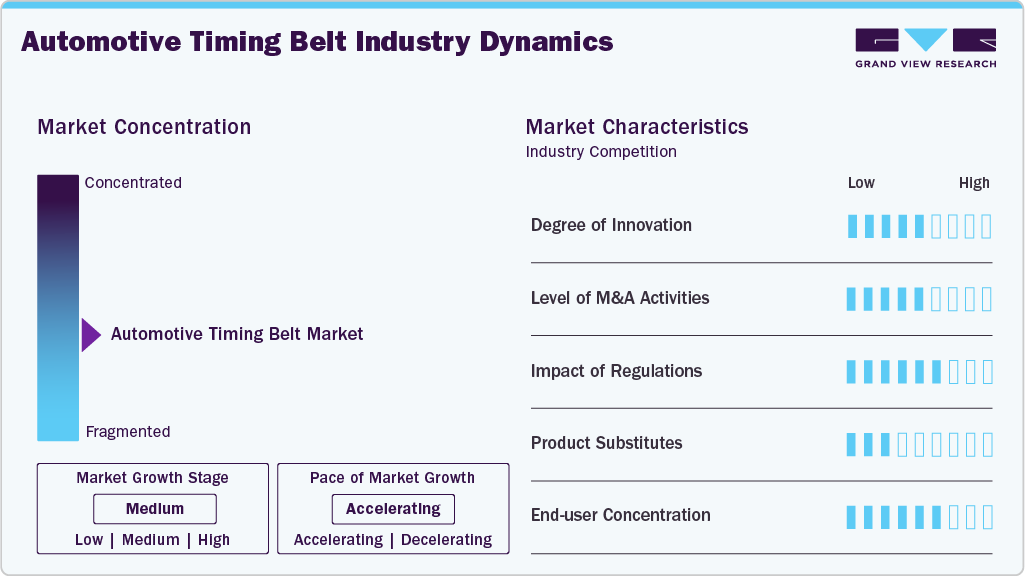 To learn more about this report, Download Free Sample Report
 Large automotive component manufacturers acquire smaller or specialized companies to obtain advanced material knowledge and enter new regional markets. These acquisitions help increase production capacity, reduce operational costs through economies of scale, and strengthen their competitive position in the global automotive components industry.
Stricter emission norms require precise engine timing, increasing the importance of durable and efficient timing belts. Standards promoting reduced vehicle noise and improved environmental performance also influence material selection and manufacturing processes. Compliance with quality and safety certifications further drives manufacturers to adopt consistent production and testing practices.
Drivers, Opportunities & Restraints
Increasing global vehicle production and ownership levels are fueling the market. As more passenger and commercial vehicles are manufactured and used, the demand for reliable engine components such as timing belts rises. Regular maintenance requirements and scheduled belt replacements also contribute to steady aftermarket demand. Growing consumer awareness about preventive vehicle maintenance further supports consistent replacement cycles and sustained market growth across regions.
Development of advanced, long-life timing belts with improved resistance to heat, wear, and chemical exposure is creating a significant opportunity in the market. As automotive engines become more compact and efficient, there is a rising demand for high-performance components that enhance durability and reduce maintenance frequency. Expanding automotive markets in developing regions also offer growth potential, as increasing vehicle ownership creates long-term demand for replacement timing belts and related services.
Growing adoption of timing chains and alternative engine technologies that require less frequent replacement is being challenged in the market. Timing chains typically offer longer service life, reducing the need for periodic replacement compared to belts. In addition, fluctuations in raw material prices, particularly rubber and synthetic fibers, can increase production costs. Intense competition among manufacturers also pressures pricing and profit margins, making market differentiation more difficult.
Type Insights
The dry belt segment dominated the market with the largest revenue share of 54.9% in 2025. The segment is driven by its cost-effectiveness and simplicity. Dry belts are typically less expensive to produce and install, making them an attractive choice for both manufacturers and consumers looking for budget-friendly options. Their straightforward design and reliable performance across various engine types further contribute to their popularity.
The chain segment is expected to witness consistent growth. For timing chains, durability and longevity are key drivers. Timing chains are known for their extended service life compared to timing belts, making them suitable for high-performance and high-mileage vehicles. In addition, their low maintenance requirements appeal to users seeking long-term reliability and reduced upkeep costs.
Vehicle Type Insights
The passenger vehicles segment accounted for the largest revenue share of 64.9% in 2025, driven by high production volumes, both in OEM and aftermarket channels. In addition, technological advancements in passenger vehicles lead to increased adoption of specialized timing belts that enhance engine performance and efficiency.
In the light commercial vehicle segment, economic growth and the rise in small business activities boost the demand for these vehicles, which in turn drives the need for timing belts. Regular maintenance schedules for light commercial vehicles also contribute to the need for replacement parts in the aftermarket.
Distribution Channel Insights
The OEM segment led the market in 2025, holding a significant market share. In the OEM distribution channel, the growth in automotive production drives demand for timing belts, as manufacturers need reliable components for new vehicles. The integration of the latest technologies and innovations in OEM components also attracts vehicle manufacturers who seek advanced, high-performance parts for their new models.
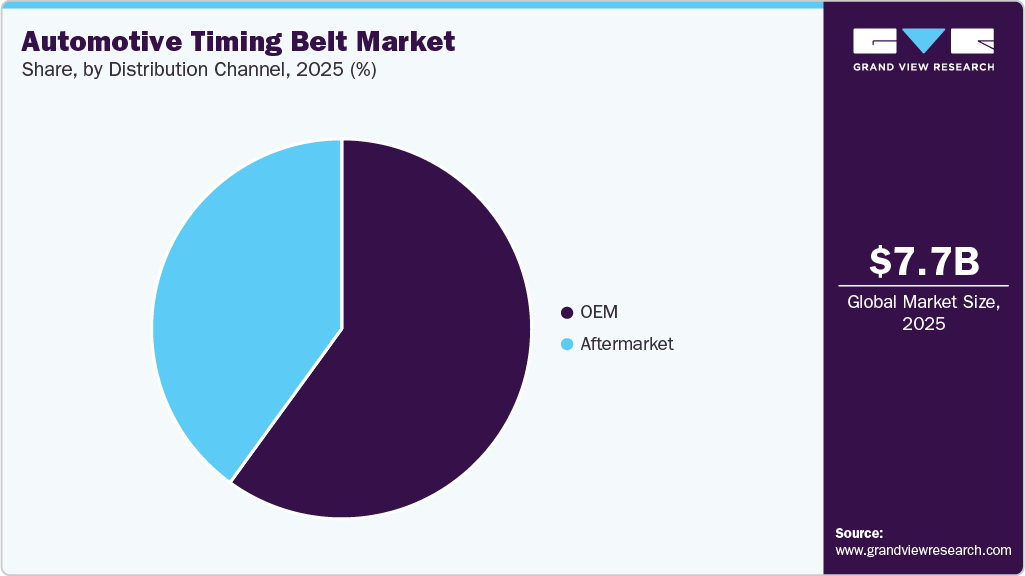 To learn more about this report, Download Free Sample Report
 The aftermarket segment is expected to grow at 4.7% CAGR during the forecast period. The aftermarket segment benefits from increased vehicle maintenance and repair needs. As vehicles age, the demand for replacement timing belts grows, driven by routine maintenance and repair requirements. In addition, the expanding vehicle fleet boosts the need for replacement parts in the aftermarket sector.
Regional Insights
North America is growing in the automotive timing belt market due to steady vehicle ownership, strong aftermarket demand, and technological upgrades in passenger and light commercial vehicles. Aging vehicle fleets in the U.S. and Canada increase the need for regular maintenance and timing belt replacement. In addition, the presence of established automotive manufacturers and component suppliers supports innovation in durable belt materials.
U.S. Automotive Timing Belt Market Trends
The automotive timing belt market in the U.S. is expanding due to high vehicle parc volumes and a strong automotive aftermarket ecosystem. Many vehicles remain in operation for extended periods, increasing demand for replacement timing belts during maintenance cycles. Growth in hybrid and fuel-efficient vehicles also contributes to demand for precise and durable engine components.
Mexico automotive timing belt market is experiencing growth due to its strong position as a vehicle manufacturing hub in North America. The presence of global automakers and increasing export-oriented production drives demand for automotive components, including timing belts. According to ITA, in 2024, Mexico became the world’s fifth-largest producer and exporter of light vehicles, highlighting its strong automotive manufacturing capabilities. Vehicle exports valued at about USD 104.8 billion reflect growing international demand, well-developed production infrastructure, and strong integration with global automotive supply chains.
Asia Pacific Automotive Timing Belt Market Trends
Asia Pacific dominated the automotive timing belt market with the largest revenue share of 35.3% in 2025 and is witnessing strong growth due to rapid vehicle production and rising demand for passenger vehicles. Expanding middle-class populations and increasing urbanization support vehicle ownership across countries such as China, India, Japan, and South Korea. The region also benefits from cost-effective manufacturing and a large supplier base.
 To learn more about this report, Download Free Sample Report
 China automotive timing belt market is a major contributor due to its position as the world’s largest vehicle producer. High production volumes create strong demand for original equipment components, including timing belts. China's commitment to achieving carbon neutrality by 2060 and its participation in international agreements like the Paris Agreement signal a long-term strategy to address environmental challenges. This commitment is likely to drive investments in green technologies and remediation practices, as the country seeks to balance economic growth with environmental sustainability.
The automotive timing belt market in India is growing due to increasing vehicle production and rising demand for passenger and commercial vehicles. According to IBEF, passenger car sales in India increased from USD 32.70 billion in FY21 and are projected to reach USD 54.84 billion by FY27, growing at over 9% CAGR from 2022 to 2027, indicating strong market expansion. As these vehicles age and accumulate mileage, the need for regular servicing and part replacement grows. This leads to higher demand for maintenance components such as timing belts, which require periodic replacement to ensure proper engine performance.
Europe Automotive Timing Belt Market Trends
The automotive timing belt market in Europe is growing due to the presence of leading automotive manufacturers and a strong emphasis on engineering precision and vehicle performance. Strict emission standards encourage the development of efficient engines that rely on reliable timing belt systems. Increasing adoption of hybrid vehicles and ongoing vehicle maintenance needs support aftermarket demand.
Germany automotive timing belt market plays a key role in Europe due to its dominance in automotive engineering and manufacturing. The presence of major vehicle manufacturers and component suppliers supports continuous innovation in engine technologies. Demand for high-performance vehicles increases the need for durable and precise timing belt systems. In addition, Germany’s strong aftermarket service network encourages regular maintenance and component replacement.
The automotive timing belt market in the UK is growing due to a well-established vehicle servicing culture and increasing demand for maintenance of aging vehicles. Growth in used vehicle ownership supports replacement demand for essential engine components such as timing belts. The presence of specialized automotive service providers strengthens aftermarket opportunities.
Middle East & Africa Automotive Timing Belt Market Trends
The automotive timing belt market in MEA is expanding due to increasing vehicle imports and gradual growth in automotive service infrastructure. Rising urbanization and economic development support higher vehicle ownership in several countries. Demand for durable components is driven by challenging climatic conditions, which require reliable engine performance.
Saudi Arabia automotive timing belt marketis experiencing significant growth due to increasing vehicle ownership and expanding transportation infrastructure. Harsh climatic conditions create the need for durable automotive components, leading to regular maintenance and replacement cycles. Government investments in infrastructure and logistics support higher commercial vehicle usage, boosting demand for reliable timing belts.
Latin America Automotive Timing Belt Market Trends
The automotive timing belt market in Latin America is expected to grow at 5.1% CAGR during the forecast period, driven by rising vehicle ownership and the expansion of automotive assembly activities. Countries such as Brazil and Argentina contribute significantly to regional vehicle production. Increasing reliance on personal vehicles and commercial transportation supports aftermarket demand for replacement components. In addition, improving automotive service networks enhance accessibility to maintenance services.
Brazil automotive timing belt market is growing due to its strong automotive manufacturing base and rising domestic vehicle demand. The presence of established assembly plants and component suppliers supports the continuous production of automotive parts. Increasing vehicle usage across urban and rural areas contributes to higher maintenance and replacement needs.
Key Automotive Timing Belt Company Insights
Some of the key players operating in the market include ContiTech Deutschland GmbH and Schaeffler Technologies AG & Co. KG, among others.
-
ContiTech Deutschland GmbH, a part of Continental AG, is engaged in the manufacture of automotive timing belts, audio and display technologies, tires, and other products. The company is based in Germany and has a robust global presence with operations in over 40 countries.
-
BorgWarner Inc. is a company involved in the production of automotive components such as timing belts, battery systems, electric drive motors, ignition technologies, and others. The company has a strong global footprint with a presence in Asia, North America, South America, and Europe.
Key Automotive Timing Belt Companies:
The following key companies have been profiled for this study on the automotive timing belt market.
- ContiTech Deutschland GmbH
- BorgWarner Inc.
- Schaeffler Technologies AG & Co. KG
- SKF
- NTN Group
- AISIN CORPORATION
- TSUBAKIMOTO CHAIN CO
- JK Fenner
- The Goodyear Tire & Rubber Company
- Gates Corporation
- Dayco Incorporated
- Ningbo GUL TZ Rubber Belt Co., Ltd.
- Toyopower
- BGA (BRITISH GASKETS LIMITED)
- L.G.Balakrishnan & Bros Ltd.
Recent Developments
-
In February 2026, Continental finalized the sale of its ContiTech Original Equipment Solutions (OESL) business to Regent L.P., a U.S.-based private industrial holding company. This move allows Continental to streamline its operations and focus on core activities. Regent, which operates globally across automotive and other sectors, gains expanded capabilities in original equipment component manufacturing and supply.
-
In December 2025, Dayco announced the introduction of its timing belt in oil (TBIO) technology to the North American automotive aftermarket, expanding access to advanced belt systems previously used mainly in original equipment vehicles. TBIO technology operates within the engine oil environment, reducing friction and improving efficiency compare.
Automotive Timing Belt Market Report Scope
Report Attribute
Details
Market size in 2025
USD 7.7 billion
Estimated market size in 2026
USD 8.1 billion
Projected market size by 2033
USD 10.9 billion
Growth rate
CAGR of 4.5% from 2026 to 2033
Historical data
2021 - 2025
Forecast period
2026 - 2033
Quantitative units
Revenue in USD million/billion and CAGR from 2026 to 2033
Report coverage
Revenue forecast, company market position analysis, competitive landscape, growth factors, and trends
Segments covered
Type, vehicle type, distribution channel, region
Regional scope
North America; Europe; Asia Pacific; Latin America; MEA
Country Scope
U.S.; Canada; Mexico; Germany; UK; Italy; Spain; France; China; Japan; India; Australia; South Korea; Brazil; Argentina; Saudi Arabia; UAE; South Africa
Key companies profiled
ContiTech Deutschland GmbH; BorgWarner Inc.; Schaeffler Technologies AG & Co. KG; SKF; NTN Group; AISIN Corporation; Tsubakimoto Chain Co.; JK Fenner; The Goodyear Tire & Rubber Company; Gates Corporation; Dayco Incorporated; Ningbo GUL TZ Rubber Belt Co., Ltd.; Toyopower; BGA (British Gaskets Limited); L.G. Balakrishnan & Bros Ltd.
Customization scope
Free report customization (equivalent up to 8 analysts working days) with purchase. Addition or alteration to country, regional & segment scope.
Pricing and purchase options
Avail customized purchase options to meet your exact research needs. Explore purchase options
Global Automotive Timing Belt Market Report Segmentation
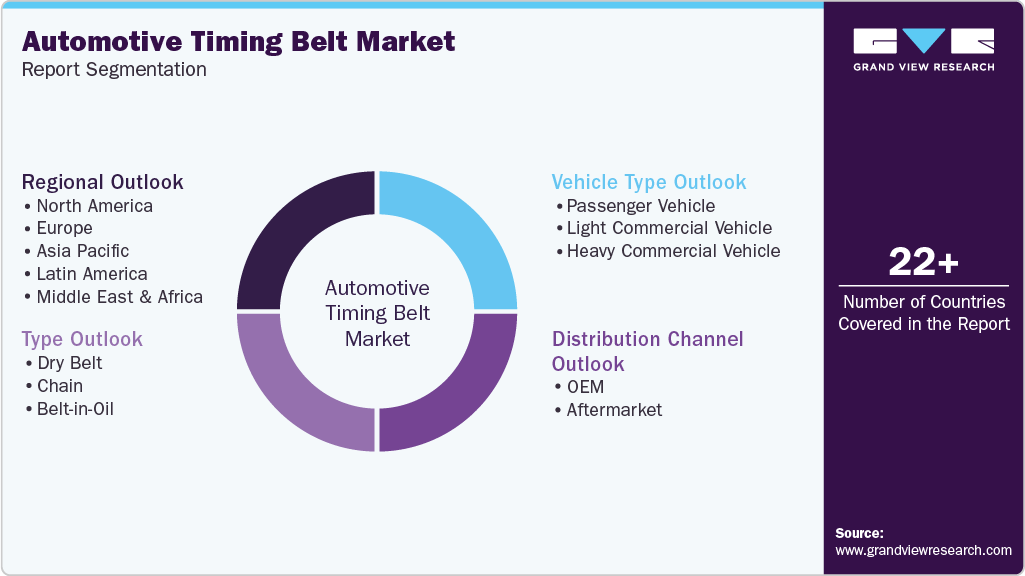
This report forecasts revenue growth at global, regional & country levels and provides an analysis on the industry trends in each of the sub-segments from 2021 to 2033. For this study, Grand View Research has segmented the global automotive timing belt market based on type, vehicle type, distribution channel, and region:
 To learn more about this report, Download Free Sample Report
 -
Type Outlook (Revenue, USD Million, 2021 - 2033)
-
Dry Belt
-
Chain
-
Belt-in-Oil
-
-
Distribution Channel Outlook (Revenue, USD Million, 2021 - 2033)
-
OEM
-
Aftermarket
-
-
Vehicle Type Outlook (Revenue, USD Million, 2021 - 2033)
-
Passenger Vehicle
-
Light Commercial Vehicle
-
Heavy Commercial Vehicle
-
-
Regional Outlook (Revenue, USD Million, 2021 - 2033)
-
North America
-
U.S.
-
Canada
-
Mexico
-
-
Europe
-
Germany
-
France
-
UK
-
Spain
-
Italy
-
-
Asia Pacific
-
China
-
India
-
Japan
-
South Korea
-
Australia
-
-
Latin America
-
Brazil
-
Argentina
-
-
Middle East & Africa
-
Saudi Arabia
-
UAE
-
South Africa
-
-
Frequently Asked Questions About This Report
The global automotive timing belt market size was estimated at USD 7.7 billion in 2025 and is expected to reach USD 8.1 billion in 2026.
Asia Pacific dominated with a 35.3% revenue share in 2025.
The dry belt segment led with a 54.9% revenue share in 2025.
The passenger vehicles segment led with a 64.9% revenue share in 2025.
The OEM segment held the largest revenue share in 2025.
The automotive timing belt market, in terms of revenue, is expected to grow at a compound annual growth rate of 4.5% from 2026 to 2033 to reach USD 10.9 billion by 2033.
The OEM segment dominated the market in 2025 accounting for 59.9% of the market share driven by increase in the volume of automotive production and technological innovation.
Some of the key players operating in the automotive timing belt include ContiTech Deutschland GmbH, BorgWarner Inc., Schaeffler Technologies AG & Co. KG, SKF, NTN Group, AISIN CORPORATION, TSUBAKIMOTO CHAIN CO, JK Fenner, The Goodyear Tire & Rubber Company, Gates Corporation, Dayco Incorporated, Ningbo GUL TZ Rubber Belt Co., Ltd., Toyopower, BGA (BRITISH GASKETS LIMITED), and L.G.Balakrishnan & Bros Ltd.
The automotive timing belt market is driven by advancements in technology, increasing production and sale of automotives, regulatory pressure on safety across various nations, and increase in aftermarket sales.
About the Author(s)
Advanced Interior Materials Research Team
Advanced Materials · Advanced Interior MaterialsThis report was authored by the advanced interior materials research team at Grand View Research - comprising two research analysts, one senior research analyst, and one industry expert - with specialized expertise in the advanced interior materials segment of the advanced materials industry. All findings are based on proprietary advanced materials databases, executive interviews, and regulatory analysis, subject to internal peer review prior to publication.
Last Updated:
Speak to Analyst

Customize this report to your needs - add regions, segments, or data points, with 20% free customization.
Or view our licence options:


ISO 9001:2015 & 27001:2022 Certified
We are GDPR and CCPA compliant! Your transaction & personal information is safe and secure. For more details, please read our privacy policy.


