
- Home
- »
- Automotive & Transportation
- »
-
Autonomous Shuttle Market Size & Share Report, 2026-2033GVR Report cover

Autonomous Shuttle Market (2026 - 2033)
Size, Share & Trends Analysis Report By Technology (Lidar-Based Systems, Camera-Based Systems, Radar-Based Systems) By Service Model (Public Transport), By Vehicle Size, By Level Of Autonomy, By Region, And Segment Forecasts
Market Size, 2025
$6.3BMarket Estimate, 2026
$7.5BMarket Forecast, 2033
$27.7BCAGR, 2026–2033
20.5%Autonomous Shuttle Market Summary
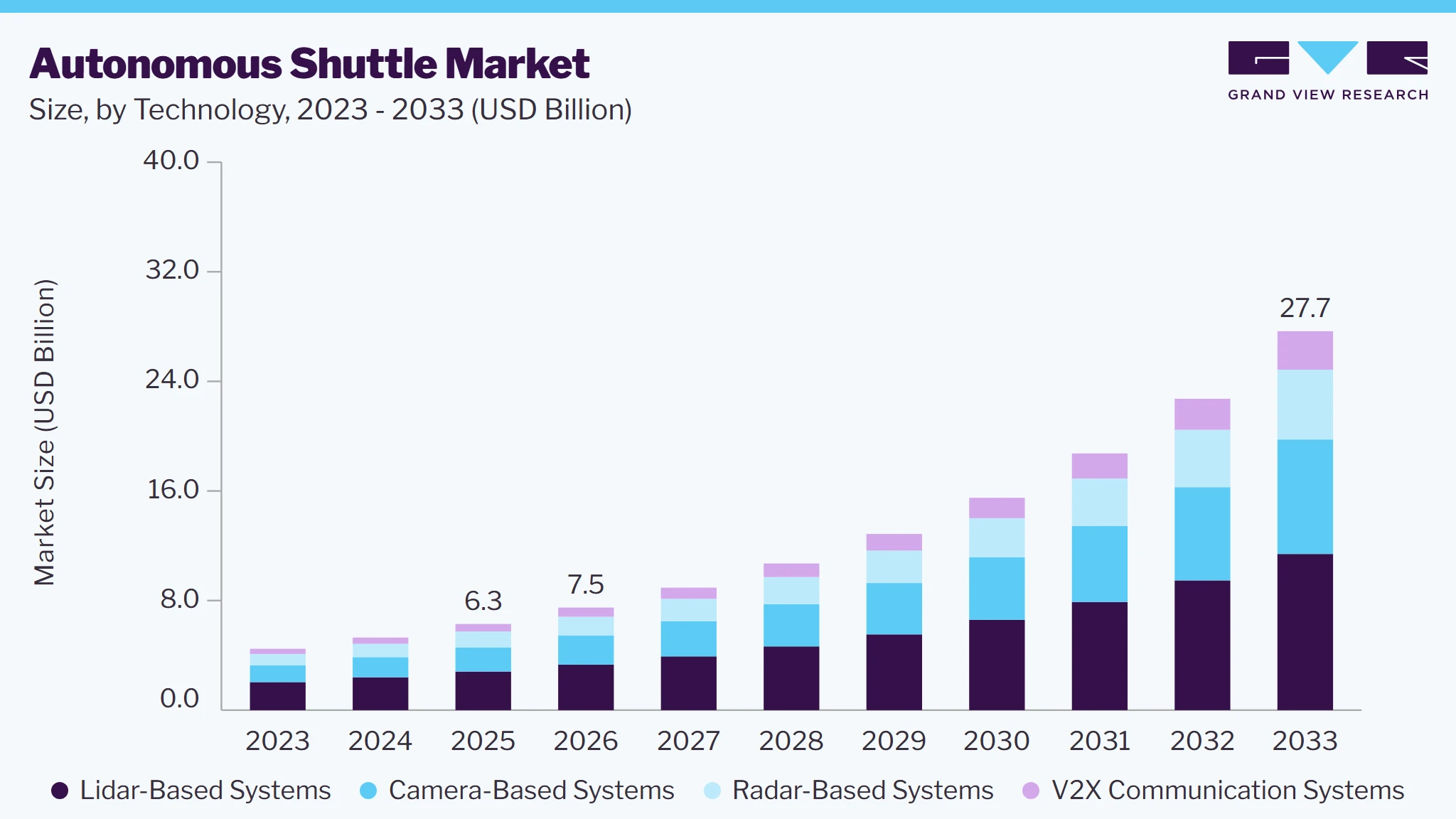
The global autonomous shuttle market size was valued at USD 6.3 billion in 2025 and is projected to grow from USD 7.5 billion in 2026 to USD 27.7 billion by 2033, at a CAGR of 20.5% from 2026 to 2033. Europe dominated the market, accounting for the largest revenue share of 35.7% in 2025. The increasing demand for sustainable and efficient last-mile transportation solutions is accelerating the adoption of autonomous shuttles.
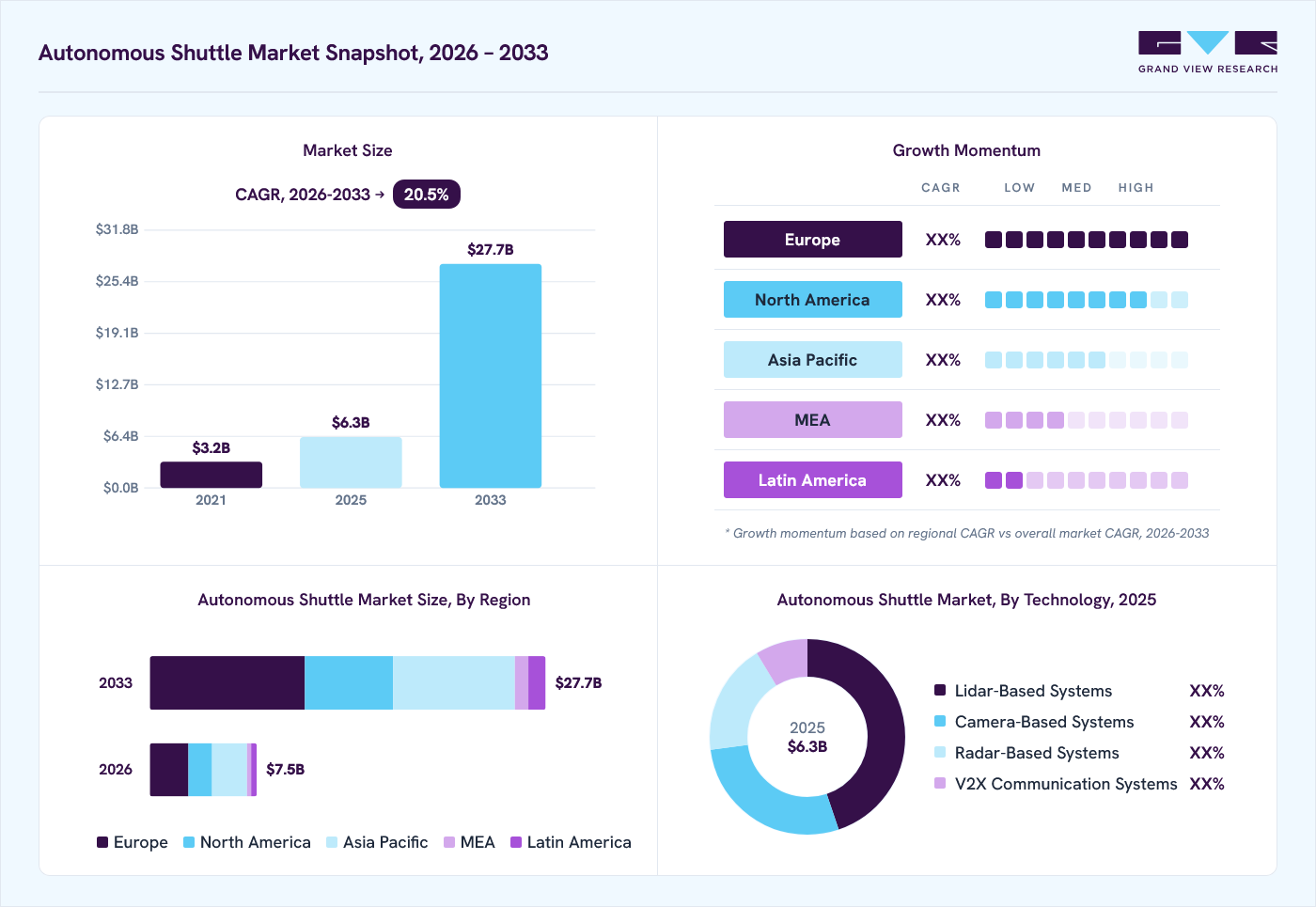 Source: Grand View Research, IR Documents, Primary Interviews, Paid DatabasesTo learn more about this report,
 Download Free Sample Report
Key Market Trends & Insights
- By technology: The lidar-based systems segment led the market and accounted for 44.8% of the global revenue in 2025.
- By service model: The public transport segment led the market and accounted for 45.5% of the global revenue in 2025.
- By vehicle size: The medium shuttles (16-30 passengers) segment accounted for the largest share of global revenue in 2025.
- By level of autonomy: The level 4 (High Automation) segment accounted for the largest market revenue share in 2025.
Regional Highlights
- Largest regional market: Europe (35.7% revenue share, 2025)
- By country: UK held the largest market share in 2025.
Market Size & Forecast
- Market size in 2025: USD 6.3 Billion
- Estimated market size in 2026: USD 7.5 Billion
- Projected market size by 2033: USD 27.7 Billion
- CAGR (2026-2033): 20.5%
Prism AI by Grand View Research Free to tryAsk a question about the autonomous shuttle marketTry asking✓Every figure cited from GVR research Prefer the report? Download free sample →
Governments and urban authorities are increasing investments in smart city infrastructure and intelligent transportation systems to improve urban mobility and support sustainable transportation solutions. This investment is encouraging the deployment of autonomous shuttles for first mile and last-mile connectivity across airports, business parks, universities, and residential communities. The growing adoption of these solutions is increasing demand for autonomous driving software, advanced sensors, and connected mobility technologies. As a result, expanding smart mobility initiatives are supporting the commercialization and growth of the market.The autonomous shuttle industry is experiencing a growing trend toward the adoption of artificial intelligence, advanced sensors, and connected technologies. These technologies help autonomous shuttles improve navigation, safety, and route optimization. Integration with smart city infrastructure enables real-time data sharing and supports efficient first mile and last-mile transportation solutions. This trend is driving wider deployment of autonomous shuttles across urban areas, airports, and commercial facilities.
 To learn more about this report, Download Free Sample Report
Governments and regulatory bodies are strengthening safety frameworks for autonomous shuttles to ensure safe deployment on public roads. Global regulations focus on safety validation, cybersecurity, system monitoring, and performance requirements for autonomous driving technologies. These standards support the commercialization of autonomous shuttles by improving operational reliability and increasing confidence among transport operators and passengers.
The Level 4 autonomous shuttle segment faces challenges due to the complexity of ensuring safe vehicle operation without human intervention. Extensive testing, safety validation, and regulatory approvals increase development costs and delay commercial deployment for manufacturers and fleet operators. These challenges slow the expansion of autonomous shuttle services and limit large-scale adoption across public transportation networks. To address these issues, companies are investing in advanced AI algorithms, sensor fusion technologies, simulation platforms, and rigorous testing programs to improve vehicle reliability and accelerate commercialization.
Market Dynamics
Rapid urbanization, increasing traffic congestion, and growing pressure on public transportation systems are driving demand for innovative mobility solutions. Cities and transportation authorities are focusing on improving connectivity, reducing operational costs, and enhancing passenger accessibility through intelligent transportation systems. Traditional public transportation networks often face challenges such as limited route flexibility, driver shortages, and increasing operating expenses, creating demand for autonomous shuttle solutions.
Autonomous shuttles address these challenges by providing automated, flexible, and cost-efficient transportation options for short-distance and controlled environments. Integration of artificial intelligence, LiDAR, cameras, radar, and vehicle-to-everything (V2X) communication enables autonomous shuttles to operate safely with minimal human intervention. Increasing deployment across airports, universities, business parks, and smart city projects is accelerating market adoption.
The high initial investment required for autonomous shuttle development and deployment remains a major challenge for market growth. Advanced hardware components, including LiDAR sensors, cameras, computing platforms, and autonomous driving software, significantly increase vehicle costs compared with conventional shuttle systems. In addition, infrastructure requirements such as dedicated lanes, digital mapping, and connectivity networks create additional implementation challenges.
High deployment costs primarily impact developing regions and smaller transportation operators with limited budgets. Regulatory uncertainty, safety validation requirements, and the need for extensive testing further delay commercialization timelines. These factors restrict large-scale adoption, particularly in public transportation applications where cost efficiency and operational reliability are critical considerations.
Increasing investments in smart city infrastructure and intelligent transportation systems are creating significant opportunities for autonomous shuttle providers. Governments and municipalities are adopting autonomous mobility solutions to improve urban connectivity, support sustainable transportation goals, and address mobility challenges in underserved areas. Controlled environments such as airports, campuses, industrial facilities, and residential communities provide favorable conditions for early autonomous shuttle deployment.
Vendors offering integrated autonomous driving platforms, fleet management software, and scalable mobility solutions are positioned to benefit from this opportunity. Companies focusing on Level 4 autonomous shuttle technologies, electric vehicle integration, and partnerships with transportation operators are expected to capture increasing market opportunities as cities move toward automated and connected mobility ecosystems.
Market Concentration & Characteristics
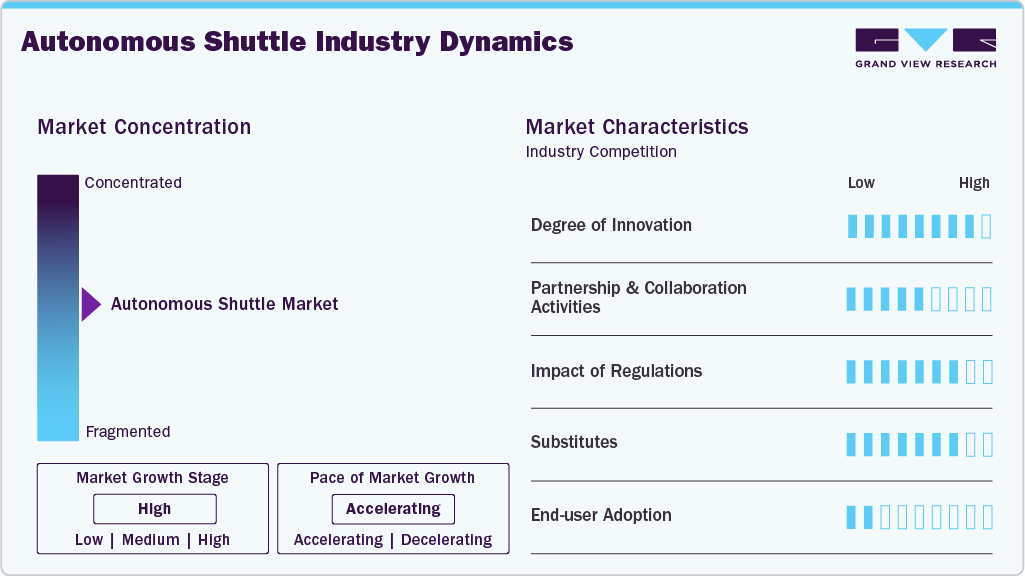
The autonomous shuttle industry is moderately consolidated in nature due to the presence of established automotive manufacturers, autonomous driving technology providers, mobility solution companies, and emerging startups competing across different segments of the industry. Companies are actively focusing on the development of autonomous shuttle platforms, artificial intelligence-based driving systems, sensor technologies, fleet management solutions, and smart mobility services. The market is currently transitioning from pilot projects toward commercial deployment, resulting in competition among technology-focused companies and automotive players rather than dominance by a single global leader. Continuous advancements in autonomous driving, connected vehicle technologies, and increasing investments in smart transportation infrastructure are further intensifying competition among market participants.
 To learn more about this report, Download Free Sample Report
The market is also driven by the growing presence of specialized autonomous mobility companies such as WeRide, Navya, and Aurrigo International PLC, which are developing dedicated autonomous shuttle solutions for airports, campuses, public transportation, and controlled environments. At the same time, major technology and automotive companies, including Mobileye, Baidu, and TOYOTA MOTOR CORPORATION, are expanding investments in autonomous driving platforms and connected mobility ecosystems. Market participants are primarily competing through autonomous technology capabilities, safety performance, regulatory approvals, deployment partnerships, and scalability of mobility solutions rather than market share dominance, which continues to maintain a moderately consolidated structure within the industry.
Analyst Perspective
The market for autonomous shuttle is transitioning from pilot-based deployments toward commercial-scale mobility solutions driven by smart city initiatives, transportation automation, and advancements in artificial intelligence. Increasing adoption of Level 4 autonomous systems, electric vehicle platforms, and connected mobility technologies is reshaping the competitive landscape. Future investments are expected to focus on scalable autonomous platforms, fleet management solutions, and integration with intelligent transportation infrastructure. Strategic partnerships among technology providers, vehicle manufacturers, and transportation operators are becoming increasingly important to accelerate commercialization.
Technology Insights
Based on technology, the Lidar-based systems segment accounted for 44.8%, the largest share of global revenue in 2025. LiDAR-based systems are gaining importance in autonomous shuttles due to their ability to provide accurate 3D mapping, object detection, and environmental perception. The increasing focus on improving vehicle safety and reliability is encouraging manufacturers to integrate LiDAR sensors with AI-based autonomous driving platforms. These systems enhance the ability of shuttles to navigate complex environments, detect obstacles, and operate efficiently in controlled areas such as campuses, airports, and urban routes. As a result, growing demand for advanced perception technologies is supporting the adoption of LiDAR-based autonomous shuttle solutions.
The V2X communication systems segment is projected to grow at the fastest CAGR over the forecast period. V2X communication systems are witnessing increased adoption as autonomous shuttle operators focus on improving vehicle connectivity and operational efficiency. These systems enable real-time communication between shuttles, surrounding vehicles, traffic infrastructure, and cloud platforms, helping improve safety and traffic coordination. The expansion of smart city initiatives and connected transportation networks is encouraging investments in V2X-enabled mobility solutions. Consequently, increasing deployment of intelligent transportation infrastructure is supporting the growth of V2X communication systems in autonomous shuttles.
Service Model Insights
Based on service model, the public transport segment accounted for 45.5%, the largest share of global revenue in 2025, The public transport segment is experiencing growth due to rising demand for efficient, accessible, and sustainable transportation solutions in urban areas. Transit authorities are increasingly exploring autonomous shuttles to enhance first-mile and last-mile connectivity while reducing operational challenges associated with conventional transportation systems. The integration of autonomous shuttles into public transit networks improves route flexibility, reduces emissions, and enhances passenger accessibility. As cities continue to modernize transportation infrastructure, the adoption of autonomous shuttle services in public transport is increasing.
The on-demand mobility services segment is projected to grow at the fastest CAGR over the forecast period. The on-demand mobility services segment is gaining traction due to increasing consumer preference for convenient and flexible transportation options. Autonomous shuttles integrated with digital mobility platforms enable passengers to access shared transportation services based on real-time demand. This model helps operators improve fleet utilization, optimize routes, and reduce operational costs. As Mobility-as-a-Service (MaaS) platforms continue to expand, the adoption of autonomous shuttles for on-demand transportation is expected to increase.
Vehicle Size Insights
Based on vehicle size, the medium shuttles (16-30 passengers) segment led the market and accounted for the global revenue in 2025. Medium autonomous shuttles are witnessing increasing demand due to their ability to balance passenger capacity, operational efficiency, and deployment flexibility. These vehicles are suitable for applications such as airports, corporate campuses, universities, and public transit routes where moderate passenger movement is required. Their lower operating costs compared with larger vehicles and higher capacity compared with small shuttles make them suitable for various mobility applications. As operators seek scalable and cost-effective autonomous transportation solutions, demand for medium-sized shuttles is increasing.
The large shuttles (31+ passengers) segment is projected to grow at the fastest CAGR over the forecast period The large shuttles (31+ passengers) segment is gaining traction due to rising demand for efficient transportation solutions that can handle high passenger volumes in urban transit networks, airports, and large commercial facilities. These shuttles help operators improve passenger throughput, reduce operational costs, and enhance mobility efficiency on fixed routes with high travel demand. The growing focus on automated public transportation and smart city initiatives is encouraging the deployment of large-capacity autonomous shuttles. As transit operators seek scalable mobility solutions, demand for large autonomous shuttles is supporting segment growth.
Level of Autonomy Insights
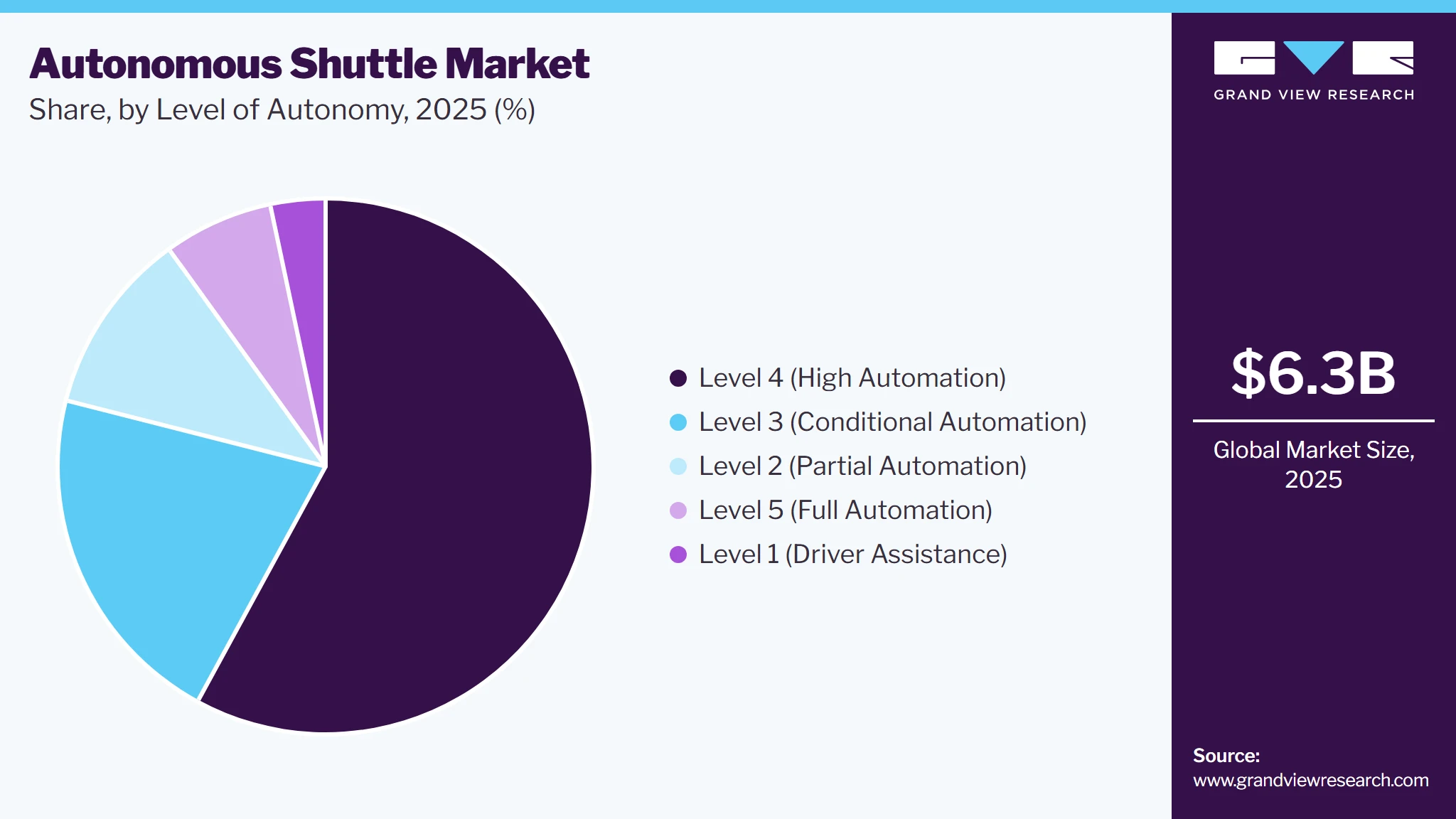
Based on level of autonomy, level 4 (High Automation) accounted for the largest share of global revenue in 2025. Level 4 autonomous shuttles are gaining adoption due to their ability to operate without human intervention within defined operational areas. These vehicles are increasingly deployed in controlled environments such as airports, campuses, industrial parks, and dedicated transit routes where operating conditions are predictable. Advancements in AI, sensor technologies, and autonomous driving software are improving vehicle reliability and enabling commercial deployment. As a result, increasing demand for driverless mobility solutions is supporting the expansion of Level 4 autonomous shuttle services.
 To learn more about this report, Download Free Sample Report
Level 5 (Full Automation) is projected to grow at the fastest CAGR over the forecast period. The Level 5 autonomy segment is attracting increasing investments as automotive and technology companies continue developing fully autonomous transportation solutions. These vehicles are designed to operate without human assistance under all driving conditions, creating opportunities for future mobility services. Continuous advancements in artificial intelligence, computing power, and sensor technologies are improving the capabilities required for full automation. Although commercial adoption remains limited, ongoing research and development activities are supporting long-term growth opportunities for Level 5 autonomous shuttles.
Regional Insights
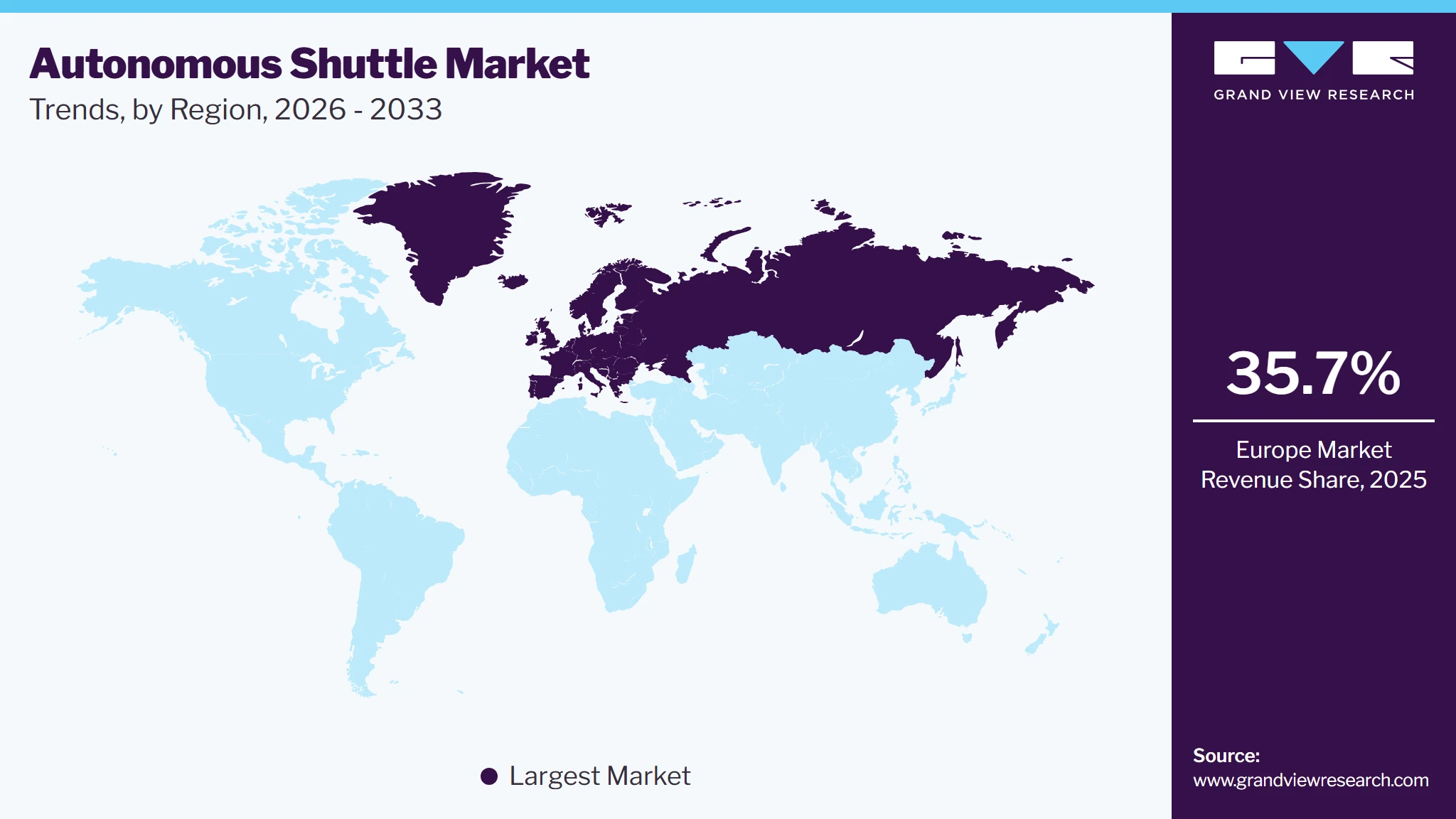
The Europe autonomous shuttle market led with revenue share of 35.7% in 2025 and is expected to register the fastest CAGR from 2026 to 2033. Europe is witnessing steady growth in the adoption of autonomous shuttles as countries focus on developing sustainable and connected transportation networks. Public transport modernization initiatives and efforts to reduce urban mobility challenges are encouraging cities to integrate autonomous shuttle services into existing transit systems.
 To learn more about this report, Download Free Sample Report
UK Autonomous Shuttle Market Trends
The UK autonomous shuttle market is gaining momentum in the global market as government-supported trials and mobility programs accelerate the testing of driverless transport solutions. Increasing demand for accessible and flexible transportation options is encouraging the use of autonomous shuttles in urban areas and transport hubs.
The Germany autonomous shuttle market held a substantial share in the Europe region. Germany is becoming a key market for autonomous shuttles driven by strong automotive expertise and focus on vehicle automation technologies. The country’s investments in connected infrastructure and autonomous public transport projects are supporting the transition toward advanced mobility solutions
North America Autonomous Shuttle Market Trends
North America autonomous shuttle marketis expected to grow at a significant CAGR over the forecast period, supported by growing investments in autonomous mobility and smart transportation solutions. The region is witnessing an increase in the deployment of shuttles at airports, universities, and commercial campuses, where short-distance connectivity enhances transportation efficiency.
The U.S. autonomous shuttle market held the largest market share in 2025.The U.S. holds a significant position in the market as technology developers and automotive companies continue to expand testing and commercialization activities. The increasing use of autonomous shuttles in controlled environments, including airports and corporate campuses, is creating new opportunities for scalable mobility solutions.
Asia Pacific Autonomous Shuttle Market Trends
The Asia Pacific autonomous shuttle market held a significant share in 2025. The Asia Pacific market is experiencing rapid growth, fueled by increasing urbanization, rising household spending, and growing demand for advanced transportation solutions. The region benefits from increasing consumer purchasing power, expanding adoption of everyday mobility services, and rising demand across the autonomous shuttle sector, supporting market expansion.
China autonomous shuttle market held a dominant share in the Asia Pacific region. China is a major market for autonomous shuttles, supported by strong advancements in autonomous driving technologies and intelligent transportation infrastructure. Large-scale smart city developments and commercial deployment initiatives are accelerating the integration of autonomous shuttles into urban mobility networks.
Japan autonomous shuttle industry is expected to grow at a significant CAGR over the forecast period. Japan is expanding its market as the country aims for innovative solutions to address transportation challenges in aging and rural communities. Autonomous shuttles are gaining importance by providing reliable mobility options, improving accessibility, and strengthening local transportation networks.
Key Autonomous Shuttle Company Insights
Key players operating in the Autonomous Shuttle include WeRide.ai, Navya Mobility, beep, Mobileye, TOYOTA MOTOR CORPORATION, Aurrigo International PLC, BENTELER, Baidu, PIXMOVING, INC., Ohmio. Key players in the Autonomous Shuttle are heavily investing in autonomous driving technologies, artificial intelligence-based mobility platforms, advanced sensor integration, fleet management solutions, and strategic partnerships to enhance vehicle safety, improve operational efficiency, and accelerate commercial deployment of autonomous shuttle services.
-
WeRide.ai is a global autonomous driving technology company. The company develops autonomous mobility technologies designed to improve transportation safety, accessibility, and efficiency. The company offers a diversified autonomous driving product portfolio, including Robotaxi, Robobus, Robovan, Robosweeper, and advanced driver-assistance systems (ADAS), supporting applications across smart mobility, smart logistics, and smart sanitation. The company focuses on autonomous bus and shuttle solutions designed for public transportation, urban mobility, and controlled-environment deployments.
-
Navya Mobility is an autonomous mobility company. The company offers autonomous mobility solutions, including the Autonom Shuttle for passenger transportation and the Autonom Tract (AT135) for automated goods and logistics transportation. Navya Mobility focuses on delivering sustainable and intelligent mobility solutions by integrating advanced hardware, software, and operational tools.
Key Autonomous Shuttle Companies
The following key companies have been profiled for this study on the autonomous shuttle market.
-
WeRide.ai.
-
Navya Mobility
-
beep
-
Mobileye
-
TOYOTA MOTOR CORPORATION.
-
Aurrigo International PLC
-
BENTELER.
-
Baidu
-
PIXMOVING,INC.
-
Ohmio.
Competitive Benchmarking
Operating Strategies
Competitive Edge
Weaknesses
Mature Players: Mobileye, TOYOTA MOTOR CORPORATION, Baidu, BENTELER
- Mature players in the autonomous shuttle are focus on developing advanced autonomous driving platforms, integrating artificial intelligence, sensors, and connected vehicle technologies to support large-scale mobility applications.
- Their strong automotive background and strategic collaborations enable them to expand autonomous shuttle solutions across commercial and public transportation environments.
- Mature players gain a competitive advantage through strong R&D capabilities, global presence, established automotive ecosystems, and advanced technology platforms, which help improve autonomous driving performance, safety, and scalability.
- Their financial strength supports continuous innovation and long-term market expansion.
- These companies face challenges related to complex organizational structures, longer development cycles, and difficulties adapting broad automotive technologies for specialized autonomous shuttle applications.
- Higher investment requirements and regulatory validation processes can also slow commercialization.
Emerging Players: WeRide.ai, Navya Mobility, Aurrigo International PLC
- Emerging players in the autonomous shuttle are focus on specialized autonomous shuttle platforms, pilot deployments, and partnerships with transportation operators, airports, campuses, and smart city projects.
- Their strategies emphasize rapid commercialization, targeted mobility applications, and flexible deployment models to address specific transportation needs.
- Emerging players gain market traction through specialized autonomous shuttle expertise, faster innovation cycles, and focused solutions for controlled environments.
- Their ability to customize mobility solutions and collaborate closely with local operators supports faster adoption in niche applications.
- Emerging players face limitations due to smaller operational scale, limited financial resources, and lower global market presence compared with established automotive players.
- Dependence on regulatory approvals, infrastructure readiness, and strategic partnerships can restrict expansion speed.
Recent Developments
-
In March 2025, WeRide.ai partnered with Renault Group, a multinational automobile manufacturer, to launch a Level 4 autonomous Robobus trial in Barcelona, Spain. With this launch, the company demonstrated the capabilities of autonomous shuttle technology under real urban traffic conditions and strengthened its expansion into European mobility markets. This partnership is expected to support market growth by accelerating the adoption of autonomous public transportation solutions and increasing confidence in commercial autonomous shuttle deployments.
-
In September 2025, TOYOTA MOTOR CORPORATION. launched its next-generation e-Palette, a battery-electric mobility platform designed for flexible transportation applications, including autonomous shuttle services. The launch supports the company's smart mobility strategy by advancing connected, accessible, and scalable transportation solutions. This initiative strengthens the company's presence in the market by enabling future deployment of automated mobility services.
Autonomous Shuttle Market Report Scope
Report Attribute
Details
Market size value in 2025
USD 6.3 billion
Market size value in 2026
USD 7.5 billion
Revenue forecast in 2033
USD 27.7 billion
Growth rate
CAGR of 20.5% from 2026 to 2033
Base year for estimation
2025
Historical data
2021 - 2024
Forecast period
2026 - 2033
Quantitative units
Revenue in USD billion and CAGR from 2026 to 2033
Report coverage
Revenue forecast, company ranking, competitive landscape, growth factors, and trends
Segments covered
Technology, service model, vehicle size, level of autonomy, region
Regional scope
North America; Europe; Asia Pacific; Latin America; MEA
Country scope
U.S.; Canada; Mexico; Germany; UK; France; China; Japan; India; South Korea; Australia; Brazil; Kingdom of Saudi Arabia (KSA); UAE; South Africa
Key companies profiled
WeRide.ai; Navya Mobility; beep; Mobileye; TOYOTA MOTOR CORPORATION; Aurrigo International PLC; BENTELER; Baidu; PIXMOVING, INC.; Ohmio
Customization scope
Free report customization (equivalent up to 8 analysts working days) with purchase. Addition or alteration to country, regional & segment scope.
Pricing and purchase options
Avail customized purchase options to meet your exact research needs. Explore purchase options
Global Autonomous Shuttle Market Report Segmentation
The report forecasts revenue growth at global, regional, and country levels and provides an analysis of the latest industry trends in each of the sub-segments from 2021 to 2033. For this study, Grand View Research has segmented the autonomous shuttle market report based on technology, service model, vehicle size, level of autonomy, and region:
-
Technology Outlook (Revenue, USD Billion, 2021 - 2033)
-
Lidar-Based Systems
-
Camera-Based Systems
-
Radar-Based Systems
-
V2X Communication Systems
-
-
Service Model Outlook (Revenue, USD Billion, 2021 - 2033)
-
Public Transport
-
Intercity Transportation
-
Corporate Shuttle Services
-
On-Demand Mobility Services
-
-
Vehicle Size Outlook (Revenue, USD Billion, 2021 - 2033)
-
Small Shuttles (10-15 passengers)
-
Medium Shuttles (16-30 passengers)
-
Large Shuttles (31+ passengers)
-
-
Level of Autonomy Outlook (Revenue, USD Billion, 2021 - 2033)
-
Level 1 (Driver Assistance)
-
Level 2 (Partial Automation)
-
Level 3 (Conditional Automation)
-
Level 4 (High Automation)
-
Level 5 (Full Automation)
-
-
Regional Outlook (Revenue, USD Billion, 2021 - 2033)
-
North America
-
U.S.
-
Canada
-
Mexico
-
-
Europe
-
Germany
-
UK
-
France
-
-
Asia Pacific
-
China
-
India
-
Japan
-
South Korea
-
Australia
-
-
Latin America
-
Brazil
-
-
Middle East & Africa (MEA)
-
UAE
-
Kingdom of Saudi Arabia (KSA)
-
South Africa
-
-
Research Methodology
The autonomous shuttle market figures in this report are based on a proven research process that combines executive interviews with secondary research from proprietary databases, company filings, and recognized regulatory and institutional sources. Market size is built through value-chain sizing-reconciling supply-side and demand-side estimates-and triangulated with bottom-up and top-down approaches. Every estimate passes multiple levels of expert validation before publication, with each autonomous shuttle segment quantified using the revenue-capture definitions in the table below.
Segment Definition
Segment - Technology
Revenue capture definition
Lidar-Based Systems
The segment revenue is generated from LiDAR hardware, 3D perception sensors, scanning modules, processing units, and related integration solutions used for autonomous shuttle navigation, obstacle detection, and environmental mapping.
Camera-Based Systems
The segment revenue is generated from vision cameras, image-processing systems, perception software, and computer vision technologies used for object recognition, lane detection, passenger safety monitoring, and autonomous driving functions.
Radar-Based Systems
The segment revenue is generated from radar sensors, detection modules, and signal-processing technologies used for distance measurement, collision avoidance, and reliable object detection in varying weather conditions.
V2X Communication Systems
The segment revenue is generated from vehicle-to-vehicle (V2V), vehicle-to-infrastructure (V2I), connectivity modules, communication platforms, and networking solutions enabling real-time data exchange between autonomous shuttles and external systems.
Segment - Service Model
Revenue capture definition
Public Transport
The segment revenue is generated from autonomous shuttle services deployed by municipalities, transit authorities, and government transportation operators for urban mobility, first-mile/last-mile connectivity, and public passenger transportation.
Intercity Transportation
The segment revenue is generated from autonomous shuttle solutions used for medium- and long-distance passenger transportation between cities, transportation hubs, and regional mobility networks.
Corporate Shuttle Services
The segment revenue is generated from autonomous shuttle deployments for employee transportation within corporate campuses, technology parks, industrial facilities, and private business locations.
On-Demand Mobility Services
The segment revenue is generated from autonomous shuttle platforms providing flexible, app-based transportation services based on passenger demand, route optimization, and shared mobility models.
Segment - Vehicle Size
Revenue capture definition
Small Shuttles (10-15 passengers)
The segment revenue is generated from compact autonomous shuttle vehicles designed for short-distance transportation in campuses, airports, residential communities, and controlled environments.
Medium Shuttles (16-30 passengers)
The segment revenue is generated from mid-capacity autonomous shuttle vehicles used for public transit routes, corporate transportation, and urban mobility applications requiring moderate passenger capacity.
Large Shuttles (31+ passengers)
The segment revenue is generated from high-capacity autonomous shuttle vehicles designed for large-scale public transportation networks, intercity routes, and high-demand mobility corridors.
Segment - Level of Autonomy
Revenue capture definition
Level 1 (Driver Assistance)
The segment revenue is generated from level 1 equipped with basic driver assistance technologies, including adaptive cruise control, automated braking, lane assistance, and other support features that assist human drivers.
Level 2 (Partial Automation)
The segment revenue generated from level 2 integrating multiple automated driving functions, such as steering and acceleration/deceleration control, while requiring continuous human monitoring and intervention.
Level 3 (Conditional Automation)
The segment revenue generated from level 3 can perform most driving functions under specific operational conditions, including autonomous decision-making with human takeover capability when required.
Level 4 (High Automation)
The segment revenue is generated from level 4, which can operate without human intervention within defined operational areas, including autonomous public transit, campus mobility, airport transportation, and controlled environments.
Level 5 (Full Automation)
The segment revenue generated from level 5 can operate under all road, traffic, and environmental conditions without any human involvement.
Estimation Model
Layer Name
Key Question
Description
Technology Adoption Assessment
What autonomous technologies are integrated into shuttle systems?
This layer evaluates the adoption of LiDAR, camera, radar, artificial intelligence, and V2X communication technologies within autonomous shuttle platforms. It analyzes how sensor advancements and software capabilities influence vehicle performance, safety, and commercialization. The assessment captures technology-driven revenue opportunities across hardware and software components.
Application and Deployment Analysis
Where are autonomous shuttles being deployed?
This layer examines deployment environments including public transportation, airports, corporate campuses, universities, industrial facilities, and smart cities. It evaluates demand patterns, operational requirements, and regional adoption trends. The analysis identifies application segments contributing to autonomous shuttle market expansion.
Vehicle and Autonomy Level Evaluation
What type of autonomous shuttle solutions are being adopted?
This layer analyzes autonomous shuttle adoption based on vehicle capacity and automation levels. It evaluates demand for small, medium, and large shuttles along with Level 1 to Level 5 autonomous capabilities. The assessment determines technology maturity and commercialization potential across segments.
Competitive and Market Ecosystem Analysis
Which companies are shaping market development?
This layer evaluates the competitive landscape, partnerships, technology collaborations, and strategic initiatives among autonomous shuttle providers. It assesses established and emerging players based on product offerings, geographic presence, and innovation capabilities.
Delivered Customization
We have successfully delivered the following deep-dive customizations
Client Request
Customization Delivered
Value Adds
Regional Autonomous Shuttle Market Opportunity Assessment
Country/region-wise market sizing and forecasts
Analysis of demand, adoption trends, and regulatory landscape
Identification of high-growth regions and investment hotspots
Identified region-specific growth opportunities
Supported expansion and go-to-market strategy
Enabled informed regional investment decisions
Cross-Segmentation Analysis for the Autonomous Shuttle Market
Criss-cross market analysis by technology, service model vehicle size, level of autonomy
Demand and adoption assessment across key segments
Segment attractiveness and growth potential benchmarking
Identified high-potential market segments
Supported targeted service model positioning and marketing strategy
Improved customer and segment prioritization
Competitive Benchmarking and Strategic Positioning in the Autonomous Shuttle Market
Benchmarking of key competitors across service models, pricing, partnerships, and innovation
Comparative assessment of market share, capabilities, and strategies
Analysis of competitive strengths, gaps, and differentiation areas
Identified competitive white spaces and growth gaps
Supported strategic positioning and differentiation
Enabled data-driven competitive strategy development
Frequently Asked Questions About This Report
The global autonomous shuttle market size was valuedat USD 6.3 billion in 2025 and is projected to reach USD 7.5 billion in 2026.
The lidar-based systems segment led the market and accounted for 44.8% of the global revenue in 2025, while V2X communication systems segment is the fastest growing segment.
The global autonomous shuttle market is expected to grow at a CAGR of 20.5% from 2026 to 2033, reaching USD 27.7 billion by 2033.
Europe dominated the market, accounting for the largest revenue share of 35.7% in 2025.
The increasing demand for sustainable and efficient last-mile transportation solutions is accelerating the adoption of autonomous shuttles market.
Some key players operating in the autonomous shuttle market include WeRide.ai, Navya Mobility, beep, Mobileye, TOYOTA MOTOR CORPORATION, Aurrigo International PLC, BENTELER, Baidu, PIXMOVING, INC., Ohmio
Public transport segment accounted for 45.5%, the largest share of global revenue in 2025, while on-demand mobility services segment is the fastest growing service model.
Medium shuttles (16-30 passengers) segment led the market and accounted for the global revenue in 2025, while large shuttles (31+ passengers) segment is the fastest growing vehicle size.
Level 4 (High Automation) accounted for the largest share of global revenue in 2025, while Level 5 (Full Automation) is segment is the fastest growing level of autonomy.
About the Author(s)
Automotive & Transportation Research Team
Technology · Automotive & TransportationThis report was authored by the automotive & transportation research team at Grand View Research - comprising two research analysts, one senior research analyst, and one industry expert - with specialized expertise in the automotive & transportation segment of the technology industry. All findings are based on proprietary technology databases, executive interviews, and regulatory analysis, subject to internal peer review prior to publication.
Last Updated:
Speak to Analyst

Customize this report to your needs - add regions, segments, or data points, with 20% free customization.
Or view our licence options:


ISO 9001:2015 & 27001:2022 Certified
We are GDPR and CCPA compliant! Your transaction & personal information is safe and secure. For more details, please read our privacy policy.


