
- Home
- »
- Advanced Interior Materials
- »
-
Basalt Rock Market Size, Share & Trends Report, 2026-2033GVR Report cover

Basalt Rock Market (2026 - 2033)
Size, Share & Trends Analysis Report By Product Type (Basalt Fiber, Basalt Aggregates, Basalt Tiles/Slabs), By End-use (Building & Construction, Infrastructure, Automotive & Transportation, Energy & Power), By Region, And Segment Forecasts
Market Size, 2025
$2.0BMarket Estimate, 2026
$2.1BMarket Forecast, 2033
$3.5BCAGR, 2026–2033
7.7%Basalt Rock Market Summary
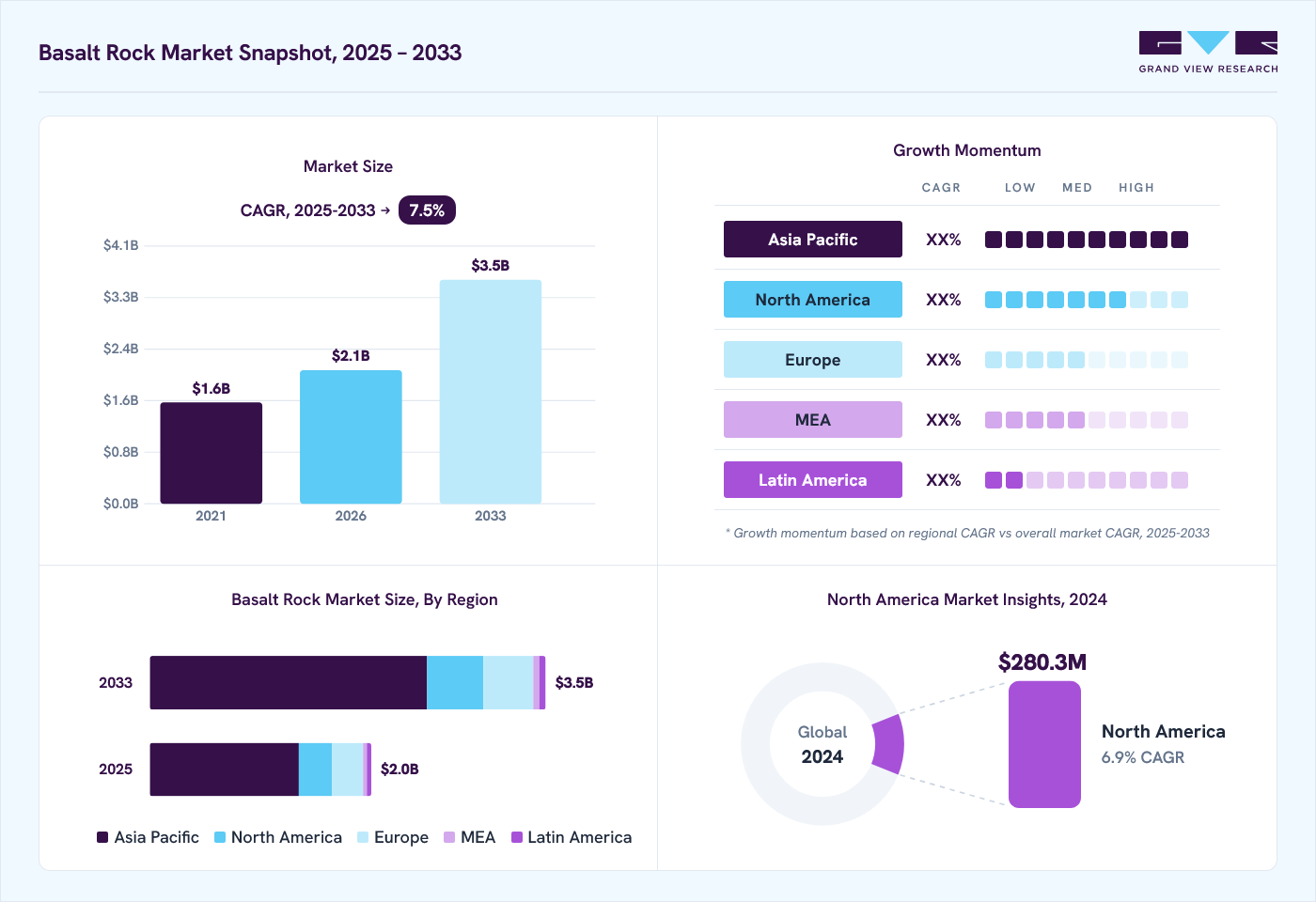
The basalt rock market size was valued at USD 2.0 billion in 2025 and is projected to grow from USD 2.1 billion in 2026 to USD 3.5 billion by 2033, at a CAGR of 7.7% from 2026 to 2033. Asia Pacific dominated the basalt rock market with the largest revenue share of 67.3% in 2025. Due to its excellent physical properties, such as high compressive strength, corrosion resistance, and thermal stability, basalt rock finds extensive applications across various industries.
 Source: Grand View Research, IR Documents, Primary Interviews, Paid DatabasesTo learn more about this report,
 Download Free Sample Report
 Key Market Trends & Insights
- By product type: Basalt fiber segment held the largest market share of 53.1% in 2025.
- By end use: Building & construction segment held the largest market share of 35.4% in 2025.
Regional Highlights
- Largest regional market: Asia Pacific (67.3% revenue share, 2025)
- By country: China held the largest market share in 2025
Market Size & Forecast
- Market size in 2025: USD 2.0 Billion
- Estimated market size in 2026: USD 2.1 Billion
- Projected market size by 2033: USD 3.5 Billion
- CAGR (2026-2033): 7.7%
Three ways to get this report
Buy it, customize it, or ask a question.Ask an Analyst
A direct answer, usually in 1 working day
- AccessReport author, directly
- Reply timeWithin 1 working day
- No sales callDirect answer only
- FormatEmail reply
- CostFree, no cost
Get the Full Report
What the study covers
- FormatsPDF · Excel · Dashboard
- Timeline2026–2033 annual, 2025 base
- Coverage20+ countries, 5 regions
- Companies10+ key players profiled
Customize the Report
20% free customization
- IncludeCountries, segments, points
- TailorTo your product definition
- ExtendDeeper competitor detail
- OrA fully bespoke study
- Turnaround5–10 working days
In April 2025, China hosted the "Basalt Fiber Composite Materials New Standards, New Technologies, and New Products Application Promotion Conference" in Dazhou City, Sichuan Province. During this event, Southeast University and the Dazhou High-tech Zone Management Committee released the "2024 Basalt Fiber and Composite Materials Industry Development Report." This report analyzes the development status of the basalt fiber and composite materials industry, highlighting technical obstacles and future trends. The initiative underscores China's commitment to advancing basalt fiber applications and establishing industry standards.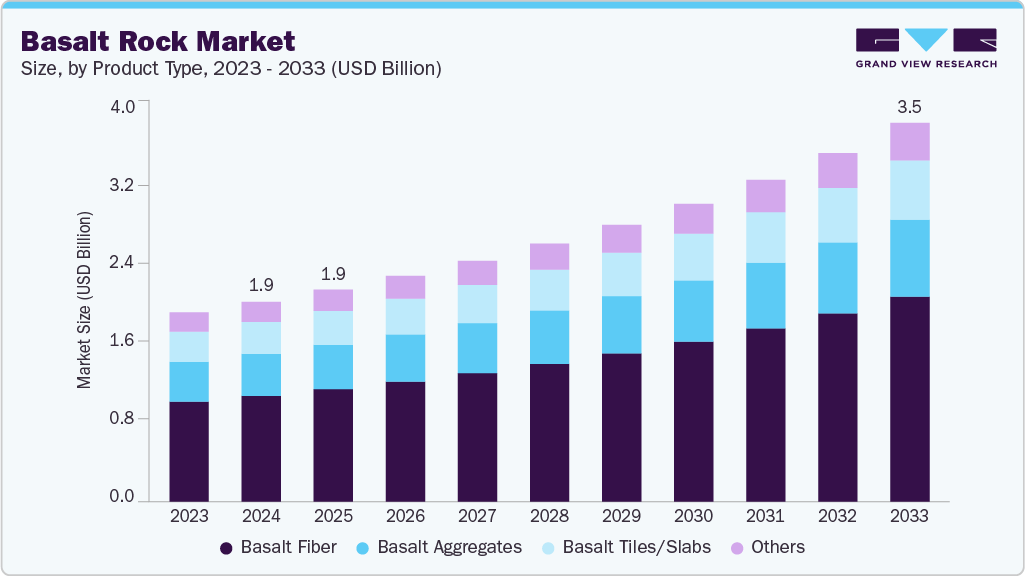 To learn more about this report, Download Free Sample Report
 The application of basalt rock in the building and construction sector is gaining significant traction globally, driven by its superior mechanical properties, environmental benefits, and cost-effectiveness. Several major players and regions actively invest in basalt-based materials to enhance infrastructure resilience and sustainability.
Sustainability initiatives and recycling are increasingly influencing the future of the basalt rock industry. The recovery and reuse of basalt fibers and aggregates from construction and industrial waste are gaining traction as part of wider circular economic practices. Furthermore, industry stakeholders are investing in R&D to enhance eco-friendly extraction and processing technologies, aiming to reduce carbon emissions and improve energy efficiency. As global industries advance toward sustainable infrastructure and carbon neutrality, basalt will continue to play a vital role in material innovation, offering durability, recyclability, and a low environmental footprint.
Market Dynamics
The basalt rock market is experiencing steady growth due to increasing demand from the construction, infrastructure, transportation, and industrial sectors. Basalt rock is widely utilized as aggregate in roads, railways, concrete production, and civil engineering projects owing to its high strength, durability, abrasion resistance, and weather-resistant properties. Rapid urbanization, population growth, and rising investments in transportation networks, residential construction, and public infrastructure are driving global demand.
Increasing investments in infrastructure development are a major factor driving the growth of the basalt rock market. Governments across both developed and developing economies are allocating substantial funds toward the construction and modernization of roads, highways, bridges, railways, airports, ports, and urban infrastructure. Basalt rock is widely used as an aggregate in concrete, asphalt, railway ballast, and drainage systems due to its high compressive strength, durability, and resistance to wear and weathering. The growing need for long-lasting construction materials that can withstand heavy loads and harsh environmental conditions is accelerating the adoption of basalt rock in large-scale infrastructure projects worldwide.
Furthermore, rapid urbanization and industrialization are increasing demand for residential, commercial, and industrial construction activities, particularly in the Asia Pacific, the Middle East, and Latin America. Governments are also investing in smart city developments, industrial corridors, logistics hubs, and public transportation networks to support economic growth and population expansion. The continuous expansion of transportation infrastructure and urban development projects is creating sustained demand for high-quality construction aggregates, positioning basalt rock as a preferred material due to its superior mechanical properties and cost-effectiveness. As infrastructure spending continues to rise globally, the demand for basalt rock is expected to remain strong throughout the forecast period.
Stringent environmental regulations governing quarrying and mining activities pose a significant challenge to the basalt rock market. Regulatory requirements related to land use, emissions, dust control, biodiversity protection, and rehabilitation of quarry sites can increase operational costs and project timelines. Furthermore, obtaining permits for new quarry developments has become increasingly complex in many regions. Rising energy, transportation, and labor costs associated with basalt extraction and processing also impact profitability for market participants, potentially restraining market growth.
The growing use of basalt fiber in construction, automotive, aerospace, wind energy, and marine applications presents a significant opportunity for the basalt rock market. Basalt fiber offers advantages such as high tensile strength, corrosion resistance, thermal stability, lightweight properties, and environmental sustainability compared to conventional materials. Increasing demand for lightweight and durable composite materials, particularly in transportation and renewable energy sectors, is driving the adoption of basalt-based products. Additionally, rising interest in sustainable construction materials and corrosion-resistant reinforcement solutions is expected to create new growth avenues for basalt fiber manufacturers and basalt rock producers over the forecast period.
Analyst Perspective
The basalt rock market is gaining momentum due to increasing utilization of basalt aggregates, fibers, and stone products in transportation networks, commercial construction, renewable energy projects, and industrial applications. Accelerating infrastructure modernization programs, expansion of urban centers, and growing investments in roads, railways, bridges, airports, and smart city developments are creating sustained demand for high-strength and durable basalt-based materials. In addition, the rising adoption of basalt fiber as a lightweight, corrosion-resistant alternative to traditional reinforcement materials is opening new growth avenues across construction, automotive, and energy sectors.
Drivers, Opportunities & Restraints
The basalt rock industry is gaining momentum primarily due to its increasing adoption in the construction and infrastructure sectors, which are undergoing robust global expansion. One of the key drivers is the rising demand for corrosion-resistant and eco-friendly alternatives to traditional materials like steel and concrete. Basalt rebar, for instance, is increasingly used in coastal infrastructure projects because it does not corrode steel in high-moisture and salt-laden environments. A prime example is the growing use of basalt rebar in Middle Eastern countries such as Saudi Arabia and the UAE, where major infrastructure projects under Vision 2030 (such as NEOM and The Line) emphasize using sustainable materials. Moreover, basalt aggregates are used in large-scale road and rail projects due to their durability and resistance to thermal stress.
The market will benefit significantly from the growing use of basalt fiber composites in the automotive and aerospace sectors. These industries are seeking lightweight materials to improve fuel efficiency and reduce emissions. Basalt fiber offers an excellent alternative to carbon and glass fiber composites due to its comparable strength and significantly lower cost. For example, companies like Sinoma and Kamenny Vek are expanding basalt fiber production to meet rising global demand, particularly in electric vehicles (EVs) and lightweight aircraft components. The shift toward electric mobility and carbon-neutral manufacturing further enhances the market outlook for basalt fiber applications.
High initial cost and technical complexity involved in the production of basalt fibers and advanced composites restrict the market growth. Unlike traditional building materials, basalt-based products often require specialized processing equipment, which can deter small and mid-sized manufacturers. In addition, a lack of industry standards and limited awareness among end-users about basalt's benefits hampers its broader adoption. In developing regions, traditional materials still dominate due to their cost advantage and widespread availability. Overcoming these challenges will require increased investment in R&D, public-private collaborations, and educational efforts to promote the long-term benefits of basalt-based solutions.
Product Type Insights
By product type, the basalt fiber segment led the market with the largest revenue share of 53.1% in 2025, driven by its superior mechanical and thermal properties and environmental advantages. Derived from natural basalt rock, this fiber offers high tensile strength, thermal stability up to 800°C, excellent corrosion resistance, and a lightweight profile. It is a beautiful alternative to traditional materials like steel, glass, and carbon fibers. These characteristics have led to widespread adoption across construction, automotive, aerospace, and marine sectors.
The demand for basalt tiles and slabs is steadily increasing across the construction and interior design industries due to their durability, aesthetic appeal, and eco-friendliness. Basalt, a volcanic rock, is naturally dense, non-porous, and resistant to wear, making it an ideal material for indoor and outdoor applications. These tiles are widely used in flooring, wall cladding, countertops, paving, and facades, particularly in high-traffic and high-moisture environments like commercial buildings, public infrastructure, and luxury residences.
End-use Insights
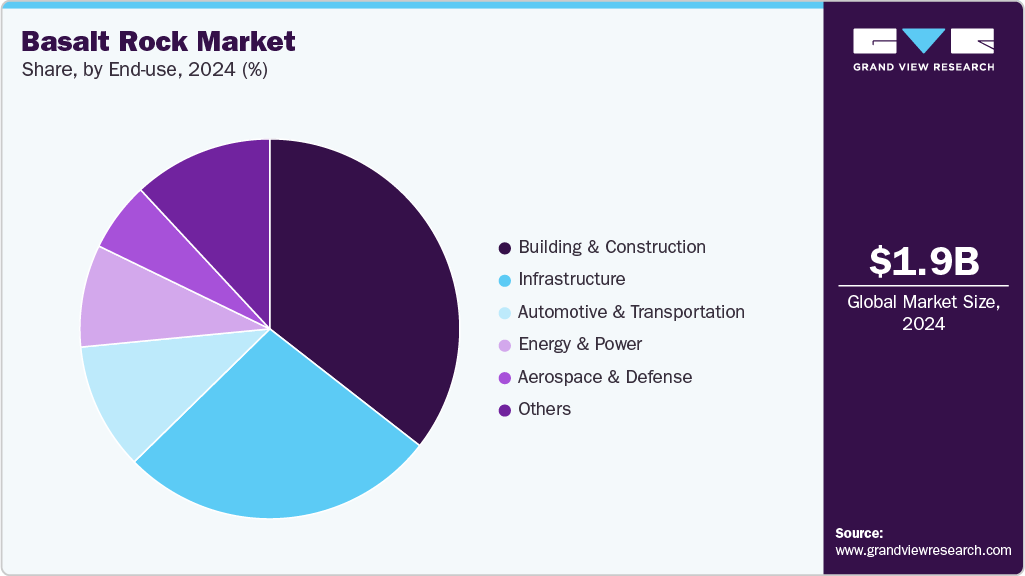
By end use, the building & construction segment led the market with the largest revenue share of 35.4% in 2025, primarily driven by the growing demand for durable, sustainable, and cost-effective materials in infrastructure development. Basalt rock, known for its high compressive strength, resistance to weathering, and fire-retardant properties, is increasingly used in applications such as aggregates, tiles, slabs, rebar, and insulation materials.
 To learn more about this report, Download Free Sample Report
 The automotive and transportation segment is experiencing growing demand for basalt rock, driven by the industry’s push for lightweight, high-performance, and environmentally friendly materials. Basalt fiber composites are increasingly used to substitute heavier and more expensive materials like steel, carbon fiber, and fiberglass. Their excellent strength-to-weight ratio, thermal stability, sound insulation, and corrosion resistance make them ideal for automotive applications such as body panels, heat shields, brake pads, and interior components.
Regional Insights
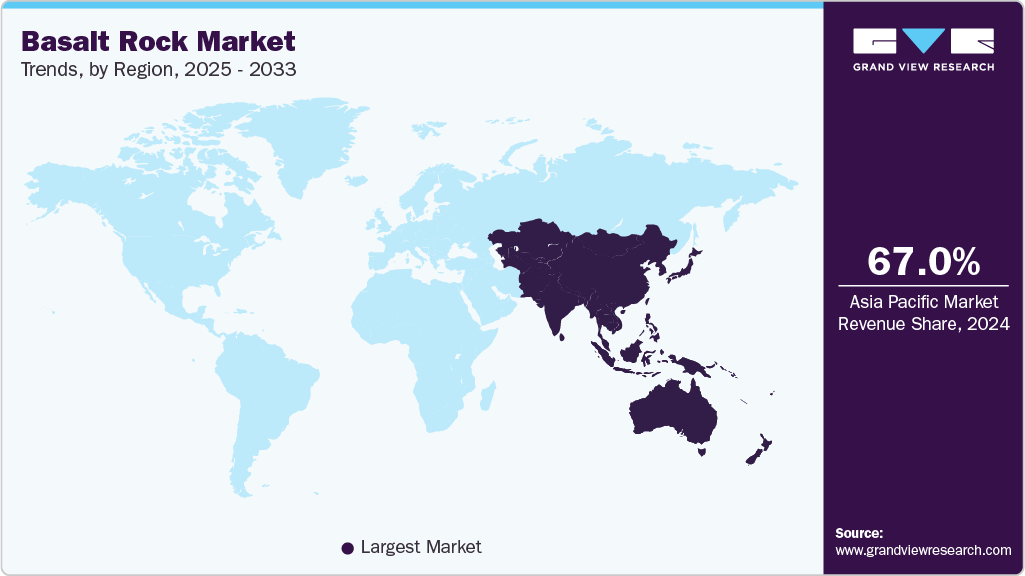
Asia Pacific dominated the basalt rock market with the largest revenue share of 67.3% in 2025, primarily driven by rapid urbanization and industrialization. Countries such as China, India, and Southeast Asian nations are witnessing a surge in construction activities to accommodate expanding urban populations and to support industrial development. Basalt rock, known for its durability and resistance to environmental factors, is increasingly utilized in infrastructure projects, including roads, bridges, and buildings.
 To learn more about this report, Download Free Sample Report
 China Basalt Rock Market Trends
The basalt rock market in China held the largest share in the Asia Pacific region in 2025. In China, basalt fiber-reinforced concrete has been extensively utilized in large-scale infrastructure projects, notably the Hong Kong-Zhuhai-Macao Bridge. This application has significantly enhanced the bridge's durability and crack resistance. The market for basalt fiber-reinforced concrete in China is expected to grow at a lucrative pace over the coming year, reflecting the country's commitment to integrating sustainable materials into its construction practices.
North America Basalt Rock Market Trends
The basalt rock market in North America is experiencing significant growth, primarily driven by the increasing demand for sustainable and durable construction materials. Basalt rock's inherent properties, such as high compressive strength, resistance to weathering, and thermal stability, make it an ideal choice for infrastructure projects. The region's focus on green building initiatives and the adoption of eco-friendly materials has further propelled the use of basalt in construction applications, including aggregates, tiles, and rebar.
U.S. Basalt Rock Market Trends
The basalt rock market in the U.S. is experiencing robust growth, driven by multiple converging factors across infrastructure, sustainability, and advanced materials sectors. The U.S. government's continued emphasis on infrastructure development, including roads, bridges, and public buildings, has significantly increased the demand for durable construction materials. The USD 1.2 trillion infrastructure spending bill from 2021 continues to fuel growth in the building materials sector, with companies like Vulcan Materials Co. and Martin Marietta Materials, Inc. benefiting from this surge in demand.
Europe Basalt Rock Market Trends
The basalt rock market in Europe is experiencing significant growth, driven by sustainability initiatives, infrastructure development, and technological advancements. Europe's commitment to environmental sustainability has led to innovative applications of basalt rock, particularly in carbon sequestration. Enhanced rock weathering, a process that accelerates the natural reaction between CO₂ and crushed basalt, is gaining traction as a carbon dioxide removal technique.
Key Basalt Rock Company Insights
Some of the key players operating in the market include Kamenny Vek, Mafic SA, and Technobasalt-Invest LLC.
-
Kamenny Vek is a leading manufacturer of high-quality basalt fiber products. The company is renowned for its advanced production techniques and innovative solutions catering to various automotive, aerospace, construction, and marine industries.
-
Mafic SA is a renowned manufacturer of advanced basalt fiber solutions, specializing in high-modulus basalt fiber for aerospace and automotive applications. The company has a strong R&D team and collaborates with leading industry players.
-
Technobasalt-Invest is one of Europe’s largest producers, controlling over 20% of global basalt fiber output. The company focuses on vertical integration and owns basalt quarries and manufacturing facilities, which reduces dependency on raw material suppliers and ensures consistent quality.
Key Basalt Rock Companies:
The following key companies have been profiled for this study on the basalt rock market.
- Aravali India Marbles & Granites
- Basaltex NV
- Basalt Fiber Tech
- Deutsche Basalt Faser GmbH
- Galen Ltd
- Jumeisheng
- Kamenny Vek
- Mafic SA
- Mudanjiang Basalt Fiber Co. Ltd
- Shanxi Basalt Fiber Technology Co., Ltd.
- Technobasalt Invest LLC
Competitive Benchmarking
Category
Operating Strategies
Competitive Edge
Weakness
Established Players (Basaltex NV, Deutsche Basalt Faser GmbH, Kamenny Vek, Mafic SA, Mudanjiang Basalt Fiber Co., Ltd., Technobasalt Invest LLC)
- Prioritize development of high-performance basalt fiber products and engineered solutions for construction, transportation, energy, and industrial sectors.
- Maintain a strong focus on process optimization, quality enhancement, and commercialization of next-generation basalt composite technologies.
- Expand market reach through global sales networks, technical support capabilities, and collaborations with OEMs, contractors, and composite manufacturers.
- Strong expertise in fiber production technologies and advanced material engineering.
- Extensive experience in supplying certified products for demanding structural and industrial applications.
- Ability to support large-volume orders while maintaining consistent product quality and technical performance.
- Significant dependence on energy-intensive manufacturing processes and specialized production equipment.
- Continuous need for investment in technology upgrades, product testing, and compliance certifications.
- The widespread use of conventional materials with established supply chains can constrain market penetration.
Emerging & Regional Players (Aravali India Marbles & Granites, Basalt Fiber Tech, Galen Ltd, Jumeisheng, Shanxi Basalt Fiber Technology Co., Ltd.)
- Concentrate on strengthening domestic market presence through localized production and customer-focused offerings.
- Target niche opportunities in infrastructure development, construction materials, and regional composite manufacturing industries.
- Improve competitiveness through capacity additions, distributor partnerships, and gradual expansion into adjacent application areas.
- Strong regional market knowledge and close engagement with local customers and distributors.
- Ability to respond quickly to project-specific requirements and changing market conditions.
- Competitive cost structures support penetration into price-sensitive markets.
- Restricted access to global distribution channels and international customer networks.
- Smaller operational scales may limit bargaining power and manufacturing efficiency.
- Greater vulnerability to fluctuations in regional construction activity and industrial investment trends.
Recent Developments
-
In June 2024, Deutsche Basalt Faser GmbH, in collaboration with FibreCoat GmbH, developed a novel basalt-aluminum composite fiber designed to shield electromagnetic radiation. This innovation, known as AluCoat, offers an affordable, sustainable solution for applications in digital devices, medical technology, and electric vehicle batteries. The project was awarded the overall prize at the 17th “IQ Innovationspreis Mitteldeutschland” on June 24, 2024.
-
In July 2024, JOGANI Reinforcement introduced high-tensile basalt fiber reinforcement in India for the concrete and infrastructure sectors. These advanced fibers are explicitly designed for high-grade concrete applications and promise to revolutionize how modern construction addresses challenges like durability, tensile strength, and crack resistance.
-
In January 2024, the Arab Basalt Fiber Company participated in the Future Minerals Forum 2024 held in Riyadh, Saudi Arabia. The company showcased its latest innovations in basalt fiber technology, emphasizing applications in the construction and automotive industries, and engaged in discussions on sustainable practices in the minerals industry.
Basalt Rock Market Report Scope
Report Attribute
Details
Market definition
The market size represents the total revenue generated from the consumption of basalt rock across end-use industries, including building & construction, infrastructure, automotive & transportation,
aerospace & defense, energy & power and other applications.
Market size in 2025
USD 2.0 billion
Estimated market size in 2026
USD 2.1 billion
Projected market size by 2033
USD 3.5 billion
Growth rate
CAGR of 7.7% from 2026 to 2033
Base year for estimation
2025
Historical data
2021 - 2024
Forecast period
2026 - 2033
Quantitative units
Revenue in USD million and CAGR from 2026 to 2033
Report coverage
Revenue forecast, company ranking, competitive landscape, growth factors, and trends
Segments covered
Product type, end use, region
Regional scope
North America; Europe; Asia Pacific; Latin America; Middle East & Africa
Country scope
U.S.; Canada; Mexico, Germany; France; UK; Italy; China; India; Japan; Brazil
Key companies profiled
Aravali India Marbles & Granites, Basaltex NV; Basalt Fiber Tech; Deutsche Basalt Faser GmbH; Galen Ltd; Jumeisheng; Kamenny Vek; Mafic SA; Mudanjiang Basalt Fiber Co., Ltd.; Shanxi Basalt Fiber Technology Co., Ltd.; Technobasalt Invest LLC
Customization scope
Free report customization (equivalent up to 8 analysts' working days) with purchase-addition or alteration to country, regional & segment scope.
Pricing and purchase options
Avail customized purchase options to meet your exact research needs. Explore purchase options
Global Basalt Rock Market Report Segmentation
This report forecasts revenue growth at the global, country, and regional levels and provides an analysis of the latest trends in each of the sub-segments from 2021 to 2033. For this study, Grand View Research has segmented the global basalt rock market report based on the product type, end-use, and region.
 To learn more about this report, Download Free Sample Report
 -
Product Type Outlook (Revenue, USD Million, 2021 - 2033)
-
Basalt Fiber
-
Basalt Aggregates
-
Basalt Tiles/Slabs
-
Others
-
-
End-use Outlook (Revenue, USD Million, 2021 - 2033)
-
Building & Construction
-
Infrastructure
-
Automotive & Transportation
-
Aerospace & Defense
-
Energy & Power
-
Others
-
-
Regional Outlook (Revenue, USD Million, 2021 - 2033)
-
North America
-
U.S.
-
Canada
-
Mexico
-
-
Europe
-
Germany
-
France
-
UK
-
Italy
-
-
Asia Pacific
-
China
-
India
-
Japan
-
-
Latin America
-
Brazil
-
-
Middle East & Africa
-
Research Methodology
The basalt rock market figures in this report are based on a proven research process that combines executive interviews with secondary research from proprietary databases, company filings, and recognized regulatory and institutional sources. Market size is built through value-chain sizing - reconciling supply-side and demand-side estimates - and triangulated with bottom-up and top-down approaches. Every estimate passes multiple levels of expert validation before publication, with each basalt rock segment quantified using the revenue-capture definitions in the table below.
Segment Definition
Product Type
Revenue Capture Definition
Basalt Fiber
This segment includes basalt rock processed into continuous fibers used in composite materials, reinforcement products, insulation, and industrial applications. Revenue is generated from the sale of basalt fibers utilized in construction, automotive, aerospace, marine, wind energy, and electrical insulation applications due to their high strength, corrosion resistance, and thermal stability.
Basalt Aggregates
This segment comprises crushed basalt rock used as aggregates in concrete, asphalt, railway ballast, road base, drainage systems, and civil engineering projects. Revenue is generated from the supply of basalt aggregates for residential, commercial, industrial, and infrastructure construction activities.
Basalt Tiles/Slabs
This segment includes processed basalt rock manufactured into tiles, slabs, paving stones, and architectural stone products. Revenue is generated from the sale of basalt-based flooring, wall cladding, landscaping materials, monuments, and decorative construction products used in residential and commercial buildings.
Others
This segment covers other basalt-derived products such as basalt rebars, meshes, geogrids, insulation materials, dimension stones, and specialty industrial products. Revenue is generated from their use in construction reinforcement, marine structures, energy infrastructure, industrial facilities, and other niche applications.
End Use
Revenue Capture Definition
Building & Construction
Revenue generated from the use of basalt rock, aggregates, fibers, tiles, slabs, and reinforcement products in residential, commercial, institutional, and industrial building construction projects.
Infrastructure
Revenue generated from basalt materials used in roads, highways, bridges, railways, tunnels, airports, ports, dams, water management systems, and other public infrastructure projects.
Automotive & Transportation
Revenue generated from basalt fiber composites and lightweight materials used in automotive components, commercial vehicles, rail transportation, and other transportation applications.
Aerospace & Defense
Revenue generated from basalt fiber-based composites and high-performance materials used in aircraft structures, defense equipment, protective systems, and military applications.
Energy & Power
Revenue generated from basalt materials used in wind turbine blades, power generation facilities, transmission infrastructure, thermal insulation, and renewable energy projects.
Others
Revenue generated from basalt products used in marine, industrial, landscaping, environmental, and other specialized applications not covered under the above categories.
Estimation Model
Layer Name
Key Question
Description
End-Use Industry Demand Base Layer
What forms the demand base?
Identify demand for basalt rock across major end-use industries, including building & construction, infrastructure, automotive & transportation, aerospace & defense, energy & power, and other industrial applications. Assess the utilization of basalt rock in aggregates, concrete production, asphalt mixtures, railway ballast, dimension stone, basalt fiber manufacturing, reinforcement materials, insulation products, and specialty industrial applications. This layer establishes the total addressable demand for basalt rock globally.
Basalt Rock Production & Supply Layer
Where is basalt rock sourced and supplied?
Estimate basalt rock availability from quarries, mining operations, and processing facilities across key producing regions. Analyze extraction capacity, quarry production volumes, processing infrastructure, transportation networks, trade flows, and regional supply distribution. Evaluate the role of mining companies, aggregate producers, stone processors, and basalt fiber manufacturers in supplying materials to end-use industries.
Application Consumption Intensity Layer
How much basalt rock is consumed?
Analyze basalt rock consumption intensity across construction aggregates, infrastructure projects, basalt fiber production, architectural stone applications, transportation infrastructure, and industrial uses. Evaluate material requirements per application, project size, infrastructure spending levels, construction activity, and manufacturing output. Consumption intensity varies based on engineering specifications, end-use requirements, economic development, and regional construction practices.
Revenue Layer
How is market revenue generated?
Market revenue is quantified through the sale of basalt rock and basalt-derived products, including aggregates, basalt fibers, tiles, slabs, dimension stones, and other specialty products. Revenue generation is influenced by product pricing, processing value addition, transportation costs, quarry output, infrastructure investments, construction activity, industrial demand, and adoption of advanced basalt-based materials. Market size is calculated based on revenue generated from basalt rock consumption across all end-use industries and regions.
Delivered Customizations
This report has been delivered with the following In-depth customizations
Client Request
Customization Delivered
Value Adds
Pricing & Cost Structure Analysis
Comprehensive evaluation of basalt rock pricing trends influenced by quarrying costs, processing requirements, transportation expenses, energy consumption, product type, and regional supply-demand dynamics. Included analysis of value addition across aggregates, fibers, tiles/slabs, and specialty basalt products.
Supported pricing optimization, profitability assessment, competitive benchmarking, and informed decision-making regarding production and supply chain strategies.
Quarry Resource & Production Capacity Assessment
Mapped major basalt quarry locations, reserve availability, extraction capacity, and processing infrastructure across key producing countries. Evaluated supply concentration and future capacity expansion projects.
Supported long-term sourcing strategies, capacity planning, and identification of regions with favorable raw material availability.
Opportunity Assessment
Identified emerging growth opportunities driven by infrastructure development, transportation network expansion, urban construction activities, renewable energy investments, and increasing adoption of basalt fiber composites. Assessed opportunities across high-growth regions, advanced material applications, sustainable construction solutions, and industrial modernization initiatives.
Enabled prioritization of attractive market segments, supported long-term investment decisions, and identified strategic growth opportunities across construction materials, composite applications, and infrastructure development projects globally.
Frequently Asked Questions About This Report
The key factor driving the growth of the global basalt rock market is the increasing investment in infrastructure and construction projects, which is driving demand for durable, high-strength aggregates and basalt-based materials.
Asia Pacific dominated the basalt rock market with the largest revenue share of 67.3% in 2025.
The basalt rock market in China held the largest share in the Asia Pacific region in 2025.
By end use, the building & construction segment led the market with the largest revenue share of 35.4% in 2025.
The basalt rock market size was estimated at USD 2.0 billion in 2025 and is expected to reach USD 2.1 billion in 2026.
The basalt rock market is expected to grow at a compound annual growth rate of 7.7% from 2026 to 2033 to reach USD 3.5 billion by 2033.
By product type, the basalt fiber segment led the market with the largest revenue share of 53.1% in 2025.
The key players operating in the basalt rock market are Aravali India Marbles & Granites, Basaltex NV; Basalt Fiber Tech; Deutsche Basalt Faser GmbH; Galen Ltd; Jumeisheng; Kamenny Vek; Mafic SA; Mudanjiang Basalt Fiber Co., Ltd.; Shanxi Basalt Fiber Technology Co., Ltd., Technobasalt Invest LLC, among others.
About the Author(s)
Advanced Interior Materials Research Team
Advanced Materials · Advanced Interior MaterialsThis report was authored by the advanced interior materials research team at Grand View Research - comprising two research analysts, one senior research analyst, and one industry expert - with specialized expertise in the advanced interior materials segment of the advanced materials industry. All findings are based on proprietary advanced materials databases, executive interviews, and regulatory analysis, subject to internal peer review prior to publication.
Last Updated:
Speak to Analyst

Customize this report to your needs - add regions, segments, or data points, with 20% free customization.
Or view our licence options:


ISO 9001:2015 & 27001:2022 Certified
We are GDPR and CCPA compliant! Your transaction & personal information is safe and secure. For more details, please read our privacy policy.


