
- Home
- »
- Homecare & Decor
- »
-
Building Care Chemicals Market Size, Growth Report, 2026-2033GVR Report cover

Building Care Chemicals Market (2026 - 2033)
Size, Share & Trends Analysis Report By Product (Power Cleaners, Toilet Bowl Cleaners), By End User (Healthcare, Food Service, Hotels & Hospitality), By Supply Type, By Type, By Enterprise Size, By Region, And Segment Forecasts
Market Size, 2025
$17.1BMarket Estimate, 2026
$17.9BMarket Forecast, 2033
$25.9BCAGR, 2026–2033
5.5%Building Care Chemicals Market Summary
The global building care chemicals market size was valued at USD 17.1 billion in 2025 and is projected to grow from USD 17.9 billion in 2026 to USD 25.9 billion by 2033, at a CAGR of 5.5% from 2026 to 2033. North America dominated the global market, accounting for the largest revenue share of 33.1% in 2025. The market is undergoing rapid change, driven by rising hygiene standards, sustainability mandates, and the expansion of institutional infrastructure across healthcare, hospitality, and commercial real estate.
Key Market Trends & Insights
- By product: Power cleaners accounted for a market share of 15.6% in 2025.
- By end user: Healthcare segment accounted for a market share of 16.1% in 2025.
- By supply type: Contract segment accounted for a market share of 63.0% in 2025.
Regional Highlights
- Largest regional market: North America (33.1% revenue share, 2025)
- Fastest-growing regional market: Asia Pacific (highest CAGR, 2026-2033)
- By country: The U.S. building care chemicals industry is a major contributor to the global market.
Market Size & Forecast
- Market size in 2025: USD 17.1 Billion
- Estimated market size in 2026: USD 17.9 Billion
- Projected market size by 2033: USD 25.9 Billion
- CAGR (2026-2033): 5.5%
Prism AI by Grand View Research Free to tryAsk a question about the building care chemicals marketTry asking✓Every figure cited from GVR research Prefer the report? Download free sample →Post-pandemic sanitation protocols continue to influence purchasing cycles, particularly for high-frequency touchpoint cleaning solutions, while regulatory pressure around chemical safety and environmental impact is reshaping product portfolios. At the same time, volatility in raw material prices, especially surfactants and petrochemical derivatives, remains a constraint for manufacturers. Rising labor costs in facility management are also driving demand for high-efficiency, concentrated, and automated cleaning chemical systems that balance cost optimization with performance requirements.
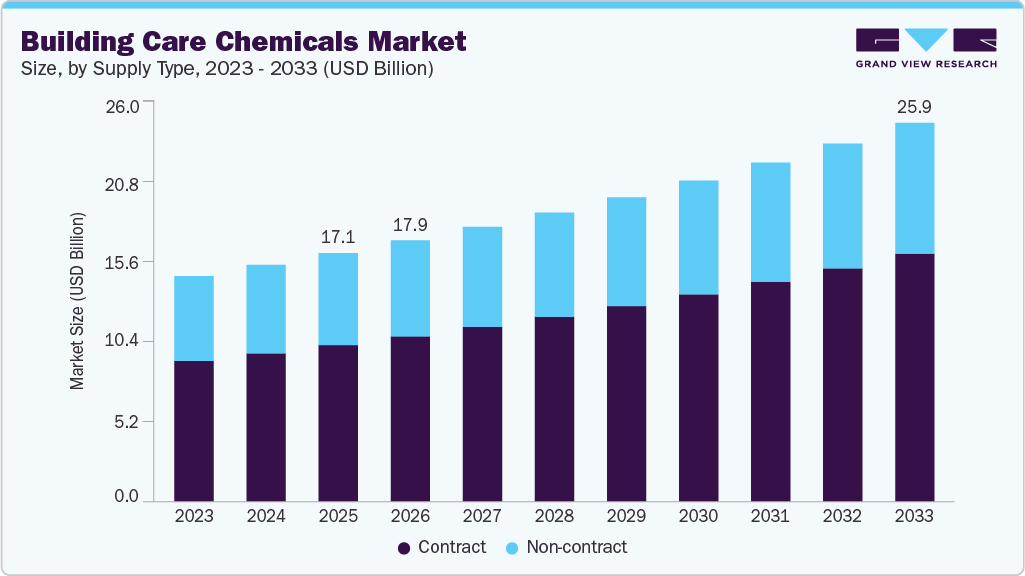 Source: Grand View Research, IR Documents, Primary Interviews, Paid DatabasesTo learn more about this report,
 Download Free Sample Report
One prominent driver for the building care chemicals industry is the institutionalization of advanced hygiene practices across healthcare, aviation, and corporate offices. Governments and health authorities have formalized cleaning protocols, creating sustained demand for disinfectants and specialty cleaners. What began as a pandemic-led response has now become a long-term facility management practice. Cleaning frequencies have increased significantly. Multiple daily disinfections of high-touch surfaces are now standard across offices, healthcare facilities, and public infrastructure. According to the Building Service Contractors Association International, around 37% of customers now prioritize hygiene in choosing cleaning service providers. Nearly 59% of facilities outsource cleaning operations to specialized contractors. This outsourcing trend is critical as it consolidates purchasing power among large service providers who demand certified, high-performance chemicals at scale. In the U.S. alone, the commercial cleaning industry revenues are supported by over 3 million cleaning professionals. This highlights the scale of recurring chemical consumption embedded in service contracts.
At the same time, the market is undergoing a fundamental transition toward sustainable and bio-based chemistry, driven by regulation rather than voluntary adoption. The United States Environmental Protection Agency updated its Safer Choice and Design for the Environment standards in 2024, expanding certification requirements for cleaning products and even recognizing service providers that exclusively use compliant formulations. This has made eco-certified products a prerequisite in many institutional tenders. Companies such as The Clorox Company and Henkel have been recognized under these programs, reflecting the industry-wide pivot. On the innovation front, BASF introduced biomass-balanced ingredients in 2024 that reduce carbon footprint without compromising performance. Bio-based surfactants such as sophorolipids and rhamnolipids are gaining traction, offering up to ~50% lower greenhouse gas emissions compared to petrochemical alternatives. This shift directly influences procurement eligibility, making sustainability a non-negotiable requirement for market participation.
Beyond formulation, innovation in product formats is emerging as a key competitive differentiator. The move toward concentrated, pre-portioned, and solid-format chemicals is reshaping how cleaning solutions are stored, transported, and used. In 2025, Ecolab launched its ReadyDose system, a tablet-based solution that reduces plastic packaging by nearly 99% and significantly lowers storage requirements. Similarly, Solenis strengthened its position in this space through the 2024 acquisition of Aqua ChemPacs, enabling on-site dilution using dissolvable pods. These innovations address both sustainability and operational efficiency while minimizing dosing errors. At the same time, companies like Essity (through its Tork brand) are integrating smart dispensing systems, highlighting a broader shift toward bundled solutions that combine chemicals, dispensing systems, and performance monitoring.
Looking at demand fundamentals, the expansion of global commercial infrastructure remains a powerful long-term growth driver. Rapid urbanization across Asia-Pacific, the Middle East, and Latin America is continuously adding new commercial floor space, each of which requires ongoing maintenance and cleaning chemicals. Asia-Pacific represents a significant share of the global industrial cleaning chemicals market, supported by large-scale infrastructure investments across the region. In India, government-backed initiatives such as the National Infrastructure Pipeline, with an outlay of around USD 1.4 trillion (as reported by the Ministry of Finance), are driving the expansion of commercial and institutional infrastructure, thereby generating sustained downstream demand for building care chemicals. Similarly, in China, policy support under frameworks such as the 14th Five-Year Plan, highlighted by the National Bureau of Statistics of China, continues to promote growth in the healthcare, food processing, and hospitality sectors, thereby indirectly strengthening demand for industrial cleaning solutions.
Furthermore, the integration of digital technologies is redefining how cleaning programs are designed and executed. IoT-enabled systems, data analytics, and automation are enabling demand-based cleaning rather than fixed schedules. For instance, Tork’s Vision Cleaning platform has demonstrated up to a 75% reduction in occupant complaints and a 68% improvement in operational efficiency, according to 2025 industry disclosures. Organizations such as ISSA have identified AI, robotics, and smart sensors as core industry priorities moving forward. This shift toward data-driven cleaning is increasing the need for precisely formulated chemicals compatible with automated systems that deliver consistent results under controlled dosing conditions. As a result, the market is transitioning from a volume-driven model to a performance- and solutions-driven ecosystem, where innovation, compliance, and integration define competitive advantages.
Company Market Share Insights
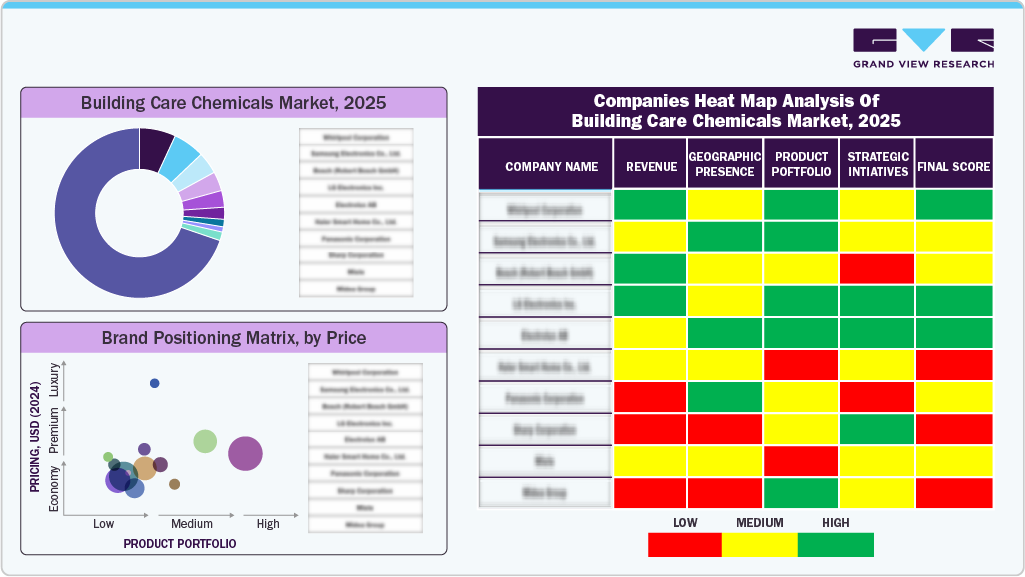
The global building care chemicals market is highly competitive, with market share concentrated among multinational consumer goods companies and specialized institutional solution providers competing on performance, compliance, and integrated service capabilities. Companies such as Procter & Gamble Company, Unilever PLC, and Reckitt Benckiser Group plc dominate high-volume categories like surface cleaners and disinfectants through strong brand equity and global distribution networks. In contrast, players like Ecolab Inc. and Solenis LLC (Diversey) command significant shares in institutional segments by offering bundled solutions that integrate chemicals, dosing systems, and service contracts, particularly in healthcare and hospitality. Competition is increasingly centered on sustainability and regulatory compliance, with The Clorox Company, Henkel AG & Co. KGaA, and Kao Corporation advancing eco-certified and bio-based formulations to meet stringent procurement standards. Meanwhile, S. C. Johnson & Son, Inc. and 3M Company are differentiating through safer chemistry and advanced dispensing technologies. The increasing outsourcing of facility management services and growth of long-term institutional contracts are intensifying competition, as buyers prioritize integrated solutions, compliance, and lifecycle cost over standalone product pricing. Overall, competitive intensity is rising as the market shifts toward solution-oriented offerings, where long-term contracts, innovation, and compliance increasingly determine share gains.
 To learn more about this report, Download Free Sample Report
Product Insights
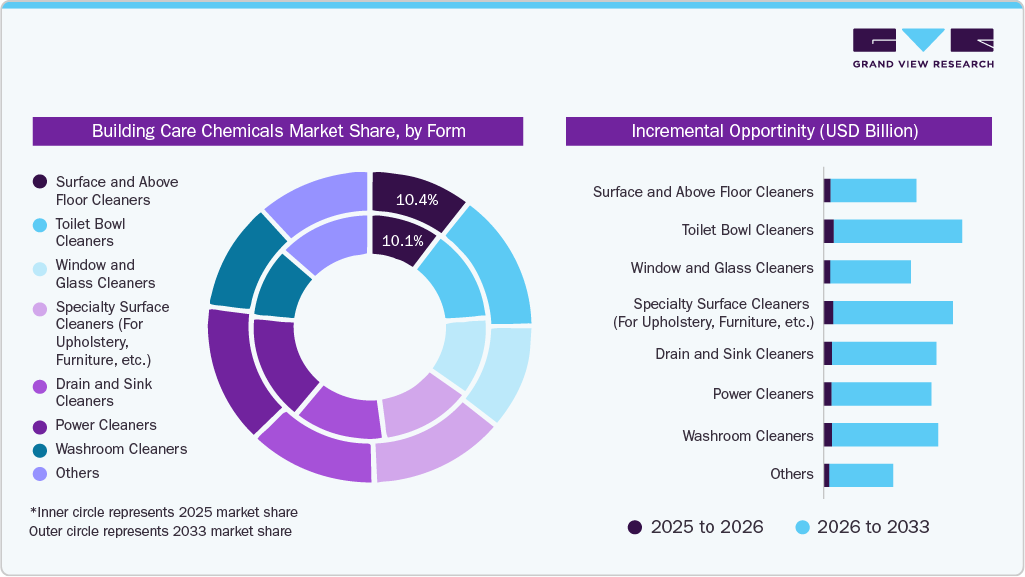
The power cleaners segment led the building care chemicals industry, accounting for the largest share of 15.6% in 2025, driven by the need for fast-acting chemicals in commercial facilities for stubborn grime, grease, and accumulated soil on hard surfaces that are cleaned repeatedly throughout the day. In offices, malls, transport hubs, and other high-traffic spaces, high-touch points such as counters, door handles, elevator buttons, desks, and restroom fixtures require regular cleaning, which keeps demand steady for strong multi-surface and heavy-duty formulations. The segment also benefits from the broader shift toward safer, more sustainable chemistries, as EPA’s Safer Choice program helps facilities, such as schools and office buildings, identify cleaners with safer ingredients without sacrificing performance.
 To learn more about this report, Download Free Sample Report
The washroom cleaners segment is anticipated to grow at a CAGR of 6.8% from 2026 to 2033, supported by the non-discretionary nature of restroom hygiene in commercial buildings. Restrooms remain one of the most sensitive areas in any facility because high-touch surfaces are frequently touched and contamination risk is elevated, so cleaning often needs to be repeated throughout the day rather than once per shift. This is especially relevant in high-traffic environments where operators prioritize odor control, stain removal, disinfection, and fast turnaround between users. The segment is also getting a lift from sustainability-led reformulations and certified products, since buyers increasingly want cleaners that meet performance requirements while aligning with environmental and worker-safety expectations.
End User Insights
The healthcare segment led the building care chemicals market, accounting for the largest share of 16.1% in 2025, driven by the integral role of infection prevention in routine hospital operations, which ensures sustained, consistent demand for cleaning chemicals. WHO describes infection prevention and control as a practical, evidence-based approach that is universally relevant to every health worker and patient, while CDC guidance specifically calls for regular cleaning of high-touch surfaces and restroom fixtures in healthcare settings. That creates sustained pull for disinfectants, surface cleaners, and washroom chemistries that can support frequent cleaning cycles and help reduce avoidable infections. In this end-user base, purchasing decisions are shaped by safety, efficacy, and compliance rather than aesthetics alone.
Pharmaceutical manufacturing is projected to grow at a CAGR of 6.7% from 2026 to 2033, driven by the critical importance of cleanliness as both a regulatory compliance requirement and an operational necessity. Stringent guidelines such as the FDA’s Current Good Manufacturing Practice (CGMP) standards mandate minimum requirements for methods, facilities, and process controls in drug manufacturing, while also emphasizing that equipment must be designed to enable effective cleaning and maintenance. That makes pharmaceutical sites a strong buyer of specialized cleaning and sanitation chemicals for production floors, equipment areas, and support spaces. As manufacturing footprints expand and quality scrutiny tightens, the need for consistent, validated cleaning programs rises, supporting faster growth than in more mature commercial end users.
Supply Type Insights
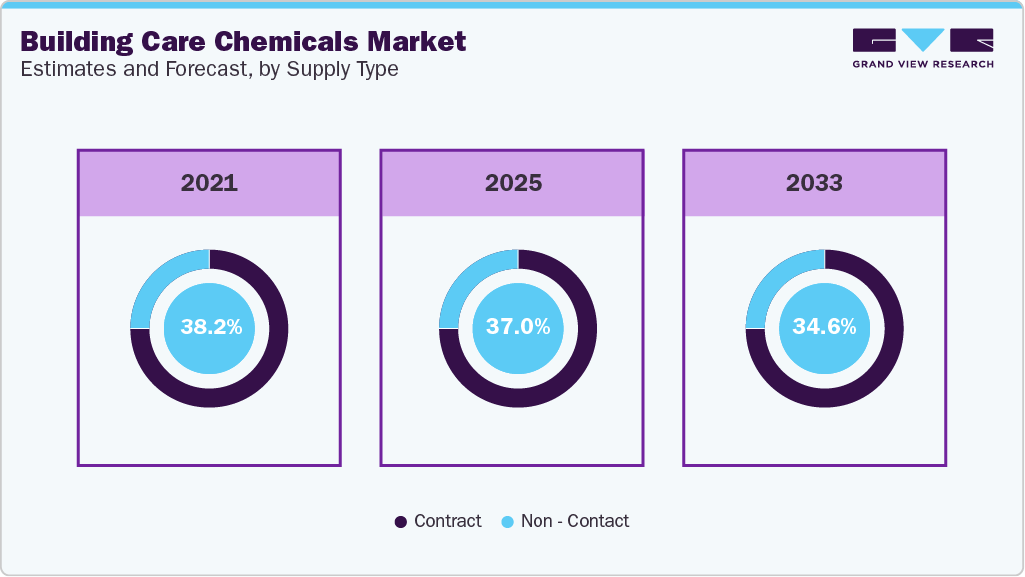
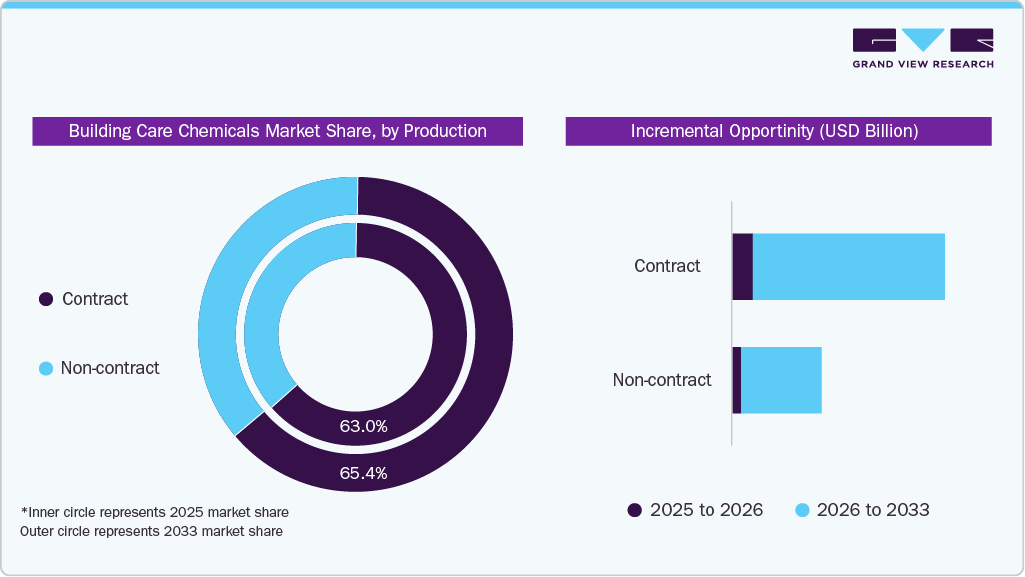
Contract supply type dominated the building care chemicals industry, accounting for the largest share of 63.0% in 2025, reflecting the strong preference for outsourced, recurring supply arrangements across commercial buildings. JLL notes that organizations outsourcing facility management can achieve cost savings of up to 20% and operational efficiencies of 10-15% over a multi-year contract period, while CBRE’s procurement research shows that FM buyers are actively focused on outsourcing strategies, inflation, sustainability, and risk. In practice, contract supply is attractive because it reduces procurement complexity, stabilizes replenishment, and gives building operators access to standardized products, training, and service continuity across multiple sites. This makes the model especially strong in office portfolios, healthcare networks, and multi-site commercial operations.
 To learn more about this report, Download Free Sample Report
Contract supply type is expected to grow at a CAGR of 6.0% from 2026 to 2033, as buyers continue shifting toward consolidated sourcing and performance-led service models. Multi-site cleaning contracts work best when organizations need standardized procedures, site-level customization, and tight accountability, which is why the model is gaining traction in complex portfolios. For suppliers, contract supply also improves planning visibility and supports upselling of bundled janitorial and sanitation chemistry. For buyers, it lowers administrative burden and helps ensure that replenishment, compliance, and service quality stay aligned across locations.
Type Insights
Contract type accounted for the largest market share of 63.0% in 2025, driven by the growing preference for service-based procurement models, where commercial building care chemical purchases are increasingly integrated into long-term service agreements rather than one-off transactions. This is especially true in facilities where cleaning standards must stay consistent and auditable across many spaces. CleanLink notes that multi-site cleaning contracts require standardized procedures, performance reviews, and clear communication to deliver consistency and accountability. At the same time, CBRE highlights outsourcing and risk management as central procurement themes. As a result, contract-based buying is favored by organizations that want predictable budgets, easier vendor management, and service continuity across their buildings.
 To learn more about this report, Download Free Sample Report
Enterprise Size Insights
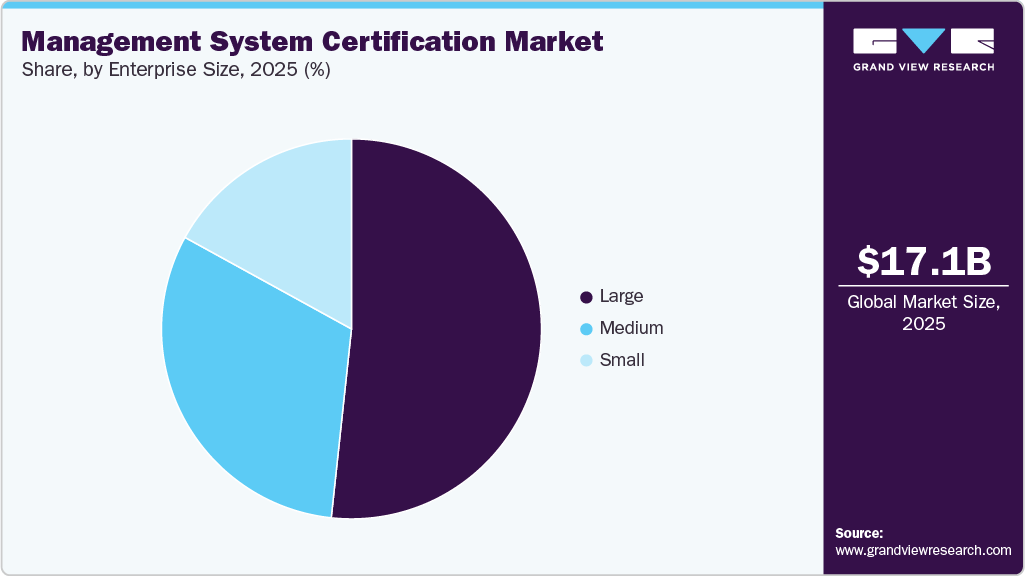
The large enterprises segment dominated the building care chemicals market, accounting for the largest share of 51.7% in 2025, and is expected to grow at a CAGR of 5.9% from 2026 to 2033, driven by their expansive commercial infrastructure, including offices, hospitals, airports, retail chains, and hospitality facilities that require continuous and standardized cleaning. These organizations operate under strict hygiene protocols and regulatory frameworks, resulting in high-volume and recurring demand for building care chemicals such as disinfectants, floor cleaners, and washroom solutions. The presence of centralized procurement systems and long-term contracts with facility management companies ensures consistent consumption patterns. Additionally, high-footfall environments such as healthcare institutions and transit hubs require frequent cleaning cycles, thereby increasing chemical usage intensity. The integration of automated dispensing and dilution control systems further optimizes consumption while maintaining efficiency.
 To learn more about this report, Download Free Sample Report
The growth of large enterprises is further supported by increasing investments in commercial real estate, particularly in emerging economies where urbanization and infrastructure expansion are accelerating. The continued focus on workplace hygiene, employee safety, and brand perception is pushing organizations to adopt premium and eco-friendly cleaning solutions. Sustainability commitments are also influencing procurement strategies, with a growing shift toward biodegradable, low-toxicity formulations. Moreover, the adoption of smart facility management technologies, including data-driven cleaning schedules based on occupancy levels, is enhancing operational efficiency while sustaining demand.
Regional Insights
North America Building Care Chemicals Market Trends
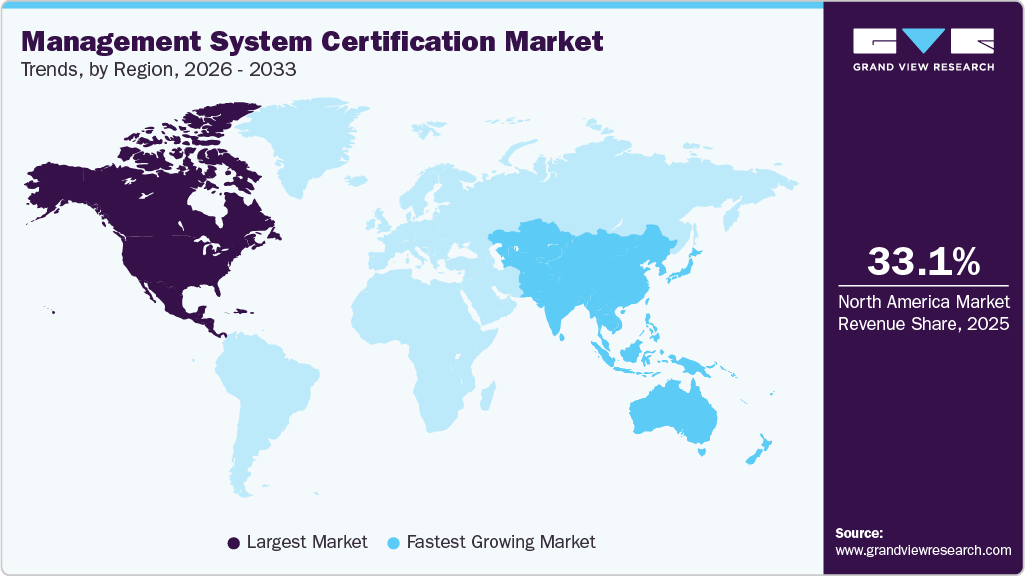
North America dominated building care chemicals industry for market share of 33.1% in 2025 and is expected to grow at a CAGR of 4.9% over the forecast period and represents the dominant regional market, structurally anchored by a highly evolved regulatory and certification ecosystem that actively governs chemical selection rather than leaving it to discretionary purchasing. The U.S. Environmental Protection Agency’s Safer Choice and Design for the Environment (DfE) programs serve as central gatekeepers for commercial cleaning formulations, and the August 2024 update to Safer Choice significantly expanded the certification scope, introduced stricter sustainable packaging requirements, and created new compliance pathways for service providers. This has directly elevated specification requirements across office buildings, healthcare campuses, and institutional facilities, effectively filtering non-compliant products from procurement pipelines. The impact is visible in industry alignment, 43 companies across 20 U.S. states were recognized as Safer Choice Partners of the Year in 2024, including major manufacturers, reinforcing eco-certified chemistry as a baseline requirement rather than a differentiator.
 To learn more about this report, Download Free Sample Report
U.S. Building Care Chemicals Market Trends
The building care chemicals industry in the U.S. accounted for a revenue of around USD 4.53 billion in 2025. The market is expected to grow at a CAGR of 4.6% during the forecast period, driven by a highly structured regulatory and procurement ecosystem in which product selection is governed by compliance standards rather than discretionary buying. Programs such as the EPA Safer Choice and Design for the Environment (DfE) have made certified, low-toxicity formulations a baseline requirement across commercial facilities. The market is further supported by the scale of the commercial cleaning industry, with a workforce of over 3 million janitors, creating strong, recurring demand. Additionally, outsourcing trends and contract-based procurement ensure consistent consumption across offices, healthcare, and institutional buildings.
The Canada building care chemicals market is expected to grow at a CAGR of 4.9% from 2026 to 2033, supported by strong alignment with green procurement and sustainability-led cleaning practices. Government-backed initiatives encourage the adoption of low-impact and environmentally responsible cleaning chemicals across public buildings, healthcare institutions, and commercial facilities. Demand is reinforced by the need for consistent maintenance in climate-sensitive environments, where indoor air quality and surface hygiene are critical. The market is also benefiting from the increasing adoption of standardized facility management practices, which promote the recurring use of compliant, performance-driven building care formulations.
Europe Building Care Chemicals Market Trends
The Europe building care chemicals industry is expected to grow at a CAGR of 4.3% from 2026 to 2033. Europe’s market is defined by its regulatory rigor and sustainability-first procurement culture, in which environmental compliance is deeply embedded in purchasing decisions across both commercial and public infrastructure. The European Union’s Green Public Procurement (GPP) framework and EU Ecolabel program have systematically pushed the adoption of low-toxicity, biodegradable, and resource-efficient cleaning products across offices, hospitals, and transport systems. Unlike less regulated markets, chemical selection in Europe is often dictated by compliance requirements tied to public tenders and building certifications, creating a consistent demand base for environmentally aligned formulations. This has also accelerated the transition toward concentrated products, reduced packaging waste, and safer ingredient profiles across the region.
The France building care chemicals market is expected to grow at a CAGR of 4.6% from 2026 to 2033, shaped by increasing emphasis on product transparency, environmental labeling, and safe chemical usage. Procurement decisions in both the public and private sectors are influenced by clear ingredient disclosure and compliance with sustainability standards. The market is supported by strong demand across healthcare, hospitality, and office spaces, where hygiene and surface maintenance are closely linked to user experience. Additionally, France’s alignment with broader EU sustainability goals is encouraging the adoption of eco-friendly formulations, thereby reinforcing demand for compliant, performance-driven building care chemicals.
The building care chemicals market in Germany is expected to grow at a CAGR of 4.3% from 2026 to 2033, driven by a strong preference for certified, high-performance, and environmentally compliant products. Labels such as the Blue Angel ecolabel play a key role in influencing procurement decisions, particularly in public and institutional sectors. The market is characterized by a quality-focused approach, where buyers prioritize efficiency, safety, and long-term surface maintenance. Demand is further supported by a well-developed industrial and commercial infrastructure, including offices, healthcare facilities, and manufacturing sites, all of which require regular, standardized cleaning programs aligned with strict regulatory requirements.
Asia Pacific Building Care Chemicals Market Trends
The Asia Pacific building care chemicals industry is expected to grow fastest at a CAGR of 7.4% from 2026 to 2033, making it the fastest-growing region, driven by structural forces such as rapid urbanization, expanding commercial real estate, and the formalization of hygiene standards across developing economies. The region’s growing industrial and institutional cleaning chemicals market reflected sustained long-term expansion. This growth is underpinned by massive infrastructure development, ranging from airports and metro systems to office parks and healthcare facilities, which continuously adding new commercial floor space that requires routine maintenance and cleaning. At the same time, governments across the region are actively promoting higher hygiene standards, further embedding recurring demand for building care chemicals.
The China building care chemicals market is expected to grow at a CAGR of 7.8% from 2026 to 2033, driven by large-scale urbanization and rapid expansion of commercial infrastructure, including airports, office complexes, and retail developments. The country’s cleaning chemicals market generated approximately $14 billion in 2025, reflecting strong demand for maintenance solutions across high-traffic facilities. Government-backed infrastructure initiatives and smart city projects are continuously adding new commercial spaces, creating recurring demand for building care chemicals. Additionally, investments such as Reckitt’s $41.2 million R&D center in Shanghai highlight the growing importance of localized, high-performance cleaning solutions tailored to large-scale commercial environments.
The building care chemicals market in India is expected to grow at a CAGR of 7.8% from 2026 to 2033, driven by rapid urbanization and the expansion of commercial real estate, particularly supported by the growth of IT parks, airports, metro systems, and healthcare infrastructure. Government initiatives such as the Swachh Bharat Mission have normalized hygiene practices across public and commercial spaces, while regulatory actions promoting eco-friendly chemicals are further shaping demand. Increasing outsourcing of facility management is also consolidating chemical consumption into structured procurement systems.
Central & South America Building Care Chemicals Market Trends
The Central & South America building care chemicals industry is expected to grow at a CAGR of 5.5% from 2026 to 2033, driven by increasing awareness of hygiene standards across public and private spaces. Countries are actively investing in retail, healthcare, and hospitality infrastructure; for instance, Brazil recorded over 600 shopping centers as per Abrasce, all of which require ongoing maintenance chemicals, while healthcare expansion across the region post-COVID-19 has structurally increased demand for disinfectants and surface care solutions. Simultaneously, the shift toward outsourced and professional facility management is accelerating, led by companies like Sodexo and ISS A/S expanding operations in Latin America, indicating stronger institutional demand for standardized cleaning chemicals. Industry platforms such as CleanTec Show Americas highlight a gradual transition toward sustainable formulations, including concentrated chemicals, low-VOC products, and water-efficient cleaning systems. Brazil remains the dominant market, driven by its large urban population (over 87% urban) and strong demand across commercial real estate, hospitals, and transport hubs, alongside stringent infection prevention protocols in healthcare settings. Argentina follows with stable demand supported by municipal sanitation programs in cities like Buenos Aires, where public cleaning budgets and waste management initiatives sustain chemical consumption.
Middle East & Africa Building Care Chemicals Market Trends
The Middle East & Africa building care chemicals industry is expected to grow at a CAGR of 5.1% from 2026 to 2033, driven by a combination of infrastructure development, healthcare expansion, and increasing focus on hygiene and infection prevention. International organizations such as the World Health Organization (WHO) emphasize the importance of infection prevention and control (IPC) in healthcare and public facilities across the region, thereby supporting the ongoing demand for cleaning and disinfecting chemicals. Rapid urban development, particularly in the Middle East, has led to the growth of large commercial complexes, airports, hotels, and retail centers, all of which require regular and high-frequency maintenance. Additionally, the harsh climatic conditions-such as dust and heat-further increase cleaning intensity in buildings.
The South Africa building care chemicals market is a key area in Africa, supported by government-led infection control frameworks and municipal cleaning initiatives that promote hygiene in public infrastructure. Saudi Arabia is a major driver in the Middle East, with large-scale investments in commercial real estate and healthcare facilities increasing the need for professional cleaning solutions.
Key Building Care Chemicals Companies:
The following key companies have been profiled for this study on the building care chemicals market.
- Procter & Gamble Company
- Kao Corporation
- Unilever PLC
- Reckitt Benckiser Group plc
- Ecolab Inc.
- Solenis LLC (Diversey Holdings, Ltd.)
- The Clorox Company
- Henkel AG & Co. KGaA
- S. C. Johnson & Son, Inc.
- 3M Company
Recent Developments
-
In March 2026, Evonik introduced Protectosil ECO-TRETE® ANTIGRAFFITI, a PFAS-free, silane-based coating that offers durable building protection and enables easy, residue-free graffiti removal. Designed to meet growing sustainability and regulatory demands, the product ensures long-lasting facade preservation even after repeated cleaning and will be showcased at the EUROCOAT in collaboration with its partner SAFIC-ALCAN.
-
In May 2025, Diversey launched the TASKI Jontec Care range, an advanced floor care program designed to improve the appearance and durability of hard flooring while lowering maintenance costs. The products exclude intentionally added PFAS and use modern chemistry for equal or better performance. With a simple three-step system-prepare, protect, maintain-the range offers sustainable, long-lasting solutions for various surfaces and high-traffic environments.
-
In May 2025, Evonik signed an exclusive U.S. distribution agreement with Sea-Land Chemical Company, expanding its reach nationwide. The partnership strengthens the supply of sustainable cleaning solutions for homecare, industrial, and institutional markets, leveraging Sea-Land’s network to deliver eco-friendly, high-performance products and support growing demand for green cleaning innovations across the U.S.
Building Care Chemicals Market Report Scope
Report Attribute
Details
Market size in 2025
USD 17.1 billion
Estimated Market size in 2026
USD 17.9 billion
Projected Market size by 2033
USD 25.9 billion
Growth rate
CAGR of 5.5% from 2026 to 2033
Base year for estimation
2025
Historical data
2021 - 2025
Forecast period
2026 - 2033
Quantitative units
Revenue in USD million/billion and CAGR from 2026 to 2033
Report coverage
Revenue forecast, company ranking, competitive landscape, growth factors, and trends
Segments covered
Product, end user, supply type, type, enterprise size, and region
Regional scope
North America; Europe; Asia Pacific; Central & South America; Middle East & Africa
Country scope
U.S.; Canada; Mexico; UK; Germany; France; Italy; Spain; China; India; Japan; South Korea; Australia & New Zealand; Brazil; Argentina; South Africa; Saudi Arabia
Key companies profiled
Procter & Gamble Company; Kao Corporation; Unilever PLC; Reckitt Benckiser Group plc; Ecolab Inc.; Solenis LLC (Diversey Holdings, Ltd.); The Clorox Company; Henkel AG & Co. KGaA; S. C. Johnson & Son, Inc.; 3M Company
Customization scope
Free report customization (equivalent up to 8 analysts working days) with purchase. Addition or alteration to country, regional & segment scope.
Pricing and purchase options
Avail customized purchase options to meet your exact research needs. Explore purchase options
Global Building Care Chemicals Market Report Segmentation
This report forecasts revenue growth at the global, regional & country levels and provides an analysis of the latest trends and opportunities in each of the sub-segments from 2021 to 2033. For this study, Grand View Research has segmented the building care chemicals market report based on product, end user, supply type, type, enterprise type, and region:
-
Product Outlook (Revenue, USD Million, 2021 - 2033)
-
Surface and Above Floor Cleaners
-
Toilet Bowl Cleaners
-
Window and Glass Cleaners
-
Specialty Surface Cleaners (For Upholstery, Furniture, etc.)
-
Drain and Sink Cleaners
-
Power Cleaners
-
Washroom Cleaners
-
Others (Toilet Seat Sanitizer, Rim Cleaner, etc.)
-
-
End User Outlook (Revenue, USD Million, 2021 - 2033)
-
Healthcare
-
Hospitals
-
Senior Living and Retirement Communities
-
Medical Centers (Life Science, Biotech, Research Centers)
-
Ambulatory Surgical Centers
-
Doctor's Offices and Clinics
-
Others (Small Rehab Centers, etc.)
-
-
Food Service
-
Restaurants & Beverage Outlets
-
Cafés, Bars, and Pubs
-
Catering Establishments
-
Informal and Mobile Food Service Establishments
-
-
Hotels & Hospitality
-
Hotels & Resorts
-
Non-Hotel & Alternative Hospitality Accommodation
-
Leisure and Entertainment Parks
-
Event Venues and Recreational Facilities
-
-
Industrial and Manufacturing Facilities
-
Food Processing and Beverage Facilities
-
Pharmaceutical Manufacturing
-
Defense & Aerospace Facilities
-
Building Service Contractors and Facility Management Companies
-
Retail & Public-Facing Commercial Spaces
-
Educational Institutions
-
Transportation and Travel
-
Airports
-
Railway Stations
-
Bus Terminals and Depots
-
Metro and Subway Systems
-
-
Ports and Harbors
-
Offices and Business Parks
-
Government Offices and Buildings
-
Others (Religious Institutions, etc.)
-
-
Supply Type Outlook (Revenue, USD Million, 2021 - 2033)
-
Contract
-
Service-Led Contract Holders
-
Building Service Contractors (BSCs)
-
Facilities Management (FM) Companies
-
-
End-User-Led Contract Holders
-
Group Purchasing Organizations (GPOs)
-
-
Non-contract
-
-
Type Outlook (Revenue, USD Million, 2021 - 2033)
-
Contract
-
Product-Only Supply Contracts
-
Service Inclusive Contracts
-
Equipment Inclusive Supply Contracts
-
Training & Compliance Inclusive Contracts
-
Fully Integrated Hygiene-as-a-Service (HaaS)/Performance-Based
-
-
Non-contract
-
-
Enterprise Size Outlook (Revenue, USD Million, 2021 - 2033)
-
Small
-
Medium
-
Large
-
-
Regional Outlook (Revenue, USD Million, 2021 - 2033)
-
North America
-
U.S.
-
Canada
-
Mexico
-
-
Europe
-
UK
-
Germany
-
France
-
Italy
-
Spain
-
-
Asia Pacific
-
China
-
India
-
Japan
-
South Korea
-
Australia & New Zealand
-
-
Central & South America
-
Brazil
-
Argentina
-
-
Middle East & Africa
-
South Africa
-
Saudi Arabia
-
-
Frequently Asked Questions About This Report
Asia Pacific is the fastest-growing region over the forecast period.
Power cleaners segment led with a 15.6% revenue share in 2025.
Healthcare segment held the largest share (over 16.1%) revenue share in 2025.
Contract segment held the largest revenue share 63.0% in 2025.
Key players include Procter & Gamble Company; Kao Corporation; Unilever PLC; Reckitt Benckiser Group plc; Ecolab Inc.; Solenis LLC (Diversey Holdings, Ltd.); The Clorox Company; Henkel AG & Co. KGaA; S. C. Johnson & Son, Inc.; 3M Company
The global building care chemicals market is expected to grow at a CAGR of 5.5% from 2026 to 2033, reaching USD 25.9 billion.
The global building care chemicals market size was valued at USD 17.1 billion in 2025 and is estimated at USD 17.9 billion for 2026.
North America dominated with a 33.1% revenue share in 2025.
The major driving factors include rising hygiene standards, sustainability mandates, and the expansion of institutional infrastructure across healthcare, hospitality, and commercial real estate. Post-pandemic sanitation protocols continue to influence purchasing cycles, particularly for high-frequency touchpoint cleaning solutions, while regulatory pressure around chemical safety and environmental impact is reshaping product portfolios
About the Author(s)
Homecare & Decor Research Team
Consumer Goods · Homecare & DecorThis report was authored by the homecare & decor research team at Grand View Research - comprising two research analysts, one senior research analyst, and one industry expert - with specialized expertise in the homecare & decor segment of the consumer goods industry. All findings are based on proprietary consumer goods databases, executive interviews, and regulatory analysis, subject to internal peer review prior to publication.
Last Updated:
Speak to Analyst

Customize this report to your needs - add regions, segments, or data points, with 20% free customization.
Or view our licence options:


ISO 9001:2015 & 27001:2022 Certified
We are GDPR and CCPA compliant! Your transaction & personal information is safe and secure. For more details, please read our privacy policy.


