
- Home
- »
- IT Services & Applications
- »
-
Captive Portal Market Size, Share & Trends Report, 2033GVR Report cover

Captive Portal Market (2026 - 2033)
Size, Share & Trends Analysis Report By Component (Solution, Services), By Deployment Mode (Cloud, On-premises), By Application (Wi-Fi Management, Content Filtering), By End Use, By Region, And Segment Forecasts
Market Size, 2025
$2.2BMarket Estimate, 2026
$2.5BMarket Forecast, 2033
$6.2BCAGR, 2026–2033
14.0%Captive Portal Market Summary
The global captive portal market size was valued at USD 2.2 billion in 2025 and is projected to grow from USD 2.5 billion in 2026 to USD 6.2 billion by 2033, at a CAGR of 14.0% from 2026 to 2033. North America dominated the market, accounting for a revenue share of 40.0% in 2025. The market is driven by increasing demand for secure and user-authenticated public Wi-Fi access across various industries.
 Source: Grand View Research, IR Documents, Primary Interviews, Paid DatabasesTo learn more about this report,
 Download Free Sample Report
Key Market Trends & Insights
- By component: Solution segment held the largest market share of around 66.0% in 2025.
- By deployment mode: Cloud segment led the market with a share of around 55.0% in 2025.
- By application: Wi-Fi Management segment held the largest market share of around 46.0% in 2025.
- By end use: Hospitality segment dominated the market with a share of around 26.0% in 2025.
Regional Highlights
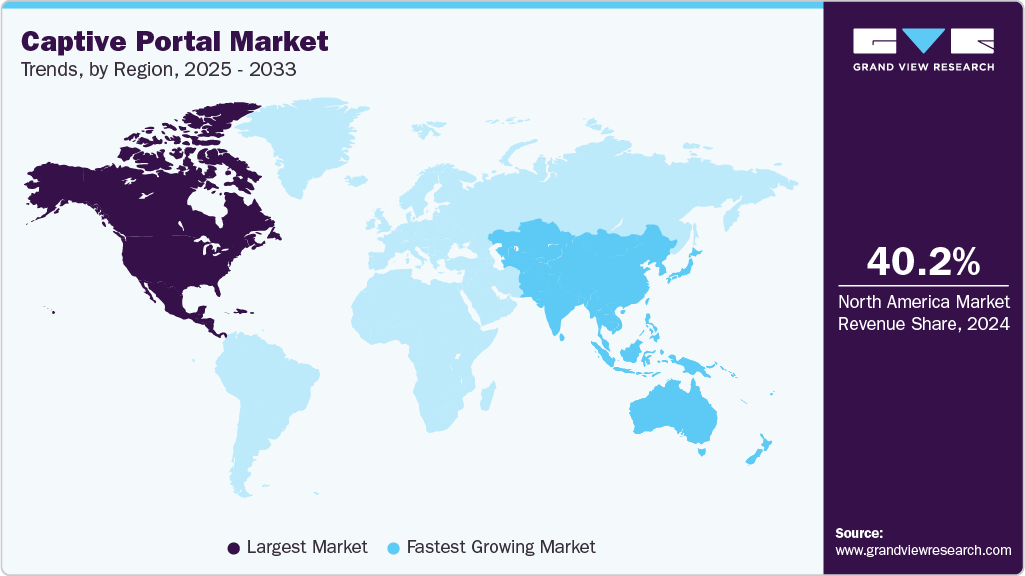
- Largest regional market: North America (40.0% revenue share, 2025)
- Fastest-growing regional market: Asia Pacific (highest CAGR, 2026-2033)
Market Size & Forecast
- Market size in 2025: USD 2.2 Billion
- Estimated market size in 2026: USD 2.5 Billion
- Projected market size by 2033: USD 6.2 Billion
- CAGR (2026-2033): 14.0%
Prism AI by Grand View Research Free to tryAsk a question about the captive portal marketTry asking✓Every figure cited from GVR research Prefer the report? Download free sample →
In addition, organizations are leveraging captive portals not only to manage guest connectivity but also to enhance user engagement, collect customer data, and enforce content filtering. The growing demand for secure and controlled access to public and semi-public Wi-Fi networks drives the global captive portal market. As digital connectivity becomes essential across the hospitality, retail, healthcare, education, and transportation sectors, businesses are adopting captive portals to regulate access, ensure compliance with privacy laws, and deliver customized user experiences.Key trend fueling market growth is the integration of captive portals with advanced analytics and marketing automation tools. By capturing user information during login, businesses can build first-party data sets that are valuable in a privacy-first digital environment. This enables personalized marketing, customer segmentation, loyalty program integration, and real-time promotions, thereby improving customer retention and increasing revenue per user. For instance, in February 2025, Cisco Meraki for Government achieved FedRAMP Moderate and StateRAMP Moderate authorization for its cloud-managed networking platform. The authorization enables the use of Meraki's cloud networking capabilities across government environments that require stringent security and compliance controls, strengthening confidence in centrally managed wireless and guest-access infrastructure.
Analyst Perspective
The captive portal market is growing steadily due to increased global adoption of secure Wi-Fi networks in sectors like hospitality, retail, transportation, and education. Enterprise use of cloud-based solutions is rising for their management, scalability, and integration benefits. Captive portals are evolving from basic authentication to include analytics, customer profiling, marketing automation, and engagement tools. Concerns about security, privacy, and controlled access are driving adoption. The growth of connected devices and public Wi-Fi infrastructure supports this trend. Asia Pacific is expected to see the fastest growth due to expanding digital and hospitality infrastructure in emerging economies.
Component Insights
The solution segment held the largest market share of around 66.0% in 2025, driven by rising demand for integrated platforms that combine secure user authentication, branded splash pages, data analytics, and seamless marketing automation in a single package. Businesses adopt these comprehensive solutions over standalone services, as they simplify deployment, ensure regulatory compliance, and enable advanced customer engagement strategies. For instance, in May 2024, Astound Business Solutions launched Wi-Fi Pro for Small Business, powered by eero, an integrated Wi-Fi networking solution designed for businesses with up to 50 employees and their customers. The solution included a captive portal that enabled businesses to provide branded guest Wi-Fi experiences through personalized splash pages and branding options. The integration of guest access functionality into a broader managed Wi-Fi platform demonstrates the growing preference for comprehensive solutions that combine connectivity, access management, and customer-facing capabilities within a single offering. Therefore, the increasing availability of integrated captive portal solutions with customizable and secure guest access features is contributing significantly to the adoption of the solution segment.
The service segment is expected to experience the fastest growth during the forecast period, driven by the increasing need for specialized expertise in deploying and maintaining advanced captive portal solutions. Additionally, the growing demand of portals in organizations for CRM integration, personalized marketing, and compliance with evolving privacy regulations is driving the need for professional services such as consulting, system integration, and customization. Moreover, managed services reduce the operational burden of network performance monitoring, content filtering, security updates, and real-time analytics, particularly in retail chains, hotels, and public venues, where centralized support ensures uniformity and efficiency. For instance, in May 2025, ivision was recognized as a Cisco Premier Provider for its managed “Meraki Access” service, highlighting the growing trend toward outsourcing captive portal operations. This service supports hundreds of retail locations by delivering scalable, secure, and branded Wi-Fi login experiences. Such advancements emphasize that managed and professional services have evolved from being supplementary offerings to becoming integral elements of contemporary captive portal strategies.
Deployment Mode Insights
The cloud segment held the largest market share, at around 55.0% in 2025, driven by its scalability, centralized management, and support for guest Wi-Fi deployments across multiple locations. Cloud-based captive portals enable organizations to manage authentication, branded login experiences, user policies, analytics, and integrations through a centralized platform without maintaining extensive on-site infrastructure. Their ability to integrate with CRM, marketing, security, and compliance systems further supports adoption across hospitality, retail, education, transportation, and enterprise environments.
The on-premises segment is expected to register significant growth over the forecast period, supported by the demand from organizations requiring greater control over network infrastructure, authentication policies, and sensitive user data. Government, healthcare, financial services, and other highly regulated organizations may prefer on-premises deployments to maintain data within internal IT environments and to customize access-control policies to meet specific security requirements. Integration with existing enterprise infrastructure and reduced dependence on external cloud services further support adoption among organizations with established IT capabilities.
Application Insights
The Wi-Fi Management segment held the largest market share of around 46.0% in 2025, due to its essential role in enabling secure, scalable, and user-friendly guest access across various industries. Captive portals function as the primary interface for user authentication, onboarding, and compliance in public and enterprise Wi-Fi networks, facilitating seamless connectivity and delivering valuable analytics for network administrators. For instance, in January 2025, Kajeet partnered with Long Beach Transit to launch a 25-bus pilot of Kajeet Transit, integrating secure rider Wi-Fi with a captive portal, digital signage, and targeted advertising capabilities. The solution provided passengers with branded internet access while enabling the transit operator to deliver service information and advertising through connected digital channels. Such deployments demonstrate the expanding role of captive portals in managing public Wi-Fi access while supporting user engagement and operational capabilities. These advancements reinforce the importance of Wi-Fi management in the captive portal market, as organizations increasingly rely on integrated solutions to provide secure connectivity, manage user access, and enhance customer experiences.
The content filtering segment is expected to grow at the highest CAGR during the forecast period due to increasing concerns around cybersecurity and regulatory compliance. Organizations across education, healthcare, and enterprise sectors are deploying captive portals with integrated content filtering to enforce browsing policies, block malicious websites, and reduce the risk of data breaches. Additionally, the rise of remote work is driving growth in the content filtering segment as organizations seek to maintain secure, compliant internet use across distributed networks and personal devices. As employees access corporate resources from diverse locations over unsecured networks, content filtering via captive portals enables IT teams to enforce consistent web usage policies and safeguard sensitive data against cyber threats. For instance, in September 2024, WatchGuard introduced Captive Portal for its cloud-managed Fireboxes, enabling organizations to restrict client access to the Internet and network resources until users complete a captive portal splash page. The feature demonstrates the growing use of captive portals to enforce controlled network access and apply access policies before users are permitted to connect to network resources. Such developments are expected to support the adoption of captive portal solutions with access control and content management capabilities as organizations increasingly prioritize secure, policy-based Internet access.
End Use Insights
The hospitality segment held the largest market share of around 26.0% in 2025, driven by its pivotal role in delivering secure, seamless, and brand-consistent guest access across industries. Captive portals serve as the essential gateway for user authentication, onboarding, and compliance enforcement functions that are foundational to both public and private Wi‑Fi networks. They not only streamline connectivity but also empower network operators with rich analytics on usage patterns, device types, and traffic flows, enabling smarter infrastructure decisions and improved service quality. For instance, in May 2025, Accor launched a new captive portal in collaboration with Nonius to enhance its hotel guest Wi-Fi experience. The portal embedded ALL loyalty program enrollment into the Wi-Fi login process and provided a fully customizable branded interface, validated guest data collection, analytics integration, and multiple authentication options. The deployment demonstrates how hospitality providers are increasingly using captive portals beyond basic network authentication to strengthen guest engagement, loyalty enrollment, and data-driven customer experiences.
The retail segment is expected to register the fastest growth from 2026 to 2033, driven by the rising adoption of captive portals as strategic tools for customer engagement and data monetization. As retailers seek to enhance in-store experiences and compete with e-commerce platforms, captive portals offer a unique way to transform free Wi‑Fi access into a marketing and analytics engine. By prompting users to sign in via branded splash pages, retailers collect valuable first-party data, including email addresses, demographic details, and behavioral insights linked to loyalty programs. This enables them to deliver hyper-personalized promotions, trigger real-time offers based on user profiles or store location, and re-engage customers across digital channels. For instance, in May 2025, Système U selected Cloudi-Fi to deploy its cloud-based captive portal solution across approximately 1,500 stores. The platform provides secure guest Wi-Fi authentication, branded login experiences, compliant customer data collection, and marketing capabilities, demonstrating how retailers are integrating captive portals with in-store customer engagement and centralized network management.
Regional Insights
North America captive portal market held a significant share of approximately 40.0% in 2025, driven by increasing investments in advanced network security and seamless user authentication systems, particularly in sectors such as hospitality, retail, and healthcare. Businesses are leveraging captive portals not only to provide controlled Wi-Fi access but also to gather actionable customer data that supports targeted marketing and personalized engagement strategies. The rise of remote work and mobile device use has intensified demand for reliable, secure network access, prompting organizations to adopt cloud-based captive portal solutions to ensure scalability and compliance with evolving privacy regulations. Additionally, collaborations between captive portal providers and major cloud and networking companies are accelerating innovation, driving adoption of sophisticated features such as AI-powered analytics and real-time user behavior monitoring across the region.
 To learn more about this report, Download Free Sample Report
U.S. Captive Portal Market Trends
The captive portal market in the U.S. is expected to grow significantly, driven by the increasing demand for secure and personalized Wi-Fi access in public spaces, such as airports, hotels, and retail establishments, which has led businesses to adopt captive portals to authenticate users and collect valuable data. Additionally, advancements in technology, including the integration of artificial intelligence and machine learning, have enhanced the capabilities of captive portals, enabling businesses to deliver tailored experiences and targeted marketing. Moreover, the proliferation of mobile devices and the growing emphasis on data privacy and regulatory compliance with frameworks such as GDPR and CCPA have further fueled the adoption of captive portal solutions across various industries.
Europe Captive Portal Market Trends
Captive portal market in Europe is anticipated to register considerable growth from 2026 to 2033, owing to the increasing adoption of cloud-based solutions, enhancing scalability and flexibility, enabling businesses to manage multiple locations efficiently. Additionally, integration with the Internet of Things (IoT) provides enhanced user experience and operational efficiencies. Advanced analytics tools offer actionable insights into user behavior, allowing businesses to personalize services and improve customer engagement. Moreover, innovations in user authentication methods, such as biometric authentication and QR code scanning, are enhancing security and user experience. Furthermore, collaborations between captive portal providers and industries are fostering innovation and expanding captive portal functionality. These developments are contributing to the growth of the captive portal market in Europe, as businesses seek to enhance user experience and operational efficiencies.
The UK captive portal market is experiencing notable growth, driven by rising demand for secure Wi-Fi access in public spaces such as airports, hotels, and retail establishments. Moreover, the proliferation of mobile devices, alongside stringent data privacy regulations such as the GDPR, has further accelerated adoption across industries. For instance, Lytchett Minster School in the UK uses captive portal functionality to provide Wi-Fi access to guests attending events at its facilities, requiring users to accept the applicable terms and conditions before accessing the network. The deployment also incorporates centralized network management, enabling the school’s IT team to monitor connected devices and manage network performance remotely. Such deployments demonstrate the growing adoption of captive portals by UK organizations to provide controlled guest connectivity, simplify network administration, and improve visibility into Wi-Fi usage.
The captive portal market in Germany is growing, driven by stringent data privacy regulations such as the GDPR and a strong emphasis on secure, controlled Wi-Fi access in public and enterprise environments. The market growth is supported by increasing internet penetration, the proliferation of smart devices, and the rising adoption of cloud-based captive portal solutions that offer scalability, centralized management, and compliance capabilities. Key industry verticals fueling demand include hospitality, retail, transportation, and coworking spaces, where secure guest access and user authentication are critical. Germany’s market dominance in Europe is also attributed to substantial investments in digital infrastructure and the presence of major technology providers innovating in captive portal platforms.
Asia Pacific Captive Portal Market Trends
Asia Pacific is expected to register the fastest CAGR from 2026 to 2033, driven by increasing government investments in digital education across the APAC. As governments prioritize developing digital infrastructure to enhance educational access and quality, demand for secure, scalable Wi-Fi solutions in educational institutions is rising. Captive portals play a crucial role in this ecosystem by providing secure internet access, user authentication, and data collection capabilities, thereby supporting the delivery of digital education services. For example, India's PM-WANI framework continues to expand public Wi-Fi availability through an ecosystem of Public Data Offices, aggregators, and app providers. App providers support user registration and authentication, underscoring the growing need for structured access management as public Wi-Fi infrastructure expands nationwide.
Japan captive portal market is experiencing substantial growth, driven by increasing internet penetration and the government's push for enhanced digital infrastructure. Key trends include rising demand for secure, seamless Wi-Fi access in public spaces such as airports, train stations, and commercial establishments, fueled by a growing number of tourists. Additionally, there's a heightened focus on leveraging captive portals for data collection and personalized marketing, aligning with the country’s advanced adoption of technology. The integration of advanced authentication methods, such as biometric verification and mobile-based logins, is also gaining traction to enhance security and user experience.
The captive portal market in China is supported by the continued expansion of public Wi-Fi, commercial wireless networks, smart retail environments, transportation hubs, and connected public infrastructure. The rising deployment of managed Wi-Fi in high-traffic locations is increasing the need for user authentication, controlled network access, and centralized guest connectivity management. Growing digitalization across hospitality, retail, education, and commercial facilities is expected to support further adoption of captive portal solutions.
Key Captive Portal Market Company Insights
Key players operating in the captive portal industry are Cisco Systems, Hewlett Packard Enterprise Development, Extreme Networks, and others. Companies are focusing on various strategic initiatives, including new product development, partnerships & collaborations, and agreements to gain a competitive advantage over their rivals. The following are some instances of such initiatives.
Key Captive Portal Companies
The following key companies have been profiled for this study on the captive portal market.
-
Adentro
-
Arista Networks
-
Boingo
-
Cisco Systems
-
Cloud4Wi
-
Datavalet
-
Extreme Networks
-
GlobalReach
-
GoZone WiFi
-
Hewlett Packard Enterprise Development
-
IronWifi
-
Juniper Networks
-
Netgear
-
Purple
-
ray.life
-
Spotipo
Recent Developments
-
In April 2025, NETGEAR introduced a free internal captive portal with Insight 7.7, enabling businesses to provide authenticated guest Wi-Fi access without purchasing a separate captive portal service. The feature supports social media login and centralized guest access management, strengthening NETGEAR's cloud-managed wireless networking capabilities.
-
In May 2024, Astound Business Solutions launched Wi-Fi Pro for Small Businesses, a new Wi-Fi networking solution powered by eero, designed to deliver fast, secure, and scalable internet connectivity for businesses with up to 50 employees. The product features eero’s mesh Wi-Fi technology and includes a captive portal that enables businesses to offer a branded guest Wi-Fi experience with customizable splash pages, guest access controls, and bandwidth management. This captive portal functionality enhances security and user engagement, making it easier for small businesses to manage and personalize their guest network while maintaining reliable performance.
Captive Portal Market Report Scope
Report Attribute
Details
Market size in 2025
USD 2.2 billion
Estimated market size in 2026
USD 2.5 billion
Projected market size by 2033
USD 6.2 billion
Growth rate
CAGR of 14.0% from 2026 to 2033
Base year for estimation
2025
Historical data
2021 - 2024
Forecast period
2026 - 2033
Quantitative units
Revenue in USD billion, and CAGR from 2026 to 2033
Report coverage
Revenue forecast, company ranking, competitive landscape, growth factors, and trends
Segments covered
Component, deployment mode, application, end use, region
Regional scope
North America; Europe; Asia Pacific; Latin America; MEA
Country scope
U.S.; Canada; Mexico; UK; Germany; France; China; India; Japan; Australia; South Korea; Brazil; UAE; Saudi Arabia; South Africa
Key companies profiled
Cisco Systems; Hewlett Packard Enterprise Development; Extreme Networks; Arista Networks; Juniper Networks; Purple; Cloud4Wi; IronWifi; Netgear; GlobalReach; GoZone WiFi; Adentro; Spotipo; Boingo; Datavalet; ray.life
Customization scope
Free report customization (equivalent to 8 analyst working days) with purchase. Addition or alteration to country, regional & segment scope.
Pricing and purchase options
Avail of customized purchase options to meet your exact research needs. Explore purchase options
Global Captive Portal Market Report Segmentation
This report forecasts revenue growth at the global, regional, and country levels and provides an analysis of the latest industry trends and opportunities across each sub-segment from 2021 to 2033. For this study, Grand View Research has segmented the global captive portal market report based on component, deployment mode, application, end use, and region:
-
Component Outlook (Revenue, USD Billion, 2021 - 2033)
-
Solution
-
Services
-
Professional Services
-
Managed Services
-
-
Deployment Mode Outlook (Revenue, USD Billion, 2021 - 2033)
-
Cloud
-
On-premises
-
-
Application Outlook (Revenue, USD Billion, 2021 - 2033)
-
Wi-Fi Management
-
Content Filtering
-
Device Management
-
Bandwidth Management
-
-
End Use Outlook (Revenue, USD Billion, 2021 - 2033)
-
Hospitality
-
Retail
-
Healthcare
-
Education
-
Transportation
-
Public Venues
-
Corporate/Enterprise Offices
-
-
Regional Outlook (Revenue, USD Billion, 2021 - 2033)
-
North America
-
U.S.
-
Canada
-
Mexico
-
-
Europe
-
UK
-
Germany
-
France
-
-
Asia Pacific
-
China
-
Japan
-
India
-
Australia
-
South Korea
-
-
Latin America
-
Brazil
-
-
Middle East and Africa
-
UAE
-
Saudi Arabia
-
South Africa
-
Frequently Asked Questions About This Report
The global captive portal market size was valued at USD 2.2 billion in 2025 and is estimated at USD 2.5 billion for 2026.
The global captive portal market is expected to grow at a CAGR of 14.0% from 2026 to 2033, reaching USD 6.2 billion.
North America dominated with an approximately 40.0% revenue share in 2025.
Key players in the market include Cisco Systems; Hewlett Packard Enterprise Development; Extreme Networks; Arista Networks; Juniper Networks; Purple; Cloud4Wi; IronWifi; Netgear; GlobalReach; GoZone WiFi; Adentro; Spotipo; Boingo; Datavalet; ray.life and others.
The solution segment accounted for the largest revenue share, at around 66.0%, in 2025.
About the Author(s)
IT Services & Applications Research Team
Technology · IT Services & ApplicationsThis report was authored by the it services & applications research team at Grand View Research - comprising two research analysts, one senior research analyst, and one industry expert - with specialized expertise in the it services & applications segment of the technology industry. All findings are based on proprietary technology databases, executive interviews, and regulatory analysis, subject to internal peer review prior to publication.
Last Updated:
Speak to Analyst

Customize this report to your needs - add regions, segments, or data points, with 20% free customization.
Or view our licence options:


ISO 9001:2015 & 27001:2022 Certified
We are GDPR and CCPA compliant! Your transaction & personal information is safe and secure. For more details, please read our privacy policy.


