
- Home
- »
- Food Additives & Nutricosmetics
- »
-
Citric Acid Market Size, Share & Trends Report, 2026-2033GVR Report cover

Citric Acid Market (2026 - 2033)
Size, Share & Trends Analysis Report By Form (Liquid, Powder), By Application (Pharmaceutical, Food & Beverages), By Region (North America, Europe, Asia Pacific, Latin America, Middle East & Africa), And Segment Forecasts
Market Size, 2025
$4.6BMarket Estimate, 2026
$4.8BMarket Forecast, 2033
$7.1BCAGR, 2026–2033
5.6%Citric Acid Market Summary
The global citric acid market size was valued at USD 4.6 billion in 2025 and is projected to grow from USD 4.8 billion in 2026 to USD 7.1 billion by 2033, growing at a CAGR of 5.6% from 2026 to 2033. Asia Pacific dominated the market, accounting for a revenue share of 35.0% in 2025. High demand for different types of citric acid, mainly used to preserve food, is expected to be a key driver for the industry's growth.
Key Market Trends & Insights
- By form: The powder segment accounted for the largest revenue share of around 60.0% in 2025.
- By application: The food & beverages segment held the largest market share of around 71.0% in 2025.
Regional Highlights
- Largest regional market: Asia Pacific (35.0% revenue share, 2025)
Market Size & Forecast
- Market size in 2025: USD 4.6 Billion
- Estimated market size in 2026: USD 4.8 Billion
- Projected market size by 2033: USD 7.1 Billion
- CAGR (2026-2033): 5.6%
Three ways to get this report
Buy it, customize it, or ask a question.Ask an Analyst
Analyst response in 1 business day
- AccessReport author, directly
- Reply timeWithin 1 working day
- No sales callDirect answer only
- FormatEmail reply
- CostFree, no cost
Get the Full Report
What the study covers
- FormatsPDF · Excel · Dashboard
- Timeline2026–2033 annual, 2025 base
- Coverage20+ countries, 5 regions
- Companies10+ key players profiled
Customize the Report
20% free customization
- IncludeCountries, segments, points
- TailorTo your product definition
- ExtendDeeper competitor detail
- OrA fully bespoke study
- Turnaround5–10 working days
Citric acid is largely used in the regional food processing industry to enhance the shelf life of convenience foods. The well-established food processing industry in the region is expected to have a positive impact on industry trends. Regulations on the use of citric acid in nutraceuticals, nutricosmetics, and dietary supplements, especially in infant formulas, in North America are stringent, which is expected to pose a challenge for regional players. This has led to stagnation in product innovation for infant formulations. Source: Grand View Research, IR Documents, Primary Interviews, Paid DatabasesTo learn more about this report,
 Download Free Sample Report
 The manufacturers are penetrating into various market segments by introducing citric acid-based products such as confectionery, diabetic baked products, ice creams, low-calorie jellies, low-calorie sugar, dietary beverages & snacks, and low-fat dairy products. The rising demand for these products is expected to boost demand among consumers.
Market Dynamics
The citric acid market is driven by rising demand for clean-label food and beverage products, where citric acid is widely used as a natural preservative and acidulant. In addition, changes in raw material and energy costs continue to challenge manufacturers by impacting production economics. At the same time, expanding applications in pharmaceuticals, dietary supplements, and eco-friendly cleaning products are creating significant growth opportunities for market participants.
The increasing consumer preference for natural, clean-label, and minimally processed food and beverage products remains a major driver for the citric acid market. Citric acid is widely used as a natural acidulant, preservative, flavor enhancer, and pH stabilizer in soft drinks, processed foods, confectionery, and convenience foods. The increasing use of packaged foods, functional beverages, and health-oriented products is supporting the market adoption globally. In addition, manufacturers are replacing artificial additives with naturally derived ingredients to meet changing consumer demand and regulatory requirements, further supporting market growth.
Several food and beverage companies are undertaking efforts to expand their clean-label offerings. Companies such as Nestlé and The Kraft Heinz Company have implemented initiatives to simplify ingredient lists of their products and remove artificial additives from several product categories. Manufacturers are seeking natural alternatives that can maintain product stability, taste, and shelf life. Citric acid has emerged as a preferred ingredient due to its multifunctional properties and widespread regulatory acceptance. This shift toward transparent labeling and natural ingredient formulations continues to create sustained demand for citric acid across the global food and beverage industry.
Fluctuating prices of major raw materials such as corn, sugar, and molasses, along with rising energy and transportation costs, continue to restrain the citric acid market. Since citric acid production largely depends on fermentation processes using carbohydrate-based raw materials, changes in agricultural commodity prices directly affect manufacturing costs and profit margins. Supply chain disruptions, export restrictions from major producing countries, and logistics bottlenecks have also contributed to price instability, creating challenges for both producers and end-users in the market.
A notable example was the global supply chain disruption experienced during and after the pandemic, which was further aggravated by high costs of logistics and volatility in agricultural commodity markets. Major citric acid-producing regions, particularly in China, faced production and logistics constraints, resulting in fluctuations in global citric acid availability and pricing. Such market volatility makes long-term procurement planning difficult for food, beverage, pharmaceutical, and personal care manufacturers that rely on citric acid as a key ingredient. Consequently, unpredictable raw material and production costs remain a significant challenge for sustained market growth.
The citric acid market is experiencing a growing use in pharmaceutical formulations and sustainable household cleaning products. Citric acid is widely used in medicines, dietary supplements, effervescent tablets, and personal care products due to its chelating, buffering, and stabilizing properties. In addition, rising environmental awareness and stringent chemical regulations are driving demand for biodegradable cleaning solutions, where citric acid serves as an effective natural ingredient. The shift toward green chemistry and bio-based products is expected to create new growth opportunities for the citric acid manufacturers over the coming years.
Analyst Perspective
The citric acid market is set to continue its upward momentum fueled by dynamic trends in food and beverages, pharmaceuticals, and the rise of sustainable consumer products. Increasing consumer demand for clean-label, naturally derived ingredients drives the use of citric acid as a preservative, acidulant, and flavor enhancer in processed foods, functional beverages, and dietary supplements. Expanding applications in pharmaceuticals, nutraceuticals, and eco-friendly cleaning products support market growth. Citric acid’s biodegradable and multifunctional properties meet evolving regulatory and sustainability standards. Increased demand from health-conscious consumers and innovation in clean-label products, driven by robust food processing industries and cost-effective manufacturing, boost the market. Major firms face challenges from fluctuating raw material prices, rising energy costs, and supply chain uncertainties.
Form Insights
The powder segment accounted for the largest revenue share of around 60.0% in 2025. The powder form is used as an alternative to lemon juice or vinegar in culinary applications. It is used as a chelating agent to prevent and eliminate lime scale buildup in evaporators and boilers. In addition, it is also used to treat water to improve the effectiveness of laundry detergents and soaps. The powder form of the product is widely used in food & beverage applications for preservation and flavoring. In addition, it is used as an emulsifying agent in ice creams to prevent the fats from separating. It is commonly sold in grocery stores and markets as sour salt because it resembles table salt.
The liquid segment is expected to grow at a CAGR of approximately 4.0% during the forecast period. Liquid form is used in a variety of food and dairy products due to its beneficial properties, including its role as an acidifying agent, texture modifier, and flavor enhancer. Liquid form is also used in the oil industry as an iron control additive for chelating and maintaining the pH of acidizing fluids to help reduce the precipitation of iron in oil. In addition, key companies in the market are expanding their global footprint by investing in upgrades to manufacturing plants and facilities. For instance, in November 2025, Jungbunzlauer completed the acquisition of a manufacturing facility in Illinois, strengthening its North American production footprint and expanding capacity for naturally derived ingredients, including citric acid. The investment supported rising regional demand for both powder and liquid citric acid products, contributing to the segment growth.
Application Insights
The food & beverages segment accounted for the largest revenue share of about 71.0% in 2025. The high market share of the food & beverage segment can be attributed to the extensive usage in ice creams and dietary supplements. It is used to control the pH in medicines and to form salt derivatives of minerals and metals in pharmaceuticals. Furthermore, it is employed in conjunction with sodium bicarbonate in effervescent formulae for the manufacturing of personal care and ingestion tablets & powder products. The food & beverages segment is further driven by clean-label reformulation, functional beverages, and innovations in citrus-based ingredients.
The pharmaceuticals segment is expected to grow with a significant CAGR of around 4.0% over the forecast period. Citric acid is predominantly used as an excipient in pharmaceutical formulations, serving multiple functions, including stabilizing pH levels, acting as a chelating agent, and ensuring the stability and efficacy of diverse medications. It plays a crucial role in the production of effervescent tablets, serving as a vital component that creates effervescence and improves patient compliance with the medication regimen. Furthermore, the increasing commercialization of biologics and advanced therapies is driving demand for formulation excipients such as citric acid and citrate buffers. Pharmaceutical developers, such as Pfizer, continue to invest in biologics manufacturing and injectable drug development, where citric acid plays an important role in formulation stabilization and pH control. Such trends worldwide are supporting the growth of the pharmaceutical segment in the citric acid market.
Regional Insights
North America citric acid market held a significant revenue share in 2025, driven by strong demand from the food & beverage, pharmaceuticals, nutraceuticals, personal care, and industrial cleaning sectors. The region is experiencing growth driven by clean-label food trends, increasing consumption of processed and convenience foods, expansion of functional beverages, rising pharmaceutical production, and efforts to strengthen domestic ingredient supply chains. The U.S. is the largest market in the region, while Canada and Mexico are witnessing growing demand from food processing, beverage manufacturing, and healthcare industries.
The U.S. citric acid market is experiencing steady growth due to rising demand from the food & beverage, pharmaceutical, nutraceutical, and cleaning product industries. Increasing consumer preference for clean-label foods, natural preservatives, functional beverages, and health supplements is driving higher use of citric acid as an acidulant, preservative, flavor enhancer, and pH regulator. In addition, investments in domestic production capacity are supporting regional supply chains. Growth in sports drinks, electrolyte beverages, dietary supplements, and pharmaceutical formulations is further supporting market expansion within the U.S. market.
Asia Pacific Citric Acid Market Trends
The Asia Pacific citric acid market accounted for the largest revenue share of around 35.0% in 2025. Asia Pacific, being one of the largest and fastest-growing regions in the world, holds a prominent position in the global citric acid market. The region's strong economic growth, rapid industrialization, and increasing urbanization have fueled the demand for processed food and beverages, pharmaceuticals, and personal care products.
 To learn more about this report, Download Free Sample Report
 The China citric acid market accounted for a significant share of the APAC market in 2025. China remains one of the world’s largest producers and exporters of citric acid, supported by abundant corn-based raw material availability and cost-efficient production infrastructure. Rising consumption of processed foods, carbonated beverages, functional drinks, and dietary supplements is increasing domestic demand. Moreover, pharmaceutical manufacturing growth is further supporting the use of citric acid as an excipient and a buffering agent. In addition, Chinese producers are investing in production optimization, sustainability initiatives, and export competitiveness to strengthen their global market position.
Europe Citric Acid Market Trends
The Europe citric acid market accounted for a significant share in 2025, driven by increasing demand from the food & beverage, pharmaceutical, nutraceutical, and personal care industries. The regional development in clean-label products, natural food additives, sustainable ingredients, and health-oriented formulations is accelerating the use of citric acid as a preservative, acidulant, flavor enhancer, and buffering agent. In addition, growing consumption of functional beverages, dietary supplements, and processed foods across countries such as Germany, France, the U.K., and Italy continues to support market expansion. The growing emphasis on environmentally friendly cleaning products and bio-based ingredients across Europe is also supporting the citric acid market.
Central & South America Citric Acid Market Trends
The Central & South America is expected to grow at a CAGR of 5.0% during the forecast period. Citric acid manufacturers find plenty of prospects in the region, owing to its varied economies, burgeoning middle-class population, and expanding food and beverage sector. As disposable incomes rise and urbanization accelerates, there is a growing inclination towards convenience foods and ready-to-drink beverages, driving increased demand for citric acid as a crucial ingredient. Furthermore, the region's flourishing pharmaceutical and personal care industries also contribute to the consumption of citric acid in the area.
Key Citric Acid Company Insights
Major technological shifts in manufacturing processes and the rising use of advanced machinery are expected to positively affect the growth of citric acid production over the forecast period. The use of advanced machinery has enabled manufacturers to develop innovative products, such as encapsulated citric acid. Companies in the industry are also investing in R&D to develop citric acid products for applications in detergents, food & beverages, pharmaceuticals, and cosmetics.
Key Citric Acid Companies
The following key companies have been profiled for this study on the citric acid market
-
Pfizer, Inc.
-
Tate & Lyle PLC
-
Danisco A/S
-
Cargill
-
Kenko Corporation
-
ADM
-
Jungbunzlauer Suisse AG
-
TTCA Co., Ltd.
-
RZBC Group Co., Ltd.
-
Citribel NV
Recent Developments
-
In November 2025, Brenntag showcased citric acids and citrate-based pharmaceutical ingredients at CPHI India 2025, highlighting their role in advanced drug formulations and regulatory-compliant healthcare applications. The initiative supported the growing demand for high-purity citric acid powder and liquid products in the pharmaceutical sector, indicating ongoing innovation and product development across the industry.
-
In August 2024, Jungbunzlauer announced the pharmaceutical application of citric acid anhydrous, expanding its use as an active pharmaceutical ingredient (API) in antacids, laxatives, and drug formulations. This development strengthened demand for powder-form citric acid, particularly in pharmaceutical applications, supporting the market growth.
Citric Acid Market Report Scope
Report Attribute
Details
Market size in 2025
USD 4.6 billion
Estimated market size in 2026
USD 4.8 billion
Projected market size by 2033
USD 7.1 billion
Growth rate
CAGR of 5.6% from 2026 to 2033
Base year for estimation
2025
Historical data
2021 - 2024
Forecast period
2026 - 2033
Quantitative units
Revenue in USD billion, and CAGR from 2026 to 2033
Report coverage
Revenue forecast, company ranking, competitive landscape, growth factors, and trends
Segments covered
Form, application, region
Regional Scope
North America; Europe; Asia Pacific; Latin America; Middle East & Africa
Key companies profiled
Pfizer, Inc.; Tate & Lyle PLC; Danisco A/S; Cargill; Kenko Corporation; ADM; Jungbunzlauer Suisse AG; TTCA Co., Ltd.; RZBC Group Co., Ltd.; Citribel NV
Customization scope
Free report customization (equivalent up to 8 analysts working days) with purchase. Addition or alteration to country, regional & segment scope.
Pricing and purchase options
Avail of customized purchase options to meet your exact research needs. Explore purchase options
Global Citric Acid Market Report Segmentation
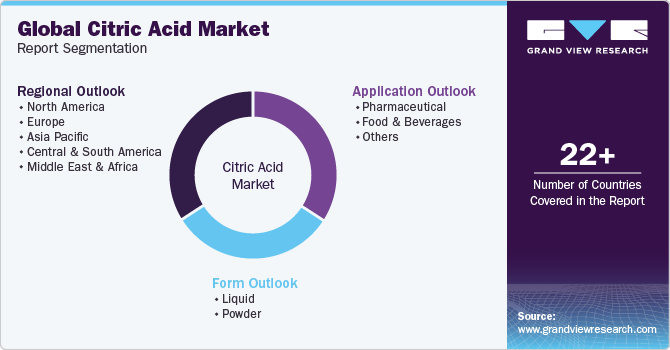
This report forecasts revenue growth at the global, regional, and country levels and provides an analysis on the latest industry trends and opportunities in each of the sub-segments from 2021 to 2033. For the purpose of this study, Grand View Research has segmented the global citric acid market report on the basis of form, application, and region:
 To learn more about this report, Download Free Sample Report
 -
Form Outlook (Volume, Kilotons; Revenue, USD Million, 2021 - 2033)
-
Liquid
-
Powder
-
-
Application Outlook (Volume, Kilotons; Revenue, USD Million, 2021 - 2033)
-
Pharmaceutical
-
Food & Beverages
-
Others
-
-
Regional Outlook (Volume, Kilotons; Revenue, USD Million, 2021 - 2033)
-
North America
-
U.S.
-
Canada
-
Mexico
-
-
Europe
-
UK
-
Germany
-
France
-
Italy
-
Spain
-
-
Asia Pacific
-
China
-
Japan
-
India
-
South Korea
-
-
Central & South America
-
Brazil
-
Argentina
-
-
Middle East and Africa
-
Saudi Arabia
-
South Africa
-
-
Frequently Asked Questions About This Report
The global citric acid market size was valued at USD 4.6 billion in 2025 and is estimated at USD 4.8 billion for 2026.
The global citric acid market is expected to grow at a CAGR of 5.6% from 2026 to 2033, reaching USD 7.1 billion.
Key players include Pfizer, Inc.; Tate & Lyle PLC; Danisco A/S; Cargill; Kenko Corporation; ADM; Jungbunzlauer Suisse AG; TTCA Co., Ltd.; RZBC Group Co., Ltd.; Citribel NV
Asia Pacific dominated with a 35.0% revenue share in 2025.
Food & beverages dominated the citric acid market with a share of 71.0% in 2025.
About the Author(s)
Food Additives & Nutricosmetics Research Team
Specialty & Chemicals · Food Additives & NutricosmeticsThis report was authored by the food additives & nutricosmetics research team at Grand View Research - comprising two research analysts, one senior research analyst, and one industry expert - with specialized expertise in the food additives & nutricosmetics segment of the specialty & chemicals industry. All findings are based on proprietary specialty & chemicals databases, executive interviews, and regulatory analysis, subject to internal peer review prior to publication.
Last Updated:
Speak to Analyst

Customize this report to your needs - add regions, segments, or data points, with 20% free customization.
Or view our licence options:


ISO 9001:2015 & 27001:2022 Certified
We are GDPR and CCPA compliant! Your transaction & personal information is safe and secure. For more details, please read our privacy policy.


