
- Home
- »
- Next Generation Technologies
- »
-
Cloud Database And DBaaS Market Size Report, 2026-2033GVR Report cover

Cloud Database And DBaaS Market (2026 - 2033)
Size, Share & Trends Analysis Report By Component (Solution, Service), By Database Type, By Deployment (Public, Private), By Enterprise Size, By End-use (BFSI, Healthcare), By Region, And Segment Forecasts
Market Size, 2025
$25.5BMarket Estimate, 2026
$29.5BMarket Forecast, 2033
$90.3BCAGR, 2026–2033
17.3%Cloud Database And DBaaS Market Summary
The global cloud database and DBaaS market size was valued at USD 25.5 billion in 2025 and is projected to grow from USD 29.5 billion in 2026 to USD 90.3 billion by 2033, at a CAGR of 17.3% from 2026 to 2033. The market in North America dominated with a revenue share of 36.5% in 2025. This growth is driven by increasing adoption of cloud computing across enterprises.
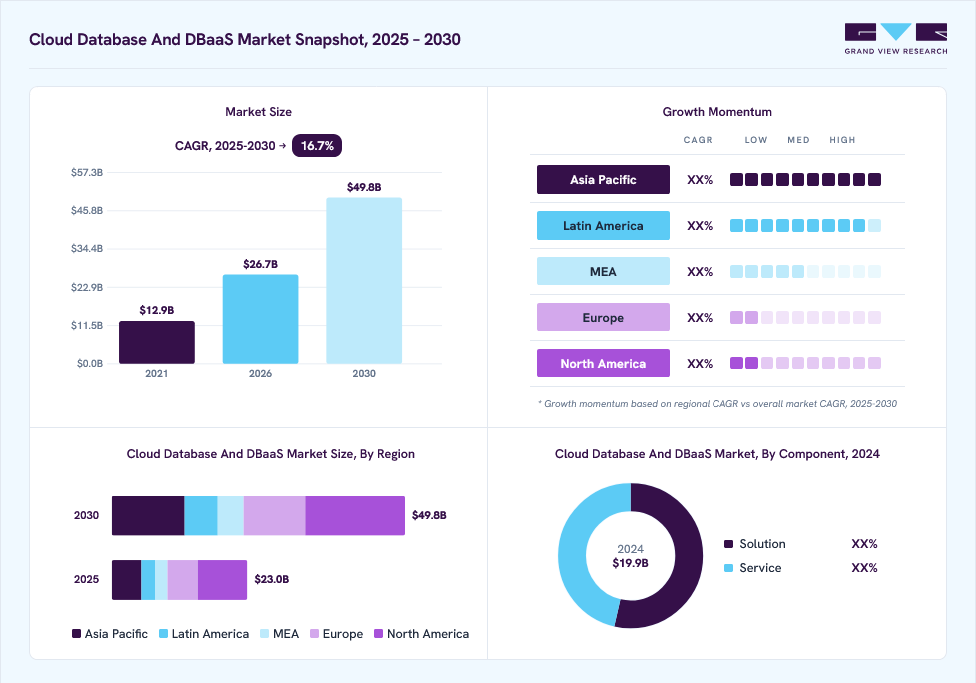 Source: Grand View Research, IR Documents, Primary Interviews, Paid DatabasesTo learn more about this report,
 Download Free Sample Report
 Key Market Trends & Insights
- By component: Solution segment dominated the market, with a revenue share of 53.1% in 2025.
- By database type: Relational database segment held the largest market share of 58.4% in 2025.
- By deployment: Public segment held the largest market share of 45.8% in 2025.
- By enterprise size: Large size enterprises segment held the largest market share of 51.8% in 2025.
- By end use: IT & telecommunications segment held the largest market share of 17.2% in 2025.
Regional Highlights
- Largest regional market: North America (36.5% revenue share, 2025)
- Fastest-growing regional market: Asia Pacific (highest CAGR, 2026-2033)
- By country: The U.S. held the largest market share in 2025.
Market Size & Forecast
- Market size in 2025: USD 25.5 Billion
- Estimated market size in 2026: USD 29.5 Billion
- Projected market size by 2033: USD 90.3 Billion
- CAGR (2026-2033): 17.3%
Three ways to get this report
Buy it, customize it, or ask a question.Ask an Analyst
Analyst response in 1 business day
- AccessReport author, directly
- Reply timeWithin 1 working day
- No sales callDirect answer only
- FormatEmail reply
- CostFree, no cost
Get the Full Report
What the study covers
- FormatsPDF · Excel · Dashboard
- Timeline2026–2033 annual, 2025 base
- Coverage20+ countries, 5 regions
- Companies10+ key players profiled
Customize the Report
20% free customization
- IncludeCountries, segments, points
- TailorTo your product definition
- ExtendDeeper competitor detail
- OrA fully bespoke study
- Turnaround5–10 working days
It enables businesses to access their data and applications from anywhere in the world, using any device with an internet connection. It is particularly beneficial for businesses with remote or distributed workforces, as it allows employees to collaborate and share data in real time regardless of location. As data volumes and complexity grow, businesses can add more resources to their cloud database or DBaaS to handle the increased workload. It ensures businesses have the necessary resources to handle their data management needs without investing in costly hardware or software.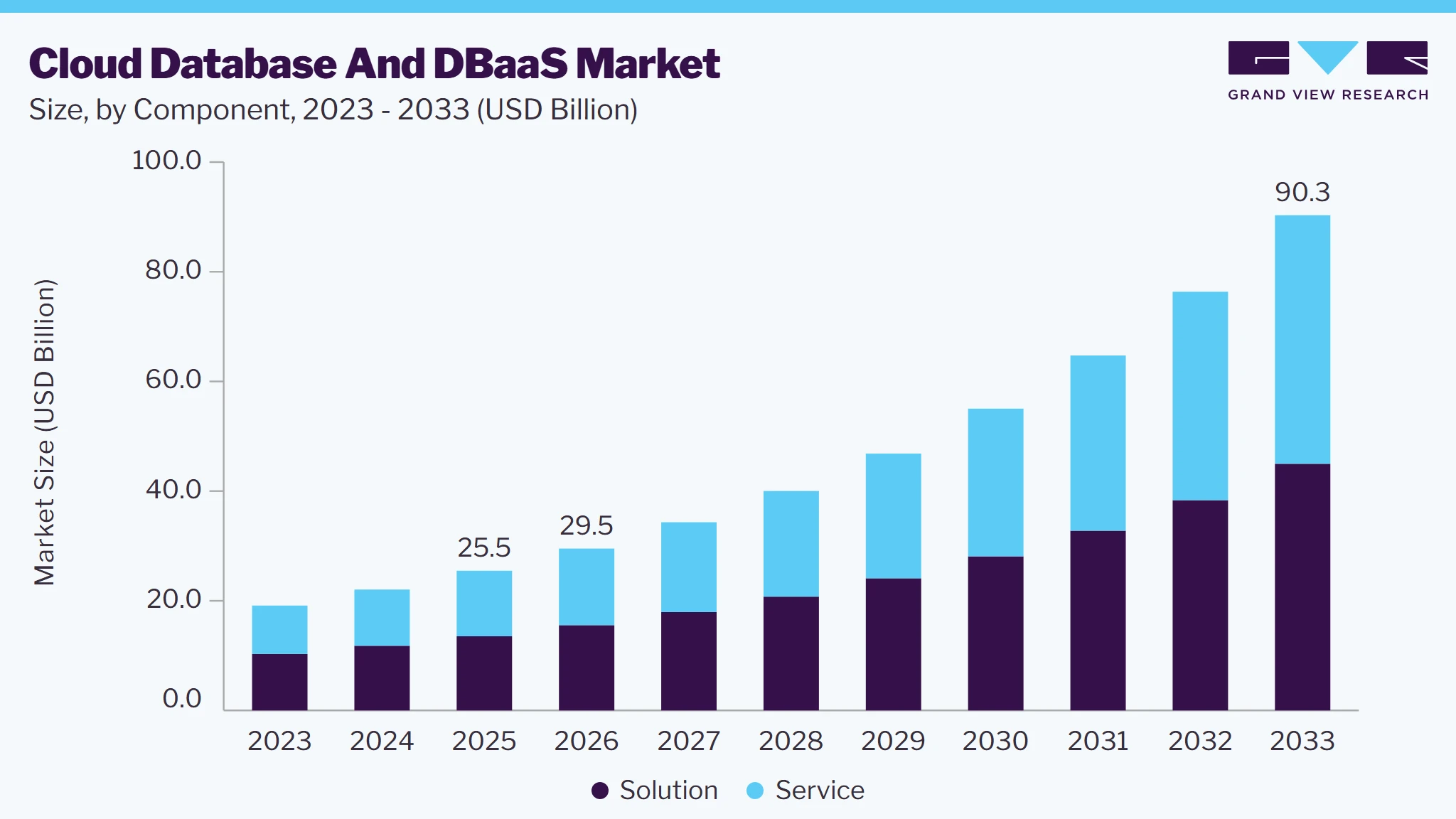 To learn more about this report, Download Free Sample Report
 Businesses globally are rapidly digitizing their operations, leading to growth in structured and unstructured data. The growing need for cost-effective and scalable solutions has pushed businesses to opt for cloud databases, eliminating the constraints on premises systems. Moreover, DBaaS offers a pay-as-you-go model, minimizing upfront costs and operational complexity while ensuring access to high-performance database services. The cost-effective model enables MSMEs to access advanced capabilities without any high investments. In addition, automation and AI-driven database management minimize administrative overhead, further improving operational efficiency.
Gaining popularity of serverless databases as they eliminate the need for manual infrastructure management is driving the growth of cloud database and DBaaS industry. Platforms like Google Cloud Firestore and Amazon Aurora Serverless provide autoscaling capabilities, reducing operational complexities and improving efficiency. The rise in data generated from various sources, including social media, IoT devices, and enterprise applications, has created a demand for efficient data management solutions. Cloud databases enable businesses to store, process, and analyze large datasets in real time, facilitating faster decision-making and improved customer insights are increasing the adoption of cloud database and DBaaS.
In response to growing cyber-attacks, cloud database providers have integrated advanced security measures, including identity access management, encryption, and multi-factor authentication. Compliance with regulatory frameworks such as CCPA, GDPR, and HIPAA has become critical factors in cloud database adoption, ensuring data protection and governance.
Market Dynamics
The cloud database and Database-as-a-Service (DBaaS) market is expanding rapidly as organizations increasingly migrate business-critical applications and data workloads to cloud environments. Enterprises are adopting DBaaS solutions to eliminate the complexity of database deployment, maintenance, patching, scaling, and infrastructure management, allowing IT teams to focus on application development and innovation. The growing volume of structured and unstructured data generated by digital transformation initiatives, cloud-native applications, artificial intelligence, and analytics workloads is accelerating demand for flexible and scalable database platforms. Additionally, the rising preference for consumption-based pricing models and the need for high availability, disaster recovery, and global accessibility are further supporting market growth.
The rising adoption of multi-cloud and hybrid cloud architectures is driving the cloud database and DBaaS market growth, as organizations increasingly seek greater flexibility in managing their IT infrastructure. Businesses no longer want to rely entirely on a single cloud provider due to concerns about vendor lock-in, service limitations, and operational risks. Multi-cloud strategies enable enterprises to distribute workloads across multiple cloud environments, selecting the most suitable platform for specific applications and business requirements. DBaaS providers are responding by offering solutions that support interoperability, cross-cloud data synchronization, and centralized management capabilities. As organizations continue pursuing flexible infrastructure strategies, demand for cloud-native database services is expected to grow substantially. Flexera’s 2025 State of the Cloud Report indicates that 89% of enterprises currently operate in multi-cloud environments. Organizations are increasingly adopting multi-cloud strategies to gain greater flexibility (50%), enhance operational agility (41%), improve cost efficiency (40%), and minimize business and infrastructure risks (39%). Furthermore, CloudTech projects that by 2027, approximately 90% of organizations will implement hybrid cloud models, highlighting that hybrid cloud environments will continue to play a significant role alongside multi-cloud strategies rather than being replaced by them.
Data security and privacy concerns associated with cloud-based storage is a significant restraint affecting the cloud database and DBaaS market. Organizations often store highly sensitive information within databases, including customer records, financial transactions, intellectual property, healthcare data, and confidential business information. When this data is migrated to cloud environments, many enterprises become concerned about losing direct control over how information is stored, managed, and protected. Unlike traditional on-premises databases, where organizations maintain complete ownership of infrastructure, cloud environments involve third-party service providers that manage critical components of the data ecosystem. This perceived reduction in control can create hesitation among decision-makers considering adopting a cloud database. As a result, concerns regarding unauthorized access, data exposure, and information misuse continue to slow migration initiatives, particularly among highly regulated industries.
The expansion of serverless database services is a significant opportunity for the Cloud Database and DBaaS market because it fundamentally changes how organizations deploy and manage database infrastructure. Traditional database environments often require substantial administrative effort for provisioning, scaling, patching, performance tuning, and capacity planning. Serverless databases eliminate many of these responsibilities by automatically allocating resources based on workload requirements. This allows businesses to focus more on application development and innovation rather than infrastructure management. Organizations with limited IT resources, particularly startups and small enterprises, can access enterprise-grade database capabilities without maintaining dedicated database administration teams. As companies increasingly seek operational simplicity and greater agility, serverless database offerings create a strong growth opportunity for cloud database providers.
Analyst Perspective
The cloud database and DBaaS market is evolving beyond infrastructure outsourcing and increasingly becoming a strategic layer within modern enterprise technology architectures. Competitive differentiation is shifting toward performance optimization, multi-cloud interoperability, automation, and support for diverse data models, rather than basic database hosting services. Vendors that can simplify data management across distributed environments while maintaining security, compliance, and low-latency access are likely to gain a stronger competitive position. As organizations continue to build AI-driven, real-time, and data-intensive applications, database platforms that combine operational efficiency with advanced analytics and developer-friendly services will be best positioned to capture long-term growth opportunities.
Component Insights
In terms of component, the cloud database and DBaaS market is segmented into solutions and services. The solution segment is further bifurcated into database management and storage. The solution segment led the market with the largest revenue share of 53.1% in 2025. The solution segment refers to the range of offerings cloud databases and DBaaS providers provide their customers to meet their specific database needs. The solution segment includes many services, such as data migration, backup and recovery, performance tuning, security, and scalability. These services help businesses optimize their database infrastructure, reduce costs, and improve their efficiency. Cloud database and DBaaS providers offer a variety of solutions to their customers, ranging from primary database hosting to advanced analytics and data management services.
The service segment is expected to witness the fastest CAGR during the forecast period. The service segment is bifurcated into professional services and managed services. The services in the cloud database and DBaaS industry refer to vendors' offerings to help organizations implement, manage, and optimize their cloud databases. These services further encompass consultation, support, training, migration, and ongoing maintenance and monitoring. Consultation services can help organizations determine which type of cloud database or DBaaS solution is best suited for their needs and provide guidance on implementing and integrating it with their existing systems. Support services are essential for ensuring that any issues or problems with the database are addressed quickly and effectively. Training services can help organizations get up to speed on using and optimizing their cloud database, while migration services can help them move their existing data to the cloud.
Database Type Insights
Based on database type, the global cloud database and DBaaS industry is segmented into NoSQL and relational databases. The relational database segment led the market with the largest revenue share of 58.4% in 2025. Relational databases have been a driving factor for the development of cloud databases due to their popularity in modern applications. As businesses and organizations have become more data-driven, the demand for efficient and scalable data storage solutions has significantly grown in recent years. Cloud databases provide an ideal solution for this need, as they offer flexible storage options and the ability to scale up or down as data needs quick changes.
The NoSQL segment is expected to witness the fastest CAGR of 18.3% during the forecast period. The emergence of NoSQL databases can be considered as one of the driving factors behind the rise of cloud databases. NoSQL databases have been developed to address the limitations of traditional relational databases, which are designed to handle structured data in a highly consistent manner. However, with the advent of big data, social media, and the internet of things (IoT), there is a need for databases that could handle large amounts of unstructured data in a flexible and scalable way. Hence, such factors are driving the demand for NoSQL database.
Deployment Insights
Based on deployment, the global industry for cloud database and DBaaS is divided into public, private, and hybrid. The public segment led the market with the largest revenue share of 45.8% in 2025. The increasing modernization of government IT infrastructure is driving market growth in the public segment of the cloud database and DBaaS market as government agencies increasingly replace fragmented and aging database environments with scalable cloud-based platforms. Public institutions manage large volumes of citizen records, administrative data, financial information, public service information, and operational datasets that require reliable database infrastructure. Cloud database solutions provide government organizations with greater flexibility to expand storage and computing capacity according to changing data requirements. DBaaS platforms also reduce the need for agencies to manage all database infrastructure, patching, and maintenance activities internally. The ongoing digital transformation of public institutions is propelling demand for cloud database and DBaaS solutions.
On the other hand, the hybrid segment is expected to witness the fastest CAGR during the forecast period. The adoption of hybrid cloud databases has become increasingly popular as it provides businesses with the flexibility to use both on-premises and cloud-based databases. The hybrid approach allows companies to leverage the benefits of cloud-based databases, such as scalability and cost savings, while still maintaining control over their sensitive data and complying with data sovereignty regulations. Additionally, hybrid cloud databases offer a flexible and cost-effective solution for businesses that want to maintain control over their sensitive data while also leveraging the benefits of cloud-based databases. With the increasing adoption of hybrid cloud databases, it is anticipated to drive the market growth.
Enterprise Size Insights
Based on enterprise size, the large size enterprises segment led the market with the largest revenue share of 51.8% in 2025. Large enterprises are gaining a significant competitive edge by migrating to cloud database solutions due to rapid digital acceleration. Large-size organizations often have complex and diverse data requirements, which can be challenging to manage with traditional on-premises databases. Cloud databases offer virtually limitless scalability, allowing organizations to quickly and easily add more storage capacity or processing power quickly and efficiently as their data needs increase over time. This means they can avoid the costs and complexities of maintaining on-premises infrastructure. In December 2022, Cockroach Labs, a cloud-native distributed SQL database company, partnered with Computacenter plc, independent technology and services provider to enhance and boost the widespread utilization of cloud-native technology. This collaboration enables large enterprises to streamline migrations, automate manual tasks, and boost effectiveness and efficiency.
On the other hand, the small and medium-sized enterprises segment is anticipated to witness the fastest CAGR during the forecast period. Small and medium-sized organizations are increasingly adopting cloud database and Database-as-a-Service (DBaaS) solutions. Cloud databases and DBaaS solutions can offer SMEs a cost-effective, scalable, and reliable way to manage their data without needing expensive on-premises infrastructure. One of the key benefits of cloud databases and DBaaS for SMEs is that it can provide a more cost-effective way to manage their data.
End-use Insights
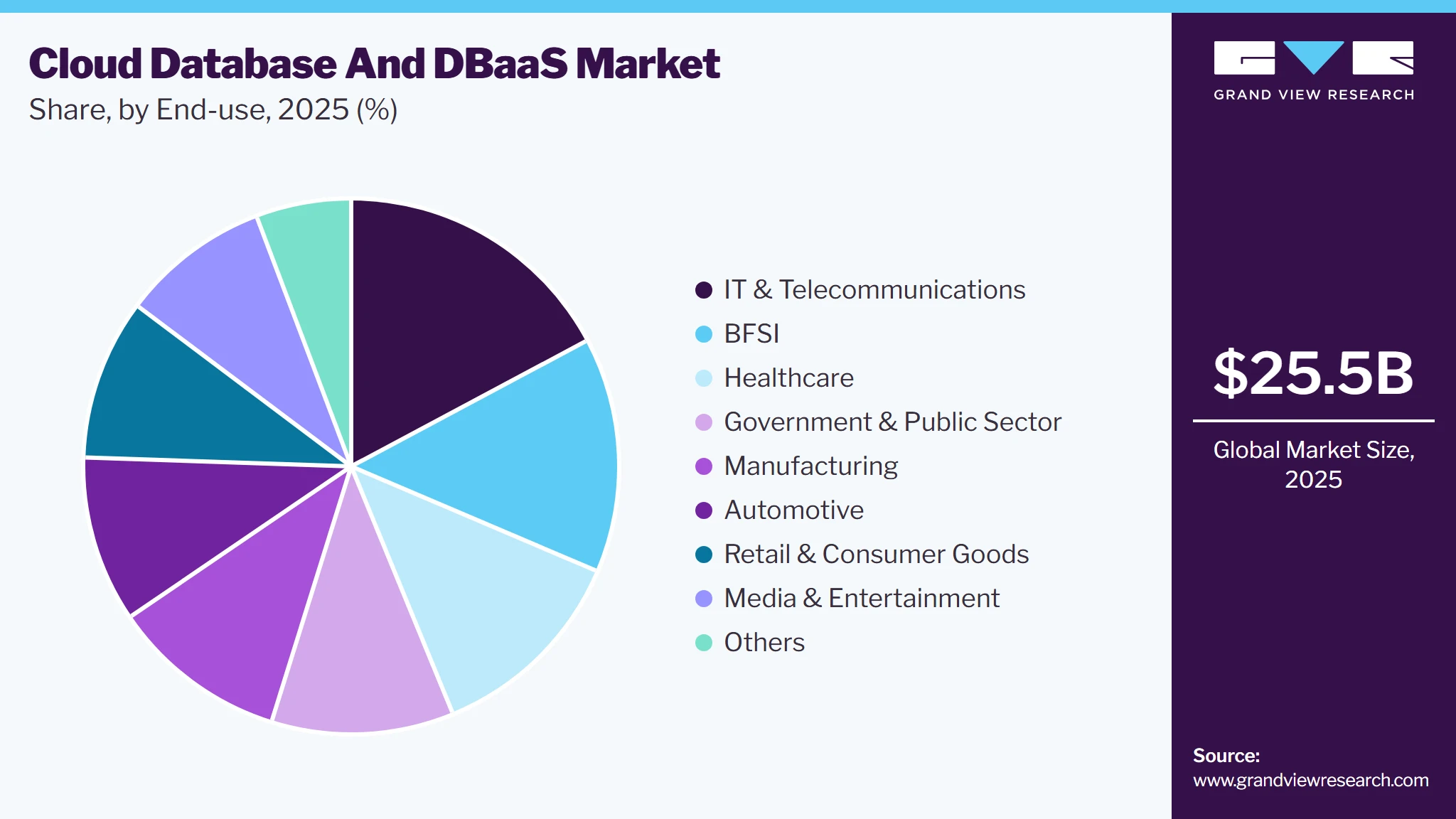
Based on end use, the IT & telecommunications segment led the market with the largest revenue share of 17.2% in 2025 and is expected to maintain its dominance over the forecast period. Cloud database technologies and DBaaS offerings allow IT & Telecommunication companies to quickly provision and scale their database infrastructure without needing physical hardware. This can significantly reduce the time and resources required to manage and maintain databases while providing greater agility and scalability to support changing business needs. In addition to database provisioning and management, DBaaS providers offer a range of features and services to help IT & Telecommunication companies optimize their database infrastructure. These include backup and recovery services, automatic scaling, load balancing, and security features such as encryption and access control. The segment expected to grow in the coming years as more companies move their database infrastructure to the cloud.
 To learn more about this report, Download Free Sample Report
 The automotive segment is anticipated to witness the fastest CAGR of 19.9% during the forecast period. The automotive industry increasingly adopts cloud databases and Database-as-a-Service (DBaaS) solutions to manage their data, optimize their operations, and deliver better customer experiences. With cloud databases, automotive companies can store, and process vast amounts of data generated by their vehicles, customers, and operations. Cloud databases and DBaaS solutions can store and process data from various sources, including sensors, IoT devices, and customer interactions which can help the industry in making better decisions based on the collected data.
Regional Insights
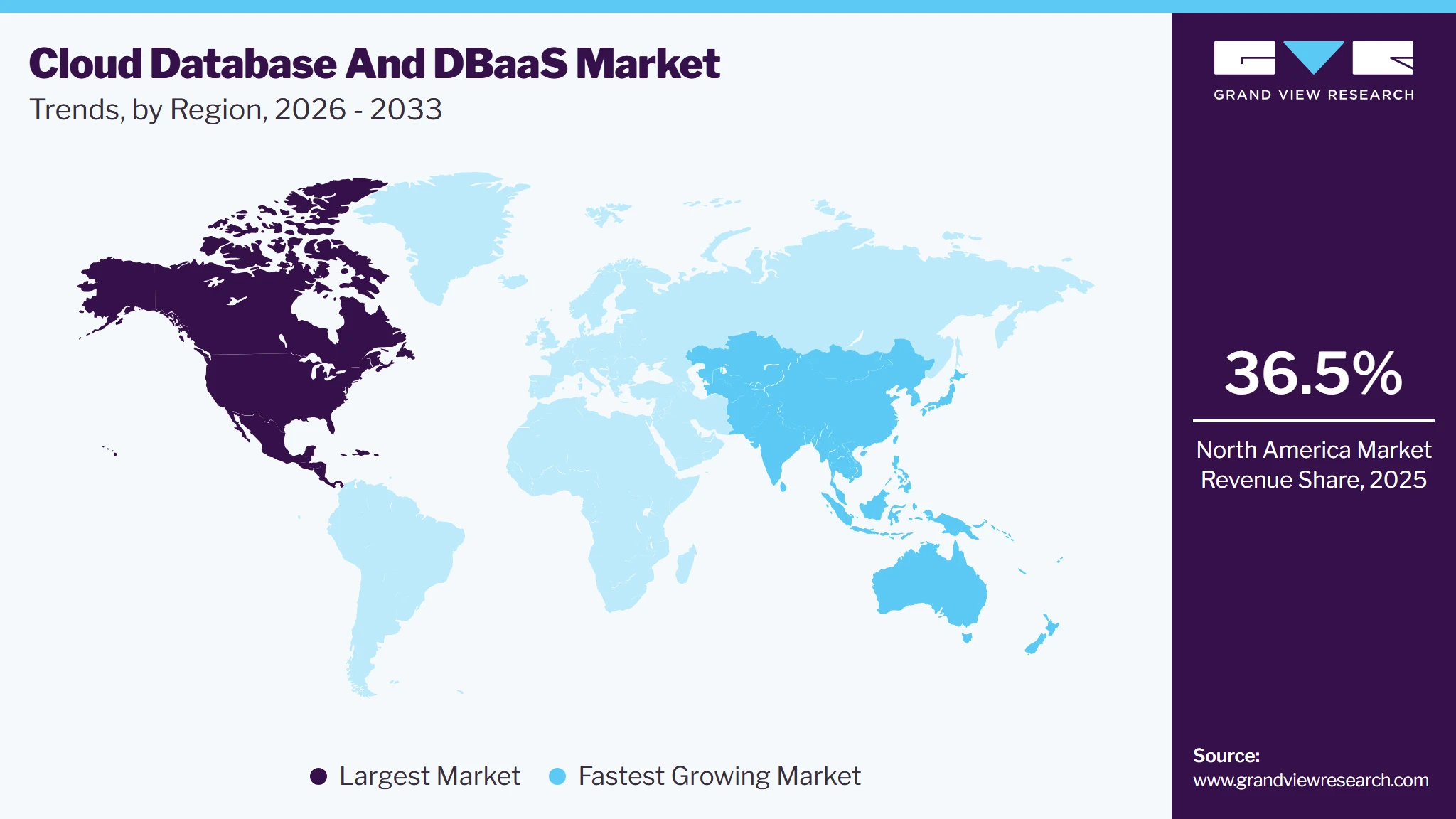
North America dominated the global cloud database and DBaaS market with the largest revenue share of 36.5% in 2025. There has been a significant increase in the demand for cloud databases in North America in recent years. This growth is driven by several factors, including the increased adoption of cloud-based technologies across various industries and the rise of big data and analytics. Also, the expansion of cloud computing is one of the main factors driving the growth of cloud databases in the region. As more businesses move to the cloud, the demand for cloud-based data storage solutions is rising. Organizations in the region are launching the latest updates to their cloud database solutions to gain a competitive edge over its competitors.
 To learn more about this report, Download Free Sample Report
 U.S. Cloud Database And DBaaS Market Trends
The cloud database and DBaaS market in the U.S. held the largest share in the North America region in 2025, owing to high cloud-adoption rate, growing investments in AI and machine learning, and strong presence of market vendors. Market players like Google LLC, Microsoft Corporation, and AWS offer comprehensive cloud database solutions. The growing demand for data security, AI-driven analytics, and hybrid cloud environments continues to shape the industry landscape.
Europe Cloud Database And DBaaS Market Trends
Europe cloud database and DBaaS market is expected to register a CAGR of 18.5% during the forecast period. The market in the region is influenced by stringent data privacy regulations such as GDPR, encouraging enterprises to adopt secure and compliant cloud solutions. Countries in the region are witnessing substantial investments in cloud infrastructure further anticipated to drive the demand for cloud database and DBaaS over the forecast period.
The U.K. cloud database and DBaaS market is expected to grow rapidly in the coming years. This growth can be attributed to the rapid adoption of digital banking, enterprise cloud migration strategies, and fintech growth. Furthermore, the rise of multi-cloud adoption is another trend shaping the market in the U.K.
Asia Pacific Cloud Database And DBaaS Market Trends
The cloud database and DBaaS industry in the Asia Pacific is expected to witness the fastest CAGR of 19.4% during the forecast period. The market for cloud database and DBaaS in this region is driven by the rise in investments by cloud computing companies. For instance, in September 2022, Alibaba Cloud, the cloud computing subsidiary of Alibaba.com, announced its plans to invest USD 1 billion to help customers adopt cloud computing solutions, reignite growth, and bolster the company's market position. The investment is specifically focused on offering cloud computing services, including data storage, artificial intelligence, and analytics capabilities, to customers across various industries. The move comes amid fierce competition in the cloud computing market in China and globally, with tech giants like Tencent, Huawei Technologies Co., Ltd., and Amazon Web Services, Inc. competing over gaining market share.
The cloud database and DBaaS market in China held a substantial market share in 2025, owing to strong government support for cloud computing and digital infrastructure development. Additionally, companies like Tencent Cloud, Alibaba, and Huawei are investing heavily in DBaaS solutions is further driving the market growth in China. The push for AI-driven database management and the expansion of cloud-based fintech applications are anticipated to drive the market growth in China.
Key Cloud Database And DBaaS Company Insights
The key market players in the global cloud database and DBaaS market include Oracle, IBM Corporation, SAP SE, Google LLC, Microsoft Corporation, and Alibaba Cloud. The market has a fragmented competitive landscape as it features various global and regional market players. Leading industry players are undertaking strategies such as product launches, collaborations, and partnerships to survive the highly competitive environment and expand their business footprints.
-
In September 2024, Oracle Corporation launched a database named Oracle Database@AWS in a strategic partnership with Amazon Web Services, Inc. (AWS). The database allows the customers to access Oracle Exadata Database Service and Oracle Autonomous Database within AWS.
-
In January 2024, Silk, a cloud data platform provider launched Cloud Database as a Service (DBaaS) platform. Through the platform the company offers cloud database services such as updates, monitoring, tuning, and patching to their users.
-
In January 2023, DataStax, a real-time Artificial Intelligence (AI) company, acquired Kaskada Inc., a machine learning (ML) company. With this acquisition, DataStax intends to initially open source the basic Kaskada Inc., technology, with plans to launch a new machine learning cloud component in the same year.
Key Cloud Database And DBaaS Companies:
The following key companies have been profiled for this study on the cloud database and DBaaS market.
-
Google LLC
-
Nutanix
-
Oracle
-
IBM Corporation
-
SAP SE
-
Amazon Web Services, Inc.
-
Alibaba Cloud
-
MongoDB, Inc.
-
Microsoft
-
Teradata
-
Ninox
-
DataStax
Competitive Benchmarking
Category
Operating Strategies
Competitive Edge
Weakness
Established Players (Amazon Web Services; Microsoft; Oracle; Google Cloud; IBM)
- Mature players in the Cloud Database and DBaaS market focus on delivering fully managed database environments across public, private, and hybrid clouds. They provide a broad range of relational, NoSQL, in-memory, and distributed database services to support diverse workloads. Their strategy emphasizes high availability, disaster recovery, and enterprise-grade security for mission-critical applications. They also bundle database services with cloud infrastructure, AI, analytics, and application development platforms.
- Mature players benefit from extensive global data center networks and large cloud ecosystems. Their platforms offer proven scalability for handling massive transaction volumes and complex workloads. Strong compliance certifications and security capabilities attract highly regulated industries. Deep integration with cloud-native services enhances customer retention and platform adoption.
- These providers often face concerns about vendor lock-in and the complexity of migration. Pricing structures can become difficult to manage as workloads scale. Customers may encounter challenges when moving databases across cloud environments. Large platform ecosystems can also increase operational complexity for organizations.
Emerging Players (MongoDB; Cockroach Labs; Redis; PlanetScale; SingleStore)
- Emerging players focus on developer-centric and cloud-native database architectures. They emphasize serverless deployment, distributed databases, and simplified database management. Their strategy targets modern applications requiring flexibility, real-time performance, and multi-cloud compatibility. Many offer consumption-based pricing models to attract digital-native businesses and startups.
- Emerging players provide highly flexible database solutions optimized for modern application development. Their platforms simplify scalability and reduce the need for database administration. Strong support for microservices, containers, and distributed computing environments enhances adoption. They also innovate rapidly in areas such as serverless databases and multi-cloud operations.
- Emerging players have smaller enterprise customer bases compared to major cloud vendors. Their ecosystems may lack the breadth of complementary services offered by hyperscale providers. Global infrastructure coverage can be more limited in certain regions. Competition from integrated cloud platform providers may also restrict market expansion opportunities.
Cloud Database And DBaaS Market Report Scope
Report Attribute
Details
Market size in 2025
USD 25.5 billion
Estimated market size in 2026
USD 29.5 billion
Projected market size by 2033
USD 90.3 billion
Growth rate
CAGR of 17.3% from 2026 to 2033
Base year for estimation
2025
Historical data
2021 - 2024
Forecast period
2026 - 2033
Quantitative units
Revenue in USD million/billion and CAGR from 2026 to 2033
Report coverage
Revenue forecast, company market share analysis, competitive landscape, growth factors, and trends
Segments covered
Component, database type, deployment, enterprise size, end use, region
Regional scope
North America; Europe; Asia Pacific; Latin America; MEA
Country scope
U.S., Canada, Mexico, U.K., Germany, France, China, India, Japan, South Korea, Australia, Brazil, UAE, Saudi Arabia, South Africa
Key companies profiled
Google LLC; Nutanix; Oracle; IBM Corporation; SAP SE; Amazon Web Services, Inc.; Alibaba Cloud; MongoDB, Inc.; Microsoft; Teradata; Ninox; DataStax
Customization scope
Free report customization (equivalent up to 8 analysts' working days) with purchase. Addition or alteration to country, regional & segment scope.
Pricing and purchase options
Avail customized purchase options to meet your exact research needs. Explore purchase options
Global Cloud Database And DBaaS Market Report Segmentation
This report forecasts revenue growth at global, regional, and country levels and provides an analysis of the latest industry trends in each of the sub-segments from 2021 to 2033. For this study, Grand View Research has segmented the global cloud database and DBaaS market report based on component, database type, deployment, enterprise size, end-use, and region:
-
Component Outlook (Revenue, USD Million, 2021 - 2033)
-
Solution
-
Database Management
-
Storage
-
-
Service
-
Professional Services
-
Managed Services
-
-
-
Database Type Outlook (Revenue, USD Million, 2021 - 2033)
-
NoSQL
-
Relational Database
-
-
Deployment Outlook (Revenue, USD Million, 2021 - 2033)
-
Public
-
Private
-
Hybrid
-
-
Enterprise Size Outlook (Revenue, USD Million, 2021 - 2033)
-
Large Size Enterprises
-
Small and Medium Sized Enterprises (SMEs)
-
-
End-use Outlook (Revenue, USD Million, 2021 - 2033)
-
IT & Telecommunications
-
BFSI
-
Healthcare
-
Government & Public Sector
-
Manufacturing
-
Automotive
-
Retail & Consumer Goods
-
Media & Entertainment
-
Others
-
-
Regional Outlook (Revenue, USD Million, 2021 - 2033)
-
North America
-
U.S.
-
Canada
-
Mexico
-
-
Europe
-
UK
-
Germany
-
France
-
Italy
-
Sweden
-
Finland
-
Netherlands
-
Finland
-
-
Asia Pacific
-
China
-
India
-
Japan
-
Australia
-
Singapore
-
-
Latin America
-
Brazil
-
Argentina
-
Chile
-
Argentina
-
-
Middle East & Africa
-
UAE
-
Saudi Arabia
-
South Africa
-
-
Research Methodology
The cloud database and DBaaS market figures in this report are based on a proven research process that combines executive interviews with secondary research from proprietary databases, company filings, and recognized regulatory and institutional sources. Market size is built through value-chain sizing - reconciling supply-side and demand-side estimates - and triangulated with bottom-up and top-down approaches. Every estimate passes multiple levels of expert validation before publication, with each cloud database and DBaaS segment quantified using the revenue-capture definitions in the table below.
Segment Definition
Segment - Component
Revenue capture definition
Solution
Market value is captured through managed database platforms that provide storage, processing, scalability, backup, replication, and analytics capabilities. Providers monetize through consumption-based pricing, subscription plans, and premium features such as automated scaling, disaster recovery, and advanced security controls.
Service
Economic activity stems from database migration, cloud modernization, performance optimization, consulting, managed operations, and technical support. Organizations increasingly engage service providers to accelerate cloud adoption while minimizing operational complexity and downtime risks.
Segment - Database Type
Revenue capture definition
NoSQL
Spending is driven by applications handling unstructured and semi-structured data, including IoT platforms, real-time analytics, social media applications, and content management systems. Vendors benefit from the growing demand for flexible schemas, horizontal scalability, and high-speed data processing.
Relational Database
Value is derived from mission-critical transactional workloads requiring structured data management, consistency, and regulatory compliance. Enterprises continue to invest in managed relational databases for ERP systems, financial applications, customer management platforms, and business operations.
Segment - Deployment
Revenue capture definition
Public
The largest deployment segment is supported by pay-as-you-go pricing models that eliminate the need for infrastructure ownership. Cloud providers benefit from economies of scale, enabling organizations to rapidly deploy databases while optimizing operational expenditure.
Private
Market opportunities arise as enterprises prioritize dedicated infrastructure, enhanced security, and regulatory compliance. Adoption remains particularly strong among organizations that handle highly sensitive data and operate in tightly regulated industries.
Hybrid
Commercial value is created by enabling seamless database operations across public cloud and on-premise environments. Organizations adopt hybrid architectures to balance performance, compliance, business continuity, and workload flexibility requirements.
Segment - Enterprise Size
Revenue capture definition
Large Size Enterprises
The large enterprises segment, with respect to the number of employees, typically comprises organizations employing more than 1,000 employees for multinational corporations.
Small and Medium Enterprises
The SMEs segment, with respect to the number of employees, generally includes organizations employing between 10 and 999 employees.
Segment - End Use
Revenue capture definition
IT & Telecommunications
Demand is fueled by network management platforms, customer databases, billing systems, application hosting, and real-time service delivery environments. The sector requires highly scalable databases capable of handling massive transaction volumes and continuous service availability.
BFSI
Financial institutions invest heavily in managed databases to support digital banking, payment processing, fraud detection, risk analytics, and customer relationship management. Database providers benefit from requirements for security, reliability, compliance, and low-latency transaction processing.
Healthcare
Value is captured through the management of electronic health records, medical imaging repositories, clinical research datasets, and telehealth applications. The ongoing digitalization of healthcare services continues to drive demand for secure, compliant cloud database environments.
Government & Public Sector
Spending is directed toward citizen service platforms, tax administration systems, public records management, and smart government initiatives. Database solutions that meet stringent security, sovereignty, and regulatory requirements gain significant traction in this segment.
Manufacturing
Adoption is linked to industrial IoT deployments, production monitoring systems, supply chain management platforms, and predictive maintenance applications. Database providers support manufacturers seeking to leverage operational data to improve efficiency and drive automation initiatives.
Automotive
Market value is generated through connected vehicle ecosystems, autonomous driving data management, fleet analytics, and digital mobility platforms. The growing volume of vehicle-generated data is driving demand for scalable, high-performance database services.
Retail & Consumer Goods
Retailers utilize cloud databases to manage customer data, inventory systems, omnichannel operations, loyalty programs, and demand forecasting models. Providers benefit from the need to process large volumes of transactional and consumer behavior data in real time.
Media & Entertainment
Demand originates from content management platforms, streaming services, digital asset repositories, audience analytics systems, and advertising technologies. Database scalability and performance are critical for supporting fluctuating content consumption patterns.
Others
This segment includes education, energy, logistics, travel, hospitality, and professional services. Organizations across these sectors leverage DBaaS platforms to modernize applications, improve data accessibility, and support digital transformation initiatives without the need for extensive infrastructure investments.
Estimation Model
Layer
Question
Analysis
Data Management Requirement Layer
Who requires cloud database and DBaaS solutions?
Identify enterprises, digital-native businesses, software developers, financial institutions, e-commerce platforms, telecommunications providers, and public-sector organizations that need scalable and reliable data storage and management capabilities. This layer focuses on organizations generating large volumes of structured and unstructured data that require high availability, real-time access, and simplified database administration to support business-critical applications.
Cloud Adoption & Migration Layer
Who can transition database workloads to DBaaS platforms?
Evaluate organizations based on their cloud maturity, IT modernization initiatives, cybersecurity readiness, regulatory compliance capabilities, and availability of cloud infrastructure. Adoption potential is influenced by the ability to migrate legacy databases, integrate hybrid or multi-cloud architectures, and support data governance requirements while reducing infrastructure complexity and operational burdens.
Platform Utilization Layer
Who actively deploys and manage workloads on DBaaS platforms?
Analyze businesses utilizing managed relational databases, NoSQL databases, distributed databases, in-memory databases, and data warehousing services to support applications, analytics, artificial intelligence, and transactional processing. This layer examines actual usage intensity based on application development activities, digital transformation programs, data-driven decision-making initiatives, and the need for automated database provisioning, scaling, backup, and disaster recovery capabilities.
Consumption & Revenue Layer
How is revenue generated in the cloud database and DBaaS ecosystem?
Assess revenue generated through subscription-based database services, consumption-based pricing models, storage capacity charges, compute resource utilization, data transfer fees, premium security features, and managed support services. Additional revenue streams arise from database migration services, performance optimization offerings, advanced analytics integrations, and enterprise-grade compliance solutions, reflecting the growing shift from infrastructure ownership to pay-as-you-use database consumption models.
Delivered Customizations
This report has been delivered with the following In-depth customizations
Client Request
Customization Delivered
Value Adds
Multi-Cloud Data Management & Database Modernization Trends
Conducted a focused analysis of enterprise database modernization initiatives covering migration from legacy on-premise databases to cloud-native and managed database environments, including adoption across BFSI, retail, healthcare, and technology sectors.
Helps stakeholders identify modernization priorities, evaluate cloud database adoption patterns, and assess opportunities arising from enterprise digital transformation initiatives.
Real-Time Data Processing, Scalability & Application Performance Trends
Evaluated adoption trends for distributed databases, serverless databases, NoSQL platforms, in-memory databases, and high-availability architectures supporting real-time applications, analytics workloads, and customer-facing digital services.
Provides insights into evolving performance requirements, scalability demands, and commercially attractive database technologies supporting next-generation application development.
Managed Database Services & Data Infrastructure Opportunity Assessment
Assessed demand for Database-as-a-Service (DBaaS) solutions covering automated provisioning, backup and recovery, workload management, disaster recovery, database monitoring, and operational automation, along with challenges related to data sovereignty, vendor lock-in, and migration complexity.
Supports investment and expansion strategies by identifying high-growth managed service opportunities, evaluating enterprise cloud readiness, and strengthening long-term growth potential in cloud-based data infrastructure markets.
Frequently Asked Questions About This Report
Large size enterprises segment held the largest share (over 51.0%) in 2025, while the small and medium-sized enterprises segment is the fastest-growing size.
The global cloud database and DBaaS market is expected to grow at a CAGR of 17.3% from 2026 to 2033, reaching USD 90.3 billion by 2033.
The global cloud database and DBaaS market size was valued at USD 25.5 billion in 2025 and is estimated at USD 29.5 billion for 2026.
North America dominated with a 36.5% revenue share in 2025.
Asia Pacific is the fastest-growing region over the forecast period.
The solution segment led with a 53.1% revenue share in 2025, while the service segment is the fastest-growing component.
The relational database segment led with a 58.4% revenue share in 2025, while the NoSQL segment is the fastest-growing type.
The public segment held the largest share (over 45.0%) in 2025, while hybrid segment is the fastest-growing deployment.
Key players operating in the cloud database and DBaaS market include Google LLC; Nutanix; Oracle; IBM Corporation; SAP SE; Amazon Web Services, Inc.; Alibaba Cloud; MongoDB, Inc.; Microsoft; Teradata; Ninox; DataStax.
Key factors include increasing adoption of cloud computing across enterprises, rising adoption of multi-cloud and hybrid cloud architectures, and the adoption of hydroponic and expansion of serverless database services.
About the Author(s)
Next Generation Technologies Research Team
Technology · Next Generation TechnologiesThis report was authored by the next generation technologies research team at Grand View Research - comprising two research analysts, one senior research analyst, and one industry expert - with specialized expertise in the next generation technologies segment of the technology industry. All findings are based on proprietary technology databases, executive interviews, and regulatory analysis, subject to internal peer review prior to publication.
Last Updated:
Speak to Analyst

Customize this report to your needs - add regions, segments, or data points, with 20% free customization.
Or view our licence options:


ISO 9001:2015 & 27001:2022 Certified
We are GDPR and CCPA compliant! Your transaction & personal information is safe and secure. For more details, please read our privacy policy.


