
- Home
- »
- Petrochemicals
- »
-
Compressor Oil Market Size And Share Report, 2026-2033GVR Report cover

Compressor Oil Market (2026 - 2033)
Size, Share & Trends Analysis Report By Compressor (Positive Displacement Compressor, Dynamic Compressor), By Base Oil (Synthetic, Mineral, Bio-based), By End-use (Manufacturing, Oil & Gas), By Region, And Segment Forecasts
Market Size, 2025
$5.6BMarket Estimate, 2026
$5.8BMarket Forecast, 2033
$7.3BCAGR, 2026–2033
3.4%Compressor Oil Market Summary
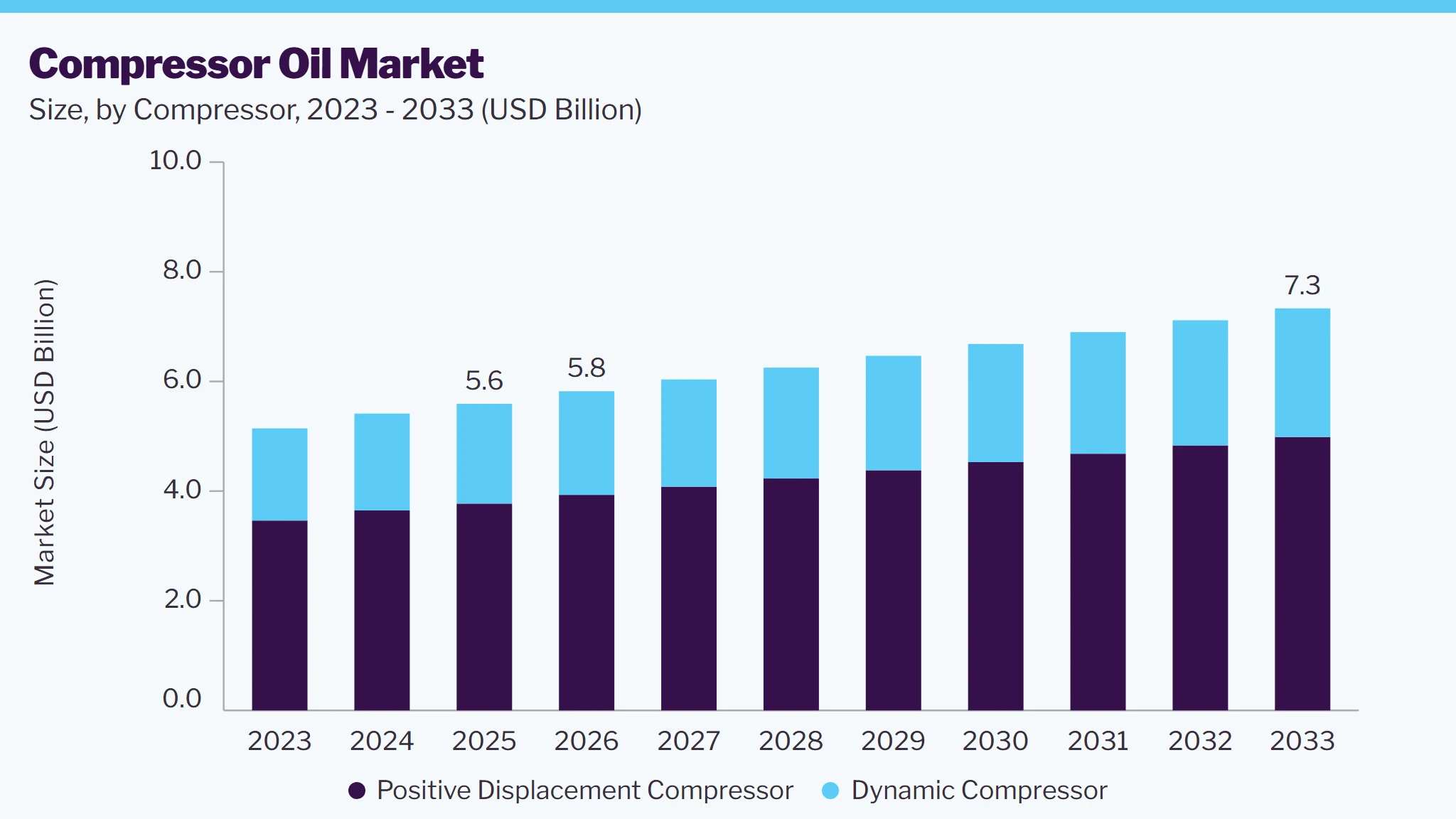
The global compressor oil market size was valued at USD 5.6 billion in 2025 and is projected to grow from USD 5.8 billion in 2026 to USD 7.3 billion by 2033, at a CAGR of 3.4% from 2026 to 2033. The market in Asia Pacific dominated with a revenue share of 43.3% in 2025. This is attributed to the expansion of end use industries, including manufacturing, food processing, chemical, automotive, construction, and aerospace.
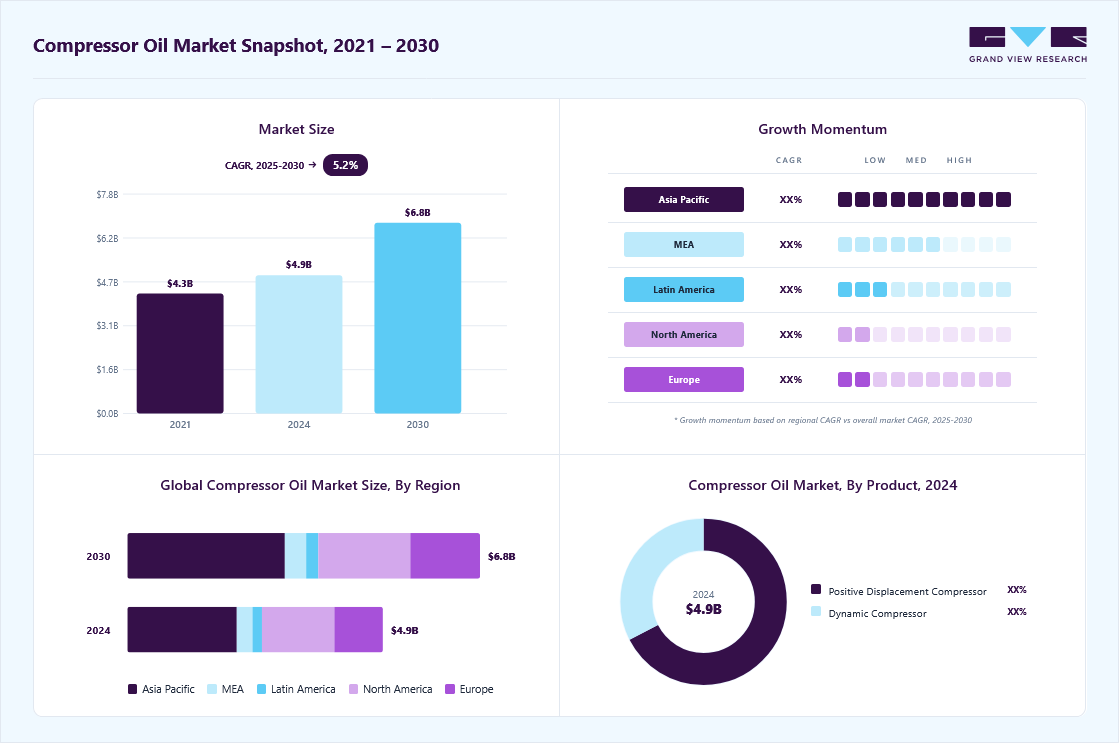 Source: Grand View Research, IR Documents, Primary Interviews, Paid DatabasesTo learn more about this report,
 Download Free Sample Report
 Key Market Trends & Insights
- By compressor: Positive displacement compressor segment held the largest market share of 67.5% in 2025.
- By base oil: Synthetic segment held the largest market share of 44.1% in 2025.
- By end-use: Manufacturing segment held the largest market share of 33.3% in 2025.
Regional Highlights
- Largest regional market: Asia Pacific (43.3% revenue share, 2025)
- By country: China held the largest market share in 2025.
Market Size & Forecast
- Market size in 2025: USD 5.6 Billion
- Estimated market size in 2026: USD 5.8 Billion
- Projected market size by 2033: USD 7.3 Billion
- CAGR (2026-2033): 3.4%
Three ways to get this report
Buy it, customize it, or ask a question.Ask an Analyst
Analyst response in 1 business day
- AccessReport author, directly
- Reply timeWithin 1 working day
- No sales callDirect answer only
- FormatEmail reply
- CostFree, no cost
Get the Full Report
What the study covers
- FormatsPDF · Excel · Dashboard
- Timeline2026–2033 annual, 2025 base
- Coverage20+ countries, 5 regions
- Companies10+ key players profiled
Customize the Report
20% free customization
- IncludeCountries, segments, points
- TailorTo your product definition
- ExtendDeeper competitor detail
- OrA fully bespoke study
- Turnaround5–10 working days
Compressor oils ensure smoother operation and help reduce the machine's downtime and repair. Moreover, heat generated by compressors during operations results in more power consumption and wear & tear on the machine. These lubricants assist in heat dissipation, keeping the equipment temperature in control.
 To learn more about this report, Download Free Sample Report
 The adoption of cost optimization practices is one of the key trends escalating market growth. Organizations that implement such continuous improvements have been observed to have reduced their power consumption and ensure constant operational flow as a result of good lubrication practices. The growing demand for cost optimization is anticipated to be a key driver of market growth. Several incidents of rotary screw gas compressor shutdowns have been reported due to wear, with viscosity and gas solubility being identified as critical factors contributing to these failures.
The HVAC sector is a major user of compressor oils, with rising global temperatures fueling increased demand for air conditioning systems and, subsequently, compressor oils. The growth of the automotive industry, especially in emerging markets, is also driving the need for compressor oils in air conditioning systems. Industries also prioritize improving compressor performance and durability, boosting the demand for high-quality compressor oils.
Market Dynamics
The compressor market is supported by increasing industrial automation, expanding manufacturing activities, and rising investments in energy and process industries. Demand for reliable, compressed air systems across sectors such as manufacturing, oil & gas, power generation, and automotive continues to drive equipment upgrades and new installations. Businesses are increasingly prioritizing energy-efficient compressors to reduce operating costs, comply with stringent environmental regulations, and achieve corporate sustainability targets. Technological advancements, including variable speed drives, digital monitoring, predictive maintenance, and IoT-enabled asset management, are enhancing equipment performance while lowering lifecycle costs. At the same time, the growing adoption of synthetic and bio-based compressor lubricants is improving operational reliability and extending equipment service intervals. Emerging economies are experiencing significant infrastructure development and industrial expansion, creating additional opportunities for compressor manufacturers and lubricant suppliers. However, fluctuating raw material prices, high capital investment requirements, and economic uncertainty can influence purchasing decisions and project timelines.
The accelerating adoption of industrial automation across manufacturing facilities is a primary driver of the compressor market. Modern production plants increasingly rely on compressed air systems to operate pneumatic tools, robotic assembly lines, packaging equipment, and material handling systems with high precision and reliability. As manufacturers invest in smart factories and digital production technologies to improve productivity and reduce operational downtime, the demand for efficient compressors continues to strengthen. Industries such as automotive, electronics, food processing, pharmaceuticals, and general manufacturing require uninterrupted compressed air supply to maintain production quality and optimize operational efficiency, making compressors an indispensable component of industrial infrastructure.
Government initiatives promoting domestic manufacturing, industrial modernization, and infrastructure development are encouraging investments in new production facilities across both developed and emerging economies. These projects create sustained demand for advanced compressor systems capable of delivering higher energy efficiency and lower maintenance costs. Manufacturers are also replacing aging equipment with technologically advanced compressors featuring variable speed drives, intelligent controls, and predictive maintenance capabilities to reduce energy consumption and enhance operational performance.
The compressor market is the substantial capital investment required for purchasing, installing, and maintaining industrial compressor systems, particularly for large-scale manufacturing, oil & gas, and power generation applications. Beyond the initial acquisition cost, organizations must also account for installation expenses, infrastructure modifications, energy consumption, routine maintenance, lubricant replacement, and periodic component overhauls throughout the equipment lifecycle. These cumulative ownership costs can discourage small and medium-sized enterprises from investing in premium compressor technologies, especially during periods of economic uncertainty or constrained capital expenditure. In addition, rising raw material prices and supply chain disruptions can increase equipment costs, while volatile energy prices further elevate operating expenses for compressor users. As a result, many end users extend the service life of existing systems rather than replacing them with newer models, slowing equipment replacement cycles and limiting short-term market expansion despite ongoing technological advancements.
The increasing emphasis on energy efficiency and digital transformation presents a significant growth opportunity for the compressor market. Industrial facilities are actively seeking compressor solutions that reduce electricity consumption, improve system reliability, and support sustainability objectives. Advanced technologies such as variable speed drives, intelligent controllers, remote monitoring platforms, predictive maintenance, and Industrial Internet of Things (IoT) integration enable real-time performance optimization while minimizing unexpected equipment failures. These capabilities help organizations lower operating costs, improve asset utilization, and enhance production continuity, making digitally connected compressor systems an increasingly attractive investment.
Tightening environmental regulations and corporate decarbonization strategies are encouraging industries to adopt compressors with improved energy performance and lower emissions. Equipment manufacturers are expanding their portfolios with high-efficiency compressor designs, advanced lubrication technologies, and smart service offerings that provide continuous performance monitoring and lifecycle optimization. The integration of digital services with aftermarket maintenance contracts and condition-based monitoring is creating recurring revenue streams while strengthening customer relationships.
Analyst Perspective
The compressor market is expected to grow as industries continue to prioritize operational efficiency, automation, and energy optimization across manufacturing and process-intensive sectors. Demand is increasingly shifting toward high-performance compressor systems that integrate digital monitoring, predictive maintenance, and energy-saving technologies. Sustainability goals and stricter environmental regulations are also encouraging the adoption of advanced lubricants and low-emission compressor solutions. While high capital costs may moderate short-term investments in certain regions, ongoing industrial expansion and infrastructure development will continue to support long-term demand. Companies that combine technological innovation with strong aftermarket service capabilities are likely to strengthen their competitive position in the evolving global market.
Compressor Insights
Based on compressor, positive displacement compressor held the largest revenue share of 67.5% in 2025. They are used in different manufacturing sectors, including chemical, petrochemical, metal production, construction, and mining equipment. They capture a volume of air into the chamber and reduce the chamber's volume to compress the air. Positive displacement compressors are prized for energy efficiency, helping businesses reduce costs amid rising energy prices and stricter regulations. As demand for specialized equipment grows, they're increasingly used in renewable energy sectors, such as hydrogen production and energy storage.
The dynamic compressor segment in the compressor oil market is expected to grow significantly at a CAGR of 3.1% over the forecast period. Dynamic compressors are widely used in petroleum refining, pulp and paper, mining, food processing, and automotive industries. Rising demand for gas turbine maintenance services and oil refinery processes are anticipated to fuel the product demand. The oil and gas industry, with its need for high-pressure and high-flow gas compression, remains a major consumer of dynamic compressors, particularly for pipeline transmission and petrochemical applications.
Base Oil Insights
Based on base oil, synthetic segment held a dominant position, contributing 44.1% of total revenue in 2025. Synthetic oils are cleaner, less expensive, last longer, and are less prone to contamination than conventional ones. Soaring need to minimize downtime and maintenance requirements is estimated to foster their growth. As industries seek higher efficiency and reliability, synthetic oils are favored for their stability, performance in extreme temperatures, and low volatility. The automotive sector, particularly with the rise of fuel-efficient, electric, and hybrid vehicles, drives demand for synthetic lubricants, enhancing engine performance, fuel efficiency, and meeting stringent specifications.
The bio-based oil segment in the compressor oil market is estimated to grow at the fastest CAGR of 3.6% over the forecast period. As sustainability becomes a priority for both consumers and industries, bio-based oils derived from renewable resources are gaining traction due to their lower environmental impact. These oils reduce reliance on petroleum products and offer biodegradable, eco-friendly alternatives. In the automotive industry, bio-based oils are used in lubricants and systems, providing superior performance, reducing wear, and supporting sustainable automotive solutions.
End-use Insights
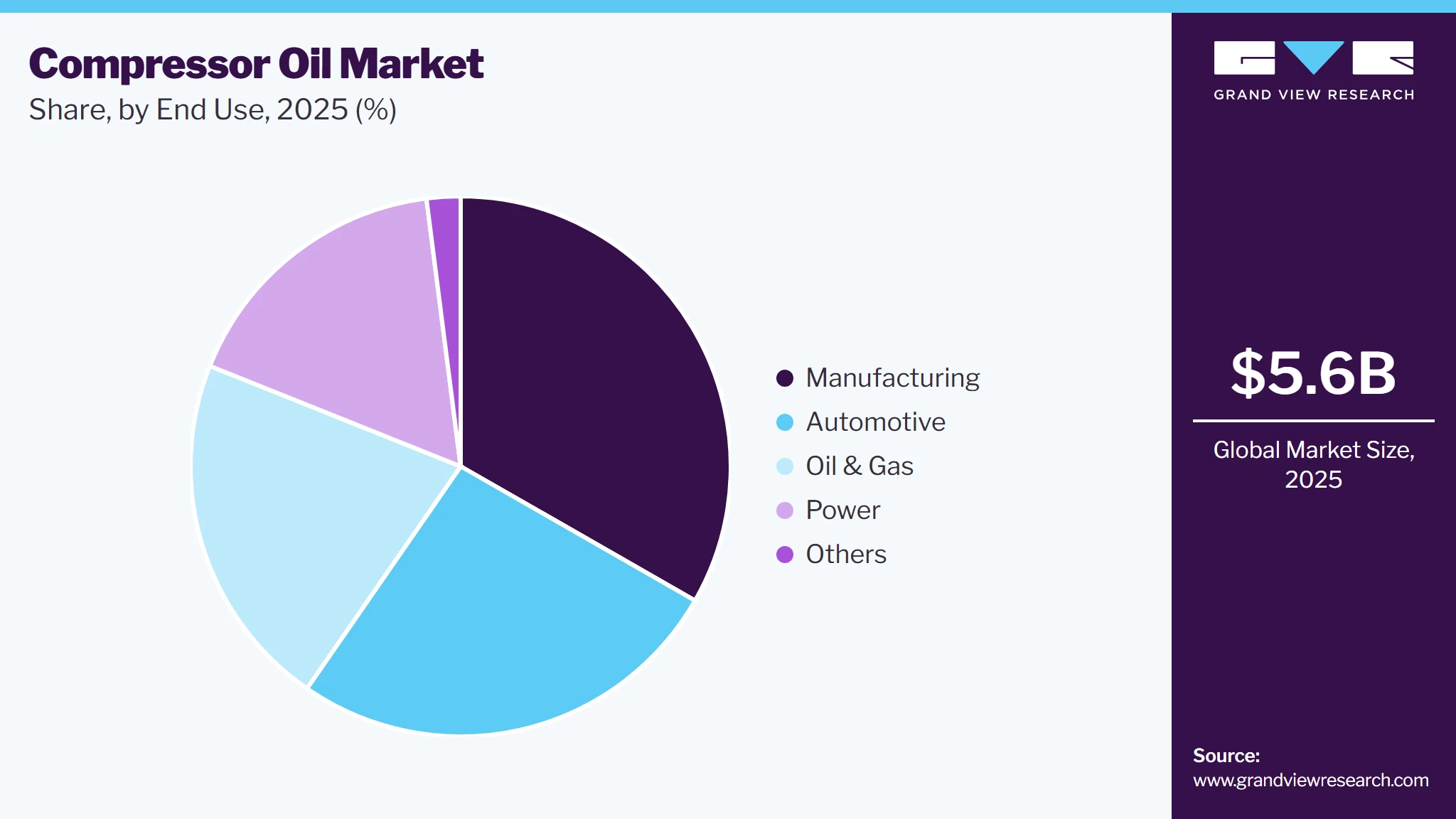
By end-use, manufacturing segment led the market with 33.3% of the revenue in 2025. The sector's growth can be attributed to rising maintenance activities and lubrication applications. Compressor oils are essential for the smooth operation of various manufacturing processes, including machinery, equipment, and systems that require continuous and reliable lubrication. The growing industrialization and demand for more efficient and durable equipment fuel this sector's increasing need for high-quality compressor oils.
 To learn more about this report, Download Free Sample Report
 The oil and gas industry in the compressor oil market is expected to grow significantly at a CAGR of 3.4% over the forecast period. Rising oil and gas demand has led to increased exploration and production, requiring high-quality compressor oils for equipment efficiency and longevity. The global growth in liquefied natural gas (LNG) production further boosts the need for specialized oils to support compressors in LNG production and transport. As machinery complexity grows, maintaining equipment is vital, with compressor oils reducing wear, minimizing downtime, and improving efficiency, driving the demand for advanced lubricants.
Regional Insights
The North America compressor oil market held a substantial market share in 2025. North America's manufacturing sector, including automotive, aerospace, and heavy machinery, depends on compressors for production, driving the need for high-performance lubricants to enhance operation and minimize downtime. As industries grow and modernize, the demand for compressor oils increases. Additionally, rising temperatures and growing urban populations boost the demand for air conditioning and refrigeration systems, which rely on compressors, further increasing the need for reliable compressor oils in both residential and commercial sectors.
U.S. Compressor Oil Market Trends
The compressor oil market in the U.S. dominated the North America market, with the highest revenue share of 85.3% in 2025. The rise in U.S. shale gas production has boosted compressor use in natural gas extraction, storage, and transportation, driving the demand for high-performance oils that ensure efficiency under high-pressure conditions. Additionally, increasing infrastructure projects in energy, construction, and power generation require compressors for various applications, further elevating the need for reliable and efficient compressor oils to support large-scale operations and maintain the smooth functioning of essential machinery.
Asia Pacific Compressor Oil Market Trends
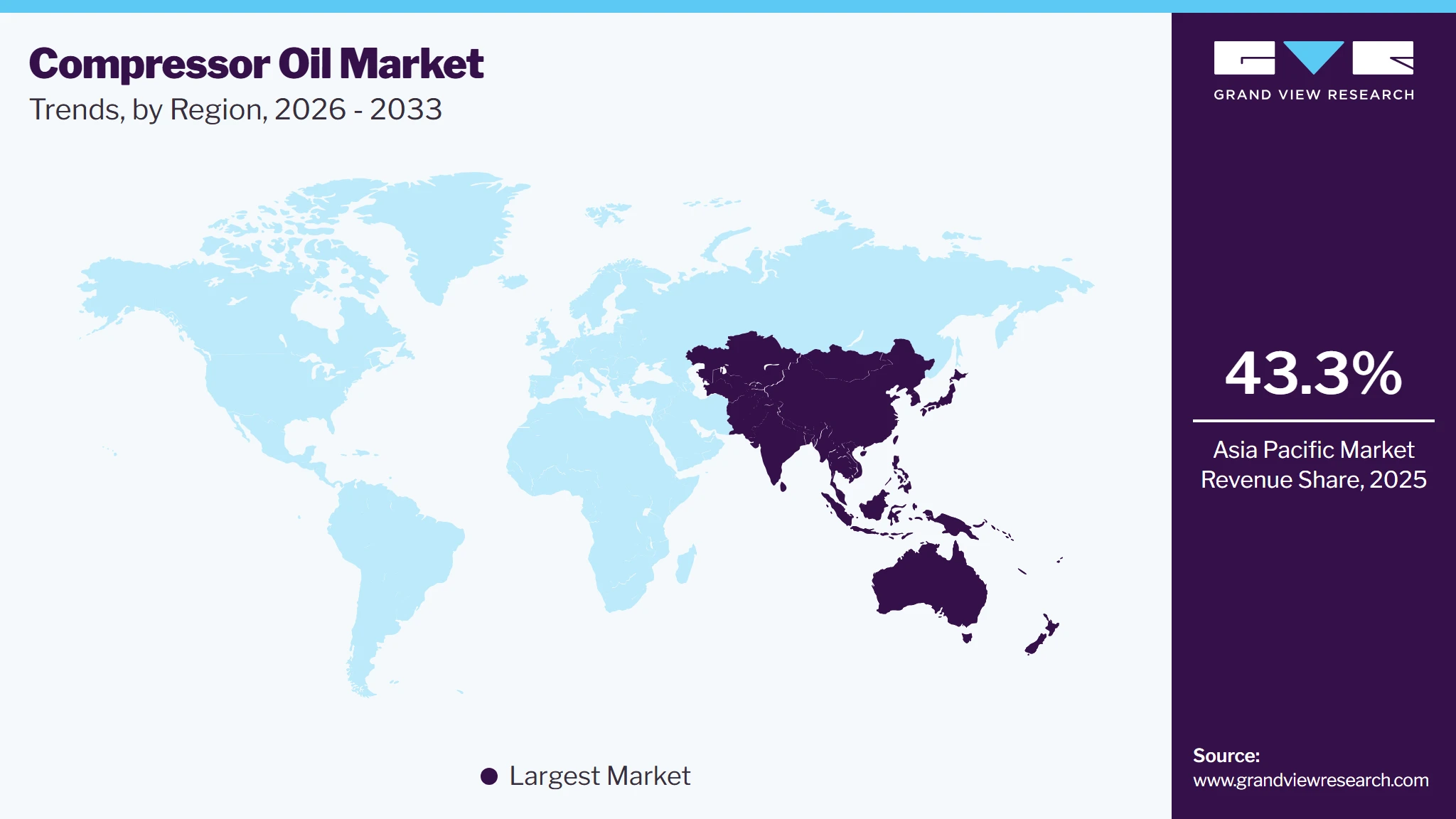
Asia Pacific dominated the compressor oil market with the highest revenue share of 43.3% in 2025, owing to the high growth rate of major end use industries such as metalworking, food processing, chemicals, and textiles, coupled with rapid urbanization and industrialization. The regional market presents numerous opportunities for innovators to introduce new products with advantageous product characteristics to tap into niche applications. As countries such as China, India, and Southeast Asian nations continue to industrialize and urbanize, there is an increasing demand for energy and infrastructure.
 To learn more about this report, Download Free Sample Report
 China dominated the Asia Pacific compressor oil market in 2025. China remains a global manufacturing hub, with extensive use of compressors in industries such as automotive, electronics, textiles, and refrigeration. As China’s industrial sector continues to expand and modernize, the demand for compressor oils to maintain the efficiency and longevity of equipment increases. As one of the world’s largest energy producers and consumers, China’s oil and gas sector is seeing steady growth in exploration, production, and transportation activities.
Middle East & Africa Compressor Oil Market Trends
The Middle East & Africa compressor oil market is expected to grow significantly at a CAGR of 3.7% over the forecast period as the region is home to some of the largest oil and gas reserves in the world and with continued exploration, extraction, and transportation activities. Multiple countries in the MEA region are experiencing rapid industrialization, especially in the Gulf Cooperation Council (GCC) countries. The hot climate in the MEA region drives demand for air conditioning and refrigeration systems, which depend on compressors, thereby increasing the need for compressor oils to maintain efficiency and prevent breakdowns across sectors.
The compressor oil market in Saudi Arabia dominated the Middle East & Africa market with the highest revenue share in 2025. Saudi Arabia, a leading oil producer, relies on compressors for exploration, extraction, and transportation, increasing demand for high-quality compressor oils to maintain performance and minimize downtime. As part of Vision 2033, the country is diversifying its economy into manufacturing, petrochemicals, and power generation, raising the need for compressor oils in these sectors. Infrastructure investments, such as NEOM and the Red Sea project, further boost demand as compressors are essential in construction and energy production, driving the need for reliable lubricants.
Key Compressor Oil Company Insights
Key global compressor oil market companies include Shell plc, Chevron Corporation, Exxon Mobil Corporation, and Repsol, among others. Major compressor oil companies are focusing on technological innovation, sustainability, and expanding product portfolios. They invest in developing high-performance, eco-friendly oils that meet industry standards and regulatory requirements. Companies are also strengthening their global supply chains, enhancing customer service, and targeting emerging markets. Strategic partnerships, acquisitions, and increased R&D in compressor oil formulations help them address evolving customer needs and maintain market leadership.
-
Shell plc is an energy company headquartered in The Hague, Netherlands. It operates across all sectors of the energy industry, including exploration, production, refining, and distribution of oil and natural gas. The company produces a wide range of products, including fuel, lubricants, and chemicals, and investments in renewable energy, such as wind and solar power.
-
Chevron Corporation provides lubricants designed to optimize compressor performance and ensure the longevity of equipment across various industries, including oil and gas, manufacturing, and refrigeration. Its compressor oils include Chevron Rando HD Series and Chevron Delo 400 LE Multigrade, among others. The company is headquartered in San Ramon, California, U.S.
Key Compressor Oil Companies
The following key companies have been profiled for this study on the compressor oil market.
-
Shell plc
-
Chevron Corporation
-
Exxon Mobil Corporation
-
Repsol
-
FUCHS
-
Atlas Copco Group
-
Hitachi, Ltd.
-
Siemens AG
-
KAESER KOMPRESSOREN
-
MITSUBISHI HEAVY INDUSTRIES, LTD.
Competitive Benchmarking
Category
Operating Strategies
Competitive Edge
Weakness
Established Players (Shell plc, Chevron Corporation, Exxon Mobil Corporation, Repsol, FUCHS, Atlas Copco Group, Hitachi, Ltd.)
- Focus on continuous investment in research and development to improve compressor efficiency and lubricant performance.
- Expand global manufacturing and distribution networks to strengthen regional market presence and reduce delivery lead times.
- Offer integrated solutions combining compressors, lubricants, digital monitoring, and aftermarket services to increase customer retention.
- Pursue strategic acquisitions, partnerships, and product portfolio expansion to address diverse industrial applications.
- Well-established global brands with strong customer relationships across multiple industrial sectors.
- Extensive product portfolios covering compressors, industrial lubricants, automation technologies, and lifecycle services.
- Significant financial resources enabling continuous innovation, capacity expansion, and compliance with evolving environmental regulations.
- Strong aftermarket service infrastructure with technical expertise and worldwide service centers supporting long-term customer operations.
- Large organizational structures can slow decision-making and delay commercialization of new technologies.
- High operating costs associated with global manufacturing, workforce management, and regulatory compliance.
- Greater dependence on mature industrial markets with comparatively slower growth rates.
- Complex supply chains increase exposure to raw material price volatility, geopolitical risks, and logistics disruptions.
Emerging Players (ELGi Equipments Limited, FS-Elliott Co., LLC, BOGE Kompressoren)
- Concentrate on niche industrial applications and specialized compressor or lubricant solutions to establish market differentiation.
- Build regional distribution partnerships to expand market reach while minimizing capital investment.
- Prioritize agile product development and rapid customization to address evolving customer requirements.
- Leverage digital sales channels and localized technical support to strengthen customer acquisition and brand visibility.
- Greater operational flexibility enables faster response to changing market demands and customer specifications.
- Competitive pricing strategies help penetrate cost-sensitive industrial markets.
- Ability to introduce innovative products with shorter development and commercialization cycles.
- Strong focus on underserved regional markets where global competitors have relatively limited penetration.
- Limited financial capacity may restrict investments in advanced manufacturing technologies and large-scale expansion.
- Smaller distribution and service networks reduce market coverage and aftermarket support capabilities.
- Lower brand recognition can make it difficult to secure long-term contracts with multinational industrial customers.
- Higher dependence on third-party suppliers and distributors increases vulnerability to supply chain disruptions and input cost fluctuations.
Recent Developments
-
In February 2025, Shell plc (SHEL) announced the purchase of 1,495,840 shares for cancellation as part of its share buyback program, executed across multiple platforms, including the London Stock Exchange (LSE), Chi-X, BATS, XAMS, and CBOE DXE. The buyback, managed by Natixis until April 2025, follows a strategic capital allocation decision aiming to optimize liquidity and minimize market impact. This move reflects strong cash flow, with potential earnings per share growth for investors.
-
In February 2025, Chevron confirmed plans to reduce its workforce by 15% to 20%, affecting approximately 6,830 to 9,100 jobs, as part of an organizational restructuring. The layoffs, impacting its over 45,000 employees, are aimed at improving efficiency, centralization, and results. Vice Chairman Mark Nelson stated the changes would enhance long-term competitiveness, with the reductions expected to be completed by the end of 2026. Chevron did not specify which areas would be impacted by the layoffs.
Compressor Oil Market Report Scope
Report Attribute
Details
Market size in 2025
USD 5.6 billion
Estimated market size in 2026
USD 5.8 billion
Projected market size by 2033
USD 7.3 billion
Growth rate
CAGR of 3.4% from 2026 to 2033
Base year for estimation
2025
Historical data
2021 - 2024
Forecast period
2026 - 2033
Quantitative units
Revenue in USD billion/million, Volume in Kilotons, and CAGR from 2026 to 2033
Report coverage
Revenue forecast, company ranking, competitive landscape, growth factors, and trends
Segments covered
Compressor, base oil, end-use, region
Regional scope
North America; Europe; Asia Pacific; Latin America; Middle East & Africa
Country scope
U.S.; Canada; Mexico; Germany; UK; France; Spain; Russia; China; India; Japan; South Korea; Australia; Saudi Arabia; South Africa; Kuwait; Iraq; Brazil; Argentina; Venezuela
Key companies profiled
Shell plc; Chevron Corporation; Exxon Mobil Corporation; Repsol; FUCHS; Atlas Copco Group; Hitachi, Ltd.; Siemens AG; KAESER KOMPRESSOREN; MITSUBISHI HEAVY INDUSTRIES, LTD.
Customization scope
Free report customization (equivalent up to 8 analysts' working days) with purchase. Addition or alteration to country, regional & segment scope.
Pricing and purchase options
Avail customized purchase options to meet your exact research needs. Explore purchase options
Global Compressor Oil Market Report Segmentation
This report forecasts revenue growth at global, regional, and country levels and analyzes the latest industry trends in each sub-segment from 2021 to 2033. For this study, Grand View Research has segmented the global compressor oil market report based on compressor, base oil, end-use, and region:
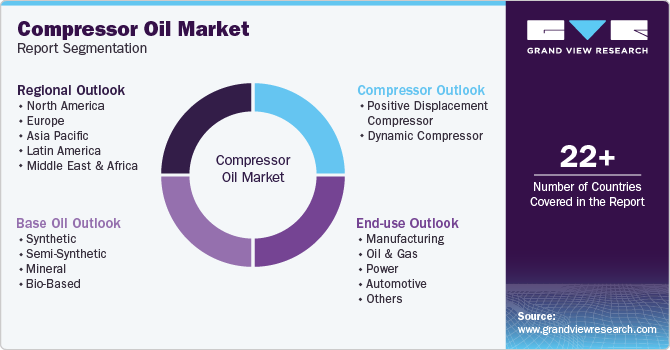 To learn more about this report, Download Free Sample Report
 -
Compressor Outlook (Volume, Kilotons; Revenue, USD Million; 2021 - 2033)
-
Positive Displacement Compressor
-
Dynamic Compressor
-
-
Base Oil Outlook (Volume, Kilotons; Revenue, USD Million; 2021 - 2033)
-
Synthetic
-
Semi-Synthetic
-
Mineral
-
Bio-Based
-
-
End-use Outlook (Volume, Kilotons; Revenue, USD Million; 2021 - 2033)
-
Manufacturing
-
Oil & Gas
-
Power
-
Automotive
-
Others
-
-
Regional Outlook (Volume, Kilotons; Revenue, USD Million; 2021 - 2033)
-
North America
-
U.S.
-
Canada
-
Mexico
-
-
Europe
-
Germany
-
UK
-
France
-
Spain
-
Russia
-
-
Asia Pacific
-
China
-
India
-
Japan
-
South Korea
-
Australia
-
-
Latin America
-
Brazil
-
Argentina
-
Venezuela
-
-
Middle East & Africa
-
Saudi Arabia
-
South Africa
-
Kuwait
-
Iraq
-
-
Research Methodology
The compressor oil Market figures in this report are based on a proven research process that combines executive interviews with secondary research from proprietary databases, company filings, and recognized regulatory and institutional sources. Market size is built through value-chain sizing - reconciling supply-side and demand-side estimates - and triangulated with bottom-up and top-down approaches. Every estimate passes multiple levels of expert validation before publication, with each compressor oil Market segment quantified using the revenue-capture definitions in the table below.
Segment Definition
Segment - Compressor
Revenue capture definition
Positive Displacement Compressor
Strong commercial performance is supported by increasing deployment across manufacturing, oil & gas, and process industries requiring consistent pressure delivery, high operational reliability, and continuous-duty operation.
Dynamic Compressor
Market expansion is driven by rising utilization in power generation, petrochemical processing, and large industrial facilities where high airflow capacity and superior efficiency improve operational output.
Segment - Base Oil
Revenue capture definition
Synthetic
Value creation is strengthened by growing preference for premium lubricants that extend compressor lifespan, improve thermal stability, minimize maintenance requirements, and enhance energy efficiency.
Semi-Synthetic
Market earnings are supported by increasing incorporation in craniofacial reconstruction, facial contour correction, and maxillofacial procedures, where biocompatible graft materials improve aesthetic and functional outcomes.
Mineral
Demand generation is fueled by widespread use in conventional compressor systems across general manufacturing due to affordability, broad availability, and compatibility with existing equipment.
Bio-Based
Business potential is expanding with rising adoption of environmentally sustainable lubricants that support regulatory compliance, reduce ecological impact, and align with corporate sustainability initiatives.
Segment - End-use
Revenue capture definition
Manufacturing
Growth opportunities stem from extensive compressor deployment in automated production lines, pneumatic machinery, material handling systems, and factory operations requiring dependable, compressed air.
Oil & Gas
Commercial demand remains strong due to continuous compressor utilization in gas processing, pipeline transportation, refining activities, and offshore production facilities
Power
Industry value is enhanced through compressor applications in turbine operation, plant instrumentation, emission control systems, and auxiliary equipment that improve generating efficiency.
Automotive
Market gains are supported by increasing use of compressors in vehicle assembly, robotic manufacturing, surface finishing, and component testing to ensure production precision.
Other End Uses
Incremental business is generated through expanding adoption across food & beverage, pharmaceuticals, chemicals, mining, construction, and electronics industries requiring reliable compressed air solutions.
Estimation Model
Layer Name
Key Question
Description
Raw Material & Production Layer
What forms the supply base?
Assess the manufacturing of compressor systems using key raw materials such as cast iron, aluminum alloys, stainless steel, copper, engineered plastics, electric motors, bearings, seals, valves, and electronic control components. The analysis evaluates production technologies including precision machining, casting, forging, CNC manufacturing, assembly automation, and performance testing, while examining supplier networks, component sourcing, quality assurance practices, production capacity, and regional manufacturing hubs influencing the global supply landscape.
Application Adoption Layer
Where is compressor oil consumed?
Examine compressor deployment across manufacturing, oil & gas, power generation, automotive, chemicals, food & beverage, mining, construction, and pharmaceutical industries. Market adoption is supported by growing demand for compressed air and gas handling solutions used in pneumatic equipment, industrial automation, process control, refrigeration, gas compression, and critical production operations requiring dependable system performance.
Consumption Intensity Layer
How much compressor oil is utilized?
Analyze utilization trends by assessing industrial output, facility expansion, installed equipment base, infrastructure development, maintenance cycles, and capital expenditure across major end-use industries. The evaluation considers compressor installations in factories, refineries, power plants, automotive assembly facilities, and other industrial operations to determine regional and global equipment demand intensity.
Revenue Layer
How is market revenue generated?
Industry value is generated through the sale of positive displacement and dynamic compressors, aftermarket services, replacement components, maintenance contracts, digital monitoring solutions, and compressor lubricants. Commercial expansion is supported by industrial modernization, energy-efficiency upgrades, equipment replacement programs, technological innovation, and increasing investments in automated manufacturing and process industries requiring reliable compressed air systems.
Delivered Customizations
This report has been delivered with the following In-depth customizations
Client Request
Customization Delivered
Value Adds
Regional Segmentation
The study delivers detailed country-level analysis across major compressor manufacturing and consumption markets. It evaluates production capacity, component availability, manufacturing technologies, industrialization trends, supply chain dynamics, import-export patterns, pricing outlook, regulatory frameworks, infrastructure development, and demand across manufacturing, oil & gas, power, automotive, and other industrial sectors.
Enables stakeholders to identify high-growth regional markets, evaluate production capabilities, optimize sourcing strategies, understand regulatory requirements, and prioritize investments based on industrial demand, manufacturing strength, and supply chain resilience.
Competitive Benchmarking
The report provides a comprehensive benchmarking assessment of leading compressor manufacturers and lubricant suppliers, covering product portfolios, compressor technologies, manufacturing capabilities, production capacity, geographic presence, distribution networks, research and development initiatives, service capabilities, operational efficiency, sustainability strategies, and recent strategic developments.
Supports organizations in evaluating competitive positioning, identifying technological differentiators, benchmarking operational excellence, establishing strategic partnerships, and strengthening market presence through innovation, service expansion, and product diversification.
Opportunity Assessment
The study evaluates emerging growth opportunities across energy-efficient compressors, smart monitoring systems, predictive maintenance solutions, variable speed drive technologies, sustainable compressor lubricants, industrial automation, and digital asset management. It also examines opportunities arising from infrastructure development, Industry 4.0 adoption, and increasing investments in advanced manufacturing and process industries.
Assists companies in identifying high-potential growth areas, aligning product development with evolving industrial requirements, accelerating innovation initiatives, expanding application portfolios, and strengthening long-term competitiveness through technology-driven industrial solutions.
Frequently Asked Questions About This Report
The global compressor oil market size was valued at USD 5.6 billion in 2025 and is estimated at USD 5.8 billion for 2026.
The global compressor oil market is expected to grow at a CAGR of 3.4% from 2026 to 2033, reaching USD 7.3 billion by 2033.
Key players in the compressor oil market include Shell plc; Chevron Corporation; Exxon Mobil Corporation; Repsol; FUCHS; Atlas Copco Group; Hitachi, Ltd.; Siemens AG; KAESER KOMPRESSOREN; MITSUBISHI HEAVY INDUSTRIES, LTD.
Based on base oil, synthetic segment held a dominant position, contributing 44.1% of total revenue in 2025, supported by its superior thermal stability, extended service life, enhanced oxidation resistance, and ability to improve compressor efficiency under demanding operating conditions.
Asia Pacific dominated the compressor oil market with the highest revenue share of 43.3% in 2025. The region is supported by rapid industrialization, expanding manufacturing capacity, strong demand from the oil & gas and automotive sectors, and increasing investments in energy-efficient industrial equipment.
Asia Pacific is the fastest growing region with a CAGR of 4.7% in the forecast period. Robust manufacturing expansion, rapid industrial automation, and increasing investments in infrastructure, electronics, and automotive production across China, India, Japan, and Southeast Asia continue to strengthen demand for advanced compressor systems throughout the region.
The compressor oil market is primarily driven by the increasing adoption of industrial compressors across manufacturing, oil & gas, power generation, and automotive sectors, where reliable lubrication is essential for efficient equipment performance. Growing demand for energy-efficient compressors, longer equipment service life, and the shift toward high-performance synthetic and bio-based lubricants are further supporting market growth.
By end use, manufacturing segment led the market with 33.3% of the revenue in 2025. This is due to the widespread use of compressed air systems in automated production lines, pneumatic equipment, material handling, and precision manufacturing processes across diverse industrial sectors.
Based on compressor, positive displacement compressor held the largest revenue share of 67.5% in 2025, due to its widespread adoption across manufacturing, oil & gas, and process industries, where consistent pressure delivery, operational reliability, and versatility are essential for continuous industrial operations.
About the Author(s)
Petrochemicals Research Team
Bulk Chemicals · PetrochemicalsThis report was authored by the petrochemicals research team at Grand View Research - comprising two research analysts, one senior research analyst, and one industry expert - with specialized expertise in the petrochemicals segment of the bulk chemicals industry. All findings are based on proprietary bulk chemicals databases, executive interviews, and regulatory analysis, subject to internal peer review prior to publication.
Last Updated:
Speak to Analyst

Customize this report to your needs - add regions, segments, or data points, with 20% free customization.
Or view our licence options:


ISO 9001:2015 & 27001:2022 Certified
We are GDPR and CCPA compliant! Your transaction & personal information is safe and secure. For more details, please read our privacy policy.


