
- Home
- »
- Advanced Interior Materials
- »
-
Conductive Flooring Materials Market Size Report 2026-2033GVR Report cover
![Conductive Flooring Materials Market (2026 - 2033)Report]()
Conductive Flooring Materials Market (2026 - 2033)
Size, Share & Trends Analysis Report By Material (Conductive Vinyl, Conductive Rubber, Conductive Epoxy), By Product Form (Tiles, Sheets/Rolls, Liquid-applied/Poured), By End Use, By Region, And Segment Forecasts
Market Size, 2025
$1.5BMarket Estimate, 2026
$1.6BMarket Forecast, 2033
$2.5BCAGR, 2026–2033
6.4%Conductive Flooring Materials Market Summary
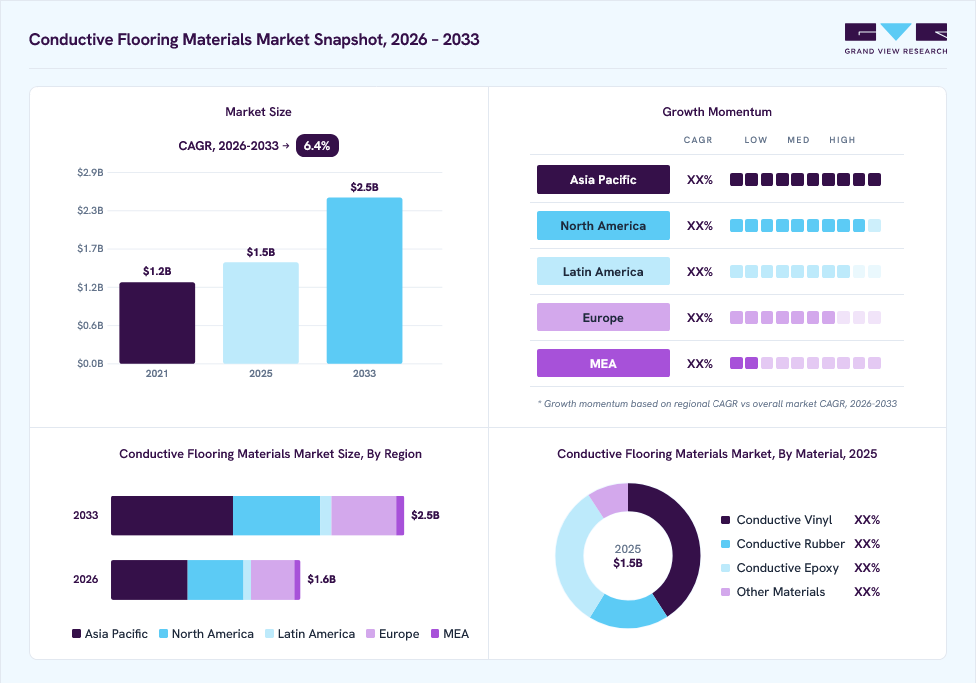
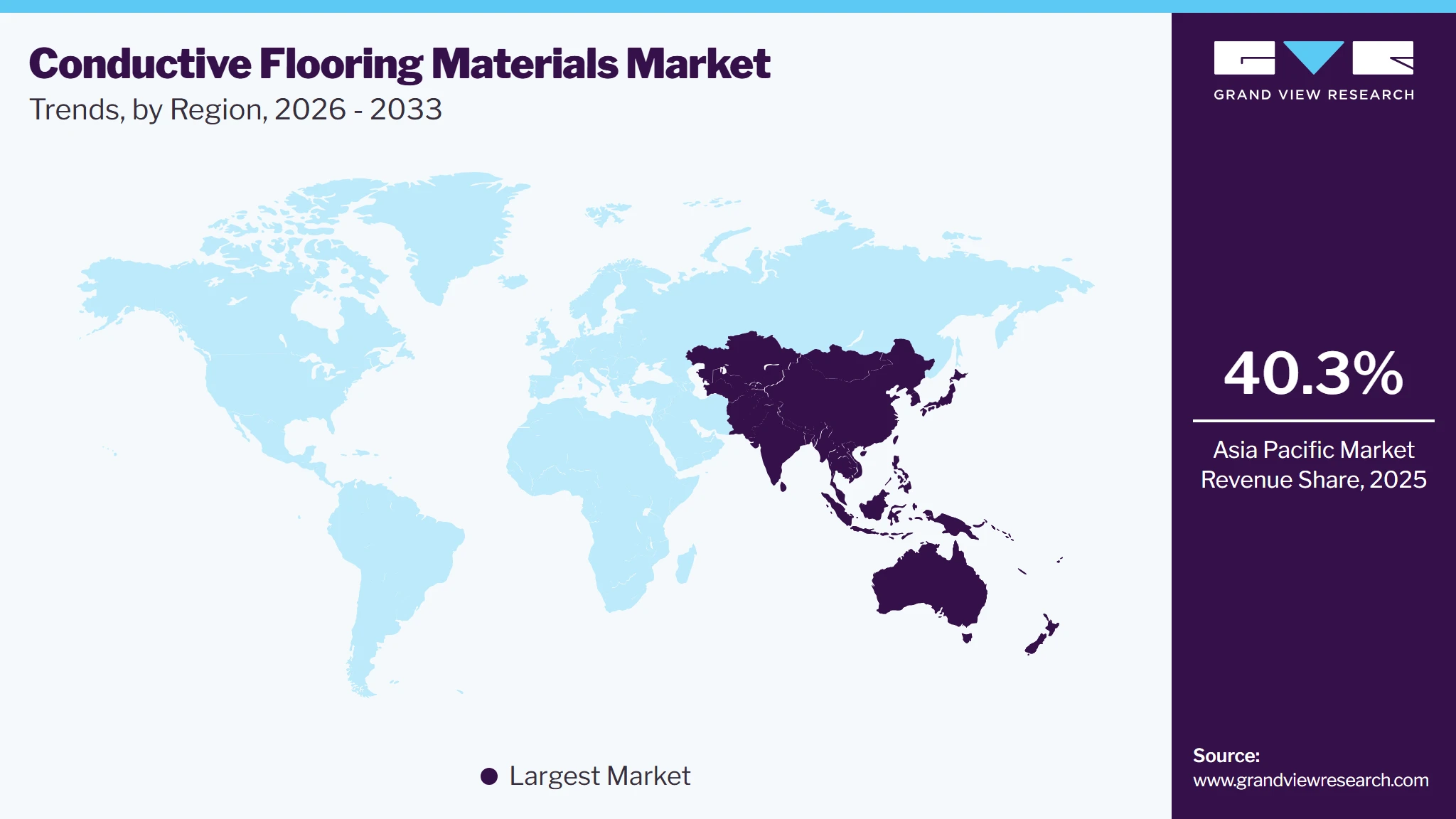
The global conductive flooring materials market size was valued at USD 1.5 billion in 2025 and is projected to grow from USD 1.6 billion in 2026 to USD 2.5 billion by 2033, at a CAGR of 6.4% from 2026 to 2033. Asia Pacific dominated the market, accounting for a revenue share of 40.3% in 2025. The industry is driven by the increasing need for controlled electrostatic discharge (ESD) protection across environments where static electricity can damage sensitive equipment, disrupt production, contaminate clean areas, or create safety risks.
Key Market Trends & Insights
- By material: Conductive vinyl segment held the highest revenue share of 40.8% in 2025.
- By end use: Electronics & semiconductor segment dominated the market with a revenue share of 39.5% in 2025.
- By product form: Liquid-applied/poured segment is projected to register a CAGR of 7.1% during the forecast period from 2026 to 2033.
Regional Highlights
- Largest regional market: Asia Pacific (40.3% revenue share, 2025)
- By country: China held the largest market share in 2025
Market Size & Forecast
- Market size in 2025: USD 1.5 Billion
- Estimated market size in 2026: USD 1.6 billion
- Projected market size by 2033: USD 2.5 Billion
- CAGR (2026-2033): 6.4%
Three ways to get this report
Buy it, customize it, or ask a question.Get the Full Report
What the study covers
- FormatsPDF · Excel · Dashboard
- Timeline2026–2033 annual, 2025 base
- Coverage20+ countries, 5 regions
- Companies10+ key players profiled
Customize the Report
20% free customization
- IncludeCountries, segments, points
- TailorTo your product definition
- ExtendDeeper competitor detail
- OrA fully bespoke study
- Turnaround5–10 working days
Ask Prism AI
A cited answer in seconds
- Corpus30K studies, 1.2M points
- ScopeAll markets, not just this
- CitationTraced to report & table
- HonestySays "not covered" if so
- SpeedSeconds, not days
Conductive flooring provides a controlled path for accumulated electrical charges to dissipate toward ground and is increasingly incorporated into specialized industrial and commercial flooring systems. Demand is particularly relevant in electronics manufacturing, semiconductor facilities, healthcare environments, laboratories, pharmaceutical production, data centers, and industrial facilities handling sensitive or combustible materials.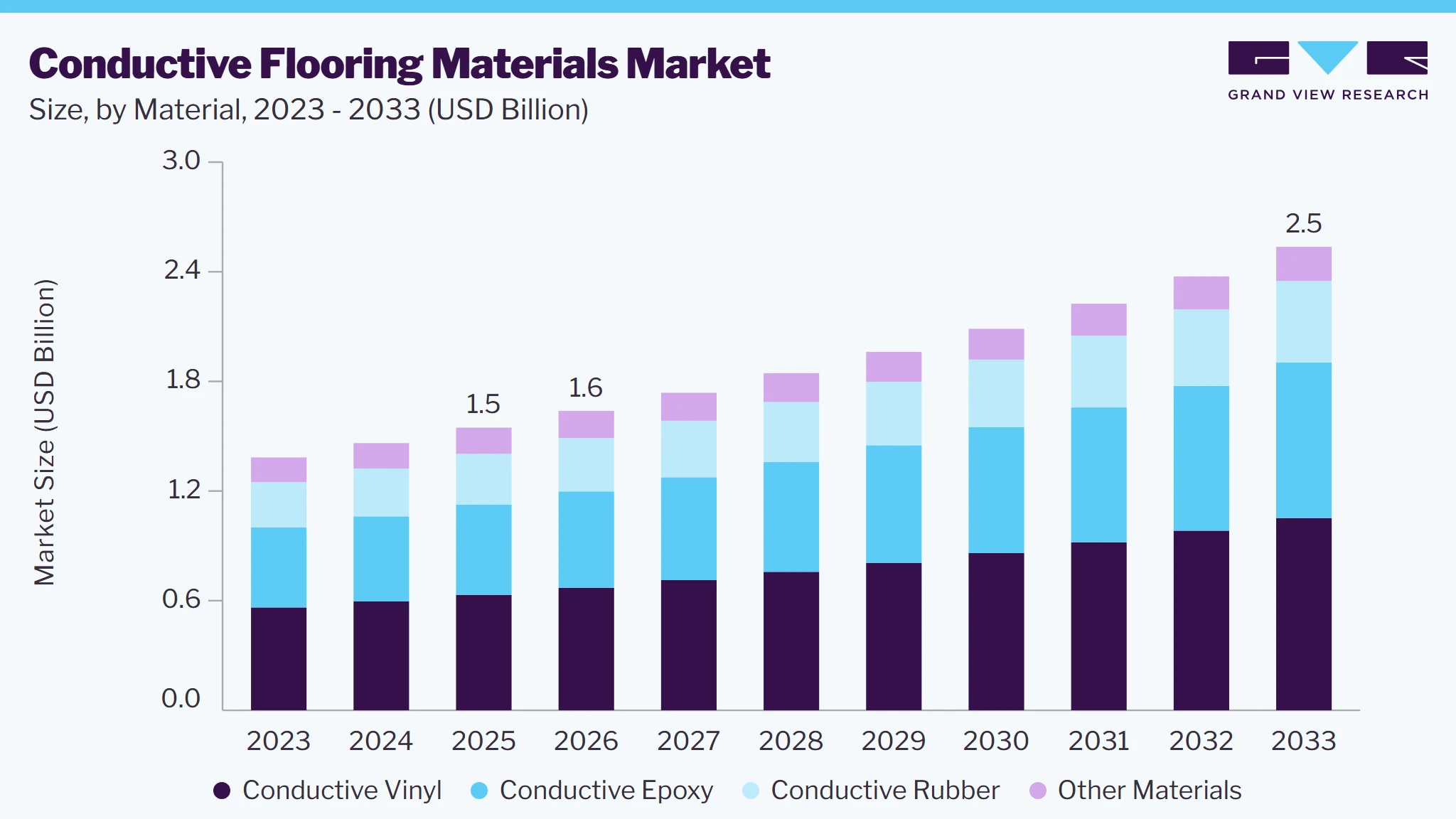
Manufacturing environments increasingly require flooring that combines electrostatic protection with chemical resistance, mechanical durability, ease of cleaning, and compatibility with cleanroom operations. Conductive epoxy, polyurethane, vinyl, rubber, and specialized resin-based systems are therefore being adopted according to the operating requirements of individual facilities. The increasing use of automated equipment, sensitive electronic components, and precision manufacturing processes further increases the need to manage electrostatic charge throughout the production environment.
Market Dynamics
The conductive flooring materials market is shaped by the increasing requirement for electrostatic protection, the expansion of sensitive manufacturing environments, regulatory and standards-based requirements, and technological improvements in flooring formulations. At the same time, high installation requirements, substrate preparation, grounding complexity, and maintenance requirements can limit adoption in conventional facilities. The market is therefore moving toward flooring systems that provide electrostatic control while also delivering durability, hygiene, chemical resistance, and operational reliability.
The expansion of semiconductor, electronics, battery, pharmaceutical, medical-device, and precision manufacturing facilities is increasing the demand for conductive and static-control flooring. These facilities handle equipment and components that can be affected by uncontrolled electrostatic discharge, making flooring an important component of the broader ESD control system. IEC 61340-5-1:2024 specifically establishes requirements for ESD control programs covering organizations involved in manufacturing, processing, assembly, testing, packaging, transportation, and other handling activities involving electrostatic-sensitive electronic equipment.
The increasing complexity of manufacturing environments is also raising requirements for flooring beyond basic conductivity. Production facilities increasingly seek systems that can withstand forklifts, heavy equipment, chemicals, frequent cleaning, and continuous personnel movement while maintaining stable electrical performance. This supports the adoption of resin-based conductive flooring, conductive vinyl and rubber flooring, and specialized ESD flooring systems that integrate electrical performance with industrial durability.
Conductive flooring systems generally require appropriate substrate preparation, conductive layers or grounding networks, proper installation practices, and post-installation verification of electrical resistance. Poor grounding, contamination, wear, or changes in the flooring system can affect electrostatic performance. IEC 61340-4-1 provides test methods for measuring the resistance of floor coverings and installed floors, while ANSI/ESD STM7.1 provides procedures for the qualification, acceptance, and monitoring of floor systems. These additional requirements can increase project complexity and total installation costs compared with conventional flooring.
An important opportunity lies in developing conductive flooring systems that combine ESD protection with sustainability, improved indoor environmental performance, durability, and smart monitoring capabilities. Manufacturers can differentiate through low-emission resin formulations, longer-life flooring systems, recyclable or partially bio-based materials, and conductive formulations requiring fewer maintenance interventions. Integration with facility monitoring systems could also enable continuous or periodic monitoring of flooring resistance and grounding performance, particularly in critical manufacturing and healthcare environments.
Market Concentration & Characteristics
The conductive flooring materials market is moderately consolidated, with participation by global flooring and construction-materials manufacturers, specialized ESD flooring producers, and regional installation companies. Large manufacturers benefit from established resin technologies, broad product portfolios, global distribution networks, technical certification capabilities, and relationships with industrial construction contractors. However, the market remains relatively specialized because product selection depends heavily on application-specific electrical performance, substrate conditions, installation expertise, and compliance requirements.
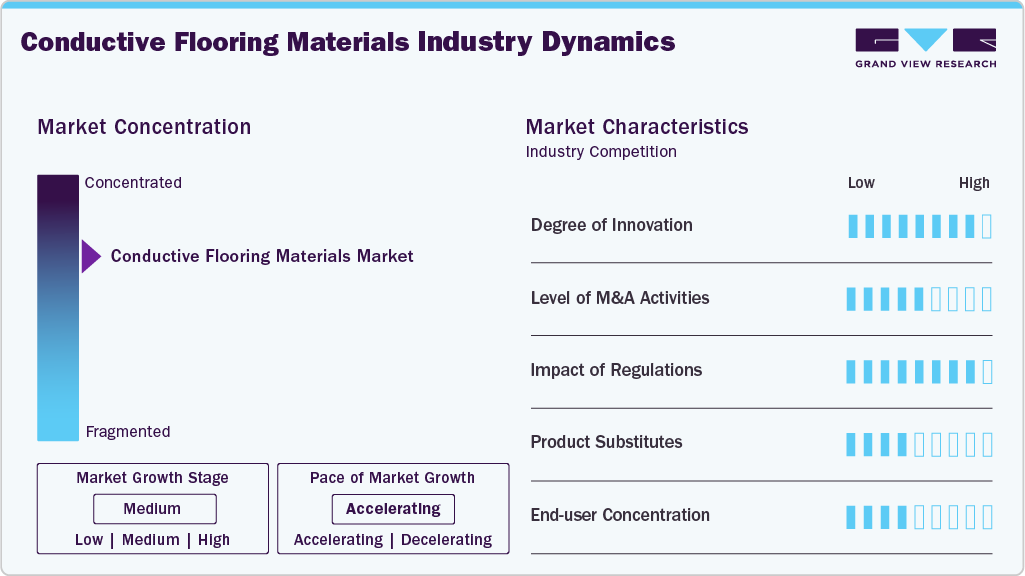
The threat of substitutes is moderate, as conductive flooring can be replaced in certain applications by static-dissipative flooring, conductive mats, grounding systems, conductive footwear, ESD workstations, and other localized electrostatic-control solutions. However, these alternatives generally do not provide the same continuous floor-level protection across an entire facility. In critical manufacturing and cleanroom environments, flooring forms part of an integrated person-footwear-flooring system, and IEC 61340-4-5 specifically addresses the evaluation of footwear and flooring together with a person.
Analyst Perspective
The conductive flooring materials market is expected to benefit from the growing adoption of ESD-controlled environments across electronics and semiconductor manufacturing, pharmaceuticals, healthcare, automotive, aerospace, laboratories, and cleanrooms. Demand is shifting toward high-performance flooring systems that combine electrical conductivity with durability, chemical resistance, hygiene, and ease of maintenance. Technological developments in conductive epoxies, polyurethanes, vinyls, and rubber, conductive additives, and integrated grounding systems are supporting product innovation. Increasing emphasis on workplace safety, electrostatic control standards, cleanroom requirements, and advanced manufacturing infrastructure is expected to create further opportunities for specialized conductive flooring solutions.
Material Insights
The conductive vinyl segment held the largest revenue share of 40.8% in 2025, supported by its widespread use in electronics and semiconductor facilities, healthcare environments, cleanrooms, laboratories, and other ESD-sensitive applications. Conductive vinyl offers a combination of controlled electrical resistance, durability, ease of maintenance, and relatively straightforward installation. Its availability in sheet and tile formats also enables flexible application across both new construction and renovation projects, supporting its established position within conductive flooring materials.
The conductive epoxy segment is expected to grow at a CAGR of 7.1% over the forecast period, driven by increasing demand for seamless, durable flooring in electronics manufacturing, semiconductor facilities, industrial plants, laboratories, and other environments requiring reliable electrostatic control. Conductive epoxy systems provide strong adhesion, chemical and abrasion resistance, and can be applied as continuous flooring over large areas. Growing investment in advanced manufacturing and technically controlled facilities is expected to create further opportunities for conductive epoxy systems.
Product Form Insights
The tiles segment accounted for the largest revenue share of 44.0% in 2025, supported by their modular installation, ease of replacement, design flexibility, and suitability for commercial and industrial environments. Conductive tiles are particularly attractive for facilities where localized replacement or maintenance is required without disrupting the entire flooring system. Their availability in conductive vinyl and rubber formats further supports adoption across electronics, healthcare, data center, and industrial applications.
The liquid-applied/poured segment is expected to grow at a CAGR of 7.1% over the forecast period, primarily driven by rising demand for seamless conductive flooring in industrial, electronics, pharmaceutical, cleanroom, and other high-performance environments. Liquid-applied systems provide continuous surfaces with minimal joints, improving cleanability and resistance to chemical and mechanical stresses. The ability to customize conductivity, thickness, surface finish, and chemical resistance further supports their adoption in specialized facilities.
End Use Insights
The electronics & semiconductor segment held a dominant revenue market share of 39.5% in 2025, owing to the critical need for electrostatic discharge protection during the manufacturing, assembly, testing, and handling of sensitive electronic components. Conductive flooring is an important part of broader ESD control systems by providing a controlled path for electrostatic charges. Continued expansion of semiconductor, electronics, and advanced manufacturing facilities is supporting sustained demand for conductive flooring in this segment.
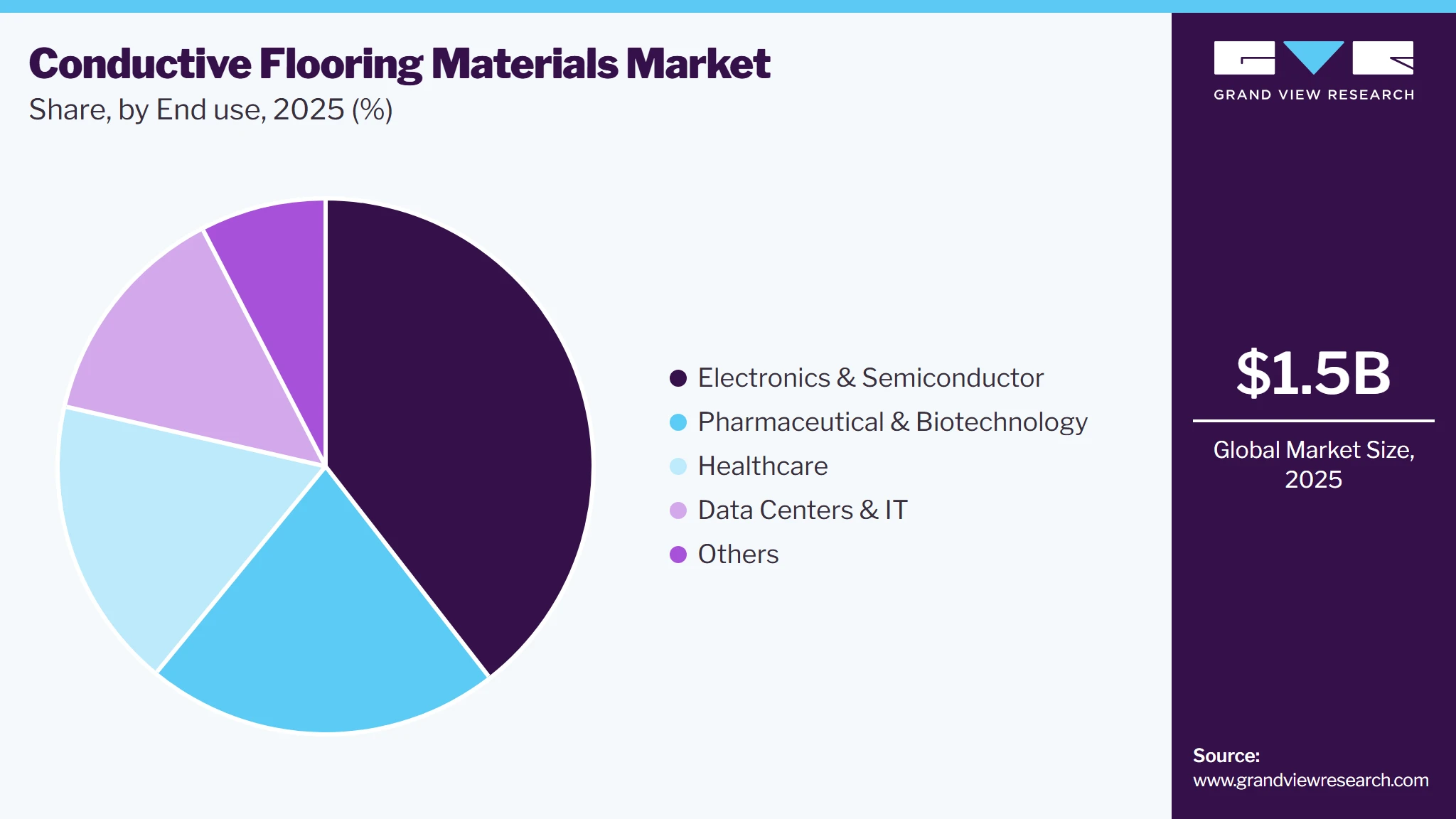
The data centers & IT segment is expected to grow at a CAGR of 7.2% over the forecast period, supported by increasing construction and modernization of data centers, server rooms, and other technology-intensive facilities. Conductive and ESD flooring helps control static electricity and reduce risks to sensitive electronic equipment, particularly during installation, maintenance, and equipment handling. Rising digitalization, cloud computing, AI infrastructure, and high-density computing are expected to create additional demand for specialized flooring solutions in data center environments.
Regional Insights
The conductive flooring materials market in the Asia Pacific dominated the global industry and accounted for the largest revenue share of 40.3% in 2025, reflecting the region's position as a major global manufacturing hub. Asia Pacific is also expected to grow at the fastest CAGR over the forecast period. Large-scale investments in semiconductor fabs, electronics assembly, electric-vehicle batteries, and precision manufacturing are increasing the number of facilities that require controlled production environments. China, Taiwan, South Korea, Japan, and India are expanding domestic capabilities across different stages of high-technology supply chains, creating demand for flooring systems that support electrostatic control and process reliability. The proliferation of cleanrooms, automated production lines, and high-density manufacturing facilities is broadening applications beyond conventional industrial settings.
The China conductive flooring materials market is closely tied to the country's extensive electronics, battery, electric vehicle, and industrial production clusters. The concentration of component manufacturers, electronics assemblers, semiconductor facilities, and battery plants creates a large installed base of environments where static control is required. Battery manufacturing is an especially relevant application area because production lines combine sensitive electronic components with stringent cleanliness and process-control requirements. Flooring is also required in testing laboratories, electronics assembly areas, pharmaceutical facilities, and other technically controlled spaces.
North America Conductive Flooring Materials Market Trends
The conductive flooring materials market in North America is increasingly influenced by the reindustrialization and modernization of domestic manufacturing capacity. Investments in electric vehicle supply chains, aerospace production, semiconductor fabrication, and advanced industrial facilities are resulting in new technically controlled production spaces. Unlike markets driven predominantly by high-volume manufacturing, North American projects often place greater emphasis on documented product performance, installation standards, testing, and lifecycle reliability. Conductive flooring is consequently specified as part of broader facility-level ESD-control systems. The expansion of laboratories, data centers, medical technology facilities, and research infrastructure creates additional demand beyond manufacturing applications.
U.S. Conductive Flooring Materials Market Trends
The conductive flooring materials market in the U.S. is benefiting from a renewed focus on domestic semiconductor and advanced manufacturing capacity, with large-scale facility development generating requirements for specialized production infrastructure. Semiconductor fabs, electronics facilities, battery plants, aerospace production sites, and pharmaceutical manufacturing environments require tightly controlled operating conditions in which flooring can form an important component of ESD management. Existing industrial facilities are also being upgraded as manufacturing processes become increasingly automated and electronics intensive. Product selection is strongly influenced by electrical resistance characteristics, installation quality, testing procedures, and compatibility with facility ESD programs.
Europe Conductive Flooring Materials Market Trends
The conductive flooring materials market in Europe is increasingly shaped by the region's emphasis on performance standards, environmental considerations, and long-term building efficiency. Flooring suppliers are therefore competing on a broader combination of attributes, including electrostatic performance, chemical resistance, hygiene, emissions, durability, and maintenance requirements. Pharmaceutical production, automotive manufacturing, laboratories, electronics, and cleanroom applications provide established demand across major European industrial economies. The transition toward more resource-efficient construction is also encouraging greater consideration of product lifespan, material efficiency, recyclability, and environmental characteristics.
The Germany conductive flooring materials market is closely associated with the country’s automotive engineering and highly automated industrial production ecosystem. Manufacturing plants increasingly incorporate robotics, electronic control systems, automated handling equipment, and precision machinery, increasing the importance of managing electrostatic risks within production areas. Automotive electronics, component manufacturing, laboratories, machinery production, and chemical facilities represent important application environments. The country's strong engineering culture also emphasizes consistent technical performance and long-term reliability when specifying industrial flooring.
Central and South America Conductive Flooring Materials Market Trends
The conductive flooring materials market in Central and South America has gained impetus from industrial localization and the modernization of production infrastructure. For instance, Brazil provides a separate demand base through its pharmaceutical, healthcare, automotive, electronics, and industrial sectors. Adoption remains more concentrated around major manufacturing centers and new facility projects than across the broader regional building stock.
Middle East & Africa Conductive Flooring Materials Market Trends
The conductive flooring materials market in the Middle East & Africa presents a project-driven demand, with conductive flooring primarily associated with specialized new-build facilities. Gulf countries are investing in healthcare complexes, pharmaceutical and life-science facilities, laboratories, data centers, technology infrastructure, and industrial diversification projects, creating applications for technically controlled flooring systems. Saudi Arabia and the UAE are particularly relevant as large-scale development programs increase the construction of high-specification facilities. In Africa, opportunities are more concentrated around healthcare, pharmaceuticals, electronics, mining-related facilities, and major industrial projects.
Key Conductive Flooring Materials Company Insights
Some of the key players operating in the market include Sika AG and Forbo Flooring Systems, among others.
-
Sika AG is a Switzerland-based specialty chemicals and construction materials company offering flooring solutions for industrial, commercial, healthcare, and cleanroom applications. Its Sikafloor portfolio includes conductive and electrostatic-dissipative flooring systems, particularly epoxy and polyurethane solutions designed for environments requiring controlled electrostatic discharge.
-
Forbo Flooring Systems is a global flooring manufacturer offering resilient, textile, and specialty flooring solutions. Its portfolio includes conductive and ESD flooring, such as Colorex and Sphera EC, designed for electronics, healthcare, cleanrooms, pharmaceutical, and other static-sensitive environments.
StaticWorx and Altro are some of the emerging market participants in the conductive flooring materials market.
-
StaticWorx is a specialized manufacturer focused on static-control and ESD flooring solutions for environments where electrostatic discharge needs to be controlled. Its product portfolio includes conductive and static-dissipative flooring systems for electronics, healthcare, manufacturing, laboratories, and other sensitive facilities.
-
Altro is a global manufacturer of commercial and specialist flooring and walling systems, serving healthcare, manufacturing, hospitality, transport, and other demanding environments. The company offers flooring solutions designed for safety, durability, hygiene, and static-control requirements, including applications where electrostatic protection is important.
Key Conductive Flooring Materials Companies
The following key companies have been profiled for this study on the conductive flooring materials market:
-
Sika AG
-
Forbo Flooring Systems
-
Gerflor
-
Polyflor
-
Tarkett
-
Flowcrete
-
Altro
-
StaticWorx
-
MAPEI S.p.A.
-
Mohawk Industries
Competitive Benchmarking
Category
Operating Strategies
Competitive Edge
Weakness
Established Players - Sika AG, Forbo Flooring Systems, Gerflor, Polyflor, Tarkett, Flowcrete
- Invest in advanced conductive and ESD flooring technologies across epoxy, polyurethane, vinyl, and other flooring systems.
- Expand product portfolios and distribution networks to serve industrial, healthcare, electronics, pharmaceutical, cleanroom, and commercial applications.
- Focus on durability, electrical performance, chemical resistance, hygiene, and compliance with relevant ESD standards.
- Strong global presence, established brands, and extensive flooring portfolios.
- Broad distribution and relationships with contractors, architects, industrial customers, and facility operators support market penetration.
- Strong R&D and technical capabilities enable development of application-specific conductive flooring systems.
- Large product portfolios can lead to less specialization in conductive flooring than niche ESD manufacturers.
- Higher operating and manufacturing costs can make premium products less competitive in price-sensitive markets.
- Complex installation and project-specific requirements can increase dependence on qualified contractors and technical support.
Emerging Players - Altro, StaticWorx, MAPEI S.p.A., Mohawk Industries
- Develop specialized conductive and ESD flooring solutions targeting electronics, healthcare, industrial, cleanroom, and other static-sensitive environments.
- Expand through distributors, contractors, project partnerships, and specialized flooring channels.
- Prioritize product performance, application-specific solutions, installation efficiency, and differentiation through technical capabilities.
- Strong specialization in particular flooring materials, ESD applications, or specialty construction systems.
- Flexible product development and application-focused solutions can allow faster response to customer requirements.
- Established expertise in flooring and construction materials supports credibility in specialized applications.
- Smaller conductive-flooring footprint or narrower ESD specialization compared with the largest global flooring companies.
- Greater dependence on specific end-use sectors, distribution partners, and project-based demand.
- Competing against large players with broader portfolios, stronger geographic reach, and greater R&D and marketing resources.
Recent Developments
-
In February 2025, Sika acquired Elmich Pte Ltd, a Singapore-based construction solutions company, strengthening its presence in Asia Pacific.
-
In November 2024, Flowcrete introduced Flowshield ESD BVG Advantage, a carbon-fibre-free ESD epoxy flooring system using single-walled carbon nanotubes to provide stable conductivity and improved visual appearance.
Conductive Flooring Materials Market Report Scope
Report Attribute
Details
Market size in 2025
USD 1.5 billion
Estimated market size in 2026
USD 1.6 billion
Projected market size by 2033
USD 2.5 billion
Growth rate
CAGR of 6.4% from 2026 to 2033
Base year for estimation
2025
Actual estimates/Historical data
2021 - 2024
Forecast period
2026 - 2033
Quantitative units
Revenue in USD billion and CAGR from 2026 to 2033
Report coverage
Revenue forecast, company ranking, competitive landscape, growth factors, and trends
Segments covered
Material, product form, end use, region
Regional scope
North America; Europe; Asia Pacific; Central and South America; Middle East and Africa
Country scope
U.S.; Canada; Mexico; Germany; UK; France; Italy; Spain; China; Japan; India; South Korea; Brazil; Saudi Arabia
Key companies profiled
Sika AG; Forbo Flooring Systems; Gerflor; Polyflor; Tarkett; Flowcrete; Altro; StaticWorx; MAPEI S.p.A.; Mohawk Industries
Customization scope
Free report customization (equivalent up to 8 analysts working days) with purchase. Addition or alteration to country, regional & segment scope.
Pricing and purchase options
Avail customized purchase options to meet your exact research needs. Explore purchase options
Global Conductive Flooring Materials Market Report Segmentation
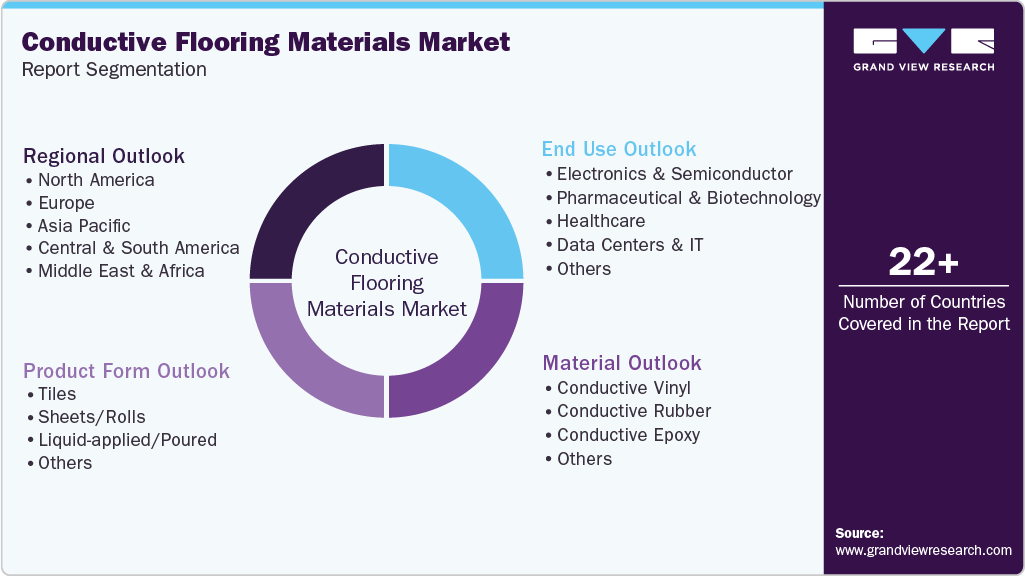
This report forecasts revenue growth at global, regional & country levels and provides an analysis on the industry trends in each of the sub-segments from 2021 to 2033. For this study, Grand View Research has segmented the global conductive flooring materials market report on the basis of material, product form, end use, and region:
-
Material Outlook (Revenue, USD Billion, 2021 - 2033)
-
Conductive Vinyl
-
Conductive Rubber
-
Conductive Epoxy
-
Others
-
-
Product Form Outlook (Revenue, USD Billion, 2021 - 2033)
-
Tiles
-
Sheets/Rolls
-
Liquid-applied/Poured
-
Others
-
-
End Use Outlook (Revenue, USD Billion, 2021 - 2033)
-
Electronics & Semiconductor
-
Pharmaceutical & Biotechnology
-
Healthcare
-
Data Centers & IT
-
Others
-
-
Regional Outlook (Revenue, USD Billion, 2021 - 2033)
-
North America
-
U.S.
-
Canada
-
Mexico
-
-
Europe
-
UK
-
Germany
-
France
-
Italy
-
Spain
-
-
Asia Pacific
-
China
-
Japan
-
India
-
South Korea
-
-
Central and South America
-
Brazil
-
-
Middle East and Africa
-
Saudi Arabia
-
-
Research Methodology
The conductive flooring materials marketfigures in this report are based on a proven research process that combines executive interviews with secondary research from proprietary databases, company filings, and recognized regulatory and institutional sources. Market size is built through value-chain sizing-reconciling supply-side and demand-side estimates-and triangulated with bottom-up and top-down approaches. Every estimate passes multiple levels of expert validation before publication, with eachconductive flooring materialssegment quantified using the revenue-capture definitions in the table below.
Segment Definition
Material
Revenue capture definition
Conductive Vinyl
Revenue generated from the sale of conductive vinyl flooring materials designed to provide controlled dissipation of electrostatic charges in ESD-sensitive environments.
Conductive Rubber
Revenue generated from the sale of conductive rubber flooring materials designed for static control, durability, and electrostatic discharge protection.
Conductive Epoxy
Revenue generated from the sale of conductive epoxy flooring systems, including resin-based coatings and self-leveling systems designed for ESD and electrostatic-control applications.
Others
Revenue generated from other conductive flooring materials, including conductive cementitious and specialty resin-based flooring systems.
Product Form
Revenue capture definition
Tiles
Revenue generated from the sale of conductive and ESD flooring supplied in modular tile formats for industrial, commercial, healthcare, electronics, and other applications.
Sheets/Rolls
Revenue generated from the sale of conductive and ESD flooring supplied in continuous sheet or roll formats, primarily for seamless and hygiene-sensitive installations.
Liquid-applied/Poured
Revenue generated from the sale of liquid-applied or poured conductive flooring systems, including epoxy and polyurethane systems installed directly onto prepared substrates.
Others
Revenue generated from other conductive flooring product formats, including specialized modular or customized flooring systems.
End Use
Revenue capture definition
Electronics & Semiconductor
Revenue generated from conductive flooring supplied to electronics and semiconductor manufacturing facilities requiring protection against electrostatic discharge and contamination.
Pharmaceutical & Biotechnology
Revenue generated from conductive flooring supplied to pharmaceutical and biotechnology facilities where ESD control, hygiene, chemical resistance, and cleanability are required.
Healthcare
Revenue generated from conductive and ESD flooring supplied to hospitals, laboratories, operating environments, and other healthcare facilities requiring electrostatic control and hygienic surfaces.
Data Centers & IT
Revenue generated from conductive flooring supplied to data centers, server rooms, and IT facilities to support static control and protect sensitive electronic equipment.
Others
Revenue generated from conductive flooring supplied to laboratories, cleanrooms, warehouses, commercial facilities, and other specialized applications requiring electrostatic control.
Estimation Model
Layer Name
Key Question
Description
Parent Market Analysis
What is the overall size and growth outlook of the global flooring and specialty flooring markets?
The estimation begins with the broader flooring market, including resilient, vinyl, rubber, epoxy, polyurethane, and industrial flooring. Construction activity, industrial development, and demand from specialized facilities are assessed to establish the addressable market.
Conductive & ESD Flooring Penetration Analysis
What proportion of the overall flooring market is represented by conductive and ESD flooring?
This layer estimates the penetration of conductive and ESD flooring across epoxy, polyurethane, vinyl, rubber, and other flooring types. Adoption is assessed based on electrical performance, grounding systems, and application requirements.
Regional & End-use Demand Assessment
Which regions and end-use industries contribute the highest demand for conductive flooring materials?
Demand is assessed across major regions based on industrial construction, electronics, semiconductor, pharmaceutical, healthcare, automotive, aerospace, laboratories, and cleanroom activity.
Company Revenue Validation & Market Forecasting
How is the final market size validated and forecast?
Estimates are validated using company revenues, product portfolios, production capacity, facilities, installations, certifications, investments, and capacity expansions. Bottom-up and top-down approaches are triangulated to develop market estimates and forecasts.
Delivered Customizations
We have successfully delivered the following deep-dive customizations:
Client Request
Customization Delivered
Value Adds
Conductive Flooring Material & Product Form Assessment
Evaluate conductive flooring materials including epoxy, polyurethane, vinyl, rubber, and other specialty flooring systems based on conductivity, durability, chemical resistance, installation requirements, and application suitability.
Helps flooring manufacturers and technology providers identify high-potential material technologies and differentiate products based on performance and application requirements.
ESD Application & End-use Demand Assessment
Assess demand for conductive flooring across electronics and semiconductor manufacturing, pharmaceuticals, healthcare, automotive, aerospace, laboratories, cleanrooms, data centers, and industrial facilities.
Helps identify high-growth end-use industries and applications where electrostatic control is critical, supporting targeted market expansion and product positioning.
Regional & Regulatory Opportunity Assessment
Evaluate regional demand based on industrial construction, advanced manufacturing investments, ESD control requirements, safety standards, cleanroom regulations, and infrastructure development.
Helps identify attractive geographic markets, regulatory-driven opportunities, and regions with strong potential for conductive flooring adoption.
Frequently Asked Questions About This Report
The conductive flooring materials market is expected to grow at a compound annual growth rate of 6.4% from 2026 to 2033 to reach USD 2.5 billion by 2033.
Asia Pacific held the highest revenue market share of 40.3% in 2025.
Key factors driving the conductive flooring materials market include rising ESD protection requirements, expansion of electronics and semiconductor manufacturing, growth of cleanrooms and data centers, and increasing adoption of durable, chemical-resistant flooring systems.
Some key players in the conductive flooring materials market include Sika AG, Forbo Flooring Systems, Gerflor, Polyflor, Tarkett, Flowcrete, Altro, StaticWorx, Mohawk Industries, and MAPEI S.p.A.
The conductive flooring materials market size was valued at USD 1.5 billion in 2025 and is estimated at USD 1.6 billion in 2026.
The tiles segment accounted for the highest revenue share of 44.0% in 2025, driven by their ease of installation, replacement, durability, and suitability for ESD-sensitive industrial and commercial environments.
The electronics & semiconductor segment held a dominant revenue market share of 39.5% in 2025 while data centers & IT segment is second fastest growing market
The conductive vinyl segment held the largest revenue share of 40.8% in 2025, supported by its widespread use in electronics and semiconductor facilities, healthcare environments, cleanrooms, laboratories, and other ESD-sensitive applications.
About the Author(s)
Advanced Interior Materials Research Team
Advanced Materials · Advanced Interior MaterialsThis report was authored by the advanced interior materials research team at Grand View Research - comprising two research analysts, one senior research analyst, and one industry expert - with specialized expertise in the advanced interior materials segment of the advanced materials industry. All findings are based on proprietary advanced materials databases, executive interviews, and regulatory analysis, subject to internal peer review prior to publication.
Last Updated:
Speak to Analyst


Customize this report to your needs - add regions, segments, or data points, with 20% free customization.
Or view our licence options:


ISO 9001:2015 & 27001:2022 Certified
We are GDPR and CCPA compliant! Your transaction & personal information is safe and secure. For more details, please read our privacy policy.


