
- Home
- »
- Next Generation Technologies
- »
-
Connected Aircraft Market Size & Share Report, 2026-2033GVR Report cover
![Connected Aircraft Market (2026 - 2033)Report]()
Connected Aircraft Market (2026 - 2033)
Size, Share, & Trend Analysis Report, By Type (System, Service), By Connectivity (In-flight Connectivity, Air-to-Ground Connectivity, Air-to-Air Connectivity), Frequency Band, By Application, By Region, And Segment Forecasts
Market Size, 2025
$6.7BMarket Estimate, 2026
$8.4BMarket Forecast, 2033
$42.3BCAGR, 2026–2033
26.0%Connected Aircraft Market Summary
The global connected aircraft market size was valued at USD 6.7 billion in 2025 and is projected to grow from USD 8.4 billion in 2026 to USD 42.3 billion by 2033, at a CAGR of 26.0% from 2026 to 2033. North America is expected to hold a significant share of the global connected aircraft market, accounting for 37.1% of market revenue in 2025. The market is driven by the growing adoption of in-flight connectivity, connected aircraft technologies, and high-speed satellite and air-to-ground communication systems.

Key Market Trends & Insights
- By Type: Service segment led the market and held the largest revenue share of over 57.0% in 2025.
- By Connectivity: In-flight connectivity segment led the market and held the largest revenue share of over 60.2% in 2025.
- By application: Commercial aviation segment led the market and held the largest revenue share of 66.5% in 2025.
- By frequency band: Ku-Band segment led the market share of 49.1% in 2025.
Regional Highlights
- Largest regional market: North America (37.1% revenue share, 2025)
- Fastest-growing regional market: Asia Pacific (highest CAGR, 2026-2033)
- By country: The U.S. held the largest market share in 2025.
Market Size & Forecast
- Market Size in 2025: USD 6.7 Billion
- Estimated Market Size in 2026: USD 8.4 Billion
- Projected Market Size by 2033: USD 42.3 Billion
- CAGR (2026-2033): 26.0%

Moreover, increasing demand for real-time aircraft data, predictive maintenance, and the integration of IoT, AI, and cloud platforms is further supporting investments by airlines and aircraft operators to improve passenger experience and operational efficiency. The demand for connected aircraft technologies is increasing as airlines, aircraft operators, and aviation stakeholders accelerate the deployment of connected aircraft systems across passenger connectivity, fleet management, aircraft operations, and predictive maintenance applications. Airlines are investing in high-speed in-flight connectivity (IFC), satellite communications (SATCOM), air-to-ground connectivity, Wi-Fi, IoT-enabled aircraft systems, and real-time data frequency bands to enable seamless passenger connectivity, operational visibility, and efficient aircraft management. At the same time, growing adoption of AI, cloud computing, edge computing, and predictive analytics is enabling real-time aircraft health monitoring, predictive maintenance, flight optimization, and data-driven decision-making, strengthening demand for reliable, high-bandwidth, secure, and low-latency connectivity solutions.Market Dynamics
The Connected Aircraft Market is experiencing significant growth, driven by increasing adoption of in-flight connectivity (IFC), rising demand for real-time aircraft data, growing investments in digital aviation infrastructure, and the increasing integration of connected technologies across commercial and business aircraft. Airlines and aircraft operators are investing in high-speed Wi-Fi, satellite communications (SATCOM), air-to-ground connectivity, aircraft data management systems, IoT-enabled systems, and cloud-based frequency bands to enhance passenger experience and improve operational efficiency. The growing adoption of AI, predictive analytics, digital twins, and real-time aircraft health monitoring is further strengthening market growth. However, high installation and retrofit costs, cybersecurity risks, complex integration requirements, and connectivity infrastructure limitations remain key challenges. At the same time, advancements in next-generation satellite networks, 5G connectivity, edge computing, AI-enabled analytics, and connected aircraft ecosystems are creating significant opportunities for market participants.
The Connected Aircraft Market is primarily driven by increasing demand for reliable, high-speed connectivity and the digitalization of aircraft operations. Airlines and aircraft operators are deploying advanced in-flight Wi-Fi, SATCOM, air-to-ground connectivity, real-time aircraft data systems, and connected cabin technologies to improve passenger experience and operational visibility. The growing availability of low-earth orbit (LEO) satellite networks is supporting higher-speed and lower-latency connectivity, enabling passengers to access streaming, cloud applications, and other data-intensive services during flights. In parallel, connected aircraft systems enable airlines to monitor aircraft health, optimize flight operations, support predictive maintenance, and improve fuel and fleet management, further supporting market expansion.
Despite strong growth prospects, the connected aircraft market faces challenges associated with the high installation, retrofit, integration, and lifecycle costs of connected aircraft systems. Advanced connectivity equipment, satellite communication terminals, antennas, onboard servers, routers, sensors, and aircraft data frequency bands require significant investment for installation, upgrades, and maintenance. Integrating connectivity systems with existing avionics, cabin systems, flight operations frequency bands, and airline IT infrastructure while complying with aircraft weight, power, safety, and certification requirements adds further technical complexity. In addition, cybersecurity threats, data privacy concerns, limited connectivity coverage across certain flight routes, and regulatory requirements can increase implementation timelines and operational costs, particularly for older aircraft fleets requiring extensive retrofits.
The increasing adoption of AI, machine learning, IoT, edge computing, LEO satellite connectivity, and advanced aircraft data analytics is creating substantial opportunities in the Connected Aircraft Market. AI-enabled systems can analyze real-time aircraft and operational data to support predictive maintenance, aircraft health monitoring, fuel optimization, flight-path optimization, and anomaly detection, enabling faster decision-making and reducing operational disruptions. The deployment of LEO satellite constellations and next-generation connectivity networks is also expanding opportunities for high-speed, low-latency passenger and aircraft connectivity. Furthermore, integration with cloud frequency bands, digital twins, connected cabin systems, and airline operational frequency bands is enabling a more comprehensive connected aircraft ecosystem, creating long-term growth opportunities for aircraft OEMs, connectivity providers, avionics manufacturers, satellite operators, and aviation technology companies.
Market Concentration & Characteristics
The connected aircraft market is moderately concentrated, with competition led by established aerospace, avionics, satellite communications, connectivity, and aircraft technology companies. The market is characterized by continuous advancements in in-flight connectivity (IFC), satellite communications (SATCOM), air-to-ground connectivity, high-speed aircraft Wi-Fi, IoT-enabled aircraft systems, real-time data analytics, cloud connectivity, and AI-enabled aircraft health monitoring. High technology development and certification costs, stringent aviation safety requirements, complex aircraft system integration, cybersecurity considerations, and the need for reliable high-bandwidth connectivity create significant barriers to entry. These factors enable established aviation technology providers to maintain strong competitive positions through technological innovation, strategic partnerships, fleet-wide deployments, acquisitions, and long-term agreements with airlines and aircraft operators.
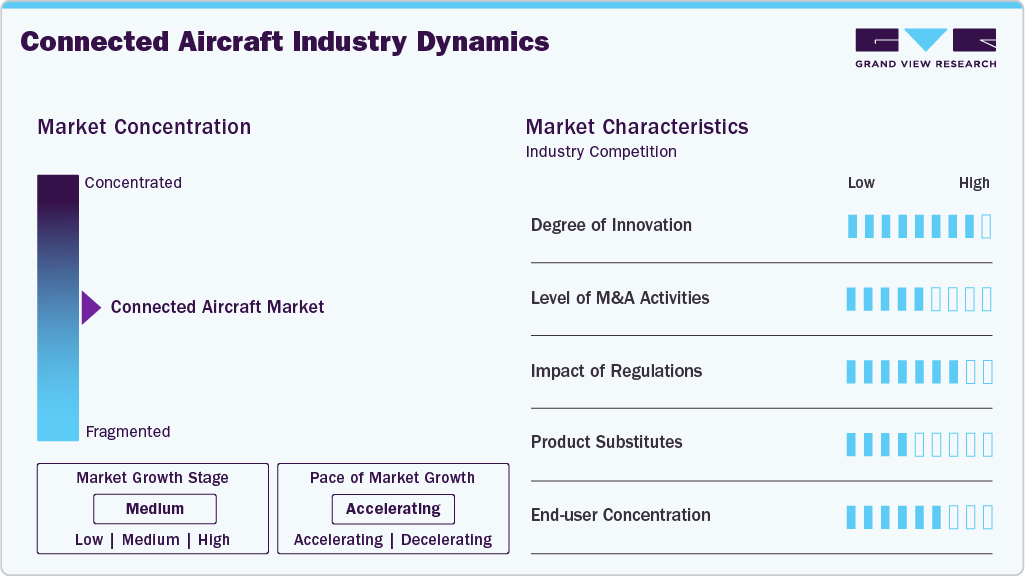
Major players such as Honeywell International, Collins Aerospace, Viasat, Inc., Panasonic Avionics Corporation, Thales, Safran, Gogo Business Aviation, Intelsat, and Lufthansa Technik are strengthening their positions in the connected aircraft market through investments in high-speed IFC, satellite connectivity, connected aircraft frequency bands, avionics systems, aircraft data management, and predictive maintenance technologies. Companies are increasingly focused on improving connectivity speeds, reducing latency, enhancing network coverage, enabling real-time aircraft data transmission, and integrating AI and analytics into aircraft operations. As airlines and aircraft operators continue to prioritize passenger experience, operational efficiency, predictive maintenance, and digital fleet management, the market is expected to witness sustained investment, strategic collaborations & technology development.
Analyst Perspective
Driven by rising demand for seamless in-flight Wi-Fi and digital operations, the Connected Aircraft Market is expanding rapidly. Airlines are investing in satellite communications, air-to-ground networks, and LEO satellite constellations to enable high-speed, low-latency connectivity across commercial and business fleets. Advanced technologies like AI, IoT, edge computing, and digital twins now leverage real-time aircraft data for health monitoring, predictive maintenance, and fuel optimization. These intelligent systems significantly enhance overall operational efficiency and passenger experience. Despite high retrofit costs, cybersecurity risks, integration challenges, and strict regulatory standards, ongoing investments in next-generation digital infrastructure ensure sustained, long-term industry growth.
Type Insights
The service segment holds a significant share of 57.7% of the connected aircraft market, driven by the widespread deployment of critical ISR systems, including airborne radar, electro-optical/infrared (EO/IR) sensors, signals intelligence (SIGINT) systems, electronic support measures (ESM), mission computers, and secure communication systems across fixed-wing aircraft, rotary-wing aircraft, and UAVs. These systems are essential for real-time intelligence collection, surveillance, target detection and tracking, threat identification, battlefield monitoring, and situational awareness. The system segment is expected to witness significant growth during the forecast period, supported by increasing demand for ISR system integration, maintenance, upgrades, training, mission support, data analytics, and lifecycle management services. The growing complexity of airborne ISR Frequency Bands and the need to maintain high operational availability are driving defense and homeland security agencies to invest in specialized services for system deployment, modernization, software updates, sensor calibration, and technical support. In addition, the increasing adoption of advanced UAVs, AI-enabled ISR systems, and multi-sensor Frequency Bands is creating sustained demand for integration, maintenance, and operational support services throughout the lifecycle of ISR Frequency Bands.
Connectivity Insights
The In-flight connectivity segment holds a significant share over 60.2% of the connected aircraft market, driven by increasing passenger demand for high-speed internet access, streaming, connected entertainment, and seamless digital services during flights. Airlines are increasingly deploying satellite-based connectivity, onboard Wi-Fi, and next-generation broadband solutions to enhance passenger experience and differentiate their services. The growing adoption of LEO satellite networks and high-throughput satellite (HTS) systems is further improving connectivity speed, coverage, and latency, supporting the segment’s strong market position.
The air-to-ground connectivity segment is expected to witness significant growth during the forecast period, driven by increasing deployment of ground-based broadband networks and the need for reliable aircraft-to-ground communication. Air-to-ground systems support real-time data transmission, operational communications, aircraft monitoring, and passenger internet services, particularly across flight routes with established terrestrial network coverage. Increasing investments in next-generation air-to-ground networks, improved bandwidth, and integration with connected aircraft frequency bands are further supporting segment growth.
Frequency Band Insights
The Ku-Band segment holds a significant share over 49.1% of the connected aircraft market supported by its established deployment across satellite-based in-flight connectivity systems and broad coverage capabilities. Ku-band connectivity offers reliable bandwidth for passenger internet, onboard entertainment, and aircraft operational communications, making it widely adopted by airlines and connectivity service providers. Its mature satellite infrastructure established aircraft antenna ecosystem, and compatibility with existing IFC systems continue to support demand.
The Ka-Band segment is expected to witness significant growth during the forecast period, driven by increasing demand for high-speed, high-capacity, and low-latency in-flight connectivity. Ka-band systems can support higher data throughput, enabling bandwidth-intensive applications such as streaming, cloud-based services, real-time aircraft data transmission, and connected cabin applications. The expansion of high-throughput satellites and next-generation satellite constellations, along with growing airline investments in advanced IFC systems, is accelerating Ka-band adoption across commercial and business aircraft.
Application Insights
The commercial aviation segment dominates the connected aircraft market, accounting for over 66.5% of the market share in 2025, driven by the widespread adoption of in-flight connectivity, connected cabin systems, real-time aircraft data solutions, and digital fleet management technologies across commercial airline fleets. Airlines are increasingly investing in high-speed Wi-Fi, satellite-based connectivity, aircraft health monitoring, predictive maintenance, and connected passenger services to enhance passenger experience, improve operational efficiency, and reduce aircraft downtime. The large global commercial aircraft fleet, increasing passenger expectations for seamless connectivity, and growing digitalization of airline operations further strengthen the segment’s leading position.
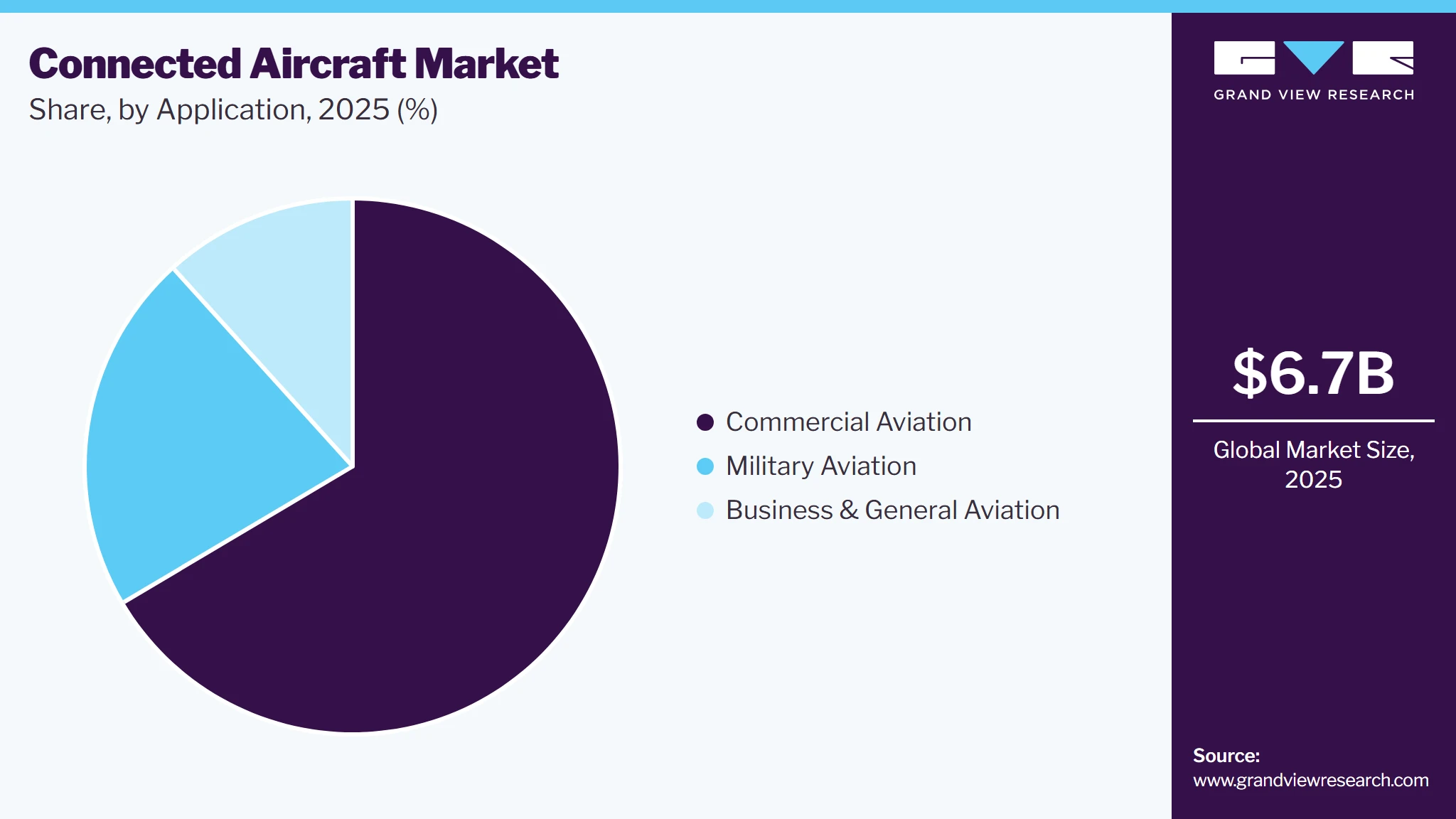
The military aviation segment is expected to witness a significant CAGR during the forecast period, driven by increasing adoption of connected aircraft technologies for secure communications, real-time aircraft data transmission, fleet monitoring, and mission-critical operations. Defense organizations are increasingly integrating SATCOM, secure data links, advanced avionics, IoT-enabled monitoring, predictive maintenance, and real-time aircraft health management into military aircraft to enhance operational readiness and situational awareness. Growing investments in modernizing military aircraft fleets, expanding deployment of connected unmanned aerial vehicles (UAVs), and increasing demand for secure, resilient, and low-latency communications are further supporting segment growth.
Regional Insights
North America leads the global connected aircraft market, accounting for 37.1% of the market share in 2025, driven by the high adoption of advanced in-flight connectivity solutions, extensive deployment of connected aircraft technologies, and continued investments in next-generation aviation communication and digital infrastructure. The region, led by the United States, benefits from the presence of major aerospace and avionics companies, satellite connectivity providers, aircraft technology developers, and a well-established aviation ecosystem. Increasing investments in high-speed in-flight connectivity, SATCOM, air-to-ground connectivity, connected cabin systems, aircraft data analytics, IoT, and AI-enabled predictive maintenance are strengthening the region’s connected aircraft capabilities.

U.S. Connected Aircraft Market Trends
The U.S. leads the North American Connected Aircraft Market, supported by a large commercial aviation fleet, high passenger demand for seamless connectivity, and continuous investments in advanced aircraft communication and digital technologies. The country benefits from a strong ecosystem of aerospace companies, avionics manufacturers, satellite operators, and connectivity service providers. Increasing deployment of high-speed in-flight connectivity, SATCOM, air-to-ground connectivity, connected cabin systems, aircraft data platforms, and AI-enabled predictive maintenance is strengthening U.S. connected aircraft capabilities. The growing adoption of connected aircraft solutions for passenger services, real-time aircraft monitoring, fleet optimization, and operational efficiency is further supporting market growth.
Europe Connected Aircraft Market Trends
The Europe Connected Aircraft Market is witnessing steady growth due to increasing digitalization of aviation operations, rising passenger expectations for onboard connectivity, and growing investments in advanced aircraft communication technologies. European airlines and aircraft operators are adopting in-flight Wi-Fi, satellite connectivity, air-to-ground communication, connected cabin systems, aircraft health monitoring, and real-time data analytics to enhance passenger experience and operational efficiency. Increasing investments in next-generation satellite networks, IoT-enabled aircraft systems, predictive maintenance, and cloud-based aviation platforms are further supporting the modernization of European aircraft fleets.
The UK Connected Aircraft Market is witnessing steady growth, driven by increasing adoption of high-speed in-flight connectivity, digital aircraft technologies, and connected aviation services. Airlines and aircraft operators are investing in SATCOM, onboard Wi-Fi, aircraft data management, predictive maintenance, and connected cabin technologies to improve passenger experience and fleet performance. Growing emphasis on real-time aircraft monitoring, operational analytics, cloud connectivity, and integration of connected aircraft systems with airline digital platforms is further supporting market development.
The Germany Connected Aircraft Market is experiencing significant growth, supported by a strong commercial aviation ecosystem, increasing fleet digitalization, and investments in advanced aircraft connectivity and avionics technologies. Airlines and aircraft operators are expanding the use of in-flight connectivity, SATCOM, aircraft health monitoring, IoT-enabled systems, real-time data analytics, and predictive maintenance solutions to improve operational efficiency and passenger services. Increasing adoption of AI-enabled analytics, connected aircraft platforms, and digital fleet management technologies is further strengthening the German connected aircraft market.
Asia Pacific Connected Aircraft Market Trends
The Asia Pacific connected aircraft market is witnessing the fastest growth, driven by expanding commercial aviation fleets, rising passenger traffic, increasing demand for onboard internet connectivity, and rapid digitalization of aviation infrastructure across countries such as China, India, Japan, South Korea, and Australia. Airlines are increasingly investing in high-speed IFC, satellite connectivity, connected cabin systems, aircraft data platforms, and predictive maintenance technologies to enhance passenger experience and operational efficiency. The expansion of LEO satellite networks, growing adoption of next-generation aircraft communication systems, and increasing investments in connected aviation infrastructure are further accelerating regional market growth.
The China Connected Aircraft Market is expanding due to rapid growth in commercial aviation, increasing aircraft fleet modernization, and rising demand for advanced passenger connectivity and digital aviation services. Chinese airlines and aircraft operators are increasingly adopting in-flight Wi-Fi, SATCOM, connected cabin technologies, aircraft data analytics, and digital fleet management solutions to improve passenger experience and operational performance. The country’s growing focus on indigenous aerospace technologies, AI-enabled aircraft analytics, IoT, predictive maintenance, and next-generation connectivity infrastructure is further strengthening its connected aircraft ecosystem. Increasing passenger demand for seamless digital services and continued expansion of domestic and international air travel are expected to sustain demand for connected aircraft solutions in China.
Key Connected Aircraft Company Insights
The connected aircraft market is characterized by the presence of leading aerospace, avionics, satellite communications, connectivity, and aircraft technology companies. Competition is driven by continuous innovation in in-flight connectivity (IFC), satellite communications (SATCOM), air-to-ground connectivity, high-speed aircraft Wi-Fi, connected cabin systems, aircraft data management, predictive maintenance, and AI-enabled analytics. Established players maintain strong market positions through extensive R&D capabilities, aircraft integration expertise, connectivity infrastructure, strategic partnerships with airlines and aircraft manufacturers, and long-term service agreements.
-
Honeywell International Inc. is a leading provider of connected aircraft technologies, avionics, aircraft connectivity, and real-time data solutions. Its portfolio supports aircraft operators with connected avionics, flight management, aircraft health monitoring, and digital solutions designed to improve operational efficiency and aircraft performance.
-
Viasat Inc. is a prominent provider of satellite-based in-flight connectivity and high-speed broadband services for commercial and business aviation. Its technologies support high-bandwidth passenger connectivity, onboard Wi-Fi, and real-time data communications through satellite networks.
Key Connected Aircraft Companies
The following key companies have been profiled for this study on the connected aircraft market:
-
Panasonic Avionics Corporation
-
Collins Aerospace
-
Thales
-
Safran
-
Gogo Business Aviation
-
Intelsat
-
Lufthansa Technik
-
SITA
-
RTX Corporation
-
Boeing
-
Airbus
-
Collins Aerospace
-
Anuvu
-
SmartSky Networks, LLC
-
Iridium Communications Inc.
-
Viasat Inc.
-
Honeywell International Inc.
Competitive Benchmarking
Category
Operating Strategies
Competitive Edge
Weakness
Mature Players: Panasonic Avionics Corporation, Collins Aerospace, Thales, Safran, Gogo Business Aviation, Intelsat, Lufthansa Technik, RTX Corporation, Boeing, Airbus, Honeywell International Inc., Viasat Inc., Iridium Communications Inc.
- • Expand connected aircraft capabilities through long-term airline contracts, aircraft OEM partnerships, fleet modernization programs, and investments in in-flight connectivity (IFC), satellite communications, cabin systems, avionics, cybersecurity, and aircraft data platforms.
- • Invest in high-throughput satellite connectivity, 5G/air-to-ground networks, cloud-based aviation platforms, connected cabin technologies, predictive maintenance, real-time aircraft data analytics, and next-generation avionics.
- • Strong expertise in aerospace, avionics, satellite communications, aircraft connectivity, cabin systems, and aviation software.
- • Established relationships with aircraft OEMs, airlines, business aviation operators, and aviation service providers.
- • High R&D, certification, infrastructure, and system-integration costs.
- • Long aircraft development and certification cycles, complex airline procurement processes, and dependence on aviation fleet expansion and connectivity investments can slow deployment.
Emerging Players: SmartSky Networks, LLC, Intelsat, SITA
- • Focus on specialized connected aircraft technologies, including high-speed in-flight connectivity, air-to-ground connectivity, satellite broadband, aviation data platforms, and real-time passenger and operational services.
- • Expand market presence through airline partnerships, technology alliances, satellite network expansion, OEM integration, and deployment of next-generation connectivity solutions.
- • Specialized expertise in high-speed aircraft connectivity and aviation communication networks.
- • Agile technology development and ability to address specific airline, business aviation, and regional connectivity requirements.
- • Smaller scale and narrower geographic or technology portfolios compared with major aerospace and defense primes.
- • Greater dependence on airline contracts, satellite/ground infrastructure, aircraft installation cycles, and ecosystem partners can constrain independent expansion.
Recent Developments
-
In April 2025, Viasat launched Viasat Amara, its next-generation in-flight connectivity (IFC) solution for commercial aviation. The solution combines multi-orbit satellite connectivity, smart network enhancements, digital products, and application-level data linking to deliver scalable and flexible connectivity experiences. Viasat also introduced the Viasat Aera electronically steered antenna (ESA), designed to support simultaneous connections across GEO, HEO, and LEO satellites, strengthening high-capacity connected aircraft capabilities
-
In September 2025, Viasat announced a five-fold capacity increase for its JetXP business aviation connectivity service across the Eastern United States. The enhancement supports bandwidth-intensive applications such as HD video conferencing, content streaming, and generative AI across multiple connected devices, strengthening the capacity and performance of connected aircraft networks. The company planned a phased expansion of the increased capacity nationwide
Connected Aircraft Market Report Scope
Report Attribute
Details
Market size in 2025
USD 6.7 billion
Estimated market size in 2026
USD 8.4 billion
Projected market size by 2033
USD 42.3 billion
Growth rate
CAGR of 26.0% from 2026 to 2033
Actual data
2021 - 2025
Forecast period
2026 - 2033
Quantitative units
Revenue in USD Million/Billion and CAGR from 2026 to 2033
Report coverage
Revenue forecast, company ranking, competitive landscape, growth factors, and trends
Segments covered
Type, connectivity, frequency band, application & region
Regional scope
North America; Europe; Asia Pacific; Latin America; MEA
Country scope
U.S.; Canada; Mexico; Germany; UK; France; China; India; Japan; Australia; South Korea; Brazil; UAE; South Africa; KSA
Key companies profiled
Panasonic Avionics Corporation, Collins Aerospace, Thales, Safran, Gogo Business Aviation, Intelsat, Lufthansa Technik, SITA, RTX Corporation, Boeing, Airbus, Collins Aerospace, Anuvu, SmartSky Networks, LLC, Iridium Communications Inc., Viasat Inc., Honeywell International Inc.
Customization scope
Free report customization (equivalent up to 8 analysts working days) with purchase. Addition or alteration to country, regional & segment scope.
Pricing and purchase options
Avail customized purchase options to meet your exact research needs. Explore purchase options
Global Connected Aircraft Market Report Segmentation
This report forecasts revenue growth at global, regional, and country levels and provides an analysis of the latest industry trends in each of the sub-segments from 2021 to 2033. For this study, Grand View Research has segmented the global connected aircraft market report based on type, connectivity, frequency band, connectivity, application, and region.
-
Type Outlook (Revenue, USD Million, 2021 - 2033)
-
System
-
Service
-
-
Connectivity Outlook (Revenue, USD Million, 2021 - 2033)
-
In-flight Connectivity
-
Air-to-Ground Connectivity
-
Air-to-Air Connectivity
-
-
Frequency Band Outlook (Revenue, USD Million, 2021 - 2033)
-
Ku-Band
-
Ka-Band
-
L-Band
-
-
Application Outlook (Revenue, USD Million, 2021 - 2033)
-
Commercial Aviation
-
Military Aviation
-
Business & General Aviation
-
-
Regional Outlook (Revenue, USD Million, 2021 - 2033)
-
North America
-
U.S.
-
Canada
-
Mexico
-
-
Europe
-
UK
-
Germany
-
France
-
-
Asia Pacific
-
China
-
Japan
-
India
-
Australia
-
South Korea
-
-
Latin America
-
Brazil
-
-
Middle East and Africa (MEA)
-
KSA
-
UAE
- South Africa
-
-
Research Methodology
The connected aircraft market figures in this report are based on a proven research process that combines executive interviews with secondary research from proprietary databases, company filings, and recognized regulatory and institutional sources. Market size is built through value-chain sizing-reconciling supply-side and demand-side estimates-and triangulated with bottom-up and top-down approaches. Every estimate passes multiple levels of expert validation before
publication, with each connected aircraft segment quantified using the revenue-capture
definitions in the table below.Segment Definition
Segment - Type
Revenue capture definition
Service
Revenue in this segment is generated through the provision of connectivity, data, communication, digital, and support services that enable airlines, aircraft operators, and passengers to access and utilize connected aircraft capabilities. These services include in-flight connectivity (IFC), satellite communication, air-to-ground connectivity, managed network services, aircraft data analytics, predictive maintenance, connected cabin services, cybersecurity, fleet connectivity management, and technical support and maintenance services.
System
Revenue in this segment is generated through the design, development, manufacturing, integration, and deployment of physical hardware and software systems that enable connected aircraft operations. These include in-flight connectivity (IFC) systems, satellite communication systems, aircraft communication systems, antennas, modems, onboard routers, aircraft data systems, connected cabin systems, avionics connectivity systems, and cybersecurity infrastructure, supporting reliable aircraft-to-ground communication, passenger connectivity, real-time data exchange, aircraft monitoring, and connected operations.
Segment - Connectivity
Revenue capture definition
In-flight Connectivity
Revenue in this segment is generated through the design, development, manufacturing, integration, and deployment of systems and equipment that enable high-speed internet and data connectivity onboard aircraft. These include satellite communication systems, air-to-ground (ATG) connectivity systems, antennas, modems, onboard Wi-Fi equipment, network routers, and connectivity management platforms, supporting passenger internet access, streaming, real-time data exchange, crew applications, and connected aircraft operations.
Air-to-Ground Connectivity
Revenue in this segment is generated through the design, development, integration, and deployment of communication systems that establish broadband connectivity between aircraft and ground-based networks. These include air-to-ground antennas, ground stations, modems, onboard routers, wireless communication equipment, and network management systems, enabling high-speed internet, real-time data transmission, operational communications, passenger connectivity, and continuous aircraft-to-ground connectivity across supported flight routes.
Air-to-Air Connectivity
Revenue in this segment is generated through the design, development, integration, and deployment of communication systems that enable direct data and information exchange between aircraft and other airborne platforms. These include airborne wireless communication systems, aircraft-to-aircraft data links, ad-hoc networking equipment, onboard routers, antennas, and communication management systems, supporting real-time aircraft coordination, operational data sharing, collision avoidance, formation flying, air traffic awareness, and connected flight operations
Segment - Frequency Band
Revenue capture definition
Ku-Band
Revenue in this segment is generated through the design, development, manufacturing, integration, and deployment of Ku-band satellite communication systems and equipment used to provide broadband connectivity to aircraft. These include Ku-band antennas, satellite terminals, modems, transceivers, onboard routers, and network management systems, enabling high-speed in-flight internet, passenger Wi-Fi, streaming, real-time data transmission, and connected aircraft operations.
Ka-Band
Revenue in this segment is generated through the design, development, manufacturing, integration, and deployment of Ka-band satellite communication systems and equipment used to deliver high-capacity broadband connectivity to aircraft. These include Ka-band antennas, satellite terminals, modems, transceivers, onboard routers, and connectivity management systems, supporting high-speed in-flight internet, passenger Wi-Fi, streaming, real-time data exchange, and connected aircraft operations.
L-Band
Revenue in this segment is generated through the design, development, manufacturing, integration, and deployment of L-band satellite communication systems and equipment used for reliable aircraft connectivity and communications. These include L-band antennas, satellite terminals, transceivers, modems, and communication management systems, supporting voice and data communication, aircraft tracking, flight operations, safety services, messaging, and low-bandwidth connectivity applications.
Segment - Application
Revenue capture definition
Commercial Aviation
Revenue in this segment is generated through the deployment and adoption of connected aircraft systems and services across commercial passenger and cargo aircraft. These include in-flight connectivity, satellite and air-to-ground communication, passenger Wi-Fi, connected cabin systems, aircraft data platforms, real-time aircraft monitoring, predictive maintenance, and digital fleet management solutions, enabling enhanced passenger experience, operational efficiency, aircraft performance monitoring, and real-time communication between aircraft and ground operations.
Military Aviation
Revenue in this segment is generated through the design, development, integration, and deployment of secure connected aircraft systems and services for military aircraft and defense operations. These include secure satellite communications, tactical data links, airborne networking, encrypted communications, real-time aircraft data exchange, mission connectivity, electronic warfare connectivity, and aircraft health monitoring systems, supporting secure command and control, situational awareness, intelligence sharing, mission coordination, and real-time communication between airborne platforms and ground-based command centers.
Business & General Aviation
Revenue in this segment is generated through the deployment of connected aircraft systems and services across business jets, private aircraft, charter aircraft, and general aviation platforms. These include in-flight connectivity, satellite and air-to-ground communication, passenger Wi-Fi, connected cabin systems, aircraft tracking, flight data services, and digital aircraft management solutions, supporting high-speed internet access, real-time communication, passenger experience, flight operations, and enhanced aircraft monitoring.
Estimation Model
Layer Name
Key Question
Description
Addressable Connected Aircraft Base Layer
Which aircraft are equipped or require connected aircraft capabilities?
Estimate the global installed base and annual deliveries of commercial aircraft, business & general aviation aircraft, and military aircraft that are equipped or intended to be equipped with connected aircraft capabilities. The assessment considers aircraft type, fleet size, connectivity requirements, passenger demand, operational needs, and regional deployment.
Connectivity Technology Adoption Layer
Which connectivity technologies and systems are deployed across aircraft?
Apply adoption rates for in-flight connectivity (IFC), air-to-ground connectivity, air-to-air connectivity, satellite communication, onboard Wi-Fi, connected cabin systems, and aircraft data connectivity based on aircraft type, operational requirements, route coverage, passenger demand, and connectivity infrastructure availability.
Connectivity System Content & Deployment Layer
What connectivity systems and equipment are installed per aircraft?
Estimate connected aircraft system value based on the penetration and average content of antennas, satellite terminals, modems, transceivers, onboard routers, wireless access points, communication systems, connectivity management platforms, and connected cabin equipment. The model also considers system upgrades, retrofit programs, replacement cycles, aircraft installation requirements, and technology-specific configurations across Ku-band, Ka-band, L-band, and other connectivity technologies.
Delivered Customization
We have successfully delivered the following deep-dive customizations:
Client Request
Customization Delivered
Value Adds
Connected Aircraft Market Entry & Growth Strategy
Assessment of demand for connected aircraft systems and services across commercial aviation, military aviation, and business & general aviation.
Analysis of opportunities across in-flight connectivity (IFC), air-to-ground connectivity, air-to-air connectivity, satellite communications, connected cabin systems, and aircraft data connectivity.
Identified high-growth connectivity technologies, aircraft segments, applications, and geographic markets.
Supported market entry, product positioning, partnership identification, customer targeting, and long-term expansion strategies.
Next-Generation Connected Aircraft Technology & Capability Assessment
Assessment of emerging technologies including multi-orbit satellite connectivity, electronically steered antennas (ESA), 5G/air-to-ground connectivity, LEO satellite networks, AI-enabled connectivity management, edge computing, connected cabin technologies, and real-time aircraft data platforms.
Evaluation of connectivity technology requirements across commercial, military, and business aviation platforms.
Identified technology gaps and high-potential innovation areas within the connected aircraft ecosystem.
Supported technology roadmap development, R&D prioritization, product development, and next-generation connectivity solution strategies.
Connected Aircraft System & Connectivity Opportunity Assessment
Detailed assessment of demand for IFC systems, satellite communication systems, air-to-ground connectivity, antennas, modems, onboard routers, transceivers, connected cabin systems, aircraft data platforms, and connectivity management solutions across aircraft types
Identified high-value connected aircraft systems, equipment, and connectivity technologies with strong growth potential.
Supported product portfolio optimization, technology investment decisions, customer targeting, and identification of addressable revenue opportunities.
About the Author(s)
Next Generation Technologies Research Team
Technology · Next Generation TechnologiesThis report was authored by the next generation technologies research team at Grand View Research - comprising two research analysts, one senior research analyst, and one industry expert - with specialized expertise in the next generation technologies segment of the technology industry. All findings are based on proprietary technology databases, executive interviews, and regulatory analysis, subject to internal peer review prior to publication.
Last Updated:
Speak to Analyst


Customize this report to your needs — add regions, segments, or data points, with 20% free customization.
Or view our licence options:


ISO 9001:2015 & 27001:2022 Certified
We are GDPR and CCPA compliant! Your transaction & personal information is safe and secure. For more details, please read our privacy policy.


