
- Home
- »
- Healthcare IT
- »
-
Connected Healthcare Platform Market Report, 2026-2033GVR Report cover

Connected Healthcare Platform Market (2026 - 2033)
Size, Share & Trends Analysis Report By Solution Types (Electronic Medical Records, Patient Engagement & Patient Portals), By Deployment Mode (Cloud-Based, On-Premise), By End-use, By Region, And Segment Forecasts
Market Size, 2025
$16.5BMarket Estimate, 2026
$17.5BMarket Forecast, 2033
$28.2BCAGR, 2026–2033
7.1%Connected Healthcare Platform Market Summary
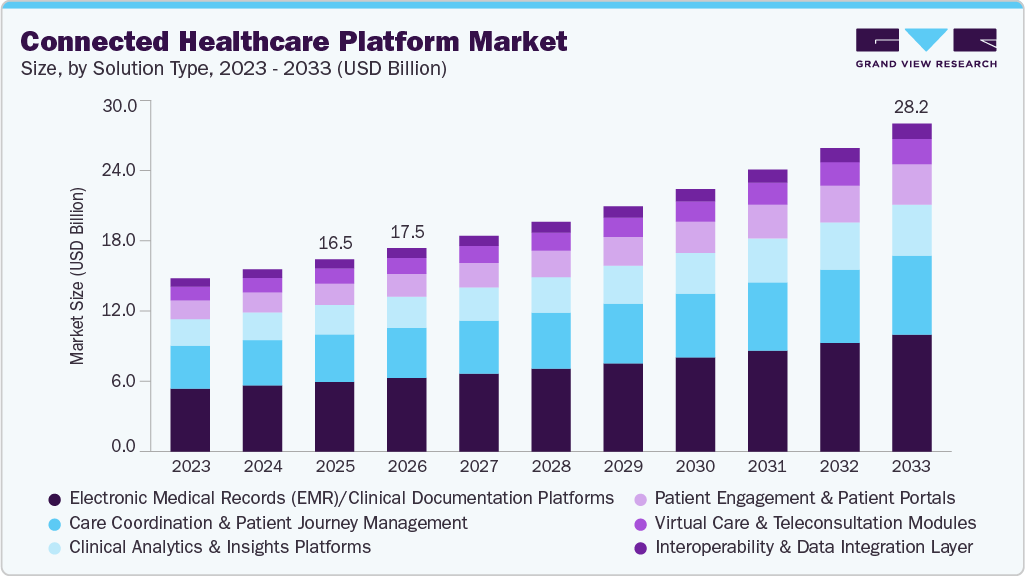
The global connected healthcare platform market size was valued at USD 16.5 billion in 2025 and is projected to grow from USD 17.5 billion in 2026 to USD 28.2 billion by 2033, at a CAGR of 7.1% from 2026 to 2033. The North America held the largest share of 52.9% of the global market in 2025. This growth is attributed to telehealth and remote patient monitoring expansion, rising adoption of digital health solutions, increased use of wearable & IoT devices, and demand for personalized and preventive care.
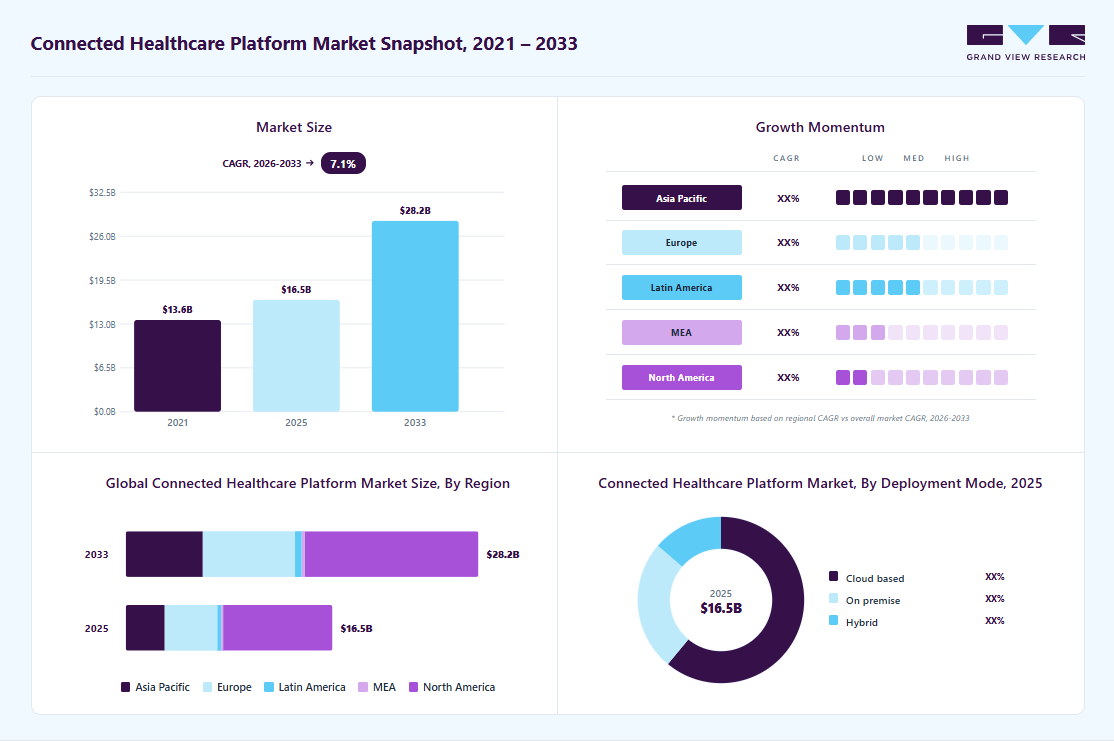 Source: Grand View Research, IR Documents, Primary Interviews, Paid DatabasesTo learn more about this report,
 Download Free Sample Report
 Key Market Trends & Insights
- By solution type: Electronic medical records (EMR)/clinical documentation platforms segment held the largest share of 36.3% in 2025.
- By deployment mode: Cloud-based segment held the dominant market share in 2025.
- By end-use: Hospitals & integrated delivery networks held the dominant market share of 58.4% in 2025.
Regional Highlights
- Largest regional market: North America (52.9% revenue share, 2025)
- Fastest-growing regional market: Asia Pacific (highest CAGR, 2026-2033)
- By country: The U.S. led the North America market in 2025.
Market Size & Forecast
- Market size in 2025: USD 16.5 Billion
- Estimated market size in 2026: USD 17.5 Billion
- Projected market size by 2033: USD 28.2 Billion
- CAGR (2026-2033): 7.1%
Three ways to get this report
Buy it, customize it, or ask a question.Ask an Analyst
Analyst response in 1 business day
- AccessReport author, directly
- Reply timeWithin 1 working day
- No sales callDirect answer only
- FormatEmail reply
- CostFree, no cost
Get the Full Report
What the study covers
- FormatsPDF · Excel · Dashboard
- Timeline2026–2033 annual, 2025 base
- Coverage20+ countries, 5 regions
- Companies10+ key players profiled
Customize the Report
20% free customization
- IncludeCountries, segments, points
- TailorTo your product definition
- ExtendDeeper competitor detail
- OrA fully bespoke study
- Turnaround5–10 working days
The growing adoption of telehealth and remote patient monitoring solutions is driving the connected healthcare platform industry. These platforms provide the digital infrastructure necessary for virtual care delivery and continuous monitoring beyond traditional settings. Healthcare providers increasingly use video consultations, connected medical devices, and home-based monitoring tools.
As a result, demand grows for platforms that securely integrate real-time patient data into clinical workflows. For instance, in November 2024, the Canadian Space Agency launched a telemedicine hub pilot project at the Pierrefonds CLSC in Montreal. This project uses space-derived healthcare technologies integrated by Baüne, enabling users to measure vital signs such as blood pressure, pulse, and blood oxygen levels. It demonstrates how space innovation can improve access to quality healthcare on Earth. Such initiatives enhance patient access and engagement. They also accelerate demand for integrated digital platforms, expanding the adoption and growth of connected healthcare solutions in hospitals, clinics, and home care settings worldwide.
 To learn more about this report, Download Free Sample Report
 Connected healthcare platforms are increasingly incorporating genomic data integration and analysis to support more precise and personalized care delivery. These platforms enable seamless ingestion and harmonization of complex genomic datasets, including variant and reference genome information, alongside traditional clinical records, allowing clinicians and researchers to correlate genetic variations with health outcomes and tailor treatments accordingly. By providing tools for visualization of genomic variants within patient timelines and supporting cohort‑level analysis, connected platforms help bridge the gap between genomic research and everyday clinical decision‑making, enhancing predictive diagnostics, risk stratification, and targeted therapy selection in precision medicine programs.
In addition, the growing focus on personalized and preventive care is driving growth in the connected healthcare platform market, as healthcare shifts from a one-size-fits-all approach to treatments tailored to individual patient profiles. Connected platforms enable integration of diverse health data, including medical history, lab results, genomics, and lifestyle information, allowing clinicians to deliver targeted interventions and early preventive measures. By supporting continuous monitoring, predictive analytics, and risk stratification, these platforms help identify potential health issues before they become critical, improve chronic disease management, and enhance patient outcomes. This growing emphasis on proactive, patient-centered care is driving healthcare providers to adopt connected healthcare platforms that can deliver personalized insights at scale.
AI in Connected Healthcare Platforms
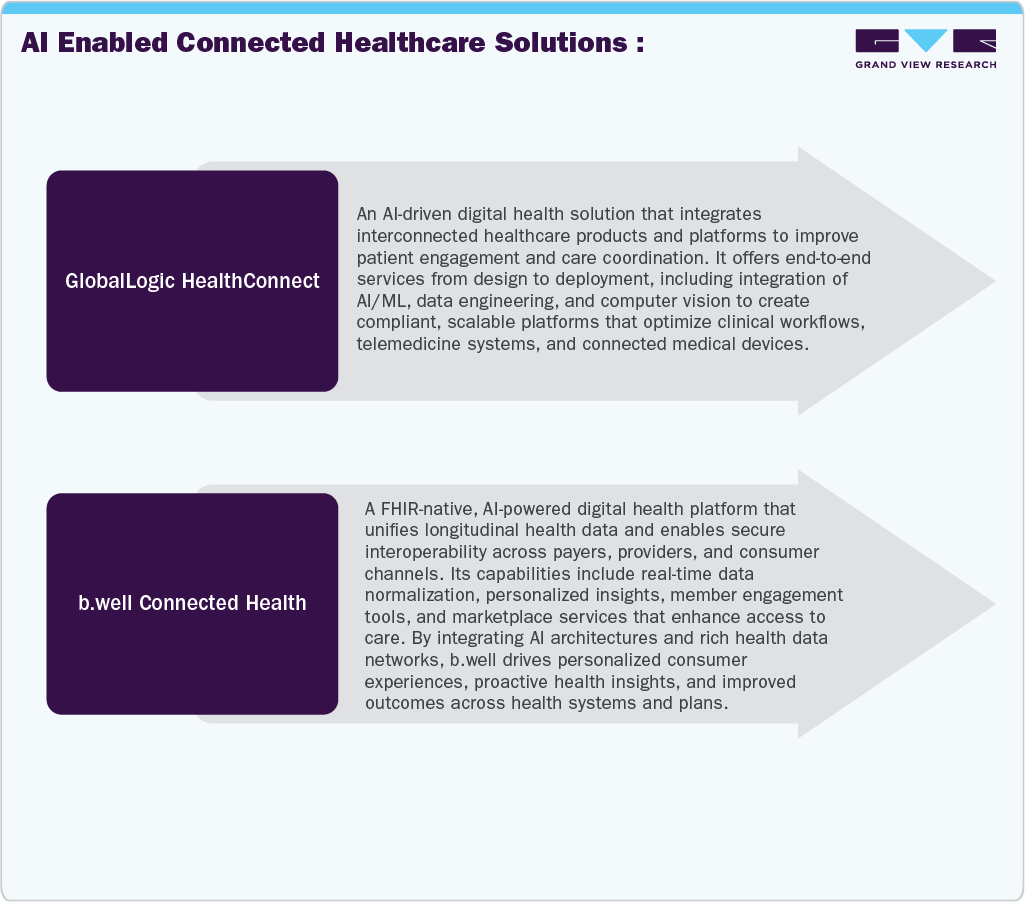
Artificial intelligence (AI) is increasingly integrated within connected healthcare platforms to enhance data integration, patient engagement, operational efficiency, and personalized care delivery. By leveraging real‑time analytics, machine learning, and intelligent automation, these platforms help healthcare organizations extract actionable insights from disparate data sources, improve clinical decision‑making, and streamline care coordination across the care continuum. AI‑enabled connected platforms also support predictive health management and enhance patient experiences by delivering tailored recommendations and reducing administrative burden.
 To learn more about this report, Download Free Sample Report
 Market Concentration & Characteristics
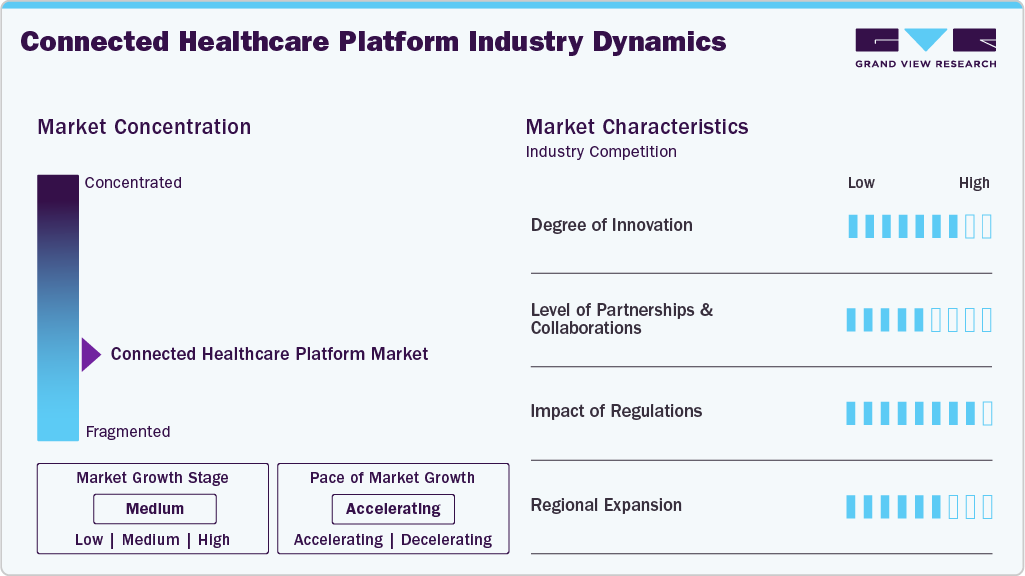
The chart below illustrates the relationship between market concentration, industry characteristics, and industry participants. The x-axis represents the level of industry concentration, ranging from low to high. The y-axis represents various industry characteristics, including industry competition, impact of regulations, level of partnerships & collaborations activities, degree of innovation, and regional expansion. For instance, the connected healthcare platform market is slightly fragmented, with many providers entering the market. The degree of innovation, the level of partnerships & collaboration activities, and the impact of regulations on the industry is high. However, the regional expansion observes moderate growth.
Innovation in the industry is rapidly advancing, driven by the need for smarter, real-time, and personalized care solutions. Advances in digital integration, remote monitoring, and AI-enabled analytics are enabling healthcare providers to deliver continuous, patient-centered care, support early intervention, and improve clinical outcomes.
The level of partnerships and collaborations in the connected healthcare platform market is growing, reflecting a focus on strengthening digital infrastructure, interoperability, and seamless care delivery. Providers are increasingly forming alliances with technology vendors, healthcare organizations, and digital health companies to integrate data systems, enhance patient engagement, and enable real-time monitoring across virtual, home, and clinical settings. For instance, in December 2025, Bupa CareConnect partnered with InterSystems to implement the InterSystems TrakCare unified health information system across its virtual, home, and physical care services in Saudi Arabia, enhancing interoperability and supporting seamless patient care within a connected healthcare ecosystem.
 To learn more about this report, Download Free Sample Report
 Regulations play a crucial role in the industry by ensuring data security, patient privacy, and compliance with healthcare standards. Regional differences in rules, such as those set by the FDA in the U.S., EMA in Europe, and Saudi FDA, create operational challenges that require tailored compliance strategies. At the same time, these regulations drive investments in secure data management, interoperability standards, staff training, and quality assurance, ensuring platforms deliver safe, reliable, and trusted digital healthcare solutions.
The industry is experiencing growth across regions, driven by increasing demand for remote care, telehealth services, and personalized patient management, as well as the expansion of home-based monitoring and virtual care solutions. In addition, supportive regulatory frameworks, adoption of interoperability standards, and strategic partnerships between healthcare providers, technology vendors, and digital health companies are accelerating platform deployment and expanding access to integrated, data-driven healthcare services
Case Study :
Neteera Deploys Proprietary AI on BioT’s Distributed Medical Device Platform to Improve Patient Care
Background:
Neteera developed the Neteera 130, a continuous, contactless vital signs monitoring solution designed to passively capture patient biomarkers such as heart rate and respiration without requiring wearable devices or direct patient interaction. The goal was to improve patient care, reduce clinical workload, and lower overall healthcare costs.
Challenge:
To bring this innovative solution to market quickly and affordably, Neteera needed a secure, scalable, and compliant cloud infrastructure capable of processing high‑frequency data and running proprietary AI algorithms. Building such an infrastructure in‑house posed challenges, including prolonged development time, cybersecurity and privacy risks, and a lack of internal cloud and compliance expertise.
Solution:
Neteera partnered with BioT’s distributed medical device platform, a no‑code, self‑service cloud solution designed for regulated medical use. The platform enabled deployment of Neteera’s AI algorithms in the cloud, ensuring medical‑grade compliance, ongoing cybersecurity, and flexible algorithm updates without extensive backend development. It also supported real‑time data streaming using AWS services, allowing seamless delivery of vital signs and alerting capabilities to clinicians and caregivers.
Results:
-
Accelerated Time to Market: BioT’s out‑of‑the‑box infrastructure allowed rapid deployment and scaling of Neteera’s system.
-
Enhanced Patient Monitoring: Real‑time alerts based on biometric data streamlined monitoring workflows, reducing clinician burden and enabling faster response to changes in patient condition.
- Ongoing Innovation: With the cloud platform managing compliance and operations, Neteera could focus on improving its AI and expanding features, such as monitoring additional health indicators.
Conclusion:
By leveraging a distributed medical device platform, Neteera successfully integrated advanced AI into a connected healthcare solution that enhances continuous patient monitoring, improves clinical efficiency, and supports future feature growth, demonstrating how cloud‑based AI platforms can accelerate innovation in connected healthcare.
Solutions Type Insights
Based on solution type, the electronic medical records (EMR)/clinical documentation platforms segment held the largest market share of 36.26% in 2025. The segment's dominance is due to its central role in capturing, storing, and managing patient data, enabling streamlined clinical workflows, regulatory compliance, and integration with other healthcare IT systems such as analytics, telehealth, and patient engagement platforms. Its widespread adoption is further supported by mandatory digital recordkeeping policies, the need for accurate real-time clinical information, and its function as the foundational layer for interoperability across the connected healthcare ecosystem.
The patient engagement & patient portals segment is expected to grow at the fastest CAGR of 8.43% during the forecast period. This growth is driven by increasing demand for direct, real-time access to personal health information and self-service tools. In addition, factors such as rising patient expectations for digital communication with providers, adoption of telehealth and remote monitoring services, regulatory emphasis on patient access to electronic health records, and the need to improve patient adherence and satisfaction are further contributing to the segment's growth.
Deployment Mode Insights
Based on the deployment mode, the cloud-based segment held the largest revenue share in 2025 and is expected to grow at the fastest CAGR during the forecast period. This growth is attributed to the scalability, cost-efficiency, and flexibility offered by cloud solutions, allowing healthcare providers to access real-time patient data from multiple locations without heavy on-premises infrastructure. In addition, Various market players, including IQVIA, b.well, GlobalLogic, Epic Systems Corporation, and ZS, are offering cloud-based connected healthcare platforms, driving adoption across hospitals, clinics, and home-care settings by providing integrated, secure, and interoperable digital health solutions.
Moreover, the on-premise segment held a substantial share in the market owing to its higher control over sensitive patient data, compliance with stringent regulatory requirements, and ability to customize infrastructure to meet specific organizational needs, making it preferred for hospitals and large healthcare institutions with critical security and privacy priorities.
End-use Insights
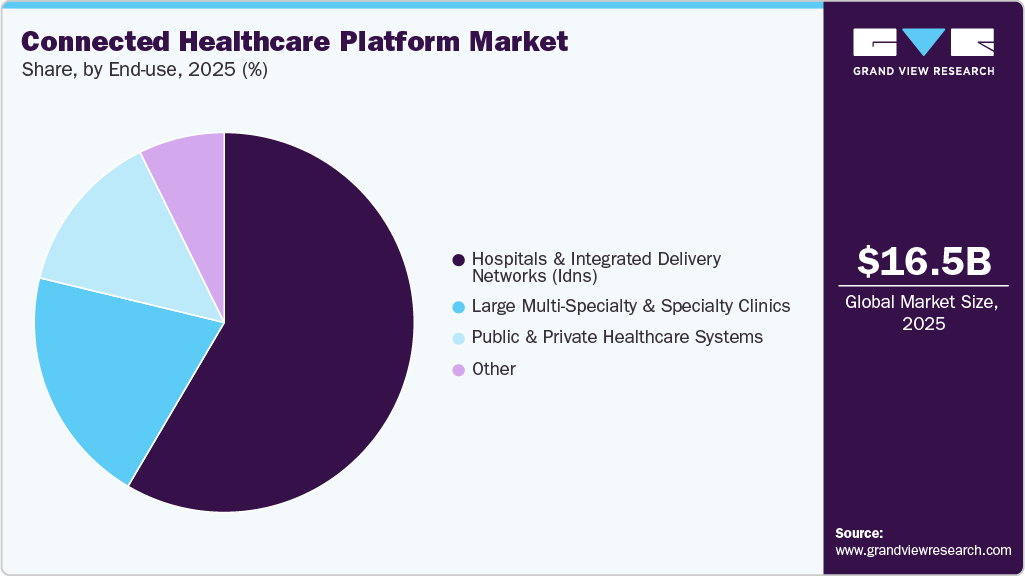
Based on end use, hospitals and integrated delivery networks (IDNs) held the dominant market share of 58.4% in 2025. The segment growth can be attributed to the high patient volumes, complex care workflows, and strong need for integrated digital platforms to manage clinical data, streamline operations, and support interoperability across departments and care settings.
 To learn more about this report, Download Free Sample Report
 Large multi-specialty and specialty clinics also held a significant share of the market, driven by their focus on delivering coordinated, patient-centered care, adoption of digital tools for managing clinical workflows, and increasing use of connected platforms to support telehealth, patient engagement, and data-driven decision-making.
Regional Insights
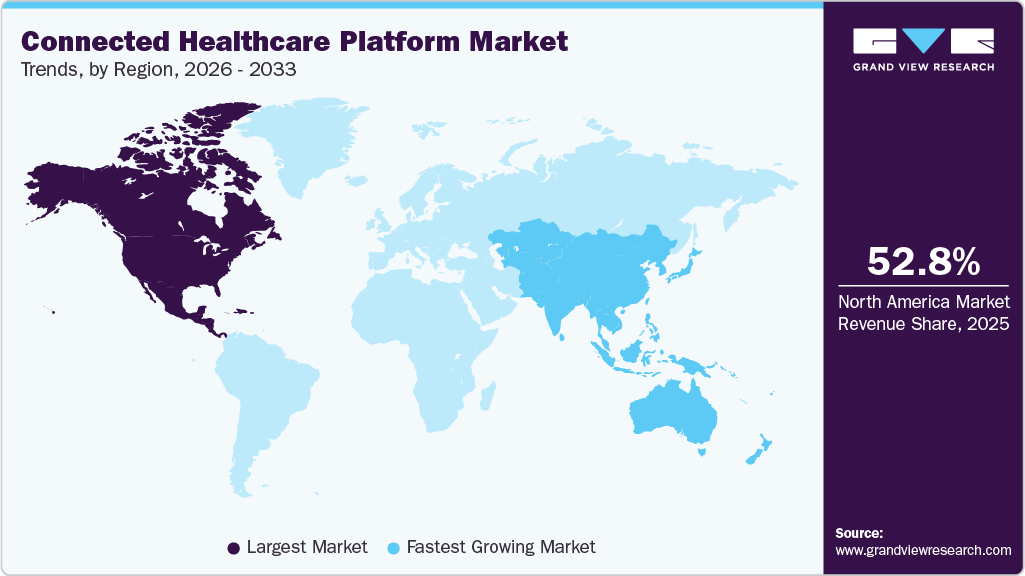
North America connected healthcare platform market held the largest revenue share of 52.85% in 2025, driven by well-established healthcare infrastructure, high digital literacy, and strong policy support for digital health adoption. Widespread implementation of Electronic Health Records (EHRs), increasing investments in healthcare information technology by providers and payers, and the growing preference for telehealth and remote patient monitoring have accelerated the adoption of connected healthcare platforms across the region. For instance, according to an Elation article published in March 2023, approximately 9 out of 10 U.S.-based physicians have implemented EHR systems, providing a strong foundation for interoperable, data-driven, and connected healthcare platforms.
 To learn more about this report, Download Free Sample Report
 U.S Connected Healthcare Platform Market Trends
The connected healthcare platform market in the U.S is supported by advanced healthcare infrastructure, high adoption of electronic health records, and widespread use of telehealth and remote patient monitoring. Strong regulatory focus on interoperability and patient data access, along with increasing healthcare IT investments by providers and payers, is driving adoption of integrated, cloud-based connected healthcare solutions across care settings. In addition, the presence of well-established players in the U.S. is further contributing to the growth of the market.
Europe Connected Healthcare Platform Market Trends
The connected healthcare platform market in Europe is expected to grow significantly, driven by ongoing digital transformation initiatives, efforts to improve healthcare efficiency, and a strong focus on integrated, patient-centered care. The presence of developed healthcare systems in countries such as Germany, the UK, France, Spain, and Italy is supporting the adoption of connected platforms that enable interoperability, data sharing, and digital care delivery. For instance, in December 2023, WHO/Europe and the European Commission signed a USD 13.9 million (€12 million) four-year partnership to strengthen health information systems and enhance health data governance and interoperability across 53 European countries, directly supporting the expansion of connected healthcare platforms in the region.
The UK connected healthcare platform market is driven by government initiatives to accelerate digital health adoption, including NHS programs promoting interoperability, electronic health records, and telehealth services. Rising demand for remote patient monitoring, personalized care, and data‑driven decision-making, coupled with increasing investment in AI-enabled and cloud-based healthcare solutions by providers and technology vendors, is supporting the deployment of integrated connected healthcare platforms across hospitals, clinics, and community care settings in the UK.
The connected healthcare platform market in Germanyis expected to grow significantly during the forecast period, supported by the country’s strong position as a leading healthcare IT market in Europe. High adoption of electronic health records, increasing use of integrated digital platforms to streamline clinical workflows, and a growing focus on healthcare data analytics and interoperability are driving market growth. For instance, in February 2025, Munich-based Avelios Medical secured USD 34.8 million (EUR 30 million) in Series A funding led by Sequoia Capital to modernize hospital IT through its AI-driven, modular hospital information system. Such instances highlight strong investment momentum, accelerating digital transformation, and the increasing demand for advanced, interoperable connected healthcare platforms in Germany.
Asia Pacific Connected Healthcare Platform Market Trends
The connected healthcare platform market in Asia Pacific is growing rapidly, driven by expanding healthcare digitalization, rising adoption of telehealth and remote patient monitoring, and increasing government initiatives to strengthen health IT infrastructure. In addition, large patient populations, growing burden of chronic diseases, and improved internet and smartphone penetration are accelerating demand for platforms that integrate electronic health records, virtual care, and data analytics.
Japan connected healthcare platform market held a significant share in 2024, driven by rapid healthcare digitalization, strong government support for smart healthcare initiatives, and rising adoption of cloud-based and AI-enabled digital health solutions. The growing need for interoperable platforms that can securely integrate data from hospitals, clinicians, and personal health devices is further supporting market growth. For instance, in March 2023, Fujitsu launched a cloud-based healthcare platform in Japan that securely aggregates health data from medical institutions and personal devices in compliance with HL7 FHIR standards, enabling advanced data analysis, personalized care, and drug development, highlighting the country’s progress toward a fully connected healthcare ecosystem.
The connected healthcare platform market in India is driven by a rapidly growing geriatric population, rising prevalence of chronic diseases, and increasing government focus on digital health infrastructure and interoperability. National and state-level initiatives aimed at creating integrated, data-driven healthcare ecosystems are accelerating the adoption of connected platforms across public healthcare systems. For instance, in July 2025, the Delhi Government launched a new digital health information management system (HIMS) to enable a fully digital healthcare ecosystem, supporting seamless data integration, improved care coordination, and enhanced access to patient information, underscoring the expanding role of connected healthcare platforms in India.
Latin America Connected Healthcare Platform Market Trends
The connected healthcare platform market in Latin America is growing steadily, supported by increasing healthcare digitalization, rising adoption of telehealth and remote patient monitoring, and government initiatives to improve healthcare access and efficiency. Expanding internet penetration, growing chronic disease burden, and investments in interoperable and cloud-based health IT systems are further driving the adoption of connected healthcare platforms across the region.
Middle East & Africa Connected Healthcare Platform Market Trends
The connected healthcare platform market in the Middle East & Africa is driven by expanding healthcare infrastructure, government-led digital health and smart hospital initiatives, and rising adoption of telehealth services. Increased investment in cloud-based health IT systems, a growing burden of chronic diseases, and efforts to improve interoperability and care coordination are supporting the adoption of connected healthcare platforms across the region.
Key Connected Healthcare Platform Companies Insights
Key players in the connected healthcare platform market are adopting innovative strategies, offering personalized infusion formulations, mobile and in-clinic services, and digital booking platforms to enhance accessibility and patient experience. Integration of smart infusion technologies and partnerships with wellness centers, fitness facilities, and luxury providers are further driving adoption and expanding market reach.
Key Connected Healthcare Platform Companies:
The following key companies have been profiled for this study on the connected healthcare platform market
- ZS
- Cognizant
- IQVIA
- GlobalLogic Inc.
- NTT DATA Group
- Epic Systems Corporation
- Cerner (Oracle Health)
- Athenahealth
- Salesforce, Inc.
- Biofourmis
- Innovaccer
- b.Well
Recent Developments
-
In October 2025, BD launched the BD Incada Connected Care Platform, a scalable, AI‑enabled, cloud‑based solution that unifies data from millions of connected medical devices into a single ecosystem and delivers AI‑powered analytics to drive enterprise‑wide insights and decision‑making across healthcare settings.
-
In May 2025, Innovaccer launched Innovaccer Gravity, a cloud‑agnostic healthcare intelligence platform designed to unify healthcare data from EHRs, claims, and other core systems into a single source of truth, enabling AI‑driven insights and accelerating digital transformation across clinical, operational, and financial domains.
“Health systems are under unprecedented pressure to do more with less, from improving outcomes to optimizing operations, all while managing rising costs,” “Gravity is purpose-built to address these challenges. It unifies data, scales AI adoption, and activates real-time insights, enabling healthcare organizations to drive meaningful change, faster and more cost-effectively.”
- Abhinav Shashank, cofounder and CEO of Innovaccer.
-
In October 2023, ZS announced the launch of ZAIDYN Connected Health, an AI‑powered solution within its ZAIDYN platform designed to help life sciences companies, healthcare providers, and payers better understand unmet needs, improve patient engagement, and deliver tailored interventions to enhance health outcomes.
Connected Healthcare Platform Market Report Scope
Report Attribute
Details
Market size in 2025
USD 16.5 billion
Estimated market size in 2026
USD 17.5 billion
Projected market size by 2033
USD 28.2 billion
Growth rate
CAGR of 7.1% from 2026 to 2033
Actual data
2021 - 2025
Forecast period
2026 - 2033
Quantitative units
Revenue in USD million/billion and CAGR from 2026 to 2033
Report coverage
Revenue forecast, company ranking, competitive landscape, growth factors, and trends
Segments covered
Solution type, deployment mode, end-use, region
Regional scope
North America; Europe; Asia Pacific; Latin America; MEA
Country scope
U.S.; Canada; Mexico; Germany; UK; France; Italy; Spain; Norway; Denmark; Sweden; China; Japan; India; South Korea; Australia; Thailand; Brazil; Argentina; Saudi Arabia; South Africa; UAE; Kuwait
Key companies profiled
ZS; Cognizant; IQVIA; GlobalLogic Inc.; NTT DATA Group; Epic Systems Corporation; Cerner (Oracle Health); Athenahealth; Salesforce, Inc.; Biofourmis; Innovaccer; b.Well
Customization scope
Free report customization (equivalent up to 8 analysts working days) with purchase. Addition or alteration to country, regional & segment scope.
Pricing and purchase options
Avail customized purchase options to meet your exact research needs. Explore purchase options
Global Connected Healthcare Platform Market Report Segmentation
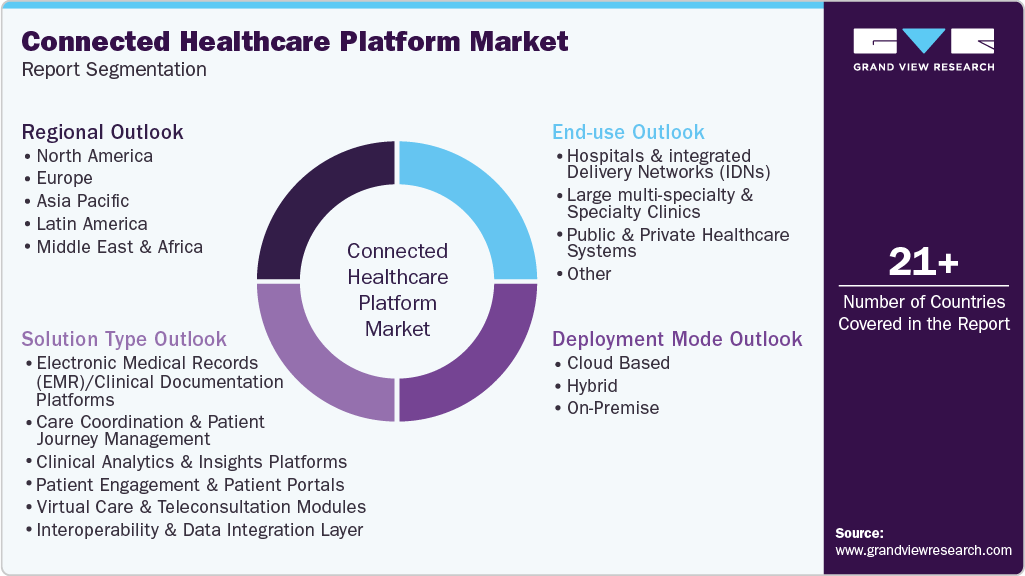
This report forecasts revenue growth at global, regional, and country levels and provides an analysis of the latest industry trends in each of the sub-segments from 2021 to 2033. For this study, Grand View Research has segmented the global connected healthcare platform market report based on solution type, deployment mode, end-use, and region:
 To learn more about this report, Download Free Sample Report
 -
Solution Type Outlook (Revenue, USD Million, 2021 - 2033)
-
Electronic Medical Records (EMR)/Clinical Documentation Platforms
-
Care Coordination & Patient Journey Management
-
Clinical Analytics & Insights Platforms
-
Patient Engagement & Patient Portals
-
Virtual Care & Teleconsultation Modules
-
Interoperability & Data Integration Layer
-
-
Deployment Mode Outlook (Revenue, USD Million, 2021 - 2033)
-
Cloud Based
-
Hybrid
-
On-Premise
-
-
End-use Outlook (Revenue, USD Million, 2021 - 2033)
-
Hospitals and integrated delivery networks (IDNs)
-
Large multi-specialty and specialty clinics
-
Public and private healthcare systems
-
Other
-
-
Regional Outlook (Revenue, USD Million, 2021 - 2033)
-
North America
-
U.S.
-
Canada
-
Mexico
-
-
Europe
-
UK
-
Germany
-
France
-
Italy
-
Spain
-
Denmark
-
Sweden
-
Norway
-
Asia Pacific
-
China
-
Japan
-
India
-
South Korea
-
Australia
-
Thailand
-
-
Latin America
-
Brazil
-
Argentina
-
-
Middle East and Africa (MEA)
-
South Africa
-
Saudi Arabia
-
UAE
-
Kuwait
-
-
Frequently Asked Questions About This Report
Electronic Medical Records (EMR)/Clinical Documentation Platforms segment led with a 36.3% revenue share in 2025, while patient engagement & patient portals is the fastest-growing segment.
Cloud-based held the largest revenue share in 2025.
Hospitals and integrated delivery networks (IDNs) segment held the largest share (over 58.4%) in 2025.
The global connected healthcare platform market is expected to grow at a compound annual growth rate of 7.1% from 2026 to 2033 to reach USD 28.2 billion by 2033
North America dominated with a 52.9% revenue share in 2025.
Some key players operating in the connected healthcare platform market include ZS, Cognizant, IQVIA, GlobalLogic Inc., NTT DATA Group, Epic Systems Corporation, Cerner (Oracle Health), Athenahealth, Salesforce, Inc., Biofourmis, Innovaccer, b.Well,
Key factors that are driving the market growth include telehealth and remote patient monitoring expansion, rising adoption of digital health solutions, increased use of wearable & IoT devices, and demand for personalized and preventive care.
The global connected healthcare platform market size was estimated at USD 16.5 billion in 2025 and is expected to reach USD 17.5 billion in 2026.
About the Author(s)
Healthcare IT Research Team
Healthcare · Healthcare ITThis report was authored by the healthcare it research team at Grand View Research - comprising two research analysts, one senior research analyst, and one industry expert - with specialized expertise in the healthcare it segment of the healthcare industry. All findings are based on proprietary healthcare databases, executive interviews, and regulatory analysis, subject to internal peer review prior to publication.
Last Updated:
Speak to Analyst

Customize this report to your needs - add regions, segments, or data points, with 20% free customization.
Or view our licence options:


ISO 9001:2015 & 27001:2022 Certified
We are GDPR and CCPA compliant! Your transaction & personal information is safe and secure. For more details, please read our privacy policy.


