
- Home
- »
- Advanced Interior Materials
- »
-
Copper Powder Market Size, Share & Trends Report, 2033GVR Report cover
![Copper Powder Market (2026 - 2033)Report]()
Copper Powder Market (2026 - 2033)
Size, Share & Trends Analysis Report By Product (Electrolytic, Water Atomized), By Application (Powder Metallurgy, Electrical & Electronics, Chemical & Catalysts), By Region, And Segment Forecasts
Market Size, 2025
$750.4MMarket Estimate, 2026
$807.3MMarket Forecast, 2033
$1,243.6MCAGR, 2026–2033
6.4%Copper Powder Market Summary
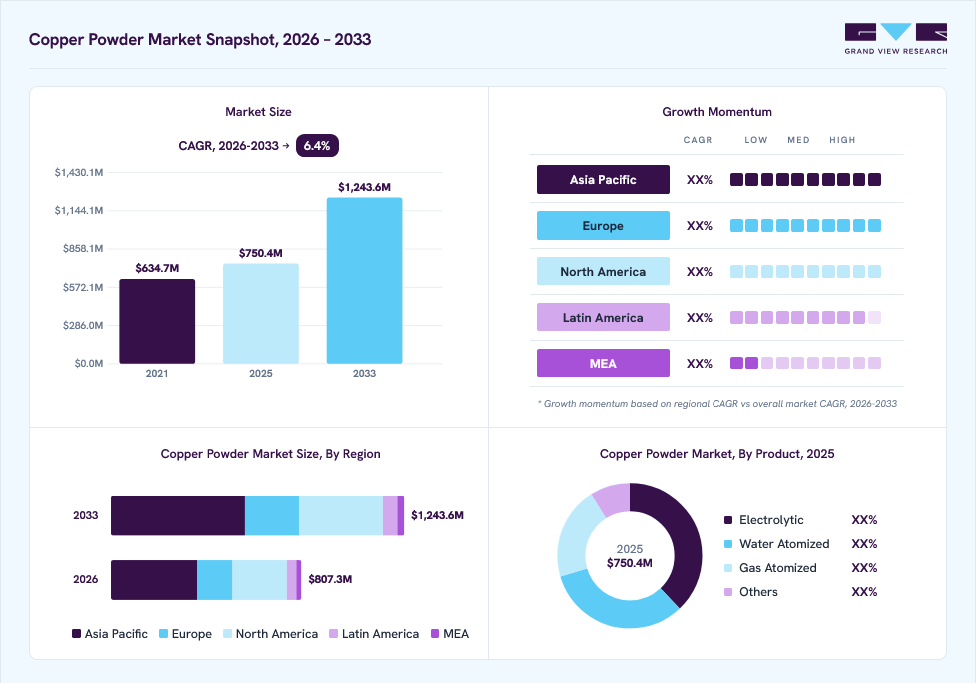
The global copper powder market size was valued at USD 750.4 million in 2025 and is projected to grow from USD 807.3 million in 2026 to USD 1,243.6 million by 2033, at a CAGR of 6.4% from 2026 to 2033. Asia Pacific dominated the market, accounting for a revenue share of 45.3% in 2025. The market growth is primarily driven by the expanding demand for high-conductivity materials across the electrical and electronics, automotive, renewable energy, and advanced manufacturing industries.
Key Market Trends & Insights
- By product: Electrolytic segment held the largest revenue share of 37.9% in 2025
- By application: Friction materials segment is expected to grow at the fastest CAGR of 7.2% from 2026 to 2033
Regional Highlights
- Largest regional market: Asia Pacific (45.3% revenue share, 2025)
- By country: China held the largest market share in 2025.
Market Size & Forecast
- Market size in 2025: USD 750.4 Million
- Estimated market size in 2026: USD 807.3 Million
- Projected market size by 2033: USD 1,243.6 Million
- CAGR (2026-2033): 6.4%
The growth of the copper powder industry is primarily driven by increasing demand from the electronics and electrical industries. Copper powder is widely used in conductive pastes, electronic components, printed circuit boards, electromagnetic shielding materials, and other applications requiring high electrical and thermal conductivity. The continued expansion of consumer electronics, telecommunications infrastructure, data centers, and advanced electrical systems is increasing demand for copper-based conductive materials, thereby supporting market growth.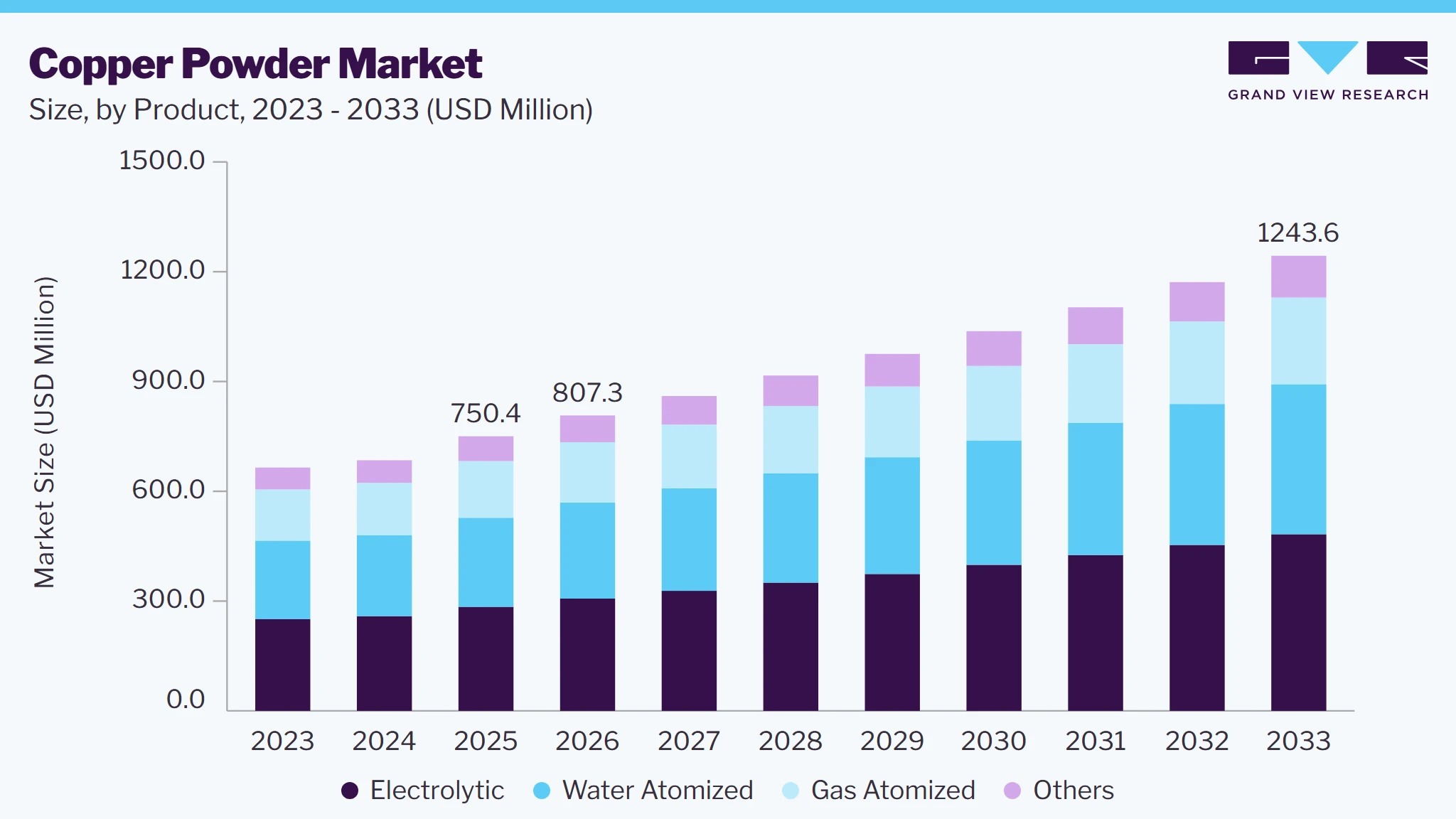
The growing adoption of electric vehicles and the broader transition toward vehicle electrification are also contributing significantly to demand for copper powder. It is used in electrical contacts, conductive coatings, braking components, friction materials, and specialized automotive parts. Rising investments in electric mobility, battery technologies, charging infrastructure, and lightweight vehicle components are expected to expand the range of applications for high-performance copper powders over the coming years.
Furthermore, the increasing use of additive manufacturing and advanced powder metallurgy is creating new growth opportunities for the copper powder market. These powders enable the production of complex components with high thermal and electrical conductivity and are increasingly being used in aerospace, industrial machinery, energy, and advanced manufacturing applications.
Market Dynamics
Rising production of consumer electronics, electric vehicles, and advanced electrical equipment is expected to support steady growth in copper powder consumption. The increasing adoption of advanced manufacturing technologies is further strengthening demand for copper powder.
Powder metallurgy, additive manufacturing, and other precision production processes are increasingly using copper powder to manufacture complex components with high conductivity and improved material efficiency. Growing investment in industrial automation, electrification, and advanced manufacturing is expanding the scope of applications for copper powder across multiple industries.
The market is affected by fluctuations in copper prices, which directly influence production costs and pricing for downstream users. In addition, copper powder is susceptible to oxidation, which can reduce conductivity and affect performance in sensitive applications. The need for controlled storage, protective coatings, and specialized processing can increase handling costs and limit adoption in certain applications.
The rapid expansion of electric vehicles, renewable energy infrastructure, and additive manufacturing presents significant opportunities for the copper powder market. Demand is increasing for high-purity, fine-particle copper powders that deliver superior electrical and thermal performance in advanced components. Continued development of atomization technologies, surface treatments, and specialized copper alloys is expected to expand the use of copper powder in high-value applications.
Product Insights
The electrolytic segment dominated the copper powder market, accounting for a revenue share of 37.9% in 2025. Electrolytic copper powder is widely used in electronics, electrical components, conductive inks, printed circuit boards, batteries, powder metallurgy, and chemical applications. The increasing production of electric vehicles, expansion of renewable energy systems, and growing demand for advanced electronic devices are driving the consumption of high-purity copper powders. In addition, the rising adoption of additive manufacturing and advanced powder metallurgy processes is creating new opportunities for electrolytic copper powder, as manufacturers increasingly require powders with consistent quality and performance characteristics.
The water atomized segment is expected to witness significant growth over the forecast period, driven by its cost-effectiveness, high production efficiency, and suitability for a wide range of industrial applications. Water-atomized copper powder is widely used in powder metallurgy, welding, friction materials, chemical applications, and electrical components, where controlled particle size and good compaction properties are required. Growing demand for metal powders from automotive, industrial machinery, construction, and electrical industries is supporting segment expansion.
Application Insights
The powder metallurgy segment dominated the copper powder industry with a revenue share of 35.1% in 2025. Copper powder is widely used in powder metallurgy to produce bearings, bushings, filters, electrical contacts, friction materials, and structural components with controlled porosity and consistent physical properties. The growing adoption of powder metallurgy across automotive, industrial machinery, electrical, and consumer product manufacturing is driving demand for the market.
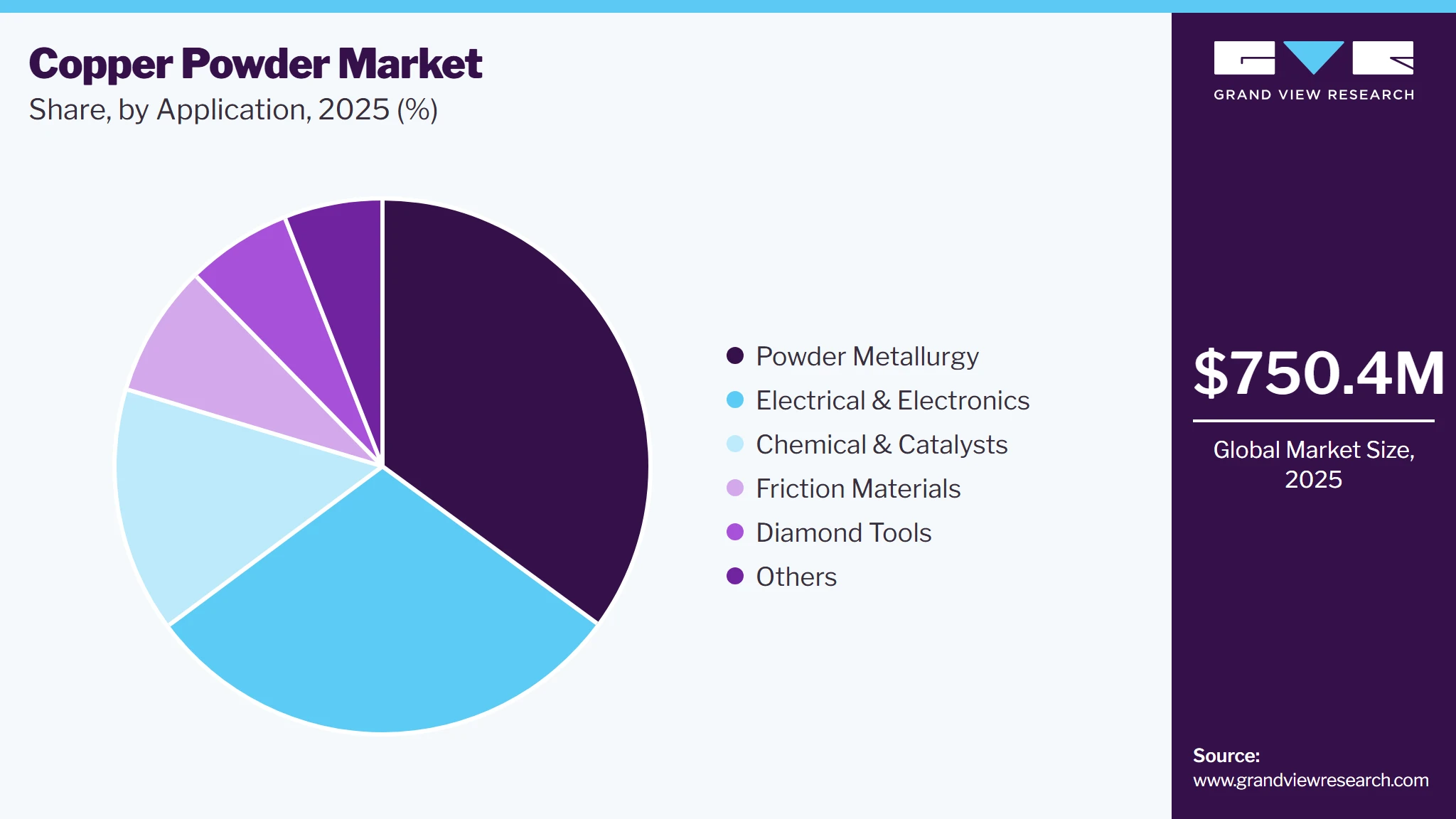
The friction materials segment is expected to witness strong growth over the forecast period, driven by the increasing demand for high-performance braking, clutch, and other friction components across the automotive, industrial machinery, railways, and heavy equipment sectors. These powders are widely used in friction material formulations because of their excellent thermal conductivity, wear resistance, and ability to dissipate heat generated during high-friction operations. Rising vehicle production, expansion of rail transportation, and increasing demand for heavy-duty industrial equipment are supporting greater consumption of copper-based friction materials.
Regional Insights
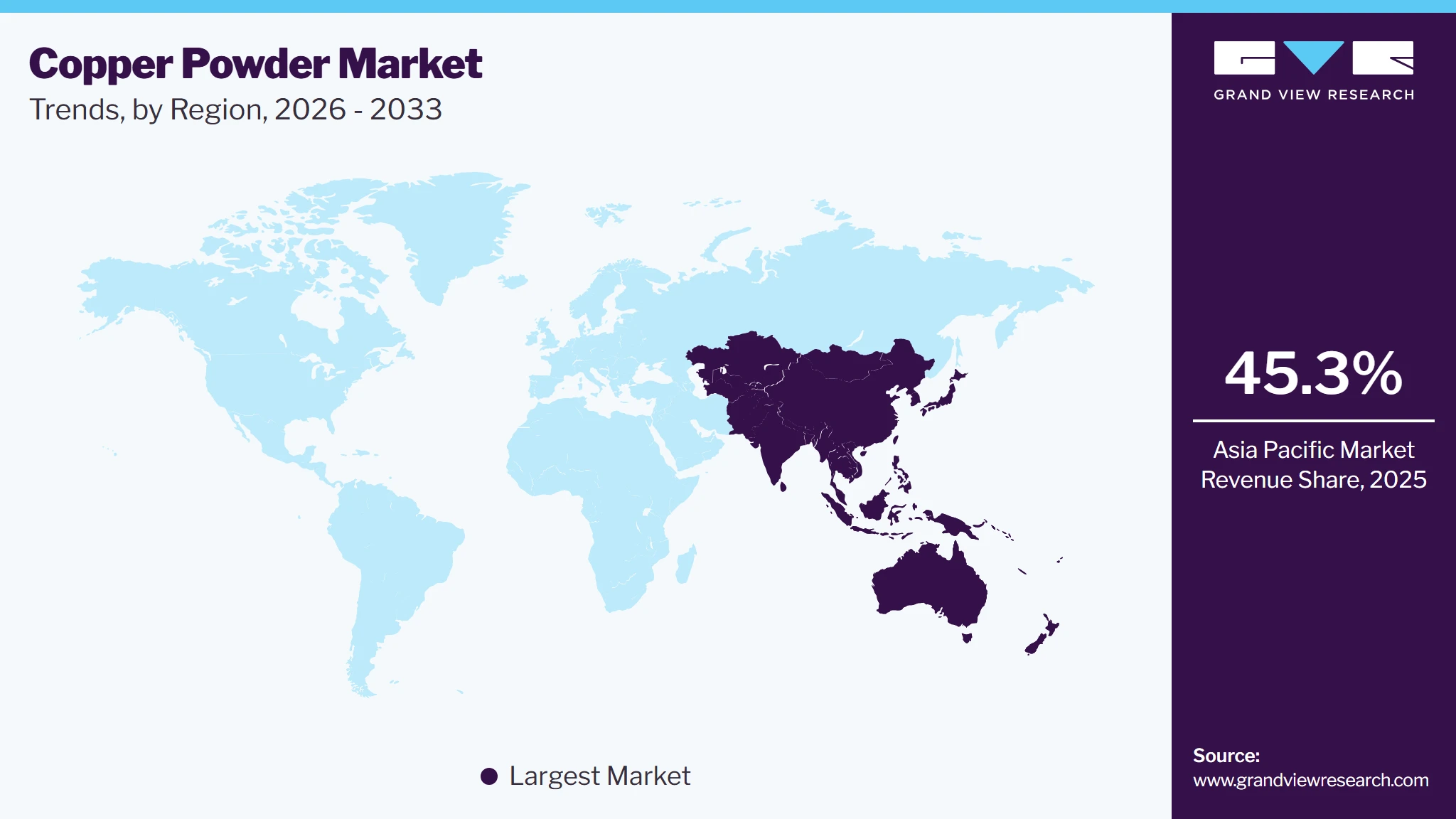
The Asia Pacific copper powder market dominated with a revenue share of 45.3% in 2025, and is expected to grow at the fastest CAGR over the forecast period. The growth is driven by its large electronics, automotive, electrical equipment, powder metallurgy, and advanced manufacturing industries. China, Japan, South Korea, and India are major consumers, with copper powder widely used in electronic components, conductive pastes, printed circuit boards, friction materials, and powder metallurgy parts.
China Copper Powder Market Trends
China copper powder market is expected to grow over the forecast period. China represents one of the largest markets, supported by its extensive electronics, electrical equipment, automotive, powder metallurgy, and chemical industries. The country's dominant position in electronics manufacturing and the rapid expansion of the electric vehicle and renewable energy industries are creating significant demand for high-purity and specialty copper powders.
Europe Copper Powder Market Trends
Europe is a significant market, supported by its established automotive, electrical equipment, industrial machinery, aerospace, and chemical industries. Germany, France, Italy, and the U.K. are key consumers, with copper powder used in powder metallurgy components, electrical contacts, friction materials, coatings, and specialized electronic applications. The transition toward electric mobility is increasing demand for copper-based components used in motors, electrical systems, and charging infrastructure.
North America Copper Powder Market Trends
North America is witnessing steady growth in the market due to increasing demand from electronics, automotive, electrical, aerospace, defense, and powder metallurgy industries. Growing investment in electric vehicle manufacturing, semiconductor production, renewable energy infrastructure, and domestic manufacturing is supporting regional demand.
The U.S. is the largest market in North America, driven by its extensive electronics, aerospace, defense, automotive, electrical equipment, and advanced manufacturing industries. The expanding adoption of metal additive manufacturing is creating opportunities for atomized copper powders used to produce complex electrical and thermal components with improved performance.
Middle East & Africa Copper Powder Market Trends
The Middle East & Africa copper powder industry is developing steadily, supported by expanding electrical infrastructure, construction, automotive assembly, industrial manufacturing, and energy projects. Countries such as Saudi Arabia and the UAE are increasing their investments in manufacturing, electrical equipment, renewable energy, and infrastructure development, creating demand for copper-based materials.
Key Copper Powder Company Insights
Some of the key players operating in the market include SCHLENK and American Chemet Corporation.
-
American Chemet Corporation is a privately owned U.S. manufacturer of metal-based chemicals and powders, established in 1946. The company has developed a strong position in copper-based materials, particularly cuprous oxide, cupric oxide, and copper powders. It serves customers across the industrial, chemical, agricultural, automotive, and materials-processing industries. Its manufacturing operations in Montana support the production of copper-based products, while its sales and distribution network serves international markets.
-
SCHLENK is a German, family-owned international manufacturer of metal powders, metallic pigments, and metal foils. The company has built a broad global presence through production facilities and technical and sales networks serving customers across Europe, the U.S., China, and Southeast Asia. Its materials business focuses on technically demanding metallic powders and applications, supported by technical application expertise and a diversified portfolio serving industries such as materials processing, coatings, chemicals, electronics, and advanced manufacturing.
Key Copper Powder Companies
The following key companies have been profiled for this study of the copper powder market.
-
American Chemet Corporation
-
Carl Schlenk AG
-
DOWA Holdings Co., Ltd.
-
Fukuda Metal Foil & Powder Co., Ltd.
-
GGP Metalpowder AG
-
GRIPM Advanced Materials Co., Ltd.
-
Kymera International
-
Mitsui Mining & Smelting Co., Ltd.
-
Pometon S.p.A.
-
Tongling Nonferrous Metals Group Co., Ltd.
Competitive Benchmarking
Operating Strategies
Competitive Edge
Weakness
Established Players (e.g., Kymera International, Mitsui Mining & Smelting Co., Ltd.)
- Mature participants in the copper powder market primarily focus on large-scale manufacturing using electrolytic, water-atomization, gas-atomization, and other advanced production processes.
- Established players possess significant competitive advantages through advanced metallurgical expertise, large-scale production capacities, and well-developed powder manufacturing infrastructure.
- Despite their strong market positions, mature players face challenges related to fluctuations in copper prices, energy costs, and the availability of high-quality feedstock.
Emerging & Regional Players (e.g., GGP Metalpowder AG)
- Emerging participants in the copper powder market generally focus on specialized powders, customized particle characteristics, and regional supply opportunities.
- Emerging companies benefit from operational flexibility and the ability to adopt modern powder production technologies without extensive legacy infrastructure.
- Emerging participants face significant challenges related to limited production capacity, lower economies of scale, and restricted financial resources.
Recent Development
-
In September 2026, Thorold-based Destiny Copper is set to receive an investment of approximately USD 100 million from Thyssenkrupp Marine Systems over the next five years, linked to the German shipbuilder's planned supply of up to 12 new submarines for the Royal Canadian Navy. The investment will support the expansion and further development of Destiny Copper's proprietary technology to recover 99.9% pure copper powder from industrial manufacturing waste, with potential applications in defense and marine coatings.
Copper Powder Market Report Scope
Report Attribute
Details
Market Definition
The market size represents the annual revenue generated by the sale of copper powder for various applications.
Market size in 2025
USD 750.4 million
Estimated market size in 2026
USD 807.3 million
Projected market size by 2033
USD 1,243.6 million
Growth rate
CAGR of 6.4% from 2026 to 2033
Base year for estimation
2025
Historical data
2021 - 2024
Forecast period
2026 - 2033
Quantitative units
Revenue in USD million, volume in kilotons, and CAGR from 2026 to 2033
Report coverage
Revenue and volume forecast, competitive landscape, growth factors, and trends
Segments covered
Product, application, region
Regional scope
North America; Europe; Asia Pacific; Latin America; Middle East & Africa
Country scope
U.S.; Canada; Mexico; Germany; UK; France; Italy; Spain; China; India; Japan; Australia
Key companies profiled
American Chemet Corporation; Carl Schlenk AG; DOWA Holdings Co., Ltd.; Fukuda Metal Foil & Powder Co., Ltd.; GGP Metalpowder AG; GRIPM Advanced Materials Co., Ltd.; Kymera International; Mitsui Mining & Smelting Co., Ltd.; Pometon S.p.A.; Tongling Nonferrous Metals Group Co., Ltd.
Customization scope
Free report customization (equivalent up to 8 analysts working days) with purchase. Addition or alteration to country, regional & segment scope.
Pricing and purchase options
Avail customized purchase options to meet your exact research needs. Explore purchase options
Global Copper Powder Market Report Segmentation
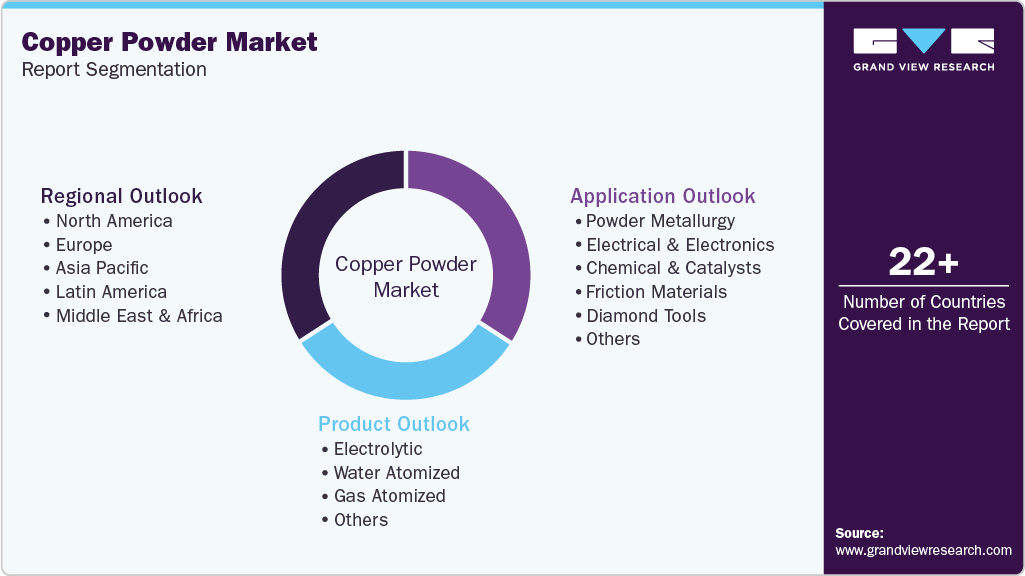
This report forecasts revenue and volume growth at the global, regional, and country levels and provides an analysis of the latest industry trends in each of the sub-segments from 2021 to 2033. For this study, Grand View Research has segmented the global copper powder market report based on product, application, and region:
-
Product Outlook (Volume, Kilotons; Revenue, USD Million, 2021 - 2033)
-
Electrolytic
-
Water Atomized
-
Gas Atomized
-
Others
-
-
Application Outlook (Volume, Kilotons; Revenue, USD Million, 2021 - 2033)
-
Powder Metallurgy
-
Electrical & Electronics
-
Chemical & Catalysts
-
Friction Materials
-
Diamond Tools
-
Others
-
-
Regional Outlook (Volume, Kilotons; Revenue, USD Million, 2021 - 2033)
-
North America
-
U.S.
-
Canada
-
Mexico
-
-
Europe
-
Germany
-
UK
-
France
-
Italy
-
Spain
-
-
Asia Pacific
-
China
-
India
-
Japan
-
Australia
-
-
Latin America
-
Middle East & Africa
-
Research Methodology
The U.S. refractory market figures in this report are based on a proven research process that combines executive interviews with secondary research from proprietary databases, company filings, and recognized regulatory and institutional sources. Market size is built through value-chain sizing-reconciling supply-side and demand-side estimates-and triangulated with bottom-up and top-down approaches. Every estimate passes multiple levels of expert validation before publication, with each U.S. refractory segment quantified using the revenue-capture definitions in the table below.
Segment Definition
Product
Revenue Capture Definition
Electrolytic
The electrolytic segment captures revenue generated from copper powder produced through electrolysis, resulting in high purity and typically dendritic particle structures.
Water Atomized
The water atomized segment represents revenue generated from copper powder produced by disintegrating molten copper using high pressure water jets.
Gas Atomized
The gas atomized segment captures revenue generated from high quality copper powder produced using inert or controlled gas streams to atomize molten copper.
Others
The others segment includes revenue generated from copper powders produced through methods such as chemical reduction, hydrometallurgical processing, oxide reduction, mechanical processing, and other specialized production routes.
Application
Revenue Capture Definition
Powder Metallurgy
The powder metallurgy segment captures revenue generated from copper powder used to manufacture sintered structural parts, self-lubricating bearings, filters, electrical contacts, and copper-based alloy components.
Electrical & Electronics
The electrical and electronics segment represents revenue generated from copper powder used in conductive inks, electronic pastes, electrical contacts, carbon brushes, electromagnetic shielding materials, and sintered electrical components.
Chemical & Catalysts
The chemical and catalysts segment captures revenue generated from copper powder used as a catalyst, reducing agent, chemical reagent, and feedstock for producing copper-based compounds.
Friction Materials
The friction materials segment includes revenue generated from copper powder used in brake pads, clutch facings, railway braking systems, and other friction components.
Diamond Tools
The diamond tools segment represents revenue generated from copper powder used as a bonding and matrix material in diamond cutting discs, grinding wheels, drilling tools, and other abrasive products.
Others
The others segment captures revenue generated from copper powder used in applications such as brazing, welding consumables, thermal spray coatings, conductive polymer composites, paints, pigments, additive manufacturing, and specialty industrial products.
Estimation Model
Layer No.
Layer Name
Key Question
Description
01
Industrial Manufacturing Demand Base Layer
What forms the demand base?
Identify global demand from major copper powder consuming industries, including automotive, electrical & electronics, chemicals, metallurgy, aerospace, energy, and additive manufacturing. Assess production volumes of powder metallurgy components, electronic devices, electrical equipment, batteries, and advanced manufactured products to establish the total addressable demand for copper powder.
02
Copper Powder Application Penetration Layer
Where is copper powder utilized?
Estimate the penetration of copper powder across key applications, including powder metallurgy, electrical & electronics, chemical & catalyst applications, friction materials, diamond tools, thermal management materials, conductive coatings, and additive manufacturing. Analyze the adoption of electrolytic, water atomized, gas atomized, and other copper powder types across end use industries and regions.
03
Copper Powder Consumption Intensity Layer
How much copper powder is consumed?
Analyze copper powder consumption intensity based on powder metallurgy component production, electronics manufacturing, electrical equipment output, friction material production, diamond tool manufacturing, and additive manufacturing activity. Evaluate material usage according to particle size, purity, morphology, conductivity, and application specific performance requirements. Consumption intensity varies according to manufacturing technology, component complexity, material specifications, and production efficiency.
04
Revenue Layer
How is market revenue generated?
Market revenue is quantified through the sale of electrolytic, water atomized, gas atomized, and specialty copper powders. Revenue generation is driven by demand from powder metallurgy, electrical & electronics, chemicals & catalysts, friction materials, diamond tools, additive manufacturing, and other industrial applications. Market value is influenced by copper prices, powder production technology, particle characteristics, purity grades, processing costs, production volumes, and regional supply-demand dynamics.
Delivered Customizations
This report has been delivered with the following In-depth customizations
Client Request
Customization Delivered
Value Adds
Regional Segmentation
Detailed regional analysis of the copper powder market across North America, Europe, Asia Pacific, Latin America, and Middle East & Africa. Included evaluation of copper powder production capacity, powder metallurgy activities, electronics manufacturing, automotive production, electrical infrastructure development, renewable energy investments, and additive manufacturing adoption.
Identified major production hubs, high growth consumption markets, and emerging advanced manufacturing centers. Enabled strategic expansion planning based on electronics production, automotive manufacturing, electrification, and industrial demand. Supported regional demand forecasting and supply chain optimization.
Opportunity Assessment
Identification of high growth opportunities across powder metallurgy, electrical and electronics manufacturing, electric vehicles, advanced electronic components, additive manufacturing, chemical catalysts, friction materials, diamond tools, renewable energy systems, and copper powder recycling.
Enabled prioritization of high return growth segments and emerging regional opportunities. Supported long term production capacity expansion, product innovation, advanced powder development, recycling investments, strategic partnerships, and business development initiatives aligned with electrification and advanced manufacturing trends.
Cross Segmentation
Comprehensive cross segmentation analysis by product type, application, end use, and region, including electrolytic, water atomized, gas atomized, and other copper powders across powder metallurgy, electrical and electronics, chemical and catalysts, friction materials, diamond tools, and other applications.
Enabled identification of the most attractive product and application combinations and high growth customer segments. Supported product portfolio optimization, customer targeting, capacity planning, and investment prioritization strategies.
About the Author(s)
Advanced Interior Materials Research Team
Advanced Materials · Advanced Interior MaterialsThis report was authored by the advanced interior materials research team at Grand View Research - comprising two research analysts, one senior research analyst, and one industry expert - with specialized expertise in the advanced interior materials segment of the advanced materials industry. All findings are based on proprietary advanced materials databases, executive interviews, and regulatory analysis, subject to internal peer review prior to publication.
Last Updated:
Speak to Analyst


Customize this report to your needs — add regions, segments, or data points, with 20% free customization.
Or view our licence options:


ISO 9001:2015 & 27001:2022 Certified
We are GDPR and CCPA compliant! Your transaction & personal information is safe and secure. For more details, please read our privacy policy.


