
- Home
- »
- Next Generation Technologies
- »
-
Crowd Analytics Market Size & Share Report, 2026-2033GVR Report cover
![Crowd Analytics Market (2026 - 2033)Report]()
Crowd Analytics Market (2026 - 2033)
Size, Share & Trends Analysis Report By Component (Software, Services), By Technology (Artificial Intelligence & Machine Learning), By Deployment (Cloud, On-premise), By Application, By End-use, By Region, And Segment Forecasts
Market Size, 2025
$4.7BMarket Estimate, 2026
$5.5BMarket Forecast, 2033
$20.1BCAGR, 2026–2033
20.2%Crowd Analytics Market Summary
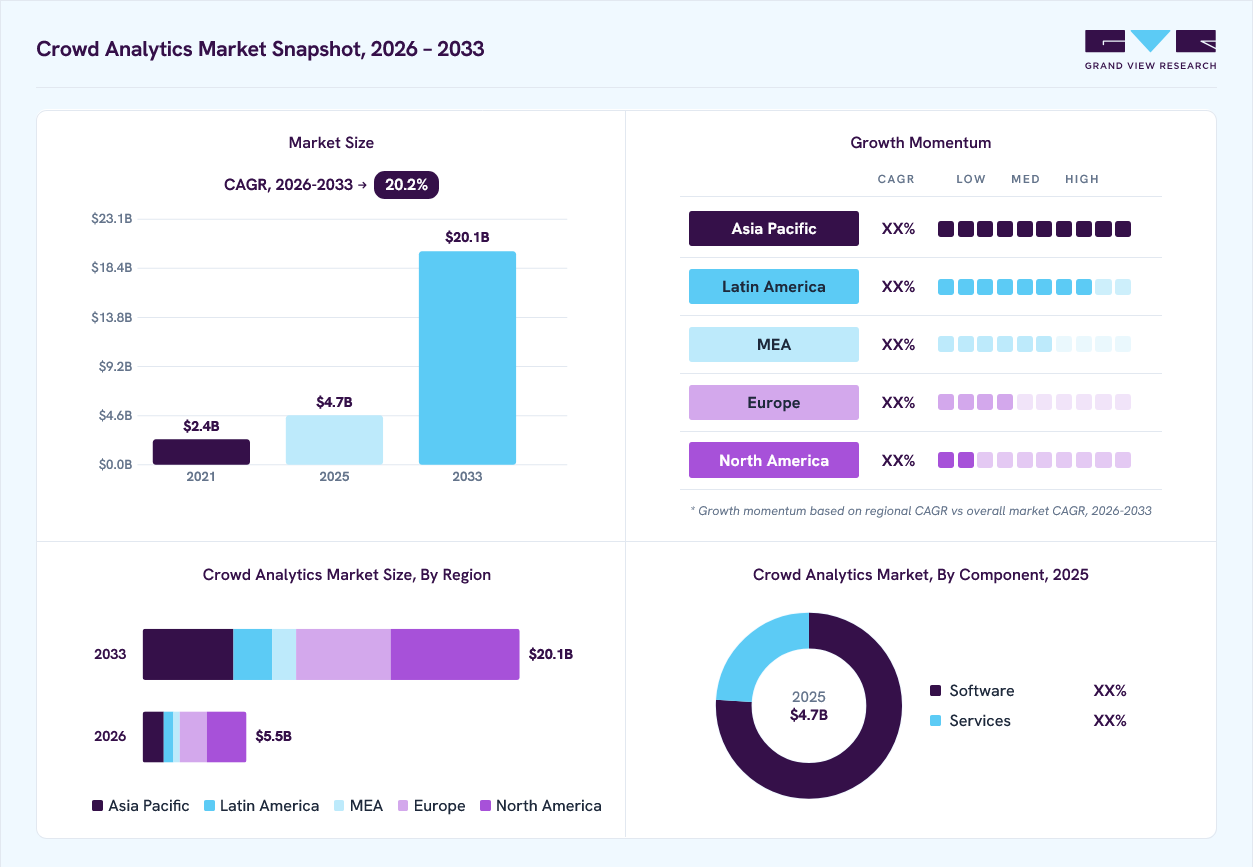
The global crowd analytics market size was valued at USD 4.7 billion in 2025 and is projected to grow from USD 5.5 billion in 2026 to USD 20.1 billion by 2033, at a CAGR of 20.2% from 2026 to 2033. North America dominated the market, accounting for a revenue share of 38.7% in 2025. Increasing development of smart cities and intelligent infrastructure is driving market growth.
Key Market Trends & Insights
- By component: Software segment dominated the market, with a revenue share of 75.9% in 2025.
- By technology: Artificial intelligence & machine learning led the market and accounted for a share of 32.8% in 2025.
- By deployment: Cloud segment dominated the market, with a revenue share of 68.8% in 2025.
- By application: Crowd monitoring & management segment dominated the market, with a revenue share of 31.8% in 2025.
- By end use: Retail segment held the largest revenue share in 2025.
Regional Highlights
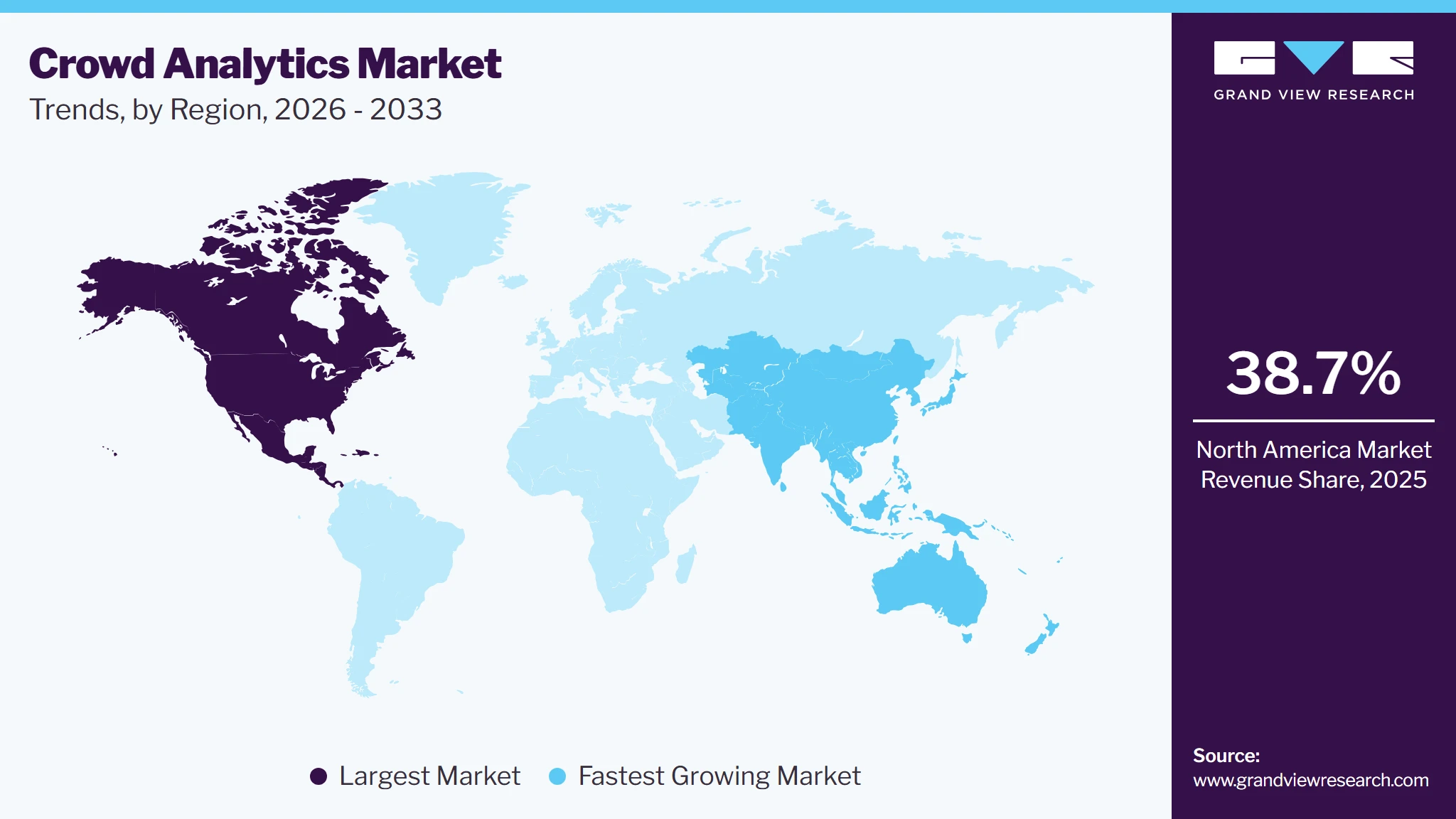
- Largest regional market: North America (38.7% revenue share, 2025)
- Fastest-growing regional market: Asia Pacific (highest CAGR, 2026-2033)
- By country: The U.S. held the largest market share in 2025
Market Size & Forecast
- Market size in 2025: USD 4.7 Billion
- Estimated market size in 2026: USD 5.5 Billion
- Projected market size by 2033: USD 20.1 Billion
- CAGR (2026-2033): 20.2%
The increasing use of crowd analytics for retail footfall optimization is driving market growth as shopping centers, department stores, supermarkets, and large-format retailers seek a deeper understanding of how visitors move through physical spaces. Retailers increasingly need information on entrance volumes, aisle traffic, dwell time, queue formation, and movement between departments to refine store layouts. Crowd analytics can process these movement patterns and identify high-traffic and underutilized areas without relying solely on manual observation. The growing complexity of large retail environments is creating demand for automated monitoring across multiple zones rather than isolated counting points. Retail operators can also integrate crowd intelligence with merchandising, staffing, and facility management systems to create more coordinated operational workflows.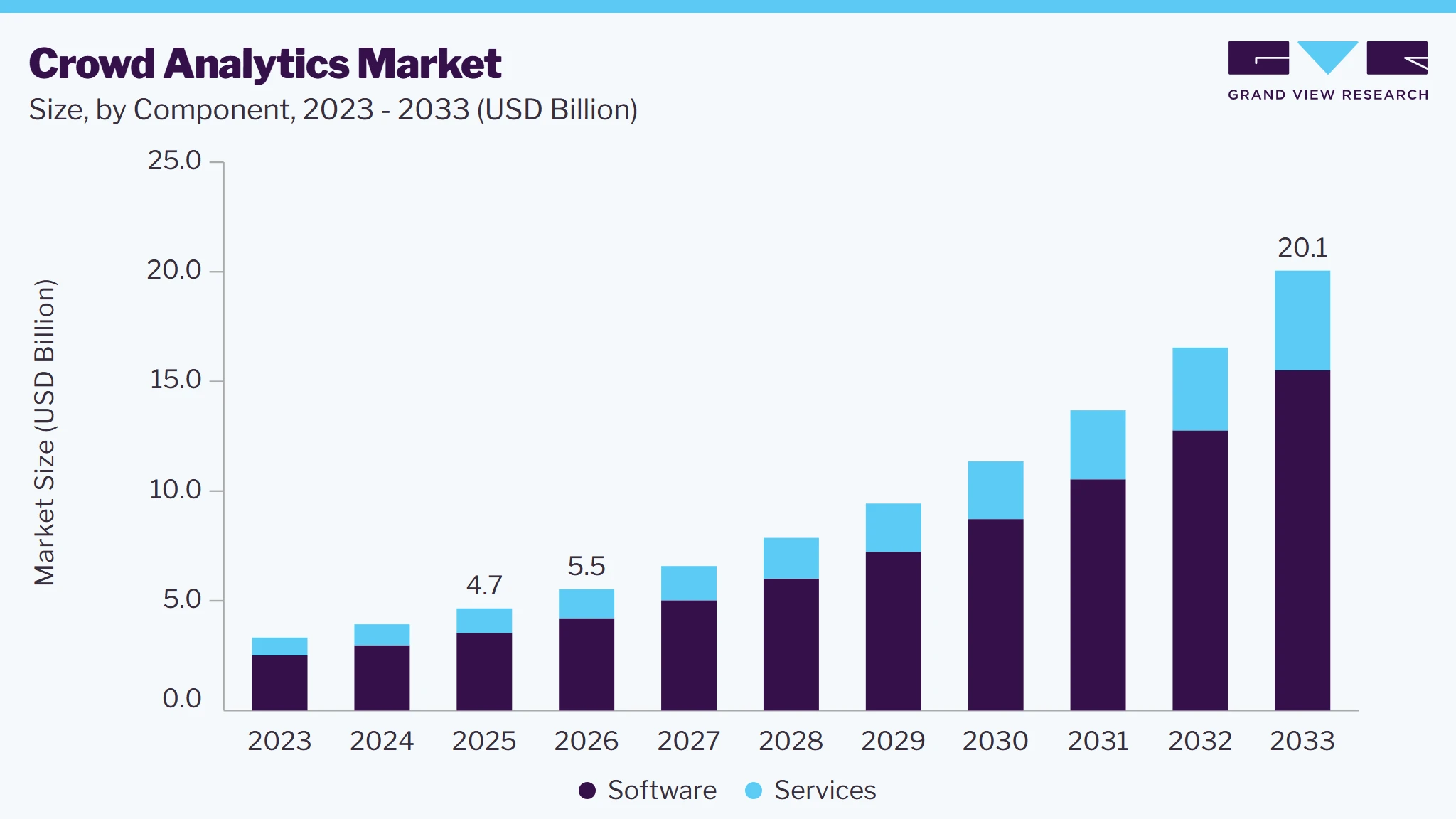
The increasing use of sensor fusion is driving market growth, as crowded environments often present conditions in which a single sensing technology may provide incomplete information. Cameras can be combined with Wi-Fi signals, Bluetooth signals, LiDAR, thermal sensors, access-control systems, ticketing information, and other operational data sources. Combining these inputs can provide a broader representation of occupancy and movement across indoor and outdoor environments. Sensor fusion is particularly relevant for large facilities that contain areas with varying lighting, visibility, density, and architectural configurations. The increasing complexity of monitored environments creates demand for platforms capable of integrating multiple data streams into unified analytics.
The increasing demand for predictive crowd-flow analysis is driving market growth as organizations move beyond monitoring current occupancy to anticipating future congestion. Historical movement patterns can be analyzed alongside event schedules, transportation timing, facility capacity, weather conditions, and other operational variables to identify potential crowd buildup. Predictive models can provide earlier visibility into bottlenecks than systems that only report current occupancy. This creates opportunities for crowd analytics platforms to become part of operational planning rather than functioning only as monitoring tools. The increasing sophistication of machine-learning models is expanding the range of movement patterns that can be analyzed automatically.
Market Dynamics
The crowd analytics market is gaining momentum as businesses, public authorities, transportation operators, sports venues, retailers, and entertainment facilities increasingly seek real-time visibility into crowd movement and behavior. Crowd analytics solutions use video surveillance, computer vision, artificial intelligence, sensors, and location-based technologies to measure occupancy, identify movement patterns, monitor congestion, and understand visitor behavior across physical environments. The growing need to improve public safety, optimize facility capacity, manage queues, and enhance operational efficiency is prompting organizations to shift from conventional surveillance to intelligent, data-driven crowd management. In addition, the expansion of smart cities, large-scale events, transportation hubs, and digitally managed commercial spaces is creating broader applications for crowd analytics technologies.
The growing use of analytics in stadiums and large entertainment venues is driving market growth as venue operators increasingly require detailed visibility into how spectators move across entrances, concourses, seating areas, concessions, restrooms, parking zones, and exit routes. Large venues experience highly concentrated visitor flows within short periods, making conventional manual monitoring difficult to maintain across the entire facility. Crowd analytics enables operators to examine movement density, dwell patterns, traffic direction, and occupancy changes across different venue zones. The increasing complexity of modern stadium layouts is driving demand for technology capable of analyzing multiple interconnected areas rather than monitoring individual locations. Venue operators are also increasingly looking for continuous data that can be reviewed across multiple events to identify recurring movement patterns.
Privacy concerns surrounding video-based crowd monitoring are creating a significant restraint on the crowd analytics market as organizations increasingly face questions about how individuals are observed, analyzed, and represented by camera-based systems. Crowd analytics platforms can process video streams to derive information about movement, occupancy, density, dwell time, and behavioral patterns, while more advanced configurations may introduce facial or biometric identification capabilities. This raises concerns about excessive surveillance, unauthorized data use, unclear retention practices, and insufficient transparency in how analytics are performed. Organizations deploying these systems may therefore require additional privacy assessments, governance procedures, consent mechanisms, anonymization capabilities, and restrictions on data access before deployment. These requirements can lengthen procurement and implementation cycles, particularly for public spaces, transportation facilities, healthcare properties, educational campuses, and large commercial venues.
Growing adoption of edge-based crowd analytics is creating new opportunities for the crowd analytics market as organizations increasingly seek to process crowd information closer to cameras, sensors, and connected devices rather than transferring all raw data to centralized servers. Edge-based processing can analyze video streams locally and generate information such as occupancy levels, pedestrian density, queue conditions, and movement patterns with reduced dependence on continuous cloud connectivity. This architecture is particularly relevant for stadiums, airports, transportation hubs, shopping centers, campuses, and public spaces where large volumes of visual data are generated simultaneously. Local processing can reduce the amount of raw video that needs to be transferred over networks, creating opportunities for deployments where bandwidth availability, data control requirements, or response speed are important considerations.
Market Concentration & Characteristics
The crowd analytics market is moderately fragmented, as the technology is being supplied by a mix of video analytics companies, AI developers, surveillance providers, sensor manufacturers, and specialized crowd-management platforms rather than a few dominant vendors. Entry barriers are moderate because basic people-counting solutions can be developed with existing computer vision technologies, but achieving reliable performance in dense, changing environments requires sophisticated algorithms, sensor integration, and extensive testing. Competitive differentiation is increasingly shifting from simple crowd counting toward behavioral analysis, anomaly detection, movement prediction, and real-time decision support.
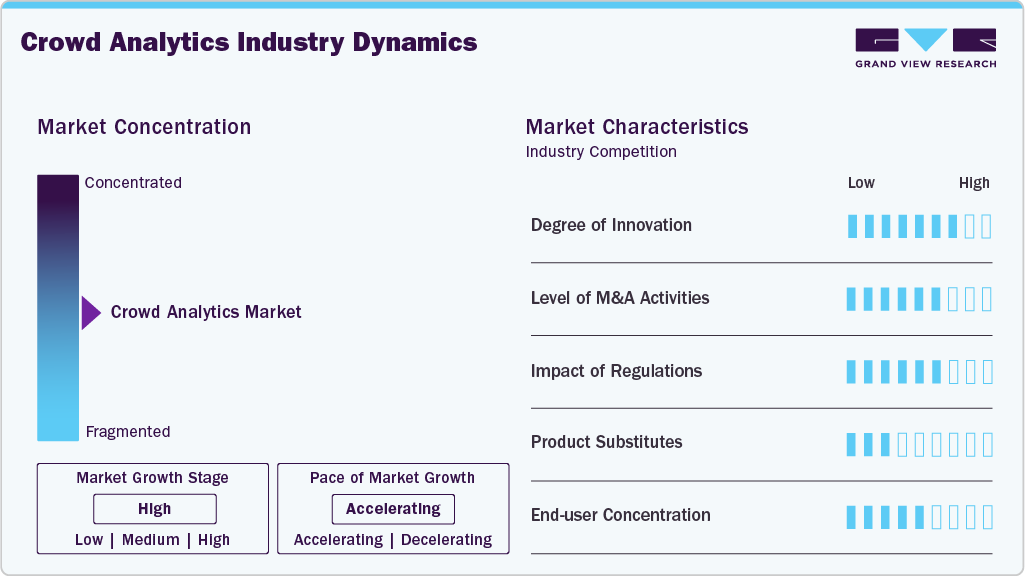
The market is in a rapid expansion stage, driven by the need to manage congestion and safety risks in airports, transportation hubs, stadiums, shopping centers, smart cities, and large public events. Adoption is moving from passive surveillance toward continuous analysis that can identify crowd density, movement patterns, unusual behavior, and developing congestion before an incident occurs. This creates demand not only from security agencies but also from transport operators, retailers, venue owners, and city authorities seeking to optimize capacity and operations.
Analyst Perspective
The crowd analytics market is evolving from a security-focused surveillance function into a broader operational intelligence platform that helps organizations understand how people move through and interact with physical spaces. Competitive differentiation is increasingly shifting toward solutions that can combine real-time occupancy detection, behavioral analysis, predictive congestion modeling, queue intelligence, and automated alerts within a unified platform. Vendors capable of integrating computer vision with existing cameras, IoT infrastructure, access-control systems, and facility management platforms are positioned to capture demand from organizations seeking measurable improvements in space utilization and operational planning. As physical environments become increasingly data-driven, crowd analytics is expected to become an important layer of smart infrastructure, enabling organizations to optimize capacity, improve visitor experiences, strengthen safety management, and make more informed decisions about the design and operation of high-traffic environments.
Component Insights
The software segment accounted for the largest market share of 75.9% in 2025 in the crowd analytics market. The increasing need for automated incident detection is driving market growth by encouraging organizations to deploy software to identify unusual crowd conditions without requiring continuous manual monitoring. Analytics platforms can establish thresholds for crowd density, occupancy, movement direction, queue length, and abnormal gathering patterns and generate alerts when predefined conditions are reached. Security personnel can then prioritize areas requiring immediate attention rather than continuously monitoring every camera feed. Software-based incident detection is particularly relevant in transportation facilities, stadiums, entertainment venues, shopping centers, campuses, and public spaces where crowd conditions can change rapidly. Integration with notification systems and operational workflows can further automate the escalation of detected events.
The services segment is anticipated to grow at significant CAGR during the forecast period. The increasing adoption of managed analytics services is propelling market growth as organizations seek continuous monitoring and technical administration without maintaining large internal teams. Managed service providers can oversee system health, monitor analytics performance, manage alerts, conduct remote diagnostics, and coordinate updates across customer environments. This approach can be particularly relevant for smaller organizations and multi-site operators that require sophisticated crowd analytics but have limited internal resources for ongoing platform administration. Managed services can also provide a predictable operating model in which analytics infrastructure and technical expertise are maintained through an ongoing service relation
Technology Insights
The artificial intelligence & machine learning segment accounted for the largest market share of 32.8% in 2025 in the crowd analytics market. The growing need for predictive crowd-flow management is driving market growth by shifting organizations from reactive monitoring to anticipating crowd conditions. Machine learning algorithms can examine historical movement patterns, current occupancy levels, time-based activity, event schedules, and other contextual information to identify conditions associated with congestion or unusual crowd formation. Transportation operators can use these capabilities to anticipate passenger buildup, while stadiums and entertainment venues can prepare for crowd surges around entrances, exits, concessions, and other high-traffic areas. Retail and commercial facilities can similarly use predictive models to understand expected footfall and visitor movement during different operating periods.
The IoT & sensor analytics segment is expected to register the fastest CAGR from 2026 to 2033. The rapid expansion of connected sensors across transportation hubs, stadiums, shopping centers, airports, campuses, and public spaces is driving growth in the IoT & Sensor Analytics segment of the crowd analytics market. Sensors can continuously collect information on occupancy, movement, proximity, environmental conditions, entry and exit activity, and pedestrian distribution across physical environments. Unlike isolated camera-based monitoring, sensor networks can provide data from multiple points within a facility, creating a more granular representation of crowd conditions. Organizations are increasingly connecting these data sources to analytics platforms to understand how people move through different zones and how occupancy changes throughout the day.
Deployment Insights
The cloud segment accounted for the largest market share of 68.8% in 2025. The growing integration of cloud crowd analytics with enterprise applications is driving market growth by enabling the incorporation of crowd information into broader organizational workflows. Cloud platforms can exchange information with business intelligence tools, customer analytics systems, facility management applications, ticketing platforms, access-control systems, and enterprise data environments through APIs and other integration mechanisms. This enables crowd information to be combined with operational, commercial, and customer datasets rather than remaining isolated within a security or monitoring system. Retail organizations can combine visitor information with sales data, while venue operators can correlate crowd patterns with ticketing and event information. Transportation operators can integrate passenger-flow information with operational schedules and facility conditions.
The on-premise segment is expected to register a significant CAGR from 2026 to 2033. The rising need for integration with legacy agricultural systems contributes to market growth by allowing organizations to connect modern mapping technologies with existing operational software already deployed within internal infrastructure. Many commercial agricultural enterprises continue utilizing established enterprise resource planning platforms, inventory systems, machinery management applications, and production databases developed over many years. On-premise mapping solutions simplify integration with these internal systems while reducing migration complexity. Better interoperability improves operational consistency across multiple business functions. Legacy system modernization creates sustained opportunities within the on-premise segment.
Application Insights
The crowd monitoring & management segment accounted for the largest market share of 31.8% in 2025 in the crowd analytics market. The increasing development of large shopping centers and mixed-use commercial complexes is contributing to market growth as property operators seek better visibility into how visitors use different areas of their facilities. Crowd monitoring can measure visitor volumes, dwell patterns, movement between floors, traffic around entrances, and concentration around specific retail or entertainment zones. Property managers can use these insights to optimize common areas, staffing arrangements, promotional placements, event layouts, and pedestrian routes. Crowd information can also be combined with commercial data to understand relationships between visitor activity and facility performance. The growing complexity of large commercial properties is creating demand for continuous monitoring of visitor movement rather than occasional manual observations.
The consumer behavior analytics segment is expected to register at the fastest CAGR from 2026 to 2033. The growing importance of experiential retail contributes to market growth by increasing demand for information about how consumers interact with physical spaces rather than merely how many visitors enter them. Retailers are increasingly incorporating demonstration areas, interactive displays, entertainment zones, food services, technology experiences, and personalized customer environments into physical locations. Behavioral analytics can measure dwell patterns, movement between experiences, and visitor concentration around specific areas. These insights can help businesses determine which experiences attract attention and how consumers move between different components of a store or commercial facility. Understanding these interactions becomes increasingly important as physical retailers compete with digital channels through differentiated in-person experiences. The expansion of experience-oriented retail environments is therefore creating additional demand for consumer behavior analytics.
End Use Insights
The retail segment accounted for the largest market share of 26.0% in 2025 in the crowd analytics market. The increasing adoption of omnichannel retailing is driving market growth by creating a need to understand how customers transition between digital and physical shopping channels. Customers may research products online, interact with digital promotions, visit a physical store, inspect products, and complete purchases through different channels. Crowd analytics provides visibility into the physical aspect of this journey by measuring store visits, movement, dwell time, and interactions with specific areas. Retailers can combine these insights with e-commerce and customer data to develop a broader understanding of shopping behavior. This creates greater analytical continuity between digital customer journeys and physical-store activity. The growing integration of online and offline retail operations is therefore expanding the role of crowd analytics within retail technology environments.
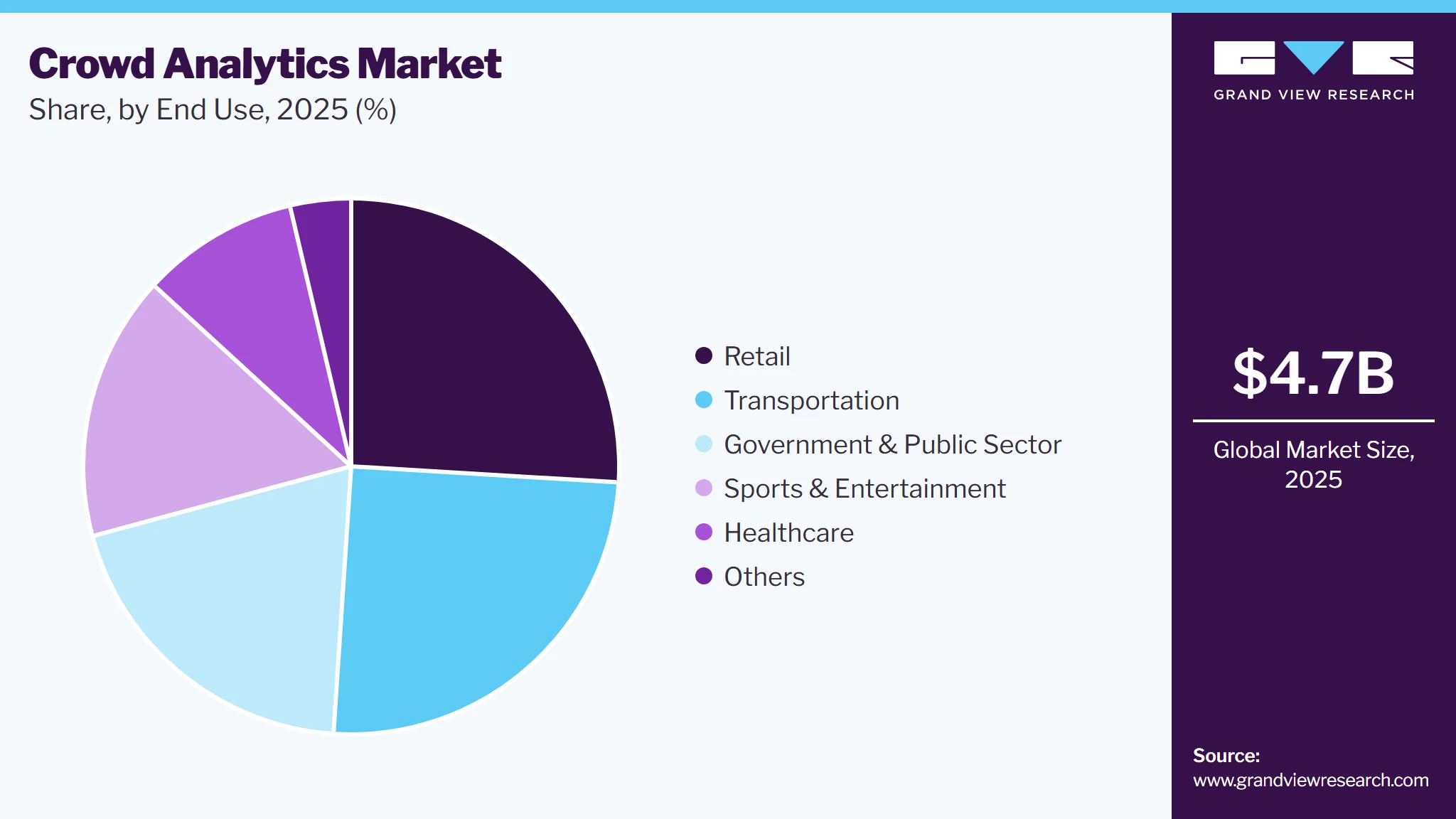
The sports & entertainment segment is anticipated to register the fastest CAGR during the forecast period. The increasing emphasis on managing spectator movement across stadiums, arenas, concert venues, theaters, and entertainment complexes is driving growth in the Sports & Entertainment segment of the crowd analytics market. These facilities experience highly concentrated visitor flows before events, during intermissions, and immediately after events, creating complex movement conditions across entrances, seating areas, concessions, merchandise zones, restrooms, and exits. Crowd analytics can provide venue operators with continuous information on how spectators are distributed across these areas. This information can be used to understand traffic concentrations, identify underutilized spaces, and coordinate operational resources in response to changing visitor patterns. The growing complexity of large entertainment venues is increasing the requirement for analytical visibility beyond conventional surveillance systems.
Regional Insights
North America dominated the crowd analytics industry, accounting for 38.7% of revenue in 2025. The high concentration of technologically advanced commercial, transportation, sports, and public infrastructure across North America is driving growth in the crowd analytics market by creating a broad base of environments where large volumes of people need to be monitored and analyzed. Airports, metropolitan transit systems, shopping centers, stadiums, universities, convention centers, entertainment districts, and large corporate campuses generate continuous pedestrian movement that can be difficult to evaluate through manual observation. Crowd analytics provides organizations with structured information about occupancy, movement patterns, traffic concentration, dwell behavior, and changes in visitor distribution. The established presence of digital surveillance, connected infrastructure, and enterprise analytics environments creates favorable conditions for integrating crowd intelligence into existing operational systems. Organizations across the region increasingly view physical-space data as an operational resource that can be analyzed alongside other business information. This growing availability of complex, high-traffic environments is driving the adoption of crowd analytics across North America.
U.S. Crowd Analytics Market Trends
The U.S. crowd analytics market is projected to grow significantly during the forecast period. The extensive U.S. sports and entertainment ecosystem is driving market growth by creating recurring demand for crowd intelligence across stadiums, arenas, concert venues, convention centers, and large event facilities. Major sporting events and entertainment programs can generate highly concentrated pedestrian flows within narrow time windows. Crowd analytics can measure entry rates, gate utilization, concession traffic, movement between seating areas, occupancy levels, and exit patterns. Venue operators can compare these indicators across different events to understand how attendance levels and event formats influence visitor movement. The growing investment in connected venue infrastructure also creates opportunities to combine crowd analytics with ticketing, mobile applications, access systems, and digital signage.
Asia Pacific Crowd Analytics Market Trends
The crowd analytics market in Asia Pacific is expected to grow at the fastest CAGR from 2026 to 2033. The rapid development of large shopping malls and organized retail destinations is contributing to market growth by creating demand for physical customer-behavior measurement. Asia Pacific contains extensive networks of shopping centers, department stores, supermarkets, specialty retail complexes, and mixed-use commercial destinations. These environments generate significant foot traffic but can have substantial differences in visitor activity between entrances, floors, stores, food courts, entertainment zones, and common areas. Crowd analytics can measure visitor volumes, movement between zones, dwell duration, and recurring traffic concentrations. Retail operators can use this information to understand physical customer circulation and compare activity between different periods or locations.
The crowd analytics industry in China is projected to grow significantly during the forecast period. The growing development of integrated urban digital platforms is driving market growth by creating environments where crowdsourced information can be connected to transportation, infrastructure, and municipal datasets. Chinese cities are increasingly developing digital systems capable of collecting information from multiple urban assets. Crowd analytics can provide a human-movement layer within these systems by measuring activity across streets, public spaces, commercial districts, transportation facilities, and event areas. Combining pedestrian information with other urban datasets can create a more comprehensive understanding of how physical infrastructure is used. This can expand crowd analytics from an individual-building application into a broader city-management capability.
The crowd analytics industry in India is projected to grow significantly during the forecast period. The expansion of metro rail networks is propelling market growth by creating large passenger environments where continuous movement analysis is increasingly valuable. Metro stations contain ticketing areas, entry gates, platforms, escalators, corridors, interchange zones, and exits that can experience substantially different passenger concentrations. Crowd analytics can provide information about passenger movement across these locations at different times of the day. Historical datasets can reveal recurring patterns associated with commuting peaks, weekends, holidays, and special events. This creates a more detailed understanding of station utilization than isolated passenger counts.
Europe Crowd Analytics Market Trends
The crowd analytics industry in Europe is anticipated to grow steadily from 2026 to 2033. The increasing requirement for privacy-conscious analytics is driving market growth by encouraging the development and deployment of systems designed around aggregated and anonymized crowd information. European organizations operate within a comparatively demanding data-governance environment, making the handling of personal information an important consideration when deploying analytics technologies. Crowd analytics can focus on metrics such as occupancy, traffic volume, movement direction, dwell time, and spatial distribution without requiring every individual to be identified. Technologies can also process selected information locally and transmit analytical outputs instead of continuously transferring raw data. This creates opportunities for organizations to obtain operational intelligence while designing systems around data minimization and controlled information handling. The growing preference for privacy-oriented analytical architectures is therefore shaping the adoption of crowd analytics across European markets.
The crowd analytics industry in the UK is expected to grow significantly during the forecast period. The expansion of smart stadium technologies is driving market growth by creating sophisticated environments in which crowd analytics can be integrated with ticketing, mobile applications, access control, IoT sensors, and venue management systems. UK football, rugby, cricket, and entertainment venues experience highly concentrated visitor flows before events, during breaks, and immediately after events. Crowd analytics can provide information about gate activity, seating-area movement, concession traffic, hospitality-zone occupancy, and pedestrian circulation. Venue operators can compare these patterns across matches, concerts, and other events with different attendance levels. The increasing digitization of stadium operations creates additional opportunities for real-time crowd intelligence and historical movement analysis.
The crowd analytics industry in Germany is expected to grow significantly during the forecast period. The increasing adoption of cloud and centralized analytics infrastructure contributes to market growth by allowing organizations to manage crowd information from multiple facilities through common platforms. German retail chains, transportation operators, stadium groups, property companies, universities, and municipalities may operate multiple locations with different traffic characteristics. Centralized platforms can standardize measurements such as footfall, occupancy, movement, density, and dwell time across these sites. Organizations can compare locations and identify differences in visitor activity without maintaining separate analytical environments for every facility. Cloud architectures also make it easier to expand analytics to additional locations as physical infrastructure becomes connected. The growing integration of crowd intelligence with centralized data platforms is therefore strengthening scalability across the German market.
Key Crowd Analytics Company Insights
Some prominent players in the crowd analytics market include NEC Hong Kong Limited and V-Count, among others.
-
NEC Hong Kong Limited is a Hong Kong-based subsidiary of NEC Corporation that provides information and communications technology solutions, systems integration, digital services, and technology infrastructure for enterprises, government organizations, and other institutions. NEC’s broader portfolio includes NEC Intelligent Video Analytics, NEC FieldAnalyst, NEC facial recognition technologies, people-counting solutions, crowd-monitoring solutions, video-surveillance analytics, and AI-based behavioral analysis platforms.
-
V-Count is a technology company specializing in people counting, occupancy measurement, visitor analytics, and computer vision solutions for physical environments. V-Count provides a portfolio of people analytics and occupancy intelligence products designed to measure and analyze human movement in physical locations. Its key products include V-Count 3D Alpha, V-Count 3D Pro, V-Count 3D Mini, V-Count Matrix, V-Count Nano, V-Count Cloud, and V-Count Analytics. These solutions use 3D computer vision and analytics technologies to measure visitor counts, occupancy levels, traffic flows, dwell times, and movement patterns.
Key Crowd Analytics Companies
The following key companies have been profiled for this study on the crowd analytics market.
-
Crowd Dynamics
-
CrowdANALYTIX
-
Dahua Technology Co., Ltd
-
FootfallCam
-
Hangzhou Hikvision Digital Technology Co., Ltd.
-
iOmniscient
-
NEC Hong Kong Limited
-
RetailNext, Inc.
-
RightCrowd
-
SAVANNAH SIMULATIONS AG
-
SenSource
-
Staqu Technologies Pvt. Ltd.
-
V-Count
-
Wavestore
-
Xovis AG
Competitive Benchmarking
Operating Strategies
Competitive Edge
Weakness
Mature Players: Dahua Technology Co., Ltd; NEC Hong Kong Limited; RetailNext, Inc.
- Established players focus on combining video surveillance, and AI analytics to monitor crowd density, movement patterns, occupancy, and potential congestion across large public spaces.
- They target airports, stadiums, transportation hubs, retail centers, and smart cities by integrating crowd insights with existing security and facility management systems.
- Their extensive infrastructure portfolios and established relationships with governments, transportation operators, and large venues support large-scale deployments.
- Strong AI, video analytics, and systems integration capabilities enable real-time monitoring across complex environments.
- High implementation costs and integration requirements can make deployments complex for smaller venues.
- Managing large volumes of video and location data also increases storage, computing, privacy, and cybersecurity requirements.
Emerging Players: Density; WaitTime; Xovis; FootfallCam; V-Count
- Emerging players focus on specialized people counting, occupancy intelligence, queue measurement, and real-time movement analytics, leveraging computer vision, sensors, and edge computing.
- They emphasize compact deployments, API-based integration, and configurable analytics for retailers, airports, venues, and commercial facilities seeking targeted crowd insights.
- Their specialized platforms enable faster deployment and more focused analytics than broad enterprise systems.
- Flexible configurations and real-time occupancy intelligence allow customers to optimize staffing, space utilization, queue management, and visitor experiences.
- Smaller vendor networks and limited deployment histories can restrict adoption in large public infrastructure projects.
- Accuracy across crowded environments, privacy concerns, and dependence on sensor or camera placement can also affect solution performance.
Recent Developments
-
In August 2025, RightCrowd launched RightCrowd Pass, a credentialing solution that issues and manages mobile, physical, and biometric access credentials through a single platform. By consolidating all three credential types into one unified program, the solution simplifies credential administration. Its mobile credentials are provisioned through a web-based API, allowing organizations to issue, suspend, and revoke access credentials directly within their existing systems without requiring an additional management console.
-
In May 2026, Dahua Technology Co., Ltd launched MultiVision 2.0 in Hangzhou, China, featuring upgraded multi-lens surveillance with wider coverage, panoramic-detail linkage, AI-powered Xinghan Vision Models, and simplified installation. Its panoramic splicing and multi-directional designs provide comprehensive monitoring, reduce blind spots, and minimize the need for multiple cameras.
Crowd Analytics Market Report Scope
Report Attribute
Details
Market size in 2025
USD 4.7 billion
Estimated market size in 2026
USD 5.5 billion
Projected market size by 2033
USD 20.1 billion
Growth rate
CAGR of 20.2% from 2026 to 2033
Actual data
2021 - 2025
Forecast period
2026 - 2033
Quantitative units
Revenue in USD billion and CAGR from 2026 to 2033
Report coverage
Revenue forecast, company share, competitive landscape, growth factors, and trends
Segments covered
Component, technology, deployment, application, end use, region
Regional scope
North America; Europe; Asia Pacific; Latin America; MEA
Country scope
U.S.; Canada; Mexico UK; Germany; France; China; India; Japan; Australia; South Korea; Brazil; UAE; Saudi Arabia; South Africa
Key companies profiled
Crowd Dynamics; CrowdANALYTIX; Dahua Technology Co., Ltd; FootfallCam; Hangzhou Hikvision Digital Technology Co., Ltd.; iOmniscient; NEC Hong Kong Limited; RetailNext, Inc.; RightCrowd; SAVANNAH SIMULATIONS AG; SenSource; Staqu Technologies Pvt. Ltd.; V-Count; Wavestore; Xovis AG
Customization scope
Free report customization (equivalent to 8 analysts working days) with purchase. Addition or alteration to country, regional & segment scope.
Pricing and purchase options
Avail customized purchase options to meet your exact research needs. Explore purchase options
Global Crowd Analytics Market Report Segmentation
This report forecasts revenue growth at global, regional, and country levels and provides an analysis of the latest industry trends in each of the sub-segments from 2021 to 2033. For this study, Grand View Research has segmented the global crowd analytics market report based on component, technology, deployment, application, end use, and region.
-
Component Outlook (Revenue, USD Million, 2021 - 2033)
-
Software
-
Services
-
-
Technology Outlook (Revenue, USD Million, 2021 - 2033)
-
Artificial Intelligence & Machine Learning
-
Computer Vision
-
Video Analytics
-
IoT & Sensor Analytics
-
Others
-
-
Deployment Outlook (Revenue, USD Million, 2021 - 2033)
-
Cloud
-
On-premise
-
-
Application Outlook (Revenue, USD Million, 2021 - 2033)
-
Crowd Monitoring & Management
-
Public Safety & Security
-
Passenger Flow Analytics
-
Consumer Behavior Analytics
-
Others
-
-
End Use Outlook (Revenue, USD Million, 2021 - 2033)
-
Government
-
Transportation
-
Retail
-
Sports & Entertainment
-
Healthcare
-
Others
-
-
Regional Outlook (Revenue, USD Million, 2021 - 2033)
-
North America
-
U.S.
-
Canada
-
Mexico
-
-
Europe
-
Germany
-
UK
-
France
-
-
Asia Pacific
-
China
-
India
-
Japan
-
South Korea
-
Australia
-
-
Latin America
-
Brazil
-
-
Middle East & Africa
-
UAE
-
Saudi Arabia
-
South Africa
-
-
Research Methodology
The crowd analytics market figures in this report are based on a proven research process that combines executive interviews with secondary research from proprietary databases, company filings, and recognized regulatory and institutional sources. Market size is built through value-chain sizing-reconciling supply-side and demand-side estimates-and triangulated with bottom-up and top-down approaches. Every estimate passes multiple levels of expert validation before publication, with each crowd analytics segment quantified using the revenue-capture definitions in the table below.
Segment Definition
Component
Revenue capture definition
Software
The largest component segment captures value through crowd analytics platforms that process video feeds, sensor data, location information, and behavioral signals to generate real-time insights on crowd density, movement, occupancy, and activity patterns. Vendors monetize through software licensing, SaaS subscriptions, analytics modules, dashboards, and AI-powered monitoring capabilities.
Services
Market value is captured through system integration, installation, data engineering, analytics consulting, customization, maintenance, technical support, and managed monitoring services. Service providers help organizations integrate crowd analytics with existing surveillance, access control, transportation, and facility management infrastructure.
Technology
Revenue capture definition
Artificial Intelligence & Machine Learning
The leading technology segment is generating value through algorithms that identify crowd patterns, predict congestion, detect anomalies, and automate risk assessment from large volumes of real-time data. AI enables organizations to move from basic monitoring toward predictive crowd management and automated decision support.
Computer Vision
Commercial demand is driven by camera-based detection of people, crowd density, movement trajectories, queue lengths, occupancy, and unusual activities. Improvements in image recognition allow organizations to extract crowd intelligence from existing CCTV infrastructure without requiring extensive additional hardware.
Video Analytics
Revenue opportunities arise from platforms that analyze live and recorded video to identify crowd buildup, restricted-area access, unusual movement, and operational bottlenecks. These capabilities are particularly valuable for venues and public spaces where continuous visual monitoring would otherwise require extensive human resources.
IoT & Sensor Analytics
Value is created by integrating data from Wi-Fi, Bluetooth, access control systems, footfall counters, RFID, environmental sensors, and other connected devices. Combining multiple sensor streams provides broader visibility into occupancy and movement than camera-based analytics alone.
Others
This segment includes location intelligence, edge analytics, geospatial analytics, thermal imaging, facial recognition, and other specialized technologies for understanding crowd behavior. Technology convergence is expanding the range of data sources available for real-time crowd intelligence.
Deployment
Revenue capture definition
Cloud
The dominant deployment model is supported by centralized data processing, remote monitoring, scalable analytics, and integration across multiple venues or facilities. Cloud platforms allow organizations to aggregate crowd information from geographically distributed locations while reducing the need for dedicated local computing infrastructure.
On-Premise
Demand is concentrated among government agencies, transportation operators, security-sensitive facilities, and organizations requiring direct control over video and location data. Local deployment is preferred where privacy, data sovereignty, network latency, or critical infrastructure requirements restrict the movement of sensitive information to external cloud environments.
Application
Revenue capture definition
Crowd Monitoring & Management
The largest application segment is capturing value through real-time density monitoring, occupancy measurement, queue analysis, crowd flow visualization, and congestion alerts. Airports, stadiums, shopping centers, and public venues use these capabilities to distribute crowds more efficiently and prevent overcrowding.
Public Safety & Security
Market value is driven by technologies that detect abnormal crowd behavior, potential security incidents, and restricted zones, and provide early warnings during large gatherings. Government agencies and venue operators deploy analytics to strengthen situational awareness and improve emergency response.
Passenger Flow Analytics
Commercial activity is centered on tracking passenger movement through airports, railway stations, metro systems, and transit terminals. Operators use these insights to optimize gates, platforms, staffing, queues, and facility layouts while improving passenger throughput.
Consumer Behavior Analytics
Demand is supported by analytics that measure visitor journeys, dwell times, repeat visits, store traffic, and movement patterns across commercial environments. Retailers and entertainment operators use these insights to optimize merchandising, layouts, promotions, and customer experiences.
Others
This category includes workforce movement analysis, occupancy optimization, event planning, smart-city monitoring, facility utilization, and emergency-evacuation analysis. Expanding use of real-time spatial intelligence is creating additional applications beyond conventional crowd surveillance.
End Use
Revenue capture definition
Government
Government agencies deploy crowd analytics for public safety, smart city programs, emergency management, public gatherings, transportation planning, and infrastructure utilization. Investment is increasingly directed toward systems that provide centralized situational awareness across large public spaces.
Transportation
Airports, railways, metro operators, bus terminals, and other transportation facilities use crowd analytics to manage passenger volumes, optimize queues, improve terminal utilization, and identify congestion before it becomes disruptive. Increasing passenger volumes and smart mobility initiatives reinforce demand for these solutions.
Retail
Retailers use crowd intelligence to understand foot traffic, customer journeys, dwell times, and store occupancy. These insights help optimize store layouts, staffing, promotional placement, and conversion strategies while improving the overall shopping experience.
Sports & Entertainment
Stadiums, arenas, concert venues, theme parks, and entertainment facilities utilize crowd analytics for entry management, seating-area monitoring, queue optimization, security, and emergency preparedness. Large events create strong demand for real-time visibility into crowd movement and venue occupancy.
Healthcare
Hospitals and healthcare facilities apply crowd analytics to monitor patient and visitor flows, emergency department congestion, waiting areas, and facility occupancy. Analytics can help improve resource allocation and reduce bottlenecks while supporting safer movement through complex healthcare environments.
Others
This segment includes corporate campuses, educational institutions, hospitality, manufacturing facilities, religious venues, and public attractions. These organizations increasingly use crowd analytics to optimize space utilization, improve safety, and understand movement patterns across high-traffic environments.
Estimation Model
Layer
Question
Analysis
Crowd Behavior Intelligence Layer
What crowd patterns need to be understood?
Identify movement, density, dwell time, queue formation, direction of travel, gathering patterns, and abnormal crowd behavior across stadiums, airports, shopping centers, transit hubs, entertainment venues, and public spaces. This layer defines demand based on the need to understand how people move and interact within physical environments rather than simply counting visitors.
Real-Time Observation Layer
How is crowd activity captured continuously?
Assess the use of CCTV feeds, computer vision, Wi-Fi and Bluetooth signals, mobile location data, access-control systems, sensors, and other location-aware technologies to generate real-time crowd information. The market depends on the ability to combine multiple data sources while maintaining sufficient accuracy, processing speed, privacy controls, and coverage across complex environments.
Crowd Flow Management Layer
How are analytics converted into immediate operational actions?
Analyze how venue operators, transportation authorities, retailers, event organizers, and security teams use crowd intelligence to manage congestion, optimize entrances and exits, adjust staffing, redirect pedestrian flows, identify bottlenecks, improve queue management, and respond to unusual activity. Integration with digital signage, access systems, security platforms, and facility management tools allows analytics to influence physical operations in real time.
Safety, Capacity & Experience Value Layer
How is commercial value generated from crowd analytics?
Evaluate revenue through analytics software subscriptions, computer vision platforms, implementation services, managed monitoring, data analytics, and customized venue intelligence solutions. Additional value is created through higher venue capacity utilization, reduced congestion, improved security response, optimized staffing, better retail conversion, and enhanced visitor experiences, while recurring revenues increasingly come from cloud-based monitoring and continuous analytics services.
Delivered Customization
This report has been delivered with the following In-depth customizations
Client Request
Customization Delivered
Value Adds
Crowd Flow Intelligence & Venue Operations Trends
Conducted a focused analysis of crowd analytics across stadiums, airports, shopping centers, transportation hubs, and large public venues, covering people counting, density monitoring, queue analysis, dwell-time measurement, and movement pattern identification.
Helps stakeholders identify operational use cases, evaluate crowd movement requirements, and assess opportunities for data-driven venue management and capacity planning.
Event Safety, Occupancy Monitoring & Real-Time Response Adoption Trends
Evaluated adoption of computer vision, video analytics, occupancy tracking, anomaly detection, and real-time crowd alerts for managing congestion, bottlenecks, unauthorized access, and emergency evacuation scenarios.
Provides insights into safety management requirements, faster incident response opportunities, and commercially attractive analytics capabilities for high-density environments.
Retail Behavior, Mobility Intelligence & Crowd Analytics Opportunity Assessment
Assessed demand for location-based customer movement analysis, footfall attribution, zone-level engagement measurement, heat mapping, and integration with security, facility management, and retail analytics platforms, along with challenges related to privacy, camera infrastructure, and data accuracy.
Supports investment and expansion strategies by identifying revenue-generating and operational use cases, evaluating technology readiness, and strengthening long-term opportunities in intelligent venue and public-space management.
About the Author(s)
Next Generation Technologies Research Team
Technology · Next Generation TechnologiesThis report was authored by the next generation technologies research team at Grand View Research - comprising two research analysts, one senior research analyst, and one industry expert - with specialized expertise in the next generation technologies segment of the technology industry. All findings are based on proprietary technology databases, executive interviews, and regulatory analysis, subject to internal peer review prior to publication.
Last Updated:
Speak to Analyst


Customize this report to your needs — add regions, segments, or data points, with 20% free customization.
Or view our licence options:


ISO 9001:2015 & 27001:2022 Certified
We are GDPR and CCPA compliant! Your transaction & personal information is safe and secure. For more details, please read our privacy policy.


