
- Home
- »
- Advanced Interior Materials
- »
-
Data Center Chillers Market Size & Share Report, 2026-2033GVR Report cover

Data Center Chillers Market (2026 - 2033)
Size, Share & Trends Analysis Report By Product (Air-Cooled Chillers, Water-Cooled Chillers), By Modular Capacity, By Compressor (Centrifugal, Screw, Scroll, Oil-free/Magnetic-bearing), By Deployment, By Region, And Segment Forecasts
Market Size, 2025
$841.0MMarket Estimate, 2026
$891.8MMarket Forecast, 2033
$1,450.5MCAGR, 2026–2033
7.2%Data Center Chillers Market Summary
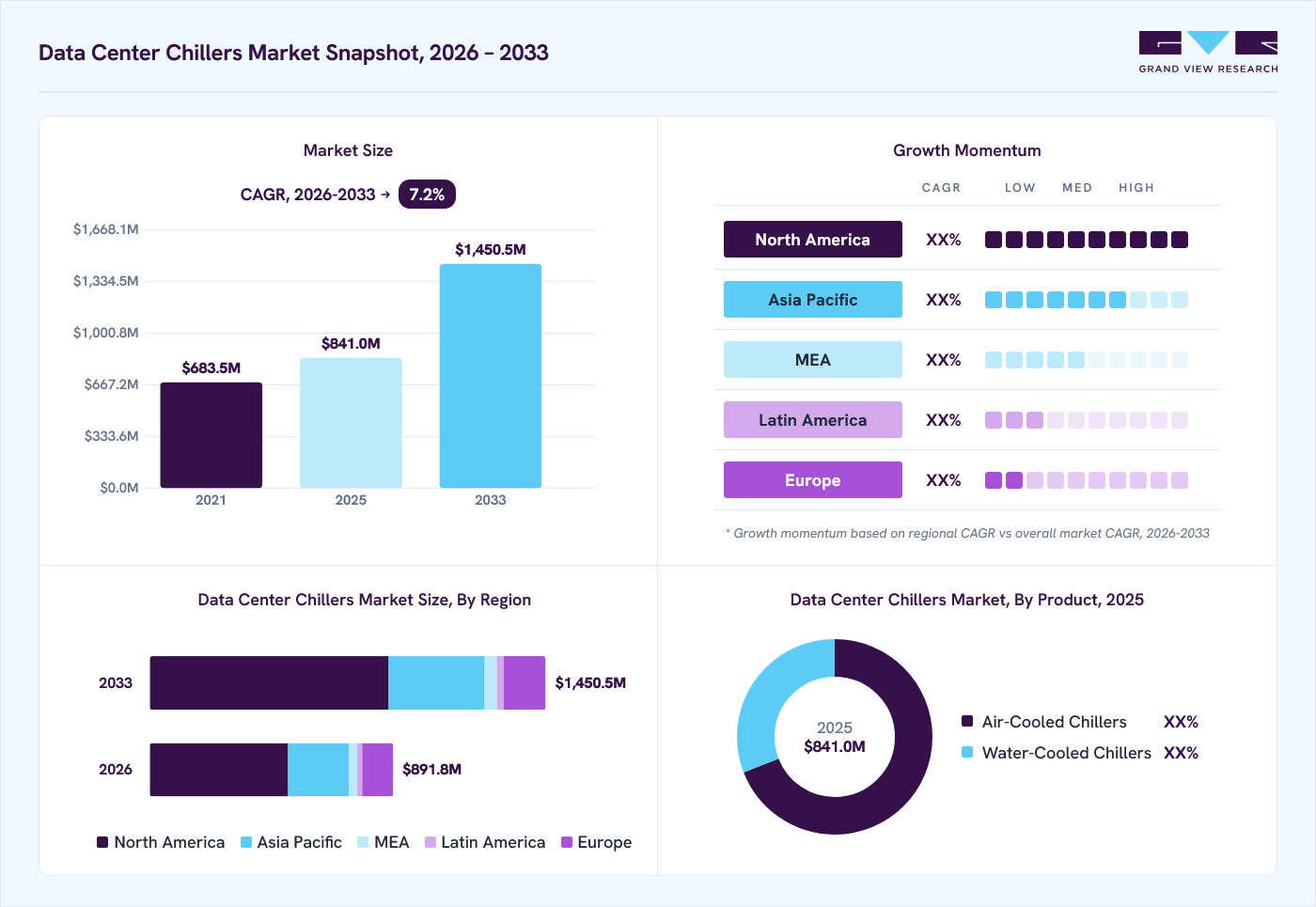
The global data center chillers market size was valued at USD 841.0 million in 2025 and is projected to grow from USD 891.8 million in 2026 to USD 1,450.5 million by 2033, at a CAGR of 7.2% from 2026 to 2033. North America dominated the market, accounting for a revenue share of 56.6% in 2025. The rapid expansion of hyperscale, colocation, and AI-focused data centers is a major market growth driver.
 Source: Grand View Research, IR Documents, Primary Interviews, Paid DatabasesTo learn more about this report,
 Download Free Sample Report
 Key Market Trends & Insights
- By product: Air-cooled chillers segment led the market with the largest revenue share of 69.0% in 2025.
- By deployment: New installation segment led the market with the largest revenue share of 74.4% in 2025.
- By compressor: Centrifugal segment led the market with the largest revenue share of 42.3% in 2025.
- By modular capacity: <500 kW segment led the market with the largest revenue share of 32.1% in 2025.
Regional Highlights
- Largest regional market: North America (56.6% revenue share, 2025)
- By country: The U.S. held the largest market share in 2025.
Market Size & Forecast
- Market size in 2025: USD 841.0 Million
- Estimated market size in 2026: USD 891.8 Million
- Projected market size by 2033: USD 1,450.5 Million
- CAGR (2026-2033): 7.2%
Three ways to get this report
Buy it, customize it, or ask a question.Ask an Analyst
A direct answer, usually in 1 working day
- AccessReport author, directly
- Reply timeWithin 1 working day
- No sales callDirect answer only
- FormatEmail reply
- CostFree, no cost
Get the Full Report
What the study covers
- FormatsPDF · Excel · Dashboard
- Timeline2026–2033 annual, 2025 base
- Coverage20+ countries, 5 regions
- Companies10+ key players profiled
Customize the Report
20% free customization
- IncludeCountries, segments, points
- TailorTo your product definition
- ExtendDeeper competitor detail
- OrA fully bespoke study
- Turnaround5–10 working days
Growing cloud adoption, digitalization, and AI workloads are increasing computing capacity and rack power density, resulting in higher heat loads and greater demand for reliable thermal management. High-density AI and HPC infrastructure requires advanced cooling systems capable of maintaining stable operating temperatures while supporting continuous workloads, creating opportunities for high-capacity air-cooled and water-cooled chillers.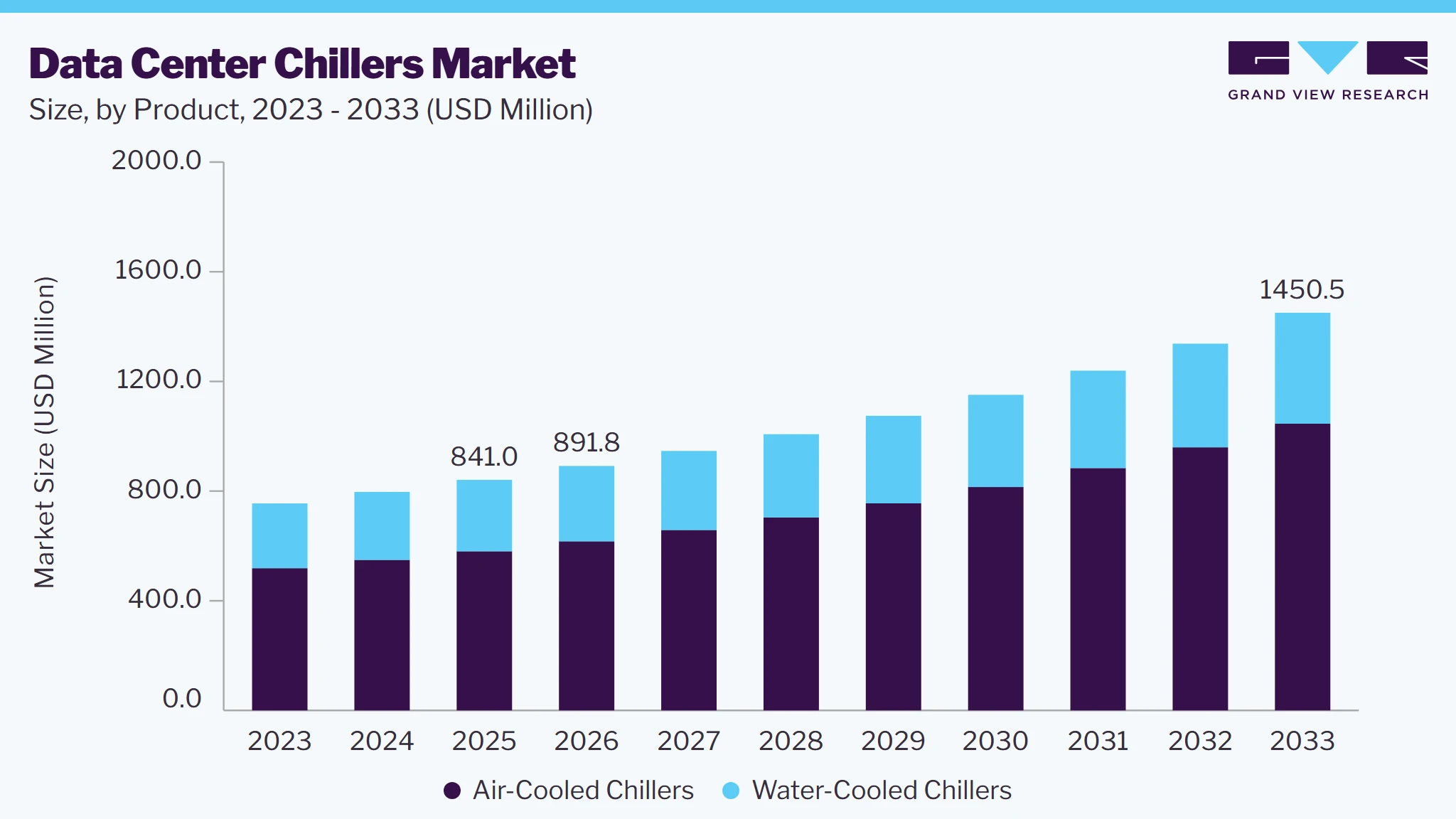 To learn more about this report, Download Free Sample Report
 The increasing focus on energy efficiency, operational reliability, and cooling optimization is further supporting chiller adoption. Data center operators are seeking efficient systems that can reduce cooling-related energy consumption, improve PUE, and maintain uptime across large-scale facilities. This is encouraging the adoption of variable-speed compressors, oil-free/magnetic-bearing technologies, free-cooling configurations, and higher-efficiency water-cooled systems, particularly in hyperscale and continuously operating facilities. At the same time, rapid data center construction and capacity expansion are creating additional demand for new chiller installations and replacement of aging cooling equipment.
Market Dynamics
The data center chillers market is being shaped by the rapid expansion of hyperscale, cloud, colocation, and AI-oriented data centers, which is increasing both cooling capacity requirements and rack-level thermal loads. At the same time, operators are prioritizing energy efficiency, uptime, scalability, and lower environmental impact, encouraging the adoption of high-efficiency chillers, advanced compressors, free-cooling configurations, intelligent controls, and modular cooling infrastructure. The market is also evolving as high-density AI workloads increasingly require liquid-assisted or liquid-cooling architectures, creating both competitive pressure and new opportunities for chiller manufacturers.
The rapid expansion of AI, HPC, cloud computing, and hyperscale data centers is a key driver for the market. AI workloads rely heavily on GPUs and other high-performance accelerators that generate substantially greater heat loads than conventional computing infrastructure. As rack power densities continue to rise, data center operators require robust centralized cooling systems capable of handling larger and more variable thermal loads while maintaining continuous operation. This is increasing demand for high-capacity chillers, particularly in large-scale new data center facilities.
The growth of AI infrastructure is also encouraging operators to redesign cooling architectures rather than simply expand legacy systems. Although direct-to-chip liquid cooling is increasingly adopted for very high-density AI racks, chillers remain important in the broader facility cooling infrastructure, particularly for hybrid systems and conventional data center zones. The resulting need for scalable, energy-efficient, and highly reliable thermal-management infrastructure is expected to support demand for advanced centrifugal, screw, and oil-free/magnetic-bearing chillers.
High upfront investment associated with advanced chiller systems is a major restraint, particularly for facilities requiring large-capacity water-cooled systems, cooling towers, pumps, piping, controls, and redundant equipment. The cost becomes even more significant when existing facilities need to be upgraded because legacy data centers may require extensive modifications to accommodate new chilled-water infrastructure. These capital requirements can encourage operators to extend the life of existing cooling equipment or consider alternative cooling technologies, particularly where the expected efficiency gains do not immediately justify the investment.
The growing adoption of liquid cooling and modular cooling infrastructure presents a significant opportunity for chiller manufacturers. As AI and HPC workloads push rack densities beyond the practical limits of conventional air cooling, specialized liquid-cooling systems require efficient heat rejection and facility-side thermal management infrastructure. Chillers can therefore evolve from conventional room-level cooling equipment into integrated components of hybrid and liquid-cooling architectures, supporting higher-temperature loops, heat exchangers, and advanced controls.
Market Concentration & Characteristics
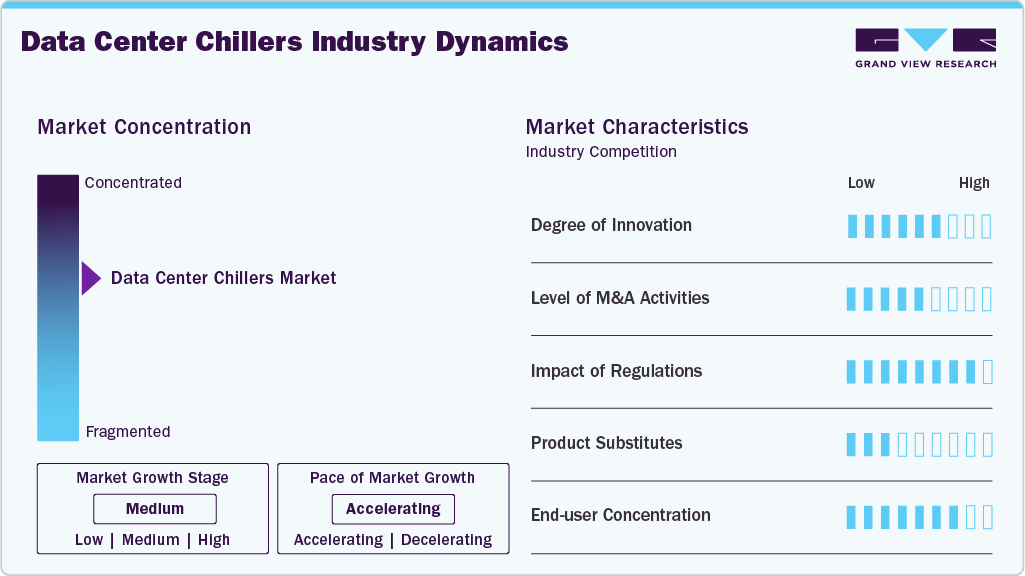
The data center chillers market is concentrated, with a significant share held by a small group of established global HVAC and mission-critical cooling manufacturers. Johnson Controls, Trane Technologies, Carrier, Daikin, and Vertiv are among the leading participants, benefiting from extensive product portfolios, global service networks, strong data center references, and advanced chiller technologies. However, regional manufacturers and specialized cooling providers such as STULZ, Airedale, Geoclima, and others continue to compete in specific applications and geographies. This creates a competitive structure where major global players dominate large-scale projects, while niche and regional suppliers capture specialized opportunities.
The global data center chillers industry has a high degree of innovation, driven by rising rack densities, AI workloads, and the need to improve cooling efficiency without compromising reliability. Manufacturers are developing higher-efficiency centrifugal, screw, scroll, and oil-free/magnetic-bearing chillers, along with variable-speed controls, intelligent monitoring, free-cooling configurations, and hybrid cooling architectures. The increasing thermal requirements of AI and HPC facilities are also encouraging closer integration between chillers and liquid-cooling systems, creating demand for cooling infrastructure that can adapt to rapidly changing load profiles.
 To learn more about this report, Download Free Sample Report
 Regulation and industry standards have a high impact on the market because data centers are intensive users of electricity and, in many cooling configurations, water. Standards such as ASHRAE 90.4 establish energy-efficiency requirements for data center design, construction, operation, and maintenance, while environmental considerations increasingly address energy consumption, water use, and greenhouse-gas emissions. These requirements encourage operators to select high-efficiency chillers, economization technologies, advanced controls, and lower-water cooling configurations. The introduction of the 2025 edition of ASHRAE 90.4 further reinforces the importance of energy and environmental performance in data center cooling decisions.
The market has high end-user concentration, particularly in large-scale deployments, as hyperscale cloud providers, colocation operators, and major technology companies account for a substantial portion of new data center capacity and cooling requirements. These customers typically procure cooling systems in large volumes and impose stringent requirements related to energy efficiency, uptime, scalability, and lifecycle performance, giving them significant influence over technology selection and supplier specifications. The rapid expansion of AI infrastructure is further strengthening this concentration, as high-density facilities require specialized and highly reliable thermal-management solutions.
Analyst Perspective
The global data center chillers market is expected to sustain growth as data center expansion, AI workloads, and rising rack power densities increase demand for reliable, energy-efficient cooling. Established manufacturers will maintain strong positions through broad portfolios, global service networks, and relationships with major operators, while specialized suppliers can gain share through oil-free/magnetic-bearing compressors, modular systems, free cooling, and high-temperature chilled-water solutions. North America remains the leading market, while Asia Pacific, Europe, the Middle East, Latin America, and other emerging regions offer additional opportunities. Replacement of aging cooling infrastructure will also gain importance as operators pursue higher efficiency, cooling capacity, and reliability for next-generation data centers.
Product Insights
Air-cooled chillers segment led the market with the largest revenue share of 69.0% in 2025, supported by their simpler installation, lower infrastructure requirements, and reduced dependence on water. These systems do not require cooling towers or condenser-water circuits, making them attractive for data centers located in water-stressed regions and for facilities where rapid deployment and ease of maintenance are priorities. Their suitability for modular, edge, and small- to medium-scale data centers further supports adoption, particularly for operators seeking to minimize installation complexity and upfront infrastructure costs.
Water-cooled chillers are expected to grow at a CAGR of 5.7% over the forecast period, as hyperscale, colocation, AI, and high-performance computing facilities increasingly require efficient cooling for large, continuous thermal loads. Their higher energy efficiency and scalability make them particularly suitable for large data center campuses with substantial cooling requirements, despite the additional infrastructure associated with cooling towers and water systems. As rack densities rise and operators focus more strongly on energy efficiency and total cost of ownership, water-cooled systems are gaining traction in large-scale deployments and are expected to narrow the gap with air-cooled chillers over the forecast period.
Modular Capacity Insights
The <500 kW segment led the market with the largest revenue share of 32.1% in 2025, supported by demand from small and medium-sized data centers, edge facilities, and modular deployments. These chillers offer a relatively compact footprint, lower initial investment, and flexibility for facilities with moderate cooling loads. The continued expansion of distributed computing and edge infrastructure is driving demand for lower-capacity systems, particularly where cooling requirements must scale with localized IT loads.
The 501-1,000 kW segment is expected to register the fastest growth at a CAGR of 8.2%, driven by increasing deployment of medium-sized enterprise and colocation data centers and the growing preference for modular cooling architectures. Chillers in this capacity range strike a balance among cooling output, efficiency, scalability, and redundancy, allowing operators to deploy multiple units and match cooling capacity to changing workloads. Rising AI and high-density computing requirements are further encouraging data center operators to adopt scalable chiller configurations in this range, while manufacturers are increasingly offering dedicated data center chillers around 500 kW and 1,000 kW capacities.
Compressor Insights
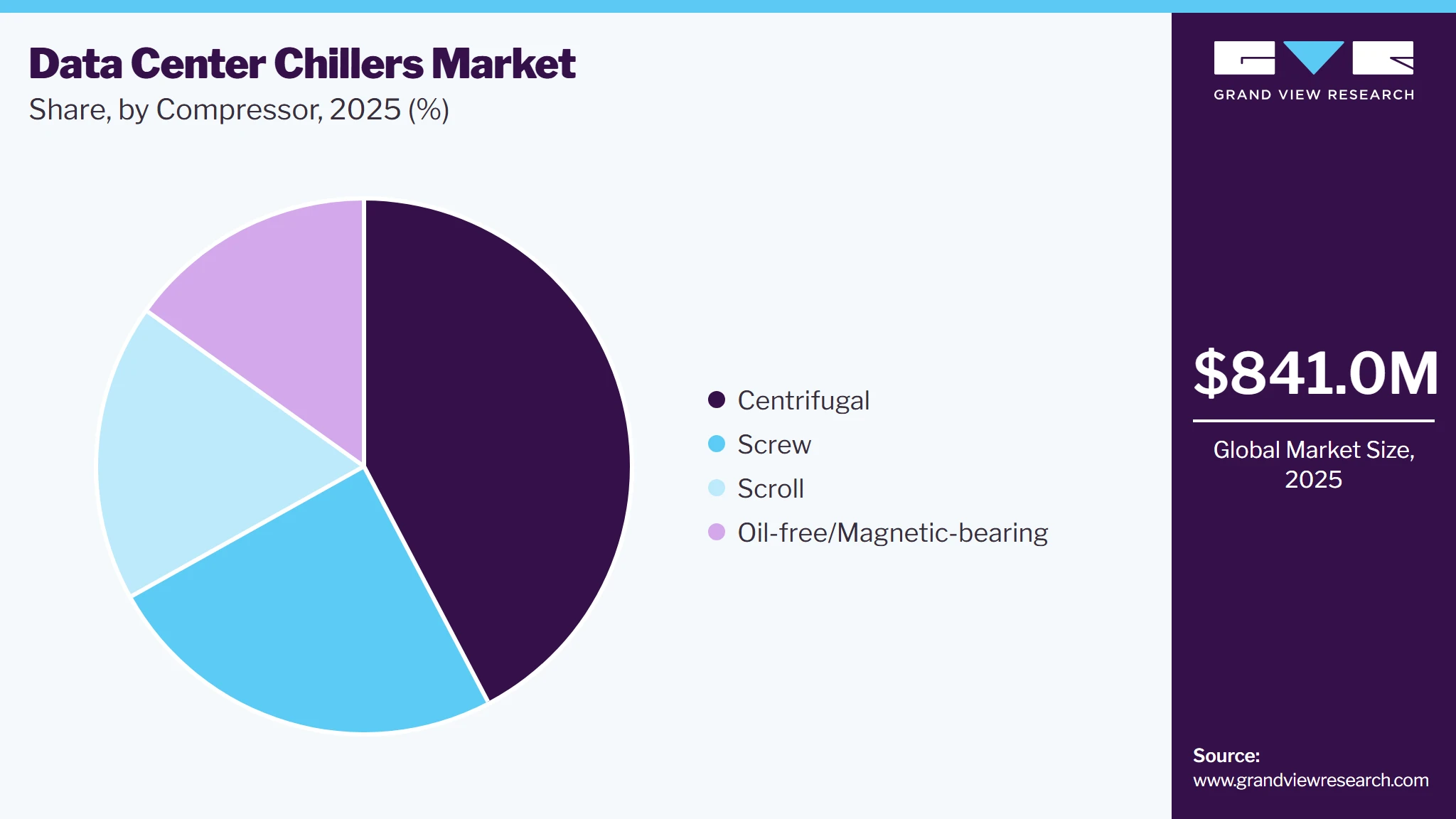
The centrifugal segment led the market with the largest revenue share of 42.3% in 2025, primarily due to their suitability for large-capacity cooling applications and strong efficiency at high loads. Their ability to provide substantial cooling capacity with relatively high efficiency makes them well-suited to hyperscale, colocation, and other large data center facilities where continuous and reliable heat removal is critical. Centrifugal technology also offers scalability and compatibility with variable-speed operation, supporting efficient management of changing data center loads.
 To learn more about this report, Download Free Sample Report
 Oil-free/magnetic-bearing compressors are expected to grow at the fastest CAGR of 8.4% over the forecast period, driven by increasing emphasis on energy efficiency, lower maintenance, and improved part-load performance. Magnetic-bearing compressors eliminate mechanical contact and the need for conventional lubrication, reducing frictional losses and preventing oil from entering the refrigerant circuit. Their strong efficiency at partial loads is particularly valuable for data centers, where cooling demand can vary significantly with IT utilization. These advantages, combined with rising energy costs and sustainability targets, are encouraging data center operators to adopt oil-free chiller technologies despite their higher initial investment.
Deployment Insights
The new installation segment led the market with the largest revenue share of 74.4% in 2025, driven by the rapid development of hyperscale, colocation, enterprise, and AI-focused data centers worldwide. The ongoing expansion of digital infrastructure requires new cooling plants to be designed alongside electrical and IT infrastructure, creating substantial demand for high-efficiency chillers, redundant cooling systems, and scalable configurations. Rising investment in new data center capacity, particularly for high-density AI workloads, is further strengthening demand for new chiller installations.
The replacement segment is expected to grow at the fastest CAGR of 7.9% over the forecast period, driven by the need to modernize aging data center cooling infrastructure and improve energy efficiency, reliability, and cooling capacity. Existing facilities are increasingly upgrading legacy chillers to accommodate higher rack densities and changing thermal loads while reducing operating costs and meeting stricter efficiency and environmental requirements. Replacement projects can also involve upgrading to variable-speed, oil-free, magnetic-bearing, and low-GWP technologies, making the installed base an increasingly important source of market demand.
Regional Insights
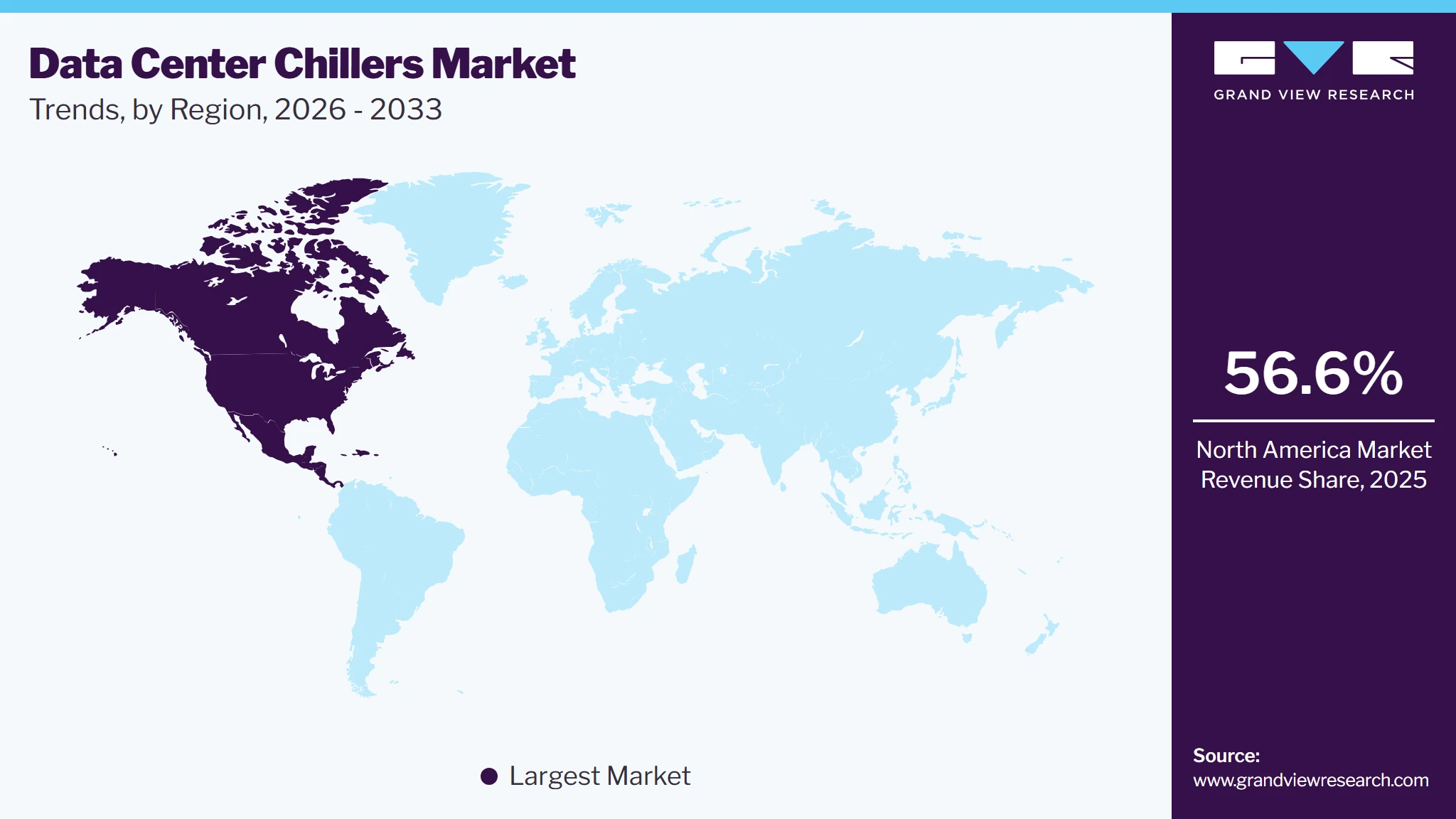
North America dominated the data center chillers market with a revenue share of 56.6% in 2025, and is expected to remain one of the fastest-growing regions, supported by the region’s large concentration of hyperscale, colocation, and AI-oriented data centers. The U.S. accounts for the majority of regional capacity, while rapid investment in AI infrastructure and high-density computing is increasing demand for high-capacity and advanced cooling systems. Strong presence of leading cloud service providers, established data center ecosystems, and substantial capital expenditure on new facilities further strengthen regional demand for efficient and reliable chillers.
 To learn more about this report, Download Free Sample Report
 U.S. Data Center Chillers Market Trends
The U.S. data center chillers industry dominated North America in 2025, reflecting the country’s extensive data center base and growing computing requirements. According to the U.S. Department of Energy, data centers used around 176 TWh of electricity in 2023, accounting for 4.4% of overall U.S. electricity consumption. DOE estimates that this demand could rise to 325-580 TWh by 2028, corresponding to approximately 6.7%-12% of U.S. electricity consumption. The rapid increase in electricity use is closely associated with expanding computing infrastructure, including AI workloads, which is increasing the need for dependable and energy-efficient cooling equipment and creating favorable conditions for advanced chiller deployment.
Europe Data Center Chillers Market Trends
The Europe data center chillers industry is projected to experience steady growth, driven by increasing demand for cloud services, data sovereignty, AI infrastructure, and energy-efficient data center operations. Sustainability requirements are particularly influential in the region, encouraging operators to deploy cooling systems that reduce energy and water consumption while improving overall facility efficiency. Established data center hubs such as London, Frankfurt, Amsterdam, and Paris continue to attract investment, while Nordic markets offer additional opportunities due to favorable climates and the integration of data center heat into district-heating networks.
The Germany data center chillers market dominated Europe in 2025, supported by its well-established digital infrastructure, strong industrial base, and concentration of enterprise, colocation, and cloud data centers. Growing adoption of cloud services, AI applications, and digital technologies is increasing computing requirements and creating greater demand for dependable cooling infrastructure. The country’s focus on energy efficiency and sustainable data center operations is also encouraging the adoption of advanced chillers with improved efficiency, intelligent controls, and lower environmental impact.
The data center chillers market in the UK is expected to experience strong growth over the forecast period, driven by the continued development of hyperscale, colocation, cloud, and AI-oriented facilities. London and other established data center hubs are attracting investments as demand for digital services and computing capacity expands. Increasing emphasis on energy-efficient infrastructure, operational resilience, and sustainable facility design is encouraging operators to modernize cooling systems and adopt advanced chiller technologies capable of supporting increasingly dense computing environments.
Asia Pacific Data Center Chillers Market Trends
The Asia Pacific data center chillers industry is expected to register strong growth, supported by rapid digitalization, expanding cloud adoption, and increasing development of hyperscale and colocation facilities across China, India, Japan, South Korea, and other Southeast Asian markets. The region is also witnessing growing investments in AI and high-performance computing, while constraints related to power availability, land, and environmental performance are encouraging operators to adopt more efficient cooling architectures. Rising data center capacity and colocation activity are creating significant opportunities for both conventional chillers and advanced cooling technologies.
The China data center chillers market dominated Asia Pacific in 2025, supported by its large digital infrastructure base, rapid cloud adoption, and continued expansion of computing and telecommunications infrastructure. The country is also accelerating the development of AI-oriented computing capacity and integrated data center networks, increasing the need for reliable thermal-management systems. According to China’s Ministry of Industry and Information Technology (MIIT), the three major telecom operators had 938,000 externally serviceable data center racks at the end of 2025, an increase of 108,000 racks from the previous year. The continued expansion of data center infrastructure and intelligent computing services is creating sustained demand for efficient and scalable cooling systems.
The data center chillers market in India is expected to witness strong growth during the forecast period, driven by rapid digitalization, cloud adoption, AI workloads, and increasing investments in domestic data center infrastructure. According to the Government of India, national data center capacity increased from approximately 375 MW in 2020 to around 1,575 MW in 2026, while data center power demand is projected to reach approximately 17 GW by 2031-32. Mumbai and Navi Mumbai currently represent the largest data center hub, accounting for more than 25% of India’s capacity, while emerging locations across several states are attracting new investments. The growing scale of AI and high-performance computing is expected to increase requirements for high-efficiency chillers and other advanced cooling technologies.
Middle East & Africa Data Center Chillers Market Trends
The Middle East & Africa data center chillers industry is expected to grow over the forecast period, supported by digital transformation initiatives, cloud adoption, data localization requirements, and government-backed investments in AI and digital infrastructure. The UAE and Saudi Arabia are emerging as important data center development markets, with large-scale projects requiring robust cooling solutions to operate reliably under challenging climatic conditions. In Africa, expanding cloud availability and colocation deployments are gradually increasing demand for modern cooling infrastructure, creating opportunities for energy-efficient and water-conscious chiller technologies.
The Saudi Arabia data center chillers market is country in Middle East & Africa, supported by its national digital transformation agenda and growing investments in cloud computing, artificial intelligence, and data center infrastructure. The country is strengthening its position as a regional technology hub through initiatives focused on AI development and digital infrastructure, while the availability of reliable energy supports large-scale computing facilities. The expansion of data centers associated with Vision 2030 and the development of dedicated cloud and digital infrastructure are expected to increase demand for reliable, high-efficiency cooling systems capable of operating under demanding climatic conditions.
Latin America Data Center Chillers Market Trends
The Latin America data center chillers industry is expected to witness increasing adoption over the forecast period, primarily driven by expanding cloud services, colocation infrastructure, digital banking, and regional content delivery requirements. Brazil remains the region’s leading data center market, with São Paulo serving as a major hub for hyperscale and colocation development. Growing investments in digital infrastructure, rising data consumption, and the increasing need for reliable thermal management are supporting demand for efficient chiller systems across the region. However, power availability, grid reliability, and infrastructure constraints may influence the pace of data center expansion in certain markets.
The Brazil data center chillers market is expected to continue leading Latin America over the forecast period, supported by expanding cloud computing, AI adoption, digital services, and investments in domestic digital infrastructure. The country is increasingly positioning itself as a regional hub for data centers, with the Southeast region accounting for the highest concentration of facilities, according to Brazil’s National Telecommunications Agency. Government initiatives aimed at strengthening data center infrastructure, improving energy efficiency, and attracting investment are further supporting market development.
Key Data Center Chillers Company Insights
Some of the key players operating in the market include Johnson Controls, Trane Technologies, and Carrier.
-
Johnson Controls company offering solutions for building efficiency, thermal management, automation, and infrastructure optimization. The company provides a broad range of HVAC, refrigeration, building controls, and digital technologies, with its solutions serving sectors such as data centers, healthcare, manufacturing, and commercial buildings. Its capabilities in intelligent building systems and cooling technologies position the company as a significant participant in the data center infrastructure and thermal management market.
-
Trane, a brand of Trane Technologies, is a global provider of thermal management, HVAC, energy, sustainability, and building automation solutions. The company serves a broad range of applications, including data centers, healthcare, education, government, retail, and commercial buildings. Its portfolio includes air- and water-cooled chillers, modular and process chillers, liquid cooling systems, building controls, and energy-efficiency services, enabling customers to improve operational performance while addressing energy and decarbonization objectives. Trane combines global technical expertise with local service capabilities to support customers throughout the lifecycle of their building and cooling infrastructure.
Key Data Center Chillers Companies
The following key companies have been profiled for this study of the data center chillers market.
-
Johnson Controls
-
Trane Technologies
-
Carrier
-
Daikin Applied
-
Vertiv Group Corp.
-
Schneider Electric
-
Mitsubishi Electric Corporation
-
STULZ GMBH
-
AIREDALE INTERNATIONAL AIR CONDITIONING LTD.
-
LG Electronics
-
Thermax
-
Blue Star Limited
-
Geoclima International S.r.l.
-
Danfoss
-
Munters
Competitive Benchmarking
Category
Operating Strategies
Competitive Edge
Weakness
Established Players (e.g., Johnson Controls; Trane Technologies; Carrier; Daikin Applied; Vertiv Group Corp.)
- Expand high-capacity chiller portfolios to address hyperscale, AI, and high-density data center requirements.
- Invest in magnetic-bearing, energy-efficient, low-water, and advanced cooling technologies.
- Strengthen global service networks and long-term relationships with major data center operators.
- Strong global brand recognition and extensive installed base.
- Broad product portfolios covering multiple capacities, compressor technologies, and cooling configurations.
- Strong project execution capabilities, technical expertise, and lifecycle service support.
- Large organizational structures can reduce flexibility for highly customized or smaller projects.
- Higher manufacturing, R&D, and service costs can result in comparatively higher product prices.
- Greater exposure to fluctuations in large hyperscale and colocation capital expenditure.
Emerging & Regional Players (e.g., Schneider Electric; Mitsubishi Electric Corporation; STULZ GmbH; Airedale International Air Conditioning Ltd.; Geoclima International S.r.l.)
- Focus on specialized data center cooling applications and specific regional requirements.
- Develop differentiated solutions such as modular chillers, free cooling, oil-free compressors, and high-efficiency systems.
- Expand through regional partnerships, localized manufacturing, and targeted geographic expansion.
- Greater flexibility in customizing products and responding to specific project requirements.
- Ability to target niche applications and emerging data center markets.
- Strong understanding of regional climatic conditions, regulations, and customer requirements.
- Smaller global distribution and after-sales service networks compared with established OEMs.
- Lower brand recognition among hyperscale and multinational data center operators.
- More limited financial and manufacturing scale can restrict participation in very large multi-site projects.
Recent Developments
-
In February 2026, Johnson Controls introduced the YORK YDAM, a high-density air-cooled chiller developed for multistory data centers and AI-focused facilities. The system uses magnetic-bearing centrifugal compressor technology and is designed to deliver high cooling capacity while minimizing equipment footprint. Its compatibility with warm-water cooling supports the thermal requirements of advanced GPU infrastructure and can help improve overall cooling efficiency.
-
In July 2026, Trane launched the HSWE magnetic-bearing centrifugal chiller specifically for the Asia Pacific market, with a focus on demanding data center cooling applications. The water-cooled system combines oil-free magnetic-bearing technology with advanced heat exchanger and control technologies to deliver high efficiency and stable performance. It offers capacities of up to more than 1,500 RT for data centers and supports higher chilled-water temperatures for integration with free-cooling systems.
Data Center Chillers Market Report Scope
Report Attribute
Details
Market size in 2025
USD 841.0 million
Estimated market size in 2026
USD 891.8 million
Projected market size by 2033
USD 1,450.5 million
Growth rate
CAGR of 7.2% from 2026 to 2033
Historical data
2021 - 2024
Forecast period
2026 - 2033
Quantitative units
Revenue in USD million and CAGR from 2026 to 2033
Report coverage
Revenue forecast, company ranking, competitive landscape, growth factors, and trends
Segments covered
Product, modular capacity, compressor, deployment, region
Regional scope
North America; Europe; Asia Pacific; Latin America; Middle East & Africa
Country scope
U.S.; Canada; Mexico; UK; Germany; France; Spain; Italy; China; Japan; India; Australia; South Korea; Brazil; Argentina; Saudi Arabia; South Africa; UAE
Key companies profiled
Johnson Controls; Trane Technologies; Carrier; Daikin Applied; Vertiv Group Corp.; Schneider Electric; Mitsubishi Electric Corporation; STULZ GmbH; Airedale International Air Conditioning Ltd.; LG Electronics; Thermax; Blue Star Limited; Geoclima International S.r.l.; Danfoss; Munters
Customization scope
Free report customization (equivalent up to 8 analysts working days) with purchase. Addition or alteration to country, regional & segment scope.
Pricing and purchase options
Avail customized purchase options to meet your exact research needs. Explore purchase options
Global Data Center Chillers Market Report Segmentation
This report forecasts revenue growth at the global, regional, and country levels and provides an analysis of the latest industry trends in each of the sub-segments from 2021 to 2033. For this study, Grand View Research has segmented the global data center chillers market report based on product, modular capacity, compressor, deployment, and region:
-
Product Outlook (Revenue, USD Million, 2021 - 2033)
-
Air-Cooled Chillers
-
Water-Cooled Chillers
-
-
Modular Capacity Outlook (Revenue, USD Million, 2021 - 2033)
-
<500 kW
-
501-1000kW
-
1001-1500kW
-
>1501kW
-
-
Compressor Outlook (Revenue, USD Million, 2021 - 2033)
-
Centrifugal
-
Screw
-
Scroll
-
Oil-free/Magnetic-bearing
-
-
Deployment Outlook (Revenue, USD Million, 2021 - 2033)
-
New Installation
-
Replacement
-
-
Regional Outlook (Revenue, USD Million, 2021 - 2033)
-
North America
-
U.S.
-
Canada
-
Mexico
-
-
Europe
-
Germany
-
France
-
Italy
-
Spain
-
UK
-
-
Asia Pacific
-
China
-
India
-
Japan
-
South Korea
-
Australia
-
-
Latin America
-
Brazil
-
Argentina
-
-
Middle East and Africa
-
Saudi Arabia
-
South Africa
-
UAE
-
-
Research Methodology
The data center chillers market figures in this report are based on a proven research process that combines executive interviews with secondary research from proprietary databases, company filings, and recognized regulatory and institutional sources. Market size is built through value-chain sizing-reconciling supply-side and demand-side estimates-and triangulated with bottom-up and top-down approaches. Every estimate passes multiple levels of expert validation before publication, with each data center chillers segment quantified using the revenue-capture definitions in the table below.
Segment Definition
Modular Capacity
Revenue Capture Definition
<500 kW
Revenue generated from the sale of data center chillers with rated cooling capacities below 500 kW, primarily covering compact and modular cooling requirements. The segment includes systems suitable for smaller data centers, edge facilities, and installations where cooling capacity needs to be deployed incrementally.
501-1000kW
Revenue generated from the sale of chillers with cooling capacities between 501 kW and 1000 kW. These systems address medium-scale data center requirements and can be deployed individually or in multiple-unit configurations to provide scalability, redundancy, and capacity matching.
1001-1500kW
Revenue generated from the sale of chiller systems rated from 1001 kW to 1500 kW. This category covers higher-capacity installations intended for facilities with substantial and continuously operating IT cooling loads.
>1501kW
Revenue generated from the sale of chillers with cooling capacities exceeding 1501 kW. These systems primarily address large-scale data center cooling requirements where substantial thermal loads, operational continuity, and high-capacity centralized cooling are required.
Compressor
Revenue Capture Definition
Centrifugal
Revenue generated from the sale of chillers incorporating centrifugal compressors, which use rotating impellers to compress refrigerant and are generally suited to high-capacity cooling applications. Their scalability and efficiency make them particularly relevant for large data center cooling plants.
Screw
Revenue generated from the sale of chillers equipped with screw compressors that use intermeshing helical rotors for refrigerant compression. These systems are commonly used across medium- and large-capacity applications because of their robust operation and suitability for varying cooling loads.
Scroll
Revenue generated from the sale of chillers incorporating scroll compressors, which compress refrigerant through the movement of intermeshing spiral components. These systems are generally suited to smaller and modular cooling applications and can be configured in multiple-compressor arrangements.
Oil-free/Magnetic-bearing
Revenue generated from the sale of chillers using oil-free or magnetic-bearing compressor technology, in which magnetic bearings support the compressor shaft without conventional mechanical contact and lubrication. These systems are increasingly relevant to data centers because of their potential for high efficiency, particularly under part-load operating conditions, along with reduced oil-related maintenance requirements.
Product
Revenue Capture Definition
Air-Cooled Chillers
Revenue generated from the sale of air-cooled chiller systems designed to remove heat from data center cooling circuits by rejecting heat directly to the surrounding air. This includes packaged and modular units used where simplified installation, lower infrastructure requirements, or limited water availability are important considerations.
Water-Cooled Chillers
Revenue generated from the sale of water-cooled chiller systems that transfer heat through a condenser-water circuit, typically supported by cooling towers or related heat-rejection equipment. These systems are generally used for larger cooling loads where higher efficiency and centralized cooling performance are important.
Deployment
Revenue Capture Definition
New Installation
Revenue generated from the sale of chiller systems installed as part of newly constructed data centers or newly developed cooling plants. This includes equipment supplied for new hyperscale, colocation, enterprise, AI, and other data center facilities, including associated cooling infrastructure commissioned during initial construction.
Replacement
Revenue generated from the sale of chiller systems used to replace aging, inefficient, obsolete, or insufficient cooling equipment in existing data centers. Replacement sales can include upgrades to higher-efficiency, variable-speed, oil-free, or magnetic-bearing technologies to improve cooling performance and accommodate increasing IT loads.
Estimation Model
Layer Name
Key Question
Description
Market Scope & Definition
What constitutes the data center chillers market?
Define the market scope by identifying data center chiller systems included in the study, along with applicable product types, capacity ranges, compressor technologies, and deployment categories.
Segment & Regional Assessment
How is the market distributed?
Assess demand across air-cooled and water-cooled chillers, modular capacity ranges, compressor types, deployment categories, and major regions and countries to determine segment-level market shares and growth patterns.
Manufacturer & Market Assessment
Who are the key market participants?
Evaluate major manufacturers, product portfolios, competitive positioning, technology offerings, geographic presence, and market participation to determine the contribution of key players across different market segments.
Revenue Estimation
What is the total market revenue?
Calculate data center chillers market revenue by aggregating segment-level sales across product, capacity, compressor, deployment, regional, and country markets within the defined market scope.
Delivered Customizations
This report has been delivered with the following In-depth customizations
Client Request
Customization Delivered
Value Adds
Regional Segmentation
Delivered a comprehensive regional and country-level assessment covering North America, Europe, Asia Pacific, Latin America, and Middle East & Africa, with key country analysis for the U.S., Germany, UK, China, India, Saudi Arabia, and Brazil. The analysis identifies regional market leaders, high-growth countries, demand factors, data center development trends, and cooling infrastructure requirements.
Provides a clear understanding of regional demand concentration, growth opportunities, and country-specific market dynamics, helping identify priority markets for expansion and investment.
Competitive Benchmarking
Delivered a detailed competitive assessment of major participants including Johnson Controls, Trane Technologies, Carrier, Daikin Applied, Vertiv, Schneider Electric, Mitsubishi Electric, STULZ, Airedale International, and Geoclima. The assessment covers market positioning, product portfolios, technology focus, strategic developments, operating strategies, competitive advantages, and key limitations.
Enables comparison of established and emerging participants based on technology capabilities, product breadth, data center focus, geographic presence, and strategic positioning, supporting competitor identification and benchmarking.
Opportunity Assessment
Delivered an assessment of major growth opportunities across high-density AI data centers, water-efficient cooling, oil-free/magnetic-bearing chillers, high-capacity systems, modular cooling infrastructure, replacement demand, and emerging data center markets in Asia Pacific, Latin America, and the Middle East & Africa.
Highlights high-growth segments, emerging technology opportunities, regional white spaces, and evolving customer requirements, helping identify areas with strong future revenue potential.
Frequently Asked Questions About This Report
The global data center chillers market is expected to grow at a CAGR of 7.2% from 2026 to 2033, to reach USD 1,450.5 million by 2033.
Air-cooled chillers dominated the market, accounting for 69.0% of global revenue in 2025. Their lower infrastructure requirements, simpler installation, reduced water dependency, and suitability for different data center environments supported their leading position.
New installation segment led the market with the largest revenue share of 74.4% in 2025 while replacement segment is expected to be the fastest-growing market.
The centrifugal segment led the market with the largest revenue share of 42.3% in 2025 while oil-free/magnetic-bearing compressors is second fastest growing market.
The data center chillers market size was valued at USD 841.0 million in 2025 and is estimated at USD 891.8 million in 2026.
North America was the largest regional market, accounting for 56.6% of global revenue in 2025.
Some of the key players operating in the global data center chillers market include Johnson Controls; Trane Technologies; Carrier; Daikin Applied; Vertiv Group Corp.; Schneider Electric; Mitsubishi Electric Corporation; STULZ GmbH; Airedale International Air Conditioning Ltd.; LG Electronics; Thermax; Blue Star Limited; Geoclima International S.r.l.; Danfoss; Munters.
The market is primarily driven by the rapid expansion of hyperscale, colocation, cloud, and AI-focused data centers, increasing rack power densities, rising demand for high-performance computing, and the growing need for reliable and energy-efficient cooling infrastructure. Increasing emphasis on reducing data center energy consumption and modernizing aging cooling systems is also supporting the adoption of advanced chiller technologies.
About the Author(s)
Advanced Interior Materials Research Team
Advanced Materials · Advanced Interior MaterialsThis report was authored by the advanced interior materials research team at Grand View Research - comprising two research analysts, one senior research analyst, and one industry expert - with specialized expertise in the advanced interior materials segment of the advanced materials industry. All findings are based on proprietary advanced materials databases, executive interviews, and regulatory analysis, subject to internal peer review prior to publication.
Last Updated:
Speak to Analyst

Customize this report to your needs - add regions, segments, or data points, with 20% free customization.
Or view our licence options:


ISO 9001:2015 & 27001:2022 Certified
We are GDPR and CCPA compliant! Your transaction & personal information is safe and secure. For more details, please read our privacy policy.


