
- Home
- »
- Next Generation Technologies
- »
-
Data Center Ups Market Size & Share Report, 2026-2033GVR Report cover

Data Center UPS Market (2026 - 2033)
Size, Share & Trends Analysis Report By Setup (Centralized, Distributed), By UPS Architecture, By Data Center Size, By Product (Line Interactive, Double Conversion), By End Use, By Region, And Segment Forecasts
Market Size, 2025
$7.7BMarket Estimate, 2026
$8.2BMarket Forecast, 2033
$15.5BCAGR, 2026–2033
9.4%Data Center UPS Market Summary
The global data center UPS market size was valued at USD 7.7 billion in 2025 and is projected to grow from USD 8.2 billion in 2026 to USD 15.5 billion by 2033, at a CAGR of 9.4% from 2026 to 2033. North America dominated the market, accounting for 35.0% of revenue in 2025. This growth is driven by the rapid expansion of hyperscale and AI-ready data centers, coupled with increasing cloud adoption and stringent uptime requirements.
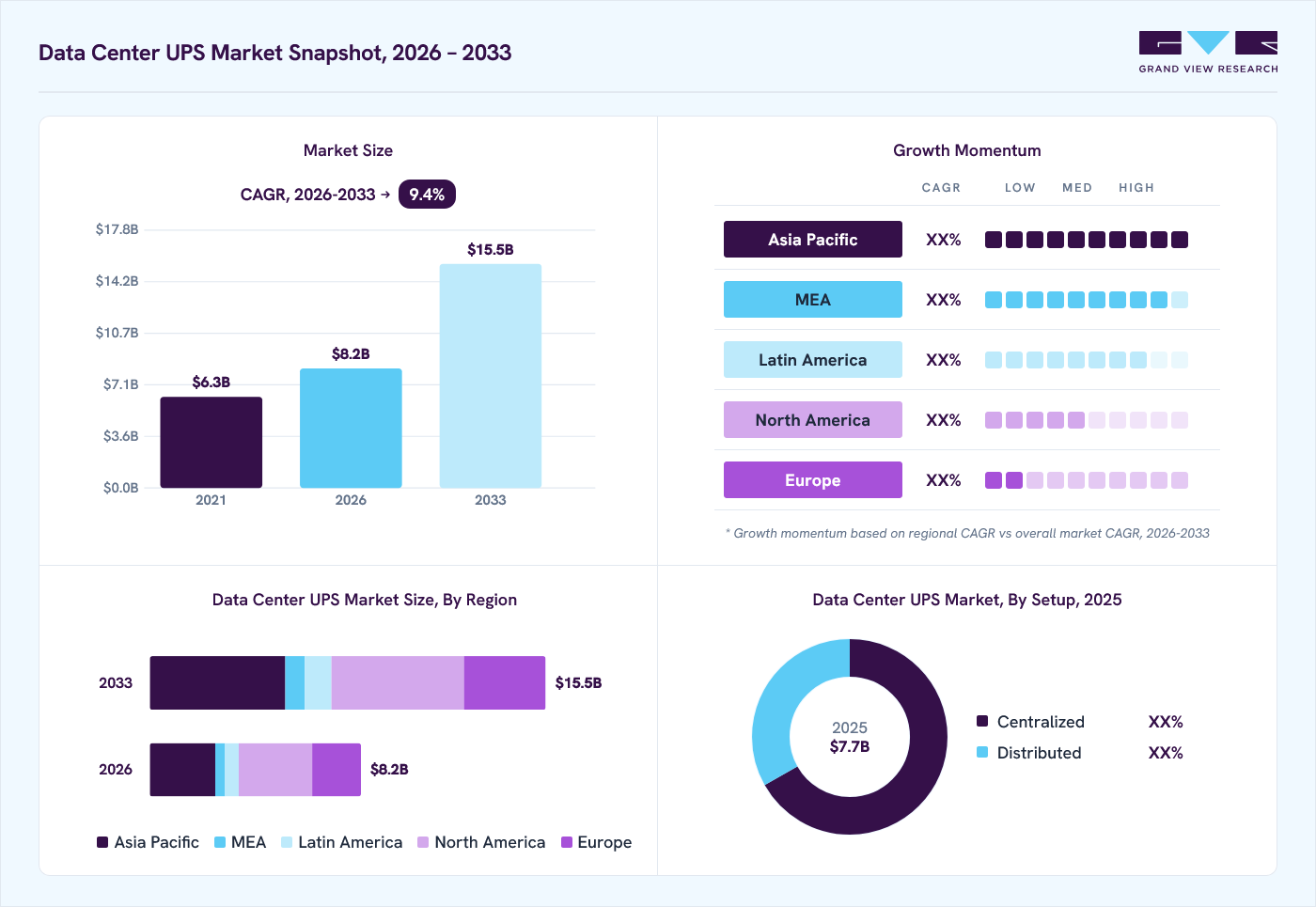 Source: Grand View Research, IR Documents, Primary Interviews, Paid DatabasesTo learn more about this report,
 Download Free Sample Report
Key Market Trends & Insights
- By setup: Centralized segment dominated the market, with a revenue share of 66.7% in 2025
- By UPS architecture: Monolithic segment dominated the market, with a revenue share of 60.6% in 2025
- By data center size: Large data centers (more than 500 kVA) segment dominated the market, with a revenue share of 46.6% in 2025
- By product: Double conversion segment dominated the market, with a revenue share of 67.4% in 2025
- By end use: IT & telecommunications segment held the largest revenue share in 2025
Regional Highlights
- Largest regional market: North America (35.0% revenue share, 2025)
- Fastest-growing regional market: Asia Pacific (highest CAGR, 2026-2033)
- By country: The U.S. held the largest market share in 2025.
Market Size & Forecast
- Market size in 2025: USD 7.7 Billion
- Estimated market size in 2026: USD 8.2 Billion
- Projected market size by 2033: USD 15.5 Billion
- CAGR (2026-2033): 9.4%
Three ways to get this report
Buy it, customize it, or ask a question.Ask an Analyst
Analyst response in 1 business day
- AccessReport author, directly
- Reply timeWithin 1 working day
- No sales callDirect answer only
- FormatEmail reply
- CostFree, no cost
Get the Full Report
What the study covers
- FormatsPDF · Excel · Dashboard
- Timeline2026–2033 annual, 2025 base
- Coverage20+ countries, 5 regions
- Companies10+ key players profiled
Customize the Report
20% free customization
- IncludeCountries, segments, points
- TailorTo your product definition
- ExtendDeeper competitor detail
- OrA fully bespoke study
- Turnaround5–10 working days
One of the primary drivers is the rapid expansion of data centers due to increasing digitalization and the growing reliance on cloud computing services. As businesses and consumers demand more digital services, the need for reliable Uninterruptible Power Supply (UPS) systems has intensified to ensure operational continuity. In addition, the growing awareness of the risks associated with power outages, such as data loss and operational downtime, has led organizations to prioritize robust power management solutions in their data centers.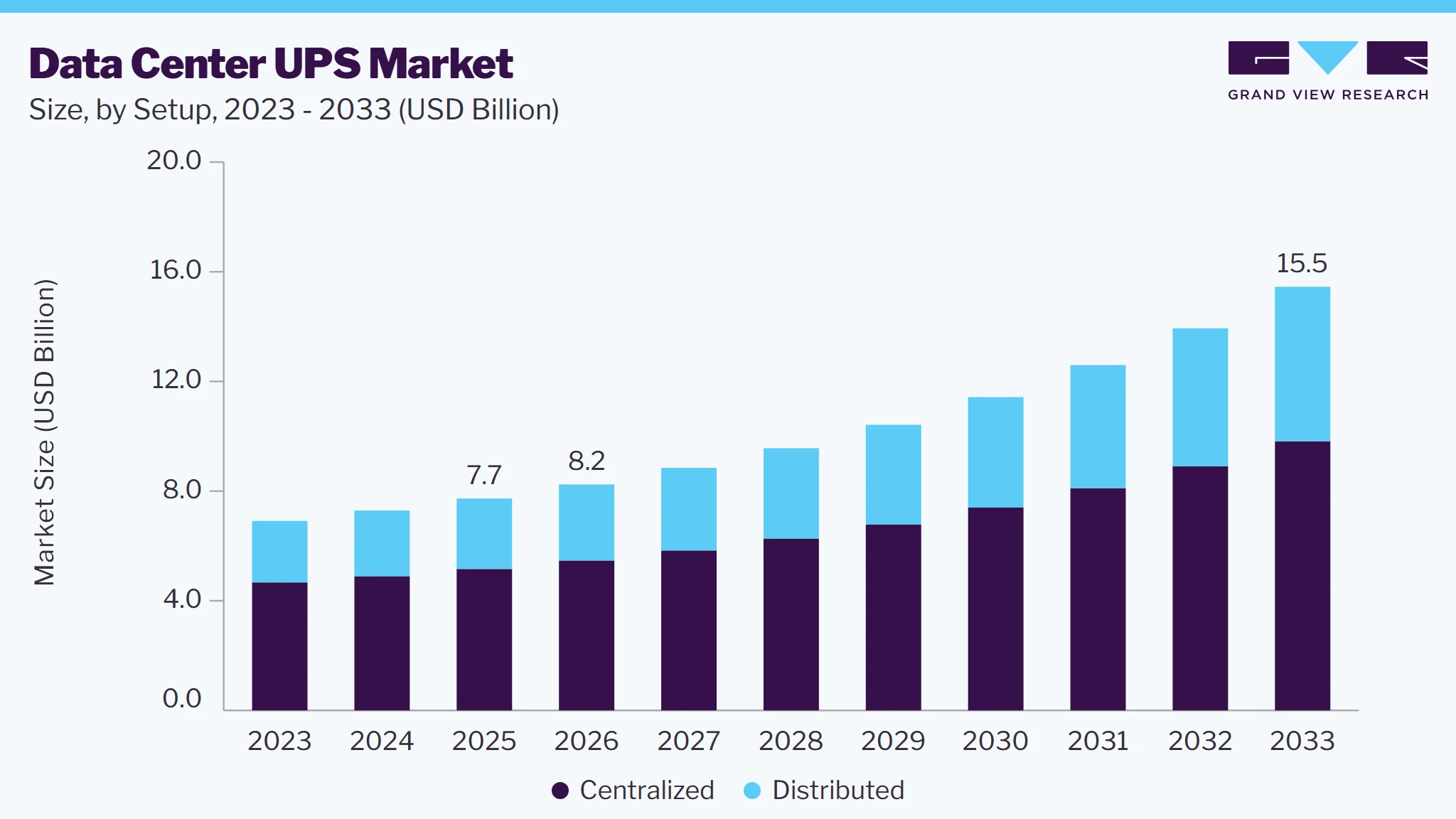 To learn more about this report, Download Free Sample Report
Technological advancements are expected to further propel the data center UPS industry. The shift toward more sophisticated UPS systems capable of handling higher capacities and enhancing efficiency is becoming increasingly important. Innovations such as modular UPS systems and lithium-ion battery technology are gaining traction, offering improved performance and reduced maintenance costs. These technological advancements enhance reliability and align with the growing emphasis on energy efficiency and sustainability in data center operations.
Moreover, regulatory pressures and corporate sustainability goals are likely to drive demand for eco-friendly UPS solutions. As governments implement stricter regulations regarding energy consumption and carbon emissions, data centers are increasingly required to adopt greener technologies to comply with these mandates. This shift toward sustainable practices encourages investment in advanced UPS systems that utilize renewable energy sources and promote energy efficiency. These factors are set to create a robust growth trajectory for the global data center UPS market in the coming years.
Market Dynamics
The global data center UPS market is witnessing strong growth as organizations increasingly prioritize uninterrupted power availability, operational resilience, and energy-efficient infrastructure to support mission-critical digital operations. Enterprises are adopting advanced UPS systems to ensure continuous power protection for servers, storage, networking equipment, and critical IT infrastructure while minimizing downtime and safeguarding against power disturbances. Modern data center UPS solutions leverage modular architectures, lithium-ion battery technology, intelligent power management, remote monitoring, and predictive maintenance capabilities to optimize energy efficiency, enhance scalability, and improve system reliability. The rapid expansion of hyperscale and colocation data centers, cloud computing, AI workloads, and edge computing is driving demand for data center UPS solutions that ensure reliable power, energy efficiency, and uninterrupted operations.
The rapid expansion of hyperscale and colocation data centers, coupled with the growing adoption of cloud computing, AI workloads, and high-density computing, is a significant driver of the global data center UPS market. Organizations are increasingly deploying advanced UPS systems to ensure continuous power availability for mission-critical IT infrastructure, minimizing downtime caused by power fluctuations and outages. Modern UPS solutions integrate modular architectures, lithium-ion batteries, intelligent power management, remote monitoring, and predictive maintenance capabilities to improve energy efficiency, enhance scalability, and reduce operational costs. For instance, in April 2026, ABB introduced the 34.5kV HiPerGuard UPS, a medium-voltage UPS designed specifically for AI data centers. The solution enables direct grid connection without voltage conversion while supporting battery storage, renewable energy integration, and microgrid-ready architectures, improving energy efficiency, resilience, and power availability for next-generation AI workloads.
The substantial capital investment required to deploy and maintain advanced UPS systems remains a key restraint for the data center UPS market. Organizations must invest in UPS equipment, battery systems, power distribution infrastructure, cooling integration, and ongoing maintenance to ensure reliable operations. Upgrading legacy data centers to support high-density AI and cloud workloads often requires significant electrical redesign, increasing implementation costs and operational complexity. In addition, battery replacement, lifecycle management, regulatory compliance, and integration with existing facility management systems add to the total cost of ownership. Small and medium-sized data center operators, in particular, may face budget constraints that delay modernization projects and limit the adoption of advanced UPS technologies.
The growing focus on energy efficiency, sustainability, and intelligent power management presents a significant growth opportunity for the global data center UPS market. Data center operators are increasingly investing in next-generation UPS solutions featuring lithium-ion batteries, AI-enabled monitoring, predictive maintenance, modular scalability, and cloud-based power management platforms to improve reliability while reducing operating costs. The rapid deployment of hyperscale, colocation, and edge data centers, along with increasing AI and high-performance computing workloads, is driving demand for high-efficiency UPS systems capable of supporting higher power densities. Moreover, the integration of UPS systems with renewable energy sources, battery energy storage systems (BESS), microgrids, and smart energy management platforms is creating new opportunities for vendors to deliver resilient, low-carbon, and future-ready power infrastructure that supports global sustainability goals.
Analyst Perspective
The Data Center UPS market sits at the intersection of accelerating digital transformation, rapid expansion of hyperscale and edge data centers, and increasing demand for uninterrupted power availability. Organizations are increasingly required to ensure continuous operation of mission-critical IT infrastructure supporting cloud computing, AI workloads, big data analytics, and enterprise applications, driving strong demand for reliable and energy-efficient UPS systems. Traditional power infrastructure is becoming inadequate for high-density computing, driving adoption of advanced Data Center UPS solutions with modular designs, intelligent power management, and energy-efficient technologies to ensure scalable, resilient, and uninterrupted operations.
Setup Insights
Based on the setup, the centralized segment led the market with the largest revenue share of 66.7% in 2025, owing to its ability to deliver reliable, efficient power management for large-scale data centers. Centralized UPS systems are designed to support extensive IT infrastructure, ensuring uninterrupted power supply during outages. This configuration allows for easier maintenance and management, making it a favored choice among operators seeking to optimize performance and minimize downtime. In addition, centralized systems often integrate advanced monitoring and management features, enabling operators to address potential issues before they escalate.
The distributed segment is expected to grow at the highest CAGR over the forecast period, driven by the increasing need for flexibility and scalability in data center operations. As organizations expand their digital infrastructures, distributed UPS systems offer modularity that aligns with evolving business requirements. These systems allow for decentralized power management, which is particularly beneficial in multi-site operations where power demands vary significantly. Furthermore, the ability to easily scale up or down based on real-time needs makes distributed systems appealing to businesses aiming to enhance their operational resilience.
UPS Architecture Insights
Based on UPS architecture, the monolithic segment led the market with the largest revenue share of 60.6% in 2025. Monolithic systems are ideal for facilities with consistent power demands, providing robust support without the complexities associated with modular setups. Their reliability in critical applications has solidified their position within the data center UPS industry. Moreover, monolithic UPS systems often offer high efficiency and lower total cost of ownership, making them an economical choice for organizations focused on long-term operational stability. Monolithic systems play a significant role in shaping market dynamics as more companies seek dependable solutions for their power needs.
The modular segment is expected to grow at the highest CAGR over the forecast period. Modular UPS systems allow incremental capacity upgrades, accommodating fluctuating power needs without significant upfront investments. This feature is particularly appealing in an era where rapid technological advancements necessitate agile infrastructure solutions. In addition, modular designs facilitate easier maintenance and component replacement, reducing downtime during service operations. For instance, many power modules are designed in two rows to maximize space efficiency, resulting in a footprint that occupies up to 50% less floor space than traditional standalone units. As organizations strive to optimize their energy consumption while maintaining high availability, modular UPS systems are becoming integral to future-proofing data center operations within the data center UPS industry.
Data Center Size Insights
Based on data center size, the large data centers (more than 500 kVA) segment led the market with the largest revenue share of 46.6% in 2025 due to the proliferation of edge computing and localized data processing needs. These smaller facilities often require cost-effective yet reliable power solutions, making them ideal candidates for efficient UPS systems that can ensure operational continuity without excessive expenditure. The growth of IoT devices and applications has further increased demand for small data centers that can process data closer to its source. As businesses seek to enhance responsiveness and reduce latency, investments in small-scale UPS solutions are expected to continue to rise in the data center UPS industry.
The large data centers (More than 500 kVA) segment is expected to grow at the highest CAGR over the forecast period. The growing volume of data generated by enterprises necessitates robust backup power solutions capable of supporting critical operations during outages. These large facilities often host critical applications that require uninterrupted service delivery; thus, they demand advanced UPS systems capable of handling significant power loads efficiently. As large organizations invest heavily in their IT infrastructure and digital transformation initiatives, demand for high-capacity UPS solutions tailored for these environments is set to increase.
Product Insights
By product, the double-conversion segment led the market with the largest revenue share of 67.4% in 2025, owing to its superior protection against power disturbances. This technology provides a clean and stable output voltage by converting incoming AC power into DC and back into AC, making sensitive equipment housed within data centers essential. The reliability of double-conversion systems has made them a standard choice among operators seeking to safeguard critical operations against voltage fluctuations and outages. Furthermore, as businesses increasingly rely on high-performance computing applications, the demand for double-conversion UPS systems remains strong within the data center UPS industry.
The line-interactive segment is expected to grow at the highest CAGR over the forecast period as businesses seek cost-effective solutions that still provide essential backup capabilities. Line-interactive UPS systems offer a balance between performance and price, making them attractive for small to medium-sized enterprises that require dependable power without extensive investment. These systems use Automatic Voltage Regulation (AVR) to correct minor voltage fluctuations without switching to battery mode, thereby extending battery life and reducing operational costs.
End Use Insights
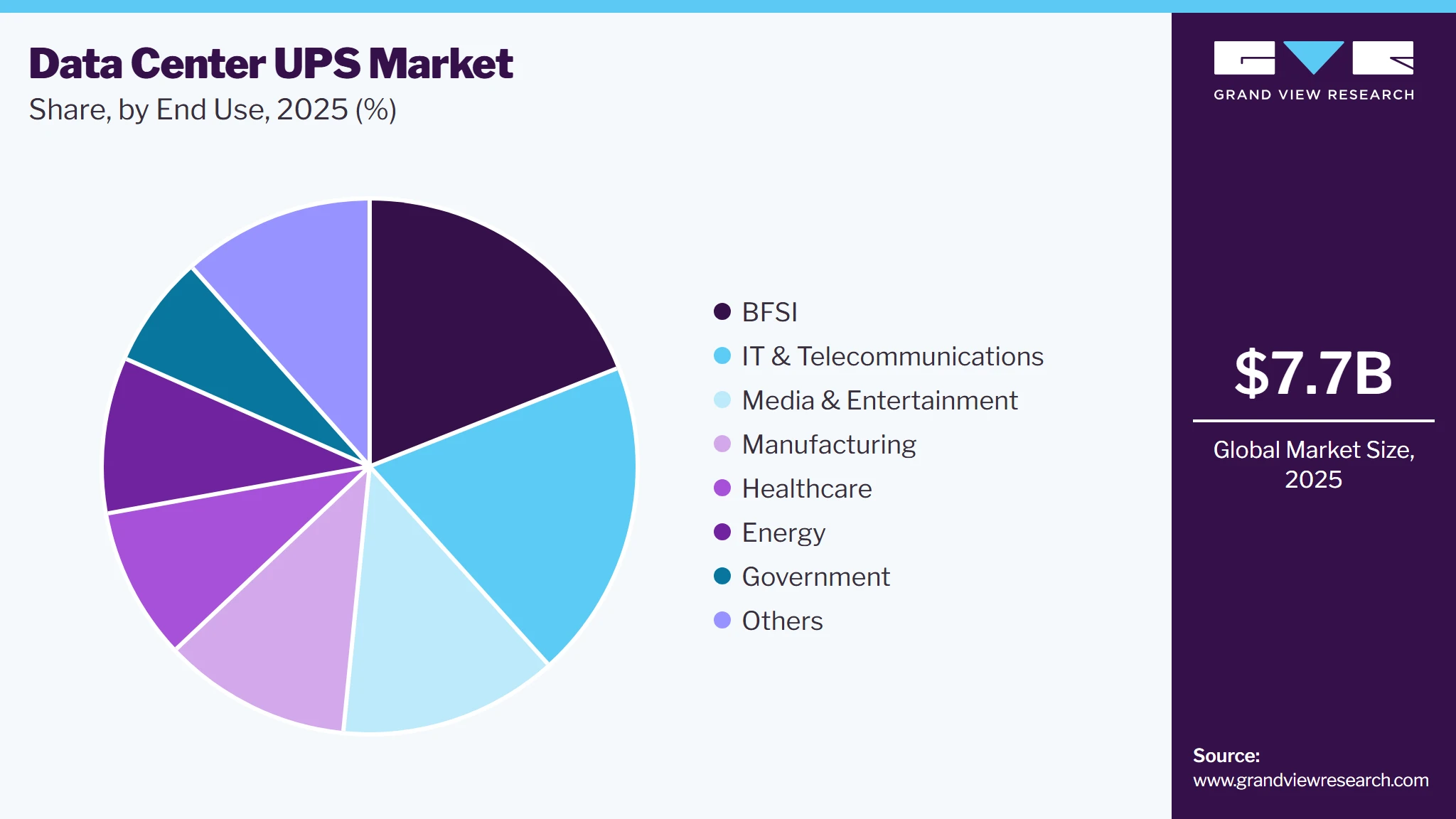
Based on end use, IT & telecommunications segment led the market with the largest revenue share of 19.3% in 2025 due to its heavy reliance on data centers for storing and processing vast amounts of information. The critical nature of data integrity and availability within this sector drives significant investments in UPS systems designed specifically for high-demand environments. Companies operating in this space require reliable power solutions that support continuous operations while minimizing the risks of downtime or system failures.
 To learn more about this report, Download Free Sample Report
The BFSI segment is expected to grow at a significant CAGR over the forecast period as financial institutions increasingly prioritize data security and operational continuity. The reliance on real-time transactions necessitates robust UPS solutions that mitigate the risks of power failures while ensuring compliance with regulatory requirements for data protection. As financial services continue their digital transformation journeys, investments in advanced uninterruptible power supply systems are essential for maintaining service reliability and safeguarding sensitive information.
Regional Insights
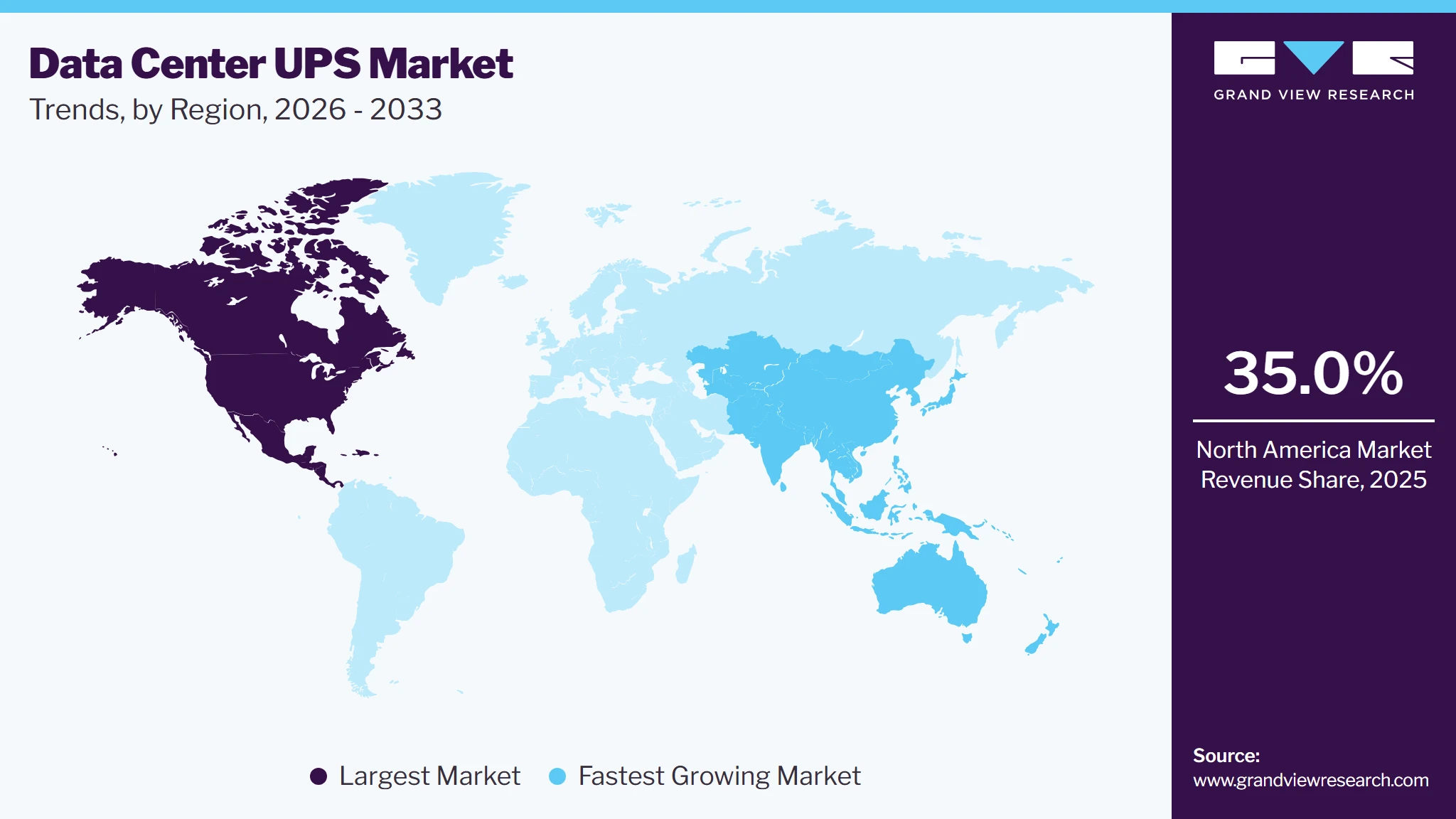
North America dominated the global data center UPS market, with the largest revenue share of 35.0% in 2025, driven by a mature digital infrastructure and high demand for cloud services. The region's numerous data centers leverage advanced UPS technologies to maintain operational efficiency amidst growing digital transformation initiatives across various industries. In addition, North America's strong focus on innovation drives continuous improvements in power management solutions tailored to diverse data center applications.
 To learn more about this report, Download Free Sample Report
U.S. Data Center UPS Market Trends
The data center UPS market in the U.S. held the largest share in the North America region in 2025 due to its concentration of major technology firms and extensive data center networks. This dominance reflects substantial infrastructure investments to meet increasing consumer demands for digital services while ensuring a reliable power supply during outages or fluctuations. The presence of leading cloud service providers further amplifies the demand for sophisticated UPS solutions capable of effectively supporting large-scale operations.
Middle East & Africa Data Center UPS Market Trends
Middle East & Africa data center UPS market is anticipated to grow at the highest CAGR. The growing number of new data centers, driven by economic diversification efforts, highlights a critical need for reliable power solutions to support expanding operations across the finance, healthcare, and telecommunications sectors. As governments prioritize digital infrastructure development initiatives to foster economic growth through technology adoption, demand for advanced uninterruptible power supply systems is expected to rise within this region's evolving landscape.
Saudi Arabia data center UPS market dominated the regional market in 2025. The country's focus on diversifying its economy beyond oil has increased demand for efficient UPS solutions to support expanding data center operations across multiple industries, including the finance and telecommunications sectors. As Saudi Arabia continues to invest heavily in building state-of-the-art facilities equipped with cutting-edge technologies such as AI-driven analytics tools and IoT-enabled devices, advancements within its local data center UPS market are expected to support this growth.
Asia Pacific Data Center UPS Market Trends
The Asia Pacific data center UPS market is expected to grow at a significant CAGR from 2026 to 2033 as countries in this region ramp up their digital initiatives amid rising internet penetration and increasing smartphone adoption worldwide. The rising number of new entrants into this space and existing players expanding their footprints reinforce the opportunities available across various segments, including small- to medium-sized enterprises seeking reliable backup options tailored to unique operational requirements.
Key Data Center UPS Company Insights
The data center UPS market features several key players who shape its landscape. ABB is known for its MegaFlex DPA UPS solutions, emphasizing high efficiency and compact design and catering to the demand for sustainable power technologies. Vertiv Group Corp. provides robust UPS systems such as the Liebert ITA2, designed to ensure operational continuity for critical applications. AMETEK, Inc. focuses on advanced power management solutions that enhance reliability and efficiency in data center operations. These companies play a significant role in shaping the data center UPS industry.
-
ABB specializes in providing innovative solutions for the data center UPS market, with a focus on energy efficiency and reliability. The company offers a range of uninterruptible power supply systems, including the MegaFlex DPA, which is designed for high-density computing environments. Their products address critical power challenges by ensuring seamless power availability, maximizing uptime, and enhancing overall energy management.
-
Vertiv Group Corp. delivers comprehensive power management solutions tailored for the data center UPS market. The company’s offerings include a variety of uninterruptible power supply systems designed to ensure operational continuity and protect sensitive IT equipment from power disturbances. Vertiv’s Liebert UPS systems are engineered for high performance and reliability, catering to a wide range of applications within data centers. The company emphasizes efficiency and scalability in its products, enabling data center operators to adapt to changing demands while maintaining optimal performance.
Key Data Center UPS Companies:
The following key companies have been profiled for this study on the data center UPS market.
-
ABB
-
Vertiv Group Corp.
-
AMETEK, Inc.
-
Belkin
-
BENNING Elektrotechnik und Elektronik GmbH & Co. KG
-
Clary Corporation
-
Eaton
-
Emerson Electric Co.
-
Fuji Electric Co., Ltd.
- General Electric Company
Competitive Benchmarking
Category
Operating Strategies
Competitive Edge
Weakness
Established Players (ABB, Vertiv Group Corp., Eaton, Emerson Electric Co., Fuji Electric Co., Ltd.)
- Expand high-capacity UPS portfolios with modular architectures, lithium-ion battery integration, intelligent power management, and AI-enabled monitoring to support hyperscale, colocation, and AI-driven data centers.
- Strengthen partnerships with cloud providers, colocation operators, EPC firms, and system integrators while investing in energy-efficient, scalable, and sustainable critical power infrastructure.
- Extensive global manufacturing, service, and distribution networks enable reliable deployment and lifecycle support for large-scale data center projects.
- Comprehensive portfolios combining UPS systems, battery solutions, power distribution, digital monitoring, and maintenance services provide end-to-end critical power solutions and strong customer retention.
- High R&D and manufacturing investments increase operating costs and product prices compared with those of regional vendors.
- Integration with legacy electrical infrastructure, long procurement cycles, and complex deployment requirements can extend implementation timelines and increase project costs.
Emerging Players (AMETEK, Inc., Belkin, Clary Corporation, BENNING)
- Focus on specialized UPS solutions for edge data centers, enterprise facilities, and regional deployments, delivering cost-effective, compact, application-specific power protection.
- Differentiate through flexible customization, rapid product innovation, localized service capabilities, and targeted solutions for SMBs and niche mission-critical applications.
- Competitive pricing, customized offerings, and faster response to regional customer requirements enable strong positioning in niche markets.
- Specialized expertise in power protection and localized support helps address specific requirements of enterprise and industrial data centers.
- Smaller global service networks and limited manufacturing scale reduce competitiveness for hyperscale and multinational data center projects.
- Lower brand recognition, narrower product portfolios, and fewer strategic partnerships limit participation in large enterprise contracts and global infrastructure deployments.
Recent Development
-
In December 2024, Vertiv launched the Vertiv PowerUPS 9000, a compact, energy-efficient uninterruptible power supply (UPS) system with high power density. Designed to support a range of IT applications, from traditional computing to high-density environments, this UPS is available globally in CE and UL models, with power capacities ranging from 250 to 1250 kW per unit.
-
In May 2024, ABB unveiled the integration of nickel-zinc (NiZn) batteries into its MegaFlex line of high-power uninterruptible power supply (UPS) solutions designed for data centers and critical power applications. These batteries, sourced from ZincFive, provide a safe, resilient, and sustainable energy storage option compared to conventional battery technologies.
Data Center UPS Market Report Scope
Report Attribute
Details
Market size in 2025
USD 7.7 billion
Estimated market size in 2026
USD 8.2 billion
Projected market size by 2033
USD 15.5 billion
Growth rate
CAGR of 9.4% from 2026 to 2033
Base year for estimation
2025
Historical data
2021 - 2024
Forecast period
2026 - 2033
Quantitative units
Revenue in USD million/billion and CAGR from 2026 to 2033
Report coverage
Revenue forecast, company market share analysis, competitive landscape, growth factors, and trends
Segments covered
Setup, UPS architecture, data center size, product, end use, and region
Regional scope
North America; Europe; Asia Pacific; Latin America; MEA
Country scope
U.S.; Canada; Mexico; Germany; UK; France; Italy; China; Japan; India; South Korea; Australia; Brazil; Saudi Arabia; South Africa
Key companies profiled
ABB; Vertiv Group Corp.; AMETEK, Inc.; Belkin; BENNING Elektrotechnik und Elektronik GmbH & Co. KG; Clary Corporation; Eaton; Emerson Electric Co.; Fuji Electric Co., Ltd.; General Electric Company
Customization scope
Free report customization (equivalent to up to 8 analysts' working days) with purchase. Addition or alteration to country, regional & segment scope.
Pricing and purchase options
Avail customized purchase options to meet your exact research needs. Explore purchase options
Global Data Center UPS Market Report Segmentation
This report forecasts revenue growth at the global, regional, and country levels and provides an analysis of the latest industry trends across sub-segments from 2021 to 2033. For this study, Grand View Research has segmented the global data center UPS market report based on setup, UPS architecture, data center size, product, end use, and region:
-
Setup Outlook (Revenue, USD Million, 2021 - 2033)
-
Centralized
-
Distributed
-
-
UPS Architecture Outlook (Revenue, USD Million, 2021 - 2033)
-
Monolithic
-
Modular
-
-
Data Center Size Outlook (Revenue, USD Million, 2021 - 2033)
-
Small Data Centers (20 kVA to 200 kVA)
-
Medium Data Centers (200.1 kVA to 500 kVA)
-
Large Data Centers (More than 500 kVA)
-
-
Product Outlook (Revenue, USD Million, 2021 - 2033)
-
Line Interactive
-
Standby
-
Double Conversion
-
-
End Use Outlook (Revenue, USD Million, 2021 - 2033)
-
IT & Telecommunications
-
BFSI
-
Healthcare
-
Government
-
Manufacturing
-
Media & Entertainment
-
Energy
-
Others
-
-
Regional Outlook (Revenue, USD Million, 2021 - 2033)
-
North America
-
U.S.
-
Canada
-
Mexico
-
-
Europe
-
Germany
-
UK
-
France
-
Italy
-
-
Asia Pacific
-
China
-
Japan
-
India
-
Australia
-
South Korea
-
-
Latin America
- Brazil
-
Middle East & Africa
-
Saudi Arabia
- South Africa
-
-
Research Methodology
The data center UPS market figures in this report are based on a proven research process that combines executive interviews with secondary research from proprietary databases, company filings, and recognized regulatory and institutional sources. Market size is built through value-chain sizing - reconciling supply-side and demand-side estimates - and triangulated with bottom-up and top-down approaches. Every estimate passes multiple levels of expert validation before publication, with each data center UPS segment quantified using the revenue-capture definitions in the table below.
Segment Definition
Segment - Setup
Revenue capture definition
Centralized
Revenue is generated from centralized UPS systems that provide backup power protection for the entire data center via a common power infrastructure. Revenue includes UPS equipment, battery systems, monitoring software, installation, commissioning, and related maintenance services.
Distributed
Revenue is generated from distributed UPS systems installed at the rack, row, or zone level to provide localized power protection for critical IT equipment. Revenue includes modular UPS units, batteries, installation, monitoring, and lifecycle support services.
Segment - UPS Architecture
Revenue capture definition
Monolithic
Revenue is generated from integrated UPS systems with fixed power capacity designed for dedicated data center applications. Revenue includes hardware, battery cabinets, control systems, installation, and maintenance services.
Modular
Revenue is generated from scalable UPS systems comprising hot-swappable power modules, enabling incremental capacity expansion. Revenue includes modular UPS hardware, battery systems, intelligent management software, deployment, and support services.
Segment - Data Center Size
Revenue capture definition
Small Data Centers (20 kVA to 200 kVA)
Revenue is generated from UPS solutions deployed in enterprise server rooms, branch offices, and small edge data centers requiring reliable backup power.
Medium Data Centers (200.1 kVA to 500 kVA)
Revenue is generated from UPS systems supporting medium-sized enterprise and colocation facilities with higher power capacity, redundancy, and availability requirements.
Large Data Centers (More than 500 kVA)
Revenue is generated from high-capacity UPS systems deployed in hyperscale, colocation, and large enterprise data centers, including equipment, battery infrastructure, monitoring platforms, and associated services.
Segment - Product
Revenue capture definition
Line Interactive
Revenue is generated from line-interactive UPS systems that provide voltage regulation and battery backup for data center applications with moderate power protection requirements.
Standby
Revenue is generated from standby UPS systems that supply emergency backup power during utility outages for entry-level and non-critical data center environments.
Double Conversion
Revenue is generated from online double-conversion UPS systems that provide continuous, high-quality power with zero transfer time for mission-critical data center infrastructure. Revenue includes UPS hardware, battery systems, software, installation, and maintenance services.
Segment - End Use
Revenue capture definition
IT & Telecommunications
Revenue includes UPS deployments supporting cloud service providers, telecom networks, hyperscale facilities, enterprise data centers, and colocation operators.
BFSI
Revenue includes UPS deployments protecting banking, financial services, payment processing, and insurance data centers requiring continuous power availability.
Healthcare
Revenue includes UPS systems supporting hospital data centers, electronic health record infrastructure, diagnostic systems, and healthcare IT operations.
Government
Revenue includes UPS deployments across government data centers, defense facilities, public sector IT infrastructure, and critical digital services.
Manufacturing
Revenue includes UPS systems protecting industrial data centers, factory IT infrastructure, automation platforms, and manufacturing execution systems.
Media & Entertainment
Revenue includes UPS deployments supporting broadcasting, digital media, OTT platforms, content production, and media storage infrastructure.
Energy
Revenue includes UPS systems deployed in utilities, oil & gas, renewable energy, and power-generation data centers that support critical operational technologies.
Others
Revenue includes UPS deployments across education, retail, transportation, research institutions, and other industries requiring uninterrupted power protection for mission-critical data center infrastructure.
Estimation Model
Layer
Question
Analysis
Critical Power Infrastructure Demand Layer
Who can benefit from data center UPS solutions?
Identify organizations operating mission-critical IT infrastructure that require uninterrupted power protection to ensure business continuity. These include hyperscale and colocation data centers, cloud service providers, enterprise data centers, telecom operators, financial institutions, healthcare organizations, government agencies, and industrial facilities supporting digital operations. Organizations with high uptime requirements, increasing data processing demands, and business-critical applications benefit significantly from Data Center UPS solutions.
Infrastructure & Data Center Readiness Layer
Who can access data center UPS solutions?
Evaluate organizations based on their data center maturity, IT infrastructure scale, power capacity requirements, and digital transformation initiatives. Enterprises operating on-premises, colocation, hyperscale, edge, hybrid cloud, and AI-enabled data centers represent the primary addressable market. Organizations expanding computing capacity or modernizing power infrastructure possess the operational readiness to deploy advanced UPS systems integrated with intelligent monitoring, battery management, and energy-efficient power distribution.
Adoption & Utilization Layer
Who actively uses data center UPS solutions?
Analyze the deployment of UPS systems for continuous power protection across server rooms, enterprise data centers, hyperscale facilities, colocation centers, edge data centers, and AI/HPC environments. Active users include cloud providers, telecommunications companies, BFSI institutions, healthcare providers, government organizations, manufacturing enterprises, media companies, and other organizations requiring high availability and protection against power interruptions.
Monetization Layer
How much revenue is generated?
Assess revenue generated through the sale of data center UPS hardware, modular and monolithic UPS systems, lithium-ion and VRLA battery solutions, battery cabinets, monitoring and power management software, installation, commissioning, preventive maintenance, battery replacement, lifecycle management, remote monitoring, managed services, and long-term service contracts. Additional revenue streams include system upgrades, capacity expansion, consulting, integration, and energy optimization services supporting reliable and efficient data center power infrastructure.
Delivered Customizations
This report has been delivered with the following In-depth customizations
Client Request
Customization Delivered
Value Adds
AI Data Centers & High-Density Power Infrastructure Trends
Conducted a structured analysis of Data Center UPS technologies focused on AI-ready power infrastructure, high-density computing, modular UPS systems, lithium-ion batteries, and intelligent power management.
Helped stakeholders understand evolving AI data-center power requirements, identify high-growth UPS technologies, and evaluate commercialization opportunities in next-generation critical-power infrastructure.
Energy Efficiency & Sustainable UPS Technologies Trends
Conducted a comprehensive analysis of energy-efficient UPS solutions, including high-efficiency double-conversion systems, lithium-ion battery adoption, battery energy storage integration, and intelligent energy management platforms.
Helped stakeholders identify opportunities in sustainable data center power infrastructure, evaluate energy optimization strategies, and assess investments aligned with carbon reduction and operational efficiency goals.
Intelligent Power Monitoring & Predictive Maintenance Trends
Conducted a comprehensive analysis of UPS solutions integrating AI-enabled monitoring, remote diagnostics, predictive maintenance, digital twins, cloud-based power management, and asset lifecycle management.
Helps stakeholders understand the growing demand for intelligent power infrastructure, evaluate opportunities in predictive maintenance and remote management, and assess enterprise adoption of smart UPS solutions to enhance reliability and reduce downtime.
Frequently Asked Questions About This Report
The centralized setup segment held the largest share (over 66.0%) in 2025, while the distributed setup segment is the fastest-growing segment.
North America dominated with 35.0% revenue share in 2025.
Asia Pacific is the fastest-growing region over the forecast period.
The monolithic segment led with a 60.6% revenue share in 2025, while the modular segment is the fastest-growing segment.
The global data center UPS market size was valued at USD 7.7 billion in 2025 and is expected to reach USD 8.2 billion in 2026.
The global data center UPS market is expected to grow at a compound annual growth rate of 9.4% from 2026 to 2033 to reach USD 15.5 billion by 2033.
Key factors include the rapid expansion of hyperscale and colocation data centers, coupled with the growing adoption of cloud computing, AI workloads, and high-density computing.
Some key players operating in the data center UPS market include ABB, Vertiv Group Corp., AMETEK, Inc., Belkin, BENNING Elektrotechnik und Elektronik GmbH & Co. KG, Clary Corporation, Eaton, Emerson Electric Co., Fuji Electric Co., Ltd., and General Electric Company.
The double-conversion segment led with a 67.4% revenue share in 2025, while the line-interactive segment is the fastest-growing.
About the Author(s)
Next Generation Technologies Research Team
Technology · Next Generation TechnologiesThis report was authored by the next generation technologies research team at Grand View Research - comprising two research analysts, one senior research analyst, and one industry expert - with specialized expertise in the next generation technologies segment of the technology industry. All findings are based on proprietary technology databases, executive interviews, and regulatory analysis, subject to internal peer review prior to publication.
Last Updated:
Speak to Analyst

Customize this report to your needs - add regions, segments, or data points, with 20% free customization.
Or view our licence options:


ISO 9001:2015 & 27001:2022 Certified
We are GDPR and CCPA compliant! Your transaction & personal information is safe and secure. For more details, please read our privacy policy.


