
- Home
- »
- Next Generation Technologies
- »
-
Data Warehouse as a Service Market Size Report 2026-2033GVR Report cover

Data Warehouse As A Service Market (2026 - 2033)
Size, Share & Trends Analysis Report By Deployment Mode (Public Cloud, Private Cloud, Hybrid Cloud), By Usage, By Enterprise Size, By Application, By End Use, By Region, And Segment Forecasts
Market Size, 2025
$11.6BMarket Estimate, 2026
$14.1BMarket Forecast, 2033
$58.1BCAGR, 2026–2033
22.4%Data Warehouse As A Service Market Summary
The global data warehouse as a service market size was valued at USD 11.6 billion in 2025 and is projected to grow from USD 14.1 billion in 2026 to USD 58.1 billion by 2033, at a CAGR of 22.4% from 2026 to 2033. North America held the largest market share of 37.6% in 2025. The data warehouse as a service market is witnessing strong growth, driven by the increasing demand for scalable, cost-efficient, and high-performance data storage and analytics solutions across multiple industries.
 Source: Grand View Research, IR Documents, Primary Interviews, Paid DatabasesTo learn more about this report,
 Download Free Sample Report
 Key Market Trends & Insights
- By deployment mode: Public cloud segment held the largest market share of over 60.0% in 2025.
- By usage: Data mining segment held the largest market share of over 54.0% in 2025.
- By application: Fraud detection segment held the largest market share of over 45.0% in 2025.
- By enterprise size: Large enterprises segment held the largest market share of over 55.0% in 2025.
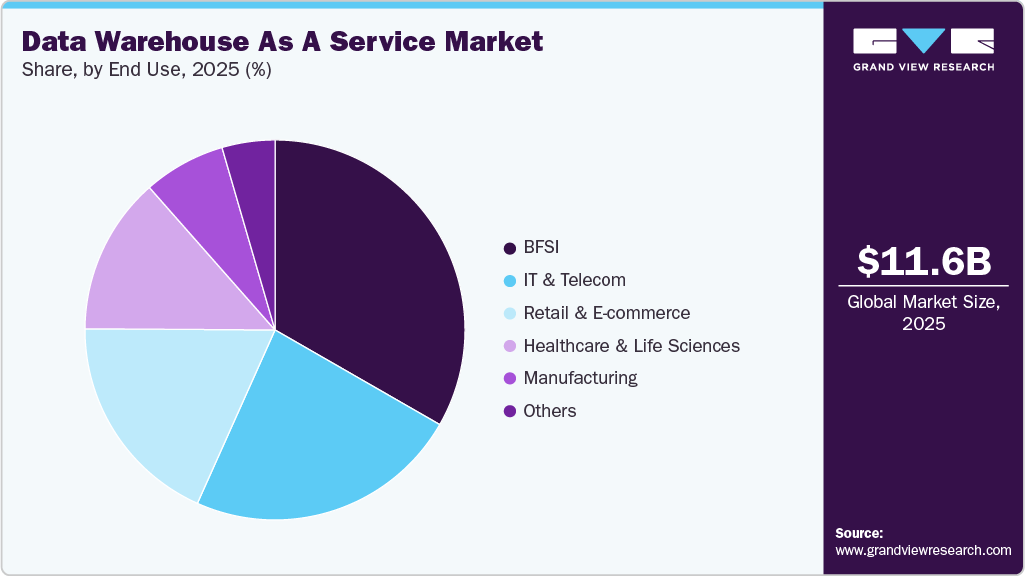
- By end use: BFSI segment held the largest market share of over 33.0% in 2025.
Regional Highlights
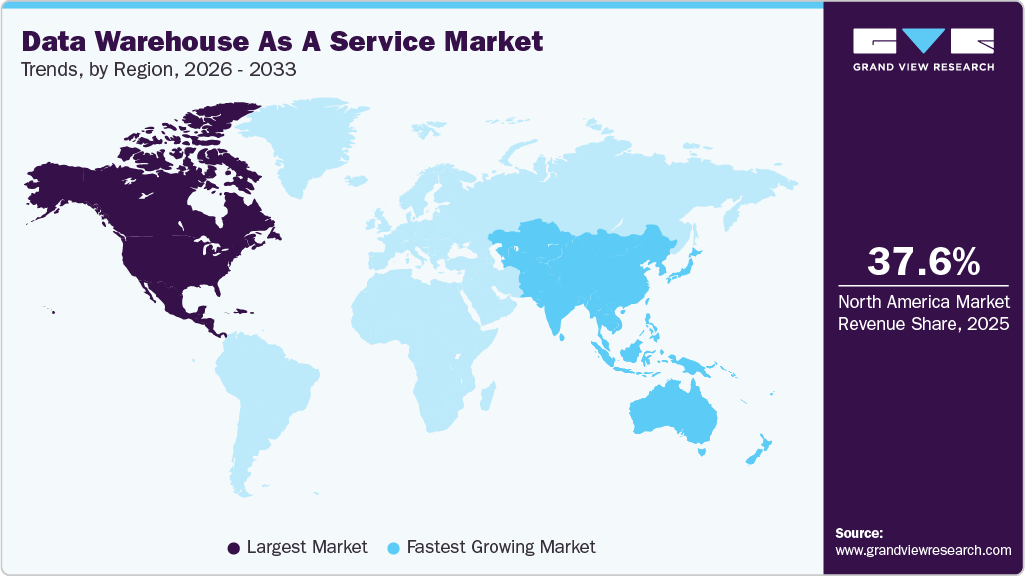
- Largest regional market: North America (37.6% market share, 2025)
- Fastest-growing regional market: Asia Pacific (highest CAGR, 2026-2033)
- By country: The U.S. held the largest market share in 2025.
Market Size & Forecast
- Market size in 2025: USD 11.6 Billion
- Estimated market size in 2026: USD 14.1 Billion
- Projected market size by 2033: USD 58.1 Billion
- CAGR (2026-2033): 22.4%
Three ways to get this report
Buy it, customize it, or ask a question.Ask an Analyst
Analyst response in 1 business day
- AccessReport author, directly
- Reply timeWithin 1 working day
- No sales callDirect answer only
- FormatEmail reply
- CostFree, no cost
Get the Full Report
What the study covers
- FormatsPDF · Excel · Dashboard
- Timeline2026–2033 annual, 2025 base
- Coverage20+ countries, 5 regions
- Companies10+ key players profiled
Customize the Report
20% free customization
- IncludeCountries, segments, points
- TailorTo your product definition
- ExtendDeeper competitor detail
- OrA fully bespoke study
- Turnaround5–10 working days
As organizations generate vast volumes of structured and unstructured data, the need for cloud-based data warehousing platforms has become critical to enable real-time insights and data-driven decision-making. The rapid adoption of advanced technologies such as artificial intelligence (AI), machine learning (ML), Internet of Things (IoT), and big data analytics is further accelerating market growth. DWaaS solutions enable seamless data integration, faster query processing, and centralized data management, allowing enterprises to derive actionable insights with improved efficiency. These solutions support advanced analytics, business intelligence, and real-time reporting, making them essential for sectors such as BFSI, healthcare, retail, IT & telecom, and manufacturing.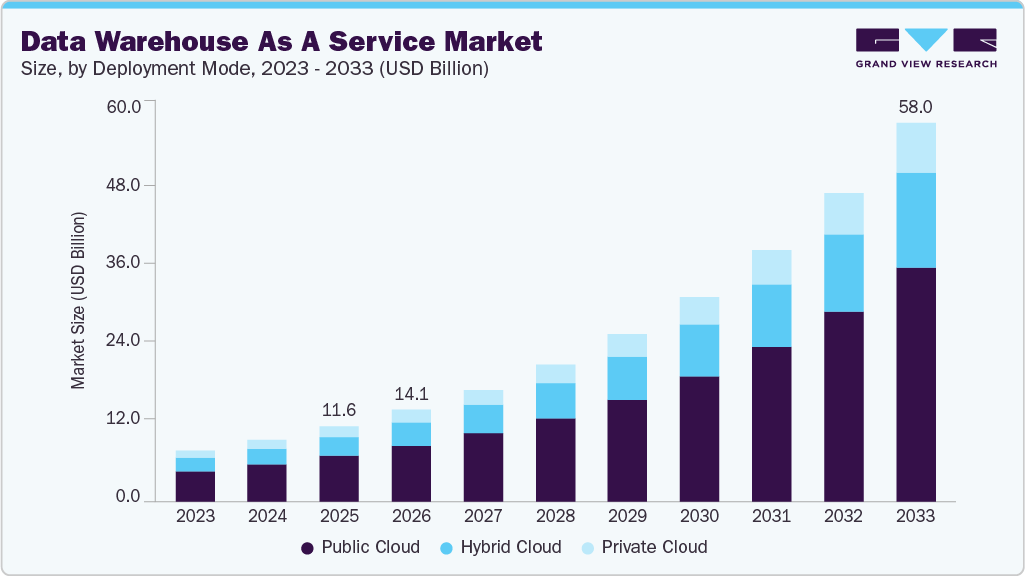 To learn more about this report, Download Free Sample Report
 The demand for data warehouse as a service solution is increasing as organizations seek to enhance scalability, performance, and cost efficiency in managing rapidly growing data volumes. Many enterprises are increasingly adopting cloud-based data warehousing solutions that enable seamless data integration, centralized storage, and high-speed analytics across diverse data sources. These solutions allow organizations to efficiently process large volumes of structured and unstructured data while supporting real-time insights and advanced analytics capabilities. In addition, the rapid adoption of technologies such as artificial intelligence, machine learning, Internet of Things, and big data analytics is driving the need for flexible and scalable data warehousing platforms that can support continuous data generation and real-time processing requirements. Data warehouse as a service solutions play a critical role in enabling faster query performance, automated data management, and efficient resource utilization, helping organizations make informed, data-driven decisions.
Cloud-based data warehousing platforms also reduce the complexity associated with traditional on-premise infrastructure by eliminating the need for significant upfront investments in hardware and maintenance. This improves operational efficiency, enhances scalability, and allows businesses to quickly adapt to changing data demands. Furthermore, the growing adoption of digital transformation initiatives across industries such as banking, financial services, insurance, healthcare, retail, information technology, and manufacturing is accelerating the demand for advanced data warehousing solutions.
These solutions enable organizations to achieve improved data accessibility, enhanced business intelligence capabilities, better compliance with data governance requirements, and optimized operational performance. As a result, data warehouse as a service is becoming a critical component of modern enterprise data strategies and a key enabler of data-driven innovation and competitive advantage.
Deployment Mode Insights
The public cloud segment dominated the Data Warehouse as a Service market, accounting for over 60.0% of the global revenue share in 2025, driven by the increasing demand for highly scalable, cost-efficient, and on-demand data warehousing solutions across data-intensive industries. This deployment model enables organizations to leverage cloud-based infrastructure without significant upfront capital investment, allowing them to scale storage and compute resources dynamically based on workload requirements. The pay-as-you-go pricing model, combined with reduced maintenance and operational complexity, makes public cloud an attractive option for enterprises seeking agility and cost optimization. In addition, public cloud platforms provide seamless integration with advanced analytics tools, artificial intelligence, and machine learning capabilities, enabling faster data processing and real-time insights. The growing adoption of big data analytics, Internet of Things, and digital transformation initiatives is significantly contributing to the dominance of this segment, as organizations increasingly prioritize flexible and cloud-native architectures that support rapid deployment, high performance, and global accessibility.
The hybrid cloud segment is witnessing notable growth in the Data Warehouse as a Service market, driven by the increasing need for a balanced approach between data security, regulatory compliance, and operational flexibility. This deployment model allows organizations to combine on-premises infrastructure with public cloud environments, enabling them to store sensitive or mission-critical data in private systems while leveraging the scalability and advanced analytics capabilities of the cloud for less-sensitive workloads. This flexibility is particularly important for industries with strict data governance requirements, such as banking, financial services, healthcare, and government.
Moreover, hybrid cloud adoption is growing as enterprises seek to modernize legacy data warehouse systems without fully migrating to the cloud, reducing migration risks and ensuring business continuity. The ability to optimize workloads across environments, improve data control, and support customized deployment strategies is significantly contributing to the growth of this segment.
Usage Insights
The data mining segment dominated the data warehouse as a service market, accounting for over 54.0% of the global revenue share in 2025, driven by the increasing need for extracting actionable insights from large volumes of structured and unstructured data. Organizations are increasingly leveraging data mining techniques to identify patterns, trends, and correlations that support strategic decision-making, risk management, and customer behavior analysis. This capability is critical in data-intensive industries such as banking, financial services, retail, healthcare, and telecommunications, where timely insights directly impact business outcomes. In addition, the rapid growth of big data, along with the rising adoption of artificial intelligence and machine learning, is significantly contributing to the dominance of this segment.
The real-time analytics segment is witnessing notable growth in the data warehouse as a service market, driven by the increasing demand for instant data processing and actionable insights across dynamic business environments. Organizations are increasingly adopting real-time analytics capabilities to monitor operations, track customer interactions, and respond to market changes as they occur, enabling faster and more informed decision-making. This growth is further supported by the rapid expansion of data generated from sources such as Internet of Things devices, digital platforms, and online transactions, which require continuous processing and low-latency analysis. As enterprises continue to prioritize agility, operational efficiency, and competitive advantage, the adoption of real-time analytics within Data Warehouse as a Service platform is expected to grow significantly.
Enterprise Size Insights
The large enterprises segment dominated the data warehouse as a service market, accounting for over 55.0% of the global revenue share in 2025, driven by the increasing need to manage vast volumes of structured and unstructured data across complex organizational environments. Large enterprises typically operate across multiple geographies and business units, requiring scalable, high-performance data warehousing solutions to support advanced analytics, reporting, and strategic decision-making. In addition, these organizations have greater financial resources and established IT infrastructure, enabling faster adoption of cloud-based data warehousing platforms. The growing emphasis on data-driven decision-making, regulatory compliance, and real-time business intelligence is significantly contributing to the dominance of this segment.
The small and medium-sized enterprises segment is witnessing notable growth in the Data Warehouse as a Service market, driven by the increasing need for cost-effective, scalable, and easy-to-deploy data management solutions. Unlike traditional on-premise data warehouses, cloud-based platforms eliminate the requirement for significant upfront capital investment, making them highly accessible to smaller organizations with limited IT budgets. In addition, the availability of pay-as-you-go pricing models and managed services allows small and medium-sized enterprises to leverage advanced analytics, business intelligence, and data integration capabilities without requiring extensive technical expertise. Hence, the growing adoption of digital technologies, e-commerce platforms, and data-driven decision-making is further accelerating demand within this segment.
Application Insights
The fraud detection segment dominated the Data Warehouse as a Service market, accounting for over 45.0% of the global revenue share in 2025, driven by the increasing need for advanced data analytics to identify, prevent, and mitigate fraudulent activities across industries. Organizations, particularly in banking, financial services, insurance, and e-commerce, are increasingly leveraging data warehouse platforms to analyze large volumes of transactional and behavioral data in order to detect anomalies and suspicious patterns in real time.
The segment’s dominance is further reinforced by the growing shift toward digital payments and online transactions, which has expanded the risk landscape and intensified the need for continuous monitoring systems. By leveraging centralized and scalable data environments, organizations can unify disparate data sources and apply advanced analytical models to strengthen fraud prevention strategies. This capability not only enhances threat detection accuracy but also supports proactive risk management and improved customer trust, making fraud detection a critical priority within modern data warehouse deployments.
The risk and compliance management segment is witnessing significant growth in the Data Warehouse as a Service market, driven by the increasing need for organizations to adhere to stringent regulatory requirements and manage enterprise-wide risks effectively. Industries such as banking, financial services, healthcare, and telecommunications are under constant pressure to ensure data accuracy, transparency, and regulatory compliance, leading to higher adoption of centralized data warehousing solutions. Moreover, the rising complexity of global regulations and the growing volume of data are pushing organizations to adopt advanced analytics platforms that can support audit trails, reporting, and governance frameworks. Data warehouse as a service enables seamless data consolidation from multiple sources, ensuring consistency and reliability in compliance reporting.
End Use Insights
The banking, financial services, and insurance (BFSI) segment dominated the Data Warehouse as a Service market, accounting for over 33.0% of the global revenue share in 2025, driven by the high demand for advanced data management and analytics solutions in financial institutions. These organizations generate massive volumes of transactional and customer data, requiring scalable and high-performance data warehousing platforms to support real-time analytics, risk assessment, and customer insights. In addition, the increasing need for fraud detection, regulatory compliance, and personalized financial services is significantly contributing to the dominance of this segment. Financial institutions are increasingly leveraging cloud-based data warehouse solutions to enhance operational efficiency, improve decision-making, and ensure secure data handling.
 To learn more about this report, Download Free Sample Report
 The information technology and telecommunications segment is witnessing significant growth at a higher pace in the data warehouse as a service market, driven by the exponential increase in data generated from digital platforms, network operations, and connected devices. Companies in this sector require highly scalable and high-performance data warehousing solutions to manage vast volumes of real-time data, support network optimization, and enhance service delivery.
Moreover, the rapid expansion of technologies such as 5G, cloud computing, and Internet of Things is accelerating the need for advanced analytics and data integration capabilities. Data warehouse as a service enables organizations to process and analyze streaming data, improve network performance, and gain actionable insights into customer behavior and usage patterns.
Regional Insights
North America dominated the data warehouse as a service market with a market share of over 37.6% in 2025, driven by rapid digital transformation, increasing cloud adoption, and the growing volume of data generated across emerging economies. Furthermore, the increasing adoption of data-driven strategies across industries such as banking, retail, healthcare, and telecommunications is significantly contributing to market growth. In addition, the rising demand for scalable, cost-efficient, and real-time data analytics solutions is accelerating the shift toward cloud-based data warehouse platforms. The growing need for business intelligence, customer analytics, and operational efficiency, along with supportive government initiatives for digitalization, further strengthens the region’s dominant position in the market.
 To learn more about this report, Download Free Sample Report
 U.S. Data Warehouse As A Service Market Trends
The U.S. dominates the North America data warehouse as a service market due to its advanced cloud computing ecosystem and strong presence of leading technology providers offering scalable data warehousing solutions. The country has a large base of enterprises rapidly adopting cloud-based platforms to manage growing data volumes, support advanced analytics, and enable real-time decision-making across industries such as banking, healthcare, retail, and telecommunications. In addition, the presence of major cloud service providers such as Amazon Web Services, Microsoft, and Google Cloud is accelerating innovation and widespread adoption of data warehouse as a service solution.
Europe Data Warehouse As A Service Market Trends
The Europe Data Warehouse as a Service market is witnessing steady growth, driven by the increasing demand for secure, compliant, and scalable data management solutions across industries. The region benefits from a strong regulatory framework, including data protection requirements such as General Data Protection Regulation, which is encouraging organizations to adopt centralized and well-governed cloud-based data warehousing platforms. In addition, rising investments in cloud infrastructure and digital transformation initiatives are supporting market expansion across countries such as Germany, UK, and France.
Asia Pacific Data Warehouse As A Service Market Trends
The Asia Pacific Data Warehouse as a Service market is expanding significantly, driven by rapid digital transformation, increasing cloud adoption, and the growing volume of data generated across industries. The region benefits from the strong expansion of e-commerce, fintech, and digital services, along with rising investments in cloud infrastructure and data center development across countries such as China, India, and Japan. The increasing adoption of advanced technologies such as artificial intelligence, big data analytics, and Internet of Things is significantly contributing to market growth. In addition, government-led digital initiatives and the rapid growth of small and medium-sized enterprises are accelerating the demand for scalable and cost-efficient data warehousing solutions. The need for real-time insights, improved customer analytics, and operational efficiency is further driving the adoption of data warehouse as a service across the Asia Pacific region.
Key Data Warehouse As A Service Company Insights
The data warehouse as a service market features several key players that significantly shape its global landscape through advanced cloud infrastructure, scalable data platforms, and high-performance analytics capabilities. Amazon Web Services is a prominent provider of cloud-based data warehousing solutions, widely recognized for its fully managed platform, Amazon Redshift, which enables fast query performance, seamless data integration, and real-time analytics across industries such as banking, retail, healthcare, and information technology. The company’s strong global cloud infrastructure and continuous innovation support efficient large-scale data processing and advanced analytics in complex enterprise environments.
-
Amazon Web Services is a global leader delivering scalable and fully managed data warehousing solutions, enabling organizations to store, process, and analyze large datasets efficiently. Its robust cloud ecosystem supports high performance, flexibility, and cost optimization across industries.
-
Microsoft provides advanced cloud-based data warehousing solutions through its Azure platform, offering seamless integration with analytics, artificial intelligence, and business intelligence tools. The company enables enterprises to enhance data-driven decision-making and operational efficiency.
Key Data Warehouse As A Service Companies:
The following key companies have been profiled for this study on the data warehouse as a service market.
- Amazon Web Services
- Microsoft
- Google Cloud
- Snowflake
- Oracle
- IBM
- SAP
- Teradata
- Cloudera
- Alibaba Cloud
- Huawei Cloud
- Databricks
Recent Development
-
In March 2026, Amazon Web Services announced enhancements to its Amazon Redshift platform, introducing advanced artificial intelligence-driven query optimization and automated workload management capabilities. This development aims to improve query performance, reduce operational complexity, and enable faster real-time analytics across large-scale data environments. The update reflects the growing focus on integrating intelligent automation within cloud-based data warehousing solutions to support data-driven decision-making and scalable enterprise analytics.
-
In January 2026, Microsoft expanded its Azure Synapse Analytics capabilities by integrating advanced data governance and unified analytics features across its cloud ecosystem. The enhancement enables seamless data integration, improved security, and real-time insights for enterprise users. This development highlights the increasing emphasis on unified data platforms that combine data warehousing, big data analytics, and artificial intelligence to support digital transformation initiatives.
Data Warehouse As A Service Market Report Scope
Report Attribute
Details
Market size in 2025
USD 11.6 billion
Estimated market size in 2026
USD 14.1 billion
Projected market size by 2033
USD 58.1 billion
Growth rate
CAGR of 22.4% from 2026 to 2033
Actual data
2021 - 2025
Forecast period
2026 - 2033
Quantitative units
Revenue in USD million/billion and CAGR from 2026 to 2033
Report coverage
Revenue forecast, company ranking, competitive landscape, growth factors, and trends
Segments covered
Deployment mode, usage, application, enterprise size end use, region
Regional scope
North America; Europe; Asia Pacific; Latin America; MEA
Country scope
U.S.; Canada; Mexico; Germany; UK; France; China; India; Japan; Australia; South Korea; Brazil; UAE; South Africa; KSA
Key companies profiled
Amazon Web Services; Microsoft; Google Cloud; Snowflake; Oracle; IBM; SAP; Teradata; Cloudera; Alibaba Cloud; Huawei Cloud; Databricks
Customization scope
Free report customization (equivalent up to 8 analysts working days) with purchase. Addition or alteration to country, regional & segment scope.
Pricing and purchase options
Avail customized purchase options to meet your exact research needs. Explore purchase options
Global Data Warehouse As A Service Market Report Segmentation
This report forecasts revenue growth at global, regional, and country levels and provides an analysis of the latest industry trends in each of the sub-segments from 2021 to 2033. For this study, Grand View Research has segmented global data warehouse as a service market report based on deployment mode, usage, application, enterprise size end use, and region.
-
Deployment Mode Outlook (Revenue, USD Million, 2021 - 2033)
-
Public Cloud
-
Hybrid Cloud
-
Private Cloud
-
-
Usage Outlook (Revenue, USD Million, 2021 - 2033)
-
Data Mining
-
Reporting
-
Real-time Analytics
-
-
Enterprise Size Outlook (Revenue, USD Million, 2021 - 2033)
-
Large Enterprises
-
Small & Medium Sized Enterprises
-
-
Application Outlook (Revenue, USD Million, 2021 - 2033)
-
Fraud Detection
-
Customer Analytics
-
Risk & Compliance Management
-
Asset / Operations Management
-
-
End Use Outlook (Revenue, USD Million, 2021 - 2033)
-
BFSI
-
IT & Telecom
-
Retail & E-commerce
-
Healthcare & Life Sciences
-
Manufacturing
-
Others
-
-
Regional Outlook (Revenue, USD Million, 2021 - 2033)
-
North America
-
U.S.
-
Canada
-
Mexico
-
-
Europe
-
UK
-
Germany
-
France
-
-
Asia Pacific
-
China
-
Japan
-
India
-
Australia
-
South Korea
-
-
Latin America
-
Brazil
-
-
Middle East and Africa (MEA)
-
KSA
-
UAE
-
South Africa
-
-
Frequently Asked Questions About This Report
North America dominated the global data warehouse as a service market with a revenue share of 37.6% in 2025, supported by advanced cloud infrastructure, high digital transformation adoption, and strong presence of leading technology providers.
The BFSI segment accounted for the largest market share of over 33.0% in 2025, driven by growing requirements for real-time analytics, fraud detection, regulatory compliance, and customer intelligence.
The large enterprises segment held the largest market share of over 55.0% in 2025 due to high data volumes, complex operational environments, and strong adoption of cloud-based analytics platforms.
The data mining segment held the largest market share of over 54.0% in 2025 owing to the growing need for extracting actionable insights from large volumes of enterprise data.
The public cloud segment led the market with a revenue share of over 60.0% in 2025, driven by increasing demand for scalable, cost-efficient, and cloud-native data warehousing solutions.
The global data warehouse as a service market size was valued at USD 11.6 billion in 2025 and is estimated at USD 14.1 billion in 2026.
The global data warehouse as a service market is expected to grow at a CAGR of 22.4% from 2026 to 2033, reaching USD 58.1 billion by 2033.
The fraud detection segment accounted for the largest market share of over 45.0% in 2025, supported by increasing adoption of advanced analytics for real-time fraud prevention and risk management.
Some of the key players operating in the data warehouse as a service market include Amazon Web Services, Microsoft, Google Cloud, Snowflake, Oracle, IBM, SAP, Teradata, Cloudera, Alibaba Cloud, Huawei Cloud, and Databricks.
Key factors driving the market include increasing adoption of cloud computing, rising demand for scalable and cost-efficient data storage solutions, growth of big data analytics, expanding use of artificial intelligence and machine learning technologies, increasing digital transformation initiatives, and growing demand for real-time business intelligence and advanced analytics capabilities.
About the Author(s)
Next Generation Technologies Research Team
Technology · Next Generation TechnologiesThis report was authored by the next generation technologies research team at Grand View Research - comprising two research analysts, one senior research analyst, and one industry expert - with specialized expertise in the next generation technologies segment of the technology industry. All findings are based on proprietary technology databases, executive interviews, and regulatory analysis, subject to internal peer review prior to publication.
Last Updated:
Speak to Analyst

Customize this report to your needs - add regions, segments, or data points, with 20% free customization.
Or view our licence options:


ISO 9001:2015 & 27001:2022 Certified
We are GDPR and CCPA compliant! Your transaction & personal information is safe and secure. For more details, please read our privacy policy.


