
- Home
- »
- Power Generation & Storage
- »
-
Digital Oilfield Market Size And Share Report, 2026-2033GVR Report cover

Digital Oilfield Market (2026 - 2033) Size, Share & Trends Analysis Report By Solution (Hardware Solution, Software & Service Solutions, Data Storage Solutions), By Application (Onshore, Offshore), By Process, By Region, And Segment Forecasts
Market Size, 2025
$30.7BMarket Estimate, 2026
$32.6BMarket Forecast, 2033
$47.9BCAGR, 2026–2033
5.6%Digital Oilfield Market Summary
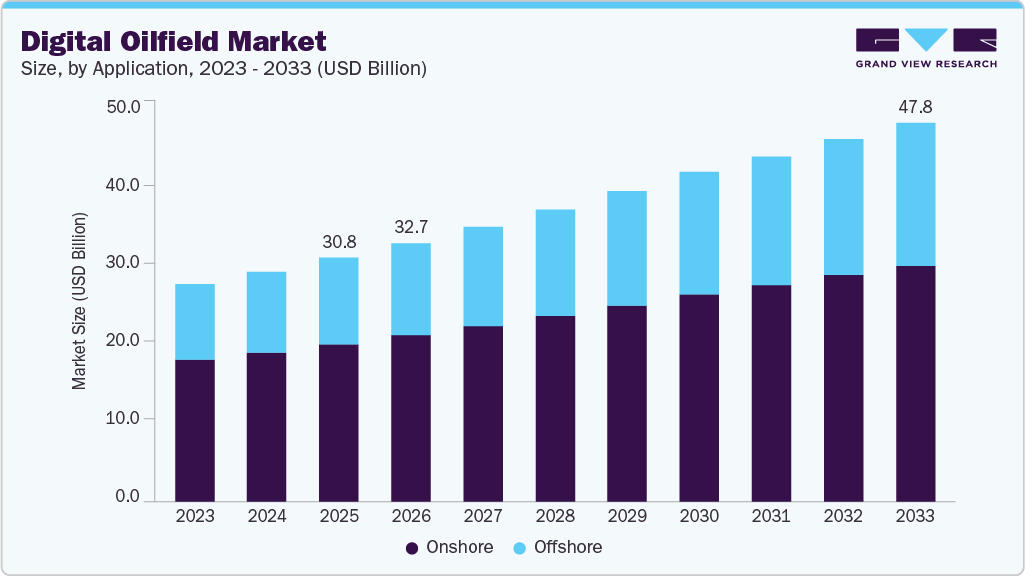
The global Digital oilfield market size was valued at USD 30.7 billion in 2025 and is projected to grow from USD 32.6 billion in 2026 to USD 47.9 billion by 2033, at a CAGR of 5.6% from 2026 to 2033. The market in North America dominated with a revenue share of 34.0% in 2025. The rapid adoption of real-time data-acquisition technologies across upstream operations is strongly driving the industry.
 Source: Grand View Research, IR Documents, Primary Interviews, Paid DatabasesTo learn more about this report,
 Download Free Sample Report
 Key Market Trends & Insights
- By process: Product optimization segment held the largest market share of over 30% in 2025.
- By solution: Hardware solutions segment held the largest market share in 2025.
- By application: Onshore segment held the largest market share in 2025.
Regional Highlights
- Largest regional market: North America (34.0% revenue share, 2025)
- Fastest-growing regional market: Asia Pacific (highest CAGR, 2026-2033)
- The digital oilfield industry in the U.S held the largest revenue share in 2025.
Market Size & Forecast
- Market size in 2025: USD 30.7 Billion
- Estimated market size in 2026: USD 32.6 Billion
- Projected market size by 2033: USD 47.9 Billion
- CAGR (2026-2033): 5.6%
Three ways to get this report
Buy it, customize it, or ask a question.Ask an Analyst
A direct answer, usually in 1 working day
- AccessReport author, directly
- Reply timeWithin 1 working day
- No sales callDirect answer only
- FormatEmail reply
- CostFree, no cost
Get the Full Report
What the study covers
- FormatsPDF · Excel · Dashboard
- Timeline2026–2033 annual, 2025 base
- Coverage20+ countries, 5 regions
- Companies10+ key players profiled
Customize the Report
20% free customization
- IncludeCountries, segments, points
- TailorTo your product definition
- ExtendDeeper competitor detail
- OrA fully bespoke study
- Turnaround5–10 working days
Oil and gas operators are deploying advanced sensors, smart meters, and connected control systems across wells, drilling rigs, pipelines, and processing facilities to continuously capture pressure, temperature, flow rate, and equipment performance data. This continuous data flow enhances field visibility and enables operators to monitor assets remotely, reducing reliance on manual inspections. Remote monitoring is particularly critical for offshore platforms and geographically isolated fields where physical access is expensive and time-consuming. As operators prioritize operational transparency and faster decision-making, investments in digital oilfield architectures continue to accelerate.Advanced analytics, artificial intelligence, and machine learning are central to transforming raw operational data into actionable insights. Predictive analytics models help identify early warning signs of equipment failure, allowing maintenance teams to intervene before breakdowns occur and avoid costly production losses. AI-driven reservoir modeling and production optimization tools support better well placement, enhanced recovery, and more efficient use of energy and chemicals. These technologies deliver tangible performance improvements, such as higher uptime, lower maintenance costs, and improved recovery rates, strengthening the business case for digital oilfield solutions across both new developments and mature assets.
 To learn more about this report, Download Free Sample Report
 The shift toward cloud-based infrastructure is another major growth driver, enabling scalable, cost-effective data management for oilfield operations. Cloud platforms allow operators to store vast volumes of seismic data, drilling logs, and production histories while providing high-speed access to analytics tools across geographically dispersed teams. This model reduces capital expenditure on in-house data centers and shortens deployment timelines for digital solutions. Cloud integration also supports collaboration among operators, service providers, and technology vendors, improving workflow efficiency and accelerating innovation across the value chain.
Cost pressure and the need for operational efficiency continue to push oil and gas companies toward digital transformation. Volatile commodity prices and rising development costs have forced operators to focus on maximizing productivity from existing assets while tightly controlling operating expenses. Digital oilfield technologies support the automation of routine tasks, the reduction of non-productive time, and the optimization of labor deployment. Remote operations and automated workflows also improve safety by limiting human exposure to hazardous environments, while helping companies meet stricter environmental and regulatory requirements through better monitoring and reporting.
Drivers, Opportunities & Restraints
Oil and gas operators are increasingly adopting advanced analytics, automation, and remote monitoring solutions to improve production performance and reduce unplanned downtime. The growing complexity of reservoirs, combined with volatile crude oil prices, has intensified the need to maximize recovery from existing assets rather than rely solely on new exploration. Digital oilfield technologies enable predictive maintenance, optimized drilling, and enhanced reservoir management, which directly support productivity gains and safer operations across upstream activities.
High initial investment requirements for digital infrastructure, including sensors, software platforms, and data integration systems, can be a barrier, especially for small and mid-sized operators. Data security and cybersecurity concerns also pose challenges, as increased connectivity exposes critical oilfield operations to potential cyber threats. In addition, the lack of skilled digital talent within traditional oil and gas organizations and resistance to change from legacy workflows can slow down large-scale digital transformation initiatives.
The market presents significant opportunities driven by technological advancements and evolving industry priorities. The integration of artificial intelligence, machine learning, and cloud computing is creating new possibilities for advanced production optimization, automated decision support, and cross-asset collaboration. Digital oilfield solutions are increasingly being applied to mature and brownfield assets, offering opportunities to extend field life and improve economic returns.
Solution Insights
Hardware solutions segment held the largest revenue share of over 49% in 2025. Hardware solutions under the solution segment of the digital oilfield market are witnessing steady growth as operators invest in robust field-level infrastructure to enable real-time data capture and automation. Advanced sensors, smart meters, downhole tools, and control systems form the backbone of digital oilfield architectures by continuously collecting high-resolution data on pressure, temperature, flow rates, and equipment health.
Software and service solutions are expanding rapidly as operators prioritize data-driven decision-making and integrated field management. Advanced software platforms aggregate data from drilling, production, and reservoir operations to deliver real-time insights through analytics, AI models, and visualization tools. These solutions support predictive maintenance, production forecasting, and operational optimization, allowing operators to respond quickly to changing reservoir conditions while improving recovery rates and reducing cost per barrel.
Application Insights
Onshore segment held the revenue share of over 64.0% in 2025, as operators focus on maximizing efficiency across large, geographically dispersed asset bases. Onshore fields, particularly shale and tight oil plays, involve high well counts and frequent drilling and completion activity, which creates significant demand for real-time monitoring, automation, and data analytics. Digital oilfield solutions enable operators to standardize workflows, optimize drilling and production performance, and rapidly identify underperforming wells, thereby reducing operating costs and improving capital productivity across mature and unconventional onshore assets.
The offshore segment is witnessing accelerated growth as operators prioritize operational efficiency and risk reduction in high-cost, technically complex environments. Offshore fields involve significant capital investment and harsh operating conditions, which heighten the need for real-time monitoring, advanced analytics, and automation to ensure stable production and asset integrity. Digital oilfield solutions support continuous surveillance of wells, subsea equipment, and surface facilities, enabling early detection of anomalies and optimized production control that helps reduce unplanned downtime and costly offshore interventions.
Process Insights
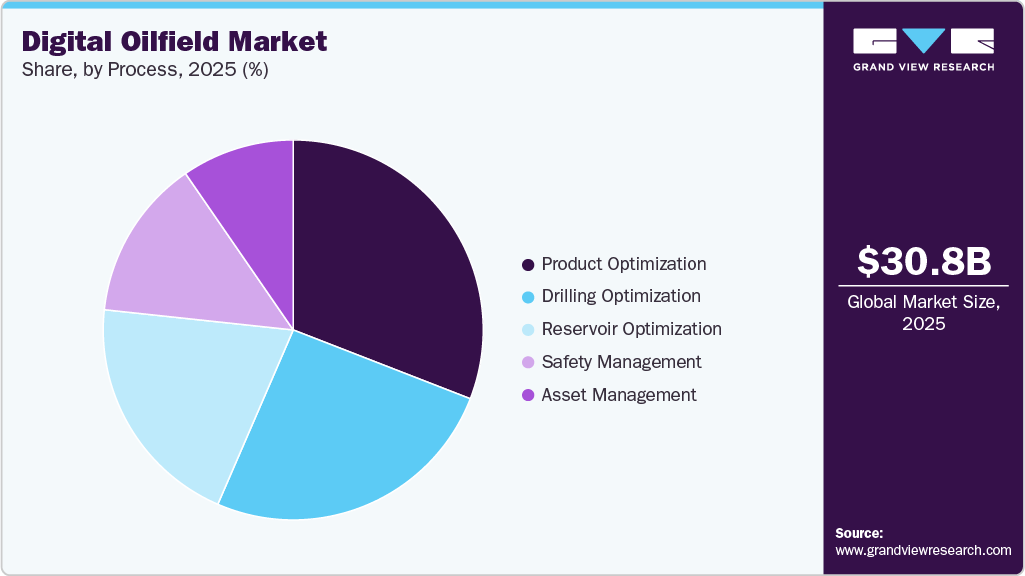
Product optimization held the largest revenue share of over 30% in 2025.Product optimization is expanding as operators increasingly rely on real-time production data and advanced analytics to maximize output from existing assets. The integration of sensors, automation systems, and AI-driven analytics enables continuous monitoring of well performance, early identification of production losses, and rapid corrective actions such as optimizing lift systems or adjusting flow parameters. This data-centric approach improves recovery rates and reduces operating costs, which is critical for mature and marginal fields where incremental efficiency gains directly impact profitability.
 To learn more about this report, Download Free Sample Report
 Drilling optimization is gaining strong momentum as operators seek to reduce non-productive time and drilling costs while improving well placement accuracy. Advanced drilling analytics integrate real-time data from downhole sensors, mud logging systems, and surface equipment to optimize parameters such as weight on bit, rotary speed, and mud flow in real time. These capabilities help prevent stuck pipe, kicks, and premature bit wear, leading to faster drilling cycles and consistent well quality, particularly in complex shale and deepwater formations.
Regional Insights
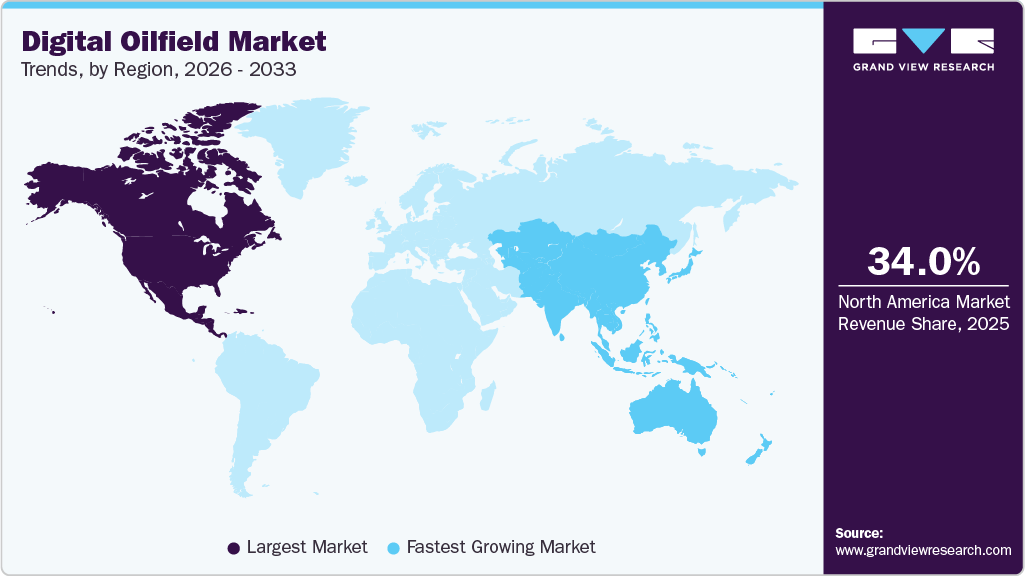
North America held over 34% revenue share of the global digital oilfield market, driven by the relentless pursuit of operational efficiency and cost reduction in a highly competitive, market-driven environment. The region's dominance in unconventional shale plays, particularly in the Permian Basin, necessitates granular, real-time data to manage complex, fast-declining wells and optimize hydraulic fracturing operations. Initiatives like The Open Group's Open Subsurface Data Universe (OSDU) data platform, heavily backed by major operators, are critical drivers, as they break down data silos and enable cloud-based analytics across the asset lifecycle. Leading operators leveraging advanced analytics and digital twins have achieved production increases of up to 10% and reductions in downtime by up to 30%. This data-centric approach is essential for maintaining profitability amid price volatility and investor pressure for capital discipline and free cash flow.
 To learn more about this report, Download Free Sample Report
 U.S. Digital Oilfield Market Trends
The digital oilfield industry in the U.S. has gained from robust investments in and adoption of advanced technologies. For instance, the U.S. Environmental Protection Agency's (EPA) final rule on methane emissions (December 2023) mandates rigorous leak detection and repair (LDAR) using advanced technologies like continuous aerial screeners and ground-based sensors. This creates a direct market for digital oilfield solutions that generate verifiable, auditable data streams. Consequently, investment is soaring; Pioneer Natural Resources reported deploying over 15,000 continuous methane monitors across its Permian operations.
Asia Pacific Digital Oilfield Market Trends
The digital oilfield industry in the Asia Pacific is witnessing a surge in demand for oil and gas. With the Asia Pacific region accounting for over 36% of global oil and gas demand (IEA), countries like China and India are aggressively pursuing digital transformation to bolster energy security. For instance, China's "Made in China 2025" initiative and India's "Digital India" campaign provide policy frameworks that incentivize the adoption of Industrial IoT and big data analytics in the energy sector. This is translating into tangible projects; major NOCs like ONGC in India have implemented integrated operations centers that use real-time data from thousands of wellhead sensors to optimize production, reportedly improving asset utilization by 15-20% and reducing operational costs significantly.
Europe Digital Oilfield Market Trends
The digital oilfield industry in Europe is driven by a unique mix of mature, high-cost assets and the world's most ambitious decarbonization agenda. The region is fundamentally gearing toward extending field life, ensuring safe decommissioning, and achieving net-zero operations. The region's offshore basins in the North Sea and Norwegian Continental Shelf are characterized by complex, aging infrastructure where maximizing recovery and optimizing operational expenditure (OPEX) are critical.
Middle East & Africa Digital Oilfield Market Trends
The digital oilfield industry in the Middle East & Africa (MEA) region is fueled by the strategic objective of maximizing the long-term value and sustainability of the world's largest and most prolific hydrocarbon reserves. For the major national oil companies (NOCs) in the Gulf Cooperation Council (GCC) countries, such as Saudi Aramco, ADNOC, and QatarEnergy, digitalization is a core pillar of ambitious national transformation plans, such as Saudi Vision 2030 and the UAE's "Operation 300bn" industrial strategy. These NOCs are deploying massive, integrated digital programs to achieve unprecedented operational efficiency, cost reduction, and reservoir recovery rates.
Key Digital Oilfield Company Insights
Some of the key players operating in the global market include SLB, Weatherford, Halliburton, Baker Hughes Company, and NOV, among others. These companies are actively expanding their market footprint through product innovation, strategic acquisitions, and collaborations to enhance their global distribution networks and technology capabilities.
Key Digital Oilfield Companies:
The following key companies have been profiled for this study on the digital oilfield market
- SLB
- Weatherford
- Halliburton
- Baker Hughes Company
- NOV
- Pason Systems Corp.
- Kongsberg Digital
- Viridien (CGG)
- Honeywell International Inc.
- Nabors Industries Ltd.
Recent Developments
- In June 2025, Huawei advanced its AI-driven initiatives in the oil and gas sector, notably through collaborations highlighted in industry discussions on digital oilfields. Efforts focused on integrating AI, 5G, cloud computing, and big data to transform traditional upstream operations into intelligent systems, as seen in partnerships with major players such as Changqing Oilfield to enable unstaffed wellsites and real-time data analysis.
Digital Oilfield Market Report Scope
Report Attribute
Details
Market Definition
The digital oilfield market refers to the revenue generated from digital solutions used to optimize upstream oil & gas operations.
Market size in 2025
USD 30.7 Billion
Estimated market size in 2026
USD 32.6 billion
Projected market size by 2033
USD 47.9 billion
Growth rate
CAGR of 5.6% from 2026 to 2033
Base year for estimation
2025
Historical data
2021 - 2024
Forecast period
2026 - 2033
Quantitative Units
Revenue in USD million/billion, and CAGR from 2026 to 2033
Report coverage
Revenue forecast, competitive landscape, growth factors, and trends
Segments covered
Solution, application, process, region
Regional scope
North America; Europe; Asia Pacific; Latin America; Middle East & Africa
Country scope
U.S.; Canada; Mexico; Germany; UK; France; Spain; Italy; China; India; Japan; South Korea; Brazil; Argentina; Saudi Arabia; UAE; South Africa
Key companies profiled
SLB; Weatherford; Halliburton; Baker Hughes Company; NOV; Pason Systems Corp.; Kongsberg Digital; Viridien (CGG); Honeywell International Inc.; Nabors Industries Ltd.
Customization scope
Free report customization (equivalent up to 8 analysts working days) with purchase. Addition or alteration to country, regional & segment scope.
Pricing and purchase options
Avail customized purchase options to meet your exact research needs. Explore purchase options
Global Digital Oilfield Market Report Segmentation
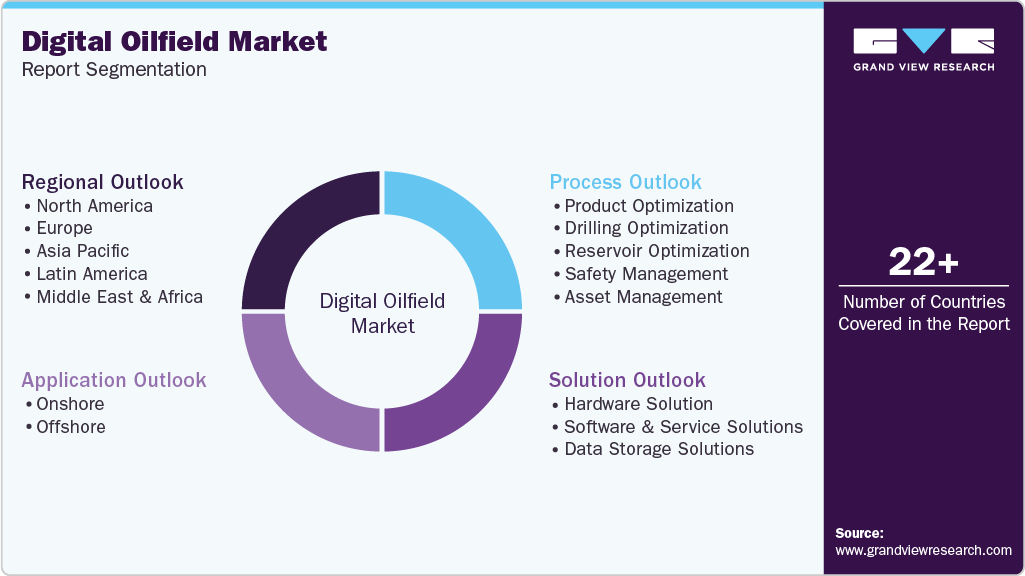
This report forecasts revenue growth at global, regional, and country levels and provides an analysis of the latest industry trends in each of the sub-segments from 2021 to 2033. For the purpose of this study, Grand View Research has segmented the global digital oilfield market report on the basis of solution, application, process, and region.
 To learn more about this report, Download Free Sample Report
 -
Process Outlook (Revenue, USD Million, 2021 - 2033)
-
Product Optimization
-
Drilling Optimization
-
Reservoir Optimization
-
Safety Management
-
Asset Management
-
-
Solution Outlook (Revenue, USD Million, 2021 - 2033)
-
Hardware Solution
-
Software & Service Solutions
-
Data Storage Solutions
-
-
Application Outlook (Revenue, USD Million, 2021 - 2033)
-
Onshore
-
Offshore
-
-
Regional Outlook (Revenue, USD Million, 2021 - 2033)
-
North America
-
U.S.
-
Canada
-
Mexico
-
-
Europe
-
Germany
-
UK
-
France
-
Spain
-
Italy
-
-
Asia Pacific
-
China
-
India
-
Japan
-
South Korea
-
-
Latin America
-
Brazil
-
Argentina
-
-
Middle East & Africa
-
Saudi Arabia
-
UAE
-
South Africa
-
-
Frequently Asked Questions About This Report
North America dominated with a 34% revenue share in 2025.
Asia Pacific is the fastest-growing region over the forecast period.
The global digital oilfield market size was estimated at USD 30.7 billion in 2025 and is expected to reach USD 32.6 billion in 2026.
Product optimization segment held the largest revenue share of over 30% in the digital oilfield market in 2025.
Key factors include rising demand for real time reservoir monitoring, advanced data analytics, automation of drilling and production operations, improved asset integrity management, and cost optimization across upstream activities.
The global digital oilfield market is expected to grow at a compound annual growth rate of 5.6% from 2026 to 2033 to reach USD 47.8 billion by 2033.
Some of the prominent players in the market include PolyPlus Battery Company, NexTech Batteries Inc., Li-S Energy Limited, Zeta Energy SLB, Weatherford, Halliburton, Baker Hughes Company, NOV, Pason Systems Corp., Kongsberg Digital, Viridien (CGG), Honeywell International Inc., Nabors Industries Ltd., and others
The hardware solutions segment led with a 49% revenue share in 2025, while software and service solutions is the fastest-growing segment.
The onshore segment led with a 64.0% revenue share in 2025, while services is the fastest-growing segment.
About the Author(s)
Power Generation & Storage Research Team
Energy & Power · Power Generation & StorageThis report was authored by the power generation & storage research team at Grand View Research - comprising two research analysts, one senior research analyst, and one industry expert - with specialized expertise in the power generation & storage segment of the energy & power industry. All findings are based on proprietary energy & power databases, executive interviews, and regulatory analysis, subject to internal peer review prior to publication.
Last Updated:
Speak to Analyst

Customize this report to your needs - add regions, segments, or data points, with 20% free customization.
Or view our licence options:


ISO 9001:2015 & 27001:2022 Certified
We are GDPR and CCPA compliant! Your transaction & personal information is safe and secure. For more details, please read our privacy policy.


