
- Home
- »
- Next Generation Technologies
- »
-
Drone Camera Market Size, Share & Trends Report, 2033GVR Report cover
![Drone Camera Market (2026 - 2033)Report]()
Drone Camera Market (2026 - 2033)
Size, Share & Trends Analysis Report By Type (HD Cameras, Thermal Cameras), By Application (Thermal Imaging, Surveillance), By Resolution (Less than 12 MP, 12 to Less than 20 MP), By End-use, By Region, And Segment Forecasts
Market Size, 2025
$11.0BMarket Estimate, 2026
$12.3BMarket Forecast, 2033
$27.9BCAGR, 2026–2033
12.5%Drone Camera Market Summary
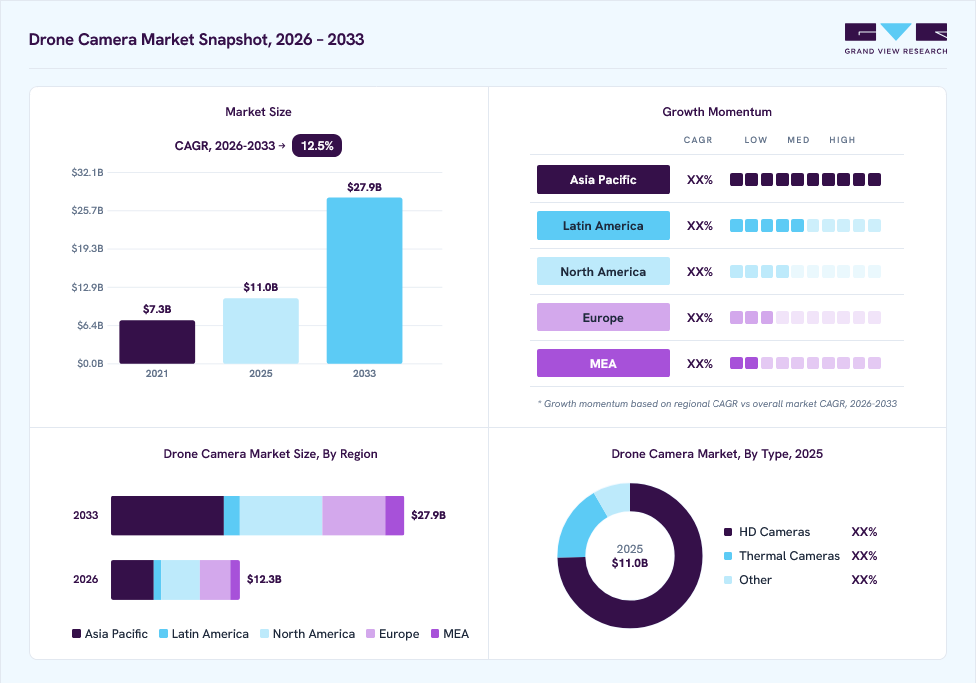
The global drone camera market size was valued at USD 11.0 billion in 2025 and is projected to grow from USD 12.3 billion in 2026 to USD 27.9 billion by 2033, at a CAGR of 12.5% from 2026 to 2033. Asia Pacific dominated the market, accounting for a revenue share of 32.4% in 2025. Growth is primarily driven by increasing drone adoption, rising demand for high-resolution aerial imaging, expanding thermal imaging applications, growing use of drones for inspection and mapping, and increasing deployment across consumer, commercial, defense, and public-safety applications globally.
Key Market Trends & Insights
- By type: The HD cameras segment accounted for over 75.0% of the market in 2025.
- By application: The photography & videography segment accounted for the largest market share in 2025.
- By resolution: The 12 to Less than 20 MP segment accounted for the largest market share in 2025.
- By end-use: The consumer segment accounted for the largest market share in 2025.
Regional Highlights
- Largest regional market: Asia Pacific (32.4% revenue share, 2025)
- By country: China held the largest market share in 2025.
Market Size & Forecast
- Market size in 2025: USD 11.0 Billion
- Estimated market size in 2026: USD 12.3 Billion
- Projected market size by 2033: USD 27.9 Billion
- CAGR (2026-2033): 12.5%
In addition, the expansion of commercial drone service programs and increasing investments in industrial and enterprise UAV platforms are accelerating demand for HD cameras that support obstacle detection, precision navigation, live monitoring, autonomy, and payload operations. Manufacturers are also investing in image-processing engineering and regulatory-compliance tools to shorten product development cycles, validate camera performance, and meet stringent aviation and data-privacy requirements. These investments are expected to support continued adoption of HD cameras as commercial drone applications scale.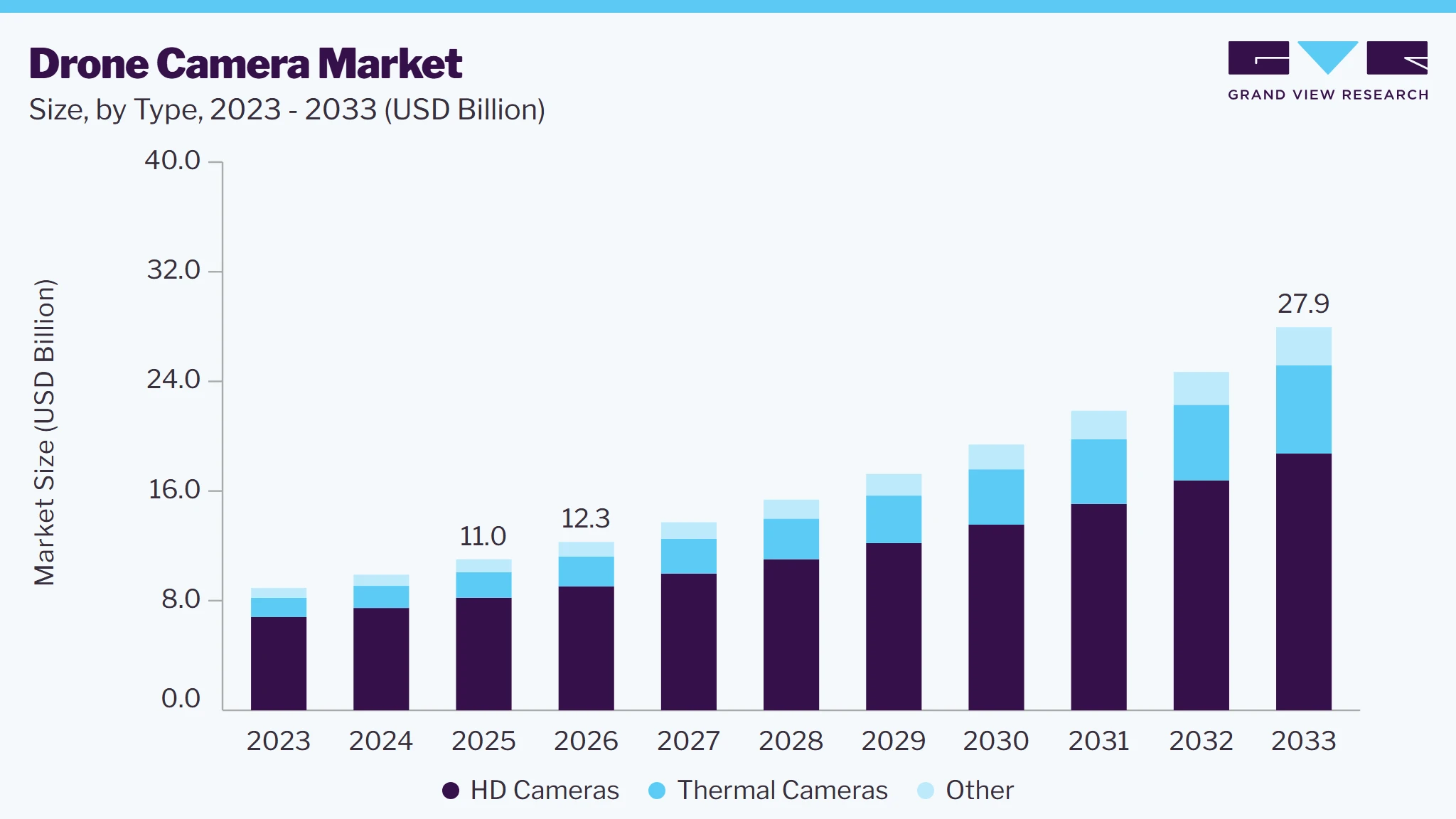
Furthermore, commercial drone operations require highly integrated HD camera architectures capable of coordinating flight stabilization, obstacle avoidance, gimbal control, battery and payload data, image transmission, and onboard analytics. HD camera-enabled automation improves situational awareness, image quality, route planning, and fleet coordination for operators, supporting safer and more scalable drone services across industries. This growing dependence on integrated onboard imaging systems is expected to strengthen HD camera adoption across the commercial drone ecosystem. These developments are expected to strengthen demand across the market throughout the forecast period.
Moreover, the integration of artificial intelligence, machine learning, cloud computing, digital mapping, and real-time data analytics is transforming drone camera development and operations. AI-enabled HD cameras can support autonomous obstacle avoidance, predictive maintenance imaging, traffic and crowd monitoring, flight-path optimization, and operational decision-making. Thermal imaging end uses enable centralized fleet, search-and-rescue, and infrastructure inspection programs, while simulation and testing tools improve product-validation efficiency. These technological advancements are expanding HD camera capabilities and encouraging stakeholders to invest in next-generation drone imaging infrastructure. These trends support continued adoption across the market.
Market Dynamics
The drone camera industry is shaped by rapid sensor development, evolving aviation and privacy regulations, increasing onboard autonomy, and the expansion of commercial drone-service infrastructure. Growth is supported by investments from drone manufacturers, imaging-technology developers, enterprise operators, and public agencies. However, complex image-quality validation, payload integration requirements, cybersecurity risks, fragmented regional standards, and uncertain commercial application timelines remain key challenges. Ongoing innovation in autonomous flight, onboard image processing, fleet management, and airspace coordination continues to shape the competitive landscape.
Commercial drones increasingly require advanced HD cameras to coordinate obstacle avoidance, navigation, gimbal stabilization, image transmission, onboard health monitoring, and autonomous flight functions. This has accelerated demand for integrated HD camera architectures that can improve flight safety, image quality, and operational efficiency across commercial and specialized missions. The shift toward autonomous and digitally managed drones is increasing demand for imaging, navigation, monitoring, and airspace-coordination camera systems.
Autonomous obstacle avoidance, real-time route planning, exposure optimization, and predictive monitoring can improve drone utilization and reduce operational complexity compared with conventional manually piloted workflows. Their ability to support highly automated flight operations makes these capabilities important to commercial drone programs. Moreover, drone manufacturers and operators are increasing investments in HD camera-defined functions, supporting sustained market growth.
The development of drone cameras requires advanced image-processing algorithms, stabilization hardware, cybersecurity controls, sensor integration, testing, and extensive validation, making product-development programs technically complex and costly. High research and development expenditures, coupled with aviation approval requirements and integration across multiple drone subsystems, increase overall HD camera development costs.
In addition, lengthy regulatory approval processes and evolving airspace and data privacy requirements can delay commercial application, particularly for emerging drone-camera developers. The need for continuous HD camera firmware updates, verification, cybersecurity management, and compatibility testing further adds to lifecycle costs. These technical and financial challenges may slow adoption, especially among smaller operators and technology providers with limited development budgets.
Increasing investments in commercial drone fleets, industrial inspection programs, and enterprise imaging ecosystems are creating significant market opportunities. For less than 12 MP and 12 to Less than 20 MP, agricultural operators, utility companies, and government agencies are investing in HD camera solutions that enable safe drone operations, efficient fleet management, airspace coordination, payload management, and scalable inspection and mapping services.
Emerging technologies such as autonomous flight systems, AI-enabled flight planning, digital mapping, thermal imaging fleet management, predictive maintenance, real-time aerial monitoring, simulation, and digital airspace management are creating new opportunities for HD camera innovation. As commercial drone programs progress toward broader regulatory approval and commercial application, the need for integrated HD cameras across drone development, testing, operations, maintenance, and infrastructure is expected to increase. These investments are expected to accelerate the adoption of specialized drone cameras and support sustained market growth over the forecast period.
Market Concentration & Characteristics
The global drone camera industry is moderately fragmented, with imaging-sensor providers, drone manufacturers, gimbal and stabilization companies, optics suppliers, and specialized technology firms competing across different HD camera layers. The market demonstrates a high degree of innovation, driven by advancements in autonomous flight, AI, digital mapping, cloud end uses, simulation, cybersecurity, and integrated payload management. The market also witnesses partnerships and selective M&A activity as established camera manufacturers collaborate with specialized sensor and autonomy companies to strengthen capabilities across emerging commercial drone programs and operations globally.
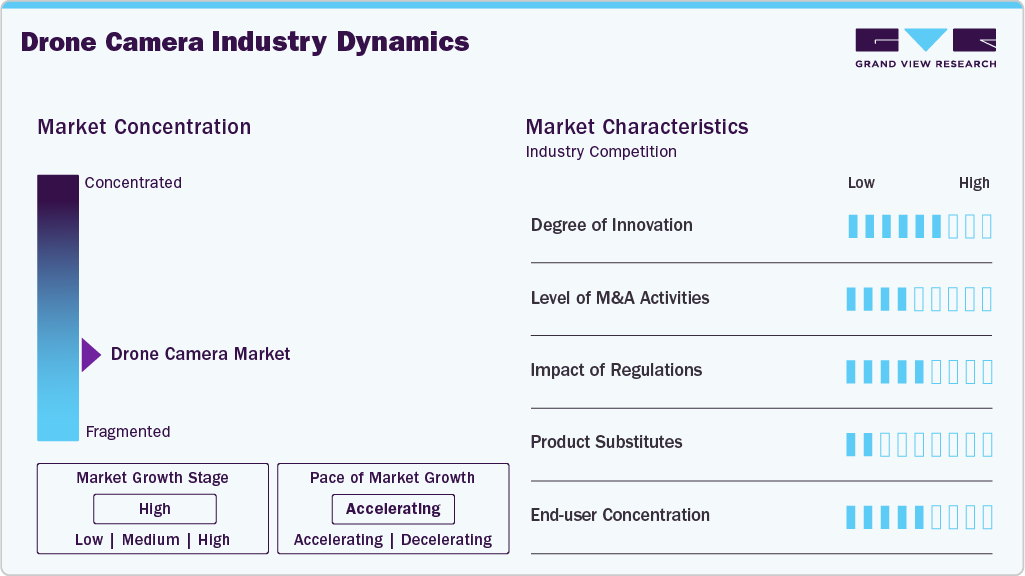
The drone camera industry is significantly affected by aviation regulations, airspace rules, cybersecurity requirements, data privacy governance, and government policies supporting commercial drone operations. HD cameras have few direct substitutes for mission-critical drone functions because certified imaging systems must meet specific performance and reliability requirements, although internally developed tools and general-purpose platforms may serve certain applications. The competitive landscape is moderately concentrated, with drone manufacturers, operators, 32 MP and Above, fleet managers, infrastructure operators, defense organizations, and public agencies representing major demand centers. Expanding commercial drone programs are broadening adoption opportunities across emerging applications and operations globally.
Analyst Perspective
The market is poised for steady expansion, driven by increasing drone adoption, rising demand for aerial imaging capabilities, advancements in camera resolution and imaging technologies, and the growing use of drones across commercial and public-safety applications. Growing demand for high-resolution, thermal, AI-enabled, and stabilized camera systems, coupled with expanding applications in photography and videography, surveillance, mapping and surveying, inspection and maintenance, and evolving drone regulations, is expected to accelerate camera adoption across the drone ecosystem in the coming years.
Type Insights
The HD cameras segment accounted for over 75.0% of the market in 2025, driven by increasing demand for navigation, obstacle avoidance, autonomy, aerial monitoring, fleet management, and simulation capabilities across commercial drone development and operations. The growing integration of HD camera-defined drone capabilities and digitally connected operational systems is further supporting the segment's dominance. These developments are expected to strengthen demand for HD cameras across drone development, operations, and infrastructure throughout the forecast period.
The thermal cameras segment is expected to register strong, significant growth from 2026 to 2033, supported by rising demand for HD camera integration, implementation, customization, regulatory-compliance support, maintenance, consulting, and lifecycle services. The increasing complexity of drone camera architectures and the need for specialized engineering support are expected to accelerate service adoption. These developments are expected to strengthen demand for drone cameras across development, operations, infrastructure, and commercial drone services.
Application Insights
The photography & videography segment accounted for the largest market share in 2025, owing to the continued use of high-resolution onboard camera systems for consumer, cinematic, and enterprise imaging, testing, and operational workflows. Requirements for image quality, stabilization, cybersecurity, and low-latency processing continue to support Photography & Videography applications across Less than 12 MP and specialized commercial organizations. These trends support continued adoption across the market.
The thermal imaging segment is expected to register the highest CAGR from 2026 to 2033, driven by the rising adoption of centralized fleet management, collaborative inspection, remote monitoring, airspace coordination, and data analytics. The growing need to connect drones, operators, ground stations, and digital end users in real time is accelerating the adoption of cloud-enabled drone cameras. These trends are expected to support continued adoption across markets.
Resolution Insights
The 12 to Less than 20 MP segment accounted for the largest market share in 2025, owing to its balanced combination of image quality, camera size, power consumption, and cost, making it suitable for consumer, commercial, and professional drone applications. The segment is widely adopted across aerial photography, mapping, inspection, surveillance, and monitoring applications, where users require detailed imagery without significantly increasing payload weight or processing requirements. These factors are expected to sustain demand for 12- to Less than 20-MP cameras across the market throughout the forecast period.
The 32 MP and Above segment is expected to register the highest CAGR from 2026 to 2033, driven by increasing demand for ultra-high-resolution aerial imagery, precision mapping, surveying, infrastructure inspection, defense, and professional content creation. In addition, advancements in image sensors, computational photography, and onboard processing capabilities are enabling drones to capture highly detailed imagery for increasingly complex applications. These developments are expected to strengthen demand for 32 MP and above cameras across the market throughout the forecast period.
End-use Insights
The consumer segment accounted for the largest market share in 2025, fueled by increasing adoption of camera-equipped drones for recreational photography, travel content creation, social media, personal videography, and hobbyist applications. The growing availability of compact, easy-to-operate drones, declining camera and drone prices, and increasing consumer preference for high-quality aerial images and videos are further supporting demand. These factors are expected to sustain the adoption of drone cameras across consumer applications throughout the forecast period.
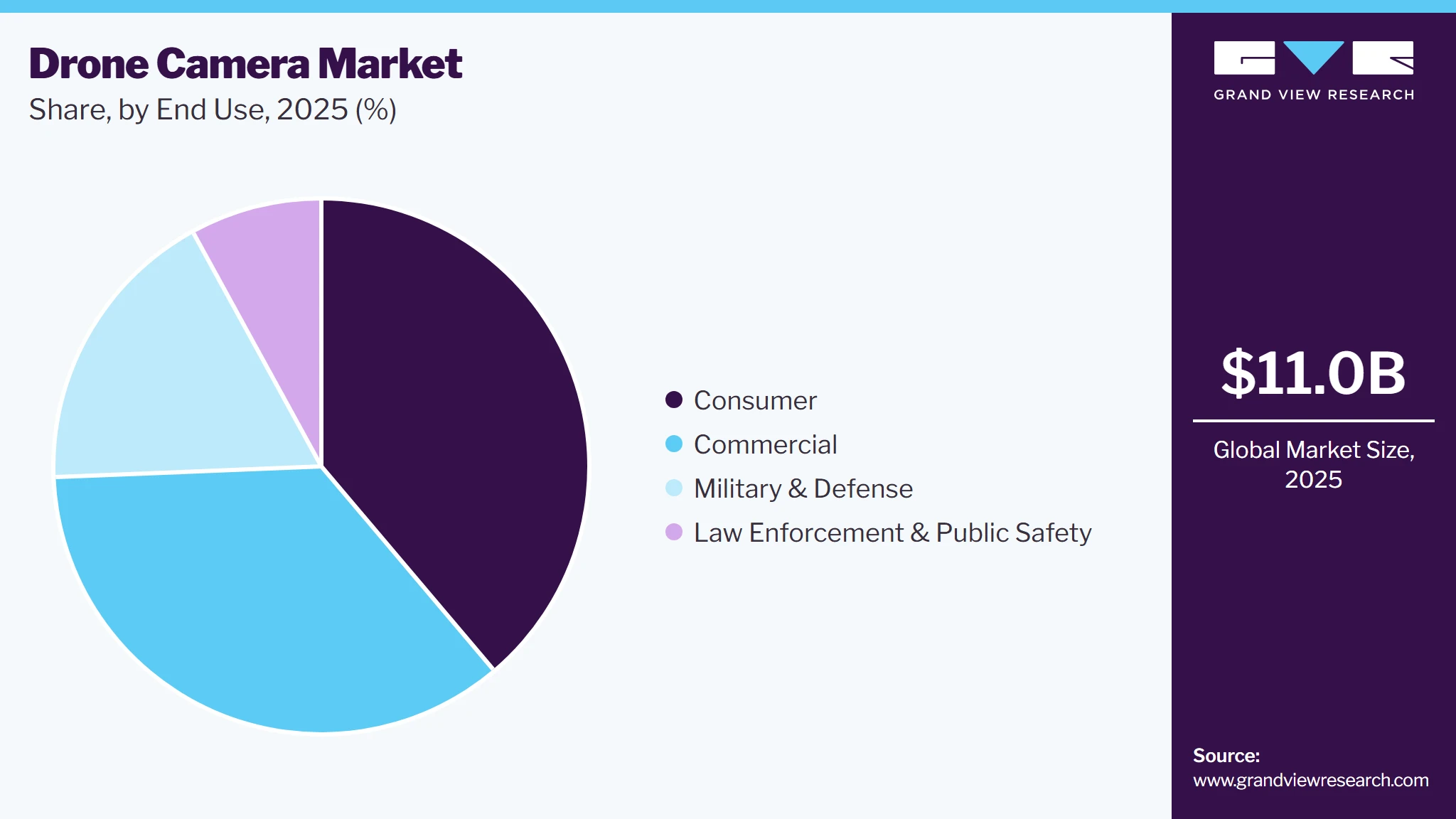
The military & defense segment is expected to register the highest CAGR from 2026 to 2033, driven by increasing deployment of drones for intelligence, surveillance, reconnaissance, border monitoring, battlefield observation, and target identification. In addition, growing demand for high-resolution imaging, thermal and multispectral cameras, long-endurance unmanned systems, and real-time situational awareness is supporting the integration of advanced drone cameras into defense operations. These developments are expected to strengthen demand for drone cameras across military and defense applications throughout the forecast period.
Regional Insights
Asia Pacific dominated the market, accounting for a revenue share of 32.4% in 2025 and is expected to grow at the fastest CAGR of over 14% from 2026 to 2033, driven by increasing investments in industrial imaging, agricultural drone use, aerospace technology, and autonomous systems. Countries across the region are developing drone camera programs, digital infrastructure, and operational end uses to support future commercial drone applications globally.

China Drone Camera Market Trends
China drone camera market is being accelerated by strong investments in commercial drone services, camera-sensor development, autonomous technologies, and domestic manufacturing capabilities. The country is investing in flight control, navigation, aerial monitoring, simulation, and fleet management systems to support emerging drone operations. Government support and expanding domestic drone programs continue to accelerate HD camera development. These trends support continued adoption across the market.
The drone camera market in Japan is expanding steadily, driven by investments in industrial imaging, urban inspection services, aerospace innovation, and advanced operational technologies. Japan is focusing on autonomous flight, navigation, aerial monitoring, simulation, and airspace management capabilities. Collaboration among technology companies, drone developers, and public agencies is further supporting the adoption of drone cameras. These trends are expected to remain important for safe and scalable commercial drone operations.
North America Drone Camera Market Trends
North America accounted for over 30.0% of the drone camera market in 2025, driven by the growing adoption of drones across commercial, defense, public safety, infrastructure inspection, and aerial imaging applications. The region’s established drone ecosystem, increasing investments in advanced imaging technologies, and expanding use of unmanned aerial systems across various industries further supported market growth.
The drone camera market in the U.S. dominated in 2025, supported by substantial commercial drone development activity, advanced HD imaging capabilities, and early adoption of autonomous flight technologies. The country is investing heavily in HD cameras, digital engineering, simulation, fleet management, and airspace integration to support the commercialization of enterprise drone services.
Europe Drone Camera Market Trends
The drone camera market in Europe is expected to grow at a CAGR of over 10% from 2026 to 2033, propelled by increasing commercial drone development, imaging innovation, sustainability targets, and investments in industrial drone infrastructure. European companies are developing camera sensors, autonomy systems, simulation end uses, and digital operational tools. Growing emphasis on regulatory readiness, interoperability, and sustainable urban inspection services is contributing to market growth across the region. These factors are expected to support continued market expansion across commercial drone programs.
The UK drone camera market is witnessing rapid expansion. Government initiatives supporting commercial drone operations, imaging innovation, and future flight technologies are driving demand for specialized HD cameras. The country is focusing on autonomous flight, simulation, airspace integration, and operational management solutions to improve the safety and scalability of emerging enterprise drone services.
The drone camera market in Germany is expected to grow significantly in the coming years, fueled by advances in imaging engineering, investments in industrial drone technology, and the development of commercial inspection solutions. The country is focusing on flight control, simulation, digital engineering, and aerial monitoring technologies. Growing collaboration among camera manufacturers, technology providers, and research institutions is further supporting the adoption of drone cameras. These trends support continued adoption across the broader drone market globally.
Key Drone Camera Company Insights
Some of the key players operating in the market include SZ DJI Technology Co., Ltd. and Autel Robotics, among others.
-
SZ DJI Technology Co., Ltd. is a major imaging technology provider with a strong market presence, offering gimbal stabilization, sensor integration, navigation, connectivity, and aerial imaging solutions. The company develops integrated HD cameras and digital systems supporting autonomous and enterprise drone operations. Its established manufacturing relationships, imaging expertise, and broad camera portfolio provide a significant competitive advantage in the market. These developments are expected to strengthen demand for drone cameras across development, operations, infrastructure, and commercial drone services.
-
Autel Robotics is a major imaging technology company with a strong market presence, offering flight controls, gimbals, navigation, payload management, and enterprise drone systems. The company develops integrated HD camera and control solutions that support advanced drone architectures. Autel Robotics benefits from extensive manufacturing partnerships, established compliance capabilities, and expertise in mission-critical systems for next-generation drones. These investments are expected to support continued adoption of HD cameras as commercial applications scale.
Teledyne FLIR and Parrot Drone SAS are among the emerging and specialized participants operating in the global market today.
-
Teledyne FLIR is a prominent imaging-technology company specializing in thermal sensors, airspace monitoring, navigation, simulation, and digital imaging solutions. The company has strengthened its position in commercial drones by enhancing HD camera capabilities that support safe drone operations, airspace integration, and digital infrastructure. Its focus on certified thermal-imaging systems and international partnerships supports its role in the drone camera ecosystem across emerging commercial programs and operations globally.
-
Parrot Drone SAS is an established provider of imaging, mapping, and digital drone technologies, offering solutions relevant to enterprise drone development, pilot training, testing, and operational readiness. The company focuses on simulation environments, digital mapping models, training end uses, and data-driven imaging solutions that support emerging drone programs. Through technology development and imaging partnerships, Parrot can expand its role in the next-generation drone camera ecosystem. These trends support continued adoption across the market.
Key Drone Camera Companies
The following key companies have been profiled for this study on the drone camera market.
-
SZ DJI Technology Co., Ltd.
-
Autel Robotics Co., Ltd.
-
Parrot Drones SAS
-
Skydio, Inc.
-
Yuneec International
-
Freefly Systems Inc.
-
Wingtra AG
-
Delair SAS
-
Potensic
-
FIMI Technology Co., Ltd.
-
Holy Stone Technology Co., Ltd.
Competitive Benchmarking
Operating Strategies
Competitive Edge
Weaknesses
Established Players (Honeywell International Inc., Collins Aerospace, Thales Group, Safran)
- Focus on long-term partnerships with Less than 12 MP, aerospace OEMs, and aviation operators to provide flight-control, avionics, navigation, simulation, and aircraft-management HD Cameras solutions.
- Invest heavily in R&D for autonomous flight systems, flight management HD Cameras, avionics HD Cameras, AI-enabled systems, digital twins, and integrated aircraft control technologies.
- Strong aerospace HD Cameras expertise, established aviation certification capabilities, and extensive experience in safety-critical systems.
- Established relationships with aircraft manufacturers and aviation customers, supported by global engineering, testing, and support infrastructure.
- High development and certification costs associated with safety-critical aviation HD Cameras and autonomous flight systems.
- Complex certification requirements and lengthy validation processes can delay the application of new HD Camera solutions.
Emerging & Specialized Players (Joby Aviation, Archer Aviation, Wisk Aero, Eve Air Mobility, BETA Technologies)
- Focus on specialized Drone Camera capabilities, including autonomous flight control, aircraft health monitoring, mission management, fleet operations, simulation, and advanced flight-planning systems.
- Expand HD Cameras capabilities through technology partnerships, strategic collaborations, vertical integration, and development of proprietary aircraft HD Cameras End Uses.
- Faster innovation cycles and greater ability to optimize HD Cameras specifically for eVTOL aircraft architectures and operating requirements.
- Strong expertise in integrating flight HD Cameras, autonomy, vehicle controls, simulation, and digital systems directly with purpose-built eVTOL End Uses.
- Limited commercial Application and operational experience compared with established aerospace technology providers.
- Smaller HD Cameras development resources and limited access to large-scale aviation customers, and an established certification infrastructure.
Recent Developments
-
In April 2026, Skydio partnered with an aerial-data analytics firm to accelerate the integration of autonomous inspection drones into utility and infrastructure monitoring programs. The partnership combines Skydio's autonomous flight technology with AI-powered image-analysis software that uses onboard thermal and HD sensors for high-fidelity infrastructure mapping. The companies plan to conduct joint field demonstrations to support scalable inspection operations and increasingly automated data coordination.
-
In May 2026, Autel Robotics reported significant progress in enterprise product certification and continued development of its AI-enabled imaging technology stack through partnerships with chipset and cloud analytics providers. Autel reported that it had completed a major compliance milestone for its enterprise inspection camera line, while its technology partnerships are focused on onboard computing, AI capabilities, connectivity, and autonomous flight development.
-
In May 2026, DJI announced that its enhanced obstacle-avoidance and thermal-imaging camera platform had been selected for use in multiple public-safety pilot programs across several regions. The program provides an opportunity for early operational deployment of advanced thermal and HD drone cameras, while DJI plans to use the program to demonstrate highly automated inspection and search-and-rescue operations.
Drone Camera Market Report Scope
Report Attribute
Details
Market size in 2025
USD 11.0 billion
Estimated market size in 2026
USD 12.3 billion
Projected market size by 2033
USD 27.9 billion
Growth rate
CAGR of 12.5% from 2026 to 2033
Actual data
2021 - 2025
Forecast period
2026 - 2033
Quantitative units
Revenue in USD billion and CAGR from 2026 to 2033
Report coverage
Report coverage, company ranking, competitive landscape, growth factors, and trends
Segments covered
Type, application, end-use, resolution, region
Regional scope
North America; Europe; Asia Pacific; Latin America; MEA
Country scope
U.S.; Canada; Mexico; Germany; UK; France; China; Japan; India; South Korea; Australia; Brazil; UAE; Saudi Arabia; South Africa
Key companies profiled
SZ DJI Technology Co., Ltd.; Autel Robotics Co., Ltd.; Parrot Drones SAS; Skydio, Inc.; Yuneec International; Freefly Systems Inc.; Wingtra AG; Delair SAS; Potensic; FIMI Technology Co., Ltd.; Holy Stone Technology Co., Ltd.
Customization scope
Free report customization (equivalent up to 8 analysts working days) with purchase. Addition or alteration to country, regional & segment scope.
Global Drone Camera Market Report Segmentation
This report forecasts revenue growth at global, regional, and country levels and provides an analysis of the latest industry trends in each of the sub-segments from 2021 to 2033. For this study, Grand View Research has segmented the global drone camera market report based on type, application, resolution, end-use, and region:
-
Type Outlook (Revenue, USD Billion, 2021 - 2033)
-
HD Cameras
-
Thermal Cameras
-
Other
-
-
Application Outlook (Revenue, USD Billion, 2021 - 2033)
-
Photography & Videography
-
Thermal Imaging
-
Surveillance
-
Mapping & Surveying
-
Inspection & Maintenance
-
Other
-
-
Resolution Outlook (Revenue, USD Billion, 2021 - 2033)
-
Less than 12 MP
-
12 to Less than 20 MP
-
20 to Less than 32 MP
-
32 MP and Above
-
-
End-use Outlook (Revenue, USD Billion, 2021 - 2033)
-
Consumer
-
Commercial
-
Military & Defense
-
Law Enforcement & Public Safety
-
-
Regional Outlook (Revenue, USD Billion, 2021 - 2033)
-
North America
-
U.S.
-
Canada
-
Mexico
-
-
Europe
-
Germany
-
UK
-
France
-
-
Asia Pacific
-
China
-
Japan
-
India
-
South Korea
-
Australia
-
-
Latin America
-
Brazil
-
-
Middle East and Africa (MEA)
-
UAE
-
Saudi Arabia
-
South Africa
-
-
Research Methodology
The drone camera market figures in this report are based on a proven research process that combines executive interviews with secondary research from proprietary databases, company filings, and recognized regulatory and institutional sources. Market size is built through value-chain sizing-reconciling supply-side and demand-side estimates-and triangulated with bottom-up and top-down approaches. Every estimate passes multiple levels of expert validation before publication, with each drone camera segment quantified using the revenue-capture definitions in the table below.
Segment Definition
Segment - Component
Revenue capture definition
HD Cameras
Revenue is generated from drone camera systems designed to capture high-definition still images and video for aerial photography, videography, recreational use, content creation, and general commercial imaging applications.
Services
Revenue is generated from thermal camera systems integrated into drones for heat detection, thermal imaging, inspection, surveillance, public safety, infrastructure monitoring, and other applications that require infrared imaging.
Other
Revenue is generated from other drone camera technologies, including multispectral, hyperspectral, low-light, infrared, and specialized imaging systems used for professional, commercial, industrial, and specialized aerial imaging applications.
Segment - Deployment
Revenue capture definition
Photography & Videography
Revenue is generated from drone cameras used for aerial photography, video production, filmmaking, media creation, advertising, real estate imaging, tourism content, and recreational photography and videography.
Thermal Imaging
Revenue is generated from drone cameras used to capture thermal images for heat detection, equipment monitoring, building inspection, firefighting, agriculture, energy infrastructure, and other temperature-based imaging applications.
Surveillance
Revenue is generated from drone cameras used for aerial surveillance, perimeter monitoring, security operations, border monitoring, event monitoring, and other applications requiring continuous or targeted observation.
Mapping & Surveying
Revenue is generated from drone cameras used for aerial mapping, topographic surveying, photogrammetry, 3D modeling, land surveying, construction monitoring, mining, agriculture, and geographic data collection.
Inspection & Maintenance
Revenue is generated from drone cameras used to inspect infrastructure, power lines, pipelines, telecommunications equipment, bridges, buildings, industrial facilities, and other assets requiring remote visual inspection.
Other
Revenue is generated from drone cameras used for specialized applications such as wildlife monitoring, environmental observation, scientific research, disaster assessment, agriculture, and other aerial imaging requirements.
Segment - Resolution
Revenue capture definition
Less than 12 MP
Revenue is generated from drone cameras with resolutions below 12 megapixels, primarily used in entry-level consumer drones, recreational applications, basic aerial photography, surveillance, and general-purpose imaging.
12 to Less than 20 MP
Revenue is generated from drone cameras offering 12 to less than 20 megapixels, supporting consumer photography, videography, commercial imaging, mapping, inspection, and other applications requiring improved image quality.
20 MP to Less than 32 MP
Revenue is generated from drone cameras offering 20 to less than 32 megapixels, primarily used for professional photography, commercial imaging, surveying, inspection, mapping, and applications requiring higher image detail.
32 MP and Above
Revenue is generated from high-resolution drone cameras offering 32 megapixels and above, supporting professional photography, advanced mapping, surveying, inspection, industrial imaging, and other applications requiring detailed aerial imagery.
Segment - End Use
Revenue capture definition
Consumer
Revenue is generated from drone cameras purchased or integrated into drones used by individual consumers, hobbyists, photographers, videographers, travelers, content creators, and recreational users for personal aerial imaging.
Commercial
Revenue is generated from drone cameras adopted by commercial users for photography, mapping, surveying, inspection, construction, agriculture, infrastructure monitoring, media production, and other business applications.
Military & Defense
Revenue is generated from drone cameras used in military and defense applications for intelligence, surveillance and reconnaissance, target observation, border monitoring, mission support, and other defense-related aerial imaging operations.
Law Enforcement & Public Safety
Revenue is generated from drone cameras used by law enforcement and public-safety agencies for surveillance, search and rescue, emergency response, disaster assessment, traffic monitoring, firefighting, and other public-safety operations.
Estimation Model
Layer Name
Key Question
Description
Drone Camera Technology & Imaging Layer
What technologies and systems enable drone camera capabilities?
Represents the core camera technologies, imaging systems, sensors, and enabling components that drive drone-based aerial imaging. Includes HD cameras, thermal cameras, multispectral and other specialized cameras, image sensors, stabilization systems, image processing, autofocus, zoom, low-light imaging, and other technologies that improve image quality, accuracy, reliability, and aerial imaging performance.
Drone Camera Application & End-Use Layer
Where are drone cameras deployed and which segments generate demand?
Represents the applications and end-use segments driving demand for drone cameras. Key applications include photography and videography, thermal imaging, surveillance, mapping and surveying, inspection and maintenance, and other specialized imaging applications. Primary end users include consumers, commercial organizations, military and defense organizations, and law enforcement and public-safety agencies.
Drone Camera Integration & Lifecycle Management Layer
How are drone cameras developed, integrated, and maintained throughout their operational lifecycle?
Covers the design, integration, testing, deployment, upgrading, maintenance, and lifecycle management of drone camera systems across different drone platforms and operating environments. Includes camera-drone integration, gimbal stabilization, sensor integration, image processing, software compatibility, calibration, firmware updates, maintenance, data management, and performance monitoring that ensure long-term reliability, image quality, and operational performance.
Drone Camera Procurement & Market Monetization Layer
How is revenue generated in the Drone Camera Market?
Revenue is generated through the sale of integrated drone camera systems, camera payloads, replacement cameras, upgrades, accessories, and related services. Key revenue streams include HD and thermal cameras, high-resolution imaging systems, specialized camera payloads, camera upgrades, maintenance and support services, and integrated drone-camera solutions purchased by consumers, commercial organizations, military and defense organizations, law enforcement agencies, and other professional users.
Delivered Customizations
This report has been delivered with the following In-depth customizations
Client Request
Customization Delivered
Value Adds
Market Sizing, Segmentation & Growth Opportunity Assessment
Assessed the global Drone Camera Market size, historical trends, forecast growth outlook, and detailed segmentation by Type (HD Cameras, Thermal Cameras, Other), Application (Photography & Videography, Thermal Imaging, Surveillance, Mapping & Surveying, Inspection & Maintenance, Other), Resolution (Less than 12 MP, 12 to Less than 20 MP, 20 MP to Less than 32 MP, 32 MP and Above), and End Use (Consumer, Commercial, Military & Defense, Law Enforcement & Public Safety). Evaluated demand patterns across aerial imaging, commercial drone operations, surveillance, mapping, inspection, and other drone-based applications.
Enables drone manufacturers, camera technology providers, commercial operators, defense organizations, public-safety agencies, and investors to identify high-growth market segments, prioritize product investments, optimize camera portfolios, and capture revenue opportunities across consumer and professional drone imaging applications.
Technology Landscape & Drone Camera Innovation Analysis
Evaluated the adoption of next-generation technologies across drone camera systems, including high-resolution imaging, thermal imaging, image stabilization, AI-enabled image processing, multispectral and specialized sensors, optical and digital zoom, low-light imaging, autofocus, obstacle-aware imaging, and integrated camera-drone systems. Analyzed technological advancements improving image quality, imaging accuracy, stabilization, operational efficiency, and performance across aerial applications.
Helps drone manufacturers, camera providers, technology companies, commercial operators, and other stakeholders identify emerging innovation opportunities, improve imaging performance, strengthen product differentiation, integrate advanced imaging technologies, and develop next-generation drone camera systems aligned with evolving aerial imaging requirements.
Regional Drone Camera Demand & Adoption Analysis
Assessed regional demand across North America, Europe, Asia Pacific, Latin America, and the Middle East & Africa by evaluating drone adoption, regulatory developments, commercial drone activity, consumer demand, defense and public-safety applications, technology development, manufacturing capabilities, distribution networks, and adoption of advanced camera systems across regional markets.
Provides actionable insights into regional growth opportunities, adoption priorities, competitive positioning, and investment hotspots, enabling stakeholders to align market-entry strategies, strengthen technology partnerships, prioritize regional resources, and capitalize on increasing demand for drone cameras driven by expanding aerial imaging applications.
Frequently Asked Questions About This Report
Key factors include the increasing drone adoption, rising demand for high-resolution aerial imaging, expanding thermal imaging applications, growing use of drones for inspection and mapping, and increasing deployment across consumer, commercial, defense, and public-safety applications are the key factors driving the market growth.
Key players include SZ DJI Technology Co., Ltd., Autel Robotics Co., Ltd., Parrot Drones SAS, Skydio, Inc., Yuneec International, Freefly Systems Inc., Wingtra AG, Delair SAS, Potensic, FIMI Technology Co., Ltd., Holy Stone Technology Co., Ltd.
The photography & videography segment accounted for the largest market share in 2025, while thermal imaging segment is the fastest growing application.
The consumer segment accounted for the largest market share in 2025, while military & defense segment is the fastest growing end-use.
The 12 to Less than 20 MP segment accounted for the largest market share in 2025, while 32 MP and Above segment is the fastest growing resolution.
The global drone camera market size was valued at USD 11.0 billion in 2025 and is projected to reach USD 12.3 billion in 2026.
The global drone camera market is expected to reach USD 27.9 billion by 2033, at a CAGR of 12.5% from 2026 to 2033
The HD cameras segment accounted for over 75.0% of the market in 2025, while thermal cameras segment is the fastest growing type.
Asia Pacific dominated the global market with 32.4% revenue share in 2025.
About the Author(s)
Next Generation Technologies Research Team
Technology · Next Generation TechnologiesThis report was authored by the next generation technologies research team at Grand View Research - comprising two research analysts, one senior research analyst, and one industry expert - with specialized expertise in the next generation technologies segment of the technology industry. All findings are based on proprietary technology databases, executive interviews, and regulatory analysis, subject to internal peer review prior to publication.
Last Updated:
Speak to Analyst


Customize this report to your needs — add regions, segments, or data points, with 20% free customization.
Or view our licence options:


ISO 9001:2015 & 27001:2022 Certified
We are GDPR and CCPA compliant! Your transaction & personal information is safe and secure. For more details, please read our privacy policy.


