
- Home
- »
- Automotive & Transportation
- »
-
Electric Commercial Vehicle Market Size Report, 2026-2033GVR Report cover

Electric Commercial Vehicle Market (2026 - 2033)
Size, Share & Trends Analysis Report By Vehicle (Light Commercial Vehicles (LCVs), Heavy Trucks), By Propulsion, By Drive (Front-wheel Drive (FWD), Rear-wheel Drive (RWD)), By Vehicle Speed, By Region, And Segment Forecasts
Market Size, 2025
$101.5BMarket Estimate, 2026
$120.9BMarket Forecast, 2033
$341.0BCAGR, 2026–2033
16.0%Electric Commercial Vehicle Market Summary
The global electric commercial vehicle market size was valued at USD 101.5 billion in 2025 and is projected to grow from USD 120.9 billion in 2026 to USD 341.0 billion by 2033, at a CAGR of 16.0% from 2026 to 2033. The Asia Pacific held the largest share of 86.0% of the global market in 2025. The market for electric commercial vehicles is undergoing rapid transformation, driven by technological advancements, regulatory pressures, and evolving business models.
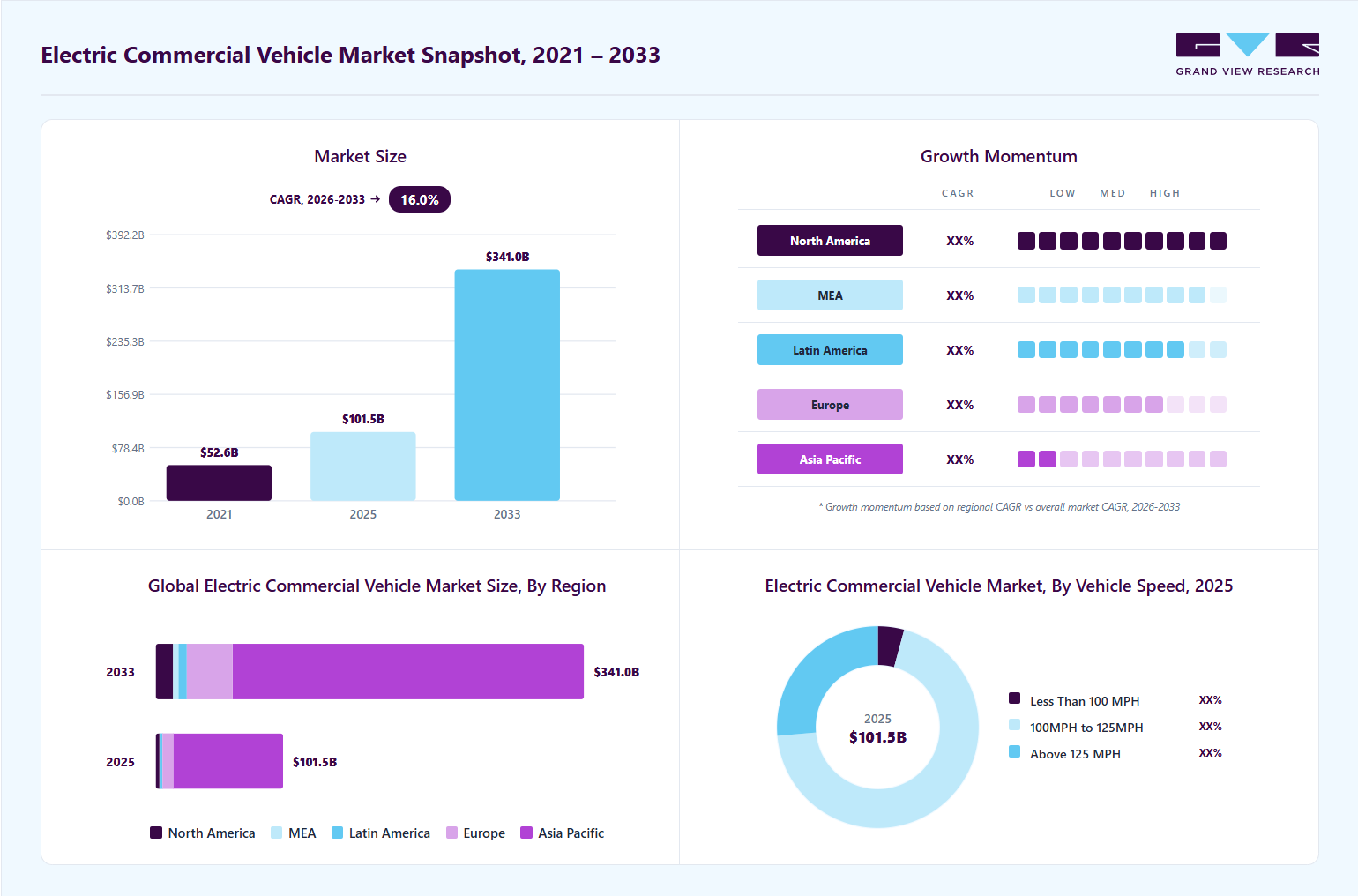 Source: Grand View Research, IR Documents, Primary Interviews, Paid DatabasesTo learn more about this report,
 Download Free Sample Report
Key Market Trends & Insights
- By vehicle: Buses & coaches segment held the largest market share of 64.7% in 2025.
- By propulsion: Battery electric vehicle (BEV) segment accounted for the largest share in 2025.
- By drive: Front-wheel drive (FWD) segment accounted for the largest market share in 2025.
- By vehicle Speed: 100MPH to 125MPH segment dominated the market in 2025.
Regional Highlights
- Largest regional market: Asia Pacific (86.0% revenue share, 2025)
- By country: China held a dominant market position in 2025.
Market Size & Forecast
- Market size in 2025: USD 101.5 Billion
- Estimated market size in 2026: USD 120.9 Billion
- Projected market size by 2033: USD 341.0 Billion
- CAGR (2026-2033): 16.0%
Three ways to get this report
Buy it, customize it, or ask a question.Ask an Analyst
Analyst response in 1 business day
- AccessReport author, directly
- Reply timeWithin 1 working day
- No sales callDirect answer only
- FormatEmail reply
- CostFree, no cost
Get the Full Report
What the study covers
- FormatsPDF · Excel · Dashboard
- Timeline2026–2033 annual, 2025 base
- Coverage20+ countries, 5 regions
- Companies10+ key players profiled
Customize the Report
20% free customization
- IncludeCountries, segments, points
- TailorTo your product definition
- ExtendDeeper competitor detail
- OrA fully bespoke study
- Turnaround5–10 working days
Factors such as advancements in battery technology and charging infrastructure, government regulations and incentives to promote adoption of EVs, and e-commerce boom and last-mile delivery electrification can be attributed to the growth of the market. In addition, falling battery prices and strategic investments in charging infrastructure and energy ecosystems further contribute to the growth of the electric commercial vehicle industry.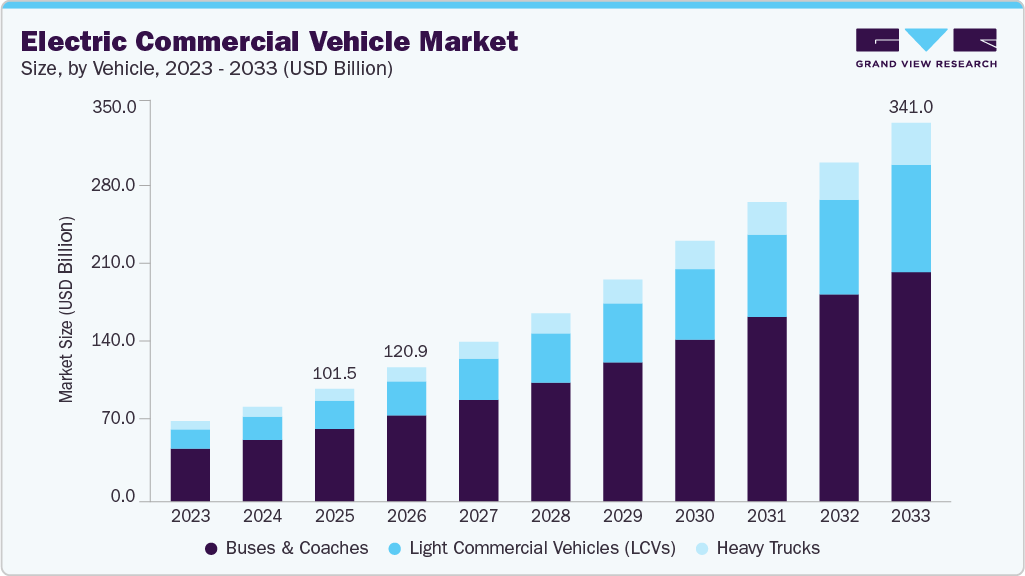 To learn more about this report, Download Free Sample Report
The electric commercial vehicle industry is heavily reliant on progress in battery technology and charging infrastructure. Ongoing research and development are yielding batteries with higher energy densities, allowing ECVs to travel greater distances on a single charge. Simultaneously, the expansion of charging networks, including the deployment of high-power fast-charging stations, is reducing charging times and improving the overall convenience of ECVs. These improvements are crucial for addressing range anxiety and operational concerns among fleet operators, thereby driving increased adoption of electric commercial vehicles across various sectors.
Government regulations and incentives play a pivotal role in shaping the electric commercial vehicle industry. Concerns about air quality and climate change are intensifying, encouraging governments to enact stricter emission standards, particularly in urban centers. These regulations, coupled with financial incentives such as subsidies, tax exemptions, and grants, are making ECVs a compelling alternative to traditional internal combustion engine vehicles for businesses. This supportive policy landscape is driving significant investment and innovation in the ECV sector, boosting market expansion.
The rapid growth of e-commerce has reshaped the logistics and delivery sector, increasing the need for efficient and sustainable last-mile solutions. Electric vans and light commercial vehicles are becoming the preferred choice due to their zero-emission operation, lower noise levels, and reduced operating costs. These benefits make them well-suited for urban delivery environments. Companies focusing on sustainability and delivery optimization are projected to drive significant growth in demand for electric commercial vehicles in last-mile logistics.
Increasing development and launch of electric commercial vehicles, such as electric buses, is further contributing to the growth of the electric commercial vehicle industry. For instance, in March 2025, Volvo Buses introduced the new Volvo 7800 Electric in Mexico, marking the country's first locally manufactured electric bi-articulated and articulated bus. Built on the company’s global Volvo BZR electromobility platform, this new model aims to enhance Mexico's Bus Rapid Transit systems, promoting a more efficient and sustainable public transportation network. Such initiatives are expected to contribute to the growth of the market.
Market Dynamics
The accelerating transition toward electrified mobility, supported by stringent emission reduction targets and national decarbonization policies, is fundamentally driving growth in the electric vehicle market. Governments across major automotive economies are implementing tighter fuel economy regulations, zero-emission vehicle mandates, and incentives for EV adoption, compelling automakers to expand their electric vehicle portfolios and accelerate investments in Battery-electric and hybrid platforms. Simultaneously, continuous advancements in lithium-ion battery technology are improving driving range, charging efficiency, and battery lifecycle performance while gradually reducing battery pack costs, making electric vehicles increasingly cost-competitive with internal combustion engine vehicles. The rapid expansion of public and private charging infrastructure is further enhancing consumer confidence by addressing range anxiety and improving accessibility for long-distance and urban mobility applications. In parallel, automotive manufacturers are increasingly integrating connected vehicle technologies, AI-enabled energy management systems, and over-the-air software capabilities into EV platforms, enhancing vehicle efficiency, predictive maintenance, and user experience. Growing corporate fleet electrification initiatives and rising investments in renewable energy integration are also strengthening the long-term adoption outlook for electric vehicles by supporting sustainable transportation ecosystems and reducing total operating costs for commercial and passenger mobility applications
Despite strong long-term growth potential, the electric commercial vehicle industry continues to face significant restraints associated with battery economics, infrastructure limitations, and supply chain vulnerabilities. Battery packs remain the most expensive component of electric vehicles, and fluctuations in the prices of critical raw materials such as lithium, cobalt, nickel, and graphite continue to impact overall vehicle affordability and manufacturer profit margins. In several developing and price-sensitive automotive markets, the higher upfront cost of electric vehicles compared to conventional internal combustion engine vehicles remains a major barrier to mass adoption despite government incentives. In parallel, inadequate charging infrastructure coverage, particularly in rural and semi-urban regions, continues to limit consumer confidence and restrict widespread EV deployment. Long charging durations compared to conventional refueling processes further affect adoption across commercial fleet and long-distance transportation applications where operational uptime is critical.
The electric commercial vehicle industry is witnessing substantial growth opportunities driven by the rapid expansion of charging infrastructure, advancements in next-generation battery technologies, and increasing electrification across commercial transportation segments. Governments and private sector stakeholders are investing heavily in ultra-fast charging corridors, smart grid integration, and vehicle-to-grid (V2G) infrastructure to support large-scale EV deployment and improve charging accessibility across urban and highway networks. Simultaneously, the emergence of solid-state batteries, sodium-ion batteries, and advanced battery management systems is expected to enhance energy density, charging speed, safety, and overall vehicle performance, creating new commercialization opportunities for automotive manufacturers and battery suppliers. The growing development of battery recycling and second-life battery utilization ecosystems is also opening new revenue streams by reducing dependence on virgin raw materials and improving supply chain sustainability. In parallel, rising electrification of commercial fleets, including delivery vans, buses, ride-hailing vehicles, and logistics transportation, is generating strong demand for high-capacity electric vehicles with lower operating and maintenance costs. Increasing integration of renewable energy sources with EV charging infrastructure, combined with the adoption of AI-enabled energy optimization and connected mobility platforms, is further enabling the development of intelligent and sustainable transportation ecosystems.
Market Characteristics & Concentration
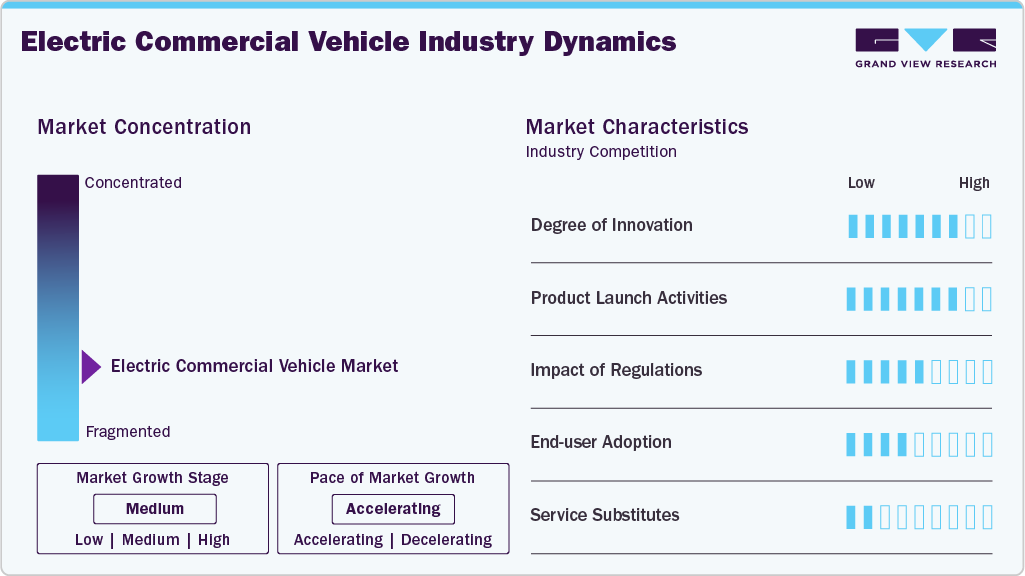
The electric commercial vehicle industry is moderately fragmented, characterized by the presence of established global automotive manufacturers, emerging electric mobility companies, battery manufacturers, and regional commercial vehicle producers competing across multiple vehicle categories and regional markets. Major players such as AB Volvo, BYD Company Ltd., Ford Motor Company, General Motors, and Mercedes-Benz Group AG dominate the market through extensive manufacturing capabilities, strong distribution networks, integrated battery technologies, and strategic partnerships with fleet operators and charging infrastructure providers. These companies are increasingly expanding their electric truck, electric bus, and last-mile delivery vehicle portfolios to strengthen their market positioning across both developed and emerging economies.
 To learn more about this report, Download Free Sample Report
Market fragmentation is further driven by rapid advancements in battery technology, charging infrastructure development, autonomous fleet management systems, and connected vehicle platforms, which continue to create opportunities for specialized and regional electric mobility providers. Emerging companies and niche manufacturers are gaining market traction by focusing on specific applications such as urban delivery vans, electric buses, mining trucks, and medium-duty commercial fleets while offering customized vehicle platforms and localized manufacturing strategies. In parallel, governments across major economies are supporting domestic electric commercial vehicle production through subsidies, localization mandates, and public transportation electrification programs, enabling regional manufacturers to strengthen their competitive presence. At the same time, strategic collaborations between automotive OEMs, battery manufacturers, charging infrastructure companies, and software providers are gradually increasing market consolidation, particularly in high-investment segments such as heavy-duty electric trucks, battery-swapping ecosystems, and fleet electrification services.
Vehicle Insights
The buses & coaches segment accounted for the largest share of 64.7% in 2025. The segment growth is driven by the increasing focus on sustainable urban transportation. Rapid urbanization and government initiatives to reduce air pollution and carbon emissions are leading to the adoption of electric buses in public transit fleets worldwide. Favorable government policies, coupled with the lower total cost of ownership resulting from reduced operating and maintenance expenses, make electric buses an attractive alternative to traditional diesel-powered vehicles. The quieter operation and zero-emission nature of electric buses further contribute to their appeal, enhancing the quality of life in densely populated urban environments.
The Light Commercial Vehicles (LCVs) segment is expected to grow at the fastest CAGR during the forecast period. The LCV segment is witnessing rapid growth, driven by the expanding e-commerce sector and the increasing demand for efficient urban logistics and last-mile delivery. Electric LCVs are particularly well-suited for these applications, offering zero-emission operation, lower operating costs, and the ability to navigate urban environments effectively. As businesses prioritize corporate sustainability and seek to reduce their environmental impact, the adoption of electric LCVs is accelerating. Improvements in vehicle range and payload capacity are further enhancing their practicality and broadening their appeal across various commercial sectors.
Propulsion Insights
The Battery Electric Vehicle (BEV) segment held the largest market in 2025. The segment’s growth is primarily driven by advancements in battery technology, declining battery costs, and widespread charging infrastructure development. Their simplicity, lower maintenance needs, and suitability for short to medium-range urban and regional routes make them ideal for applications such as delivery vans, city buses, and municipal fleets. Supportive government policies, tax incentives, and city-level zero-emission zones are further accelerating BEV adoption.
The fuel cell electric vehicle (FCEV) segment is expected to register the fastest CAGR of 18.6% during the forecast period. Fuel Cell Electric Vehicles (FCEVs) are gaining traction in segments requiring long range, high payload capacity, and rapid refueling, such as long-haul trucking and intercity buses. The segment’s growth is fueled by investments in hydrogen infrastructure, government incentives for zero-emission heavy-duty transport, and the ability to perform well in extreme climates and longer duty cycles. Hydrogen production is becoming more cost-effective, and infrastructure expansion is expected to enable FCEVs to complement BEVs in heavier-duty applications where battery-only solutions face limitations. Such factors are expected to contribute to the segment’s growth.
Drive Insights
The Front-wheel Drive (FWD) segment dominated the market in 2025. Front-wheel drive (FWD) drive is gaining traction due to its simplicity, cost-effectiveness, and efficiency in urban environments. FWD systems are typically lighter and more fuel-efficient, reducing energy consumption, making them ideal for light commercial vehicles such as delivery vans and city buses. Their ability to handle well in urban settings with smaller turning radii and good traction on flat surfaces contributes to their popularity in last-mile delivery and short-range applications.
The All-wheel Drive (AWD) segment is expected to grow at the fastest CAGR during the forecast period. AWD drive is gaining popularity in heavy-duty and off-road applications, including long-haul trucks and vehicles operating in challenging environments. AWD systems provide superior traction, stability, and power distribution, which makes them well-suited for regions with inclement weather, rough terrain, or high payload capacities. The growing demand for versatile, all-terrain vehicles, especially in logistics and construction sectors, is driving the adoption of AWD EVs.
Vehicle Speed Insights
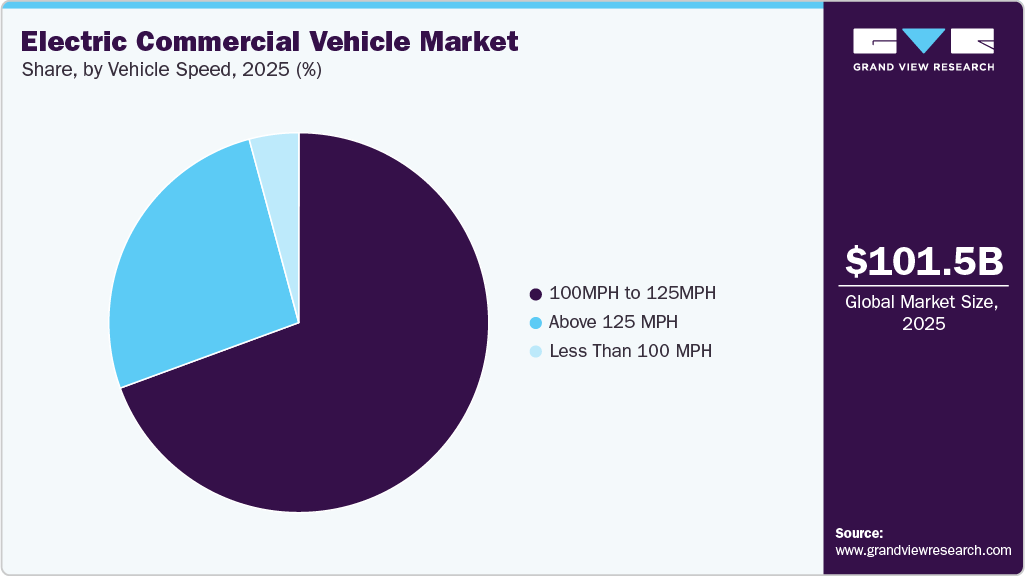
The 100MPH to 125MPH segment dominated the market in 2025. Electric commercial vehicles with speeds between 100 MPH and 125 MPH are gaining traction in segments that demand higher performance, such as intercity transport, express delivery, and highway logistics. The growth of this segment is driven by advancements in powertrain efficiency, improved battery performance, and the need for faster, long-distance transportation solutions. Fleet operators seeking quicker delivery cycles and flexible routing options increasingly favor high-speed electric vehicles to enhance productivity, thereby boosting the segment’s growth.
 To learn more about this report, Download Free Sample Report
The Less Than 100 MPH segment is anticipated to grow rapidly during the forecast period. Increasing demand for electric commercial vehicles with speeds under 100 MPH in urban and short-distance applications, where speed is less critical than efficiency, reliability, and cost, can be attributed to the segment growth. These vehicles benefit from lower energy consumption, simplified design, and reduced maintenance, making them ideal for last-mile delivery, city transit, and utility services. Government support for low-speed urban EVs, including subsidies and access to restricted emission zones, further fuels their adoption. The strong focus on sustainable urban mobility and short-route logistics continues to drive demand in this segment.
Regional Insights
The North America electric commercial vehicle industry is expected to register a moderate CAGR from 2026 to 2033. The North America market is being significantly driven by stringent emission reduction targets, government incentive programs, and increasing investments in sustainable transportation infrastructure across the United States and Canada. Regulatory policies supporting zero-emission commercial transportation, combined with tax credits and fleet electrification subsidies, are encouraging logistics operators, transit agencies, and corporate fleets to accelerate the adoption of electric buses, trucks, and delivery vehicles. Simultaneously, rapid expansion of public and private fast-charging networks, along with growing domestic battery manufacturing investments, is improving the operational viability of electric commercial vehicles across regional and long-haul transportation applications. In parallel, rising corporate sustainability commitments and increasing focus on reducing fuel and maintenance costs are further driving demand for electric commercial fleets across e-commerce, logistics, public transit, and municipal transportation sectors.
 To learn more about this report, Download Free Sample Report
U.S. Electric Commercial Vehicle Market Trends
The U.S. electric commercial vehicle industry held a dominant position in the region in 2025. The U.S. market is being significantly driven by strong federal and state-level incentives supporting zero-emission transportation and fleet electrification initiatives. Regulatory frameworks such as the Inflation Reduction Act (IRA) and stringent emission standards established by agencies including the EPA are encouraging logistics companies, transit agencies, and fleet operators to accelerate the adoption of electric buses, delivery vans, and heavy-duty trucks.
Europe Electric Commercial Vehicle Market Trends
Europe electric commercial vehicle industry is expected to register a notable CAGR from 2026 to 2033. The region’ is driven by aggressive climate goals, low-emission zones, and strong policy support from the EU. Countries across the region are deploying extensive charging infrastructure, especially for urban and regional commercial fleets. Sustainability commitments and public pressure are pushing both public and private sectors to accelerate electrification, thereby driving the growth of the electric commercial vehicle industry in the region.
The UK electric commercial vehicle industry is expanding steadily, backed by government incentives, urban clean air initiatives, and a clear roadmap to phase out internal combustion vehicles. The availability of electric vans and light trucks tailored to the country’s logistics needs is growing. Combined with strong policy alignment, this is supporting the transition across delivery, municipal, and utility segments.
The Germany electric commercial vehicle industry held a substantial market share in 2025. The Germany market is being driven by stringent European Union emission regulations and the country’s strong commitment toward industrial decarbonization and sustainable transportation. Government incentives, low-emission zone policies, and funding programs supporting electric buses, freight vehicles, and urban mobility solutions are encouraging fleet operators and logistics companies to accelerate electrification initiatives.
Asia Pacific Electric Commercial Vehicle Market Trends
The Asia Pacific electric commercial vehicle industry is anticipated to grow at a CAGR of 15.3% during the forecast period. Asia Pacific is experiencing rapid ECV market expansion, driven by high urbanization, government mandates, and growing logistics demand in emerging economies. The region benefits from a strong manufacturing base, especially in China and India, and rising demand for cost-effective, sustainable urban transport solutions.
India’s electric commercial vehicle industry is expected to grow at the fastest growth rate during the forecast period. The market is growing due to strong government push under programs such as FAME II, rising fuel prices, and the need for clean urban mobility. Light commercial vehicles and electric buses are gaining adoption in public transit and last-mile delivery sectors. Domestic manufacturers are ramping up production of affordable electric models, supported by incentives and state-level policies. The shift toward electrification is becoming a key part of India’s strategy to reduce oil dependence and urban pollution.
The China electric commercial vehicle industry held a substantial market share in 2025. The China market is primarily driven by strong government support through subsidies, zero-emission transportation mandates, and long-term industrial policies promoting new energy vehicles (NEVs). China’s dominance in lithium-ion battery manufacturing, raw material processing, and integrated EV supply chains is enabling large-scale production and cost competitiveness across electric buses, trucks, and logistics vehicles. Simultaneously, aggressive electrification of public transportation fleets, urban delivery networks, and municipal service vehicles is significantly accelerating domestic demand for electric commercial vehicles across major cities and industrial regions.
Key Electric Commercial Vehicle Company Insights
Some of the key companies in the electric commercial vehicle industry include AB Volvo, Ford Motor Company, Daimler Truck AG, BYD Company Ltd. and others. Organizations are focusing on integrating advanced technologies into their ECV offerings to maintain competitive advantages. Therefore, key players are taking several strategic initiatives, such as new product launches, business expansions, partnerships, collaborations, and agreements, among others.
-
AB Volvo is a manufacturing company known for its wide range of commercial vehicles, including trucks, buses, and construction equipment. The company operates through various segments, such as Volvo Trucks, Volvo Construction Equipment, and Volvo Buses, providing innovative and reliable transportation solutions globally. With a strong commitment to reducing its carbon footprint, Volvo has been at the forefront of developing electric and autonomous vehicles.
-
Daimler Truck AG is one of the world’s prominent manufacturers of commercial vehicles. The company’s truck product range includes light, medium, and heavy-duty trucks for distribution, construction, and long-haul applications, specialized vehicles primarily used in the municipal sector, and industrial engines. The company operates significant production facilities in Germany, France, Japan, India, Brazil, Turkey, Mexico, and the U.S., and locations across most countries worldwide.
Key Electric Commercial Vehicle Companies:
The following key companies have been profiled for this study on the electric commercial vehicle market.
- AB Volvo
- BYD Company Ltd.
- Ford Motor Company
- General Motors
- Mercedes-Benz Group AG
- Mitsubishi Motors Corporation
- Nissan Motor Co., Ltd.
- Tesla, Inc.
- Daimler Truck AG
- Renault Group
Competitive Benchmarking
Operating Strategies
Competitive Edge
Weaknesses
Mature Players: BYD, Daimler Truck, Volvo Group, Tata Motors
- Mature players focus on large-scale commercialization of electric buses, heavy-duty trucks, delivery vans, and fleet electrification solutions across regional and international markets.
- Their strategies emphasize vertically integrated manufacturing, long-term fleet partnerships, battery technology investments, and expansion of charging and aftersales service ecosystems.
- Strong manufacturing scale, extensive dealer and service networks, and established relationships with logistics operators, municipalities, and commercial fleet owners.
- Advanced capabilities in battery integration, vehicle engineering, telematics, and energy-efficient powertrain technologies.
- High capital expenditure requirements for EV platform development, battery sourcing, and charging infrastructure expansion.
- Dependence on critical battery raw materials and semiconductor supply chains exposes operations to cost volatility and procurement disruptions.
Emerging Players: Arrival, EKA Mobility
- Emerging players focus on niche electric commercial vehicle applications including last-mile delivery vans, urban logistics fleets, light-duty trucks, and electric bus platforms.
- Higher operational agility and faster product innovation cycles compared to traditional automotive OEMs.
- Strong focus on software-defined vehicles, connected mobility services, and customized fleet electrification solutions.
- Limited manufacturing scale and constrained financial resources can impact large-volume production and global expansion capabilities.
- Lower brand recognition and limited aftersales service infrastructure may affect customer adoption and long-term fleet confidence.
Recent Developments
-
In January 2026, Tata Motors announced the launch of next-generation portfolio of 17 trucks, spanning 7 to 55 tonnes. This comprehensive launch introduces the all-new Azura series, the cutting-edge Tata Trucks.ev range. This product launch is expected to help company strengthen it product portfolio and increase the customer base.
-
In May 2026, Volvo announced the launch of new heavy-duty model with a range of up to 700 km on one charge. This new product launch is expected to help company strengthen its position in the market.
-
In February 2025, Renault introduced a new generation of electric light commercial vehicles, including the Goelette, Trafic E-Tech, and Estafette electric models. Built on Ampere’s Software Defined Vehicle architecture, this adaptable and scalable lineup offers enhanced connectivity, tailored configurations, and improved efficiency to meet the needs of modern businesses.
-
In March 2024, Volvo Buses, a subsidiary of AB Volvo, introduced the Volvo 8900 Electric, a cutting-edge electric low-entry bus designed for intercity, commuter, and city operations. This innovative bus is available in both two- and three-axle configurations, allowing operators to optimize their fleet for efficient, sustainable, and profitable traffic management.
Electric Commercial Vehicle Market Report Scope
Report Attribute
Details
Market size in 2025
USD 101.5 billion
Estimated market size in 2026
USD 120.9 billion
Projected market size by 2033
USD 341.0 billion
Growth rate
CAGR of 16.0% from 2026 to 2033
Base year for estimation
2025
Historical data
2021 - 2024
Forecast period
2026 - 2033
Quantitative units
Revenue in USD million and CAGR from 2026 to 2033
Report coverage
Revenue forecast, company ranking, competitive landscape, growth factors, and trends
Segments covered
Vehicle, propulsion, drive, vehicle speed, and region
Regional scope
North America; Europe; Asia Pacific; Latin America; MEA
Country scope
U.S.; Canada; Mexico; Germany; UK; France; China; Japan; India; South Korea; Australia; Brazil; KSA; UAE; South Africa
Key companies profiled
AB Volvo; BYD Company Ltd.; Ford Motor Company; General Motors; Mercedes-Benz Group AG; Mitsubishi Motors Corporation; Nissan Motor Co., Ltd.; Tesla, Inc.; Daimler Truck AG; Renault Group
Customization scope
Free report customization (equivalent up to 8 analysts working days) with purchase. Addition or alteration to country, regional & segment scope.
Pricing and purchase options
Avail customized purchase options to meet your exact research needs. Explore purchase options
Global Electric Commercial Vehicle Market Report Segmentation
This report forecasts revenue growth at global, regional, and country levels and provides an analysis of the latest industry trends in each of the sub-segments from 2021 to 2033. For this study, Grand View Research has segmented the global electric commercial vehicle market report based on vehicle, propulsion, drive, vehicle speed, and region:
-
Vehicle Outlook (Revenue, USD Million, 2021 - 2033)
-
Light Commercial Vehicles (LCVs)
-
Heavy Trucks
-
Buses & Coaches
-
-
Propulsion Outlook (Revenue, USD Million, 2021 - 2033)
-
Battery Electric Vehicle (BEV)
-
Plug-in Hybrid Electric vehicle (PHEV)
-
Fuel Cell Electric Vehicle (FCEV)
-
-
Drive Outlook (Revenue, USD Million, 2021 - 2033)
-
Front-wheel Drive (FWD)
-
Rear-wheel Drive (RWD)
-
All-wheel Drive (AWD)
-
-
Vehicle Speed Outlook (Revenue, USD Million, 2021 - 2033)
-
Less Than 100 MPH
-
100MPH to 125MPH
-
Above 125 MPH
-
-
Regional Outlook (Revenue, USD Million, 2021 - 2033)
-
North America
-
U.S.
-
Canada
-
Mexico
-
-
Europe
-
Germany
-
UK
-
France
-
-
Asia Pacific
-
China
-
Japan
-
India
-
South Korea
-
Australia
-
-
Latin America
-
Brazil
-
-
Middle East and Africa (MEA)
-
KSA
-
UAE
-
South Africa
-
-
Delivered Customizations
This report has been delivered with the following In-depth customizations
Client Request
Customization Delivered
Value Adds
Regional Electric Commercial Vehicle Market Opportunity Assessment
Country/region-wise market sizing and forecast analysis for electric buses, trucks, vans, and fleet vehicles
Assessment of EV adoption trends, charging infrastructure development, and government incentive programs
Identification of high-growth markets based on fleet electrification initiatives, emission regulations, and public transportation investments
Identified region-specific revenue and expansion opportunities
Supported market entry, localization, and fleet deployment strategies
Enabled informed investment and partnership decisions across emerging and developed markets
Cross-Segmentation Analysis for the Electric Commercial Vehicle Market
Criss-cross market analysis by vehicle, battery capacity, propulsion technology, charging type, and end-use industry
Demand and adoption assessment across key applications
Segment attractiveness and growth potential benchmarking
Identified high-growth vehicle and application segments
Supported targeted product development and commercialization strategies
Improved customer targeting and fleet electrification prioritization
Competitive Benchmarking and Strategic Positioning in the Electric Commercial Vehicle Market
Benchmarking of key competitors across products, pricing, partnerships, and innovation
Comparative assessment of market share, production capabilities, geographic presence, and innovation strategies
Analysis of competitive strengths, technology gaps, and differentiation opportunities
Identified competitive white spaces and technology investment opportunities
Supported strategic positioning and product differentiation initiatives
Enabled data-driven competitive intelligence and long-term growth planning
Frequently Asked Questions About This Report
The front-wheel drive (FWD) segment dominated the market in 2025, while the all-wheel drive (AWD) segment is expected to grow at the fastest rate.
Asia Pacific dominated the market with an 86.0% share in 2025.
Key factors include advancements in battery technology and charging infrastructure, government regulations and incentives promoting EV adoption, rapid growth of e-commerce and last-mile delivery electrification, declining battery costs, and increasing investments in charging infrastructure and sustainable transportation ecosystems.
Key players include AB Volvo, BYD Company Ltd., Ford Motor Company, General Motors, Mercedes-Benz Group AG, Mitsubishi Motors Corporation, Nissan Motor Co., Ltd., Tesla, Inc., Daimler Truck AG, and Renault Group.
The global electric commercial vehicle market size was valued at USD 101.5 billion in 2025 and is estimated at USD 120.9 billion for 2026.
The global electric commercial vehicle market is expected to grow at a CAGR of 16.0% from 2026 to 2033, reaching USD 341.0 billion by 2033.
The buses & coaches segment led with a 64.7% market share in 2025, while the light commercial vehicles (LCVs) segment is the fastest-growing.
The battery electric vehicle (BEV) segment held the largest market share in 2025, while the fuel cell electric vehicle (FCEV) segment is the fastest-growing.
About the Author(s)
Automotive & Transportation Research Team
Technology · Automotive & TransportationThis report was authored by the automotive & transportation research team at Grand View Research - comprising two research analysts, one senior research analyst, and one industry expert - with specialized expertise in the automotive & transportation segment of the technology industry. All findings are based on proprietary technology databases, executive interviews, and regulatory analysis, subject to internal peer review prior to publication.
Last Updated:
Speak to Analyst

Customize this report to your needs - add regions, segments, or data points, with 20% free customization.
Or view our licence options:


ISO 9001:2015 & 27001:2022 Certified
We are GDPR and CCPA compliant! Your transaction & personal information is safe and secure. For more details, please read our privacy policy.


