
- Home
- »
- Plastics, Polymers & Resins
- »
-
Electric Field-responsive Polymers Market Report, 2025-2033GVR Report cover
![Electric Field-responsive Polymers Market (2025 - 2033)Report]()
Electric Field-responsive Polymers Market (2025 - 2033)
Size, Share & Trends Analysis Report By Product (Conductive Plastics, Dielectric Elastomers), By End-use (Automotive & Aerospace, Consumer Electronics, Industrial Automation), By Region, And Segment Forecasts
Market Size, 2024
$3.3BMarket Estimate, 2026
$3.6BMarket Forecast, 2033
$5.2BCAGR, 2025–2033
5.5%Electric Field-responsive Polymers Market Summary
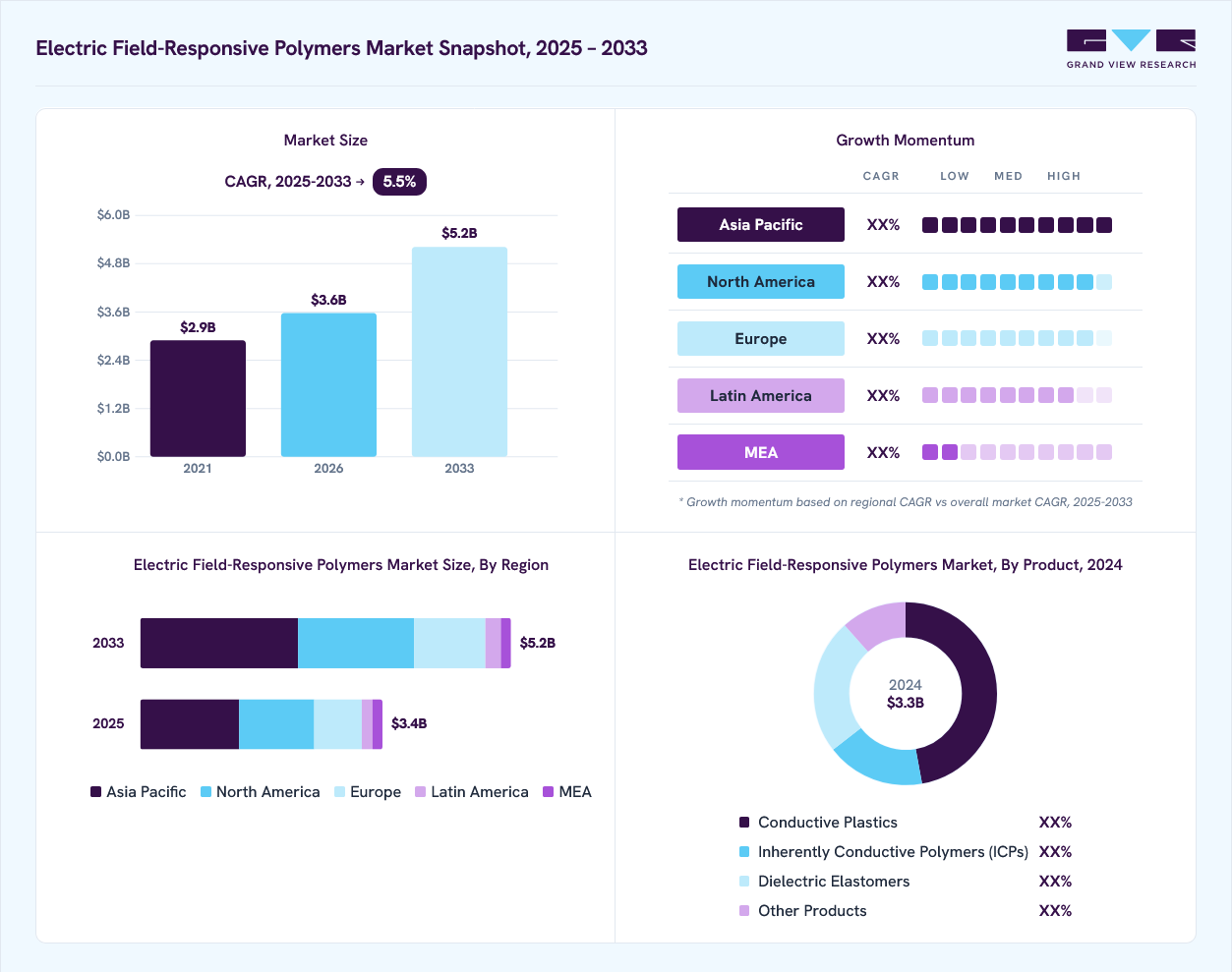
The global electric field-responsive polymers market size was valued at USD 3.3 billion in 2024 and is projected to grow from USD 3.6 billion in 2026 to USD 5.2 billion by 2033, at a CAGR of 5.5% from 2025 to 2033. Asia Pacific dominated the market, accounting for a revenue share of 40.6% in 2024. Growing use of electric field-responsive polymers in automotive applications, such as adaptive interiors and vibration control systems, is driving market growth as manufacturers seek lightweight and energy-efficient alternatives to traditional actuators.
Key Market Trends & Insights
- Asia Pacific dominated the electric field-responsive polymers market with the largest revenue share of 40.63% in 2024.
- The China electric field-responsive polymers market is anticipated to grow at a significant CAGR during the forecast period.
- By product, the conductive plastics segment led the market with the largest revenue share of 47.04% in 2024.
- By end-use, the consumer electronics segment led the market with the largest revenue share of 29.40% in 2024.
Market Size & Forecast
- 2024 Market Size: USD 3.27 Billion
- 2033 Projected Market Size: USD 5.23 Billion
- CAGR (2025-2033): 5.5%
- Asia Pacific: Largest market in 2024
The increasing push for smart and flexible electronics is also boosting demand, as these polymers enable responsive surfaces and adaptive functions that enhance product innovation and user experience. Electric field-responsive polymers are moving beyond single-material demonstrations toward engineered material systems that combine dielectric elastomers, ionic polymers, and piezoelectric polymers with conductive electrodes and microfabricated support structures. This convergence is enabling devices with multi-modal actuation, sensing and energy-harvesting capabilities, and is being driven by progress in thin-film processing, printed electronics, and embedded control electronics. As a result, suppliers are increasingly positioning themselves as solution providers rather than chemical vendors, offering design kits and integration services to accelerate adoption in product development cycles.
Drivers, Opportunities & Restraints
Commercial interest from soft robotics, wearable haptics, adaptive optics, and biomedical devices is a clear commercial driver. These applications require low-weight, compliant actuation and fine-grained control that traditional motors cannot provide. Electric field-responsive polymers deliver high strain, conformability, and low acoustic noise, which directly address product-level performance and user-experience needs in these segments. OEMs seeking to differentiate on form factor and functionality are thus willing to engage in co-development and absorb higher early-stage costs, accelerating technology maturation.
There is a significant opportunity to capture value by reducing manufacturing cost and increasing throughput through roll-to-roll processing, printable electrodes and modular assembly lines. Success in scalable production will open pathways into large-volume markets such as smart textiles, automotive adaptive surfaces and consumer haptics, where unit economics currently constrain adoption. Companies that can couple material innovation with process engineering and offer validated reliability data will be well-positioned to secure design wins and upstream licensing arrangements with system integrators.
Wider commercialization is constrained by inherent performance trade-offs and durability concerns, including limited long-term fatigue life, environmental sensitivity, and the need for relatively high driving voltages or complex power electronics in some chemistries. These technical limits increase product development risk and total cost of ownership for end users. Compounding the issue, the absence of widely accepted testing standards and unclear regulatory pathways for implanted or wearable applications slows customer qualification. It makes long lead times and conservative procurement strategies common among large buyers.
Market Concentration & Characteristics
The market growth stage of the electric field-responsive polymers industry is medium, and the pace is accelerating. The market exhibits slight fragmentation, with key players dominating the industry landscape. Major companies like 3M, Arkema, BASF SE, Celanese Corporation, Covestro AG, Dow Inc., Evonik, Heraeus, Parker Hannifin, RTP Company, Solvay S.A., and others play a significant role in shaping the market dynamics. These leading players often drive innovation within the market, introducing new products, technologies, and applications to meet evolving industry demands.
Electric field-responsive polymers are at the frontier of materials innovation because recent breakthroughs tackle core performance barriers rather than producing incremental improvements. Advances such as ionic-liquid modified elastomer composites, self-healing ionogel electrodes, and prestretch-free dielectric formulations are reducing required drive voltages, increasing energy density, and improving operational durability, which together enable more practical device architectures and faster productization. Parallel progress in roll-to-roll compatible electrode printing and co-development agreements between material suppliers and system integrators is shortening the engineering-to-production window and shifting buyer expectations toward turnkey material-plus-integration offerings.

The primary competitive substitutes for electric field-responsive polymers remain piezoelectric ceramics, shape memory alloys, and miniature electromagnetic actuators, each offering proven reliability or high force density in many incumbent applications. That said, polymers are carving out unique value where low mass, large strain, silent operation, and conformability matter, and suppliers are mitigating substitution risk by packaging materials with driver electronics and validated reliability data to meet OEM procurement standards. Market adopters therefore make tradeoffs based on system-level metrics such as lifecycle cost, integration complexity, and regulatory evidence, which keeps substitution dynamics highly segment-specific rather than uniform across end markets.
Product Insights
The conductive plastics segment led the market with the largest revenue share of 47.04% in 2024. Manufacturers of conductive plastics are seeing a clear commercial driver in electromagnetic interference shielding for next-generation connected systems. As vehicle architectures and wearable devices consolidate more antennas and high-frequency electronics, conductive polymer composites provide a lighter, corrosion-resistant alternative to metal shields while enabling design freedom through injection molding and coatings. Firms that can demonstrate repeatable conductive pathways and consistent shielding performance during scale-up gain an advantage in supplier selection for automotive and telecom OEM programs.
The dielectric elastomer segment is anticipated to grow at the fastest CAGR of 5.9% through the forecast period. Dielectric elastomers are gaining traction because their high strain and fast response time meet performance requirements for compact, soft actuators in robotics and optical systems. Recent material and electrode engineering work has reduced prestrain and improved energy density, making dielectric devices more attractive for use where smooth, silent motion and low weight are differentiators. Suppliers that combine materials innovation with validated reliability data are therefore winning early design-in opportunities with integrators who prioritize product-level performance over raw material cost.
End-use Insights
The consumer electronics segment led the market with the largest revenue share of 29.40% in 2024. In consumer electronics the imperative to deliver immersive haptics and thinner form factors is driving OEMs to evaluate electric field-responsive polymers as an alternative to electromagnetic actuators. These polymers enable low-profile tactile layers and conformal feedback mechanisms that simplify mechanical design and improve perceived product quality, particularly for headsets, foldable devices and next-generation controllers. Adoption is accelerating where haptic driver electronics and standards have matured enough to reduce integration risk for device teams.

The healthcare & medical devices segment is expected to grow at the fastest CAGR of 6.1% through the forecast period. The healthcare sector is an emergent commercial driver as electroactive polymers offer unique value in soft prosthetics, minimally invasive actuators and self-powered biosensors that require biocompatibility and compliance. Clinical and regulatory sensitivity means device developers prioritize materials with demonstrable fatigue life and safe-by-design chemistry, creating opportunities for material suppliers to co-develop application-specific formulations and provide supporting preclinical data. Companies that can bridge material performance with regulatory evidence generation stand to capture premium, long-term contracts in medtech supply chains.
Regional Insights
Asia Pacific dominated the global electric field-responsive polymers market with the largest revenue share of 40.63% in 2024 and is expected to grow at the fastest CAGR of 6.0% over the forecast period. Asia Pacific’s driver is its capacity for rapid manufacturing scale-up combined with large, addressable demand from consumer electronics, industrial automation, and textile-integrated systems. The region’s investment in roll-to-roll processing and printed electronics is lowering unit costs and enabling new form factors, which in turn attract local OEMs looking for integrated, low-profile actuation solutions. Regional supply chain density also shortens time to market for co-developed materials and accelerates volume adoption once reliability targets are met.

The China electric field-responsive polymers market is anticipated to grow at a significant CAGR during the forecast period. China’s strategic industrial programs and emphasis on advanced manufacturing continue to be a decisive driver for electroactive polymers as the country prioritizes smart materials to move up the value chain. State-led initiatives that support domestic innovation, capital expenditure in robotics and electronics, and local scale-up infrastructure create favorable conditions for rapid commercialization and localized supply. Companies that align product roadmaps with national technology priorities and on-the-ground manufacturing capabilities are advantaged in securing high-volume contracts.
North America Electric Field-responsive Polymers Market Trends
The electric field-responsive polymers market in North America is anticipated to grow at a moderate CAGR during the forecast period. North America’s commercial momentum for electric field-responsive polymers is being driven by converging demand from soft robotics, advanced manufacturing and the booming semiconductor ecosystem. Developers benefit from proximate system integrators and tier-one OEMs that require lightweight, high-strain actuators for automated handling, wafer-level inspection and haptic test equipment, which shortens qualification cycles and creates clear pilot-to-production pathways. Public and private R&D funding that targets mobility and energy-efficient actuation further lowers early-stage commercialization risk for material suppliers.
U.S. Electric Field-responsive Polymers Market Trends
The electric field-responsive polymers market in the U.S. is growing, driven by strong government investments and strategic programs that support advanced mobility, defense, and clean technology research and development.Funding mechanisms and vehicle technologies programs help bridge the valley of death for prototype actuators and sensors, while domestic OEMs in consumer electronics and automotive are actively scouting materials that deliver lower mass and improved haptics. This combination of targeted capital and large lead customers creates repeatable procurement pathways for suppliers who can demonstrate reliability and system-level performance.
Europe Electric Field-responsive Polymers Market Trends
The electric field-responsive polymers market in Europe is influenced by stringent regulatory frameworks and sustainability mandates that promote low-waste, energy-efficient components across medical devices, automotive interiors, and building-control systems. Policy frameworks and funding under Horizon Europe encourage collaborative projects that couple material innovation with life-cycle evidence, steering buyers toward suppliers who can provide validated sustainability metrics and regulatory support. For medtech, especially, evolving device rules mean manufacturers prefer materials backed by preclinical data and supplier-led compliance services.
Key Electric Field-responsive Polymers Company Insights
The electric field-responsive polymers industry is highly competitive, with several key players dominating the landscape. Major companies include 3M, Arkema, BASF SE, Celanese Corporation, Covestro AG, Dow Inc., Evonik, Heraeus, Parker Hannifin, RTP Company, and Solvay S.A. The electric field-responsive polymers industry is characterized by a competitive landscape with several key players driving innovation and market growth. Major companies in this sector are investing heavily in research and development to enhance the performance, cost-effectiveness, and sustainability of their products.
Key Electric Field-responsive Polymers Companies:
The following are the leading companies in the electric field-responsive polymers market. These companies collectively hold the largest market share and dictate industry trends.
- 3M
- Arkema
- BASF SE
- Celanese Corporation
- Covestro AG
- Dow Inc.
- Evonik
- Heraeus
- Parker Hannifin
- RTP Company
- Solvay S.A.
Recent Developments
-
In March 2024, Momentive, Datwyler and BSC Computer announced a collaboration to industrialize dielectric elastomer actuators and presented a DEA development kit at CES to accelerate design-in. This initiative covers raw materials through control to enable serial production of low-profile, energy-efficient actuators.
-
In November 2023, BSC Computer launched the BSCiDEA IoT devkit aimed at making dielectric elastomer actuator integration easier for developers. The kit provides control electronics and interfaces designed to reduce integration risk and shorten time to prototype for DEA-based systems.
Electric Field-responsive Polymers Market Report Scope
Report Attribute
Details
Market size in 2024
USD 3.3 billion
Estimated Market size in 2026
USD 3.6 billion
Projected Market size by 2033
USD 5.2 billion
Growth rate
CAGR of 5.5% from 2024 to 2033
Base year for estimation
2024
Historical data
2021 - 2023
Forecast period
2025 - 2033
Quantitative units
Volume in kilotons, revenue in USD million/billion and CAGR from 2025 to 2033
Report coverage
Revenue forecast, competitive landscape, growth factors, and trends
Segments covered
Product type, end-use, region
Regional scope
North America; Europe; Asia Pacific; Latin America; Middle East & Africa
Country Scope
U.S.; Canada; Mexico; Germany; France; UK; Spain; Italy; China; Japan; India; South Korea; Brazil; Argentina; Saudi Arabia; South Africa; UAE
Key companies profiled
3M; Arkema; BASF SE; Celanese Corporation; Covestro AG; Dow Inc.; Evonik; Heraeus; Parker Hannifin; RTP Company; Solvay S.A.
Customization scope
Free report customization (equivalent up to 8 analyst’s working days) with purchase. Addition or alteration to country, regional & segment scope
Pricing and purchase options
Avail customized purchase options to meet your exact research needs. Explore purchase options
Global Electric Field-responsive Polymers Market Report Segmentation
This report forecasts revenue growth at the global, regional, and country levels and provides an analysis of the latest industry trends in each of the sub-segments from 2021 to 2033. For this study, Grand View Research has segmented the global electric field-responsive polymers market report based on the product, end-use, and region:

-
Product Outlook (Volume, Kilotons; Revenue, USD Million, 2021 - 2033)
-
Conductive Plastics
-
Inherently Conductive Polymers (ICPs)
-
Dielectric Elastomers
-
Other Products
-
-
End-use Outlook (Volume, Kilotons; Revenue, USD Million, 2021 - 2033)
-
Automotive & Aerospace
-
Consumer Electronics
-
Healthcare & Medical Devices
-
Industrial Automation
-
Other End-uses
-
-
Regional Outlook (Volume, Kilotons; Revenue, USD Million, 2021 - 2033)
-
North America
-
U.S.
-
Canada
-
Mexico
-
-
Europe
-
Germany
-
UK
-
France
-
Italy
-
Spain
-
-
Asia Pacific
-
China
-
India
-
Japan
-
South Korea
-
-
Latin America
-
Brazil
-
Argentina
-
-
Middle East & Africa
-
Saudi Arabia
-
South Africa
-
UAE
-
-
Frequently Asked Questions About This Report
Conductive Plastics dominated the electric field-responsive polymers market across the product segmentation in terms of revenue, accounting for a market share of 47.04% in 2024 and is forecasted to grow at 5.3% CAGR from 2025 to 2033.
Some key players operating in the electric field-responsive polymers market include 3M, Arkema, BASF SE, Celanese Corporation, Covestro AG, Dow Inc., Evonik, Heraeus, Parker Hannifin, RTP Company, and Solvay S.A.
Growing use of electric field-responsive polymers in automotive applications, such as adaptive interiors and vibration control systems, is driving market growth as manufacturers seek lightweight and energy-efficient alternatives to traditional actuators.
The global electric field-responsive polymers market size was valued at USD 3.3 billion in 2024 and is estimated at USD 3.6 billion for 2026.
The global electric field-responsive polymers market is expected to grow at a CAGR of 5.5% from 2025 to 2033, reaching USD 5.2 billion by 2033.
About the Author(s)
Plastics, Polymers & Resins Research Team
Bulk Chemicals · Plastics, Polymers & ResinsThis report was authored by the plastics, polymers & resins research team at Grand View Research - comprising two research analysts, one senior research analyst, and one industry expert - with specialized expertise in the plastics, polymers & resins segment of the bulk chemicals industry. All findings are based on proprietary bulk chemicals databases, executive interviews, and regulatory analysis, subject to internal peer review prior to publication.
Last Updated:
Speak to Analyst

Need a Tailored Report?
Customize this report to your needs — add regions, segments, or data points, with 20% free customization.
Or view our licence options:


ISO 9001:2015 & 27001:2022 Certified
We are GDPR and CCPA compliant! Your transaction & personal information is safe and secure. For more details, please read our privacy policy.












