
- Home
- »
- Next Generation Technologies
- »
-
Embedded Controllers Market Size And Share Report, 2033GVR Report cover

Embedded Controllers Market (2026 - 2033)
Size, Share & Trends Analysis Report By Type (MCUs, DSPs, PLDs), By Bit Size (8-bit, 16-bit, 32-bit, 64-bit), By Application (Automotive, Consumer Electronics, Industrial Automation, Healthcare), By Region, And Segment Forecasts
Market Size, 2025
$6.3BMarket Estimate, 2026
$6.8BMarket Forecast, 2025
$13.3BCAGR, 2026–2025
10.0%Embedded Controllers Market Summary
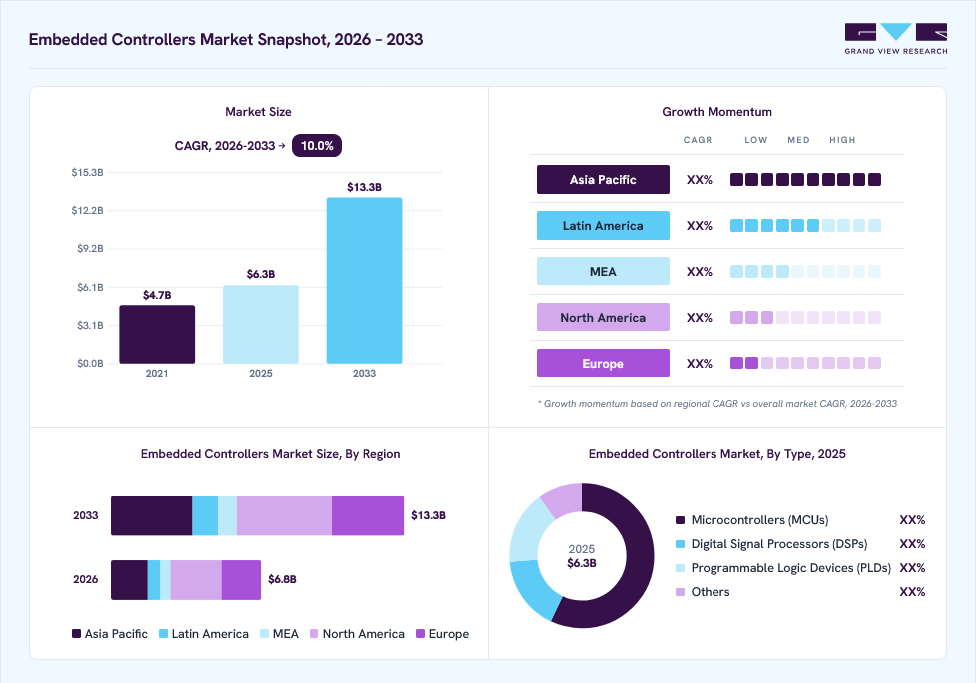
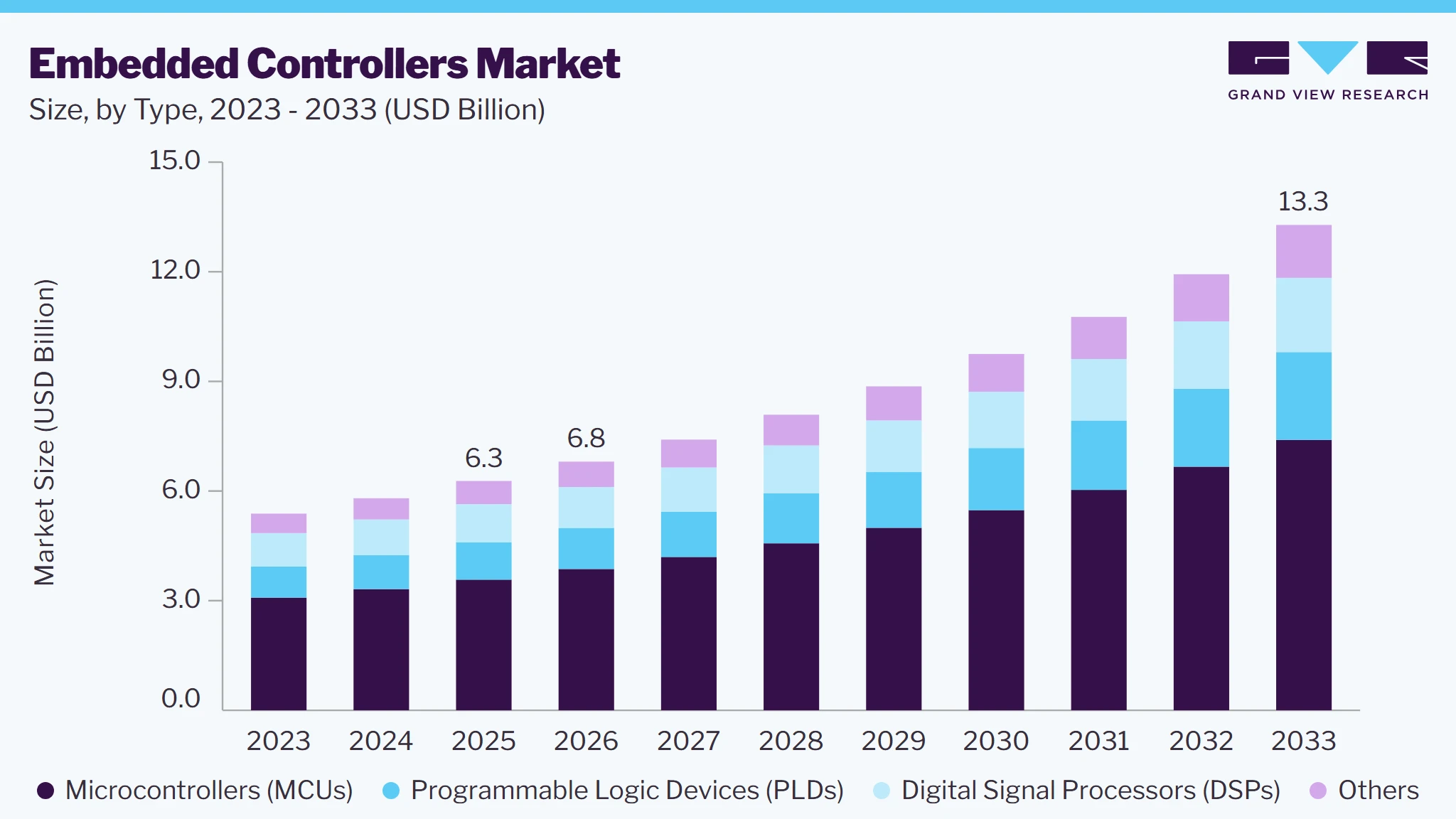
The global embedded controllers market size was valued at USD 6.3 billion in 2025 and is projected to grow from USD 6.8 billion in 2026 to USD 13.3 billion by 2033, at a CAGR of 10.0% from 2026 to 2033. North America dominated the market, accounting for a revenue share of 34.2% in 2025. The market growth is primarily driven by the rapid acceleration of industrial automation and Industry 4.0, the global transition toward electric and software-defined vehicles, and the proliferation of IoT-connected devices.
 Source: Grand View Research, IR Documents, Primary Interviews, Paid DatabasesTo learn more about this report,
 Download Free Sample Report
Key Market Trends & Insights
- By type: Microcontrollers (MCUs) held the largest revenue share of 57.0% in 2025.
- By bit size: 32-bit segment dominated the market in 2025.
- By application: Automotive segment accounted for the largest revenue share in 2025.
Regional Highlights
- Largest regional market: North America (34.2% revenue share in 2025)
- Fastest growing regional market: Asia Pacific (highest CAGR, 2026-2033)
- By Country: The U.S. held the largest market share in 2025.
Market Size & Forecast
- Market size in 2025: USD 6.3 Billion
- Estimated market size in 2026: USD 6.8 Billion
- Projected market size by 2033: USD 13.3 Billion
- CAGR (2026-2033): 10.0%
Prism AI by Grand View Research Free to tryAsk a question about the embedded controllers marketTry asking✓Every figure cited from GVR research Prefer the report? Download free sample →The growing proliferation of electronic content across vehicles, industrial equipment, consumer products, and smart infrastructure is creating sustained demand for embedded controllers. Increasing semiconductor content per device, coupled with the transition toward electric and electronically controlled systems, is expanding controller requirements for power management, motor control, sensing, human-machine interfaces, and system coordination. In automotive applications, electrification is particularly significant, as battery management systems, inverters, charging systems, thermal management, and vehicle control units require dedicated processing capabilities.
 To learn more about this report, Download Free Sample Report
Furthermore, the increasing compactness and integration of electronic systems is influencing embedded controller development, particularly in space- and power-constrained applications. Manufacturers are consolidating processing, memory, communication interfaces, timers, power-management functions, and peripheral controls within single devices to reduce board size, component count, and system complexity. This trend is encouraging demand for highly integrated controller architectures across wearables, medical devices, industrial equipment, automotive electronics, and portable consumer products.
Moreover, the shift toward longer product lifecycles, platform standardization, and software-centric product development is creating opportunities for vendors that can provide scalable controller platforms and development ecosystems. Automotive and industrial manufacturers increasingly seek reusable hardware and software architectures that can support multiple product generations while reducing development time and lifecycle costs. These factors are expected to further drive embedded controllers market growth in the coming years.
Market Dynamics
The embedded controllers market is experiencing sustained growth, supported by rising safety and security requirements, demand for energy-efficient designs, and greater hardware integration. Manufacturers are increasingly adopting highly integrated controllers to consolidate multiple functions, reduce component count, and address stringent space and power constraints, thereby accelerating the market growth.
The increasing importance of system reliability and protection against hardware and software vulnerabilities is driving the adoption of embedded controllers with integrated safety and security capabilities. Automotive, industrial, healthcare, and aerospace applications are incorporating features such as secure boot, encryption, memory protection, hardware security modules, watchdog mechanisms, and fault-detection functions to safeguard critical operations and improve system resilience.
The tightening of safety and cybersecurity requirements is encouraging manufacturers to replace conventional control architectures with more sophisticated and certified solutions. Demand for controllers capable of supporting secure system operation, fault management, and compliance with industry standards is expected to remain a key growth factor, particularly in mission-critical and connected applications.
Embedded controllers increasingly require advanced processing capabilities, integrated connectivity, cybersecurity, functional safety, and specialized hardware, resulting in higher design and development costs compared with conventional controllers. These costs can limit adoption among small electronics manufacturers and startups with constrained R&D budgets. Additional expenses associated with software development, semiconductor qualification, functional-safety certification, cybersecurity testing, and long product-development cycles can further increase the total cost of ownership and create barriers to adoption.
The increasing integration of AI and machine learning capabilities into embedded controllers is creating significant growth opportunities as industries increasingly require real-time processing, autonomous decision-making, and localized data analysis. AI-enabled MCUs, processors, and programmable devices can perform inference directly at the edge, reducing latency, bandwidth consumption, and reliance on cloud infrastructure.
Growing deployment of AI-enabled ADAS, autonomous vehicles, industrial robots, predictive maintenance systems, smart cameras, medical devices, and intelligent IoT equipment is further expanding demand for high-performance embedded controllers. Manufacturers that develop controllers with integrated AI accelerators, advanced security, low-power architectures, and high-speed connectivity are well positioned to capture emerging opportunities across next-generation intelligent embedded applications.
Market Concentration & Characteristics
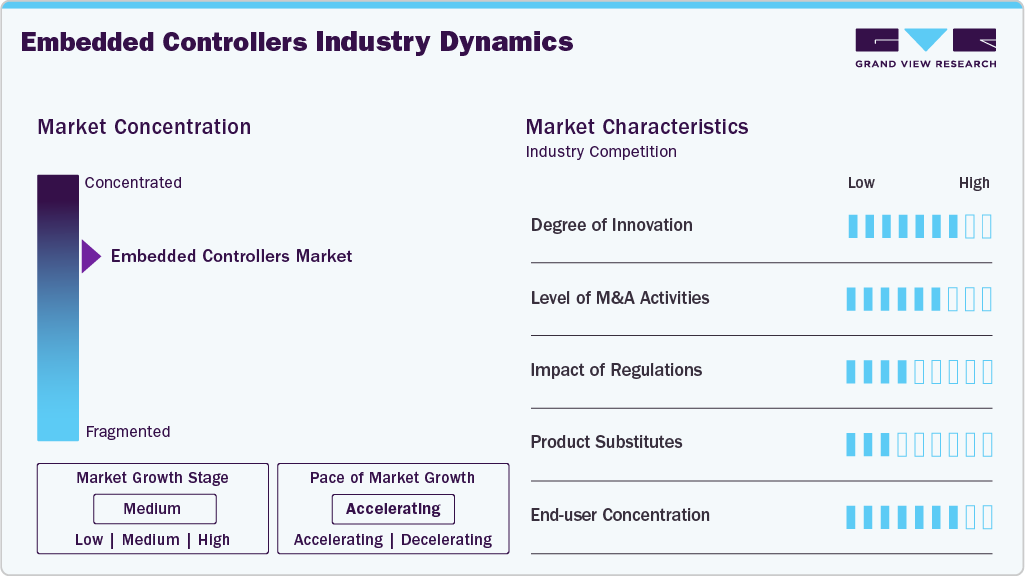
The embedded controllers market is moderately concentrated, with competition among major semiconductor manufacturers, MCU and processor suppliers, programmable logic device vendors, and specialized embedded-system technology providers. Companies compete through product performance, power efficiency, security features, software ecosystems, development tools, lifecycle support, and application-specific solutions across automotive, industrial, consumer, healthcare, telecommunications, and aerospace applications. The market exhibits a high degree of technological innovation, particularly in low-power architectures, processor design, memory integration, functional safety, and hardware security.
 To learn more about this report, Download Free Sample Report
Strategic partnerships with automotive OEMs, industrial automation providers, electronics manufacturers, IoT solution providers, and technology developers are enabling companies to expand application coverage and strengthen embedded technology ecosystems. Increasing functional safety, cybersecurity, electromagnetic compatibility, environmental, and industry-specific compliance requirements are driving demand for certified, secure, reliable, and energy-efficient embedded controllers, while increasing development and certification costs. The competition from alternative processing architectures and increasing semiconductor design complexity remain moderate constraints. Growing demand for vehicle electrification, ADAS, smart industrial equipment, connected devices, robotics, and intelligent edge applications is expected to continue strengthening product differentiation and competitive positioning across the global market.
Analyst Perspective
The embedded controllers market is transitioning from traditional low-cost control devices toward increasingly intelligent, connected, secure, and application-specific computing platforms. The convergence of IoT, edge computing, artificial intelligence, electrification, industrial automation, and software-defined architectures is expanding the role of embedded controllers across virtually every major electronic system.
Type Insights
The microcontrollers (MCUs) segment accounted for the largest market share of 57.0% in 2025, supported by their widespread deployment across automotive electronics, consumer devices, industrial automation, IoT systems, and smart appliances. Similarly, MCUs demand is driven by their low cost, low power consumption, compact architecture, and ability to provide real-time control and connectivity. Increasing adoption of electric vehicles, ADAS, connected devices, and automated industrial equipment is further expanding MCU demand.
The Programmable Logic Devices (PLDs) segment is expected to witness the fastest CAGR of 11.5% from 2026 to 2033, fueled by growing demand for flexible and reconfigurable computing in industrial automation, telecommunications, automotive electronics, aerospace & defense, and edge computing applications. Increasing requirements for real-time signal processing, hardware acceleration, rapid prototyping, and customizable logic, along with the growing integration of AI and high-speed connectivity into embedded systems, are further driving PLD adoption.
Bit Size Insights
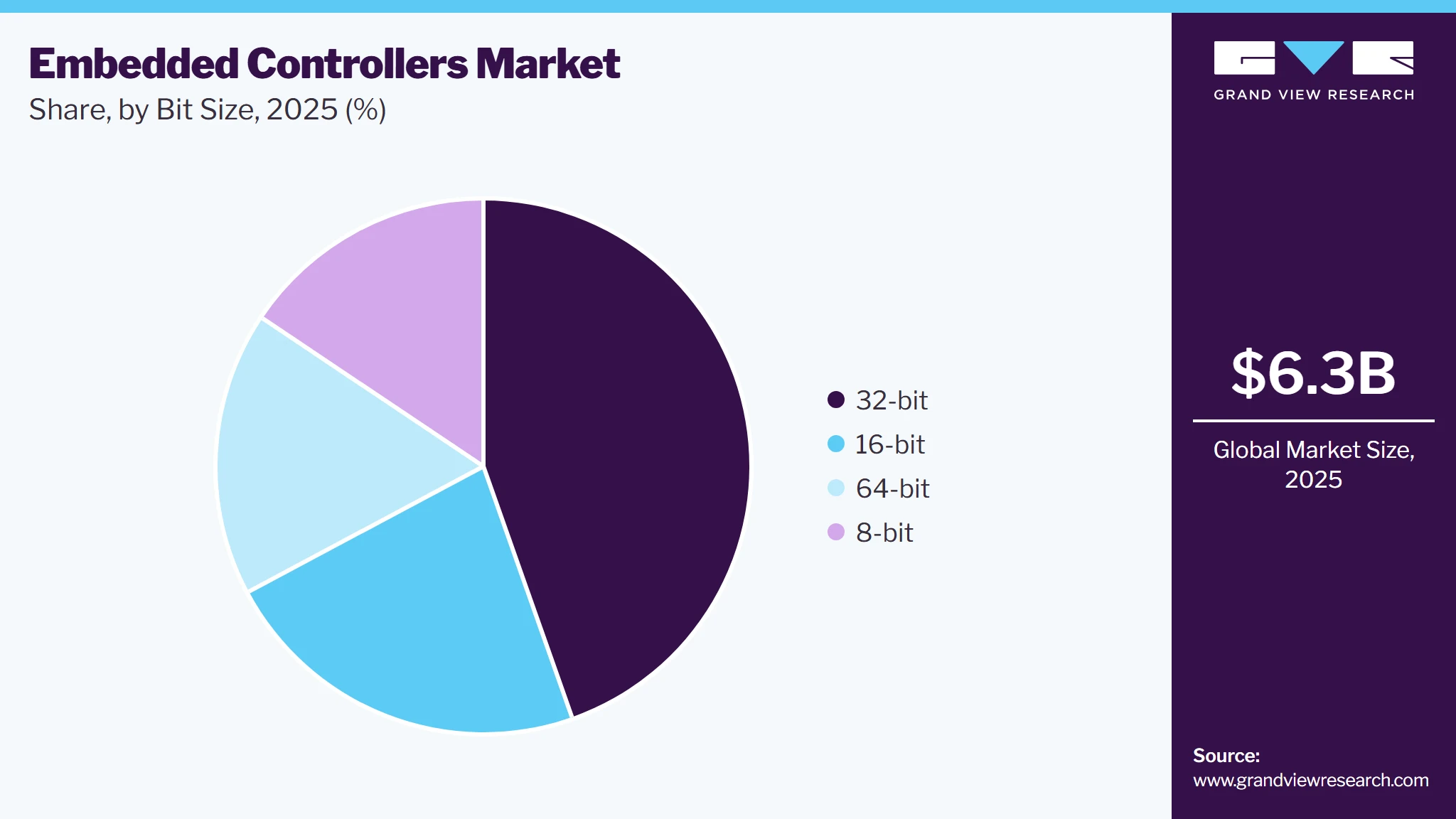
The 32-bit segment accounted for the largest market share in 2025, supported by its widespread adoption across automotive electronics, industrial control systems, consumer electronics, smart appliances, and IoT devices. The segment offers higher processing performance, larger memory capacity, and broader peripheral support while maintaining relatively low power consumption, making 32-bit microcontrollers suitable for increasingly sophisticated embedded applications. Furthermore, growing requirements for real-time data processing, connectivity management, motor control, sensing, and system diagnostics are further expanding their use.
 To learn more about this report, Download Free Sample Report
The 64-bit segment is expected to witness fastest CAGR from 2026 to 2033, fueled by growing demand for high-performance embedded computing, AI-enabled systems, autonomous vehicles, advanced robotics, edge AI, industrial automation, and data-intensive applications. Increasing workloads involving real-time AI inference, computer vision, sensor processing, advanced graphics, and large datasets are driving the adoption of higher-bit architectures with greater processing capacity and memory-addressing capabilities. The transition toward software-defined vehicles, autonomous machines, intelligent edge devices, and connected industrial systems is further accelerating demand for high-performance embedded controllers and processors.
Application Insights
The automotive segment accounted for the largest market share in 2025, fueled by the rapid adoption of advanced driver-assistance systems (ADAS), electric and hybrid vehicles, battery-management systems, vehicle electrification, connected vehicles, and software-defined vehicle architectures. The increasing integration of embedded controllers into powertrain control, braking, steering, infotainment, body electronics, and vehicle networking is further driving demand for high-performance, low-power, and safety-certified controllers.
The aerospace & defense segment is expected to grow at the fastest CAGR from 2026 to 2033, driven by growing adoption of autonomous aircraft and unmanned aerial vehicles (UAVs), avionics modernization, electronic warfare systems, radar and sensor platforms, and mission-critical flight-control systems. Increasing defense spending on autonomous and networked platforms is creating demand for high-reliability embedded controllers capable of real-time data processing and deterministic control. In addition, the development of next-generation aircraft, drones, and defense electronics is accelerating the use of radiation-tolerant, ruggedized, secure, and high-performance embedded controllers for navigation, communication, surveillance, propulsion, and mission systems.
Regional Insights
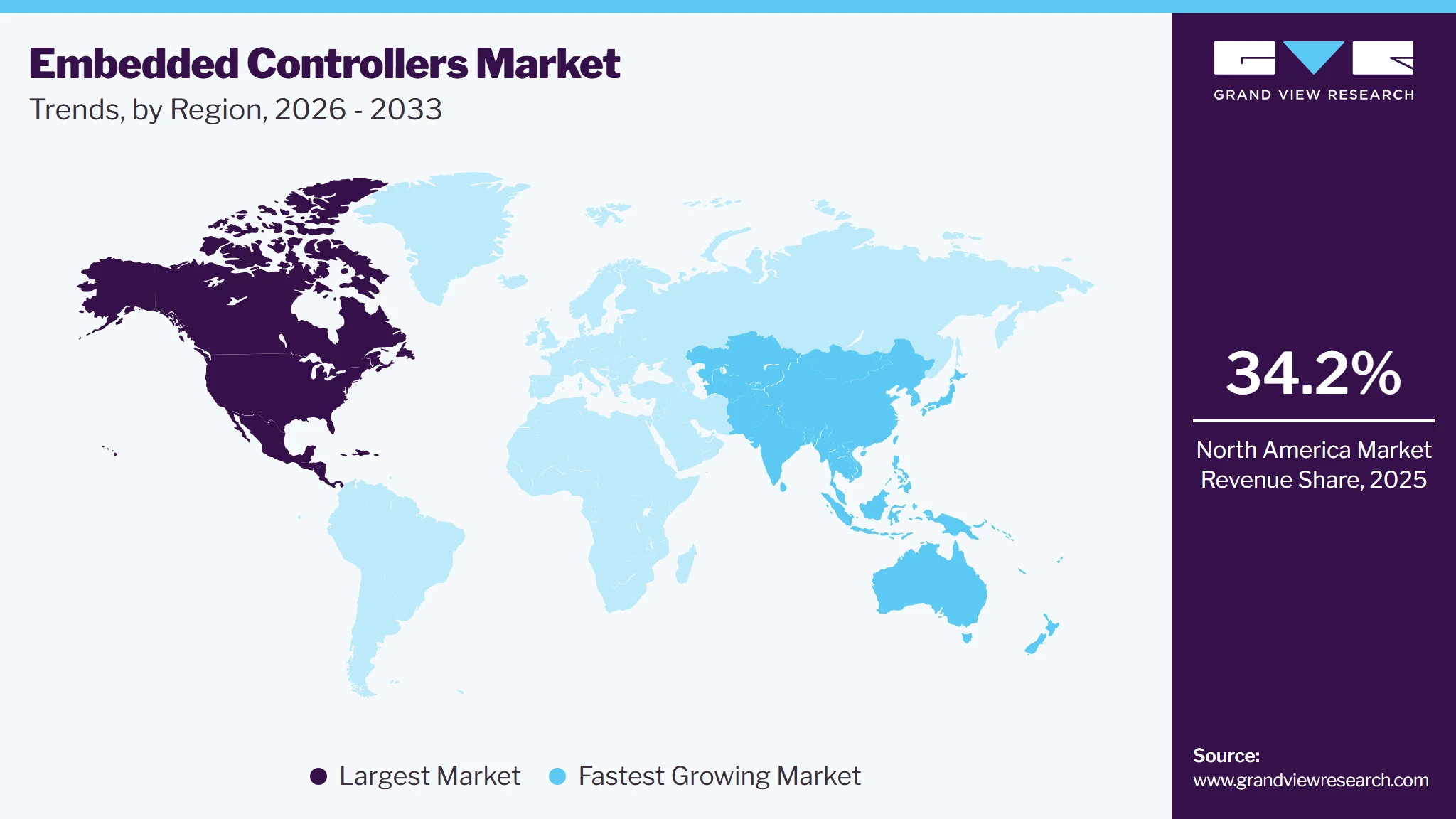
North America embedded controllers market held the largest share of 34.2% in 2025, supported by massive R&D investments in autonomous vehicle platforms, a concentration of leading semiconductor developers, and strong demand for edge AI hardware across defense and medical device sectors. Federal initiatives promoting domestic semiconductor manufacturing further support regional supply chain expansion.
 To learn more about this report, Download Free Sample Report
U.S. Embedded Controllers Market Trends
Embedded controllers industry in the U.S. held the largest share of 84.7% in 2025. Strong demand stems from advanced automotive electronics, aerospace control systems, and rapid industrial automation. Federal funding for smart grid infrastructure, combined with rising investments in software-defined vehicle architectures, continues to accelerate the adoption of high-performance 32-bit and 64-bit microcontrollers with embedded security modules. Supported by massive investments in local edge AI development and autonomous systems, the U.S. market continues to set international benchmarks for embedded processing speed, functional safety, and real-time execution.
Europe Embedded Controllers Market Trends
Embedded controllers industry in Europe is expected to grow at a significant CAGR from 2026 to 2033. The market growth is supported by stringent functional safety standards (such as ISO 26262), heavy industrial automation, and rapid adoption of electric vehicles. European automotive OEMs and industrial machine builders are actively integrating deterministic real-time microcontrollers to support green transition mandates and smart factory operations. European automotive OEMs and industrial equipment manufacturers are rapidly modernizing their embedded hardware stacks to support the mass transition toward electric vehicle (EV) powertrains, smart grid management, and robotic manufacturing lines, ensuring high demand for deterministic control platforms.
The embedded controllers market in UK is expected to grow significantly in the coming years, supported by targeted government funding initiatives aimed at scaling national capabilities in robotics, urban air mobility, and renewable energy integration. The UK.'s fabless design ecosystem and research institutions are focusing heavily on developing secure, low-power microcontrollers equipped with specialized hardware accelerators for edge computing and smart grid monitoring.
Germany embedded controllers industry is expanding rapidly. German automakers and Tier-1 suppliers are leading the adoption of centralized zonal controller architectures in vehicles, while factory automation giants integrate advanced real-time microcontrollers into automated guided vehicles (AGVs), programmable logic controllers (PLCs), and Smart Factory (Industry 4.0) assembly networks.
Asia Pacific Embedded Controllers Market Trends
The APAC embedded controllers industry is expected to grow at the fastest CAGR of 12.0% from 2026 to 2033. The region is experiencing unprecedented demand for cost-effective yet high-performance embedded controllers to power massive smart home ecosystems, industrial automation systems, and green energy infrastructure. Regional governments are actively incentivizing local chip design initiatives and expanding domestic silicon fabrication capabilities, creating a highly competitive, fast-evolving market environment that rapidly commercializes emerging microcontroller technologies.
Embedded controllers industry in Japan is gaining traction. Japanese technology firms are at the forefront of embedding ultra-low-power microcontrollers with tinyML capabilities into surgical robotics, factory automation hardware, and advanced driver-assistance systems (ADAS) to satisfy rigorous domestic safety and operational standards.
China embedded controllers industry is expanding rapidly, accelerated by massive domestic electric vehicle production, extensive IoT device manufacturing, and aggressive federal mandates to achieve self-sufficiency in semiconductor technology. Chinese tech firms and automotive manufacturers are integrating high-performance, locally designed 32-bit MCUs and edge AI chips to power everything from commercial drone flight controllers to smart energy storage systems.
Key Embedded Controllers Company Insights
Some of the key players operating in the market are Infineon Technologies AG and NXP Semiconductors N.V. among others.
-
Infineon Technologies AG is a global semiconductor company that provides a broad portfolio of embedded controllers and microcontrollers for automotive, industrial, consumer, and IoT applications. Its MCU portfolio includes AURIX, TRAVEO, PSoC, and XMC families, offering solutions focused on high performance, functional safety, security, and real-time control. The company has a strong position in automotive and industrial embedded control applications, making it a mature player in the embedded controllers market.
-
NXP Semiconductors N.V. is a global semiconductor company that develops embedded processors, microcontrollers, connectivity solutions, and edge-processing technologies for automotive, industrial, consumer, and IoT applications. Its portfolio spans 8-, 16-, and 32-bit MCUs, including automotive S32K, general-purpose MCUs, and MCX microcontrollers, supported by extensive hardware and software development ecosystems. Its long-standing MCU presence and broad application coverage position NXP as a mature player in the embedded controllers market.
Espressif Systems and Nordic Semiconductor ASA are some of the emerging and established market participants in the embedded controllers market.
-
Espressif Systems is a semiconductor company focused on wireless microcontrollers and SoCs for IoT, connected devices, and edge-AI applications. Its ESP32 family combines processing with Wi-Fi, Bluetooth, and other wireless connectivity, enabling cost-effective and low-power embedded solutions. The company is expanding its portfolio into RISC-V-based SoCs, AI-at-the-edge, Wi-Fi 6/6E, and advanced connectivity, supporting its position as an emerging player in the embedded controllers market.
-
Nordic Semiconductor ASA is a semiconductor company specializing in low-power wireless SoCs, microcontrollers, and connectivity solutions for IoT, wearables, smart devices, and industrial applications. Its product ecosystem combines MCU processing with technologies such as Bluetooth Low Energy, Thread, Zigbee, Matter, Wi-Fi, and cellular IoT, supported by software development tools. Its expanding focus on connected and energy-efficient embedded systems makes it an emerging player in the embedded controllers market.
Key Embedded Controllers Companies
The following key companies have been profiled for this study on the embedded controllers market.
-
Infineon Technologies AG
-
NXP Semiconductors N.V.
-
STMicroelectronics N.V.
-
Texas Instruments Incorporated
-
Renesas Electronics Corporation
-
Microchip Technology Inc.
-
Intel Corporation
-
Espressif Systems
-
Nordic Semiconductor ASA
-
Samsung Electronics Co., Ltd.
Competitive Benchmarking
Category
Operating Strategies
Competitive Edge
Weakness
Established Players (Infineon Technologies, NXP Semiconductors, Renesas Electronics)
- Focus on automotive, industrial, consumer, and IoT MCUs.
- Invest in high-performance, safety-certified, secure, and AI-enabled embedded controllers
- Strong global customer base, extensive MCU portfolios, advanced semiconductor manufacturing capabilities,
- Established developer ecosystems, and strong automotive and industrial relationships.
- High R&D and manufacturing costs, complex product portfolios, dependence on semiconductor supply chains
- Longer development cycles for safety-critical applications.
Emerging Players (Espressif Systems, Nordic Semiconductor)
- Focus on low-power, wireless-connected, RISC-V-based, and edge-AI controllers for IoT, wearables, and smart-home.
- Develop AI-enabled, high-performance, secure, and energy-efficient embedded controllers.
- Cost-effective solutions, integrated wireless connectivity, flexible development platforms, low-power architectures
- Faster innovation in emerging IoT applications.
- Smaller market presence in automotive and safety-critical applications.
- Narrower product portfolios, limited manufacturing scale, and lower penetration in large enterprise customers.
Recent Developments
-
In March 2026, NXP Semiconductors N.V. strengthened its collaboration with SECO through the introduction of i.MX 95-based embedded solutions, including the Modular Vision MX95 and SOM-SMARC-MX95 platforms.
-
In February 2026, Infineon Technologies AG announced its latest microcontroller and sensor solutions for AI, IoT, mobility, and robotics at Embedded World 2026, highlighting its PSoC and AURIX MCUs for edge AI, real-time processing, adaptive control, safety, and secure connectivity. The company also showcased its XENSIV sensor portfolio for environmental perception and autonomous applications, strengthening its embedded-controller portfolio for intelligent and connected systems.
-
In January 2026, at CES 2026, Espressif showcased the ESP32-E22 Wi-Fi 6E SoC and ESP32-H21 Bluetooth LE MCU, expanding its connected MCU portfolio for high-speed wireless and low-power IoT applications. The ESP32-E22 features a RISC-V processor and tri-band Wi-Fi 6E connectivity.
Embedded Controllers Market Report Scope
Report Attribute
Details
Market size value in 2025
USD 6.3 billion
Estimated market size in 2026
USD 6.8 billion
Projected market size by 2033
USD 13.3 billion
Growth rate
CAGR of 10.0% from 2026 to 2033
Base year for estimation
2025
Historical data
2021 - 2024
Forecast period
2026 - 2033
Quantitative units
Revenue in USD Billion and CAGR from 2026 to 2033
Report Product
Revenue forecast, company ranking, competitive landscape, growth factors, and trends
Segments covered
Type, bit size, application, region
Region scope
North America; Europe; Asia Pacific; Latin America; Middle East & Africa
Country scope
U.S.; Canada; Mexico; UK; Germany; France; China; Japan; India; South Korea; Australia; Brazil; Saudi Arabia; UAE; South Africa
Key companies profiled
Infineon Technologies AG; NXP Semiconductors N.V.; STMicroelectronics N.V.; Texas Instruments Incorporated; Renesas Electronics Corporation; Microchip Technology Inc.; Intel Corporation; Espressif Systems; Nordic Semiconductor ASA; Samsung Electronics Co., Ltd.
Customization scope
Free report customization (equivalent to up to 8 analyst’s working days) with purchase. Addition or alteration to country, regional & segment scope.
Pricing and purchase options
Avail customized purchase options to meet you exact research needs. Explore purchase options
Global Embedded Controllers Market Report Segmentation
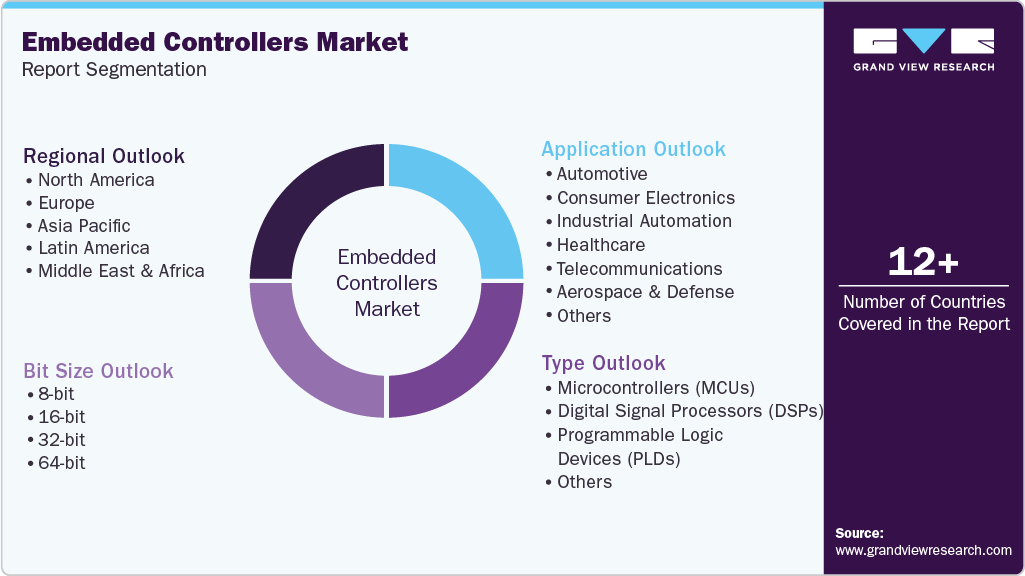
This report forecasts revenue growth at global, regional, and country levels and provides an analysis of the latest technological trends in each of the sub-segments from 2021 to 2033. For this study, Grand View Research has segmented the embedded controllers market report based on type, bit size, application, and region:
 To learn more about this report, Download Free Sample Report
-
Type Outlook (Revenue, USD Billion, 2021 - 2033)
-
Microcontrollers (MCUs)
-
Digital Signal Processors (DSPs)
-
Programmable Logic Devices (PLDs)
-
Others
-
-
Bit Size Outlook (Revenue, USD Billion, 2021 - 2033)
-
8-bit
-
16-bit
-
32-bit
-
64-bit
-
-
Application Outlook (Revenue, USD Billion, 2021 - 2033)
-
Automotive
-
Consumer Electronics
-
Industrial Automation
-
Healthcare
-
Telecommunications
-
Aerospace & Defense
-
Others
-
-
Regional Outlook (Revenue, USD Billion, 2021 - 2033)
-
North America
-
U.S.
-
Canada
-
Mexico
-
-
Europe
-
UK
-
Germany
-
France
-
-
Asia Pacific
-
China
-
Japan
-
India
-
South Korea
-
Australia
-
-
Latin America
-
Brazil
-
-
Middle East and Africa (MEA)
-
Saudi Arabia
-
UAE
-
South Africa
-
-
Research Methodology
The embedded controllers market figures in this report are based on a proven research process that combines executive interviews with secondary research from proprietary databases, company filings, and recognized regulatory and institutional sources. Market size is built through value-chain sizing-reconciling supply-side and demand-side estimates-and triangulated with bottom-up and top-down approaches. Every estimate passes multiple levels of expert validation before publication, with each embedded controllers segment quantified using the revenue-capture definitions in the table below.
Segment Definition
Segment - Type
Revenue capture definition
Microcontrollers (MCUs)
Revenue is generated from embedded microcontroller devices integrating processing cores, memory, peripherals, timers, communication interfaces, and control functions for dedicated electronic applications.
Digital Signal Processors (DSPs)
Revenue is generated from processors optimized for high-speed mathematical and signal-processing workloads such as communications, audio/video processing, radar, imaging, and industrial sensing.
Programmable Logic Devices (PLDs)
Revenue is generated from programmable or reconfigurable logic devices used for customized digital logic, hardware acceleration, interface management, and parallel processing.
Others
Revenue is generated from specialized embedded controller architectures and devices not classified under MCUs, DSPs, or PLDs.
Segment - Bit Size
Revenue capture definition
8-bit
Revenue is generated from 8-bit embedded controllers primarily used for simple, low-cost, low-power control applications.
16-bit
Revenue is generated from 16-bit controllers used where moderate processing performance, memory capability, and cost efficiency are required.
32-bit
Revenue is generated from 32-bit controllers used in advanced real-time, connected, automotive, industrial, consumer, and IoT applications.
64-bit
Revenue is generated from 64-bit embedded controllers used in high-performance systems requiring advanced processing, memory addressing, networking, graphics, or AI capabilities.
Segment - Application
Revenue capture definition
Automotive
Revenue is generated from embedded controllers used in powertrain, EV systems, battery management, ADAS, infotainment, telematics, body electronics, safety, and vehicle networking.
Consumer Electronics
Revenue is generated from controllers used in smart appliances, wearables, smartphones, televisions, gaming equipment, cameras, and connected consumer devices.
Industrial Automation
Revenue is generated from controllers used in robotics, motors, sensors, machine control, industrial networking, process automation, and smart manufacturing systems.
Healthcare
Revenue is generated from controllers used in medical devices, patient monitoring, diagnostics, imaging, laboratory equipment, and portable healthcare products.
Telecommunications
Revenue is generated from controllers used in networking equipment, base stations, routers, switches, signal processing, optical equipment, and telecom infrastructure.
Aerospace & Defense
Revenue is generated from controllers used in avionics, radar, navigation, flight control, surveillance, UAVs, satellites, defense communications, and electronic systems.
Others
Revenue is generated from embedded controllers used in energy, smart buildings, transportation, agriculture, security, marine, and other specialized applications.
Estimation Model
Layer Name
Key Question
Description
End-User Adoption Layer
Who are the potential adopters?
Identifies automotive OEMs, electronics manufacturers, industrial automation companies, medical-device manufacturers, telecom equipment providers, aerospace & defense organizations, and other embedded-system users.
Product Enablement Layer
Who supplies embedded controllers?
Evaluates semiconductor manufacturers, MCU/DSP/PLD vendors, embedded technology providers, distributors, design houses, and ecosystem partners.
Application Deployment Layer
Where are controllers being used?
Maps controller deployment across vehicles, consumer products, factories, medical equipment, telecom infrastructure, aerospace systems, and connected devices.
Technology Integration Layer
What technologies influence adoption?
Evaluates IoT, edge AI, RISC-V, automotive Ethernet, functional safety, cybersecurity, wireless connectivity, and advanced semiconductor architectures.
Revenue Generation Layer
How is market revenue generated?
Estimates revenue through controller IC sales, embedded semiconductor solutions, application-specific devices, programmable logic, and high-value industrial/automotive controller platforms.
Customization Table
Client Request
Customization Delivered
Value Adds
Market Sizing, Segmentation & Growth Opportunity Assessment
Assessed the global embedded controllers market size, historical trends, forecast growth outlook, and detailed segmentation by type (microcontrollers (MCUs), Digital Signal Processors (DSPs), Programmable Logic Devices (PLDs), Others), Bit Size (8-bit, 16-bit, 32-bit, 64-bit), and Application (Automotive, Consumer Electronics, Industrial Automation, Healthcare, Telecommunications, Aerospace & Defense, Others). Evaluated demand patterns, technology adoption, electronic-system complexity, and end-use requirements influencing market expansion.
Enables semiconductor manufacturers, embedded-system providers, OEMs, technology companies, and investors to identify high-growth controller segments, prioritize product development and R&D investments, optimize product portfolios, and capture revenue opportunities across high-performance, connected, and application-specific embedded control technologies.
Regional Market Demand & Growth Opportunity Assessment
Assessed regional embedded controller demand across North America, Europe, Asia Pacific, Latin America, and Middle East & Africa, considering electronics manufacturing, automotive production, industrial automation, semiconductor ecosystems, telecommunications infrastructure, healthcare digitization, aerospace & defense investments, IoT adoption, and technology development.
Provides actionable insights into regional growth opportunities, market-entry priorities, investment hotspots, and competitive positioning, enabling stakeholders to align expansion strategies, strengthen regional partnerships, localize product offerings, and capture demand across major embedded-system markets.
Competitive Landscape & Strategic Positioning Analysis
Evaluated the competitive environment across major embedded controller suppliers, comparing controller portfolios, processing capabilities, bit architectures, connectivity, power efficiency, functional safety, cybersecurity, application coverage, software ecosystems, geographic presence, and strategic initiatives.
Enables companies to benchmark their market position, identify competitive gaps, assess differentiation opportunities, prioritize strategic investments, and strengthen positioning across automotive, industrial, consumer, healthcare, telecommunications, and aerospace & defense applications.
Frequently Asked Questions About This Report
The global embedded controllers market size was estimated at USD 6.3 billion in 2025 and is projected to reach USD 6.8 billion in 2026.
The global embedded controllers market is projected to reach USD 13.3 billion by 2033, at a compound annual growth rate (CAGR) of 10.0% from 2026 to 2033.
By type, the Microcontrollers (MCUs) segment held the dominant position and accounted for the highest revenue share of 57.0% in 2025.
North America accounted for the largest revenue share of 34.2% in 2025
The rapid acceleration of industrial automation and Industry 4.0, the global transition toward electric and software-defined vehicles, and the growing proliferation of IoT-connected devices are the key factors driving the embedded controllers market.
Infineon Technologies AG, NXP Semiconductors N.V., STMicroelectronics N.V., Texas Instruments Incorporated, Renesas Electronics Corporation, Microchip Technology Inc., Intel Corporation, Espressif Systems, Nordic Semiconductor ASA, and Samsung Electronics Co., Ltd. are the key players in the market.
The U.S. held the largest market share in 2025.
By bit size, the 32-bit segment dominated the market in 2025.
By application, the automotive segment accounted for the largest revenue share in 2025.
About the Author(s)
Next Generation Technologies Research Team
Technology · Next Generation TechnologiesThis report was authored by the next generation technologies research team at Grand View Research - comprising two research analysts, one senior research analyst, and one industry expert - with specialized expertise in the next generation technologies segment of the technology industry. All findings are based on proprietary technology databases, executive interviews, and regulatory analysis, subject to internal peer review prior to publication.
Last Updated:
Speak to Analyst

Customize this report to your needs - add regions, segments, or data points, with 20% free customization.
Or view our licence options:


ISO 9001:2015 & 27001:2022 Certified
We are GDPR and CCPA compliant! Your transaction & personal information is safe and secure. For more details, please read our privacy policy.


