
- Home
- »
- Next Generation Technologies
- »
-
Embedded Insurance Market Size, Industry Report, 2033GVR Report cover
![Embedded Insurance Market Size, Share & Trends Report]()
Embedded Insurance Market (2026 - 2033) Size, Share & Trends Analysis Report By Insurance Line, By Distribution Channel (Digital/Online Platforms, Physical/Offline Channels), By End User Industry, By Partner Platform Type, By Region, And Segment Forecasts
Market Size, 2025
$145.2BMarket Estimate, 2026
$188.5BMarket Forecast, 2033
$1,236.6BCAGR, 2026–2033
30.8%Embedded Insurance Market Summary
The global embedded insurance market size was valued at USD 145.2 billion in 2025 and is projected to grow from USD 188.5 billion in 2026 to USD 1,236.6 billion by 2033, at a CAGR of 30.8% from 2026 to 2033. The North America embedded insurance market held the largest share of 36.7% of the global market in 2025. The robust growth of the global embedded insurance market is attributed to the rapid expansion of digital ecosystems, the increasing adoption of platform-based business models, and the rising demand for seamless, context-aware insurance solutions integrated within customer purchase journeys.

Key Market Trends & Insights
- By insurance line: The electronics protection segment accounted for the largest share of 45.8% in 2025.
- By distribution channel: The digital/online platforms segment held the largest market share in 2025.
- By end user: The e-commerce & retail segment dominated the market in 2025.
- By partner platform type: The e-commerce platforms segment dominated the market in 2025.
Regional Highlights
- Largest regional market: North America (36.7% revenue share, 2025)
- Fastest-growing regional market: Asia Pacific (highest CAGR, 2026-2033)
- The embedded insurance industry in the U.S. held the largest revenue share in 2025.
Market Size & Forecast
- Market size in 2025: USD 145.2 Billion
- Estimated market size in 2026: USD 188.5 Billion
- Projected market size by 2033: USD 1,236.6 Billion
- CAGR (2026-2033): 30.8%
Businesses across e-commerce, fintech, mobility, and travel sectors are embedding insurance offerings directly into their platforms, enabling real-time, frictionless policy issuance at the point of sale. The growing penetration of smartphones, digital payments, and online platforms is significantly driving consumer accessibility to embedded insurance products, including embedded life insurance offerings. Additionally, advancements in API-based infrastructure and insurtech solutions are enabling insurers to collaborate with non-insurance platforms efficiently, facilitating scalable and customizable insurance offerings. The shift toward personalized, usage-based, and microinsurance products is further propelling market growth. Moreover, increasing regulatory support for digital distribution and open finance ecosystems is strengthening the adoption of embedded insurance globally.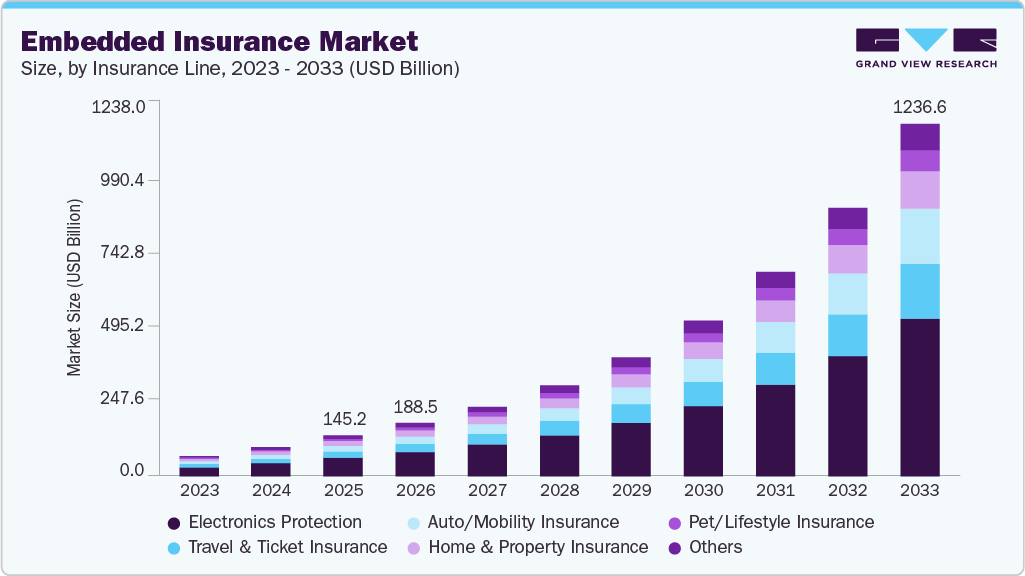
The rapid evolution of embedded finance ecosystems is significantly reshaping the way insurance products are distributed and consumed, thereby propelling the growth of the embedded insurance market. As digital platforms increasingly integrate financial services into their offerings, insurance is becoming a natural extension of transactional experiences. For instance, e-commerce platforms now offer product protection insurance at checkout, while travel platforms provide trip cancellation and delay coverage seamlessly during booking. This integration enhances customer convenience and increases insurance penetration without requiring separate policy purchases.
The growing adoption of application programming interfaces (APIs) and cloud-based infrastructure is enabling insurers to connect with third-party platforms efficiently. These technologies allow real-time underwriting, pricing, and claims processing, thereby improving customer experience and operational efficiency. As a result, insurers are increasingly partnering with fintech firms, digital marketplaces, and mobility providers to expand their distribution reach.
Furthermore, the increasing use of artificial intelligence (AI) and data analytics is enabling insurers to deliver highly personalized and dynamic insurance products. By leveraging customer data, behavioral insights, and transaction history, companies can offer tailored policies that align with individual needs, including embedded life insurance offerings designed around specific life stages or financial goals, thereby enhancing customer engagement and conversion rates. This data-driven approach is also improving risk assessment and reducing fraud, contributing to overall market growth.
The rising popularity of usage-based and on-demand insurance models is another key factor driving market expansion. Consumers are increasingly seeking flexible insurance solutions that provide coverage only when needed, particularly in sectors such as mobility and travel. This trend is encouraging platform providers to integrate insurance offerings that are contextually relevant and cost-effective.
Market Dynamics
The rapid expansion of embedded finance and digital platform ecosystems is significantly driving the growth of the embedded insurance market. Businesses across e-commerce, fintech, mobility, travel, and digital services are increasingly integrating insurance offerings directly into their customer journeys to enhance the user experience and generate additional revenue streams. As consumers increasingly prefer seamless, all-in-one digital experiences, embedded insurance is emerging as a natural extension of online transactions and platform-based services.
In addition, the growing scale and sophistication of digital ecosystems are accelerating the adoption of embedded insurance solutions. Platform providers are increasingly leveraging advanced technologies such as APIs, cloud infrastructure, artificial intelligence (AI), and data analytics to efficiently integrate real-time insurance offerings. These technologies enable insurers and platform operators to deliver personalized, context-aware, and usage-based insurance products with minimal friction during the purchase process. This shift toward digitally integrated, customer-centric insurance distribution models is driving strong global demand for embedded insurance solutions.
Data privacy concerns and complex regulatory compliance are restraining the growth of the embedded insurance market. Embedded insurance models rely heavily on customer data, transaction history, and behavioral insights to deliver personalized and real-time insurance offerings. However, increasing concerns regarding data security, consent management, and the sharing of sensitive customer information across multiple platforms are creating challenges for insurers and digital ecosystem providers. Consumers are becoming more cautious about how their personal and financial data is collected, stored, and utilized, which may reduce trust in digitally integrated insurance solutions.
The rapid expansion of digital commerce and platform-based ecosystems is creating significant growth opportunities for the embedded insurance market. The increasing adoption of e-commerce platforms, digital payment solutions, mobility applications, travel booking platforms, and fintech ecosystems is accelerating the integration of insurance products into everyday digital transactions. Consumers are increasingly seeking seamless, convenient purchasing experiences, prompting businesses to embed insurance offerings directly into customer journeys at the point of sale.
The growing scale and diversity of digital platforms are also amplifying opportunities for embedded insurance providers. As online platforms continue expanding their service portfolios, insurers can integrate highly personalized, context-aware insurance products, such as device protection, travel coverage, payment protection, mobility insurance, and subscription-based protection plans. This integration enables insurers to reach previously underserved customer segments while increasing global insurance penetration rates.
Market Concentration & Characteristics
The embedded insurance industry is moderately fragmented, with a mix of established insurance providers, insurtech firms, and embedded insurance technology platforms competing across different regions and industry verticals. A limited number of leading players hold a significant share of the market, particularly in large-scale digital partnerships and API-driven insurance distribution. Companies such as Cover Genius, Bolttech, Qover, Lemonade, and Assurant have established strong market positions through strategic collaborations with e-commerce platforms, fintech firms, travel providers, and mobility companies. Their advanced API infrastructure, digital underwriting capabilities, and scalable insurance integration models create competitive advantages and relatively high entry barriers in the premium segment of the market. At the same time, the broader embedded insurance ecosystem remains fragmented due to the growing presence of regional insurtech startups and niche platform providers.
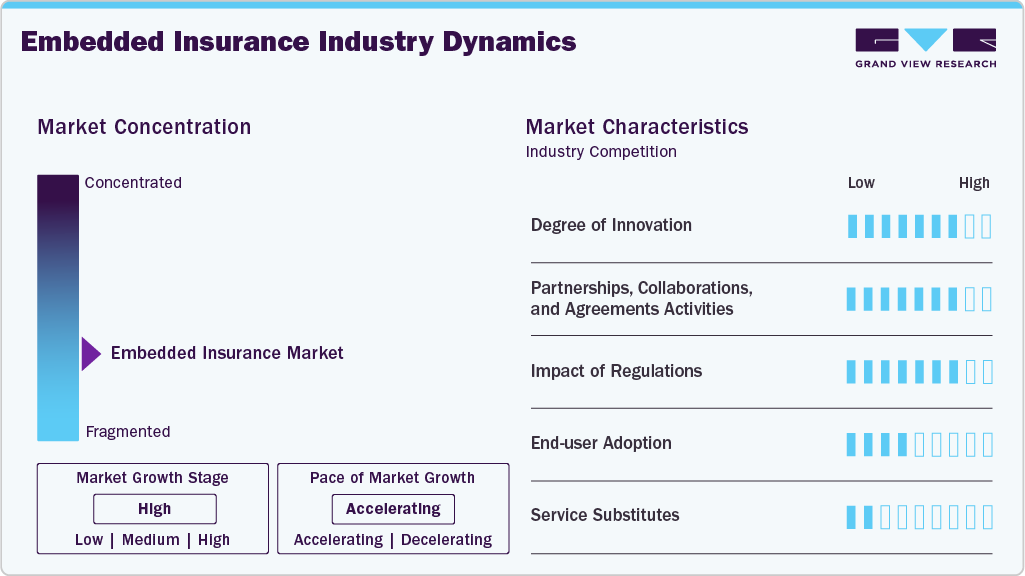
In addition, the increasing adoption of embedded finance ecosystems is intensifying competition among insurers, insurtech firms, and technology providers. Market participants are continuously investing in artificial intelligence (AI), data analytics, cloud infrastructure, and automation technologies to enhance personalization, improve claims management, and optimize customer experience. Strategic partnerships, acquisitions, and ecosystem collaborations are also becoming increasingly common as companies seek to strengthen their distribution networks and expand their presence across high-growth sectors such as e-commerce, fintech, mobility, healthcare, and travel.
Insurance Line Insights
The electronics protection segment accounted for the largest share of 45.8% in 2025. This dominance is driven by the rapid growth in global consumer electronics sales, including smartphones, laptops, and home appliances. Embedded insurance offerings for device protection are commonly integrated at the point of purchase, providing coverage against accidental damage, theft, and malfunction. The increasing consumer preference for safeguarding high-value electronic devices is propelling the growth of this segment.
The auto/mobility insurance segment is expected to grow at the fastest CAGR during the forecast period. The expansion of connected vehicles, ride-sharing services, and mobility-as-a-service (MaaS) platforms is driving demand for embedded motor insurance solutions. These offerings include pay-as-you-drive and trip-based insurance, which are seamlessly integrated into vehicle purchases, leasing services, and ride-hailing applications. The growing adoption of electric vehicles (EVs) and shared mobility solutions is further boosting segment growth.
Distribution Channel Insights
The digital/online platforms segment held the largest market share in 2025 and is expected to grow at the fastest CAGR during the forecast period. The increasing adoption of mobile applications, e-commerce platforms, and fintech ecosystems is enabling the seamless integration of insurance products into digital customer journeys. These platforms leverage APIs to offer real-time policy issuance, making insurance more accessible and convenient for consumers.
The physical/offline channels segment held a significant share of the market in 2025. Despite the rapid shift toward digitalization, traditional distribution channels such as retail stores, travel agencies, and automotive dealerships continue to play a vital role, particularly in regions with lower digital penetration. These channels complement digital offerings by providing assisted sales and customer support.
End User Industry Insights
The e-commerce & retail segment dominated the market in 2025. The integration of insurance products such as product protection, extended warranties, and shipping insurance during online purchases is driving segment growth. E-commerce platforms are leveraging embedded insurance to enhance customer trust, reduce purchase hesitation, and increase overall transaction value.
The mobility & automotive segment is expected to grow at the fastest CAGR during the forecast period. The increasing adoption of ride-sharing platforms, vehicle subscription models, and electric vehicles is creating strong demand for embedded insurance solutions tailored to mobility usage patterns. These solutions provide flexible coverage options, including per-trip and subscription-based insurance, which are seamlessly integrated into mobility platforms.
Partner Platform Type Insights
The e-commerce platforms segment dominated the market in 2025 and is projected to grow at a significant CAGR over the forecast period. The high transaction volumes and extensive customer base of e-commerce platforms make them ideal for embedding insurance offerings at the point of sale. These platforms are increasingly partnering with insurers to provide integrated protection plans and enhance customer experience.
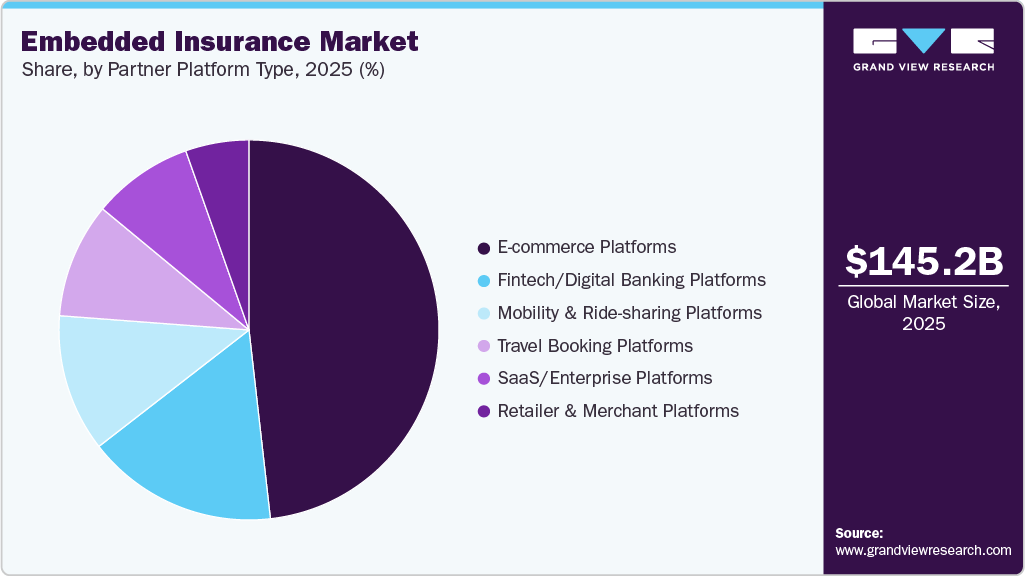
The mobility & ride-sharing platforms segment is projected to grow at the fastest CAGR over the forecast period. The rising popularity of ride-hailing services and shared mobility solutions is driving demand for real-time, usage-based insurance products. These platforms are embedding insurance directly into their services, providing coverage for drivers, passengers, and vehicles during trips.
Regional Insights
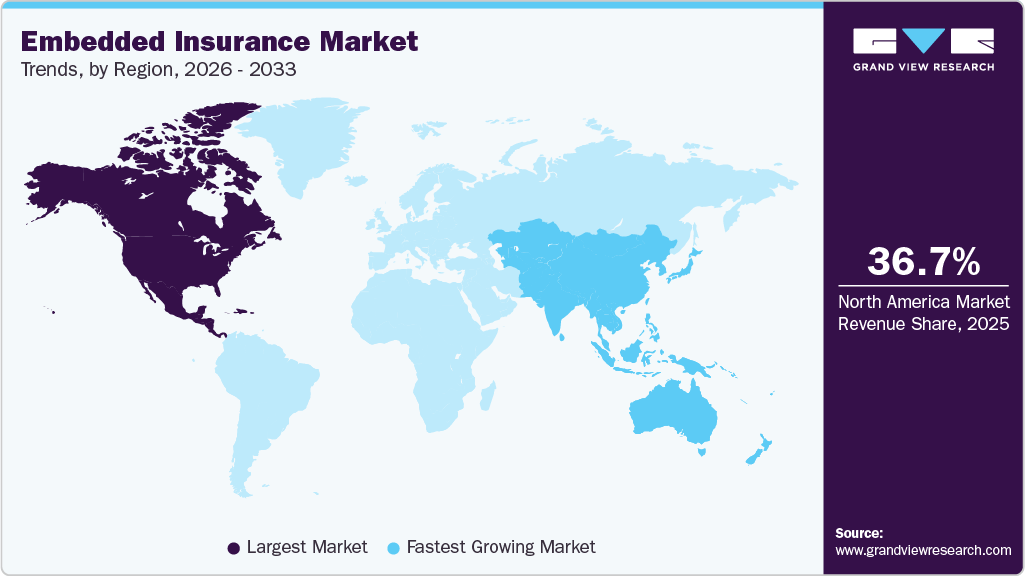
The North America embedded insurance market accounted for a significant revenue share of 36.7% in 2025, and is projected to grow at a substantial CAGR over the forecast period. The region’s growth is driven by advanced digital infrastructure, high adoption of embedded finance solutions, and the strong presence of insurtech companies. Additionally, favorable regulatory frameworks and increasing consumer awareness are supporting market expansion.
U.S. Embedded Insurance Market Trends
The U.S. embedded insurance industry held a dominant position in 2025. The market is characterized by strong collaboration between insurers and technology companies, enabling the rapid deployment of embedded insurance solutions across various sectors. The increasing adoption of digital payment platforms, e-commerce marketplaces, and mobility services is driving demand for integrated insurance offerings. Additionally, the presence of leading insurtech firms and continuous innovation in product design are further boosting market growth.
Europe Embedded Insurance Market Trends
Europe’s embedded insurance market is driven by regulatory initiatives such as open banking and digital finance frameworks. These regulations are encouraging collaboration between insurers and platform providers, facilitating the integration of insurance products into digital ecosystems. The region’s focus on consumer protection and data privacy is also promoting the development of transparent and customer-centric insurance solutions.
The embedded insurance market in Germany is characterized by a highly regulated environment combined with steady digital transformation, which is shaping a structured and trust-driven growth trajectory. The country’s strict regulatory framework, supported by European Union directives such as PSD2 and oversight from regulatory bodies, ensures strong consumer protection but can slow down rapid experimentation in embedded insurance models.
The embedded insurance market in the UK is one of the most mature and innovation-driven markets globally, supported by a strong fintech ecosystem and advanced digital infrastructure. The rise of comparison platforms and digital marketplaces has played a crucial role in familiarizing consumers with embedded and integrated insurance offerings.
Asia Pacific Embedded Insurance Market Trends
The Asia Pacific embedded insurance market is expected to grow at the fastest CAGR of 33.8% from 2026 to 2033. The region’s growth is driven by rapid digital transformation, increasing internet penetration, and the widespread adoption of super apps and fintech platforms. Countries such as China and India are emerging as key growth markets due to their large population base and expanding digital ecosystems.
The embedded insurance market in China is highly advanced and rapidly evolving, driven by the country’s dominant super-app ecosystem and digital-first consumer behavior. Platforms such as digital payment and lifestyle apps are integrating insurance products seamlessly into everyday activities, making insurance an “invisible” part of daily transactions.
The embedded insurance market in Japan is defined by high insurance penetration, technological advancement, and scenario-based product innovation. With over 90% of households already holding insurance policies, growth is increasingly driven by product innovation and distribution transformation rather than new customer acquisition.
The embedded insurance market in India is experiencing rapid growth, driven by digital adoption, financial inclusion initiatives, and a large underserved population. The expansion of digital payment systems, mobile-first platforms, and e-commerce ecosystems is enabling insurers to reach a broader customer base through embedded insurance models.
Key Embedded Insurance Company Insights
Some of the leading players in the embedded insurance market include Cover Genius, Assurant, bolttech, Qover, Lemonade, Companjon, Igloo (Axinan), Sure, REIN, and EIS Group, among others. These companies provide embedded insurance infrastructure, digital distribution capabilities, and API-driven platforms that enable seamless integration of insurance products across industries such as e-commerce, fintech, mobility, travel, and SaaS ecosystems. Their portfolios emphasize real-time policy issuance, personalization, scalability, and data-driven underwriting, enabling businesses to offer contextual and usage-based insurance products at the point of sale.
-
Cover Genius is a global player in embedded insurance, offering its proprietary XCover platform, which enables real-time, localized protection products across multiple industries. The company partners with major digital platforms across e-commerce, travel, and fintech to deliver end-to-end embedded insurance solutions, including pricing, distribution, and claims management. Its strong focus on global scalability, regulatory compliance, and customer-centric design is propelling its leadership position in the embedded insurance ecosystem.
-
Qover is a Europe-based insurtech specializing in API-first embedded insurance orchestration for fintechs, mobility providers, and digital platforms. The company enables rapid deployment of insurance products through modular infrastructure, automated claims handling, and seamless user experiences. Qover’s focus on compliance, scalability, and customer experience is driving adoption across banking and mobility ecosystems. Its ongoing expansion across multiple geographies highlights its role in accelerating embedded insurance adoption in Europe and beyond.
Key Embedded Insurance Companies:
The following key companies have been profiled for this study on the embedded insurance market.
- Cover Genius
- Bolttech
- Qover
- Lemonade
- Assurant
- Companjon
- Igloo (Axinan)
- Sure
- Rein
- EIS Group
Competitive Benchmarking
Operating Strategies
Competitive Edge
Weaknesses
Mature Players: Cover; Genius; Bolttech; Assurant; Lemonade
- Mature players focus on large-scale embedded insurance distribution through partnerships with e-commerce, fintech, travel, mobility, and digital commerce platforms.
- • Strategies emphasize API-driven insurance integration, automated underwriting, claims management, and global partnership expansion.
- Strong global presence with diversified partnership ecosystems and established brand recognition.
- Advanced technology capabilities in API integration, automation, AI-driven underwriting, and digital claims processing.
- High technology development and compliance costs may pressure profitability.
- Dependence on strategic platform partnerships creates exposure to ecosystem concentration risks.
Emerging Players: Qover; Companjon; Igloo (Axinan); Sure; Rein; EIS Group
- Emerging players focus on flexible, customizable, and sector-specific embedded insurance solutions targeting digital-first businesses and regional markets.
- Companies are prioritizing integration simplicity and customer-centric digital experiences to attract platform partners.
- Strong capabilities in niche market segments, localized solutions, and customizable insurance products.
- Competitive advantage in serving underserved digital ecosystems and emerging embedded finance platforms.
- Limited global presence and comparatively smaller partnership networks.
- Lower financial scale and brand recognition compared to established market leaders.
Recent Developments
-
In April 2026, Cover Genius expanded its embedded travel protection footprint by partnering with Tongcheng Travel to launch travel insurance in Malaysia and the Philippines, enabling customers to buy cover directly inside the booking journey through a single API integration.
-
In April 2026, Bolttech announced a partnership with Associated Carrier Group to provide device protection for member companies, adding another embedded protection use case to its global partner network.
Embedded Insurance Market Report Scope
Report Attribute
Details
Market size in 2025
USD 145.2 billion
Estimated market size in 2026
USD 188.5 billion
Projected market size by 2033
USD 1,236.6 billion
Growth rate
CAGR of 30.8% from 2026 to 2033
Base year for estimation
2025
Historical data
2021 - 2024
Forecast period
2026 - 2033
Quantitative units
Revenue in USD million/billion and CAGR from 2026 to 2033
Report coverage
Revenue forecast, company ranking, competitive landscape, growth factors, and trends
Segments covered
Insurance line, distribution channel, end-user industry, partner platform type, region
Regional scope
North America; Europe; Asia Pacific; Latin America; MEA
Country scope
U.S.; Canada; Mexico; Germany; UK; France; China; Japan; India; South Korea; Australia; Brazil; KSA; UAE; and South Africa
Key companies profiled
Cover Genius; Bolttech; Qover; Lemonade; Assurant; Companjon; Igloo (Axinan); Sure; Rein; EIS Group
Customization scope
Free report customization (equivalent up to 8 analysts working days) with purchase. Addition or alteration to country; regional & segment scope.
Pricing and purchase options
Avail customized purchase options to meet your exact research needs. Explore purchase options
Global Embedded Insurance Market Report Segmentation
This report forecasts revenue growth at the global, regional, and country levels and provides an analysis of the latest industry trends in each of the sub-segments from 2021 to 2033. For this study, Grand View Research has segmented the global embedded insurance market report based on insurance line, distribution channel, end user industry, partner platform type, and region:
-
Insurance Line Outlook (Revenue, USD Million, 2021 - 2033)
-
Electronics Protection
-
Travel & Ticket Insurance
-
Auto/Mobility Insurance
-
Home & Property Insurance
-
Pet/Lifestyle Insurance
-
Others
-
-
Distribution Channel Outlook (Revenue, USD Million, 2021 - 2033)
-
Digital/Online Platforms
-
Physical/Offline Channels
-
-
End-User Industry Outlook (Revenue, USD Million, 2021 - 2033)
-
E-commerce & Retail
-
BFSI
-
Travel & Hospitality
-
Mobility & Automotive
-
Consumer Electronics
-
Others
-
-
Partner Platform Type Outlook (Revenue, USD Million, 2021 - 2033)
-
E-commerce Platforms
-
Fintech/Digital Banking Platforms
-
Mobility & Ride-sharing Platforms
-
Travel Booking Platforms
-
SaaS/Enterprise Platforms
-
Retailer & Merchant Platforms
-
-
Regional Outlook (Revenue, USD Million, 2021 - 2033)
-
North America
-
U.S.
-
Canada
-
Mexico
-
-
Europe
-
Germany
-
UK
-
France
-
-
Asia Pacific
-
China
-
Japan
-
India
-
South Korea
-
Australia
-
-
Latin America
-
Brazil
-
-
Middle East and Africa (MEA)
-
KSA
-
UAE
-
South Africa
-
-
Delivered Customizations
This report has been delivered with the following In-depth customizations
Client Request
Customization Delivered
Value Adds
Regional Embedded Insurance Market Opportunity Assessment
Country/region-wise market sizing and forecasts
Analysis of digital ecosystem maturity, insurance penetration, and regulatory framework
Identification of high-growth regional markets and partnership opportunities
Identified region-specific growth opportunities
Supported expansion and go-to-market strategy
Enabled informed investment and geographic expansion decisions
Embedded Insurance Consumer Behavior Study
Analysis of customer purchasing behavior and insurance adoption patterns across digital platforms
Evaluation of preferred insurance types across e-commerce, travel, mobility, and fintech ecosystems
Analysis of customer preference for personalized, usage-based, and microinsurance products
Improved customer segmentation and targeting strategy
Enabled optimization of customer journey and platform integration strategies
Competitive Benchmarking and Strategic Positioning in the Embedded Insurance Market
Benchmarking of key players across API capabilities, partnerships, insurance offerings, pricing models, and innovation strategies
Comparative assessment of market share, capabilities, and strategies
Evaluation of insurtech collaboration and embedded finance ecosystem positioning
Identified competitive gaps and white-space opportunities
Supported strategic positioning and differentiation
Enabled data-driven competitive strategy development
Frequently Asked Questions About This Report
The global embedded insurance market size was estimated at USD 145.2 billion in 2025 and is expected to reach USD 188.5 billion in 2026.
North America dominated with a 36.7% revenue share in 2025.
Asia Pacific is the fastest-growing region over the forecast period.
The electronics protection segment led with a 45.8% revenue share in 2025.
The digital/online platforms held the largest revenue share in 2025.
The e-commerce platforms segment dominated the market in 2025 and is projected to grow at a significant CAGR over the forecast period.
The global embedded insurance market size is expected to grow at a significant CAGR of 30.8% to reach USD 1,236.6 billion in 2033.
North America held the largest market share of 36.7% in 2025. The region’s growth is driven by advanced digital infrastructure, high adoption of embedded finance solutions, and the strong presence of insurtech companies.
Some of the players in the market are Cover Genius, Bolttech, Qover, Lemonade, Assurant, Companjon, Igloo (Axinan), Sure, Rein, and EIS Group.
The key driving trend in the embedded insurance market is the seamless integration of insurance offerings into digital platforms and customer purchase journeys. Insurance is increasingly being offered at the point of sale, such as during online shopping, travel bookings, or ride-hailing services, making it more accessible and convenient for consumers.
About the Author(s)
Next Generation Technologies Research Team
Technology · Next Generation TechnologiesThis report was authored by the next generation technologies research team at Grand View Research - comprising two research analysts, one senior research analyst, and one industry expert - with specialized expertise in the next generation technologies segment of the technology industry. All findings are based on proprietary technology databases, executive interviews, and regulatory analysis, subject to internal peer review prior to publication.
Last Updated:
Speak to Analyst


Customize this report to your needs — add regions, segments, or data points, with 20% free customization.
Or view our licence options:


ISO 9001:2015 & 27001:2022 Certified
We are GDPR and CCPA compliant! Your transaction & personal information is safe and secure. For more details, please read our privacy policy.


