
- Home
- »
- Advanced Interior Materials
- »
-
EMI Shielding Material Market Size Report, 2026-2033GVR Report cover

EMI Shielding Material Market (2026 - 2033)
Size, Share & Trends Analysis Report By Product (Conductive Coatings & Paints, Conductive Polymers, Metal Shielding Product, EMC/EMI Filters), By End-use (Consumer Electronics, Automotive), By Region, And Segment Forecasts
Market Size, 2025
$8.7BMarket Estimate, 2026
$9.2BMarket Forecast, 2033
$13.6BCAGR, 2026–2033
5.8%EMI Shielding Material Market Summary
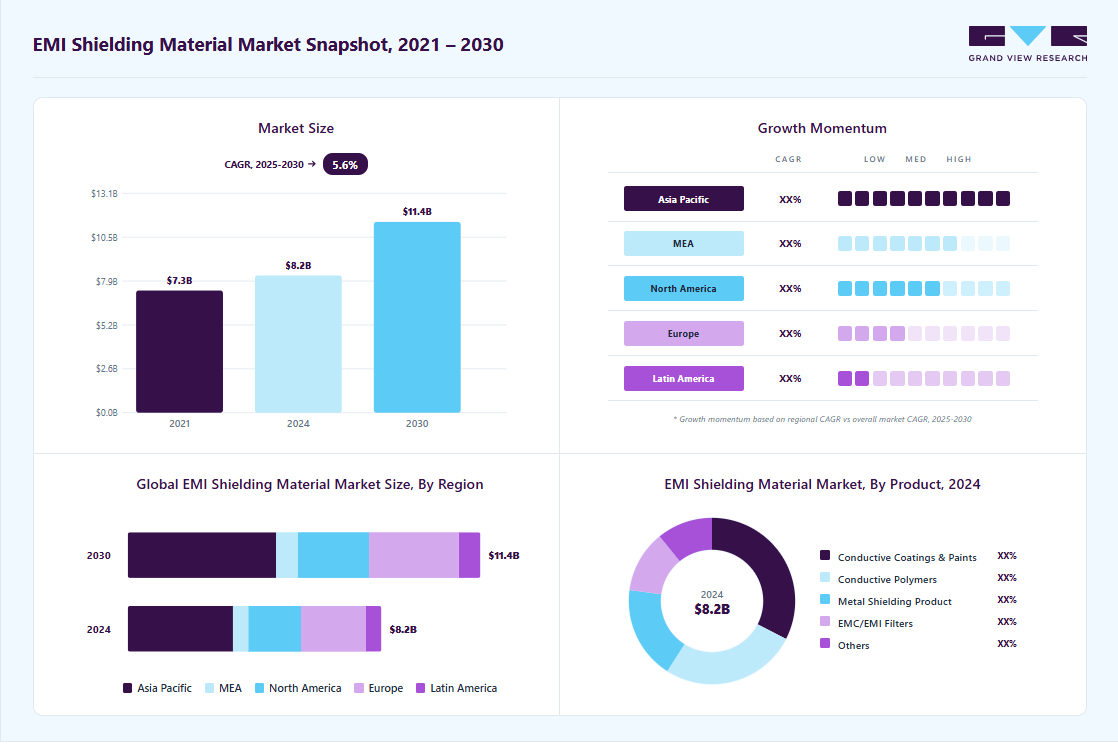
The global EMI shielding material market size was valued at USD 8.7 billion in 2025 and is projected to grow from USD 9.2 billion in 2026 to USD 13.6 billion by 2033, at a CAGR of 5.8% from 2026 to 2033. Asia Pacific dominated the market, accounting for a revenue share of 41.5% in 2025. The growing adoption of EMI shielding materials in healthcare and medical devices is also propelling market growth.
 Source: Grand View Research, IR Documents, Primary Interviews, Paid DatabasesTo learn more about this report,
 Download Free Sample Report
Key Market Trends & Insights
- By product: Conductive coatings & paints segment led the market with the largest revenue share of 32.8% in 2025.
- By end use: Consumer electronics segment led the market with the largest revenue
Regional Highlights
- Largest regional market: Asia Pacific (41.5% revenue share, 2025)
- By country: China held the largest share in 2025
Market Size & Forecast
- Market size in 2025: USD 8.7 billion
- Estimated market size in 2026: USD 9.2 billion
- Projected market size by 2033: USD 13.6 billion
- CAGR (2026-2033): 5.8%
Three ways to get this report
Buy it, customize it, or ask a question.Ask an Analyst
Analyst response in 1 business day
- AccessReport author, directly
- Reply timeWithin 1 working day
- No sales callDirect answer only
- FormatEmail reply
- CostFree, no cost
Get the Full Report
What the study covers
- FormatsPDF · Excel · Dashboard
- Timeline2026–2033 annual, 2025 base
- Coverage20+ countries, 5 regions
- Companies10+ key players profiled
Customize the Report
20% free customization
- IncludeCountries, segments, points
- TailorTo your product definition
- ExtendDeeper competitor detail
- OrA fully bespoke study
- Turnaround5–10 working days
The proliferation of consumer electronics, such as smartphones, laptops, and wearables, has led to a rising need for effective electromagnetic interference (EMI) shielding solutions to prevent signal interference and ensure device performance. Additionally, as the adoption of 5G technology accelerates, the demand for shielding materials is growing, as these networks operate at higher frequencies, making electronic components more susceptible to electromagnetic interference.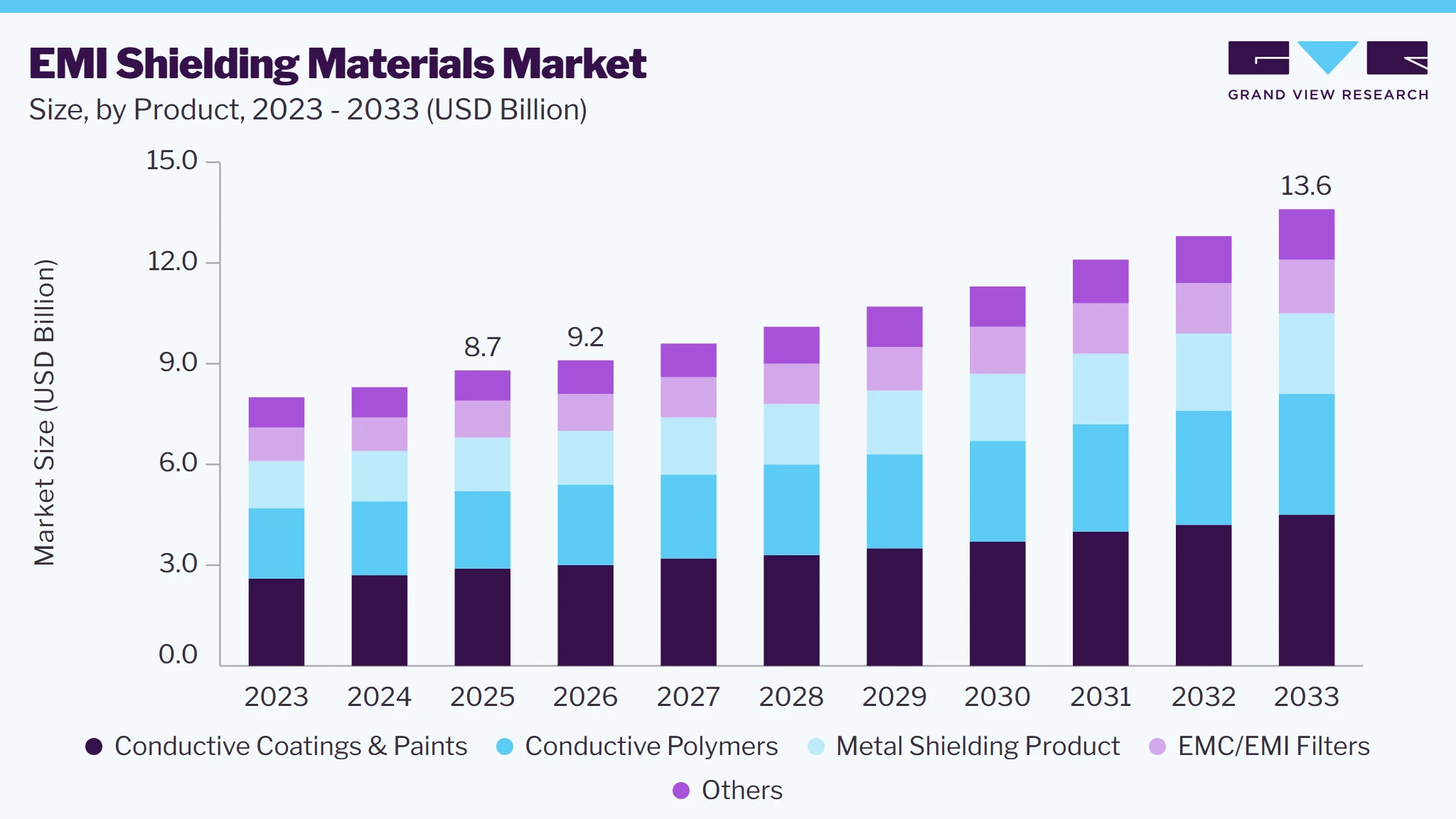 To learn more about this report, Download Free Sample Report
With the rapid advancement of medical technologies, including MRI machines, pacemakers, and wireless medical devices, the need for shielding solutions to minimize electromagnetic interference has become paramount. EMI shielding ensures the accurate functioning of sensitive medical equipment and prevents potential disruptions that could compromise patient safety. As the healthcare sector continues to embrace digitalization and connectivity, the demand for shielding materials in medical applications is expected to increase further.
Another key driver of the EMI shielding material industry is the expansion of the automotive and aerospace industries, where electronic components play a crucial role in vehicle safety, navigation, and communication systems. The increasing integration of advanced driver-assistance systems (ADAS), electric vehicle (EV) components, and in-flight communication technologies has heightened the need for robust EMI shielding solutions. In the automotive sector, shielding materials such as conductive plastics, coated fabrics, and metal enclosures are essential to prevent interference that could affect critical vehicle systems. Similarly, in aerospace applications, EMI shielding is vital to protect avionics and ensure the smooth operation of aircraft communication and control systems.
Market Dynamics
The EMI shielding material market is experiencing strong growth as electronic devices become more compact, interconnected, and performance-intensive across industries. Rising adoption of 5G infrastructure, electric vehicles, aerospace electronics, medical equipment, and industrial automation is increasing the need for effective electromagnetic interference protection. Manufacturers are focusing on lightweight, high-performance shielding materials that offer superior conductivity, thermal management, and design flexibility. Advances in conductive polymers, metal-coated composites, nanomaterials, and shielding coatings are expanding application possibilities. Regulatory requirements for electromagnetic compatibility (EMC) and increasing electronic complexity continue to support market expansion.
The rapid deployment of electric vehicles, autonomous driving technologies, and advanced driver assistance systems (ADAS) has significantly increased the number of electronic components integrated into modern vehicles. These systems generate electromagnetic interference that can disrupt critical vehicle functions, creating strong demand for high-performance EMI shielding materials. Automotive manufacturers are increasingly adopting lightweight conductive composites, shielding films, and metal-based materials to improve system reliability while reducing vehicle weight.
Similarly, the expansion of 5G networks, data centers, consumer electronics, and industrial automation is driving the need for effective electromagnetic compatibility across high-frequency electronic systems. As devices become smaller and more powerful, manufacturers require advanced shielding materials capable of maintaining signal integrity, minimizing interference, and improving overall electronic performance, making EMI shielding a critical component of next-generation electronics.
Advanced EMI shielding materials, including silver-based coatings, conductive nanomaterials, specialty alloys, and carbon-based composites, often involve high production costs and complex manufacturing techniques. Achieving consistent shielding effectiveness while maintaining lightweight properties, durability, and design flexibility increases manufacturing complexity. These cost challenges can limit adoption among small-scale manufacturers and price-sensitive applications, particularly in emerging markets.
The increasing focus on lightweight electronics, electric mobility, wearable devices, and environmentally sustainable manufacturing presents significant opportunities for the EMI shielding material market. Manufacturers are investing in recyclable conductive polymers, graphene-enhanced composites, carbon nanotube materials, and bio-based shielding solutions that provide excellent electromagnetic protection while reducing environmental impact. Continued innovation in multifunctional materials combining EMI shielding, thermal management, and structural performance is expected to create new growth opportunities across automotive, aerospace, healthcare, and consumer electronics industries.
Market Concentration & Characteristics
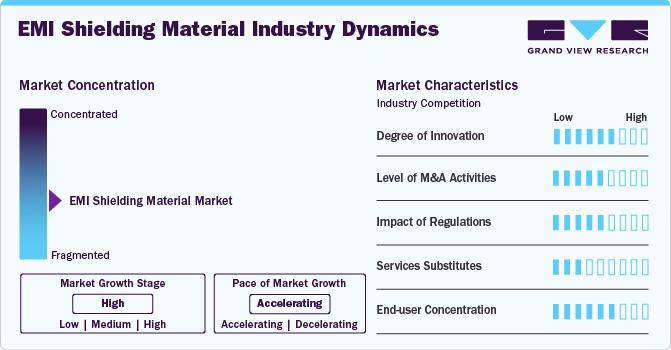
The global EMI (Electromagnetic Interference) shielding materials market is characterized by a moderate to high level of market concentration, with key players focusing on technological advancements and product innovations to gain a competitive edge. The degree of innovation in this market is significant, driven by the increasing demand for high-performance shielding materials in consumer electronics, automotive, aerospace, and telecommunications industries. Companies are investing in the development of lightweight, flexible, and high-conductivity materials, such as conductive coatings, metalized fabrics, and advanced polymer composites, to enhance shielding effectiveness while meeting stringent industry requirements. The integration of nanotechnology and advanced conductive fillers, including graphene and carbon nanotubes, has further expanded the market’s innovation landscape, offering enhanced EMI shielding capabilities with minimal impact on weight and form factors.
 To learn more about this report, Download Free Sample Report
Regulatory frameworks and environmental standards play a crucial role in shaping the EMI shielding material industry. Stringent regulations by agencies such as the Federal Communications Commission (FCC) in the U.S., the European Union’s EMC Directive, and other global regulatory bodies mandate strict electromagnetic compatibility (EMC) requirements for electronic devices and automotive components. Compliance with these regulations has driven manufacturers to adopt sustainable and RoHS-compliant materials that minimize environmental impact while maintaining superior shielding performance. Although there are limited service substitutes for EMI shielding materials, emerging alternatives such as software-based shielding techniques and embedded shielding solutions within electronic circuits pose potential competition. However, the end-user concentration remains strong in the consumer electronics and automotive sectors, where the rising demand for high-speed connectivity, autonomous vehicles, and miniaturized electronic components continues to fuel the adoption of EMI shielding solutions worldwide.
Analyst Perspective
The EMI shielding material market is undergoing a fundamental transformation from a conventional electromagnetic compatibility (EMC) solutions market to a technology-driven industry characterized by advanced conductive materials, lightweight composites, multifunctional polymers, and next-generation shielding technologies. This evolution is being driven by the rapid proliferation of electric vehicles, 5G infrastructure, high-performance consumer electronics, aerospace and defense systems, medical devices, and industrial automation, all of which require superior electromagnetic protection without compromising weight, thermal performance, or design flexibility. Consequently, innovation is increasingly focused on engineered conductive polymers, graphene- and carbon nanotube-based materials, metal-coated composites, and sustainable shielding solutions that deliver enhanced shielding effectiveness, improved thermal management, long-term durability, and compliance with increasingly stringent EMC requirements for high-frequency electronic applications.
Product Insights
Based on product, the conductive coatings & paints segment led the market with the largest revenue share of 32.8% in 2025 and is expected to grow at a CAGR of 5.9% over the forecast period, driven by the increasing demand for effective electromagnetic interference (EMI) shielding solutions across various industries. With the rapid expansion of consumer electronics, telecommunications, and automotive sectors, there is a growing need to protect sensitive electronic components from EMI, which can disrupt performance and reliability. Conductive coatings and paints, formulated with materials such as silver, copper, and nickel, provide efficient shielding by creating a conductive layer on electronic enclosures, circuit boards, and other critical components.
The conductive polymers segment is expected to grow at the fastest CAGR of 5.7% over the forecast period, driven by the increasing demand for lightweight, flexible, and cost-effective shielding solutions across various industries. Unlike traditional metal-based shielding materials, conductive polymers offer superior design flexibility, corrosion resistance, and ease of processing, making them highly suitable for modern electronic applications. With the rapid miniaturization of electronic devices and the growing complexity of circuit designs, the need for efficient EMI shielding solutions that can be integrated into compact and lightweight electronic components is rising. Conductive polymers, with their excellent electrical conductivity and adaptability, are becoming a preferred choice for manufacturers looking to enhance the electromagnetic compatibility (EMC) of their devices while maintaining design versatility.
End-use Insights
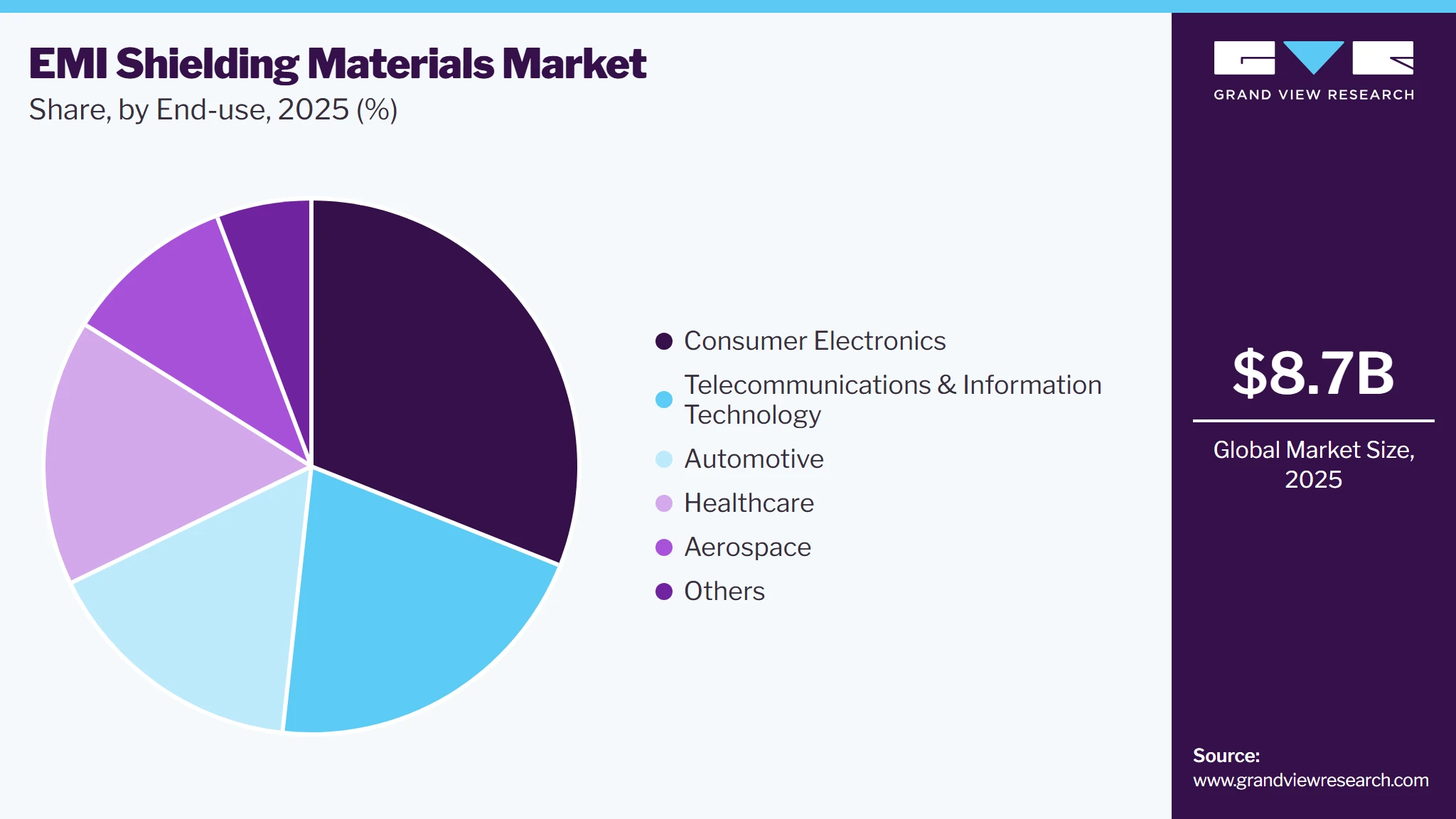
Based on end use, the consumer electronics segment led the market with the largest revenue share of 31.4% in 2025 and is expected to grow at a CAGR of 5.6% over the forecast period, as the increasing adoption of smart devices, wearables, and advanced computing systems necessitates effective electromagnetic interference (EMI) protection. The rapid expansion of the Internet of Things (IoT) and 5G-enabled devices has led to a significant rise in electronic components operating at higher frequencies, making them more susceptible to EMI-related performance issues. As a result, manufacturers are investing in advanced shielding materials, such as conductive coatings, metal enclosures, and composite-based solutions, to enhance device performance, reduce signal disruption, and comply with stringent electromagnetic compatibility (EMC) regulations.
 To learn more about this report, Download Free Sample Report
Automotive segment is expected to grow at the fastest CAGR of 6.2% over the forecast period, driven by the rapid advancement of electronic components in modern vehicles. With the increasing adoption of electric vehicles (EVs), autonomous driving technologies, and advanced infotainment systems, the need for effective electromagnetic interference (EMI) shielding has become critical. Automotive manufacturers are integrating complex electronic control units (ECUs), sensors, and wireless communication systems into vehicles, which generate high levels of electromagnetic radiation. To ensure seamless operation and prevent signal disruptions, EMI shielding materials such as conductive coatings, metal enclosures, and shielding gaskets are being widely used in vehicle design, driving demand in the market.
Regional Insights
The healthcare sector in North America is another key driver for the EMI shielding material market. With the growing prevalence of medical devices that utilize advanced electronics, including diagnostic equipment, pacemakers, and imaging systems, the demand for EMI shielding has become crucial. Electromagnetic interference can compromise the performance and reliability of medical devices, which is particularly concerning in critical healthcare applications. As a result, the industry relies on high-quality EMI shielding materials to prevent interference and ensure the accuracy and safety of medical equipment. With the ongoing development of next-generation medical devices, the demand for specialized EMI shielding solutions is anticipated to increase, further boosting market growth.
U.S. EMI Shielding Material Market Trends
The aerospace and defense industries are also driving the demand for EMI shielding materials in the U.S. These industries require highly reliable, high-performance shielding materials to protect sensitive electronic components and ensure the safety and efficiency of their systems. In aerospace applications, EMI shielding is essential to prevent interference with avionics, communication systems, and radar equipment, which could have severe consequences in mission-critical operations. Likewise, in the defense sector, advanced military technologies, including communication systems, missile guidance, and electronic warfare equipment, all require effective EMI shielding to ensure operational reliability in complex electromagnetic environments. The U.S. government’s ongoing investments in defense and aerospace innovation continue to support the growth of the EMI shielding material market in these sectors.
Asia Pacific EMI Shielding Material Market Trends
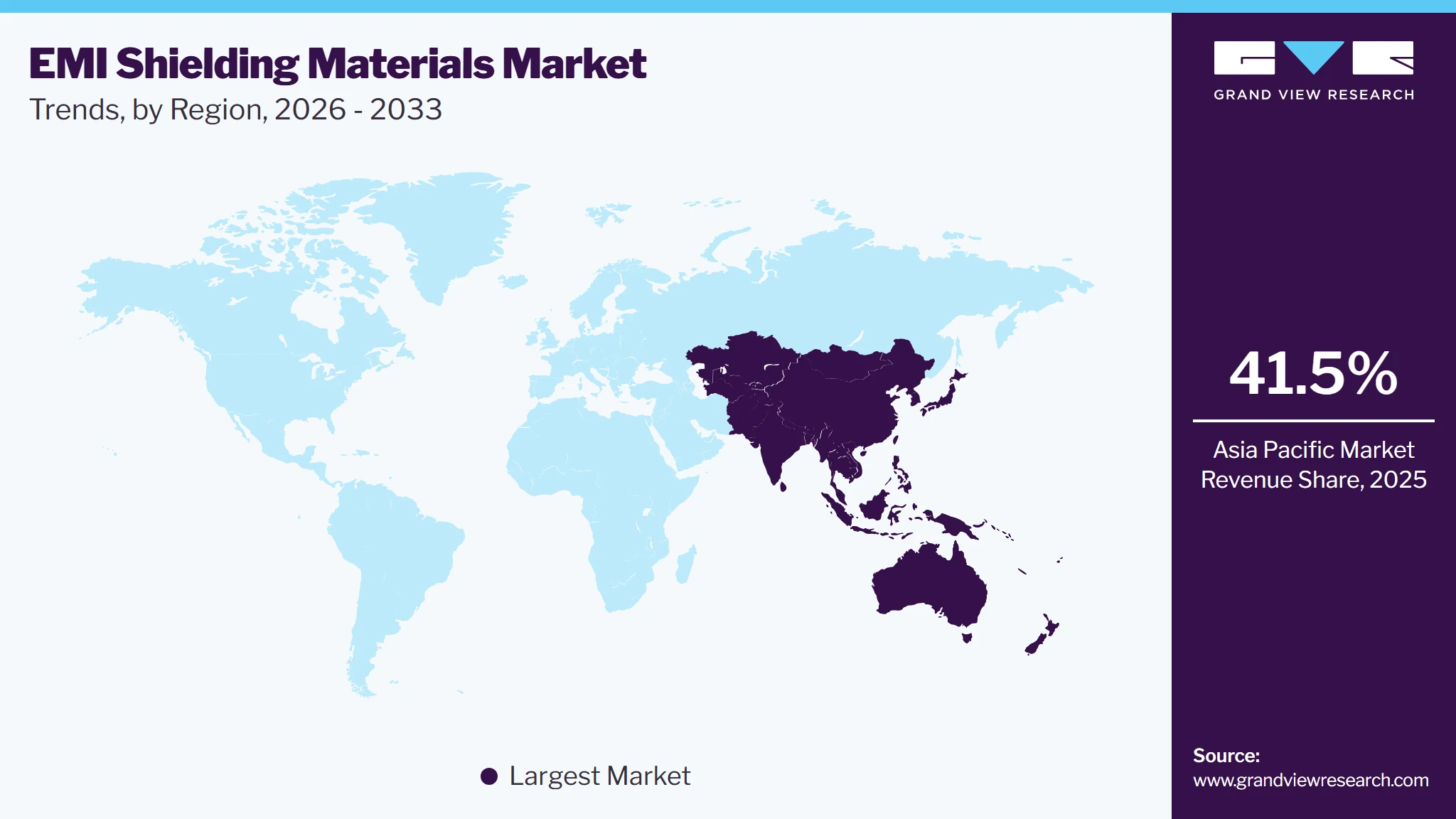
Asia Pacific dominated the EMI shielding material market with the largest revenue share of 41.5% in 2025, driven by the rapid expansion of the region’s electronics and telecommunications industries. Countries such as China, Japan, South Korea, and India are key manufacturing hubs for consumer electronics, including smartphones, laptops, tablets, and wearable devices. As these electronic products become more advanced and compact, the risk of electromagnetic interference (EMI) increases, necessitating the use of high-performance EMI shielding materials. The growing production of consumer electronics in the region is a primary factor fueling the demand for EMI shielding solutions.
 To learn more about this report, Download Free Sample Report
China EMI Shielding Material Market Trends
The EMI shielding material market in China held the largest share in the Asia Pacific region in 2025. The EMI shielding material market in China is experiencing significant growth, driven by the rapid expansion of the country's electronics and telecommunications industries. As China continues to solidify its position as a global leader in consumer electronics manufacturing, the demand for high-performance electromagnetic interference (EMI) shielding solutions has surged. The increasing complexity of electronic devices, including smartphones, laptops, and smart home appliances, necessitates robust EMI shielding materials to ensure device functionality, minimize signal disruptions, and comply with stringent electromagnetic compatibility (EMC) regulations. This trend is expected to continue as China remains at the forefront of technological advancements in the electronics sector.
Europe EMI Shielding Material Market Trends
The Europe EMI shielding material market is experiencing significant growth, driven by the increasing demand for advanced electronics across various industries, particularly in automotive, telecommunications, and consumer electronics. The region's strong presence of automobile manufacturers adopting electric and autonomous vehicles has been a key factor contributing to the need for electromagnetic interference (EMI) shielding solutions. With the integration of complex electronic systems, including battery management systems, inverters, sensors, and communication modules, automotive companies in Europe are adopting sophisticated EMI shielding materials to ensure optimal performance and safety. The growing trend towards electric vehicles (EVs) and hybrid models is further boosting demand, as these vehicles incorporate numerous electronic components that require protection from electromagnetic interference.
The automotive sector in Germany plays a crucial role in driving the demand for EMI shielding materials. As a global leader in automotive manufacturing, the country is witnessing a significant rise in the integration of electronic systems in vehicles, including advanced driver-assistance systems (ADAS), infotainment systems, and electric powertrains. With the shift toward electric vehicles (EVs) and the development of autonomous driving technologies, there is an increasing need for shielding solutions to prevent electromagnetic interference. High-voltage components, such as battery management systems and inverters in EVs, require effective shielding to ensure their optimal performance. Furthermore, the increasing deployment of wireless technologies such as 5G and V2X communication in automobiles has amplified the need for reliable EMI shielding solutions, positioning the automotive sector as a key driver of market growth in Germany.
Latin America EMI Shielding Material Market Trends
The Latin American EMI shielding material market is being driven by the region's rapidly expanding automotive industry. With increasing investments in electric vehicles (EVs) and the integration of advanced electronic systems in traditional internal combustion engine vehicles, the demand for effective EMI shielding solutions has grown. Modern vehicles are equipped with various electronic components, such as sensors, control units, infotainment systems, and communication modules, all of which generate electromagnetic interference (EMI). To ensure the proper functioning of these components and compliance with regional electromagnetic compatibility (EMC) standards, automotive manufacturers in Latin America are increasingly adopting EMI shielding materials, driving growth in the market.
Middle East & Africa EMI Shielding Material Market Trends
The telecommunications industry in the Middle East & Africa is a key driver for the EMI shielding material market. With the expansion of 5G networks and the increasing number of mobile and internet-connected devices, the need for EMI shielding has become more pronounced. 5G infrastructure, which involves high-frequency signals, can cause electromagnetic interference, making EMI shielding essential for maintaining signal integrity and preventing disruptions. As telecom companies upgrade their networks and deploy new wireless communication technologies, the demand for EMI shielding solutions to protect communication equipment, base stations, and consumer devices is anticipated to rise.
Key EMI Shielding Material Company Insights
Some of the key players operating in the market include 3M, Parker Chomerics
-
3M Company is a global operator in innovative technologies, offering a broad range of products, including materials for the EMI shielding market. Known for its strong commitment to research and development, 3M provides high-performance shielding solutions for automotive, telecommunications, consumer electronics, and healthcare industries. Their product offerings include conductive adhesives, shielding films, metal foils, and tapes designed to prevent electromagnetic interference in electronic devices.
-
Parker Chomerics, a division of Parker Hannifin, specializes in the development of electromagnetic interference (EMI) shielding and thermal management solutions. They offer a comprehensive portfolio of materials designed to protect electronic devices and systems from EMI, including conductive elastomers, metal-filled gaskets, conductive fabrics, and EMI shielding coatings. Their products are widely used across industries such as automotive, aerospace, telecommunications, and industrial electronics.
Dow, ETS-Lindgren are some of the emerging market participants in EMI shielding material market.
-
Dow Inc is a multinational corporation known for its diverse product offerings, including advanced materials for EMI shielding. Their portfolio includes silicone-based EMI shielding materials, conductive elastomers, and specialized adhesives designed for use in automotive, telecommunications, consumer electronics, and other high-tech industries. Dow’s materials are engineered to deliver excellent shielding performance while maintaining flexibility and ease of use in complex designs.
-
ETS-Lindgren, a subsidiary of ESCO Technologies, is a global leader in the field of electromagnetic interference (EMI) shielding and testing solutions. Their product offerings include high-performance shielding materials, anechoic chambers, and test equipment for a variety of industries. ETS-Lindgren’s shielding solutions are specifically designed for telecommunications, aerospace, automotive, and healthcare sectors. They offer conductive coatings, shielding enclosures, and EMI gaskets to protect sensitive electronics from electromagnetic interference. With decades of experience, ETS-Lindgren is known for its expertise in providing customized solutions that meet the stringent regulatory and performance requirements of the EMI shielding market.
Key EMI Shielding Material Companies:
The following key companies have been profiled for this study on the EMI shielding material market.
- 3M Company
- Parker Chomerics
- Dow Inc
- ETS-Lindgren
- Henkel AG & Co. KGaA
- Kitagawa Industries
- Laird Technologies Inc.
- Leader Tech Inc.
Competitive Benchmarking
Category
Operating Strategies
Competitive Edge
Weakness
Established Players (3M Company, Parker Chomerics, Dow Inc., Henkel AG & Co. KGaA)
- Expand global manufacturing capacity and strengthen supply agreements with OEMs across consumer electronics, automotive, aerospace, and telecommunications industries.
- Invest in R&D to develop lightweight conductive polymers, advanced conductive coatings, thermal interface materials, and multifunctional EMI shielding solutions for next-generation electronic devices.
- Strengthen market position through strategic acquisitions, long-term partnerships with electronics manufacturers, and continuous innovation in high-frequency EMI shielding technologies.
- Strong global brand recognition and well-established customer relationships across multiple high-value industries.
- Broad product portfolios spanning conductive adhesives, coatings, polymers, gaskets, thermal management, and EMI shielding materials.
- Advanced material science expertise, extensive patent portfolios, global manufacturing capabilities, and significant investments in research and product development.
- High manufacturing and operational costs associated with advanced material technologies and global production facilities.
- Exposure to fluctuations in prices of specialty metals, conductive fillers, polymers, and other critical raw materials.
- Long product qualification and commercialization cycles due to stringent customer specifications, regulatory compliance, and extensive performance validation requirements.
Emerging Players (ETS-Lindgren, Kitagawa Industries, Laird Technologies Inc., Leader Tech Inc.)
- Focus on specialized EMI shielding solutions for high-frequency electronics, medical devices, aerospace, industrial automation, and defense applications.
- Expand through regional manufacturing, distributor partnerships, and customized shielding solutions tailored to specific customer requirements.
- Develop cost-effective, application-specific shielding products while increasing presence in rapidly growing markets such as electric vehicles, 5G infrastructure, and IoT devices.
- Strong engineering capabilities in niche EMI shielding applications and customized product development.
- Greater flexibility in responding to customer-specific performance requirements and shorter product development cycles.
- Competitive pricing strategies and specialized expertise in selected end-use industries and regional markets.
- Limited global manufacturing footprint and distribution network compared to multinational competitors.
- Lower brand recognition across international markets and dependence on specialized customer segments.
- Relatively limited financial resources for large-scale R&D investments, acquisitions, and global business expansion.
Recent Developments
-
In February 2025, Molex introduced a new range of ruggedized EMI-filtered interconnects and RF components designed to address the growing demand for reliable electromagnetic interference (EMI) shielding in harsh environments. These innovative solutions are specifically engineered to provide enhanced protection against EMI while maintaining high performance in critical applications such as automotive, aerospace, telecommunications, and industrial electronics.
EMI Shielding Material Market Report Scope
Report Attribute
Details
Market size in 2025
USD 8.7 billion
Estimated market size in 2026
USD 9.2 billion
Projected market size by 2033
USD 13.6 billion
Growth rate
CAGR of 5.8% from 2026 to 2033
Base year for estimation
2025
Historical data
2021 - 2024
Forecast period
2026 - 2033
Quantitative units
Revenue in USD million/billion, and CAGR from 2026 to 2033
Report coverage
Revenue forecast, company ranking, competitive landscape, growth factors, and trends
Segments covered
Product, end-use, region
Regional scope
North America; Europe; Asia Pacific; Central & South America; Middle East & Africa
Country scope
U.S.; Canada; Mexico; UK; Germany; France; Italy; Spain; China; India; Japan; Australia; Brazil
Key companies profiled
3M Company; Parker Chomerics; Dow Inc; ETS-Lindgren; Henkel AG & Co. KGaA; Kitagawa Industries; Laird Technologies Inc.; Leader Tech Inc.
Customization scope
Free report customization (equivalent up to 8 analysts' working days) with purchase. Addition or alteration to country, regional & segment scope.
Pricing and purchase options
Avail customized purchase options to meet your exact research needs. Explore purchase options
Global EMI Shielding Material Market Report Segmentation
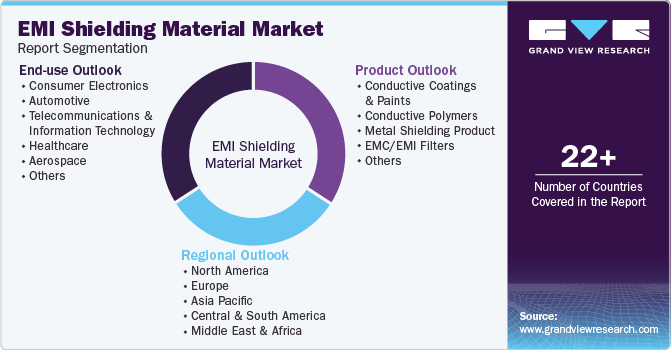
This report forecasts revenue growth at global, regional, and country levels and provides an analysis of the latest industry trends in each of the sub-segments from 2021 to 2033. For this study, Grand View Research has segmented the global EMI shielding material market report based on product, end-use and region:
 To learn more about this report, Download Free Sample Report
-
Product Outlook (Revenue, USD Million; 2021 - 2033)
-
Conductive Coatings & Paints
-
Conductive Polymers
-
Metal Shielding Product
-
EMC/EMI Filters
-
Others
-
-
End-use Outlook (Revenue, USD Million; 2021 - 2033)
-
Consumer Electronics
-
Automotive
-
Telecommunications & Information Technology
-
Healthcare
-
Aerospace
-
Others
-
-
Regional Outlook (Revenue, USD Million; 2021 - 2033)
-
North America
-
U.S.
-
Canada
-
Mexico
-
-
Europe
-
Germany
-
UK
-
France
-
Italy
-
Spain
-
-
Asia Pacific
-
China
-
India
-
Japan
-
Australia
-
-
Central & South America
-
Brazil
-
-
Middle East & Africa
-
Research Methodology
The EMI shielding material market figures in this report are based on a proven research process that combines executive interviews with secondary research from proprietary databases, company filings, and recognized regulatory and institutional sources. Market size is built through value-chain sizing - reconciling supply-side and demand-side estimates - and triangulated with bottom-up and top-down approaches. Every estimate passes multiple levels of expert validation before publication, with each EMI shielding material segment quantified using the revenue-capture definitions in the table below.
Segment Definition
Segment - Product
Revenue capture definition
Conductive Coatings & Paints
Revenue generated from the sale of conductive coatings and paints used for EMI shielding of electronic enclosures, printed circuit boards (PCBs), plastic housings, and industrial components by providing electrically conductive surfaces that reduce electromagnetic interference and improve electromagnetic compatibility (EMC).
Conductive Polymers
Revenue generated from the sale of conductive polymer-based EMI shielding materials used in lightweight electronic devices, automotive components, medical equipment, and communication systems due to their flexibility, corrosion resistance, lightweight properties, and effective electromagnetic shielding performance.
Metal Shielding Product
Revenue generated from the sale of metal-based EMI shielding products, including foils, meshes, gaskets, tapes, and shielding enclosures, used to block electromagnetic radiation in consumer electronics, aerospace, automotive, telecommunications, and industrial applications through their high electrical conductivity and shielding effectiveness.
EMC/EMI Filters
Revenue generated from the sale of EMC/EMI filters designed to suppress conducted electromagnetic interference in electrical and electronic equipment, power supplies, communication systems, medical devices, and industrial machinery to ensure compliance with electromagnetic compatibility standards.
Others
Revenue generated from the sale of other EMI shielding materials and solutions, including conductive fabrics, shielding films, ferrite absorbers, conductive adhesives, elastomers, and hybrid shielding materials used across diverse electronic and industrial applications.
Segment - End Use
Revenue capture definition
Consumer Electronics
Revenue generated from the use of EMI shielding materials in smartphones, laptops, tablets, wearable devices, gaming systems, televisions, and other consumer electronic products to minimize electromagnetic interference, enhance signal integrity, and improve device reliability.
Automotive
Revenue generated from the use of EMI shielding materials in electric vehicles (EVs), hybrid vehicles, conventional automobiles, ADAS, infotainment systems, battery management systems, sensors, and electronic control units (ECUs) to protect critical electronics from electromagnetic interference.
Telecommunications & Information Technology
Revenue generated from the use of EMI shielding materials in 5G infrastructure, networking equipment, servers, data centers, routers, antennas, communication modules, and IT hardware to maintain signal quality, reduce interference, and ensure electromagnetic compatibility.
Healthcare
Revenue generated from the use of EMI shielding materials in medical imaging equipment, diagnostic devices, patient monitoring systems, implantable medical devices, laboratory instruments, and healthcare electronics to prevent electromagnetic disturbances and ensure accurate operation.
Aerospace
Revenue generated from the use of EMI shielding materials in aircraft electronics, avionics, satellites, defense communication systems, radar equipment, navigation systems, and military electronics to provide reliable electromagnetic protection under demanding operating environments.
Others
Revenue generated from the use of EMI shielding materials in industrial automation equipment, renewable energy systems, railway electronics, marine systems, defense applications, and other specialized electronic systems requiring electromagnetic interference protection.
Estimation Model
Layer Name
Key Question
Description
End-use Industry Assessment
Which industries generate demand for EMI shielding materials?
Estimates the total addressable market by evaluating demand across consumer electronics, automotive, telecommunications & IT, healthcare, aerospace, industrial equipment, and other end-use sectors where electromagnetic interference protection is essential.
Product Penetration Analysis
Which EMI shielding material products are adopted within each industry?
Assesses the penetration of conductive coatings & paints, conductive polymers, metal shielding products, EMC/EMI filters, and other shielding solutions based on application requirements, shielding effectiveness, material properties, and regulatory compliance.
Regional Manufacturing & Consumption Analysis
Where is demand and production concentrated?
Evaluates regional consumption and manufacturing trends across North America, Europe, Asia Pacific, Latin America, and the Middle East & Africa by considering electronics production, automotive manufacturing, telecom infrastructure expansion, and industrial development.
Revenue Validation & Market Forecasting
What is the current and future revenue potential of the market?
Validates market estimates through company revenues, product pricing trends, production capacities, technology adoption, supply chain analysis, and demand forecasts to determine the overall EMI shielding material market size and growth outlook.
Delivered Customizations
This report has been delivered with the following In-depth customizations
Client Request
Customization Delivered
Value Adds
Competitive Landscape & Innovation Tracking
Comprehensive competitive intelligence covering company profiling, market share assessment, product portfolio comparison, patent analysis, R&D investments, technology innovations, strategic partnerships, mergers & acquisitions, capacity expansions, new product launches, and sustainability initiatives adopted by leading EMI shielding material manufacturers.
Helps stakeholders benchmark competitors, identify technology gaps, evaluate acquisition and partnership opportunities, strengthen innovation pipelines, anticipate competitive moves, and formulate long-term growth strategies in the global EMI shielding material market.
Regional Manufacturing & Supply Chain Analysis
In-depth evaluation of regional manufacturing capacity, production hubs, raw material suppliers, conductive filler availability, supply chain mapping, import-export trends, distribution networks, pricing dynamics, and procurement strategies across all major regions.
Assists companies in optimizing sourcing strategies, improving supply chain resilience, reducing procurement risks, identifying regional manufacturing opportunities, and supporting expansion into high-growth markets.
Product & Material Benchmarking
Detailed benchmarking of conductive coatings & paints, conductive polymers, metal shielding products, EMC/EMI filters, conductive fabrics, shielding gaskets, conductive foams, and other advanced shielding solutions. The customization includes performance comparison, shielding effectiveness, conductivity, weight, durability, thermal characteristics, cost competitiveness, and application suitability..
Supports product portfolio optimization, technology selection, competitive differentiation, pricing strategy development, and identification of emerging material innovations for next-generation electronic applications.
Frequently Asked Questions About This Report
Asia Pacific held the highest revenue market share of 41.5% in 2025, driven by its strong electronics manufacturing base, rapid expansion of electric vehicle production, growing 5G infrastructure deployment, and increasing investments in consumer electronics and industrial automation.
The conductive polymers segment is the fastest-growing application in the EMI shielding material market.
The automotive segment is the fastest-growing end-use segment in the EMI shielding materials market.
The consumer electronics segment accounted for the largest revenue share of 31.4% in 2025, due to the high production of smartphones, laptops, tablets, wearable devices, and other connected electronics requiring effective EMI shielding to ensure signal integrity and electromagnetic compatibility.
The conductive coatings & paints segment held the highest revenue market share of 32.8% in 2025, due to its widespread adoption in consumer electronics, automotive, aerospace, and telecommunications applications, offering lightweight, cost-effective, and easily integrated EMI shielding solutions for complex electronic components.
The EMI shielding material market size was estimated at USD 8.7 billion in 2025 and is expected to reach USD 9.2 billion in 2026.
The EMI shielding material market is expected to grow at a compound annual growth rate of 5.8% from 2026 to 2033 to reach USD 13.6 billion by 2033.
Some of the key players operating in the EMI shielding material market include 3M Company, Parker Chomerics, Dow Inc, ETS-Lindgren, Henkel AG & Co. KGaA, Kitagawa Industries, Laird Technologies Inc., and Leader Tech Inc.
The key factors that are driving the EMI Shielding Material market include the increasing demand for electronic devices, the rise in wireless communication technologies, regulatory standards for electronic safety, and the growing need for automotive and industrial applications with advanced shielding solutions.
About the Author(s)
Advanced Interior Materials Research Team
Advanced Materials · Advanced Interior MaterialsThis report was authored by the advanced interior materials research team at Grand View Research - comprising two research analysts, one senior research analyst, and one industry expert - with specialized expertise in the advanced interior materials segment of the advanced materials industry. All findings are based on proprietary advanced materials databases, executive interviews, and regulatory analysis, subject to internal peer review prior to publication.
Last Updated:
Speak to Analyst

Customize this report to your needs - add regions, segments, or data points, with 20% free customization.
Or view our licence options:


ISO 9001:2015 & 27001:2022 Certified
We are GDPR and CCPA compliant! Your transaction & personal information is safe and secure. For more details, please read our privacy policy.


